

The relationship between climate change and mental health: a systematic review of the association between eco-anxiety, psychological distress, and symptoms of major affective disorders
Open accessThe DOI matches its Crossref record; 94 of the 96 references it cites were found in a registry or an index; 91 of the 138 sources its claims cite were checked for support.
Abstract
BACKGROUND AND OBJECTIVES: The adverse impacts of climate change on mental health is a burgeoning area, although findings are inconsistent. The emerging concept of eco-anxiety represents distress in relation to climate change and may be related to mental health. The aim of this study was to explore the relationship between eco-anxiety with validated mental health outcomes, specifically psychological distress and symptoms of major affective disorders. DESIGN: Systematic review. METHODS: EBSCO, ProQuest, and Web of Science databases were searched to February 2024 for studies of adult samples quantifying eco-anxiety (exposure, i.e. fear, worry or anxiety in relation to climate change) and symptoms of psychological distress and major affective disorders (outcomes), as assessed by validated measures. RESULTS: 31.2 years). Consistently, eco-anxiety showed small to large positive correlations with mental health outcomes of psychological distress, depression symptoms, anxiety symptoms, and stress symptoms. However, results regarding post-traumatic stress disorder symptoms and pathological worry were mixed. Stronger associations were observed where eco-anxiety was operationalised as 'anxiety' rather than 'worry'. CONCLUSIONS: Findings underscore that eco-anxiety is related to psychological burden. Greater consideration of eco-anxiety in assessment and treatment is needed in clinical practice and further policy development is warranted at the intersection of climate and health to address the mental health challenges posed by climate change.
Overview
CoChat Summary
TL;DR
This systematic review found that eco-anxiety was consistently positively associated with psychological distress, depression, anxiety, and stress symptoms, though findings for PTSD symptoms and pathological worry were mixed. The authors conclude that eco-anxiety is related to psychological burden and warrants greater consideration in clinical assessment, treatment, and policy.
Key findings
- Across 35 included studies (N = 45,667; 61% female; mean age 31.2 years), all but three of 33 correlational studies found significant positive associations between eco-anxiety and mental health symptomatology, with small-to-large associations (r = .14 to 0.60).
- Psychological distress was significantly positively associated with eco-anxiety in all nine studies examining it (r = .17 to 0.70); depression symptoms were significant in 15 of 18 studies (r = .14 to 0.49); anxiety symptoms were significant in 18 of 23 studies (r = .17 to 0.60); and stress symptoms were significant in all nine DASS-21 studies (r = .22 to 0.46).
- Associations were stronger when eco-anxiety was operationalised as “anxiety” rather than “worry”: 26 studies using climate change-related anxiety measures consistently showed significant positive small-to-large associations, whereas worry-based findings were more variable.
- One study found 5.67% of participants had both eco-anxiety and threshold PTSD symptoms; pathological worry findings were mixed, with some positive associations no longer significant after adjustment.
Methods
- Systematic review pre-registered with INPLASY202310025 and conducted according to PRISMA guidelines; EBSCO, ProQuest, and Web of Science were searched to February 2024 for English-language, peer-reviewed studies of adults aged 15+ quantifying eco-anxiety and validated mental health outcomes.
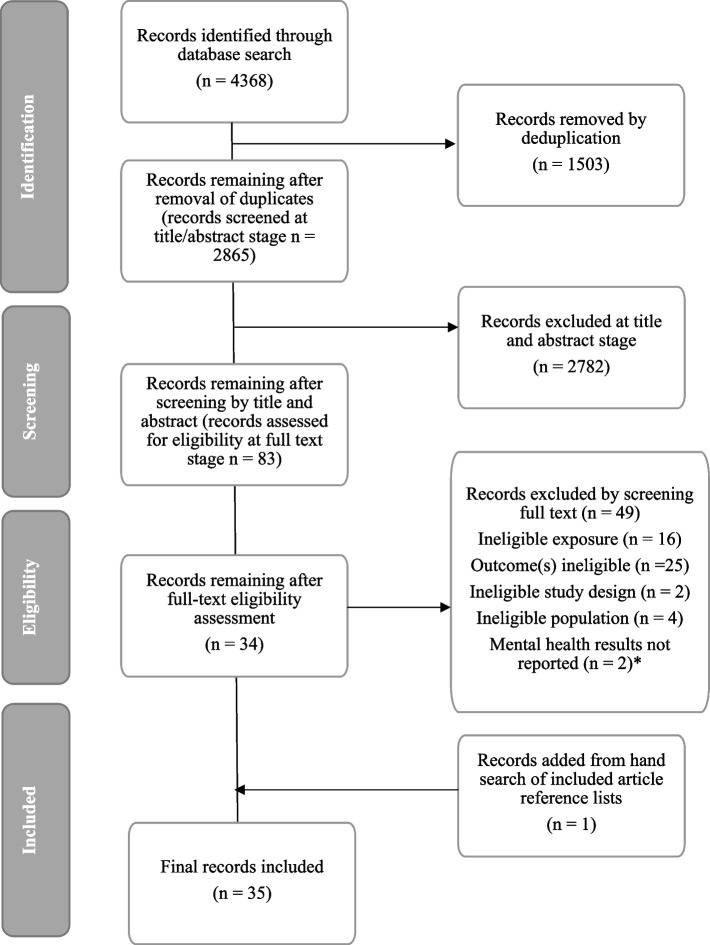
- The search yielded 4,368 articles; after duplicate removal, 2,865 remained, 83 underwent full-text review, and 35 studies were included.
- Due to anticipated methodological heterogeneity, no meta-analysis was planned; studies were grouped and synthesised by outcome, and quality was assessed with the Joanna Briggs Institute Checklist for Analytical Cross-Sectional Studies.
Limitations
- The paper states that direct experience of climate change or extreme weather events was rarely assessed or used as a covariate, so the review cannot discount direct exposure; personality traits and additional risk factors were not controlled; eco-grief and other distinct concepts were not addressed; and no meta-analysis or meta-regression for age and gender was performed.
- The paper also states that the review was restricted to peer-reviewed English-language publications, excluding grey literature and non-English studies; no formal publication bias test was conducted; and the focus on validated self-report mental health measures may have excluded qualitative studies, some cultural contexts, and cognitive processes such as rumination.
- Evident from the text: all included studies were cross-sectional, only one recruited a clinical sample, none used standardised clinical diagnostic assessments, most studies were from high-income countries (Europe, North America, Australia/New Zealand), and most analyses were unadjusted, limiting conclusions about directionality, clinical classification, and generalisability.
Model-written summary. Check it against the paper before relying on it.
Integrity signals
Registry
Cites
Statistics
Figures
Verification
Claims the paper makes
39 Valid · 5 Not valid · 19 Not checked · 63 Own results and interpretations
Some cited sources support this claim and some don’t — read each source’s verdict below.
In the paper
“A further two studies showed eco-anxiety was not significant after adjustment for covariates [53, 63].”
§ The relationship between climate change and mental health: a systematic review of the association between eco-anxiety, psychological distress, and symptoms of major affective disorders > Study and sample characteristics > Anxiety symptoms
What the sources say
- Disputedcites [53] Innocenti M, Perilli A, Santarelli G, Carluccio N, Zjalic D, Maran DA et al. How does climate change worry influence the relationship between climate change anxiety and Eco-paralysis? A moderation study. Climate. 2023;11(9):190. sourceExperimental — accuracy not yet measured
Section 2.6 says the analysis adjusted for age, gender and education. Table 5 reports that eco-anxiety was significantly associated with eco-paralysis after demographic adjustment (p < 0.001); climate change worry, not eco-anxiety, was nonsignificant (p = 0.7). The paper therefore says the contrary for its adjusted eco-paralysis analysis. (LLM, conf=0.88)
Checked by a reasoning model — may be wrong.
- Partly supportedcites [63] Stewart AE. Psychometric properties of the climate change worry scale. Int J Environ Res Public Health. 2021;18(2):494. PMC7826965 33435348 sourceExperimental — accuracy not yet measured
Study 3 Results (no page available) report that climate-change worry was no longer significantly correlated with general anxiety or depression after controlling for stress. The paper does not establish that eco-anxiety was generally nonsignificant after adjustment for covariates: its measure was climate-change worry, and its association with stress remained significant. (LLM, conf=0.82)
plain- Asserted: passes — The authors put it forward as true.
- Checkable: passes — It can be checked against evidence.
- Load-bearing: unclear — It is unclear whether the paper’s conclusions depend on it.
- Based: passes — The paper gives a reason why it holds.
- Disputed
Some cited sources support this claim and some don’t — read each source’s verdict below.
In the paper
“All nine studies investigating symptoms of psychological distress found significant small-to-large (r = .17 to 0.70) positive associations [41, 43–45, 51, 54, 55, 68, 70].”
§ The relationship between climate change and mental health: a systematic review of the association between eco-anxiety, psychological distress, and symptoms of major affective disorders > Study and sample characteristics > Psychological distress
What the sources say
- Not checked — no full text of the sourcecites [41] Clayton S, Karazsia BT. Development and validation of a measure of climate change anxiety. J Environ Psychol. 2020;69:101434. source
- Disputedcites [43] Di Fabio A, Svicher A. The Eco-generativity Scale (EGS): a New Resource to protect the Environment and Promote Health. Int J Environ Res Public Health. 2023;20(15):6474. PMC10418646 37569015 sourceExperimental — accuracy not yet measured
The Results (Section 3; page unavailable) report statistically significant *negative* correlations between eco-generativity and PANAS negative affect, rather than positive associations with a distress-related measure. The Measures section identifies negative affect with symptoms such as nervousness and fear. This paper does not establish the claimed finding across nine studies or the stated r range. (LLM, conf=0.78)
Checked by a reasoning model — may be wrong.
- Not checked — no full text of the sourcecites [44] Feather G, Williams M. The moderating effects of psychological flexibility and psychological inflexibility on the relationship between climate concern and climate-related distress. J Context Behav Sci. 2022;23:137–43. source
- Supportedcites [45] Gago T, Sá I. Environmental worry and wellbeing in young adult university students. Curr Res Environ Sustain. 2021;3:100064. source
The Results (section 3.2) report significant positive correlations between environmental worry and two psychological-distress indices: GSI (r = 0.298) and PST (r = 0.378), both within the cited range. This paper supports its place among the nine cited studies; it does not itself establish the count or full range across all nine. (LLM, conf=0.91)
- Partly supportedcites [51] Innocenti M, Santarelli G, Faggi V, Castellini G, Manelli I, Magrini G, et al. Psychometric properties of the Italian version of the climate change anxiety scale. J Clim Change Health. 2021;3:100080. sourceExperimental — accuracy not yet measured
The Results report positive associations between climate-change anxiety and psychological-distress measures; Table 2 gives a positive coefficient for K-10 total score (B = 0.437, p = 0.013). This paper reports one study, however, and gives regression coefficients rather than the cited range of correlations (r = .17 to .70), so it cannot establish the nine-study count or that range. (LLM, conf=0.84)
- Partly supportedcites [54] Larionow P, Sołtys M, Izdebski P, Mudło-Głagolska K, Golonka J, Demski M, et al. Climate change anxiety Assessment: the Psychometric properties of the Polish Version of the climate anxiety scale. Front Psychol. 2022;13:870392. 35645848 PMC9130850 sourceExperimental — accuracy not yet measured
The Results (Convergent and Divergent Validity; page unavailable) report positive associations between climate anxiety and depressive symptoms, supporting this paper’s inclusion among studies finding an association with psychological distress. The Discussion (page unavailable) also reports a positive association with combined anxiety-depressive symptoms, but says anxiety symptoms measured separately were not associated. Our copy does not provide the correlation coefficients needed to verify this study’s place in the cited r = .17–.70 range, and it cannot establish the findings of the other eight studies. (LLM, conf=0.84)
- Not checked — no full text of the sourcecites [55] Lukacs JN, Bratu A, Adams S, Logie C, Tok N, McCunn LJ et al. The concerned steward effect: exploring the relationship between climate anxiety, psychological distress, and self-reported climate related behavioural engagement. J Environ Psychol. 2023;90:102087. source
- Supportedcites [68] Wullenkord MC, Tröger J, Hamann KRS, Loy LS, Reese G. Anxiety and climate change: a validation of the climate anxiety scale in a german-speaking quota sample and an investigation of psychological correlates. Clim Change. 2021;168(3):20. source
Section 4.2 reports a positive correlation between climate anxiety and general anxiety and depressiveness (r = 0.25). Section 5.2.2 says the correlation was significant. This supports the paper's inclusion as one of the nine cited studies; the nine-study count and full range are attributed to the citations collectively. (LLM, conf=0.91)
- Supportedcites [70] Reyes MES, Carmen BPB, Luminarias MEP, Mangulabnan S, Ogunbode CA. An investigation into the relationship between climate change anxiety and mental health among Gen Z filipinos. Curr Psychol. 2023;42(9):7448–56. PMC8280276 34305362 source
The Results report a significant positive association between climate change anxiety and psychological distress among Gen Z Filipino participants (r = .39, p < .001). That coefficient falls within the citing sentence’s stated range; this paper is one of the nine studies cited, not the source of the nine-study count. (LLM, conf=0.93)
plainstates an association- Asserted: passes — The authors put it forward as true.
- Checkable: passes — It can be checked against evidence.
- Load-bearing: passes — The paper’s conclusions depend on it.
- Based: passes — The paper gives a reason why it holds.
Some cited sources support this claim and some don’t — read each source’s verdict below.
In the paper
“Eighteen studies investigated the association between eco-anxiety and symptoms of depression, with fifteen reporting a significant small-to-moderate (r = .14 to 0.49) positive association [37, 40, 42, 46, 48, 50, 51, 54, 56, 57, 62–65, 69], whereas three reported no significant relationship [49, 52, 53].”
§ The relationship between climate change and mental health: a systematic review of the association between eco-anxiety, psychological distress, and symptoms of major affective disorders > Study and sample characteristics > Depression symptoms
What the sources say
- Disputedcites [49] Hepp J, Klein SA, Horsten LK, Urbild J, Lane SP. Introduction and behavioral validation of the climate change distress and impairment scale. Sci Rep. 2023;13(1):11272. 37438436 PMC10338517 sourceExperimental — accuracy not yet measured
In Study 3, Table 2 (Results; no page given), climate change distress correlated positively with depressive symptoms (r = 0.28), contrary to the cited claim of no significant relationship. The near-zero correlation (r = 0.04) was for climate change impairment, a separate measure; the Study 3 Method reports 374 participants. (LLM, conf=0.86)
Checked by a reasoning model — may be wrong.
- Supportedcites [52] Innocenti M, Santarelli G, Faggi V, Ciabini L, Castellini G, Galassi F, et al. Psychometric properties of the Italian version of the climate change worry scale. J Clim Change Health. 2022;6:100140. source
The Results section reports no detected correlation between Climate Change Worry Scale scores and DASS-21 depression symptoms; the Discussion reiterates this finding. This supports citing the study as one of the three reporting no significant relationship, though this paper measures climate change worry specifically rather than every aspect of eco-anxiety. (LLM, conf=0.90)
- Supportedcites [53] Innocenti M, Perilli A, Santarelli G, Carluccio N, Zjalic D, Maran DA et al. How does climate change worry influence the relationship between climate change anxiety and Eco-paralysis? A moderation study. Climate. 2023;11(9):190. source
Section 3.2 reports no correlation between the Hogg Eco-Anxiety Scale and the DASS-21 depression subscale. Table 3 shows a correlation of −0.037 without a significance marker. This supports the cited paper as one of the three studies reporting no significant relationship; it does not itself establish the findings of the other two. (LLM, conf=0.93)
plain- Asserted: passes — The authors put it forward as true.
- Checkable: passes — It can be checked against evidence.
- Load-bearing: unclear — It is unclear whether the paper’s conclusions depend on it.
- Based: passes — The paper gives a reason why it holds.
- Disputed
Some cited sources support this claim and some don’t — read each source’s verdict below.
In the paper
“For example, recent multinational studies have suggested that between 49 and 59% of respondents were very or extremely worried about climate change [10, 11].”
§ The relationship between climate change and mental health: a systematic review of the association between eco-anxiety, psychological distress, and symptoms of major affective disorders > Abstract > Supplementary Information
What the sources say
- Supportedcites [10] Hickman C, Marks E, Pihkala P, Clayton S, Lewandowski RE, Mayall EE, et al. Climate anxiety in children and young people and their beliefs about government responses to climate change: a global survey. Lancet Planet Health. 2021;5(12):e863–73. 34895496 source
The Summary (p. 2) reports that 59% of respondents were very or extremely worried about climate change. This paper supports the upper end of the range attributed to the cited multinational studies; the sentence also cites another study for the range. (LLM, conf=0.92)
- Disputedcites [11] Ogunbode CA, Doran R, Hanss D, Ojala M, Salmela-Aro K, van den Broek KL et al. Climate anxiety, wellbeing and pro-environmental action: correlates of negative emotional responses to climate change in 32 countries. J Environ Psychol. 2022;84:101887. sourceExperimental — accuracy not yet measured
Section 3.1 (Preliminary observations; page unavailable) reports that 46.8% of the total sample were very or extremely worried about climate change, below the claimed 49–59% range. The paper also cautions that its samples were not nationally representative. (LLM, conf=0.90)
Checked by a reasoning model — may be wrong.
hedged- Asserted: passes — The authors put it forward as true.
- Checkable: passes — It can be checked against evidence.
- Load-bearing: unclear — It is unclear whether the paper’s conclusions depend on it.
- Based: passes — The paper gives a reason why it holds.
- Supported
Every source the paper cites for this claim was checked and supports it.
In the paper
“Only one study recruited a clinical sample [35], with an additional study utilising a sample of adults experiencing eco-anxiety [36].”
- Also stated in: § Discussion · plain
“and only one study recruited a clinical sample, both of which may limit understandings of eco-anxiety classification.”
§ The relationship between climate change and mental health: a systematic review of the association between eco-anxiety, psychological distress, and symptoms of major affective disorders > Study and sample characteristics
What the sources say
- Supportedcites [35] Gebhardt N, Schwaab L, Friederich HC, Nikendei C. The relationship of climate change awareness and psychopathology in persons with pre-existing mental health diagnoses. Front Psychiatry. 2023;14:1274523. 38090707 PMC10715411 source
The Materials and methods section (Study design, participants and procedure; page not provided) says this study recruited patients from a psychosomatic outpatient clinic. That supports its identification as a study with a clinical sample; the claim that it was the only such study concerns the citing paper's set of studies, not a finding attributed to this source. (LLM, conf=0.94)
plain- Asserted: passes — The authors put it forward as true.
- Checkable: passes — It can be checked against evidence.
- Load-bearing: passes — The paper’s conclusions depend on it.
- Based: passes — The paper gives a reason why it holds.
- Also stated in: § Discussion · plain
83 more claims · 30 with their cited sources checked
Create a free account to see all 126 claims and to verify the 5 references still open.
- It may state two separate claims as one. 24
- Probably not a substantial claim. 20
Claims other papers make about this one
Each is checked against this paper’s own text: does it say what the citing paper says it does?
In the citing paper
“Most research focuses on climate anxiety or eco-anxiety, but the questionnaires developed to assess the construct are based on different definitions and include a wide variety of partially differing symptoms [21].”
In the citing paper
“The lack of international definitions hinders research and results in varying prevalence of eco-distress and different correlations with mental health measures such as depressive or anxiety symptoms [13], [21], [22].”
Self-check
Percentages, sums and reported differences re-computed from the paper’s own numbers.
Each contradiction between two passages listed here was confirmed by an independent check.
Rated minor: it would not touch a result — a value no result rests on, a p-value that stays on the same side of the significance level, or a conflict that is clerical, resolved elsewhere in the paper, or outside its own findings.
In the paper
§ The relationship between climate change and mental health: a systematic review of the association between eco-anxiety, psychological distress, and symptoms of major affective disorders > Study and sample characteristics > Associations between eco-anxiety and mental health outcomes
“All but three of the included 33 correlational studies found eco-anxiety to be significantly positively associated with mental health symptomatology, with small-to-large associations reported (r = .14 to 0.60).”
§ The relationship between climate change and mental health: a systematic review of the association between eco-anxiety, psychological distress, and symptoms of major affective disorders > Study and sample characteristics > Psychological distress
“All nine studies investigating symptoms of psychological distress found significant small-to-large (r = .17 to 0.70) positive associations [41, 43–45, 51, 54, 55, 68, 70].”
Citations
Cites
PRISMA-P Group, Moher, D., Shamseer, L., Clarke, M., Ghersi, D., Liberati, A., Petticrew, M., Shekelle, P., & Stewart, L. A. (2015) · Systematic Reviews · doi:10.1186/2046-4053-4-1 · Cited by 26,223
Diagnostic and Statistical Manual of Mental Disorders
American Psychiatric Association (2022) · doi:10.1176/appi.books.9780890425787 · Cited by 23,476
(IPCC), I. P. O. C. C. (2023) · doi:10.1017/9781009325844 · Cited by 10,921
Diagnostic and Statistical Manual of Mental Disorders, 5th Edition
(2013) · American Psychiatric Association Publishing eBooks · doi:10.1176/appi.books.9780890425596.893619 · Cited by 4,383
JBI Manual for Evidence Synthesis
(2020) · JBI eBooks · doi:10.46658/jbimes-20-01 · Cited by 4,165
Hickman, C., Marks, E., Pihkala, P., Clayton, S., Lewandowski, R. E., Mayall, E. E., Wray, B., Mellor, C., & van Susteren, L. (2021) · The Lancet Planetary Health · doi:10.1016/s2542-5196(21)00278-3 · Cited by 2,324
Chapter 7: Systematic reviews of etiology and risk
Moola, S., Munn, Z., Tufanaru, C., Aromataris, E., Sears, K., Sfetic, R., Currie, M., Lisy, K., Qureshi, R., Mattis, P., et al. (2019) · JBI Reviewer's Manual · doi:10.46658/jbirm-17-06 · Cited by 2,114
The Effects of Climate Change on Cardiac Health
De Blois, J., Kjellstrom, T., Agewall, S., Ezekowitz, J. A., Armstrong, P. W., & Atar, D. (2015) · Cardiology · doi:10.1159/000398787 · Cited by 1,697
Climate anxiety: Psychological responses to climate change
Clayton, S. (2020) · Journal of Anxiety Disorders · doi:10.1016/j.janxdis.2020.102263 · Cited by 1,409
Solastalgia: The Distress Caused by Environmental Change
Albrecht, G., Sartore, G.-M., Connor, L., Higginbotham, N., Freeman, S., Kelly, B., Stain, H., Tonna, A., & Pollard, G. (2007) · Australasian Psychiatry · doi:10.1080/10398560701701288 · Cited by 1,369
The Impact of Climate Change on Mental Health: A Systematic Descriptive Review
Cianconi, P., Betrò, S., & Janiri, L. (2020) · Frontiers in Psychiatry · doi:10.3389/fpsyt.2020.00074 · Cited by 1,320
Development and validation of a measure of climate change anxiety
Clayton, S., & Karazsia, B. T. (2020) · Journal of Environmental Psychology · doi:10.1016/j.jenvp.2020.101434 · Cited by 1,196
Climate change and mental health: a causal pathways framework
Berry, H. L., Bowen, K., & Kjellstrom, T. (2010) · International Journal of Public Health · doi:10.1007/s00038-009-0112-0 · Cited by 1,035
Anxiety and the Ecological Crisis: An Analysis of Eco-Anxiety and Climate Anxiety
Pihkala, P. (2020) · Sustainability · doi:10.3390/su12197836 · Cited by 978
Health effects of climate change: an overview of systematic reviews
Rocque, R. J., Beaudoin, C., Ndjaboue, R., Cameron, L., Poirier-Bergeron, L., Poulin-Rheault, R.-A., Fallon, C., Tricco, A. C., & Witteman, H. O. (2021) · BMJ Open · doi:10.1136/bmjopen-2020-046333 · Cited by 932
The psychological impacts of global climate change
Doherty, T. J., & Clayton, S. (2011) · American Psychologist · doi:10.1037/a0023141 · Cited by 894
Climate change and mental health: risks, impacts and priority actions
Hayes, K., Blashki, G., Wiseman, J., Burke, S., & Reifels, L. (2018) · International Journal of Mental Health Systems · doi:10.1186/s13033-018-0210-6 · Cited by 746
Stanley, S. K., Hogg, T. L., Leviston, Z., & Walker, I. (2021) · The Journal of Climate Change and Health · doi:10.1016/j.joclim.2021.100003 · Cited by 715
Mental Health and Our Changing Climate: Impacts, Implications, and Guidance: (503122017-001)
American Psychological Association, & ecoAmerica (2017) · PsycEXTRA Dataset · doi:10.1037/e503122017-001 · Cited by 609
Ogunbode, C. A., Doran, R., Hanss, D., Ojala, M., Salmela-Aro, K., van den Broek, K. L., Bhullar, N., Aquino, S. D., Marot, T., Schermer, J. A., et al. (2022) · Journal of Environmental Psychology · doi:10.1016/j.jenvp.2022.101887 · Cited by 549
Coffey, Y., Bhullar, N., Durkin, J., Islam, M. S., & Usher, K. (2021) · The Journal of Climate Change and Health · doi:10.1016/j.joclim.2021.100047 · Cited by 541
Climate Change and Mental Health: A Scoping Review
Charlson, F., Ali, S., Benmarhnia, T., Pearl, M., Massazza, A., Augustinavicius, J., & Scott, J. G. (2021) · International Journal of Environmental Research and Public Health · doi:10.3390/ijerph18094486 · Cited by 507
The case for systems thinking about climate change and mental health
Berry, H. L., Waite, T. D., Dear, K. B. G., Capon, A. G., & Murray, V. (2018) · Nature Climate Change · doi:10.1038/s41558-018-0102-4 · Cited by 485
The Hogg Eco-Anxiety Scale: Development and validation of a multidimensional scale
Hogg, T. L., Stanley, S. K., O'Brien, L. V., Wilson, M. S., & Watsford, C. R. (2021) · Global Environmental Change · doi:10.1016/j.gloenvcha.2021.102391 · Cited by 465
Climate change anxiety and mental health: Environmental activism as buffer
Schwartz, S. E. O., Benoit, L., Clayton, S., Parnes, M. F., Swenson, L., & Lowe, S. R. (2023) · Current Psychology · doi:10.1007/s12144-022-02735-6 · Cited by 421
Verplanken, B., Marks, E., & Dobromir, A. I. (2020) · Journal of Environmental Psychology · doi:10.1016/j.jenvp.2020.101528 · Cited by 414
Climate anxiety: What predicts it and how is it related to climate action?
Whitmarsh, L., Player, L., Jiongco, A., James, M., Williams, M., Marks, E., & Kennedy-Williams, P. (2022) · Journal of Environmental Psychology · doi:10.1016/j.jenvp.2022.101866 · Cited by 401
The psychological effects of climate change on children
Burke, S. E. L., Sanson, A. V., & Van Hoorn, J. (2018) · Current Psychiatry Reports · doi:10.1007/s11920-018-0896-9 · Cited by 391
Ecological grief and anxiety: the start of a healthy response to climate change?
Cunsolo, A., Harper, S. L., Minor, K., Hayes, K., Williams, K. G., & Howard, C. (2020) · The Lancet Planetary Health · doi:10.1016/s2542-5196(20)30144-3 · Cited by 358
We need to (find a way to) talk about … Eco-anxiety
Hickman, C. (2020) · Journal of Social Work Practice · doi:10.1080/02650533.2020.1844166 · Cited by 344
Wullenkord, M. C., Tröger, J., Hamann, K. R. S., Loy, L. S., & Reese, G. (2021) · Climatic Change · doi:10.1007/s10584-021-03234-6 · Cited by 344
Fear for the future: Eco-anxiety and health implications, a systematic review
Boluda-Verdú, I., Senent-Valero, M., Casas-Escolano, M., Matijasevich, A., & Pastor-Valero, M. (2022) · Journal of Environmental Psychology · doi:10.1016/j.jenvp.2022.101904 · Cited by 306
Psychometric Properties of the Climate Change Worry Scale
Stewart, A. E. (2021) · International Journal of Environmental Research and Public Health · doi:10.3390/ijerph18020494 · Cited by 286
Climate change: The next challenge for public mental health?
Bourque, F., & Cunsolo Willox, A. (2014) · International Review of Psychiatry · doi:10.3109/09540261.2014.925851 · Cited by 285
A Scoping Review of Interventions for the Treatment of Eco-Anxiety
Baudon, P., & Jachens, L. (2021) · International Journal of Environmental Research and Public Health · doi:10.3390/ijerph18189636 · Cited by 269
Understanding persons with psychological distress in primary health care
Arvidsdotter, T., Marklund, B., Kylén, S., Taft, C., & Ekman, I. (2016) · Scandinavian Journal of Caring Sciences · doi:10.1111/scs.12289 · Cited by 268
Ogunbode, C. A., Pallesen, S., Böhm, G., Doran, R., Bhullar, N., Aquino, S., Marot, T., Schermer, J. A., Wlodarczyk, A., Lu, S., et al. (2023) · Current Psychology · doi:10.1007/s12144-021-01385-4 · Cited by 255
Climate Change and Farmers’ Mental Health: Risks and Responses
Berry, H. L., Hogan, A., Owen, J., Rickwood, D., & Fragar, L. (2011) · Asia Pacific Journal of Public Health · doi:10.1177/1010539510392556 · Cited by 235
Verplanken, B., & Roy, D. (2013) · PLoS ONE · doi:10.1371/journal.pone.0074708 · Cited by 223
Reyes, M. E. S., Carmen, B. P. B., Luminarias, M. E. P., Mangulabnan, S. A. N. B., & Ogunbode, C. A. (2023) · Current Psychology · doi:10.1007/s12144-021-02099-3 · Cited by 178
The effects of climate change on mental health
Walinski, A., Sander, J., Gerlinger, G., Clemens, V., Meyer-Lindenberg, A., & Heinz, A. (2023) · Deutsches Ärzteblatt international · doi:10.3238/arztebl.m2022.0403 · Cited by 154
Climate change and mental health research methods, gaps, and priorities: a scoping review
Hwong, A. R., Wang, M., Khan, H., Chagwedera, D. N., Grzenda, A., Doty, B., Benton, T., Alpert, J., Clarke, D., & Compton, W. M. (2022) · The Lancet Planetary Health · doi:10.1016/s2542-5196(22)00012-2 · Cited by 154
The mental health impacts of climate change: Findings from a Pacific Island atoll nation
Gibson, K. E., Barnett, J., Haslam, N., & Kaplan, I. (2020) · Journal of Anxiety Disorders · doi:10.1016/j.janxdis.2020.102237 · Cited by 152
Mental Health Impacts of Climate Change Among Vulnerable Populations Globally: An Integrative Review
White, B. P., Breakey, S., Brown, M. J., Smith, J. R., Tarbet, A., Nicholas, P. K., & Ros, A. M. V. (2023) · Annals of Global Health · doi:10.5334/aogh.4105 · Cited by 141
Extrinsic Convergent Validity Evidence to Prevent Jingle and Jangle Fallacies
Gonzalez, O., MacKinnon, D. P., & Muniz, F. B. (2021) · Multivariate Behavioral Research · doi:10.1080/00273171.2019.1707061 · Cited by 132
On the Measurement of Climate Change Anxiety: French Validation of the Climate Anxiety Scale
Mouguiama-Daouda, C., Blanchard, M. A., Coussement, C., & Heeren, A. (2022) · Psychologica Belgica · doi:10.5334/pb.1137 · Cited by 125
Prevalence and determinants of mental health related to climate change in Australia
Patrick, R., Snell, T., Gunasiri, H., Garad, R., Meadows, G., & Enticott, J. (2023) · Australian & New Zealand Journal of Psychiatry · doi:10.1177/00048674221107872 · Cited by 114
Climate change and mental health research methods, gaps, and priorities: a scoping review
Hwong, A. R. (2022) · doi:10.17605/osf.io/xr9ut · Cited by 113
Mah, A. Y. J., Chapman, D. A., Markowitz, E. M., & Lickel, B. (2020) · Journal of Anxiety Disorders · doi:10.1016/j.janxdis.2020.102282 · Cited by 113
Psychometric properties of the Italian version of the Climate Change Anxiety Scale
Innocenti, M., Santarelli, G., Faggi, V., Castellini, G., Manelli, I., Magrini, G., Galassi, F., & Ricca, V. (2021) · The Journal of Climate Change and Health · doi:10.1016/j.joclim.2021.100080 · Cited by 103
Larionow, P., Sołtys, M., Izdebski, P., Mudło-Głagolska, K., Golonka, J., Demski, M., & Rosińska, M. (2022) · Frontiers in Psychology · doi:10.3389/fpsyg.2022.870392 · Cited by 101
Mental Health Impacts of Climate Change on Women: a Scoping Review
Stone, K., Blinn, N., & Spencer, R. (2022) · Current Environmental Health Reports · doi:10.1007/s40572-022-00346-8 · Cited by 96
The clinical implications of climate change for mental health
Crandon, T. J., Dey, C., Scott, J. G., Thomas, H. J., Ali, S., & Charlson, F. J. (2022) · Nature Human Behaviour · doi:10.1038/s41562-022-01477-6 · Cited by 88
A network approach to climate change anxiety and its key related features
Heeren, A., Mouguiama-Daouda, C., & McNally, R. J. (2023) · Journal of Anxiety Disorders · doi:10.1016/j.janxdis.2022.102625 · Cited by 88
A meta-analysis on the relationship between climate anxiety and wellbeing
Gago, T., Sargisson, R. J., & Milfont, T. L. (2024) · Journal of Environmental Psychology · doi:10.1016/j.jenvp.2024.102230 · Cited by 87
Parmentier, M.-L., Weiss, K., Aroua, A., Betry, C., Rivière, M., & Navarro, O. (2024) · Journal of Anxiety Disorders · doi:10.1016/j.janxdis.2023.102799 · Cited by 73
Characteristics of worry in Generalized Anxiety Disorder
Hirsch, C. R., Mathews, A., Lequertier, B., Perman, G., & Hayes, S. (2013) · Journal of Behavior Therapy and Experimental Psychiatry · doi:10.1016/j.jbtep.2013.03.004 · Cited by 72
Eco-Anxiety in Children and Young People – A Rational Response, Irreconcilable Despair, or Both?
Hickman, C. (2024) · The Psychoanalytic Study of the Child · doi:10.1080/00797308.2023.2287381 · Cited by 72
Heeren, A., & Asmundson, G. J. G. (2023) · Journal of Anxiety Disorders · doi:10.1016/j.janxdis.2022.102654 · Cited by 71
Curll, S. L., Stanley, S. K., Brown, P. M., & O'Brien, L. V. (2022) · Translational Issues in Psychological Science · doi:10.1037/tps0000329 · Cited by 62
Innocenti, M., Perilli, A., Santarelli, G., Carluccio, N., Zjalic, D., Acquadro Maran, D., Ciabini, L., & Cadeddu, C. (2023) · Climate · doi:10.3390/cli11090190 · Cited by 61
Climate Change Related Depression, Anxiety and Stress Symptoms Perceived by Medical Students
Schwaab, L., Gebhardt, N., Friederich, H.-C., & Nikendei, C. (2022) · International Journal of Environmental Research and Public Health · doi:10.3390/ijerph19159142 · Cited by 59
A systematic review of the effects of chronic, slow-onset climate change on mental health
Burrows, K., Denckla, C. A., Hahn, J., Schiff, J. E., Okuzono, S. S., Randriamady, H., Mita, C., Kubzansky, L. D., Koenen, K. C., & Lowe, S. R. (2024) · Nature Mental Health · doi:10.1038/s44220-023-00170-5 · Cited by 58
Predicting climate change anxiety
Asgarizadeh, Z., Gifford, R., & Colborne, L. (2023) · Journal of Environmental Psychology · doi:10.1016/j.jenvp.2023.102087 · Cited by 56
Gibson, K., Haslam, N., & Kaplan, I. (2019) · Transcultural Psychiatry · doi:10.1177/1363461519847057 · Cited by 54
Climate Change Perception and Mental Health. Results from a Systematic Review of the Literature
Gianfredi, V., Mazziotta, F., Clerici, G., Astorri, E., Oliani, F., Cappellina, M., Catalini, A., Dell’Osso, B. M., Pregliasco, F. E., Castaldi, S., et al. (2024) · European Journal of Investigation in Health, Psychology and Education · doi:10.3390/ejihpe14010014 · Cited by 53
Hajek, A., & König, H. (2022) · Public Health · doi:10.1016/j.puhe.2022.09.007 · Cited by 51
Heinzel, S., Tschorn, M., Schulte-Hutner, M., Schäfer, F., Reese, G., Pohle, C., Peter, F., Neuber, M., Liu, S., Keller, J., et al. (2023) · Frontiers in Psychology · doi:10.3389/fpsyg.2023.1239425 · Cited by 50
Wu, J., Long, D., Hafez, N., Maloney, J., Lim, Y., & Samji, H. (2023) · International Journal of Mental Health Nursing · doi:10.1111/inm.13201 · Cited by 49
Feather, G., & Williams, M. (2022) · Journal of Contextual Behavioral Science · doi:10.1016/j.jcbs.2021.12.007 · Cited by 48
Introduction and behavioral validation of the climate change distress and impairment scale
Hepp, J., Klein, S. A., Horsten, L. K., Urbild, J., & Lane, S. P. (2023) · Scientific Reports · doi:10.1038/s41598-023-37573-4 · Cited by 41
Thomson, E. E., & Roach, S. P. (2023) · Frontiers in Psychology · doi:10.3389/fpsyg.2023.1241400 · Cited by 39
Plohl, N., Mlakar, I., Musil, B., & Smrke, U. (2023) · Frontiers in Psychology · doi:10.3389/fpsyg.2023.1297782 · Cited by 39
Therapy in the Face of Climate Change
Hasbach, P. H. (2015) · Ecopsychology · doi:10.1089/eco.2015.0018 · Cited by 36
Türkarslan, K. K., Kozak, E. D., & Yıldırım, J. C. (2023) · Journal of Environmental Psychology · doi:10.1016/j.jenvp.2023.102147 · Cited by 35
The Wages of Fear?: Toward Fearing Well About Climate Change
McQueen, A. (2021) · Philosophy and Climate Change · doi:10.1093/oso/9780198796282.003.0008 · Cited by 33
Eco-Anxiety: An Evolutionary Line from Psychology to Psychopathology
Mento, C., Damiani, F., Versa, M. L., Cedro, C., Muscatello, M. R. A., Bruno, A., Fabio, R. A., & Silvestri, M. C. (2023) · Medicina · doi:10.3390/medicina59122053 · Cited by 33
Eco-Anxiety and the Responses of Ecological Citizenship and Mindfulness
Bourban, M. (2023) · Environmental Politics and Theory · doi:10.1007/978-3-031-14346-5_4 · Cited by 31
Psychometric properties of the Italian version of the climate change worry scale
Innocenti, M., Santarelli, G., Faggi, V., Ciabini, L., Castellini, G., Galassi, F., & Ricca, V. (2022) · The Journal of Climate Change and Health · doi:10.1016/j.joclim.2022.100140 · Cited by 31
Lukacs, J. N., Bratu, A., Adams, S., Logie, C., Tok, N., McCunn, L. J., Lem, M., Henley, A., Closson, K., Martin, G., et al. (2023) · Journal of Environmental Psychology · doi:10.1016/j.jenvp.2023.102091 · Cited by 26
Every‐Palmer, S., McBride, S., Berry, H. L., & Menkes, D. B. (2015) · Australian & New Zealand Journal of Psychiatry · doi:10.1177/0004867415615946 · Cited by 26
Doherty, T. J. (2015) · Climate Change and Public Health · doi:10.1093/med/9780190202453.003.0010 · Cited by 25
Climate Anxiety and Mental Health in Germany
Hajek, A., & König, H.-H. (2023) · Climate · doi:10.3390/cli11080158 · Cited by 24
Environmental worry and wellbeing in young adult university students
Gago, T., & Sá, I. (2021) · Current Research in Environmental Sustainability · doi:10.1016/j.crsust.2021.100064 · Cited by 21
Maughan, D., Berry, H., & Davison, P. (2014) · International Psychiatry · doi:10.1192/s1749367600004306 · Cited by 21
The Eco-Generativity Scale (EGS): A New Resource to Protect the Environment and Promote Health
Di Fabio, A., & Svicher, A. (2023) · International Journal of Environmental Research and Public Health · doi:10.3390/ijerph20156474 · Cited by 21
Gebhardt, N., Schwaab, L., Friederich, H.-C., & Nikendei, C. (2023) · Frontiers in Psychiatry · doi:10.3389/fpsyt.2023.1274523 · Cited by 20
A systematic review of climate emotions and mental health in adults
Pitt, C., Norris, K., & Pecl, G. (2023) · Global Environmental Psychology · doi:10.5964/gep.11405 · Cited by 20
Climate change anxiety positively predicts antenatal distress in expectant female parents
Lykins, A. D., Bonich, M., Sundaraja, C., & Cosh, S. (2024) · Journal of Anxiety Disorders · doi:10.1016/j.janxdis.2023.102801 · Cited by 20
Self-citationPsychometric validation of the French version of the Hogg Eco-Anxiety Scale (HEAS-FR).
Mathé, M., Grisetto, F., Gauvrit, N., & Roger, C. (2025) · Canadian Journal of Behavioural Science / Revue canadienne des sciences du comportement · doi:10.1037/cbs0000398 · Cited by 19
Mind games: standing by while the world ignores climate change
Maughan, D. L., & Berry, H. L. (2015) · BJPsych International · doi:10.1192/s2056474000000222 · Cited by 12
Nordahl, H., Ebrahimi, O. V., Hoffart, A., & Johnson, S. U. (2022) · The Journal of Nervous and Mental Disease · doi:10.1097/nmd.0000000000001557 · Cited by 8
Lykins, A. D., Cosh, S., Nunn, P. D., Kumar, R., & Sundaraja, C. (2023) · Global Environmental Psychology · doi:10.5964/gep.11447 · Cited by 6
Self-citationEco-anxiety in Adolescents: A Meta-Analysis of the Impact of Climate Change on Mental Health
Mondal, S., Kar, J., Bagchi, E., & Mukhopadhyay, U. (2024) · Climate Change Management · doi:10.1007/978-3-031-58261-5_15 · Cited by 6
Lukacs, J. N., Bratu, A., Adams, S., Logie, C., Tok, N., McCunn, L. J., Lem, M., Henley, A., Closson, K., Martin, G., et al. (2023) · PsycEXTRA Dataset · doi:10.1037/e511632025-001
Research works printed but not linked: 3
- Schwartz SEO, Benoit L, Clayton S, Parnes MF, Swenson L, Lowe SR. Climate change anxiety and mental health: environmental activism as buffer. Curr Psychol. 2022;42:16708–21. PMC8883014 35250241 · DOI · Paper page
- Reyes MES, Carmen BPB, Luminarias MEP, Mangulabnan S, Ogunbode CA. An investigation into the relationship between climate change anxiety and mental health among Gen Z filipinos. Curr Psychol. 2023;42(9):7448–56. PMC8280276 34305362 · DOI · Paper page
- Spielberger CD. Theory and research on anxiety. Anxiety Behav. 1966;1(3):413–28.
Cited by
Climate change anxiety: A meta-analysis
Kühner, C., Gemmecke, C., Hüffmeier, J., & Zacher, H. (2025) · Global Environmental Change · doi:10.1016/j.gloenvcha.2025.103015 · Cited by 100
Climate change anxiety and pro-environmental behaviours: disentangling gender disparities
Pinho, M. (2025) · Frontiers in Sociology · doi:10.3389/fsoc.2025.1589501 · Cited by 45
Cosh, S., Williams, S. E., Lykins, A. D., Bartik, W. J., & Tully, P. J. (2024) · BMC Psychology · doi:10.1186/s40359-024-02240-4 · Cited by 35
“Climate change anxiety has largely been conceptualised as representing an anxiety disorder or subtype [43] and, in the literature to date, climate change anxiety has most commonly been explored in relation to anxiety symptoms, showing consistently small to large associations [20].”
InfluentialSelf-citationScoping review on assessing climate-sensitive health risks
Yenew, C., Bayeh, G. M., Gebeyehu, A. A., Enawgaw, A. S., Asmare, Z. A., Ejigu, A. G., Tsega, T. D., Temesgen, A., Anteneh, R. M., Yigzaw, Z. A., et al. (2025) · BMC Public Health · doi:10.1186/s12889-025-22148-x · Cited by 43
“Indirect effects arise from long-term changes in climate, such as rising temperatures and prolonged droughts, which can exacerbate existing mental health conditions and increase the risk of suicide [97].”
KERSE, Y., & Kerse, G. (2025) · BMC Psychology · doi:10.1186/s40359-025-03501-6 · Cited by 29
“Recent studies [22, 23, 24] have shown that individuals’ awareness of the general challenges posed by global climate change has increased, accompanied by a rise in psychological distress related to this awareness.”
Metadata
- Authors
- Cosh, S. M., Ryan, R., Fallander, K., Robinson, K., Tognela, J., Tully, P. J., & Lykins, A. D.
- Affiliations
- The University of Adelaide (AU)
- University of New England (AU)
- Deakin University (AU)
- Corresponding author
- Cosh, Suzanne M.
- Venue
- BMC Psychiatry
- Published
- 2024-11-20
- Volume
- 24
- Issue
- 1
- Pages
- 833-833
- ISSN
- 1471-244X (ISSN-L)
- PMC
- PMC11577747
- OpenAlex
- W4404543050
- Cited by
- 138
- References
- 92
- Citations by year
- 2026: 90 · 2025: 47 · 2024: 1
- FWCI
- 14.39
- Type
- journal article
- Language
- en
- Open access
- gold
- doi.org
- Licence
- cc-by-nc-nd
- creativecommons.org/licenses/by-nc-nd/4.0 (tdm)
- creativecommons.org/licenses/by-nc-nd/4.0 (vor)
- Locations
- BMC Psychiatry (publishedVersion, cc-by-nc-nd)
- PubMed Central (publishedVersion, cc-by-nc-nd)
- PubMed (publishedVersion)
- RUNE (Research UNE) (submittedVersion, cc-by-nc-nd)
- DOAJ (DOAJ: Directory of Open Access Journals) (submittedVersion)
- Figshare (submittedVersion, cc-by-nc-nd)
- Funders
- Medical Research Future Fund (MRF2034737)
- Topics
- Social Sciences › Sociology and Political Science › Climate Change Communication and Perception
- Physical Sciences › Environmental Science › Health, Toxicology and Mutagenesis › Climate Change and Health Impacts
- Social Sciences › Psychology › Clinical Psychology › COVID-19 and Mental Health
- Keywords
- climate anxiety, climate change, mental health, psychological distress, depressive symptoms, anxiety symptoms, stress symptoms, post-traumatic stress disorder, pathological worry, mood disorders, climate change and health
- MeSH terms
- Psychological Distress, Adult, Anxiety, Female, Humans, Male, Mental Health, Climate Change
About these checks
Registry, retraction, Cites and statistics results are computed, not judged, with one exception: a printed reference that no index lists is read once by a model before it counts as a citation error. Claims are extracted by a model and kept only when their quote appears verbatim in the text; each cited source is then checked, with a model’s help, for whether it says what the claim relies on. Those verdicts can be wrong — read the claim’s quote and the cited source before relying on one.
The claim verdicts this report counts are experimental: their accuracy is not yet measured.
A language model drew the claims from the paper on 2026-09-28, under version 3 of the claim definition (prompt extract-v3).
A second model labelled each claim on 2026-09-28 (model jev-1.13-20260917, definition revision gold-guideline-v0.2).
Cited sources are checked with a language model’s help (gpt-6-sol).
Statistics and arithmetic are recomputed, not judged.
Confidence bands are shown only for fields calibrated on our annotated test set. None is calibrated yet, so no band is shown.
What counts as a claim ›How we measure confidence ›How we check this ›
Are you an author, or do you see a problem with this page? Request a review
Data sources
Bibliographic data: Semantic Scholar, OpenAlex, Crossref.
Contains information from the Semantic Scholar Academic Graph Datasets, made available under the ODC Attribution License (ODC-BY 1.0).
Semantic Scholar’s data is described in: Kinney, R., et al. (2023). The Semantic Scholar Open Data Platform. arXiv:2301.10140.
