

Gut microbiota variations in depression and anxiety: a systematic review
Open accessThe DOI matches its Crossref record; 74 of the 74 references it cites were found in a registry or an index.
Abstract
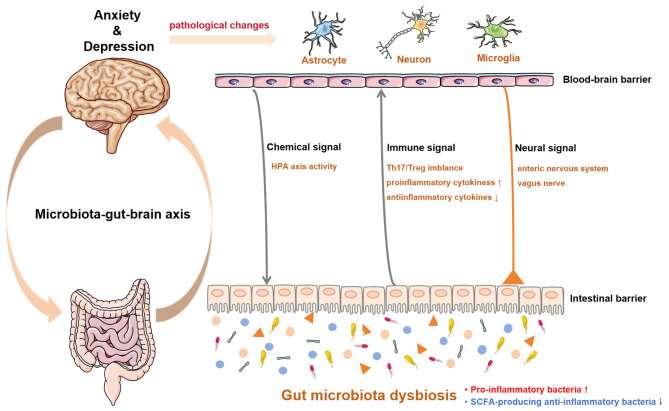
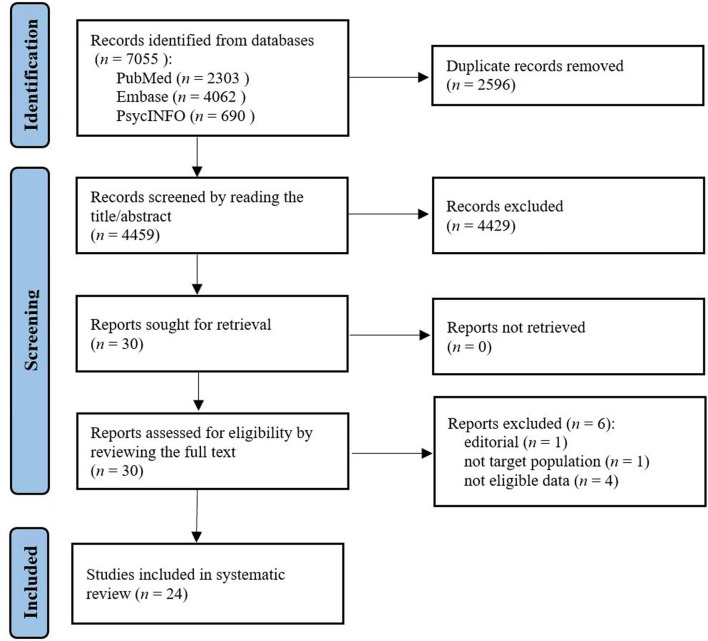
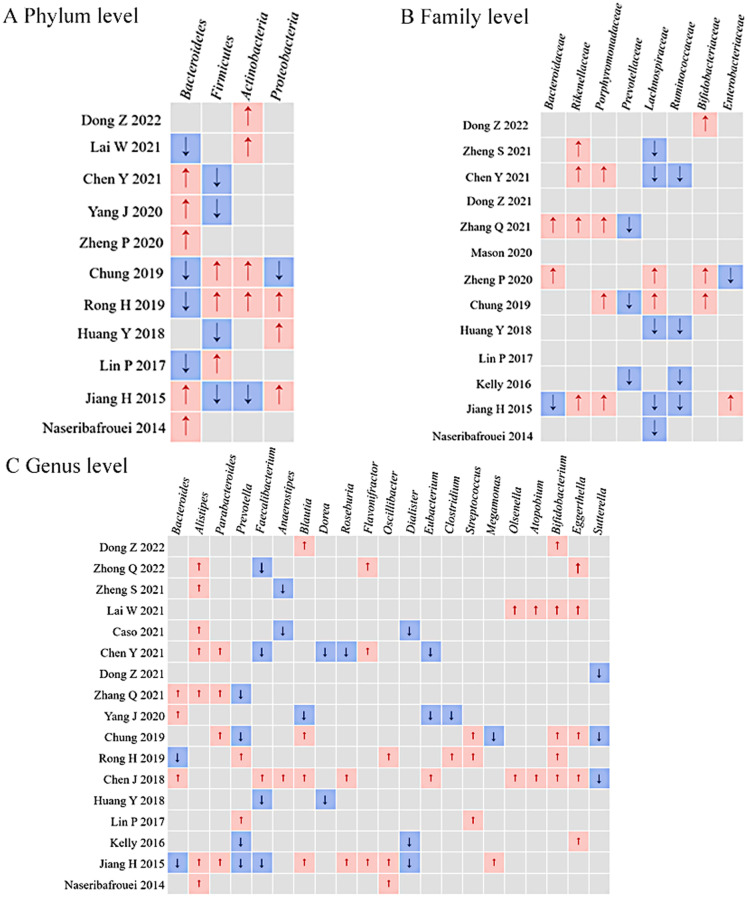
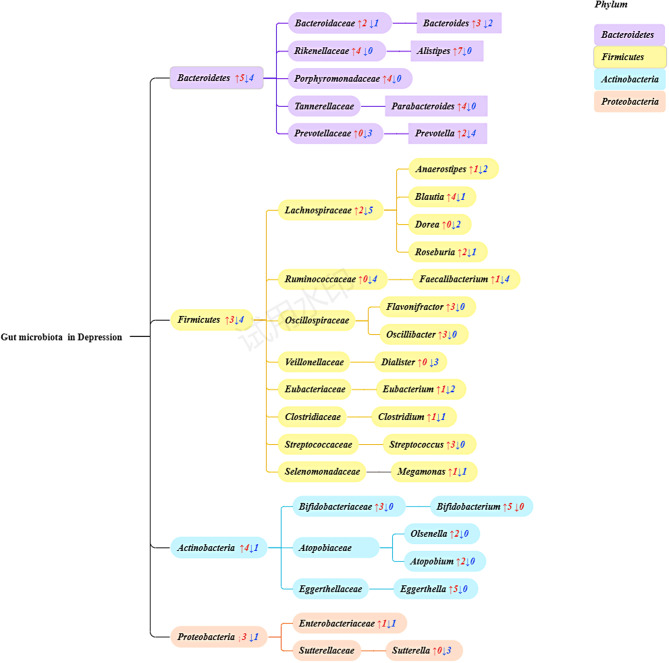
OBJECTIVE: The aim of this study is to investigate the characteristics of gut microbiota in depression and anxiety through a systematic review. METHODS: Articles were searched in the PubMed, Embase, and PsycINFO databases from their inception to February 12th, 2023. Case-control studies on the characteristics of gut microbiota in depression and anxiety were included. Methodological quality assessment of included studies was performed using the Newcastle-Ottawa Scale (NOS). A qualitative synthesis was conducted to assess bacterial diversity (α- and β-diversity) and taxa abundance differences at the phylum, family, and genus levels. RESULTS: A total of 24 articles were included in the systematic review, 20 studies were conducted in China. Our results showed that the findings of the α- and β-diversity assessments were inconsistent for both depression and anxiety. In gut microbiota composition, we found that depression and anxiety were characterized by an enrichment of pro-inflammatory bacteria and a depletion of anti-inflammatory SCFAs-producing bacteria. Specifically, Actinobacteria, Proteobacteria, Rikenellaceae, Porphyromonadaceae and Bifidobacteriaceae were more abundant in the depression group, as well as Firmicutes, Prevotellacea and Ruminococcaceae in lower abundance. In the anxiety group, the abundance of Firmicutes, Lachnospira, Faecalibacterium, Sutterella, and Butyricicoccus was lower, while the abundance of Bacteroidetes, Enterobacteriaceae, and Fusobacterium was increased. CONCLUSIONS: The systematic review found that depression and anxiety might be characterized by an enrichment of pro-inflammatory bacteria and the depletion of anti-inflammatory SCFAs-producing bacteria. However, there were conflicting reports on the abundance of bacteria due to confounders such as diet and psychotropic medications. Further studies are strongly suggested. CLINICAL TRIAL NUMBER: Not applicable.
Overview
The claims and statistics of this paper haven’t been checked yet.
Free: it reads the open-access text and checks the first 5 claims that cite a source we can check. Create a free account to check every claim.
Integrity signals
Registry
Cites
Statistics
Figures
Verification
Claims the paper makes
The claims and statistics of this paper haven’t been checked yet.
Free: it reads the open-access text and checks the first 5 claims that cite a source we can check. Create a free account to check every claim.
Claims other papers make about this one
Each is checked against this paper’s own text: does it say what the citing paper says it does?
The source backs part of the claim, not all of it — or backs it for a different population, condition or comparison.
In the citing paper
“Higher Firmicutes abundance has been associated with reduced depressive and anxiety symptoms through enhanced butyrate production, which modulates the gut-brain axis and alleviates neuroinflammation [49,50].”
From The Impact of Weizmannia coagulans BC99 on Anxiety and Depression: An 8-Week Clinical Pilot Study Through the Gut Microbiota–Brain Axis (2025) · cites this paper as [49]
Experimental — accuracy not yet measured
Self-check
Percentages, sums and reported differences re-computed from the paper’s own numbers.
The self-check needs the paper’s full text.
Citations
Cites
Human gut microbiome viewed across age and geography
Yatsunenko, T., Rey, F. E., Manary, M. J., Trehan, I., Dominguez-Bello, M. G., Contreras, M., Magris, M., Hidalgo, G., Baldassano, R. N., Anokhin, A. P., et al. (2012) · Nature · doi:10.1038/nature11053 · Cited by 7,815 · cited 1×
“First, geographic region and diet could affect the composition of the microbiome [72, 73].”
Santomauro, D. F., Mantilla Herrera, A. M., Shadid, J., Zheng, P., Ashbaugh, C., Pigott, D. M., Abbafati, C., Adolph, C., Amlag, J. O., Aravkin, A. Y., et al. (2021) · The Lancet · doi:10.1016/s0140-6736(21)02143-7 · Cited by 5,444 · cited 1×
“According to the Global Burden of Disease analysis, depression and anxiety are major contributors to global health burden [5].”
Cryan, J. F., O'Riordan, K. J., Cowan, C. S. M., Sandhu, K. V., Bastiaanssen, T. F. S., Boehme, M., Codagnone, M. G., Cussotto, S., Fulling, C., Golubeva, A. V., et al. (2019) · Physiological Reviews · doi:10.1152/physrev.00018.2018 · Cited by 5,286 · cited 1×
“The increased abundance of Parabacteroides , Oscillibacter , and Eggerthella has been correlated with persistent chronic stress responses, whereas elevated Streptococcus levels are associated with sustained neuroinflammation and increased oxidative stress [14, 15, 32, 33, 38, 66, 67, 68].”
Sokol, H., Pigneur, B., Watterlot, L., Lakhdari, O., Bermúdez-Humarán, L. G., Gratadoux, J.-J., Blugeon, S., Bridonneau, C., Furet, J.-P., Corthier, G., et al. (2008) · Proceedings of the National Academy of Sciences · doi:10.1073/pnas.0804812105 · Cited by 4,413
The Role of Short-Chain Fatty Acids From Gut Microbiota in Gut-Brain Communication
Silva, Y. P., Bernardi, A., & Frozza, R. L. (2020) · Frontiers in Endocrinology · doi:10.3389/fendo.2020.00025 · Cited by 3,043 · cited 1×
“In summary, the mechanisms of gut microbiota changes in anxiety and depression involve stress response pathways, immune-inflammatory regulation, metabolic responses, and neurotransmitter alterations, while also impacting intestinal barrier function [13, 64, 69, 70, 71].”
Gut–brain axis: How the microbiome influences anxiety and depression
Foster, J. A., & McVey Neufeld, K.-A. (2013) · Trends in Neurosciences · doi:10.1016/j.tins.2013.01.005 · Cited by 2,460 · cited 2×
“In summary, the mechanisms of gut microbiota changes in anxiety and depression involve stress response pathways, immune-inflammatory regulation, metabolic responses, and neurotransmitter alterations, while also impacting intestinal barrier function [13, 64, 69, 70, 71].”
The role of short chain fatty acids in health and disease
Tan, J., McKenzie, C., Potamitis, M., Thorburn, A. N., Mackay, C. R., & Macia, L. (2014) · Advances in immunology · doi:10.1016/b978-0-12-800100-4.00003-9 · Cited by 2,425 · cited 1×
“Short-chain fatty acids are involved in protecting gastrointestinal mucosa, reducing pro-inflammatory factors and increasing anti-inflammatory mediators [45, 46].”
Altered fecal microbiota composition in patients with major depressive disorder
Jiang, H., Ling, Z., Zhang, Y., Mao, H., Ma, Z., Yin, Y., Wang, W., Tang, W., Tan, Z., Shi, J., et al. (2015) · Brain, Behavior, and Immunity · doi:10.1016/j.bbi.2015.03.016 · Cited by 2,275 · cited 8×
“…family level, five gut microbiota showed consistent results, including Rikenellaceae (4 studies) [21, 24, 25, 33], Porphyromonadaceae (4 studies) [24, 25, 28, 33], Prevotellaceae (3 studies) [15, 25, 28], Ruminococcaceae (4 studies) [15, 24, 31, 33] and Bifidobacteriaceae (3 studies) [18, 27, 28].”
InfluentialShotgun metagenomics, from sampling to analysis
Quince, C., Walker, A. W., Simpson, J. T., Loman, N. J., & Segata, N. (2017) · Nature Biotechnology · doi:10.1038/nbt.3935 · Cited by 2,202
Chang, P. V., Hao, L., Offermanns, S., & Medzhitov, R. (2014) · Proceedings of the National Academy of Sciences · doi:10.1073/pnas.1322269111 · Cited by 2,175 · cited 1×
“Short-chain fatty acids are involved in protecting gastrointestinal mucosa, reducing pro-inflammatory factors and increasing anti-inflammatory mediators [45, 46].”
Cited by
The gut–brain–circadian axis in anxiety and depression: a critical review
Bautista, J., Hidalgo‐Tinoco, C., Delgado, M. D. C., Viteri-Recalde, J., Guerra-Guerrero, A., & López‐Cortés, A. (2025) · Frontiers in Psychiatry · doi:10.3389/fpsyt.2025.1697200 · Cited by 48
“The gut microbiome has emerged as a central determinant of neuropsychiatric health, with speci fi c microbial taxa and their metabolites increasingly recognized as candidate biomarkers for anxiety and depression (163).”
Eskandar, K. (2025) · Middle East Current Psychiatry · doi:10.1186/s43045-025-00585-z · Cited by 15
Gut–brain axis in health and brain disease
Olasunkanmi, O. I., Zheng, L., & Zheng, P. (2026) · Chinese Medical Journal · doi:10.1097/cm9.0000000000003920 · Cited by 14
“Supporting these findings, a systematic review by Cao et al [187] evaluated 24 clinical and observational studies, identifying consistent patterns of increased pro-inflammatory bacteria and decreased SCFA-producing taxa in depressive and anxious populations.”
Zhao, Y., Song, T., Ren, P., Wu, X., Luo, Q., Xie, J., Lai, H., Li, X., Wen, Y., Liao, X.-X., et al. (2025) · Phytomedicine · doi:10.1016/j.phymed.2025.157301 · Cited by 13
Shen, H., Wang, S. Y., Zhao, Y., Zhou, J. L., Zhao, J., & Zhu, W. K. (2026) · Frontiers in Microbiology · doi:10.3389/fmicb.2026.1768891 · Cited by 13
“Some enteric pathogens can alter their proliferation in response to exogenous catecholamines; for example, noradrenaline stimulates growth of several enteric pathogen strains and enhances Campylobacter jejuni virulence (Sudo, 2019; Chen Y. et al., 2021; Cao et al., 2025).”
Metadata
- Authors
- Cao, Y., Cheng, Y., Pan, W., Diao, J., Sun, L., & Meng, M.
- Affiliations
- Shandong University of Traditional Chinese Medicine (CN)
- Affiliated Hospital of Shandong University of Traditional Chinese Medicine (CN)
- Corresponding author
- Sun, LingZhi
- Meng, MiaoMiao
- Venue
- BMC Psychiatry
- Published
- 2025-05-01
- Volume
- 25
- Issue
- 1
- Pages
- 443-443
- ISSN
- 1471-244X (ISSN-L)
- PMC
- PMC12044767
- OpenAlex
- W4410005089
- Semantic Scholar
- af6c8f7298cd41a10985ebbc00cb679886d3c324
- Cited by
- 80
- References
- 74
- Citations by year
- 2026: 59 · 2025: 21
- FWCI
- 7.08
- Type
- journal article
- Language
- en
- Open access
- gold
- doi.org
- Licence
- cc-by-nc-nd
- creativecommons.org/licenses/by-nc-nd/4.0 (tdm)
- creativecommons.org/licenses/by-nc-nd/4.0 (vor)
- Locations
- BMC Psychiatry (publishedVersion, cc-by-nc-nd)
- PubMed Central (publishedVersion, cc-by-nc-nd)
- PubMed (publishedVersion)
- DOAJ (DOAJ: Directory of Open Access Journals) (submittedVersion, cc-by-sa)
- Funders
- Shandong provincial Natural Science Foundation, China (No. ZR2021MH180)
- National TCM clinical outstanding talents training program
- Topics
- Life Sciences › Biochemistry, Genetics and Molecular Biology › Molecular Biology › Gut microbiota and health
- Health Sciences › Medicine › Gastroenterology › Gastrointestinal motility and disorders
- Life Sciences › Neuroscience › Biological Psychiatry › Tryptophan and brain disorders
- Keywords
- gut microbiota, depression, anxiety, bacterial diversity, pro-inflammatory bacteria, short-chain fatty acids, SCFA-producing bacteria, Faecalibacterium, Lachnospira, Firmicutes, Bacteroidetes, Rikenellaceae, Porphyromonadaceae, Bifidobacteriaceae, Fusobacterium, Enterobacteriaceae
- MeSH terms
- Gastrointestinal Microbiome, Anxiety, Depression, Depressive Disorder, Humans
About these checks
Registry, retraction, Cites and statistics results are computed, not judged, with one exception: a printed reference that no index lists is read once by a model before it counts as a citation error. Claims are extracted by a model and kept only when their quote appears verbatim in the text; each cited source is then checked, with a model’s help, for whether it says what the claim relies on. Those verdicts can be wrong — read the claim’s quote and the cited source before relying on one.
Statistics and arithmetic are recomputed, not judged.
Confidence bands are shown only for fields calibrated on our annotated test set. None is calibrated yet, so no band is shown.
What counts as a claim ›How we measure confidence ›How we check this ›
Are you an author, or do you see a problem with this page? Request a review
Data sources
Bibliographic data: Semantic Scholar, OpenAlex, Crossref.
Contains information from the Semantic Scholar Academic Graph Datasets, made available under the ODC Attribution License (ODC-BY 1.0).
Semantic Scholar’s data is described in: Kinney, R., et al. (2023). The Semantic Scholar Open Data Platform. arXiv:2301.10140.
