

Associations of mutually exclusive categories of physical activity and sedentary time with markers of cardiometabolic health in English adults: a cross-sectional analysis of the Health Survey for England
Open accessThe DOI matches its Crossref record; 47 of the 47 references it cites were found in a registry or an index.
Abstract
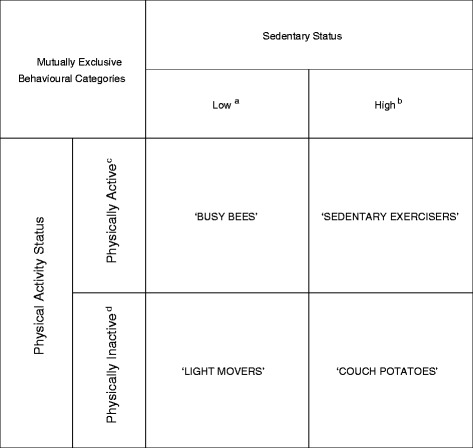
BACKGROUND: Both physical activity and sedentary behaviour have been individually associated with health, however, the extent to which the combination of these behaviours influence health is less well-known. The aim of this study was to examine the associations of four mutually exclusive categories of objectively measured physical activity and sedentary time on markers of cardiometabolic health in a nationally representative sample of English adults. METHODS: Using the 2008 Health Survey for England dataset, 2131 participants aged ≥ 18 years, who provided valid accelerometry data, were included for analysis and grouped into one of four behavioural categories: (1) 'Busy Bees': physically active & low sedentary, (2) 'Sedentary Exercisers': physically active & high sedentary, (3) 'Light Movers': physically inactive & low sedentary, and (4) 'Couch Potatoes': physically inactive & high sedentary. 'Physically active' was defined as accumulating at least 150 min of moderate-to-vigorous physical activity (MVPA) per week. 'Low sedentary' was defined as residing in the lowest quartile of the ratio between the average sedentary time and the average light-intensity physical activity time. Weighted multiple linear regression models, adjusting for measured confounders, investigated the differences in markers of health across the derived behavioural categories. The associations between continuous measures of physical activity and sedentary levels with markers of health were also explored, as well as a number of sensitivity analyses. RESULTS: In comparison to 'Couch Potatoes', 'Busy Bees' [body mass index: -1.67 kg/m(2) (p < 0.001); waist circumference: -1.17 cm (p = 0.007); glycated haemoglobin: -0.12% (p = 0.003); HDL-cholesterol: 0.09 mmol/L (p = 0.001)], 'Sedentary Exercisers' [body mass index: -1.64 kg/m(2) (p < 0.001); glycated haemoglobin: -0.11 % (p = 0.009); HDL-cholesterol: 0.07 mmol/L (p < 0.001)] and 'Light Movers' [HDL-cholesterol: 0.11 mmol/L (p = 0.004)] had more favourable health markers. The continuous analyses showed consistency with the categorical analyses and the sensitivity analyses indicated robustness and stability. CONCLUSIONS: In this national sample of English adults, being physically active was associated with a better health profile, even in those with concomitant high sedentary time. Low sedentary time independent of physical activity had a positive association with HDL-cholesterol.
Overview
The claims and statistics of this paper haven’t been checked yet.
Free: it reads the open-access text and checks the first 5 claims that cite a source we can check. Create a free account to check every claim.
Integrity signals
Registry
Cites
Statistics
Figures
Verification
Claims the paper makes
The claims and statistics of this paper haven’t been checked yet.
Free: it reads the open-access text and checks the first 5 claims that cite a source we can check. Create a free account to check every claim.
Claims other papers make about this one
Each is checked against this paper’s own text: does it say what the citing paper says it does?
In the citing paper
“Being physically active was associated with a better anthropometric and metabolic health profile whereas being sedentary independent of activity (Light Movers) is associated with lower HDL (high-density lipoprotein) cholesterol (a traditional cardiovascular risk factor).”
From Reduced physical activity in young and older adults: Metabolic and musculoskeletal implications (2019) · cites this paper as [21]
Self-check
Percentages, sums and reported differences re-computed from the paper’s own numbers.
The self-check needs the paper’s full text.
Citations
Cites
The Physical Activity Guidelines for Americans
Piercy, K. L., Troiano, R. P., Ballard, R. M., Carlson, S. A., Fulton, J. E., Galuska, D. A., George, S. M., & Olson, R. D. (2018) · JAMA · doi:10.1001/jama.2018.14854 · Cited by 9,755
Health benefits of physical activity: the evidence
Warburton, D. E. R. (2006) · Canadian Medical Association Journal · doi:10.1503/cmaj.051351 · Cited by 8,007 · cited 1×
“Previous research has largely focused on the independent associations of total physical activity, MVPA, lightintensity physical activity and sedentary time on health [2–8, 16–27], rather than the interplay between these constructs.”
Calibration of the Computer Science and Applications, Inc. accelerometer
FREEDSON, P. S., MELANSON, E., & SIRARD, J. (1998) · Medicine & Science in Sports & Exercise · doi:10.1097/00005768-199805000-00021 · Cited by 3,825 · cited 1×
“Accelerometer counts were used to calculate the time spent in each intensity band: sedentary behaviour (<100 counts per min (cpm)), light-intensity physical activity (100–1951 cpm) and MVPA (≥1952 cpm) [38].”
MethodBiswas, A., Oh, P. I., Faulkner, G. E., Bajaj, R. R., Silver, M. A., Mitchell, M. S., & Alter, D. A. (2015) · Annals of Internal Medicine · doi:10.7326/m14-1651 · Cited by 2,726 · cited 2×
“There is increasing evidence that sedentary behaviour, characterised as any waking behaviour with low energy expenditure ( ≤ 1.5 metabolic equivalents) while in a sitting or reclining posture [1], is strongly associated with a number of health outcomes [2 – 8].”
InfluentialAmount of Time Spent in Sedentary Behaviors in the United States, 2003-2004
Matthews, C. E., Chen, K. Y., Freedson, P. S., Buchowski, M. S., Beech, B. M., Pate, R. R., & Troiano, R. P. (2008) · American Journal of Epidemiology · doi:10.1093/aje/kwm390 · Cited by 2,631
Too Much Sitting: The Population Health Science of Sedentary Behavior
Owen, N., Healy, G. N., Matthews, C. E., & Dunstan, D. W. (2010) · Exercise and Sport Sciences Reviews · doi:10.1097/jes.0b013e3181e373a2 · Cited by 2,202 · cited 1×
“Sedentary behaviour and MVPA share a weak inverse relationship and it is possible for an individual, over the course of a day, to have high levels of physical activity and still accumulate large amounts of sedentary time [16 – 18].”
Letter to the Editor: Standardized use of the terms “sedentary” and “sedentary behaviours”
Networ, S. B. R. (2012) · Applied Physiology, Nutrition, and Metabolism · doi:10.1139/h2012-024 · Cited by 1,873
Wilmot, E. G., Edwardson, C. L., Achana, F. A., Davies, M. J., Gorely, T., Gray, L. J., Khunti, K., Yates, T., & Biddle, S. J. H. (2012) · Diabetologia · doi:10.1007/s00125-012-2677-z · Cited by 1,789 · cited 1×
“Although our study included a measure of glycaemia (HbA1c), more sensitive measures of insulin resistance, which have shown stronger associations with sedentary time [6, 19, 20, 46], were not available.”
BackgroundSelf-citationHamilton, M. T., Hamilton, D. G., & Zderic, T. W. (2007) · Diabetes · doi:10.2337/db07-0882 · Cited by 1,655
Sitting time and mortality from all causes, cardiovascular disease, and cancer
KATZMARZYK, P. T., CHURCH, T. S., CRAIG, C. L., & BOUCHARD, C. (2009) · Medicine & Science in Sports & Exercise · doi:10.1249/mss.0b013e3181930355 · Cited by 1,611 · cited 3×
“Previous research has largely focused on the independent associations of total physical activity, MVPA, lightintensity physical activity and sedentary time on health [2–8, 16–27], rather than the interplay between these constructs.”
Background
Cited by
Reduced physical activity in young and older adults: Metabolic and musculoskeletal implications
Bowden Davies, K. A., Pickles, S., Sprung, V. S., Kemp, G. J., Alam, U., Moore, D. R., Tahrani, A. A., & Cuthbertson, D. J. (2019) · Therapeutic Advances in Endocrinology and Metabolism · doi:10.1177/2042018819888824 · Cited by 278
Strategies to Prevent Sarcopenia in the Aging Process: Role of Protein Intake and Exercise
Rogeri, P. S., Zanella, R., Martins, G. L., Garcia, M. D. A., Leite, G., Lugaresi, R., Gasparini, S. O., Sperandio, G. A., Ferreira, L. H. B., Souza-Junior, T. P., et al. (2021) · Nutrients · doi:10.3390/nu14010052 · Cited by 181
“For each case, associations between these different “lifestyles” (through the motor activities performed) and distinct anthropometric and/or metabolic outcomes are pointed out [38].”
BackgroundMañas, A., del Pozo‐Cruz, B., García‐García, F. J., Guadalupe‐Grau, A., & Ara, I. (2017) · European Journal of Sport Science · doi:10.1080/17461391.2017.1327983 · Cited by 99
“The independent relationship of SPPB extends recent findings demonstrating that objectively measured sedentary time, controlled for MVPA, is related to metabolic syndrome (Bankoski et al., 2011), cancer (Lynch et al., 2011) and mortality (Koster et al., 2012). In contrast, investigations performed in adults failed to…”
BackgroundPutsa, B., Jalayondeja, W., Mekhora, K., Bhuanantanondh, P., & Jalayondeja, C. (2022) · BMC Public Health · doi:10.1186/s12889-022-13940-0 · Cited by 143
Husu, P., Suni, J., Vähä-Ypyä, H., Sievänen, H., Tokola, K., Valkeinen, H., Mäki-Opas, T., & Vasankari, T. (2016) · BMC Public Health · doi:10.1186/s12889-016-3591-y · Cited by 79
“health [9], depression [10] and mortality [1, 11], regardless of the level of MVPA [12], but not all studies confirm this independency [13].”
Result
Metadata
- Authors
- Bakrania, K., Edwardson, C. L., Bodicoat, D. H., Esliger, D. W., Gill, J. M. R., Kazi, A., Velayudhan, L., Sinclair, A. J., Sattar, N., Biddle, S. J. H., Khunti, K., Davies, M., & Yates, T.
- Affiliations
- University of Leicester (GB)
- Loughborough University (GB)
- British Heart Foundation (GB)
- Aston University (GB)
- Victoria University (AU)
- Corresponding author
- Edwardson, Charlotte L.
- ORCID
- Venue
- BMC Public Health
- Published
- 2015-12
- Volume
- 16
- Issue
- 1
- Pages
- 25-25
- ISSN
- 1471-2458 (ISSN-L)
- PMC
- PMC4709945
- OpenAlex
- W2233453157
- Cited by
- 106
- References
- 47
- Citations by year
- 2026: 2 · 2025: 3 · 2024: 6 · 2023: 13 · 2022: 9 · 2021: 10 · 2020: 11 · 2019: 10 · 2018: 15 · 2017: 21 · 2016: 6
- FWCI
- 10.21
- Type
- journal article
- Language
- en
- Open access
- gold
- doi.org
- Licence
- cc-by
- Locations
- BMC Public Health (publishedVersion, cc-by)
- PubMed Central (publishedVersion, cc-by)
- PubMed (publishedVersion)
- University of Southern Queensland ePrints (University of Southern Queensland) (acceptedVersion)
- ENLIGHTEN (Jurnal Bimbingan dan Konseling Islam) (acceptedVersion)
- Victoria University Research Repository (Victoria University) (submittedVersion)
- Research Portal (King's College London) (submittedVersion, cc-by)
- Aston Publications Explorer (Aston University) (submittedVersion)
- Loughborough University Institutional Repository (Loughborough University) (submittedVersion, cc-by)
- Figshare (submittedVersion, cc-by)
- Loughborough University Research Repository (Loughborough University) (submittedVersion, cc-by)
- Minerva Access (University of Melbourne) (submittedVersion, cc-by)
- Leicester Research Archive (University of Leicester) (submittedVersion, cc-by)
- Funders
- Medical Research Council (GB) (MR/K025090/1)
- Topics
- Health Sciences › Medicine › Public Health, Environmental and Occupational Health › Physical Activity and Health
- Health Sciences › Medicine › Public Health, Environmental and Occupational Health › Obesity, Physical Activity, Diet
- Physical Sciences › Computer Science › Computer Vision and Pattern Recognition › Context-Aware Activity Recognition Systems
- Keywords
- physical activity, sedentary behavior, cardiometabolic health, moderate-to-vigorous physical activity, body mass index, waist circumference, HbA1c, HDL cholesterol, triglycerides, blood pressure, sleep duration, sleep quality, sleep efficiency, sleep disorders, sleep apnea, sleep deprivation
- MeSH terms
- Adolescent, Adult, Aged, Cardiovascular Diseases, Child, Child, Preschool, Cross-Sectional Studies, England, Female, Health Surveys, Glycated Hemoglobin, Humans, Cholesterol, HDL, Male, Middle Aged, Biomarkers, Exercise, Body Mass Index, Multivariate Analysis, Waist Circumference, Young Adult, Sedentary Behavior, Accelerometry
About these checks
Registry, retraction, Cites and statistics results are computed, not judged, with one exception: a printed reference that no index lists is read once by a model before it counts as a citation error. Claims are extracted by a model and kept only when their quote appears verbatim in the text; each cited source is then checked, with a model’s help, for whether it says what the claim relies on. Those verdicts can be wrong — read the claim’s quote and the cited source before relying on one.
Statistics and arithmetic are recomputed, not judged.
Confidence bands are shown only for fields calibrated on our annotated test set. None is calibrated yet, so no band is shown.
What counts as a claim ›How we measure confidence ›How we check this ›
Are you an author, or do you see a problem with this page? Request a review
How to cite
Cite CoChat for the checks on this page, and the paper for its own findings.
- This page
- CoChat. (2026). Citation check: Associations of mutually exclusive categories of physical activity and sedentary time with markers of cardiometabolic health in English adults: a cross-sectional analysis of the Health Survey for England. https://app.cochat.ai/papers/10.1186/s12889-016-2694-9
- The paper
- Bakrania, K., Edwardson, C. L., Bodicoat, D. H., Esliger, D. W., Gill, J. M. R., Kazi, A., Velayudhan, L., Sinclair, A. J., Sattar, N., Biddle, S. J. H., Khunti, K., Davies, M., & Yates, T. (2015). Associations of mutually exclusive categories of physical activity and sedentary time with markers of cardiometabolic health in English adults: a cross-sectional analysis of the Health Survey for England. BMC Public Health. https://doi.org/10.1186/s12889-016-2694-9
Data sources
Bibliographic data: Semantic Scholar, OpenAlex, Crossref.
Contains information from the Semantic Scholar Academic Graph Datasets, made available under the ODC Attribution License (ODC-BY 1.0).
Semantic Scholar’s data is described in: Kinney, R., et al. (2023). The Semantic Scholar Open Data Platform. arXiv:2301.10140.
