

The DOI matches its Crossref record; 14 of the 15 references it cites were found in a registry or an index.
Household sanitation facilities and women's risk of non-partner sexual violence in India
Open accessAbstract
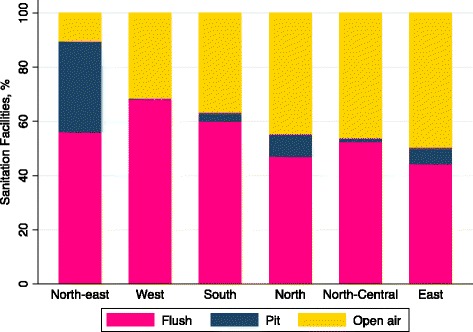
BACKGROUND: Globally, one in ten individuals practice open defecation. Despite media speculation that it increases women's risk of sexual violence, little empirical evidence supports the claims. We investigate the relationship between household sanitation facilities and women's risk of non-partner sexual violence (NPSV) in India, where nearly half of the population lives without a pit or toilet. METHODS: We use the most recent NPSV data, from the National Family Health Survey-III, to estimate logistic regression models of the effects of household sanitation facilities (toilet, pit, or none) on NPSV in the last year among women who have resided in their current home for one year or more. These effects are estimated net of other socioeconomic factors, compared to effects of household sanitation facilities on child diarrhea, and, as a falsification test, compared to effects of household sanitation facilities on intimate partner sexual violence (IPSV) in the last year. RESULTS: Net of their socioeconomic status, women who use open defecation are twice as likely to face NPSV as women with a household toilet. This is twice the association between open defecation and child diarrhea. The results of our falsification test indicate that open defecation is not correlated with IPSV, thus disconfirming a simultaneous selection of women into open defecation and sexual violence. CONCLUSIONS: Our findings provide empirical evidence that lacking household sanitation is associated with higher risk of NPSV.
Overview
The claims and statistics of this paper haven’t been checked yet.
Run the check — free, no account needed. It reads the open-access text and checks the sources it cites.
Integrity signals
Registry
Cites
Statistics
Figures
Verification
Claims the paper makes
The claims and statistics of this paper haven’t been checked yet.
Run the check — free, no account needed. It reads the open-access text and checks the sources it cites.
Claims other papers make about this one
Each is checked against this paper’s own text: does it say what the citing paper says it does?
In the citing paper
“There also exists a gap in empirical evidence on the impact of inadequate WASH in the workplace for girls and women experiencing vaginal bleeding,5 and on the violence-related challenges facing those using communal (and even household) WASH facilities when using outside toilets at night, or going for open defecation.37 38”
From Beyond menstrual hygiene: addressing vaginal bleeding throughout the life course in low and middle-income countries (2017) · cites this paper as [37]
Self-check
Percentages, sums and reported differences re-computed from the paper’s own numbers.
The self-check needs the paper’s full text.
Citations
Cites
García‐Moreno, C., Pallitto, C., Devries, K. M., Stöckl, H., Watts, C. G., & Abrahams, N. (2013) · Cited by 3,342
Mara, D., Lane, J., Scott, B., & Trouba, D. (2010) · PLoS Medicine · doi:10.1371/journal.pmed.1000363 · Cited by 594
Patil, S. R., Arnold, B. F., Salvatore, A. L., Briceno, B., Ganguly, S., Colford, J. M., & Gertler, P. J. (2014) · PLoS Medicine · doi:10.1371/journal.pmed.1001709 · Cited by 487
Worldwide prevalence of non-partner sexual violence: a systematic review
Abrahams, N., Devries, K. M., Watts, C. H., Pallitto, C., Petzold, M., Shamu, S., & Garcia‐Moreno, C. (2014) · The Lancet · doi:10.1016/s0140-6736(13)62243-6 · Cited by 438
Sahoo, K. C., Hulland, K. R. S., Caruso, B. A., Swain, R., Freeman, M. C., Panigrahi, P., & Dreibelbis, R. (2015) · Social Science & Medicine · doi:10.1016/j.socscimed.2015.06.031 · Cited by 300
Violence, gender and WASH: spurring action on a complex, under-documented and sensitive topic
Sommer, M., Ferron, S., Cavill, S., & House, S. (2015) · Environment and Urbanization · doi:10.1177/0956247814564528 · Cited by 230
Slum Sanitation and the Social Determinants of Women’s Health in Nairobi, Kenya
Corburn, J., & Hildebrand, C. (2015) · Journal of Environmental and Public Health · doi:10.1155/2015/209505 · Cited by 149
Winter, S. C., & Barchi, F. (2016) · International Journal of Environmental Health Research · doi:10.1080/09603123.2015.1111309 · Cited by 110
Gender disparities in water, sanitation, and global health
Caruso, B. A., Sevilimedu, V., Fung, I. C.-H., Patkar, A., & Baker, K. K. (2015) · The Lancet · doi:10.1016/s0140-6736(15)61497-0 · Cited by 70
Attempting the Production of Public Goods through Microfinance
Mader, P. (2011) · Journal of Infrastructure Development · doi:10.1177/097493061100300204 · Cited by 21
Research works printed but not linked: 5
- Lennon S. In: WaterAid, editor. Fear and anger: Perceptions of risks related to seuxal violence against women linked to water and sanitation in Delhi, India. London: Sanitation and Hygiene Applied Research for Equity; 2011.
- Sciences, I.I.F.P. and M. International. National Family Health Survey (NFHS-3), 2005–06: India: Volumes I and II. Mumbai: IIPS: International Institute for Population Sciences; 2007.
- Doron A, Jeffrey R. Open defecation in India. Econ Pol Wkly. 2014;XLIX(49):72–8.
- House S, et al. Violence, Gender & WASH: A Practitioner’s Toolkit – Making water, sanitation and hygiene safer through improved programming and services. London: WaterAid/SHARE; 2014. http://www.susana.org/en/resources/library/details/2098 . Accessed October 2015.
- Coffey D, et al. Revealed preference for open defecation. Econ Pol Wkly. 2014;49(38):43.
Cited by
Sorted by citations
Community-Led Total Sanitation: A Mixed-Methods Systematic Review of Evidence and Its Quality
Venkataramanan, V., Crocker, J., Karon, A. J., & Bartram, J. (2018) · Environmental Health Perspectives · doi:10.1289/ehp1965 · Cited by 217
Canetto, S. S., & Chen, J. (2020) · Cambridge University Press eBooks · doi:10.1017/9781108561716.042 · Cited by 194
Caruso, B. A., Clasen, T. F., Hadley, C., Yount, K. M., Haardörfer, R., Rout, M., Dasmohapatra, M., & Cooper, H. L. (2017) · BMJ Global Health · doi:10.1136/bmjgh-2017-000414 · Cited by 165
Health and social impacts of open defecation on women: a systematic review
Saleem, M., Burdett, T. M., & Heaslip, V. (2019) · BMC Public Health · doi:10.1186/s12889-019-6423-z · Cited by 188
Constructing Organizational Life
Lawrence, T. B., & Phillips, N. (2019) · doi:10.1093/oso/9780198840022.001.0001 · Cited by 173
Metadata
- Authors
- Jadhav, A., Weitzman, A., & Smith-Greenaway, E.
- Affiliations
- University of Michigan (US)
- Corresponding author
- Jadhav, Apoorva
- Venue
- BMC Public Health
- Published
- 2016-11-08
- Volume
- 16
- Issue
- 1
- Pages
- 1139-1139
- ISSN
- 1471-2458 (ISSN-L)
- PMC
- PMC5100257
- OpenAlex
- W2550826591
- Cited by
- 148
- References
- 15
- Citations by year
- 2026: 3 · 2025: 12 · 2024: 12 · 2023: 11 · 2022: 14 · 2021: 9 · 2020: 57 · 2019: 16 · 2018: 9 · 2017: 4
- FWCI
- 12.76
- Type
- journal article
- Language
- en
- Open access
- gold
- doi.org
- Locations
- BMC Public Health (publishedVersion, cc-by)
- PubMed Central (publishedVersion, cc-by)
- PubMed (publishedVersion)
- Deep Blue (University of Michigan) (submittedVersion)
- DOAJ (DOAJ: Directory of Open Access Journals) (submittedVersion, cc-by-sa)
- Funders
- National Institute on Aging (T32AG000221)
- Topics
- Social Sciences › Health › Intimate Partner and Family Violence
- Health Sciences › Nursing › Nutrition and Dietetics › Child Nutrition and Water Access
- Social Sciences › Gender Studies › Gender Studies and Social Issues
- Keywords
- household sanitation, open defecation, non-partner sexual violence, intimate partner sexual violence, women's health, childhood diarrhea, toilets, India
- MeSH terms
- Intimate Partner Violence, Child Health, Adolescent, Adult, Child, Defecation, Diarrhea, Family Characteristics, Female, Humans, India, Middle Aged, Rape, Risk Factors, Safety, Sanitation, Sex Offenses, Sexual Partners, Toilet Facilities, Women, Young Adult
About these checks
Registry, retraction, Cites and statistics results are computed, not judged, with one exception: a printed reference that no index lists is read once by a model before it counts as a citation error. Claims are extracted by a model and kept only when their quote appears verbatim in the text; each cited source is then checked, with a model’s help, for whether it says what the claim relies on. Those verdicts can be wrong — read the claim’s quote and the cited source before relying on one.
Statistics and arithmetic are recomputed, not judged.
Confidence bands are shown only for fields calibrated on our annotated test set. None is calibrated yet, so no band is shown.
What counts as a claim ›How we measure confidence ›How we check this ›
Are you an author, or do you see a problem with this page? Request a review
