

Prevalence of intimate partner violence and abuse and associated factors among women enrolled into a cluster randomised trial in northwestern Tanzania
Open accessThe DOI matches its Crossref record; 31 of the 31 references it cites were found in a registry or an index.
Abstract
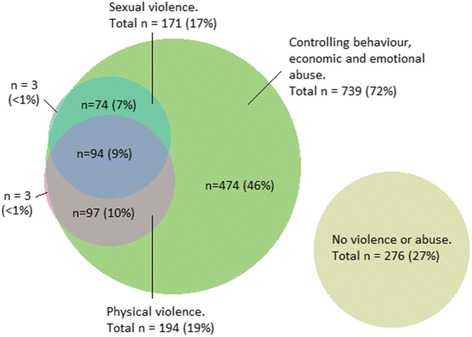
BACKGROUND: Intimate partner violence (IPV) is recognised as an important public health and social problem, with far reaching consequences for women's physical and emotional health and social well-being. Furthermore, controlling behaviour by a partner has a similar impact on women's well-being, yet little is known about the prevalence of this type of behaviour and other related abuses in Tanzania and in other sub-Saharan African countries. METHODS: We conducted a cross-sectional study to determine the lifetime and past 12-month prevalence of physical and sexual IPV, economic abuse, emotional abuse and controlling behaviour among ever-partnered women in Mwanza, Tanzania. Women (N = 1049) were enrolled in an ongoing trial (Maisha study) to assess the impact of microfinance combined with gender training on participants' experience IPV, and other related outcomes. Interviews were conducted by same sex interviewers to collect information about socio-demographic characteristics, experiences of specific acts of IPV and abuse, and symptoms of poor mental health status. RESULTS: Overall, about 61% of women reported ever experiencing physical and/or sexual IPV (95% CI: 58-64%) and 27% (95% CI: 24-29%) experienced it in the past 12 months. Partner controlling behaviour was the most prevalent type of abuse with 82% experiencing it in their lifetime and 63% during the past 12 months. Other types of abuses were also common, with 34% of women reporting economic abuse and 39% reporting emotional abuse during the past 12 months. The prevalence of IPV and abuses varied by socio-demographic characteristics, showing much higher prevalence rates among younger women, women with young partners and less educated women. After we adjusted for age and socio-economic status, physical violence (OR = 1.8; 95% CI: 1.3-2.7) and sexual violence (OR = 2.8; 95% CI: 1.9-4.1) were associated with increased reporting of symptoms of poor mental health. Similarly, experience of abuse during the past 12 months was associated with increased reporting of symptoms of poor mental health. CONCLUSIONS: The high prevalence of IPV and abuses and its strong links with symptoms of poor mental health underline the urgent need for developing and testing appropriate interventions in settings like Tanzania to tackle both violence and abusive behaviours among intimate partners. TRIAL REGISTRATION: ClinicalTrials.gov - ID NCT02592252 , registered retrospectively on 13 August 2015.
Overview
The claims and statistics of this paper haven’t been checked yet.
Free: it reads the open-access text and checks the first 5 claims that cite a source we can check. Create a free account to check every claim.
Integrity signals
Registry
Cites
Statistics
Figures
Verification
Claims the paper makes
The claims and statistics of this paper haven’t been checked yet.
Free: it reads the open-access text and checks the first 5 claims that cite a source we can check. Create a free account to check every claim.
Claims other papers make about this one
Each is checked against this paper’s own text: does it say what the citing paper says it does?
The cited source says what the claim attributes to it.
In the citing paper
“Experiencing economic abuse was found to be significantly and negatively associated with self-esteem [31], psychosocial health [45], and positively associated with symptoms of psychological distress [37].”
From Examining the impact of economic abuse on survivors of intimate partner violence: a scoping review (2022) · cites this paper as [37]
Self-check
Percentages, sums and reported differences re-computed from the paper’s own numbers.
The self-check needs the paper’s full text.
Citations
Cites
Hao (2015) · doi:10.1002/14651858 · Cited by 11,321
Health consequences of intimate partner violence
Campbell, J. C. (2002) · The Lancet · doi:10.1016/s0140-6736(02)08336-8 · Cited by 4,055
Garcia-Moreno, C., Jansen, H. A., Ellsberg, M., Heise, L., & Watts, C. H. (2006) · The Lancet · doi:10.1016/s0140-6736(06)69523-8 · Cited by 3,176 · cited 2×
“Questions asking about each type of violence and abuse were adapted from the WHO Violence Against Women instrument (Table 1) [18].”
MethodResultSelf-citationEllsberg, M., Jansen, H. A., Heise, L., Watts, C. H., & Garcia-Moreno, C. (2008) · The Lancet · doi:10.1016/s0140-6736(08)60522-x · Cited by 1,820 · cited 3×
“This is consistent with findings from other studies [5, 24, 25].”
BackgroundResultSelf-citationThe Global Prevalence of Intimate Partner Violence Against Women
Devries, K. M., Mak, J. Y. T., García-Moreno, C., Petzold, M., Child, J. C., Falder, G., Lim, S., Bacchus, L. J., Engell, R. E., Rosenfeld, L., et al. (2013) · Science · doi:10.1126/science.1240937 · Cited by 1,460 · cited 7×
“To our knowledge, this is one of the first studies to examine the prevalence of emotional and economic abuse and controlling behaviour in a relationship in an African setting.”
BackgroundResultInfluentialSelf-citationAbramsky, T., Watts, C. H., Garcia-Moreno, C., Devries, K., Kiss, L., Ellsberg, M., Jansen, H. A., & Heise, L. (2011) · BMC Public Health · doi:10.1186/1471-2458-11-109 · Cited by 1,413
Self-citationDevries, K. M., Mak, J. Y., Bacchus, L. J., Child, J. C., Falder, G., Petzold, M., Astbury, J., & Watts, C. H. (2013) · PLoS Medicine · doi:10.1371/journal.pmed.1001439 · Cited by 1,258
Self-citationBeyond SEM: General latent variable modeling
Muthén, B. O. (2002) · Behaviormetrika · doi:10.2333/bhmk.29.81 · Cited by 1,074
Mental and Physical Health and Intimate Partner Violence against Women: A Review of the Literature
Dillon, G., Hussain, R., Loxton, D., & Rahman, S. (2013) · International Journal of Family Medicine · doi:10.1155/2013/313909 · Cited by 992 · cited 1×
“Women who experience IPV show more physical symptoms of poor health, and more days out of work and injuries than women who have not been abused [5, 7].”
BackgroundThe global prevalence of intimate partner homicide: a systematic review
Stöckl, H., Devries, K., Rotstein, A., Abrahams, N., Campbell, J., Watts, C., & Moreno, C. G. (2013) · The Lancet · doi:10.1016/s0140-6736(13)61030-2 · Cited by 955 · cited 1×
“Globally, it is estimated that about 30% of women will experience physical and/or sexual violence from an intimate partner during their lifetime [1], and that one in three homicides among women are by an intimate partner [2].”
BackgroundSelf-citationGarcia‐Moreno, C. (2001) · DigitalGeorgetown (Georgetown University Library) · Cited by 933
Pronyk, P. M., Hargreaves, J. R., Kim, J. C., Morison, L. A., Phetla, G., Watts, C., Busza, J., & Porter, J. D. (2006) · The Lancet · doi:10.1016/s0140-6736(06)69744-4 · Cited by 919 · cited 2×
“One example is the Intervention with Microfinance for AIDS and Gender Equity (IMAGE) trial implemented in rural South Africa [13], which found that a gender empowerment intervention linked to microfinance loans was associated with 55% reduced IPV incidence in the past year.”
MethodSelf-citationTanzania Demographic and Health Survey 2010
Macro, I. (2011) · Unspecified eBooks · Cited by 780
Experiences of domestic violence and mental disorders: a systematic review and meta-analysis
Trevillion, K., Oram, S., Feder, G., & Howard, L. M. (2012) · PLoS ONE · doi:10.1371/journal.pone.0051740 · Cited by 729 · cited 1×
“This is consistent with findings from other studies [5, 24, 25].”
ResultIntimate Partner Violence and Women’s Physical, Mental, and Social Functioning
Bonomi, A. E., Thompson, R. S., Anderson, M., Reid, R. J., Carrell, D., Dimer, J. A., & Rivara, F. P. (2006) · American Journal of Preventive Medicine · doi:10.1016/j.amepre.2006.01.015 · Cited by 686
Abramsky, T., Devries, K., Kiss, L., Nakuti, J., Kyegombe, N., Starmann, E., Cundill, B., Francisco, L., Kaye, D., Musuya, T., et al. (2014) · BMC Medicine · doi:10.1186/s12916-014-0122-5 · Cited by 507
Rivas, C., Ramsay, J., Sadowski, L., Davidson, L. L., Dunne, D., Eldridge, S., Hegarty, K., Taft, A., & Feder, G. (2015) · Cochrane Database of Systematic Reviews · doi:10.1002/14651858.cd005043.pub3 · Cited by 392
Stöckl, H., March, L., Pallitto, C., & Garcia-Moreno, C. (2014) · BMC Public Health · doi:10.1186/1471-2458-14-751 · Cited by 361 · cited 1×
“This is also in line with prior studies reporting women below the age of 25 having higher rates of violence than women aged 25 or older [21].”
ResultSelf-citationCarbone-López, K., Kruttschnitt, C., & Macmillan, R. (2006) · Public Health Reports® · doi:10.1177/003335490612100406 · Cited by 312
Risk factors for unidirectional and bidirectional intimate partner violence among young adults
Renner, L. M., & Whitney, S. D. (2012) · Child Abuse & Neglect · doi:10.1016/j.chiabu.2011.07.007 · Cited by 239 · cited 1×
“stable, and to be associated with early pregnancy and higher levels of financial stress [22].”
BackgroundDilemmas and opportunities for an appropriate health-service response to violence against women
García-Moreno, C. (2002) · The Lancet · doi:10.1016/s0140-6736(02)08417-9 · Cited by 228
Measuring mental health in a cost-effective manner
Harpham, T. (2003) · Health Policy and Planning · doi:10.1093/heapol/czg041 · Cited by 201 · cited 1×
“Symptoms of poor mental health were assessed using a standardised tool (SRQ-20), integrated into the health section of the questionnaire, which was developed by WHO [16] and has been validated in a range of populations [17].”
MethodThe impact of current and past interpersonal violence on women's mental health
Romito, P., Molzan Turan, J., & De Marchi, M. (2005) · Social Science & Medicine · doi:10.1016/j.socscimed.2004.08.026 · Cited by 195
Mahenge, B., Likindikoki, S., Stöckl, H., & Mbwambo, J. (2013) · BJOG: An International Journal of Obstetrics & Gynaecology · doi:10.1111/1471-0528.12185 · Cited by 123 · cited 1×
“The prevalence of sexual and/or physical violence in this population is consistent with previous studies conducted in Tanzania [3, 8, 18] and in other countries in sub-Saharan Africa [1].”
ResultSelf-citationStöckl, H., & Penhale, B. (2015) · Journal of Interpersonal Violence · doi:10.1177/0886260514554427 · Cited by 122 · cited 1×
“This is consistent with findings from other studies [5, 24, 25].”
ResultSelf-citationRamsay, J., Carter, Y., Davidson, L., Dunne, D., Eldridge, S., Hegarty, K., Rivas, C., Taft, A., Warburton, A., & Feder, G. (2009) · Cochrane Database of Systematic Reviews · doi:10.1002/14651858.cd005043.pub2 · Cited by 120
Emotional abuse: a neglected dimension of partner violence
Jewkes, R. K. (2010) · The Lancet · doi:10.1016/s0140-6736(10)61079-3 · Cited by 106 · cited 1×
“While more in-depth research is required to understand the impact of the different forms of abuse and controlling behaviour, our findings suggests that comprehensive violence prevention intervention programmes areneededto address IPV and more neglected forms of abuses [20].”
BackgroundKrantz, G., & Vung, N. D. (2009) · BMC Public Health · doi:10.1186/1471-2458-9-143 · Cited by 96 · cited 1×
“Furthermore, recent evidence suggests that controlling behaviour by a partner has a similar impact on women’s well-being [11], yet little is known about the prevalence of this type of behaviour and other related abuses in Tanzania.”
BackgroundMulawa, M. I., Kajula, L. J., Yamanis, T. J., Balvanz, P., Kilonzo, M. N., & Maman, S. (2016) · Journal of Interpersonal Violence · doi:10.1177/0886260515625910 · Cited by 94 · cited 1×
“8% of women reported experiencing physical, sexual and/or psychological IPV [4].”
BackgroundIntimate Partner Violence Against Older Women in Germany: Prevalence and Associated Factors
Stöckl, H., Watts, C., & Penhale, B. (2012) · Journal of Interpersonal Violence · doi:10.1177/0886260512436390 · Cited by 55 · cited 1×
“It is also possible that the levels of recall and social desirability bias is relatively lower among young women and therefore the likelihood of reporting IPV is higher in this population [23].”
BackgroundSelf-citationIntimate Partner Violence and Mental Health
Oram, S., & Howard, L. M. (2013) · Key issues in mental health (Online)/Key issues in mental health (Print) · doi:10.1159/000342015 · Cited by 21
Research works printed but not linked: 1
- WHO A user’s guide to the self-reporting questionnaire (SRQ) 1994 Geneva World Health Organization
Cited by
Economic Abuse as an Invisible Form of Domestic Violence: A Multicountry Review
Postmus, J. L., Hoge, G. L., Breckenridge, J., Sharp-Jeffs, N., & Chung, D. (2020) · Trauma, Violence, & Abuse · doi:10.1177/1524838018764160 · Cited by 288
Cash transfers, polygamy, and intimate partner violence: Experimental evidence from Mali
Heath, R., Hidrobo, M., & Roy, S. (2019) · Journal of Development Economics · doi:10.1016/j.jdeveco.2019.102410 · Cited by 197
“The consequences of IPV are extensive and include the direct physical and mental harm of women that hinders their ability to reach their full potential (Mary Ellsberg et al. 2008; Kapiga et al. 2017).”
BackgroundExamining the impact of economic abuse on survivors of intimate partner violence: a scoping review
Johnson, L., Chen, Y., Stylianou, A., & Arnold, A. (2022) · BMC Public Health · doi:10.1186/s12889-022-13297-4 · Cited by 177
“Experiencing economic abuse was found to be significantly and negatively associated with self-esteem [31], psychosocial health [45], and positively associated with symptoms of psychological distress [37].”
BackgroundMethodRoy, S., Hidrobo, M., Hoddinott, J. F., & Ahmed, A. (2019) · The Review of Economics and Statistics · doi:10.1162/rest_a_00791 · Cited by 161
“IPV has multiple malign consequences for women’s physical and mental health (Ellsberg et al., 2008; Kapiga et al., 2017) and is the leading cause of women’s death by homicide (Devries et al.”
Spousal age difference and associated predictors of intimate partner violence in Nigeria
Adebowale, A. S. (2018) · BMC Public Health · doi:10.1186/s12889-018-5118-1 · Cited by 109
“The Creative Commons Public Domain Dedication waiver (http://creativecommons.org/publicdomain/zero/1.0/) applies to the data made available in this article, unless otherwise stated. reported IPV is more common in Southern Africa and Central Africa and increasingly in Nigeria [12].”
BackgroundResultInfluential
Metadata
- Authors
- Kapiga, S., Harvey, S., Muhammad, A. K., Stöckl, H., Mshana, G., Hashim, R., Hansen, C., Lees, S., & Watts, C.
- Affiliations
- London School of Hygiene & Tropical Medicine (GB)
- Mwanza Intervention Trials Unit (TZ)
- Corresponding author
- Kapiga, Saidi
- ORCID
- Venue
- BMC Public Health
- Published
- 2017-02-14
- Volume
- 17
- Issue
- 1
- Pages
- 190-190
- ISSN
- 1471-2458 (ISSN-L)
- PMC
- PMC5307886
- OpenAlex
- W2588801678
- Cited by
- 150
- References
- 30
- Citations by year
- 2026: 11 · 2025: 16 · 2024: 18 · 2023: 24 · 2022: 27 · 2021: 15 · 2020: 10 · 2019: 13 · 2018: 13 · 2017: 3
- FWCI
- 11.83
- Type
- journal article
- Language
- en
- Open access
- gold
- doi.org
- Licence
- cc-by
- Locations
- BMC Public Health (publishedVersion, cc-by)
- Europe PMC (PubMed Central) (publishedVersion, cc-by)
- PubMed Central (publishedVersion, cc-by)
- PubMed (publishedVersion)
- LSHTM Research Online (London School of Hygiene and Tropical Medicine) (acceptedVersion)
- DOAJ (DOAJ: Directory of Open Access Journals) (submittedVersion, cc-by-sa)
- Funders
- UKAID from the UK Department for International Development
- Anonymous donor
- Topics
- Social Sciences › Health › Intimate Partner and Family Violence
- Health Sciences › Medicine › Geriatrics and Gerontology › Elder Abuse and Neglect
- Social Sciences › Sociology and Political Science › Stalking, Cyberstalking, and Harassment
- Keywords
- intimate partner violence, physical violence, sexual violence, economic violence, emotional abuse, controlling behavior, prevalence, women's mental health, sociodemographic risk factors, microfinance, gender training, Mwanza, Tanzania, northwestern Tanzania, sub-Saharan Africa, young women, women's education
- MeSH terms
- Intimate Partner Violence, Adult, Aged, Mental Disorders, Cross-Sectional Studies, Family Characteristics, Female, Humans, Interpersonal Relations, Interviews as Topic, Male, Middle Aged, Surveys and Questionnaires, Sexual Partners, Tanzania, Women's Health Services, Prevalence, Young Adult
About these checks
Registry, retraction, Cites and statistics results are computed, not judged, with one exception: a printed reference that no index lists is read once by a model before it counts as a citation error. Claims are extracted by a model and kept only when their quote appears verbatim in the text; each cited source is then checked, with a model’s help, for whether it says what the claim relies on. Those verdicts can be wrong — read the claim’s quote and the cited source before relying on one.
Statistics and arithmetic are recomputed, not judged.
Confidence bands are shown only for fields calibrated on our annotated test set. None is calibrated yet, so no band is shown.
What counts as a claim ›How we measure confidence ›How we check this ›
Are you an author, or do you see a problem with this page? Request a review
Data sources
Bibliographic data: Semantic Scholar, OpenAlex, Crossref.
Contains information from the Semantic Scholar Academic Graph Datasets, made available under the ODC Attribution License (ODC-BY 1.0).
Semantic Scholar’s data is described in: Kinney, R., et al. (2023). The Semantic Scholar Open Data Platform. arXiv:2301.10140.
