

Development of a framework for the co-production and prototyping of public health interventions
Open accessThe DOI matches its Crossref record; 32 of the 32 references it cites were found in a registry or an index; 28 of the 79 sources its claims cite were checked for support.
Abstract
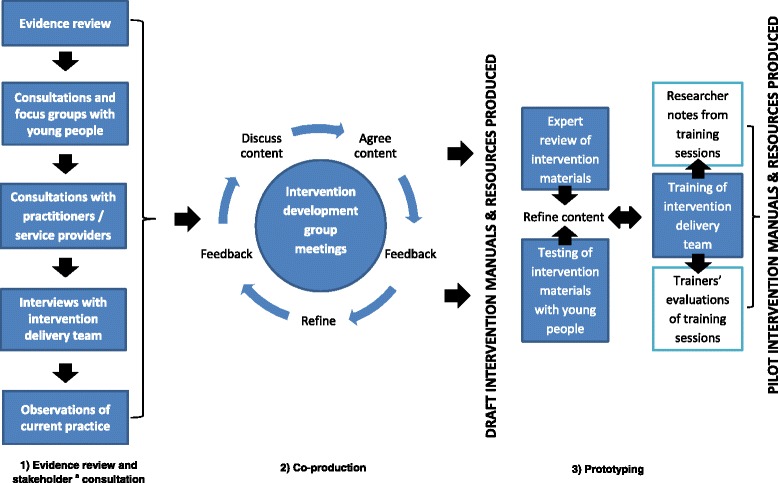
BACKGROUND: Existing guidance for developing public health interventions does not provide information for researchers about how to work with intervention providers to co-produce and prototype the content and delivery of new interventions prior to evaluation. The ASSIST + Frank study aimed to adapt an existing effective peer-led smoking prevention intervention (ASSIST), integrating new content from the UK drug education resource Talk to Frank ( www.talktofrank.com ) to co-produce two new school-based peer-led drug prevention interventions. A three-stage framework was tested to adapt and develop intervention content and delivery methods in collaboration with key stakeholders to facilitate implementation. METHODS: The three stages of the framework were: 1) Evidence review and stakeholder consultation; 2) Co-production; 3) Prototyping. During stage 1, six focus groups, 12 consultations, five interviews, and nine observations of intervention delivery were conducted with key stakeholders (e.g. Public Health Wales [PHW] ASSIST delivery team, teachers, school students, health professionals). During stage 2, an intervention development group consisting of members of the research team and the PHW ASSIST delivery team was established to adapt existing, and co-produce new, intervention activities. In stage 3, intervention training and content were iteratively prototyped using process data on fidelity and acceptability to key stakeholders. Stages 2 and 3 took the form of an action-research process involving a series of face-to-face meetings, email exchanges, observations, and training sessions. RESULTS: Utilising the three-stage framework, we co-produced and tested intervention content and delivery methods for the two interventions over a period of 18 months involving external partners. New and adapted intervention activities, as well as refinements in content, the format of delivery, timing and sequencing of activities, and training manuals resulted from this process. The involvement of intervention delivery staff, participants and teachers shaped the content and format of the interventions, as well as supporting rapid prototyping in context at the final stage. CONCLUSIONS: This three-stage framework extends current guidance on intervention development by providing step-by-step instructions for co-producing and prototyping an intervention's content and delivery processes prior to piloting and formal evaluation. This framework enhances existing guidance and could be transferred to co-produce and prototype other public health interventions. TRIAL REGISTRATION: ISRCTN14415936 , registered retrospectively on 05 November 2014.
Overview
CoChat Summary
## TL;DR
This paper presents a three-stage framework for co-producing and prototyping public health interventions, illustrated through the development of two school-based peer-led drug prevention interventions adapted from ASSIST. Over 18 months and 42 activities, stakeholder input led to new and adapted content, delivery refinements, and training/manual changes before piloting.
## Key findings
- The framework was applied over 18 months and included 42 activities.
- Stage 1 consultations involved 6 focus groups with 47 young people aged 13–15, 12 consultations, 5 interviews with the ASSIST delivery team, and 9 observations of intervention delivery.
- The process produced new and adapted intervention activities plus refinements to content, delivery format, timing, sequencing, and training manuals.
- Final observations showed delivery deviations remained: across the +Frank intervention, 5 of 15 activities were delivered in full, 8 had minor deviations, and 2 were not delivered; across Frank friends, 13 of 25 were delivered in full, 9 had minor deviations, and 3 were not delivered.
## Methods
- The study used a three-stage, multi-method framework: evidence review and stakeholder consultation, co-production, and prototyping.
- Stakeholders included the PHW ASSIST delivery team, secondary school students, and health professionals working with drug agencies or young people.
- Analysis in stage 1 used thematic analysis of focus groups/interviews, plus synthesis of observations and consultation notes to inform later co-production and prototyping.
## Limitations
- The paper states that co-production is time-consuming, can involve competing priorities and interdisciplinary conflict, and may be hard to sustain for stakeholders without the same flexibility as the PHW ASSIST team.
- The framework’s transferability may be limited because it was used to adapt an existing intervention with a strong evidence base and an experienced delivery team; the paper says these conditions “may have contributed” to success.
- Evident from the text: the framework was developed and tested in a single case study, so the paper does not provide comparative evidence that it works equally well in other settings or for other interventions.
Model-written summary. Check it against the paper before relying on it.
Integrity signals
Registry
Cites
Statistics
Figures
Verification
Claims the paper makes
7 Valid · 2 Not valid · 16 Not checked · 55 Own results and interpretations
The cited sources support only part of this claim — read each source’s verdict below.
In the paper
“Existing guidance for developing public health interventions does not provide information for researchers about how to work with intervention providers to co-produce and prototype the content and delivery of new interventions prior to evaluation.”
- Also stated in: § Background · plain
“These guidelines support development of a theoretical rationale for an intervention, but provide scant pragmatic instruction on how to develop intervention materials and delivery methods.”
§ Development of a framework for the co-production and prototyping of public health interventions > Abstract > Background
What the sources say
- Not checked yetcites [1] Conrad KJ Randolph FL Kirby MW Jr Bebout RR Creating and using logic models: four perspectives Alcoholism Treat Q 1999 17 1–2 17 31 10.1300/J020v17n01_02 source
- Not checked yetcites [2] Hardeman W Sutton S Griffin S Johnston M White A Wareham NJ Kinmonth AL A causal modelling approach to the development of theory-based behaviour change programmes for trial evaluation Health Educ Res 2005 20 6 676 687 10.1093/her/cyh022 15781446 source
- Could not verifycites [3] Collins LM Murphy SA Strecher V The multistage optimization strategy (MOST) and the sequential multiple assignment randomized trial (SMART): new methods for more potent eHealth interventions Am J of Prev Med 2007 32 5 S112 S118 10.1016/j.amepre.2007.01.022 17466815 PMC2062525 sourceExperimental — accuracy not yet measured
The MOST discussion (indexed as Abstract; page unavailable) critiques the traditional intervention–RCT cycle and assumes that initial pilot testing has already been completed. It does not assess whether existing guidance explains how researchers should work with intervention providers to co-produce or prototype interventions; searches for provider collaboration and pre-evaluation development guidance found no such passage. (LLM, conf=0.76)
- Not checked yetcites [4] NICE. Behaviour Change: The principles for effective interventions. NICE Public Health Guidance 6. National Institute for Health and Clinical Excellence; 2007.
- Not checked yetcites [5] Bartholomew LK Parcel GS Kok G Gottlieb NH Planning health promotion programs: an intervention mapping approach 2011 New Jersey John Wiley & Sons
- Partly supportedcites [6] French SD Green SE O’Connor DA McKenzie JE Francis JJ Michie S Developing theory-informed behaviour change interventions to implement evidence into practice: a systematic approach using the theoretical domains framework Implement Sci 2012 7 1 38 10.1186/1748-5908-7-38 22531013 PMC3443064 sourceExperimental — accuracy not yet measured
The Background (page not available in our copy) says MRC guidance offers a general approach to developing complex interventions but lacks detailed guidance on how to do so. It does not specifically say that existing guidance lacks instructions for working with intervention providers to co-produce and prototype content and delivery before evaluation. (LLM, conf=0.84)
- Partly supportedcites [7] De Silva MJ Breuer E Lee L Asher L Chowdhary N Lund C Theory of change: a theory-driven approach to enhance the Medical Research Council’s framework for complex interventions Trials 2014 15 1 267 10.1186/1745-6215-15-267 24996765 PMC4227087 sourceExperimental — accuracy not yet measured
The Background (page unavailable) says the MRC framework does not provide guidance on incorporating theory-driven approaches into intervention design and evaluation. The Discussion and RISE case study describe stakeholder workshops shaping intervention content and delivery before evaluation. The paper does not say that existing guidance lacks instructions specifically for working with intervention providers to co-produce and prototype interventions. (LLM, conf=0.82)
- Partly supportedcites [8] Wight D Wimbush E Jepson R Doi L Six steps in quality intervention development (6SQuID) J Epidemiol Community Health 2016 70 520 525 10.1136/jech-2015-205952 26573236 PMC4853546 sourceExperimental — accuracy not yet measured
The Introduction says existing frameworks provide little specific detail on intervention development, and its table identifies limited detail in several frameworks. The paper also advocates co-production with practitioners and small-scale testing of intervention content and delivery. It does not establish the stronger claim that existing guidance provides no information on how to do those things with intervention providers. (LLM, conf=0.84)
- Partly supportedcites [9] Michie S van Stralen MM West R The behaviour change wheel: a new method for characterising and designing behaviour change interventions Implement Sci 2011 6 42 10.1186/1748-5908-6-42 21513547 PMC3096582 sourceExperimental — accuracy not yet measured
The Background (page unavailable) says that UK Medical Research Council guidance does not specify how to select and apply theory, supporting a general concern about gaps in intervention-development guidance. It does not say that existing guidance lacks instructions for working with intervention providers to co-produce and prototype content and delivery before evaluation. (LLM, conf=0.76)
- Not checked yetcites [10] CORE Group Designing for behaviour change framework 2008 Washington CORE Group and USAID
plain- Asserted: passes — The authors put it forward as true.
- Checkable: passes — It can be checked against evidence.
- Load-bearing: passes — The paper’s conclusions depend on it.
- Based: passes — The paper gives a reason why it holds.
- Also stated in: § Background · plain
Every source the paper cites for this claim was checked and supports it.
In the paper
“ASSIST is a school-based peer-led intervention that has been shown to be effective in reducing the uptake of smoking in UK secondary schools [21].”
§ Development of a framework for the co-production and prototyping of public health interventions > Background > Case study: ASSIST + Frank intervention development study
What the sources say
- Supportedcites [21] Campbell R Starkey F Holliday J Audrey S Bloor M Parry-Langdon N An informal school-based peer-led intervention for smoking prevention in adolescence (ASSIST): a cluster randomised trial Lancet 2008 371 9624 1595 1602 10.1016/S0140-6736(08)60692-3 18468543 PMC2387195 source
The Discussion states directly that 'the ASSIST training programme was effective in achievement of a sustained reduction in uptake of regular smoking in adolescents for 2 years after its delivery', and the Abstract/Methods confirm this was a peer-led intervention delivered in 59 secondary schools in England and Wales (UK) among 10 730 students aged 12–13. The Abstract Findings report the supporting estimates (OR 0·75 immediately post-intervention, 0·77 at 1 year, and 0·78 [0·64–0·96] in the three-tier model pooling all three follow-ups), with the 2-year estimate alone not statistically significant (0·85, 0·72–1·01; p=0·067) — a nuance the citing sentence's blanket 'effective' glosses over, but the paper itself characterises the intervention as effective. (LLM, conf=0.90)
plainstates a cause- Asserted: passes — The authors put it forward as true.
- Checkable: passes — It can be checked against evidence.
- Load-bearing: passes — The paper’s conclusions depend on it.
- Based: passes — The paper gives a reason why it holds.
- Supported
The cited sources support only part of this claim — read each source’s verdict below.
In the paper
“In contrast, studies of the implementation and effectiveness of peer-led drug prevention interventions report mixed evidence [25–27].”
§ Development of a framework for the co-production and prototyping of public health interventions > Background > Case study: ASSIST + Frank intervention development study
What the sources say
- Partly supportedcites [25] MacArthur GJ Harrison S Caldwell DM Hickman M Campbell R Peer-led interventions to prevent tobacco, alcohol and/or drug use among young people aged 11–21 years: a systematic review and meta-analysis Addiction 2015 111 391 407 PMC4833174 26518976 sourceExperimental — accuracy not yet measured
The Adverse effects section reports generally favorable pooled effects but increased substance use in some higher-risk groups, supporting a mixed picture of effectiveness. The Conclusions section says process evaluations are still needed to assess implementation, fidelity and reach; it does not report mixed findings about implementation. Page numbers are unavailable in our copy. (LLM, conf=0.84)
- Not checked yetcites [26] Faggiano F Vigna-Taglianti F Burkhart G Bohrn K Cuomo L Gregori D The effectiveness of a school-based substance abuse prevention program: 18-month follow-up of the EU-dap cluster randomized controlled trial Drug Alcohol Depend 2010 108 1 56 64 10.1016/j.drugalcdep.2009.11.018 20080363 source
- Supportedcites [27] Valente TW Ritt-Olson A Stacy A Unger JB Okamoto J Sussman S Peer acceleration: effects of a social network tailored substance abuse prevention program among high-risk adolescents Addiction 2007 102 11 1804 1815 10.1111/j.1360-0443.2007.01992.x 17784893 source
The Discussion reports mixed effects in this peer-interactive substance-use prevention study: students with few substance-using peers benefited, while those with substance-using peers were more likely to be influenced negatively. This supports the cited sentence’s characterization of mixed evidence, without implying that this single paper establishes the results of every peer-led intervention. (LLM, conf=0.88)
plain- Asserted: passes — The authors put it forward as true.
- Checkable: passes — It can be checked against evidence.
- Load-bearing: passes — The paper’s conclusions depend on it.
- Based: passes — The paper gives a reason why it holds.
- Partly supported
The cited sources support only part of this claim — read each source’s verdict below.
In the paper
“It complements other intervention development guidance by providing more detail on the process of the early stages of intervention development and co-production that receives limited attention in existing guidance on intervention development [1–12].”
§ Development of a framework for the co-production and prototyping of public health interventions > Conclusions
What the sources say
- Not checked yetcites [1] Conrad KJ Randolph FL Kirby MW Jr Bebout RR Creating and using logic models: four perspectives Alcoholism Treat Q 1999 17 1–2 17 31 10.1300/J020v17n01_02 source
- Not checked yetcites [2] Hardeman W Sutton S Griffin S Johnston M White A Wareham NJ Kinmonth AL A causal modelling approach to the development of theory-based behaviour change programmes for trial evaluation Health Educ Res 2005 20 6 676 687 10.1093/her/cyh022 15781446 source
- Partly supportedcites [3] Collins LM Murphy SA Strecher V The multistage optimization strategy (MOST) and the sequential multiple assignment randomized trial (SMART): new methods for more potent eHealth interventions Am J of Prev Med 2007 32 5 S112 S118 10.1016/j.amepre.2007.01.022 17466815 PMC2062525 sourceExperimental — accuracy not yet measured
The paper’s discussion of MOST’s screening and refining phases (indexed as Abstract; page unavailable) provides detail on developing and optimizing intervention components before a confirmatory trial. It contrasts that process with a traditional intervention-development approach, but does not address co-production or establish that existing guidance gives it limited attention. (LLM, conf=0.79)
- Not checked yetcites [4] NICE. Behaviour Change: The principles for effective interventions. NICE Public Health Guidance 6. National Institute for Health and Clinical Excellence; 2007.
- Not checked yetcites [5] Bartholomew LK Parcel GS Kok G Gottlieb NH Planning health promotion programs: an intervention mapping approach 2011 New Jersey John Wiley & Sons
- Partly supportedcites [6] French SD Green SE O’Connor DA McKenzie JE Francis JJ Michie S Developing theory-informed behaviour change interventions to implement evidence into practice: a systematic approach using the theoretical domains framework Implement Sci 2012 7 1 38 10.1186/1748-5908-7-38 22531013 PMC3443064 sourceExperimental — accuracy not yet measured
The Background (page unavailable) says existing MRC guidance offers a general approach but lacks detail on how to develop an implementation intervention; the paper then outlines a four-step method. This supports the claim about more detailed development guidance, but the passages do not establish that the method addresses co-production. (LLM, conf=0.85)
- Partly supportedcites [7] De Silva MJ Breuer E Lee L Asher L Chowdhary N Lund C Theory of change: a theory-driven approach to enhance the Medical Research Council’s framework for complex interventions Trials 2014 15 1 267 10.1186/1745-6215-15-267 24996765 PMC4227087 sourceExperimental — accuracy not yet measured
The Background says the MRC framework offers little practical guidance on incorporating theory, and the Discussion describes Theory of Change as a way to involve stakeholders in initial intervention design. The paper therefore supports a gap in existing guidance and a participatory approach to early development, but it does not establish that the citing paper’s framework provides the claimed additional detail on co-production. (LLM, conf=0.82)
- Partly supportedcites [8] Wight D Wimbush E Jepson R Doi L Six steps in quality intervention development (6SQuID) J Epidemiol Community Health 2016 70 520 525 10.1136/jech-2015-205952 26573236 PMC4853546 sourceExperimental — accuracy not yet measured
The Introduction says existing frameworks offer little specific detail on intervention development and presents 6SQuID as a pragmatic six-step guide. It also recommends co-production and explains its benefits, but does not provide comparable detail on the process of co-production or establish that existing guidance gives it limited attention. Page numbers are unavailable in our copy. (LLM, conf=0.84)
- Partly supportedcites [9] Michie S van Stralen MM West R The behaviour change wheel: a new method for characterising and designing behaviour change interventions Implement Sci 2011 6 42 10.1186/1748-5908-6-42 21513547 PMC3096582 sourceExperimental — accuracy not yet measured
The Background identifies this paper as guidance for designing behaviour-change interventions and says it examines the first part of the design process. That supports citing it as existing intervention-development guidance, but our copy does not establish that such guidance gives limited attention to co-production or to the early-stage process described in the citing sentence. (LLM, conf=0.83)
- Not checked yetcites [10] CORE Group Designing for behaviour change framework 2008 Washington CORE Group and USAID
plain- Asserted: passes — The authors put it forward as true.
- Checkable: passes — It can be checked against evidence.
- Load-bearing: passes — The paper’s conclusions depend on it.
- Based: passes — The paper gives a reason why it holds.
The cited sources support only part of this claim — read each source’s verdict below.
In the paper
“This is complementary to existing intervention development guidelines which provide information about the use of mapping techniques [1, 5, 7, 10], intervention theory development [2, 6, 9] and testing [3, 8].”
§ Development of a framework for the co-production and prototyping of public health interventions > Discussion
What the sources say
- Not checked yetcites [1] Conrad KJ Randolph FL Kirby MW Jr Bebout RR Creating and using logic models: four perspectives Alcoholism Treat Q 1999 17 1–2 17 31 10.1300/J020v17n01_02 source
- Not checked yetcites [5] Bartholomew LK Parcel GS Kok G Gottlieb NH Planning health promotion programs: an intervention mapping approach 2011 New Jersey John Wiley & Sons
- Supportedcites [7] De Silva MJ Breuer E Lee L Asher L Chowdhary N Lund C Theory of change: a theory-driven approach to enhance the Medical Research Council’s framework for complex interventions Trials 2014 15 1 267 10.1186/1745-6215-15-267 24996765 PMC4227087 source
The Background describes this paper as a guide to constructing a Theory of Change and integrating it into the design and evaluation of complex interventions. The Results section explains how stakeholders develop a map of causal pathways and articulate the evidence behind them. This supports citing it as guidance on intervention theory development; the citing authors’ statement that their framework is complementary is their own framing. (LLM, conf=0.90)
- Not checked yetcites [10] CORE Group Designing for behaviour change framework 2008 Washington CORE Group and USAID
- Not checked yetcites [2] Hardeman W Sutton S Griffin S Johnston M White A Wareham NJ Kinmonth AL A causal modelling approach to the development of theory-based behaviour change programmes for trial evaluation Health Educ Res 2005 20 6 676 687 10.1093/her/cyh022 15781446 source
- Supportedcites [6] French SD Green SE O’Connor DA McKenzie JE Francis JJ Michie S Developing theory-informed behaviour change interventions to implement evidence into practice: a systematic approach using the theoretical domains framework Implement Sci 2012 7 1 38 10.1186/1748-5908-7-38 22531013 PMC3443064 source
Citation [10] is attached to the claim about mapping techniques, not the separately cited claims about intervention theory development or testing. The Results section describes how the authors mapped barriers to theoretical domains and used that mapping to select behaviour change techniques; the Discussion’s ‘Potential limitations’ section also calls this matrix mapping. (LLM, conf=0.92)
- Partly supportedcites [9] Michie S van Stralen MM West R The behaviour change wheel: a new method for characterising and designing behaviour change interventions Implement Sci 2011 6 42 10.1186/1748-5908-6-42 21513547 PMC3096582 sourceExperimental — accuracy not yet measured
The Background discusses intervention mapping and guidance from the UK Medical Research Council on developing and evaluating complex interventions. The Discussion distinguishes the behaviour change wheel from intervention mapping. These passages support a relationship to existing approaches, but do not establish that the framework is complementary to guidelines covering mapping techniques, intervention theory development, and testing as a group. (LLM, conf=0.78)
- Supportedcites [3] Collins LM Murphy SA Strecher V The multistage optimization strategy (MOST) and the sequential multiple assignment randomized trial (SMART): new methods for more potent eHealth interventions Am J of Prev Med 2007 32 5 S112 S118 10.1016/j.amepre.2007.01.022 17466815 PMC2062525 source
The citation is attached to “testing,” rather than to mapping techniques or intervention theory development. The paper’s Abstract describes MOST as a method for building and evaluating interventions, including a confirming phase that tests the optimized intervention in a randomized trial. (LLM, conf=0.88)
- Supportedcites [8] Wight D Wimbush E Jepson R Doi L Six steps in quality intervention development (6SQuID) J Epidemiol Community Health 2016 70 520 525 10.1136/jech-2015-205952 26573236 PMC4853546 source
The Introduction says 6SQuID draws on the strengths of existing intervention-development frameworks and lists intervention mapping and guidance on developing theory. Section 5, ‘Test and refine on small scale,’ provides guidance on testing interventions and adapting them. Together, these passages support the broad description of the framework as complementary to such guidance. (LLM, conf=0.86)
plain- Asserted: passes — The authors put it forward as true.
- Checkable: passes — It can be checked against evidence.
- Load-bearing: passes — The paper’s conclusions depend on it.
- Based: passes — The paper gives a reason why it holds.
26 more claims
Create a free account to see all 80 claims and to verify the 51 references still open.
- It may state two separate claims as one. 28
- Probably not a substantial claim. 29
Citations
Cites
Rogers, E. M., Singhal, A., & Quinlan, M. M. (2019) · An Integrated Approach to Communication Theory and Research · doi:10.4324/9780203710753-35 · Cited by 37,322
Michie, S., van Stralen, M. M., & West, R. (2011) · Implementation Science · doi:10.1186/1748-5908-6-42 · Cited by 13,697 · cited 2×
“Other approaches provide more detailed guidance on: developing intervention or program theory [2, 6, 9]; using mapping techniques to inform the components required in an intervention [1, 5, 7, 10]; cycles”
MethodFereday, J., & Muir-Cochrane, E. (2006) · International Journal of Qualitative Methods · doi:10.1177/160940690600500107 · Cited by 11,829 · cited 1×
“This analysis approach has been described in detail elsewhere [30].”
MethodField Theory in Social Science: Selected Theoretical Papers.
Price, D. O., Lewin, K., & Cartwright, D. (1951) · American Sociological Review · doi:10.2307/2087618 · Cited by 3,501
Planning health promotion programs an intervention mapping approach
Bartholomew, L. K., Parcel, G. S., Kok, G., & Gottlieb, N. (2006) · Research Publications (Maastricht University) · Cited by 2,321
Developing and Evaluating Complex Interventions: New Guidance
Craig, P., Dieppe, P. A., MacIntyre, S., Michie, S., Nazareth, I., & Petticrew, M. P. (2006) · UCL Discovery (University College London) · Cited by 1,989
Planning Health Promotion Programs: An Intervention Mapping Approach
Hicking-Woodison, L. (2017) · Nursing Standard · doi:10.7748/ns.32.6.33.s38 · Cited by 1,841
The Value and Challenges of Participatory Research: Strengthening Its Practice
Cargo, M., & Mercer, S. L. (2008) · Annual Review of Public Health · doi:10.1146/annurev.publhealth.29.091307.083824 · Cited by 1,468
Field Theory in Social Science: Selected Theoretical Papers
Lewin, K., & Cartwright, D. (1975) · Medical Entomology and Zoology · Cited by 1,417
French, S. D., Green, S. E., O’Connor, D. A., McKenzie, J. E., Francis, J. J., Michie, S., Buchbinder, R., Schattner, P., Spike, N., & Grimshaw, J. M. (2012) · Implementation Science · doi:10.1186/1748-5908-7-38 · Cited by 1,338 · cited 2×
“Other approaches provide more detailed guidance on: developing intervention or program theory [2, 6, 9]; using mapping techniques to inform the components required in an intervention [1, 5, 7, 10]; cycles”
Research works printed but not linked: 1
- CORE Group Designing for behaviour change framework 2008 Washington CORE Group and USAID
Cited by
Items 101–200 of 332
Evans, R., Cunningham, E., Stabler, L., Vaughan, R. A., Davies, B., Cummings, A., Boffey, M., Wooders, C., & Mannay, D. (2023) · Children and Youth Services Review · doi:10.1016/j.childyouth.2023.107321 · Cited by 12
“This reflects methodological recommendations from guidance concerning the development, optimisation and adaptation of interventions, which centralise the need for stakeholder involvement throughout (Hawkins et al., 2017; Moore et al., 2021; O ’ Cathain et al., 2019; Skivington et al., 2021).”
MethodMishu, M. P., Elsey, H., Choudhury, A. R., Dastagir, S., Khan, S. H., Tahsin, T., Suma, H. M., Karmaker, R., & Dogar, O. F. (2021) · BMC Oral Health · doi:10.1186/s12903-021-01861-0 · Cited by 12
The Liminality of Fraud: Reimagining Fraud Theory to Inform Financial Crime Prevention
Harding, N., Cooper, E., Sales, T., McDonald, A., & Kingston, S. (2024) · The British Journal of Criminology · doi:10.1093/bjc/azae069 · Cited by 11
Holmes, S. R., Thompson, A. M., Herman, K. C., & Reinke, W. M. (2021) · School Psychology Review · doi:10.1080/2372966x.2020.1870868 · Cited by 9
“CP has the potential to overcome these challenges by using stakeholders’ knowledge and expertise to develop intervention materials and procedures, thereby, maximizing the acceptability, feasibility and fit of the intervention within a school setting (Hawkins et al., 2017).”
BackgroundElgán, T. H., Andréasson, S., & Gripenberg, J. (2024) · Frontiers in Public Health · doi:10.3389/fpubh.2024.1423708 · Cited by 9
What is “good” co-production in the context of planetary health research, and how is it enabled?
Black, D., Bates, G., Gibson, A., Pain, K., Rosenberg, G., & White, J. (2024) · Earth System Governance · doi:10.1016/j.esg.2024.100229 · Cited by 9
Self-citationPavarini, G., Murta, S. G., Mendes, J. A. D. A., Siston, F. R., de Souza, R. R. A., da Cunha, R. D. O., Ferreira, J. A., Santos, V. H. D. L., Seabra, B. T. R., Talk2U, et al. (2024) · Journal of Child Psychology and Psychiatry · doi:10.1111/jcpp.14078 · Cited by 9
“…of active stakeholder involvement as well as flexibility and adaptability on the part of the creators to ensure the technology aligns with community priorities and the context in which it is embedded, as highlighted by several researchers (Hawkins et al., 2017; Zidaru, Morrow, & Stockley, 2021).”
Paudyal, P., Wasti, S. P., Neupane, P., Sapkota, J., Watts, C., Kulasabanathan, K., Silwal, R. C., Memon, A., Shukla, P., Pathak, R. S., et al. (2025) · BMJ Open · doi:10.1136/bmjopen-2024-086280 · Cited by 9
“28 The development of the storytelling intervention in our study was also a non-linear process, marked by numerous iterative phases and continual refinement prior to finalisation.”
Gilmore, H., Shannon, S., Leavey, G., Dempster, M., Gallagher, S., & Breslin, G. (2020) · Journal of Clinical Sport Psychology · doi:10.1123/jcsp.2019-0028 · Cited by 9
“415 It is proposed that over time such efforts may lead to consumer-driven prevention efforts, 416 which can be seen in other domains (e.g., smoking; Hawkins et al., 2017).”
BackgroundUsing Co-Production to Develop “Sit Less at Work” Interventions in a Range of Organisations
Mackenzie, K., Such, E., Norman, P. E., & Goyder, E. (2021) · International Journal of Environmental Research and Public Health · doi:10.3390/ijerph18157751 · Cited by 10
“First, co-producing an intervention can be time-consuming, as, by its very nature, it is an iterative process and it is not clear at the outset how long the process will take to complete [29].”
BackgroundInfluentialCO-Creation and Evaluation of Food Environments to Advance Community Health (COACH)
Whelan, J., Brimblecombe, J. K., Christian, M. S., Vargas, C., Ferguson, M., McMahon, E., Lee, A., Bell, C., Boelsen‐Robinson, T., Blake, M. R., et al. (2023) · AJPM Focus · doi:10.1016/j.focus.2023.100111 · Cited by 9
“Stages of the multimethod development of a best practic food retail, based on Hawkins et al.(26)”
MethodParsons, K., Payne, S. M., Codling, S., & Murphy, M. (2023) · Health Marketing Quarterly · doi:10.1080/07359683.2023.2235501 · Cited by 9
“Co-design Co-design is an ongoing process and, as the campaign develops through stages, continued engagement with the local community is paramount to ensuring it success (Hawkins et al., 2017).”
BackgroundSamir, N., Diaz, A. M., Hodgins, M., Matic, S., Bawden, S., Khoury, J., Eapen, V., & Lingam, R. (2021) · International Journal of Environmental Research and Public Health · doi:10.3390/ijerph18115808 · Cited by 9
Milton, K. E., Poole, K., Cross, A. J., Gasson, S. J., Gokal, K., Lyons, K. S., Pulsford, R. M., & Jones, A. (2022) · European Journal of Cancer Care · doi:10.1111/ecc.13573 · Cited by 9
Johnson, S., Laham, S., Blanc, S., & Bellanger, M. M. (2024) · Frontiers in Education · doi:10.3389/feduc.2024.1498753 · Cited by 7
Viftrup, A., Nikolajsen, L., Laustsen, S., & Dreyer, P. (2025) · International Journal of Qualitative Studies on Health and Well-Being · doi:10.1080/17482631.2025.2502193 · Cited by 8
“Understanding patients’ perspectives is essential for co-creating such interventions (Hawkins et al., 2017).”
Bates, G., & Vinther, A. S. (2021) · Performance Enhancement & Health · doi:10.1016/j.peh.2021.100193 · Cited by 11
Jones, C. J., O’Donnell, N., John, M., Cooke, D. D., Stewart, R., Hale, L. S., Skene, S. S., Kanumakala, S., Harrington, M. P., & Satherley, R. (2021) · Diabetic Medicine · doi:10.1111/dme.14738 · Cited by 8
Norris, A. E., Thalasinos, R. D., & Hecht, M. L. (2021) · JMIR Formative Research · doi:10.2196/24937 · Cited by 8
“of our research assistants illustrates how to extend the principle of coproduction of public health interventions from intervention development to adaptation of an existing evidence-based intervention [37].”
BackgroundMcKinney, A., Fitzsimons, D., Blackwood, B., White, M., & McGaughey, J. (2020) · Journal of Advanced Nursing · doi:10.1111/jan.14365 · Cited by 10
“Action research, as advocated by Hawkins et al. (2017) will be employed during the co-design stage.”
BackgroundMethodInfluentialGrant, A., Williams, G., Axbey, H., Wilkins, A., Firth, E., Lim, H., Cave, H., Williams, K., Ribbons, K., Sinfield, M., et al. (2024) · BMJ Open · doi:10.1136/bmjopen-2024-088343 · Cited by 9
“54 We will use separate groups”
Self-citationWilcock, R., Monro, A., Smith, A. W., & O’Keeffe, H. (2025) · Educational Review · doi:10.1080/00131911.2025.2459900 · Cited by 7
“This is important for, as Kutcher et al. (2016) and Hawkins et al. (2017) have noted, schools’ engagement in the coproduction of programmes that are responsive to the mental health needs of their particular pupils and contexts can benefit – if the requisite support is provided – from the additional…”
Hansen, A. B. G., Hansen, M. L., Golubovic, S., Bloch, P., Lorenzen, J. K., Almdal, T., Ried‐Larsen, M., & Thorsen, I. K. (2023) · Research Involvement and Engagement · doi:10.1186/s40900-023-00495-6 · Cited by 9
Johnsson, C., Jakobsson, E., Hagströmer, M., Guidetti, S. G. E., Patomella, A., & Asaba, E. (2025) · Research Involvement and Engagement · doi:10.1186/s40900-025-00676-5 · Cited by 7
“It is important to identify and address potential barriers through the continuum of the research process stages in order to ensure that the intervention is aligned with implementation [15].”
InfluentialRasmussen, L. G., Nielsen, R. O., Kallestrup, P., Hawkins, J. L., & Ryom, K. (2022) · Scandinavian Journal of Public Health · doi:10.1177/14034948221098929 · Cited by 9
“By combing the core elements of the MRC Framework [1] with the step-by-step guide for co-creation by Hawkins et al. [17], the ‘Move More’ study suggests how a systematic, transparent and pragmatic intervention development process can be designed.”
BackgroundMethodInfluentialSelf-citationHeart Rehabilitation for All (HeRTA): Protocol for a feasibility study and pilot randomized trial
Birke, H., Foxvig, I., Burns, K., Toft, U., Hansen, A. B. G., Hauge, P. I., Foghmar, S., Mindegaard, R. B., & Jakobsen, L. M. (2022) · PLoS ONE · doi:10.1371/journal.pone.0270159 · Cited by 8
Burn, A., Hall, P., & Anderson, J. (2024) · JMIR Formative Research · doi:10.2196/50024 · Cited by 8
“Our framework of coproduction demonstrates how we drew upon the expertise of stakeholders in the development process to address their requirements and maximize acceptability, feasibility, and future uptake of the intervention [49].”
BackgroundFox, M. T., Sidani, S., Zaheer, S., & Butler, J. I. (2022) · Worldviews on Evidence-Based Nursing · doi:10.1111/wvn.12599 · Cited by 7
Pereira, C. M., Matos, M., Carvalho, D., Macêdo, P. L. P., Calheiros, J. M., Alves, J., Ferreira, L. P., Dias, T. L., Madeira, R. N., & Jones, F. (2024) · Journal of Clinical Medicine · doi:10.3390/jcm13010300 · Cited by 10
Pallikkuth, R., Kumar, T. M., Manickam, L. S. S., Cherian, A. V., Bunders, J., & Regeer, B. J. (2021) · Indian Journal of Social Psychiatry · doi:10.4103/ijsp.ijsp_126_19 · Cited by 7
O’Donnell, N., Satherley, R., John, M., Cooke, D. D., Hale, L. S., Stewart, R., & Jones, C. J. (2022) · Frontiers in Clinical Diabetes and Healthcare · doi:10.3389/fcdhc.2022.822233 · Cited by 8
“Psychological Theory: The InformationMotivation-Behaviour Skills Framework A systematic process informing intervention development was utilised, advocated by Hawkins and colleagues’ guidelines on developing co-produced public health interventions (28).”
MethodMortensen, S. R., Pedersen, M. E., Skou, S. T., & Ried‐Larsen, M. (2023) · International Journal of Environmental Research and Public Health · doi:10.3390/ijerph20042893 · Cited by 8
“The co-creation method involves patients in the development of health interventions, and it is an effective tool to improve adherence, satisfaction, and effectiveness [11,12].”
BackgroundMethodInfluentialUsing technology to engage boys and men in the prevention of sexual assault
Oesterle, D. W., Schipani‐McLaughlin, A. M., Salazar, L. F., & Gilmore, A. K. (2022) · Elsevier eBooks · doi:10.1016/b978-0-12-819202-3.00006-7 · Cited by 7
Saleem, M., Zafar, S., Klein, T., Koesters, M., Bashir, A., Fuhr, D. C., Sikander, S., & Zeeb, H. (2025) · JMIR Formative Research · doi:10.2196/59414 · Cited by 5
“In line with the 3-stage framework of co-production and prototyping of public health interventions [25], TA-PM+ was designed in three stages: (1) qualitative investigation, (2) co-production, and (3) prototyping and usability testing.”
Baffsky, R., Ivers, R., Cullen, P., McGillivray, L., Werner‐Seidler, A., Calear, A. L., Batterham, P. J., Toumbourou, J. W., Stokes, R., Kotselas, P., et al. (2023) · Journal of Prevention · doi:10.1007/s10935-023-00749-9 · Cited by 5
“The development process was guided by Hawkins et al.’s (2017) framework for the co-design of public health interventions, using a qualitative methodology (Hawkins et al., 2017).”
MethodFløe, L. E., Bruun, J. M., Eriksen, J. G., Videbech, P., Neergaard, M. A., & Mygind, A. (2024) · European Journal of Oncology Nursing · doi:10.1016/j.ejon.2024.102748 · Cited by 5
Public engagement to refine a whole-school intervention to promote adolescent mental health
Bonell, C. P., Hope, S., Sundaram, N., Lloyd-Houldey, O., Michalopoulou, S., Scott, S., Nicholls, D., & Viner, R. (2024) · Public Health Research · doi:10.3310/jwgt4863 · Cited by 7
Self-citationRacey, M., Alliston, P., Sherifali, D., Sriskandarajah, A., Sushko, K., & Lipscombe, L. L. (2025) · Diabetes Research and Clinical Practice · doi:10.1016/j.diabres.2025.112269 · Cited by 7
Dyrehave, C., Nielsen, D. S., Wejse, C. M., Maindal, H. T., & Rodkjær, L. Ø. (2022) · Journal of Transcultural Nursing · doi:10.1177/10436596221075989 · Cited by 5
“The MRC guidelines provide more detail on these early steps in the process (Hawkins et al., 2017; Loft et al., 2017).”
BackgroundStavros, E. N., Gezon, C., Denis, L. S., Iglesias, V., Zapata, C. B., Byrne, M., Cooper, L., Cook, M., Doyle, E., Stephens, J., et al. (2023) · Applied Sciences · doi:10.3390/app131911034 · Cited by 5
Tadrous, R., Förster, A., Farrin, A. J., Coventry, P. A., & Clegg, A. P. (2025) · BMC Geriatrics · doi:10.1186/s12877-025-05844-6 · Cited by 6
“This approach followed the framework by Hawkins et al. [51], which included three stages:”
Challenges of using modelling evidence in the visceral leishmaniasis elimination programme in India
Dial, N. J., Croft, S. L., Chapman, L. A. C., Terris‐Prestholt, F., & Medley, G. F. (2022) · PLOS Global Public Health · doi:10.1371/journal.pgph.0001049 · Cited by 7
“The fidelity of co-production, however, is often limited by increased time commitment, financial and reputational costs, and power struggles [79].”
BackgroundMacDonald, B., Gibson, A., Janssen, X., Hutchinson, J., Headley, S., Matthews, T., & Kirk, A. F. (2019) · International Journal of Environmental Research and Public Health · doi:10.3390/ijerph17010239 · Cited by 7
“This approach would not be without its challenges and may require researchers to work directly with stakeholders to co-produce, and test for, sustainable interventions under real-world conditions [40].”
BackgroundAnderson, A. S., Craigie, A. M., Gallant, S., McAdam, C., Macaskill, E. J., McKell, J., Mutrie, N., O’Carroll, R. E., Sattar, N. A., Stead, M., et al. (2020) · Trials · doi:10.1186/s13063-020-04405-z · Cited by 6
Howard‐Merrill, L., Zimmerman, C., Sono, R., Riber, J., Wamoyi, J., Pawlak, P., Rolleri, L. A., Yaker, R., & Buller, A. M. (2023) · Frontiers in Psychology · doi:10.3389/fpsyg.2023.926531 · Cited by 5
McKinlay, A. R., Antonopoulou, V., Schenk, P. M., Lorencatto, F., Oliver, E. J., Vlaev, I., Kelly, M. P., Sniehotta, F. F., & Chater, A. (2025) · Health Psychology Review · doi:10.1080/17437199.2025.2485094 · Cited by 4
“…together, these fi ndings reinforce the need for stakeholder involvement during the development of interventions targeting BP check behaviours, to help ensure that the interventions will be acceptable, appropriate and enhance engagement within di ff erent demographic groups (Hawkins et al., 2017).”
Reed, H., Murphy, S., & Evans, R. (2023) · Health Research Policy and Systems · doi:10.1186/s12961-023-01086-3 · Cited by 4
“The study progresses current complex intervention development and evaluation guidance [9, 18, 27, 34, 41] by providing a framework that can operationalise context-specific co-production.”
BackgroundSelf-citationMeagher, C. E., Kariyawasam, D. S. T., Concepcion, K. A. E., Dale, R. C., Hetherington, K., Mohammad, S. S., Palmer, E. E., Woolfenden, S. R., & Farrar, M. A. (2024) · Archives of Disease in Childhood · doi:10.1136/archdischild-2024-327914 · Cited by 4
“A codesign approach was incorporated aligning with the public health intervention methodology in Hawkins et al 12 and in accordance with relevant published guidelines.”
Sakamoto, Y., Herath, A., Vuradi, T., Sallam, S., Gómez, R., & Irani, P. (2023) · International Conference on Human-Agent Interaction (HAI) · doi:10.1145/3623809.3623882 · Cited by 5
Cue card conversations to investigate domestic practices and energy demand
Harada, T., & Waitt, G. (2024) · Area · doi:10.1111/area.12936 · Cited by 4
Nilsson, I. M. S., Busck‐Rasmussen, M., & Villadsen, S. F. (2024) · Archives of Public Health · doi:10.1186/s13690-024-01401-6 · Cited by 4
“2 The method used during the development phase [21, 22, 25, 26, 28] were also incorporated in the report [32].”
MethodInfluentialIbsen, C., Katholm, K. K., Jakobsen, A., Eriksen, G. B., Lysdal, L., Nielsen, U. K., Ravn, M. B., & Maribo, T. (2024) · BMC Health Services Research · doi:10.1186/s12913-024-12073-x · Cited by 4
Dodd-Reynolds, C. J., Nevens, L., Oliver, E. J., Finch, T. L., Lake, A. A., & Hanson, C. L. (2019) · BMJ Open · doi:10.1136/bmjopen-2019-029718 · Cited by 4
Bonnesen, C. T., Rasmussen, M., Kierkegaard, L., Carlsson, R. R., Jensen, M. P., Ubbesen, T. R., Madsen, K. R., Thygesen, L. C., Krølner, R. F., Brautsch, L. A. S., et al. (2025) · BMC Public Health · doi:10.1186/s12889-025-24352-1 · Cited by 3
“Each IM step was informed by a thorough co-creation process [129, 130], inspired and guided by co-creation approaches used in other studies [129–131].”
Aadland, E., Sadownik, A. R., Rudd, J. R., Tjomsland, H. E., Okely, A. D., Eriksen, P. B., Grindheim, M., Joyce, T., Tveten, K. M., Vårnes, T. K., et al. (2025) · BMC Public Health · doi:10.1186/s12889-025-25831-1 · Cited by 5
“To better understand kindergartens’ social systems and staff’s roles, relationships, and needs, interventions should be co-created with researchers, users, and stakeholders to bring rationales, success factors, and barriers – as experienced by all parties – to the table [70, 71].”
Fleming, G. E., Kershaw, K. A., Lam, A., Lee, Y. T., Clark-Whitney, E., Beem, L., Prasad, A. H., Frick, P. J., & Kimonis, E. R. (2026) · Australian Psychologist · doi:10.1080/00050067.2026.2642046 · Cited by 3
“In Step Three, we worked with stakeholders from the St Andrews School Network in a series of several unstructured consultations taking place between March and June 2019 to co-produce a research design to address our research aims and a protocol for testing the viability of delivery PCIT at school.”
InfluentialIntervention to reduce adolescent hookah pipe use and satisfy basic psychological needs
Kader, Z., Crutzen, R., & Roman, N. V. (2020) · Cogent Psychology · doi:10.1080/23311908.2020.1782099 · Cited by 4
“Having this knowledge allows challenges and risks to be mitigated at the design phase already (Hawkins et al., 2017).”
BackgroundRowe, A., Titterington, J., Holmes, J., Henry, L. A., & Taggart, L. (2021) · Pilot and Feasibility Studies · doi:10.1186/s40814-021-00771-w · Cited by 3
Vinther, A. S. (2022) · Contemporary Drug Problems · doi:10.1177/00914509221129300 · Cited by 3
“A growing body of research points to the value of consulting various stakeholders during the development of public health interventions such as intervention providers, end-users, and experts (Hawkins et al., 2017; Leask et al., 2019; Skivington et al., 2021).”
BackgroundPeacock, S., Bayly, M., Fletcher-Hildebrand, S., Gibson, K. A. V., MacRae, R., Jack-Waugh, A., Haase, K. R., Bally, J. M. G., Duggleby, W., Hall, S., et al. (2022) · Canadian Journal on Aging / La Revue canadienne du vieillissement · doi:10.1017/s0714980822000484 · Cited by 4
“Given these concerns, there have been calls for enhanced dementia education and development of standards and core competencies for acute HCPs (Canadian Academy of Health Sciences, 2019; Houghton et al., 2016; Hynninen et al., 2014).”
BackgroundStudy protocol for the Screen-Free Time with Friends Feasibility Trial
Sørensen, S. O., Larsen, K. T., Høy, T. V., Hansen, A. B. G., Jago, R., Kristensen, P. L., Toftager, M., Grøntved, A., & Gejl, A. K. (2024) · Pilot and Feasibility Studies · doi:10.1186/s40814-024-01462-y · Cited by 3
“The intervention is based on a thorough and systematic development process [14], with continuous revisiting of the core elements of the MRC framework.”
MethodAndersen, U. O., Døssing, A., Gudbergsen, H., Hagelskjær, V., Bliddal, H., & Wæhrens, E. E. (2025) · Scandinavian Journal of Rheumatology · doi:10.1080/03009742.2025.2484127 · Cited by 3
“Engagement of stakeholders followed the framework produced by Hawkins et al. (32).”
Bo, A., Nielsen, B. K., Christensen, A. F., Christiansen, J. A., Qualter, P., Severinsen, M. G., & Lasgaard, M. (2025) · Annals of the New York Academy of Sciences · doi:10.1111/nyas.15316 · Cited by 4
“20,21 An overview of the iterative knowledge generation process used in this study is provided in Figure 1.”
A Self-Harm Awareness Training Module for School Staff: Co-Design and User Testing Study
Burn, A., Gains, H., & Anderson, J. (2025) · JMIR Formative Research · doi:10.2196/69309 · Cited by 3
“We involved relevant users throughout the development process, a key step in improving the acceptability and uptake of interventions [38,39].”
Tremblay, L., Gordon, W. V., & Elander, J. (2025) · European Journal of Mental Health · doi:10.5708/ejmh.20.2025.0044 · Cited by 3
“+Frank and Frank Friends - informal drug prevention interventions designed as adjuncts to ASSIST (Hawkins et al., 2017).”
InfluentialMa, S., Forshaw, G., Kanaan, M. N., Knapp, P., Robinson, W., Selinger, C. P., & Galdas, P. (2025) · Journal of Advanced Nursing · doi:10.1111/jan.70199 · Cited by 4
Using Co-Design to Adapt a Digital Parenting Program for Parents Seeking Mental Health Support
Bennett, M. L., Wu, L., Seguin, J. P., Olivier, P. L., Reupert, A., Jorm, A. F., Grant, S., Vaxevanis, H., Li, M., Xie, J., et al. (2026) · Children · doi:10.3390/children13010129 · Cited by 3
“Co-developing and piloting an initial prototype on a small scale is considered a feasible and cost-effective way of designing and refining new interventions during the development stages [56].”
Handover From the Emergency Department to Inpatient Units
Tobiano, G., Ryan, C., Jenkinson, K., Scott, L., & Marshall, A. P. (2020) · Journal of Nursing Care Quality · doi:10.1097/ncq.0000000000000524 · Cited by 3
“RATIONALE AND METHODS The framework for coproduction and prototyping was used to guide intervention development.(9) This framework has demonstrated utility and provides pragmatic step-by-step instructions for developing intervention content and delivery methods with diverse groups including researchers, policy makers,…”
MethodInfluentialDavies, E. L., Hussain, S., Brooke, J. M., Hale, T., Cadle, M., & Hennelly, S. E. (2022) · Violence and Victims · doi:10.1891/vv-d-19-00078 · Cited by 3
Esquivel, C. H., Wilson, K. L., Garney, W. R., Smith, C. E., McNeill, E. B., & McMaughan, D. J. (2022) · Creative Education · doi:10.4236/ce.2022.134088 · Cited by 3
Onukwugha, F. I., Dyson, J., Howlett, H., Combe, K., Catterick, M., Cohen, J., & Smith, L. A. (2023) · Patient Education and Counseling · doi:10.1016/j.pec.2023.107896 · Cited by 4
Galica, J., Silva, A., & Robb, K. (2024) · Canadian Oncology Nursing Journal · doi:10.5737/236880763414 · Cited by 3
Brooks, C. F., Lund, S., Kryl, D., Jones, S. L., & Myall, M. (2024) · Frontiers in Health Services · doi:10.3389/frhs.2024.1356961 · Cited by 3
Robinson, F., & McCabe, R. (2024) · Journal of solution-focused brief therapy · doi:10.59874/001c.123184 · Cited by 3
How to support caregivers in general practice: development of the Caregiver Care Model
Mygind, A., Offersen, S. M. H., Guldin, M., Christensen, K. S., & Nielsen, M. K. (2024) · Palliative Care and Social Practice · doi:10.1177/26323524241272103 · Cited by 3
“17 Caregivers and health-care professionals participated in the development process, thereby ensuring that the intervention would fit the clinical setting.”
BackgroundIn-Vitro α-Glucosidase Inhibitory Activities of Muntingia Calabura Linn.
Azman, N. I. I. N., Hashim, N. S., & Ahmad, R. (2019) · International Journal of Engineering & Technology · doi:10.14419/ijet.v7i4.14.27525 · Cited by 3
Randall, K., Tayleur, S., & Allamby, W. (2022) · Housing Care and Support · doi:10.1108/hcs-12-2021-0046 · Cited by 3
Ostojic, K., Karem, I., Paget, S., Berg, A., Burnett, H., Scott, T. R. D., Martin, T., Dee-Price, B.-J. M., McIntyre, S. J., Smithers‐Sheedy, H., et al. (2024) · BMJ Open · doi:10.1136/bmjopen-2023-076304 · Cited by 4
Conditions and Co-production of Integrated Care for Patients with Multimorbidity
Benthien, K. S., Gøtzsche, N., Jakobsen, L. M., & Schiøtz, M. L. (2024) · International Journal of Integrated Care · doi:10.5334/ijic.7648 · Cited by 2
Franco, S. F., Carraça, E. V., Nobre, I., Rodrigues, B., Ilharco, V., Kahlert, L., & Silva, M. N. (2025) · Pilot and Feasibility Studies · doi:10.1186/s40814-024-01587-0 · Cited by 2
“Theory needs to be translated into intervention design in a way that facilitates adoption by the intended population and maximizes implementation efforts [25].”
Co-creating a toothbrushing intervention for adults with severe mental illness
Joury, E., Steed, L., Heidari, E., Francis, F., Alhaffar, M. B. A., Begum, S., Chew-Graham, C. A., & Bhui, K. S. (2025) · BJPsych Open · doi:10.1192/bjo.2025.10905 · Cited by 3
“We followed a process split into two stages over eight steps, drawing on the framework of Hawkins et al (2017) for the co-production and prototyping of public health interventions and the above-mentioned BCW theoretical framework (Fig.”
Janerka, C., Nosaka, K., Alejandro, A. L., Hughes, J., Azlan, N. R., Rashidi, A., Zhao, W., & Saunders, R. (2026) · Australasian Emergency Care · doi:10.1016/j.auec.2025.12.001 · Cited by 3
Jones, N. L., Mawson, S., Drummond, A. E., Booth, L., Sedman, P., Horner, E., Allen, M., & O’Cathain, A. (2026) · BMC Health Services Research · doi:10.1186/s12913-026-14977-2 · Cited by 2
“This study reports the participatory development of the Breakfast Group Intervention for Stroke Rehabilitation (BISTRo), using Stage 2 of Hawkins’ intervention-devel-opment framework [16] integrated with Experience-Based Co-Design [21].”
InfluentialPerformance-Oriented Contracting—A Review
Odongo, N. H., & Wang, D. (2019) · IEEE Engineering Management Review · doi:10.1109/emr.2019.2924203 · Cited by 2
“…health services strives to cultivate evidence supporting the argument of whether the implementation of pay for the performance programs lead to better efficiency and standards of care and to review any unforeseen upshot of incentive programs ([Huang, 2019]; [Hawkins et al, 2017]; [Diez, 2017]).”
BackgroundAagesen, M., la Cour, K., Hauken, M. A., & Pilegaard, M. S. (2023) · Scandinavian Journal of Occupational Therapy · doi:10.1080/11038128.2023.2244563 · Cited by 2
“…of the programme version 1.0 and its programme theory and pertaining logic model draws on the framework of actions for intervention development in the Medical Research Council framework and Hawkins’ three-stage framework for co-production and prototyping of public health interventions [28,31,32].”
BackgroundMethodInfluentialVázquez, N., Continente, X., Bartrolí, M., Juárez, O., Muñoz, L., Sánchez‐Martínez, F., Pérez, A., & Ariza, C. (2023) · Gaceta Sanitaria · doi:10.1016/j.gaceta.2023.102323 · Cited by 2
Williams, J. M., Bradfield, J., Gardiner, A., Pendry, P., & Wauthier, L. M. (2024) · International Journal of Environmental Research and Public Health · doi:10.3390/ijerph21081066 · Cited by 3
“This study used a three-stage model of co-producing health interventions [21] applied to developing a university-based AAI for student mental health.”
MethodJolles, M. P., Willging, C. E., Tufte, J., Ostendorf, D. M., Kwan, B. M., Sevick, C. J., Holliman, B. D., & Weiner, B. J. (2024) · BMJ Open · doi:10.1136/bmjopen-2024-091966 · Cited by 2
Aslam, R. W., Williams‐Thomas, R., Townson, J. K., Lewis, R., Madan, J., Meléndez‐Torres, G. J., Lugg-Widger, F. V., Pallmann, P., BROWN, R. M. A., Bonell, C. P., et al. (2025) · Public Health Research · doi:10.3310/ahdp8546 · Cited by 2
Self-citationGeelen, S. J. G., Blok, S. L., Niemeijer, A. S., Bijker, G. C., Visser, I., Bron, R., van der Sluis, C. K., Massey, E. K., van Uden, D., Verwilligen, R. A. F., et al. (2025) · BMC Health Services Research · doi:10.1186/s12913-025-13849-5 · Cited by 2
“These challenges resonate with those found in other studies [25, 71], and underline the reality that while co-creation enhances contextual fit and alignment with stakeholder perspectives, it also demands sustained coordination, reflexivity, and flexibility throughout the process.”
A review of performance-geared contracting
Odongo, N. H., Wang, D., Bishoge, O. K., & Arrive, J. T. (2019) · The TQM Journal · doi:10.1108/tqm-11-2018-0176 · Cited by 2
Westlake, D., Stabler, L., & McDonnell, J. J. (2020) · Journal of Children s Services · doi:10.1108/jcs-08-2019-0043 · Cited by 2
Weaver, R. H., Bolkan, C. R., Coatsworth, J. D., & Hill, L. G. (2023) · Prevention Science · doi:10.1007/s11121-023-01555-9 · Cited by 2
“Life course health development remains a novel theoretical framework, but some empirical research tied to its tenets clearly reflects the interconnectivity between intervention research and such topics as intensity and timing of interventions across the lifespan (Hawkins et al., 2017) and the need for novel interventi…”
Autism and sleep across development: Advancing research and treatment through co-production
Spanò, G., Combs, D., Dwyer, P. S. R., Luongo, A., Parent-Johnson, W., & Edgin, J. O. (2024) · Neurodiversity · doi:10.1177/27546330241238668 · Cited by 3
“In the context of health interventions, participatory methods have demonstrated their effectiveness not only among neurotypical groups (Hawkins et al., 2017; Marsilio et al., 2021; Redman et al., 2021; Smith et al., 2022), but also in other populations (Armitt et al., 2022), including the autistic…”
Sacha (Renérus Barbara), V. J. (2020) · doi:10.26481/dis.20201019sv · Cited by 1
Gill, F. J., Pienaar, C. A., & Jones, T. (2021) · Research Involvement and Engagement · doi:10.1186/s40900-021-00300-2 · Cited by 1
Sidani, S., & Braden, C. J. (2021) · Wiley eBooks · doi:10.1002/9781119610113.ch4 · Cited by 1
Guruge, S., Leung, E., Boutmira, S., & Sidani, S. (2022) · Advances in Aging Research · doi:10.4236/aar.2022.113006 · Cited by 2
Häkkinen, H., Taylor, N. G., Pettorelli, N., Sutherland, W. J., Aldará, J., Anker‐Nilssen, T., Aulert, C., van Bemmelen, R. S. A., Burnell, D., Cadiou, B., et al. (2023) · Conservation Science and Practice · doi:10.1111/csp2.12985 · Cited by 2
“…environmental and sustainability research (Bremer et al., 2019; Vincent et al., 2018; Visman et al., 2022; Wyborn et al., 2019) and health services (Hawkins et al., 2017; Hickey et al., 2018), and this provides an important basis and potential frameworks for co-production of guidance in other…”
BackgroundNuckols, T. K., Chen, P. G., Shetty, K. D., Brara, H. S., Anand, N., Qureshi, N., Skaggs, D. L., Doctor, J. N., Pevnick, J. M., Mannion, A. F., et al. (2024) · PLoS ONE · doi:10.1371/journal.pone.0300475 · Cited by 1
Metadata
- Authors
- Hawkins, J., Madden, K., Fletcher, A., Midgley, L., Grant, A., Cox, G., Moore, L., Campbell, R., Murphy, S., Bonell, C., & White, J.
- Affiliations
- Centre for the Development and Evaluation of Complex Interventions for Public Health Improvement (GB)
- Cardiff University (GB)
- Public Health Wales (GB)
- University of Glasgow (GB)
- University of Bristol (GB)
- London School of Hygiene & Tropical Medicine (GB)
- Corresponding author
- Hawkins, Jemma
- ORCID
- Venue
- BMC Public Health
- Published
- 2017-09-04
- Volume
- 17
- Issue
- 1
- Pages
- 689-689
- ISSN
- 1471-2458 (ISSN-L)
- PMC
- PMC5583990
- OpenAlex
- W2751354153
- Semantic Scholar
- 0fd3739788ac6d814d8ccccf1ab98cb2d22c2e53
- Cited by
- 310
- References
- 32
- Citations by year
- 2026: 37 · 2025: 43 · 2024: 46 · 2023: 43 · 2022: 38 · 2021: 47 · 2020: 32 · 2019: 15 · 2018: 9
- FWCI
- 24.82
- Type
- journal article
- Language
- en
- Open access
- gold
- doi.org
- Licence
- cc-by
- Locations
- BMC Public Health (publishedVersion, cc-by)
- PubMed Central (publishedVersion, cc-by)
- PubMed (publishedVersion)
- ENLIGHTEN (Jurnal Bimbingan dan Konseling Islam) (acceptedVersion)
- ORCA Online Research @Cardiff (Cardiff University) (acceptedVersion)
- LSHTM Research Online (London School of Hygiene and Tropical Medicine) (acceptedVersion)
- Bristol Research (University of Bristol) (submittedVersion, other-oa)
- UWE Research Repository (UWE Bristol) (submittedVersion, cc-by)
- DOAJ (DOAJ: Directory of Open Access Journals) (submittedVersion, cc-by-sa)
- Minerva Access (University of Melbourne) (submittedVersion, cc-by)
- Explore Bristol Research (submittedVersion, other-oa)
- Funders
- Public Health Research Programme (12/3060/03)
- Topics
- Health Sciences › Health Professions › General Health Professions › Health Policy Implementation Science
- Health Sciences › Medicine › Epidemiology › Substance Abuse Treatment and Outcomes
- Health Sciences › Medicine › Public Health, Environmental and Occupational Health › School Health and Nursing Education
- Keywords
- co-production, ASSIST, peer-led intervention, school-based drug prevention, smoking prevention, intervention adaptation, stakeholder engagement, intervention fidelity, treatment acceptability, action research
- MeSH terms
- Smoking Prevention, Adolescent, Female, United Kingdom, Health Education, Humans, Male, Peer Group, School Health Services, Public Health Practice, Focus Groups, Models, Organizational
About these checks
Registry, retraction, Cites and statistics results are computed, not judged, with one exception: a printed reference that no index lists is read once by a model before it counts as a citation error. Claims are extracted by a model and kept only when their quote appears verbatim in the text; each cited source is then checked, with a model’s help, for whether it says what the claim relies on. Those verdicts can be wrong — read the claim’s quote and the cited source before relying on one.
The claim verdicts this report counts are experimental: their accuracy is not yet measured.
A language model drew the claims from the paper on 2026-10-11, under version 3 of the claim definition (model deepseek-v4.1-flash, prompt extract-v3).
A second model labelled each claim on 2026-10-11 (model jev-1.13-20260917, definition revision gold-guideline-v0.2).
Cited sources are checked with a language model’s help (gpt-6-sol and qwen3.8-omni-flash).
Statistics and arithmetic are recomputed, not judged.
Confidence bands are shown only for fields calibrated on our annotated test set. None is calibrated yet, so no band is shown.
What counts as a claim ›How we measure confidence ›How we check this ›
Are you an author, or do you see a problem with this page? Request a review
Data sources
Bibliographic data: Semantic Scholar, OpenAlex, Crossref.
Contains information from the Semantic Scholar Academic Graph Datasets, made available under the ODC Attribution License (ODC-BY 1.0).
Semantic Scholar’s data is described in: Kinney, R., et al. (2023). The Semantic Scholar Open Data Platform. arXiv:2301.10140.
