

Development of a framework for the co-production and prototyping of public health interventions
Open accessThe DOI matches its Crossref record; 32 of the 32 references it cites were found in a registry or an index; 28 of the 79 sources its claims cite were checked for support.
Abstract
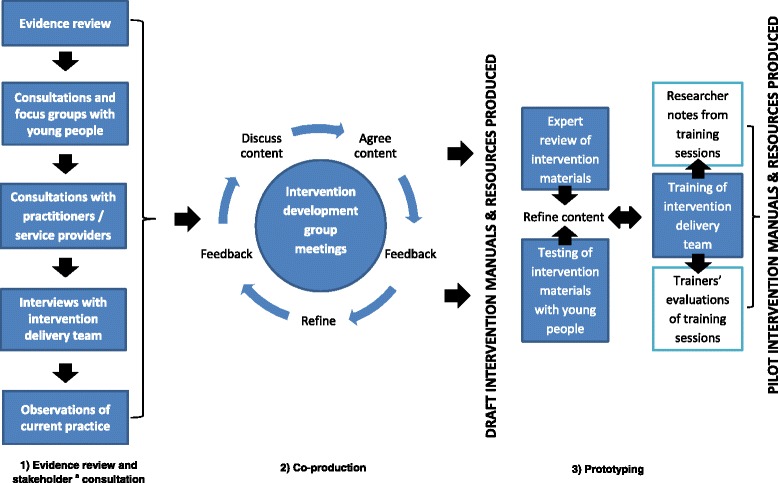
BACKGROUND: Existing guidance for developing public health interventions does not provide information for researchers about how to work with intervention providers to co-produce and prototype the content and delivery of new interventions prior to evaluation. The ASSIST + Frank study aimed to adapt an existing effective peer-led smoking prevention intervention (ASSIST), integrating new content from the UK drug education resource Talk to Frank ( www.talktofrank.com ) to co-produce two new school-based peer-led drug prevention interventions. A three-stage framework was tested to adapt and develop intervention content and delivery methods in collaboration with key stakeholders to facilitate implementation. METHODS: The three stages of the framework were: 1) Evidence review and stakeholder consultation; 2) Co-production; 3) Prototyping. During stage 1, six focus groups, 12 consultations, five interviews, and nine observations of intervention delivery were conducted with key stakeholders (e.g. Public Health Wales [PHW] ASSIST delivery team, teachers, school students, health professionals). During stage 2, an intervention development group consisting of members of the research team and the PHW ASSIST delivery team was established to adapt existing, and co-produce new, intervention activities. In stage 3, intervention training and content were iteratively prototyped using process data on fidelity and acceptability to key stakeholders. Stages 2 and 3 took the form of an action-research process involving a series of face-to-face meetings, email exchanges, observations, and training sessions. RESULTS: Utilising the three-stage framework, we co-produced and tested intervention content and delivery methods for the two interventions over a period of 18 months involving external partners. New and adapted intervention activities, as well as refinements in content, the format of delivery, timing and sequencing of activities, and training manuals resulted from this process. The involvement of intervention delivery staff, participants and teachers shaped the content and format of the interventions, as well as supporting rapid prototyping in context at the final stage. CONCLUSIONS: This three-stage framework extends current guidance on intervention development by providing step-by-step instructions for co-producing and prototyping an intervention's content and delivery processes prior to piloting and formal evaluation. This framework enhances existing guidance and could be transferred to co-produce and prototype other public health interventions. TRIAL REGISTRATION: ISRCTN14415936 , registered retrospectively on 05 November 2014.
Overview
CoChat Summary
## TL;DR
This paper presents a three-stage framework for co-producing and prototyping public health interventions, illustrated through the development of two school-based peer-led drug prevention interventions adapted from ASSIST. Over 18 months and 42 activities, stakeholder input led to new and adapted content, delivery refinements, and training/manual changes before piloting.
## Key findings
- The framework was applied over 18 months and included 42 activities.
- Stage 1 consultations involved 6 focus groups with 47 young people aged 13–15, 12 consultations, 5 interviews with the ASSIST delivery team, and 9 observations of intervention delivery.
- The process produced new and adapted intervention activities plus refinements to content, delivery format, timing, sequencing, and training manuals.
- Final observations showed delivery deviations remained: across the +Frank intervention, 5 of 15 activities were delivered in full, 8 had minor deviations, and 2 were not delivered; across Frank friends, 13 of 25 were delivered in full, 9 had minor deviations, and 3 were not delivered.
## Methods
- The study used a three-stage, multi-method framework: evidence review and stakeholder consultation, co-production, and prototyping.
- Stakeholders included the PHW ASSIST delivery team, secondary school students, and health professionals working with drug agencies or young people.
- Analysis in stage 1 used thematic analysis of focus groups/interviews, plus synthesis of observations and consultation notes to inform later co-production and prototyping.
## Limitations
- The paper states that co-production is time-consuming, can involve competing priorities and interdisciplinary conflict, and may be hard to sustain for stakeholders without the same flexibility as the PHW ASSIST team.
- The framework’s transferability may be limited because it was used to adapt an existing intervention with a strong evidence base and an experienced delivery team; the paper says these conditions “may have contributed” to success.
- Evident from the text: the framework was developed and tested in a single case study, so the paper does not provide comparative evidence that it works equally well in other settings or for other interventions.
Model-written summary. Check it against the paper before relying on it.
Integrity signals
Registry
Cites
Statistics
Figures
Verification
Claims the paper makes
7 Valid · 2 Not valid · 16 Not checked · 55 Own results and interpretations
The cited sources support only part of this claim — read each source’s verdict below.
In the paper
“Existing guidance for developing public health interventions does not provide information for researchers about how to work with intervention providers to co-produce and prototype the content and delivery of new interventions prior to evaluation.”
- Also stated in: § Background · plain
“These guidelines support development of a theoretical rationale for an intervention, but provide scant pragmatic instruction on how to develop intervention materials and delivery methods.”
§ Development of a framework for the co-production and prototyping of public health interventions > Abstract > Background
What the sources say
- Not checked yetcites [1] Conrad KJ Randolph FL Kirby MW Jr Bebout RR Creating and using logic models: four perspectives Alcoholism Treat Q 1999 17 1–2 17 31 10.1300/J020v17n01_02 source
- Not checked yetcites [2] Hardeman W Sutton S Griffin S Johnston M White A Wareham NJ Kinmonth AL A causal modelling approach to the development of theory-based behaviour change programmes for trial evaluation Health Educ Res 2005 20 6 676 687 10.1093/her/cyh022 15781446 source
- Could not verifycites [3] Collins LM Murphy SA Strecher V The multistage optimization strategy (MOST) and the sequential multiple assignment randomized trial (SMART): new methods for more potent eHealth interventions Am J of Prev Med 2007 32 5 S112 S118 10.1016/j.amepre.2007.01.022 17466815 PMC2062525 sourceExperimental — accuracy not yet measured
The MOST discussion (indexed as Abstract; page unavailable) critiques the traditional intervention–RCT cycle and assumes that initial pilot testing has already been completed. It does not assess whether existing guidance explains how researchers should work with intervention providers to co-produce or prototype interventions; searches for provider collaboration and pre-evaluation development guidance found no such passage. (LLM, conf=0.76)
- Not checked yetcites [4] NICE. Behaviour Change: The principles for effective interventions. NICE Public Health Guidance 6. National Institute for Health and Clinical Excellence; 2007.
- Not checked yetcites [5] Bartholomew LK Parcel GS Kok G Gottlieb NH Planning health promotion programs: an intervention mapping approach 2011 New Jersey John Wiley & Sons
- Partly supportedcites [6] French SD Green SE O’Connor DA McKenzie JE Francis JJ Michie S Developing theory-informed behaviour change interventions to implement evidence into practice: a systematic approach using the theoretical domains framework Implement Sci 2012 7 1 38 10.1186/1748-5908-7-38 22531013 PMC3443064 sourceExperimental — accuracy not yet measured
The Background (page not available in our copy) says MRC guidance offers a general approach to developing complex interventions but lacks detailed guidance on how to do so. It does not specifically say that existing guidance lacks instructions for working with intervention providers to co-produce and prototype content and delivery before evaluation. (LLM, conf=0.84)
- Partly supportedcites [7] De Silva MJ Breuer E Lee L Asher L Chowdhary N Lund C Theory of change: a theory-driven approach to enhance the Medical Research Council’s framework for complex interventions Trials 2014 15 1 267 10.1186/1745-6215-15-267 24996765 PMC4227087 sourceExperimental — accuracy not yet measured
The Background (page unavailable) says the MRC framework does not provide guidance on incorporating theory-driven approaches into intervention design and evaluation. The Discussion and RISE case study describe stakeholder workshops shaping intervention content and delivery before evaluation. The paper does not say that existing guidance lacks instructions specifically for working with intervention providers to co-produce and prototype interventions. (LLM, conf=0.82)
- Partly supportedcites [8] Wight D Wimbush E Jepson R Doi L Six steps in quality intervention development (6SQuID) J Epidemiol Community Health 2016 70 520 525 10.1136/jech-2015-205952 26573236 PMC4853546 sourceExperimental — accuracy not yet measured
The Introduction says existing frameworks provide little specific detail on intervention development, and its table identifies limited detail in several frameworks. The paper also advocates co-production with practitioners and small-scale testing of intervention content and delivery. It does not establish the stronger claim that existing guidance provides no information on how to do those things with intervention providers. (LLM, conf=0.84)
- Partly supportedcites [9] Michie S van Stralen MM West R The behaviour change wheel: a new method for characterising and designing behaviour change interventions Implement Sci 2011 6 42 10.1186/1748-5908-6-42 21513547 PMC3096582 sourceExperimental — accuracy not yet measured
The Background (page unavailable) says that UK Medical Research Council guidance does not specify how to select and apply theory, supporting a general concern about gaps in intervention-development guidance. It does not say that existing guidance lacks instructions for working with intervention providers to co-produce and prototype content and delivery before evaluation. (LLM, conf=0.76)
- Not checked yetcites [10] CORE Group Designing for behaviour change framework 2008 Washington CORE Group and USAID
plain- Asserted: passes — The authors put it forward as true.
- Checkable: passes — It can be checked against evidence.
- Load-bearing: passes — The paper’s conclusions depend on it.
- Based: passes — The paper gives a reason why it holds.
- Also stated in: § Background · plain
Every source the paper cites for this claim was checked and supports it.
In the paper
“ASSIST is a school-based peer-led intervention that has been shown to be effective in reducing the uptake of smoking in UK secondary schools [21].”
§ Development of a framework for the co-production and prototyping of public health interventions > Background > Case study: ASSIST + Frank intervention development study
What the sources say
- Supportedcites [21] Campbell R Starkey F Holliday J Audrey S Bloor M Parry-Langdon N An informal school-based peer-led intervention for smoking prevention in adolescence (ASSIST): a cluster randomised trial Lancet 2008 371 9624 1595 1602 10.1016/S0140-6736(08)60692-3 18468543 PMC2387195 source
The Discussion states directly that 'the ASSIST training programme was effective in achievement of a sustained reduction in uptake of regular smoking in adolescents for 2 years after its delivery', and the Abstract/Methods confirm this was a peer-led intervention delivered in 59 secondary schools in England and Wales (UK) among 10 730 students aged 12–13. The Abstract Findings report the supporting estimates (OR 0·75 immediately post-intervention, 0·77 at 1 year, and 0·78 [0·64–0·96] in the three-tier model pooling all three follow-ups), with the 2-year estimate alone not statistically significant (0·85, 0·72–1·01; p=0·067) — a nuance the citing sentence's blanket 'effective' glosses over, but the paper itself characterises the intervention as effective. (LLM, conf=0.90)
plainstates a cause- Asserted: passes — The authors put it forward as true.
- Checkable: passes — It can be checked against evidence.
- Load-bearing: passes — The paper’s conclusions depend on it.
- Based: passes — The paper gives a reason why it holds.
- Supported
The cited sources support only part of this claim — read each source’s verdict below.
In the paper
“In contrast, studies of the implementation and effectiveness of peer-led drug prevention interventions report mixed evidence [25–27].”
§ Development of a framework for the co-production and prototyping of public health interventions > Background > Case study: ASSIST + Frank intervention development study
What the sources say
- Partly supportedcites [25] MacArthur GJ Harrison S Caldwell DM Hickman M Campbell R Peer-led interventions to prevent tobacco, alcohol and/or drug use among young people aged 11–21 years: a systematic review and meta-analysis Addiction 2015 111 391 407 PMC4833174 26518976 sourceExperimental — accuracy not yet measured
The Adverse effects section reports generally favorable pooled effects but increased substance use in some higher-risk groups, supporting a mixed picture of effectiveness. The Conclusions section says process evaluations are still needed to assess implementation, fidelity and reach; it does not report mixed findings about implementation. Page numbers are unavailable in our copy. (LLM, conf=0.84)
- Not checked yetcites [26] Faggiano F Vigna-Taglianti F Burkhart G Bohrn K Cuomo L Gregori D The effectiveness of a school-based substance abuse prevention program: 18-month follow-up of the EU-dap cluster randomized controlled trial Drug Alcohol Depend 2010 108 1 56 64 10.1016/j.drugalcdep.2009.11.018 20080363 source
- Supportedcites [27] Valente TW Ritt-Olson A Stacy A Unger JB Okamoto J Sussman S Peer acceleration: effects of a social network tailored substance abuse prevention program among high-risk adolescents Addiction 2007 102 11 1804 1815 10.1111/j.1360-0443.2007.01992.x 17784893 source
The Discussion reports mixed effects in this peer-interactive substance-use prevention study: students with few substance-using peers benefited, while those with substance-using peers were more likely to be influenced negatively. This supports the cited sentence’s characterization of mixed evidence, without implying that this single paper establishes the results of every peer-led intervention. (LLM, conf=0.88)
plain- Asserted: passes — The authors put it forward as true.
- Checkable: passes — It can be checked against evidence.
- Load-bearing: passes — The paper’s conclusions depend on it.
- Based: passes — The paper gives a reason why it holds.
- Partly supported
The cited sources support only part of this claim — read each source’s verdict below.
In the paper
“It complements other intervention development guidance by providing more detail on the process of the early stages of intervention development and co-production that receives limited attention in existing guidance on intervention development [1–12].”
§ Development of a framework for the co-production and prototyping of public health interventions > Conclusions
What the sources say
- Not checked yetcites [1] Conrad KJ Randolph FL Kirby MW Jr Bebout RR Creating and using logic models: four perspectives Alcoholism Treat Q 1999 17 1–2 17 31 10.1300/J020v17n01_02 source
- Not checked yetcites [2] Hardeman W Sutton S Griffin S Johnston M White A Wareham NJ Kinmonth AL A causal modelling approach to the development of theory-based behaviour change programmes for trial evaluation Health Educ Res 2005 20 6 676 687 10.1093/her/cyh022 15781446 source
- Partly supportedcites [3] Collins LM Murphy SA Strecher V The multistage optimization strategy (MOST) and the sequential multiple assignment randomized trial (SMART): new methods for more potent eHealth interventions Am J of Prev Med 2007 32 5 S112 S118 10.1016/j.amepre.2007.01.022 17466815 PMC2062525 sourceExperimental — accuracy not yet measured
The paper’s discussion of MOST’s screening and refining phases (indexed as Abstract; page unavailable) provides detail on developing and optimizing intervention components before a confirmatory trial. It contrasts that process with a traditional intervention-development approach, but does not address co-production or establish that existing guidance gives it limited attention. (LLM, conf=0.79)
- Not checked yetcites [4] NICE. Behaviour Change: The principles for effective interventions. NICE Public Health Guidance 6. National Institute for Health and Clinical Excellence; 2007.
- Not checked yetcites [5] Bartholomew LK Parcel GS Kok G Gottlieb NH Planning health promotion programs: an intervention mapping approach 2011 New Jersey John Wiley & Sons
- Partly supportedcites [6] French SD Green SE O’Connor DA McKenzie JE Francis JJ Michie S Developing theory-informed behaviour change interventions to implement evidence into practice: a systematic approach using the theoretical domains framework Implement Sci 2012 7 1 38 10.1186/1748-5908-7-38 22531013 PMC3443064 sourceExperimental — accuracy not yet measured
The Background (page unavailable) says existing MRC guidance offers a general approach but lacks detail on how to develop an implementation intervention; the paper then outlines a four-step method. This supports the claim about more detailed development guidance, but the passages do not establish that the method addresses co-production. (LLM, conf=0.85)
- Partly supportedcites [7] De Silva MJ Breuer E Lee L Asher L Chowdhary N Lund C Theory of change: a theory-driven approach to enhance the Medical Research Council’s framework for complex interventions Trials 2014 15 1 267 10.1186/1745-6215-15-267 24996765 PMC4227087 sourceExperimental — accuracy not yet measured
The Background says the MRC framework offers little practical guidance on incorporating theory, and the Discussion describes Theory of Change as a way to involve stakeholders in initial intervention design. The paper therefore supports a gap in existing guidance and a participatory approach to early development, but it does not establish that the citing paper’s framework provides the claimed additional detail on co-production. (LLM, conf=0.82)
- Partly supportedcites [8] Wight D Wimbush E Jepson R Doi L Six steps in quality intervention development (6SQuID) J Epidemiol Community Health 2016 70 520 525 10.1136/jech-2015-205952 26573236 PMC4853546 sourceExperimental — accuracy not yet measured
The Introduction says existing frameworks offer little specific detail on intervention development and presents 6SQuID as a pragmatic six-step guide. It also recommends co-production and explains its benefits, but does not provide comparable detail on the process of co-production or establish that existing guidance gives it limited attention. Page numbers are unavailable in our copy. (LLM, conf=0.84)
- Partly supportedcites [9] Michie S van Stralen MM West R The behaviour change wheel: a new method for characterising and designing behaviour change interventions Implement Sci 2011 6 42 10.1186/1748-5908-6-42 21513547 PMC3096582 sourceExperimental — accuracy not yet measured
The Background identifies this paper as guidance for designing behaviour-change interventions and says it examines the first part of the design process. That supports citing it as existing intervention-development guidance, but our copy does not establish that such guidance gives limited attention to co-production or to the early-stage process described in the citing sentence. (LLM, conf=0.83)
- Not checked yetcites [10] CORE Group Designing for behaviour change framework 2008 Washington CORE Group and USAID
plain- Asserted: passes — The authors put it forward as true.
- Checkable: passes — It can be checked against evidence.
- Load-bearing: passes — The paper’s conclusions depend on it.
- Based: passes — The paper gives a reason why it holds.
The cited sources support only part of this claim — read each source’s verdict below.
In the paper
“This is complementary to existing intervention development guidelines which provide information about the use of mapping techniques [1, 5, 7, 10], intervention theory development [2, 6, 9] and testing [3, 8].”
§ Development of a framework for the co-production and prototyping of public health interventions > Discussion
What the sources say
- Not checked yetcites [1] Conrad KJ Randolph FL Kirby MW Jr Bebout RR Creating and using logic models: four perspectives Alcoholism Treat Q 1999 17 1–2 17 31 10.1300/J020v17n01_02 source
- Not checked yetcites [5] Bartholomew LK Parcel GS Kok G Gottlieb NH Planning health promotion programs: an intervention mapping approach 2011 New Jersey John Wiley & Sons
- Supportedcites [7] De Silva MJ Breuer E Lee L Asher L Chowdhary N Lund C Theory of change: a theory-driven approach to enhance the Medical Research Council’s framework for complex interventions Trials 2014 15 1 267 10.1186/1745-6215-15-267 24996765 PMC4227087 source
The Background describes this paper as a guide to constructing a Theory of Change and integrating it into the design and evaluation of complex interventions. The Results section explains how stakeholders develop a map of causal pathways and articulate the evidence behind them. This supports citing it as guidance on intervention theory development; the citing authors’ statement that their framework is complementary is their own framing. (LLM, conf=0.90)
- Not checked yetcites [10] CORE Group Designing for behaviour change framework 2008 Washington CORE Group and USAID
- Not checked yetcites [2] Hardeman W Sutton S Griffin S Johnston M White A Wareham NJ Kinmonth AL A causal modelling approach to the development of theory-based behaviour change programmes for trial evaluation Health Educ Res 2005 20 6 676 687 10.1093/her/cyh022 15781446 source
- Supportedcites [6] French SD Green SE O’Connor DA McKenzie JE Francis JJ Michie S Developing theory-informed behaviour change interventions to implement evidence into practice: a systematic approach using the theoretical domains framework Implement Sci 2012 7 1 38 10.1186/1748-5908-7-38 22531013 PMC3443064 source
Citation [10] is attached to the claim about mapping techniques, not the separately cited claims about intervention theory development or testing. The Results section describes how the authors mapped barriers to theoretical domains and used that mapping to select behaviour change techniques; the Discussion’s ‘Potential limitations’ section also calls this matrix mapping. (LLM, conf=0.92)
- Partly supportedcites [9] Michie S van Stralen MM West R The behaviour change wheel: a new method for characterising and designing behaviour change interventions Implement Sci 2011 6 42 10.1186/1748-5908-6-42 21513547 PMC3096582 sourceExperimental — accuracy not yet measured
The Background discusses intervention mapping and guidance from the UK Medical Research Council on developing and evaluating complex interventions. The Discussion distinguishes the behaviour change wheel from intervention mapping. These passages support a relationship to existing approaches, but do not establish that the framework is complementary to guidelines covering mapping techniques, intervention theory development, and testing as a group. (LLM, conf=0.78)
- Supportedcites [3] Collins LM Murphy SA Strecher V The multistage optimization strategy (MOST) and the sequential multiple assignment randomized trial (SMART): new methods for more potent eHealth interventions Am J of Prev Med 2007 32 5 S112 S118 10.1016/j.amepre.2007.01.022 17466815 PMC2062525 source
The citation is attached to “testing,” rather than to mapping techniques or intervention theory development. The paper’s Abstract describes MOST as a method for building and evaluating interventions, including a confirming phase that tests the optimized intervention in a randomized trial. (LLM, conf=0.88)
- Supportedcites [8] Wight D Wimbush E Jepson R Doi L Six steps in quality intervention development (6SQuID) J Epidemiol Community Health 2016 70 520 525 10.1136/jech-2015-205952 26573236 PMC4853546 source
The Introduction says 6SQuID draws on the strengths of existing intervention-development frameworks and lists intervention mapping and guidance on developing theory. Section 5, ‘Test and refine on small scale,’ provides guidance on testing interventions and adapting them. Together, these passages support the broad description of the framework as complementary to such guidance. (LLM, conf=0.86)
plain- Asserted: passes — The authors put it forward as true.
- Checkable: passes — It can be checked against evidence.
- Load-bearing: passes — The paper’s conclusions depend on it.
- Based: passes — The paper gives a reason why it holds.
26 more claims
Create a free account to see all 80 claims and to verify the 51 references still open.
- It may state two separate claims as one. 28
- Probably not a substantial claim. 29
Citations
Cites
Rogers, E. M., Singhal, A., & Quinlan, M. M. (2019) · An Integrated Approach to Communication Theory and Research · doi:10.4324/9780203710753-35 · Cited by 37,322
Michie, S., van Stralen, M. M., & West, R. (2011) · Implementation Science · doi:10.1186/1748-5908-6-42 · Cited by 13,697 · cited 2×
“Other approaches provide more detailed guidance on: developing intervention or program theory [2, 6, 9]; using mapping techniques to inform the components required in an intervention [1, 5, 7, 10]; cycles”
MethodFereday, J., & Muir-Cochrane, E. (2006) · International Journal of Qualitative Methods · doi:10.1177/160940690600500107 · Cited by 11,829 · cited 1×
“This analysis approach has been described in detail elsewhere [30].”
MethodField Theory in Social Science: Selected Theoretical Papers.
Price, D. O., Lewin, K., & Cartwright, D. (1951) · American Sociological Review · doi:10.2307/2087618 · Cited by 3,501
Planning health promotion programs an intervention mapping approach
Bartholomew, L. K., Parcel, G. S., Kok, G., & Gottlieb, N. (2006) · Research Publications (Maastricht University) · Cited by 2,321
Developing and Evaluating Complex Interventions: New Guidance
Craig, P., Dieppe, P. A., MacIntyre, S., Michie, S., Nazareth, I., & Petticrew, M. P. (2006) · UCL Discovery (University College London) · Cited by 1,989
Planning Health Promotion Programs: An Intervention Mapping Approach
Hicking-Woodison, L. (2017) · Nursing Standard · doi:10.7748/ns.32.6.33.s38 · Cited by 1,841
The Value and Challenges of Participatory Research: Strengthening Its Practice
Cargo, M., & Mercer, S. L. (2008) · Annual Review of Public Health · doi:10.1146/annurev.publhealth.29.091307.083824 · Cited by 1,468
Field Theory in Social Science: Selected Theoretical Papers
Lewin, K., & Cartwright, D. (1975) · Medical Entomology and Zoology · Cited by 1,417
French, S. D., Green, S. E., O’Connor, D. A., McKenzie, J. E., Francis, J. J., Michie, S., Buchbinder, R., Schattner, P., Spike, N., & Grimshaw, J. M. (2012) · Implementation Science · doi:10.1186/1748-5908-7-38 · Cited by 1,338 · cited 2×
“Other approaches provide more detailed guidance on: developing intervention or program theory [2, 6, 9]; using mapping techniques to inform the components required in an intervention [1, 5, 7, 10]; cycles”
Research works printed but not linked: 1
- CORE Group Designing for behaviour change framework 2008 Washington CORE Group and USAID
Cited by
Taxonomy of approaches to developing interventions to improve health: a systematic methods overview
O’Cathain, A., Croot, L., Sworn, K., Duncan, E., Rousseau, N., Turner, K., Yardley, L., & Hoddinott, P. (2019) · Pilot and Feasibility Studies · doi:10.1186/s40814-019-0425-6 · Cited by 576
“formal data extraction and were not included [10, 37].”
BackgroundSkivington, K., Matthews, L., Simpson, S. A., Craig, P., Baird, J., Blazeby, J. M., Boyd, K. A., Craig, N., French, D. P., McIntosh, E., et al. (2021) · Health Technology Assessment · doi:10.3310/hta25570 · Cited by 522
Self-citationAdapting interventions to new contexts—The ADAPT guidance
Moore, G., Campbell, M., Copeland, L., Craig, P., Movsisyan, A., Hoddinott, P., Littlecott, H., O’Cathain, A., Pfadenhauer, L., Rehfuess, E., et al. (2021) · BMJ · doi:10.1136/bmj.n1679 · Cited by 511
Moore, G. F., Evans, R. E., Hawkins, J., Littlecott, H., Melendez-Torres, G. J., Bonell, C., & Murphy, S. (2019) · Evaluation · doi:10.1177/1356389018803219 · Cited by 471
“Co-production has been central to newer case study exemplars of the development and optimization of interventions within school systems (Hawkins et al., 2017).”
BackgroundMethodSelf-citationCraig, P., Di Ruggiero, E., Frohlich, K. L., Mykhalovskiy, E., White, M., on behalf of the Canadian Institutes of Health Research (CIHR)–National Institute for Health Research (NIHR) Context Guidance Authors Group (listed alphabetically), Campbell, R., Cummins, S., Edwards, N., Hunt, K., et al. (2018) · doi:10.3310/cihr-nihr-01 · Cited by 370
Self-citationPractitioner review: Co‐design of digital mental health technologies with children and young people
Bevan Jones, R., Stallard, P., Agha, S. S., Rice, S., Werner‐Seidler, A., Stasiak, K., Kahn, J., Simpson, S. A., Alvarez‐Jimenez, M., Rice, F., et al. (2020) · Journal of Child Psychology and Psychiatry · doi:10.1111/jcpp.13258 · Cited by 317
“A central need for co-design in the context of complex interventions is to understand the interaction of the technology within the complex psycho-social system within which it attempts to enact change (Craig et al., 2008; Hawkins et al., 2017).”
BackgroundAdolescent Mental Health Program Components and Behavior Risk Reduction: A Meta-analysis
Skeen, S., Laurenzi, C. A., Gordon, S. L., du Toit, S., Tomlinson, M., Dua, T., Fleischmann, A., Kohl, K., Ross, D., Servili, C., et al. (2019) · Pediatrics · doi:10.1542/peds.2018-3488 · Cited by 171
Co-production in health policy and management: a comprehensive bibliometric review
Fusco, F., Marsilio, M., & Guglielmetti, C. (2020) · BMC Health Services Research · doi:10.1186/s12913-020-05241-2 · Cited by 178
Pérez Jolles, M., Willging, C. E., Stadnick, N. A., Crable, E. L., Lengnick-Hall, R., Hawkins, J., & Aarons, G. A. (2022) · Frontiers in Health Services · doi:10.3389/frhs.2022.942658 · Cited by 116
“We need to embrace rather than eschew the tensions possibly arising through co-creation (38), as they likely comprise a source of creativity and new ideas to plan for successful implementation.”
Self-citationPearce, T., Maple, M. J., Shakeshaft, A. P., Wayland, S., & McKay, K. (2020) · International Journal of Environmental Research and Public Health · doi:10.3390/ijerph17072229 · Cited by 149
“Public Health 2020, 17, 2229 11 of 19 Co-Creation [47] Jamin[47] 1 Co-Design [56],[50] De Jans[56], Westhorp[50] 2 Co-Evaluation [41] [60] Sicilia[60];Agrawal & Rahman[41] 2 Co-Management [82] Anderl[82] 1 Co-Production [61] [63,64] [42] Hawkins[63]; Strokosch & Osborne[61];Van Damme[64];Podgórniak- Krzykacz[42] 4 Co-…”
InfluentialMessiha, K., Chinapaw, M. J. M., Ket, J. C. F., An, Q., Anand-Kumar, V., Longworth, G. R., CHASTIN, S. F. M., & Altenburg, T. M. (2023) · Journal of Public Health · doi:10.1093/pubmed/fdad046 · Cited by 133
“Whilst the most extensively cited guidance posits that public health intervention development must be underpinned by theory and an evidence base, 3 understanding the different theories about the application of co-creation approaches, 17,18 across all initiative phases, is key.”
Designing the Future of Children’s Mental Health Services
Lyon, A. R., Dopp, A. R., Brewer, S. K., Kientz, J. A., & Munson, S. A. (2020) · Administration and Policy in Mental Health and Mental Health Services Research · doi:10.1007/s10488-020-01038-x · Cited by 115
Reed, H., Couturiaux, D., Davis, M., Edwards, A., Janes, E. H., Kim, H. S., Meléndez‐Torres, G. J., Murphy, S., Rotevatn, T. A., Smith, J. L., et al. (2020) · Prevention Science · doi:10.1007/s11121-020-01182-8 · Cited by 100
Self-citationBlake, H., Knight, H., Jia, R., Corner, J. L., Morling, J. R., Denning, C. N., Ball, J. K., Bolton, K. J., Figueredo, G. P., Morris, D. E., et al. (2021) · International Journal of Environmental Research and Public Health · doi:10.3390/ijerph18084182 · Cited by 95
“Ideally, messages for students would be co-created with students [43], since it is well-established that young people are often more heavily influenced by their peers than by other age groups and are more likely to heed advice from those in similar age groups.”
BackgroundPreventing mental health conditions in adolescents living with HIV: an urgent need for evidence
Laurenzi, C. A., Skeen, S., Gordon, S. L., Akin-Olugbade, O., Abrahams, N., Bradshaw, M., Brand, A., Toit, S. D., Meléndez‐Torres, G. J., Tomlinson, M., et al. (2020) · Journal of the International AIDS Society · doi:10.1002/jia2.25556 · Cited by 80
“Co-production strategies, such as adolescent advisory boards, allow adolescents to drive how content is delivered and what messages are emphasised [45,46].”
BackgroundMcGill, B., Corbett, L., Grunseit, A. C., Irving, M. J., & O'Hara, B. J. (2022) · Healthcare · doi:10.3390/healthcare10040647 · Cited by 81
“Two studies provided an explicit definition of co-production [33, 37], eight described the process by which co-production was used to develop or evaluated their intervention [13,28,29,32,34,35,52,90], and six did not provide details on what they meant by co-production [25,31,62,88,89,94].”
BackgroundMethodInfluentialConsolidated guidance for behavioral intervention pilot and feasibility studies
Pfledderer, C. D., von Klinggraeff, L., Burkart, S. A., Bandeira, A. D. S., Lubans, D. R., Jago, R., Okely, A. D., van Sluijs, E. M. F., Ioannidis, J. P. A., Thrasher, J. F., et al. (2024) · Pilot and Feasibility Studies · doi:10.1186/s40814-024-01485-5 · Cited by 74
“Definition Stakeholder engagement and co-production refers to the use of partnerships with individuals, communities, and service providers to aid in the development and implementation of an intervention [58].”
BackgroundPhysical education in a post-COVID world: A blended-gamified approach
Blain, D., Standage, M., & Curran, T. (2022) · European Physical Education Review · doi:10.1177/1356336x221080372 · Cited by 74
“Additionally, given the novel nature of blended-gamified approaches in PE, a thorough development phase that includes stakeholder consultation, co-production of the intervention manuals and resources and prototyping of intervention material with end users is considered important (Hawkins et al., 2017).”
BackgroundPollak, I., Stiehl, K. A. M., Birchwood, J., Schrank, B., Zechner, K. A., Wiesner, C., & Woodcock, K. A. (2023) · Journal of Youth and Adolescence · doi:10.1007/s10964-023-01871-x · Cited by 72
“It was iteratively re fi ned during a participatory development process, following intervention development guidelines (Craig et al., 2019; Hagen et al., 2012; Hawkins et al., 2017; Skivington et al., 2021).”
MethodChinsen, A., Berg, A., Nielsen, S., Trewella, K., Cronin, T. J., Pace, C. C., Pang, K. C., & Tollit, M. A. (2025) · The Lancet Child & Adolescent Health · doi:10.1016/s2352-4642(25)00063-x · Cited by 67
Schults, J. A., Kleidon, T. M., Gibson, V., Ware, R. S., Monteagle, E., Paterson, R., Charles, K., Keys, A., McBride, C. A., McTaggart, S., et al. (2022) · BMC Health Services Research · doi:10.1186/s12913-022-07605-2 · Cited by 49
“Additionally, the instrument development was underpinned by the co-production framework [19] and develop iteratively which allowed for constant adaption and improvement based on key stakeholder requirements.”
MethodBuelo, A., Kirk, A. F., Lindsay, R. S., & Jepson, R. G. (2019) · Preventive Medicine Reports · doi:10.1016/j.pmedr.2019.100877 · Cited by 55
“Co-production is an increasingly popular methodology that involves research participants being active members of the research process (Hawkins et al., 2017) and could help to close this gap between perceptions and interventions.”
BackgroundStakeholders’ experiences of the public health research process: time to change the system?
Laird, Y., Manner, J., Baldwin, L., Hunter, R. F., McAteer, J., Rodgers, S., Williamson, C., & Jepson, R. G. (2020) · Health Research Policy and Systems · doi:10.1186/s12961-020-00599-5 · Cited by 56
Murphy, K., Berk, J., Muhwava, L. S., Booley, S., Harbron, J., Ware, L. J., Norris, S. A., Zarowsky, C., Lambert, E. V., & Levitt, N. S. (2023) · BMC Public Health · doi:10.1186/s12889-023-15586-y · Cited by 55
Murphy, S., Littlecott, H., Hewitt, G., MacDonald, S., Roberts, J., Bishop, J., Roberts, C., Thurston, R., Bishop, A., Moore, L., et al. (2018) · Prevention Science · doi:10.1007/s11121-018-0969-3 · Cited by 57
Self-citationO’Dea, Á., Stanley, M. J., Coote, S. B., & Robinson, K. (2021) · PLoS ONE · doi:10.1371/journal.pone.0245738 · Cited by 53
“Guidelines on co-producing research with young people exist and can provide a framework to support the inclusion of children and young people’s voices throughout the research process [89, 90].”
BackgroundBoateng, M. A., Agyei-Baffour, E., Angel, S., Asare, O., Prempeh, B., & Enemark, U. (2021) · Research Involvement and Engagement · doi:10.1186/s40900-021-00302-0 · Cited by 51
Hagen, B. N. M., Harper, S. L., O’Sullivan, T. L., & Jones-Bitton, A. (2020) · International Journal of Environmental Research and Public Health · doi:10.3390/ijerph17113807 · Cited by 40
“When consulting our stakeholders for the development of “In the Know”, as suggested in the stage one framework for intervention co-production and prototyping [18], they agreed that frontline agricultural workers (e.”
BackgroundInfluentialMaindal, H. T., Timm, A., Dahl‐Petersen, I. K., Davidsen, E., Hillersdal, L., Jensen, N. H., Thøgersen, M., Jensen, D. M., Ovesen, P., Damm, P., et al. (2021) · BMC Public Health · doi:10.1186/s12889-021-11655-2 · Cited by 46
Henshall, C. L., Taylor, B., Goodwin, L. D., Farré, A., Jones, M. E., & Kenyon, S. L. (2018) · Midwifery · doi:10.1016/j.midw.2018.01.016 · Cited by 43
“As seen in previous public health intervention research (Hawkins et al., 2017), coproduction created a sense of ownership and buy-in of the intervention.”
BackgroundResultHanson, C. L., Oliver, E. J., Dodd-Reynolds, C. J., & Allin, L. J. (2019) · BMJ Open · doi:10.1136/bmjopen-2018-024370 · Cited by 48
Mbachu, C. O., Agu, I. C., & Onwujekwe, O. E. (2020) · Health Policy and Planning · doi:10.1093/heapol/czaa130 · Cited by 47
“This poses a threat to fidelity in formal delivery if implementers are unable to adhere to intervention delivery guidance (Hawkins, 2017).”
BackgroundCash transfers and the social determinants of health: a conceptual framework
Owusu‐Addo, E., Renzaho, A. M. N., & Smith, B. J. (2018) · Health Promotion International · doi:10.1093/heapro/day079 · Cited by 44
“The stakeholder engagement phase offered the opportunity for clarifying grey areas in the framework, and the incorporation of multiple perspectives into the development of the framework as done in other studies (Hawkins et al., 2017).”
MethodOn behalf of the Face-it Study Group, Nielsen, K. K., Dahl‐Petersen, I. K., Jensen, D. M., Ovesen, P., Damm, P., Jensen, N. H., Thøgersen, M., Timm, A., Hillersdal, L., et al. (2020) · Trials · doi:10.1186/s13063-020-4062-4 · Cited by 42
Brocklehurst, P. R., Baker, S. R., & Langley, J. (2020) · Community Dentistry And Oral Epidemiology · doi:10.1111/cdoe.12570 · Cited by 38
Norris, E., Hastings, J., Marques, M. M., Finnerty, A. N., Zink, S., & Michie, S. (2021) · Journal of Biomedical Semantics · doi:10.1186/s13326-021-00240-6 · Cited by 37
Singh, L., Kanstrup, M., Depa, K., Falk, A., Lindström, V., Dahl, O., Göransson, K. E., Rudman, A., & Holmes, E. A. (2021) · JMIR Formative Research · doi:10.2196/27473 · Cited by 37
Participatory theme elicitation: open card sorting for user led qualitative data analysis
Best, P., Badham, J., McConnell, T., & Hunter, R. F. (2021) · International Journal of Social Research Methodology · doi:10.1080/13645579.2021.1876616 · Cited by 36
Wardani, J., Bos, J. J., Ramírez-Lovering, D., & Capon, A. G. (2022) · Sustainable Development · doi:10.1002/sd.2280 · Cited by 30
Verjans-Janssen, S. R. B., Gerards, S. M. P. L., Kremers, S., Vos, S. B., Jansen, M. W. J., & van Kann, D. (2020) · International Journal of Behavioral Nutrition and Physical Activity · doi:10.1186/s12966-020-01012-8 · Cited by 30
Ponsford, R., Meiksin, R., Bragg, S., Crichton, J., Emmerson, L., Tancred, T., Tilouche, N., Morgan, G. S., Gee, P., Young, H., et al. (2021) · Pilot and Feasibility Studies · doi:10.1186/s40814-020-00752-5 · Cited by 28
Self-citationNyboe, L., Lemcke, S., Møller, A. V., & Stubbs, B. (2019) · Psychiatry Research · doi:10.1016/j.psychres.2019.112556 · Cited by 30
Wray, F., Clarke, D. J., Cruice, M. N., & Förster, A. (2021) · PLoS ONE · doi:10.1371/journal.pone.0259103 · Cited by 29
“We also recognised coproduction to be a cyclical and iterative process where feedback from one meeting fed in to the next [40].”
Betsos, A., Valleriani, J., Boyd, J., & McNeil, R. (2022) · Social Science & Medicine · doi:10.1016/j.socscimed.2022.115229 · Cited by 27
Callway, R., Gouais, A. L., Bird, E. L., Chang, M., & Kidger, J. (2023) · International Journal of Environmental Research and Public Health · doi:10.3390/ijerph20054079 · Cited by 31
“As a result, the review framework is more likely to have wider application and relevance to other LPAs in England [68].”
BackgroundDavies, E., & Matley, F. (2020) · Pastoral Care in Education · doi:10.1080/02643944.2020.1713868 · Cited by 31
“Thus, our work is grounded in a co-production framework, where we seek to not only engage with, but produce materials with relevant stakeholders (Hawkins et al., 2017).”
BackgroundRobling, M. R., Lugg-Widger, F. V., Cannings-John, R. L., Sanders, J., Angel, L., Channon, S., Fitzsimmons, D. F., Hood, K., Kenkre, J. E., Moody, G., et al. (2021) · Public Health Research · doi:10.3310/phr09020 · Cited by 32
Loops and Building Blocks: a Knowledge co-Production Framework for Equitable Urban Health
Audia, C., Berkhout, F., Owusu, G., Quayyum, Z., & Agyei‐Mensah, S. (2021) · Journal of Urban Health · doi:10.1007/s11524-021-00531-4 · Cited by 28
Marwaa, M. N., Guidetti, S. G. E., Ytterberg, C., & Kristensen, H. K. (2023) · Research Involvement and Engagement · doi:10.1186/s40900-023-00472-z · Cited by 31
“The implementation and uptake of the solution may have been facilitated by structured user-involvement in all stages and having a “hands-on-focus” in the second workshop, which gave all participants the opportunity to test the written instructions and the pilot version of the apps [25, 55].”
BackgroundMcCarthy, M. J., Wicker, A., Roddy, J., Remiker, M., Roy, I., McCoy, M., Cerino, E., & Baldwin, J. (2024) · Internet Interventions · doi:10.1016/j.invent.2024.100724 · Cited by 20
“Coproduction involves an iterative process of evidence review, systematic community input, intentional stakeholder and research team discussions, and intervention testing and refinement (Hawkins et al., 2017).”
Neill, R. D., Best, P., Lloyd, K., Williamson, J., Allen, J., Badham, J., & Tully, M. A. (2021) · School Mental Health · doi:10.1007/s12310-021-09418-w · Cited by 28
Kafle, E., Brooks, C. P., Chawner, D., Foye, U., Declercq, D., & Brooks, H. L. (2023) · Frontiers in Psychology · doi:10.3389/fpsyg.2023.1161703 · Cited by 45
Duke, S., Campling, N. C., May, C. R., Lund, S., Lunt, N. T., Bartlett, G., Harris, L., Flannery, E., Connolly, M., Booth, P., et al. (2020) · BMC Palliative Care · doi:10.1186/s12904-020-00647-5 · Cited by 24
“These cycles broadly followed an intervention development process described by Hawkins and colleagues [36] consisting of: evidence review; co-production of a conceptual framework and interventional structure and process; and pilot implementation.”
MethodNeill, R. D., Lloyd, K., Best, P., Williamson, J., Allen, J., & Tully, M. A. (2022) · Current Psychology · doi:10.1007/s12144-022-03195-8 · Cited by 26
Vinogradov, R., Holden, E., Patel, M., Grigg, R., Errington, L., Araújo‐Soares, V., & Rankin, J. M. (2024) · PLoS ONE · doi:10.1371/journal.pone.0302720 · Cited by 24
Jong, S. T., Croxson, C. H. D., Foubister, C., Brown, H. E., Guell, C., Lawlor, E. R., Wells, E. K., Wilkinson, P. O., Wilson, E., van Sluijs, E. M. F., et al. (2020) · Children · doi:10.3390/children7110231 · Cited by 28
“Co-production is seen as an inclusive method of intervention development, which may be thought to take into consideration contextual concerns [51].”
Nguyen, B., Cranney, L., Bellew, W., & Thomas, M. M. (2021) · International Journal of Environmental Research and Public Health · doi:10.3390/ijerph181910346 · Cited by 28
Corder, K. L., Brown, H. E., Croxson, C. H. D., Jong, S. T., Sharp, S. J., Vignoles, A. F., Wilkinson, P. O., Wilson, E., & van Sluijs, E. M. F. (2021) · Public Health Research · doi:10.3310/phr09060 · Cited by 26
Gill, F. J., Cooper, A. L., Falconer, P., Stokes, S., & Leslie, G. D. (2021) · Australian Critical Care · doi:10.1016/j.aucc.2021.09.004 · Cited by 21
van den Berg, V., Vos, E., de Groot, R. H. M., Singh, A. S., & Chinapaw, M. J. M. (2018) · International Journal of Environmental Research and Public Health · doi:10.3390/ijerph15122713 · Cited by 22
Larsson-Lund, M., Lexell, E. M., & Nyman, A. (2021) · Scandinavian Journal of Occupational Therapy · doi:10.1080/11038128.2021.1950206 · Cited by 18
“Models for intervention development [19,20,22] can be seen as another kind of innovation model that focuses on a new service in terms of a whole intervention [14,15].”
BackgroundPaust, A., Møller, M. C. R., Bro, F., Høj, K., Christensen, L. D., & Mygind, A. (2022) · BMC Family Practice · doi:10.1186/s12875-022-01733-8 · Cited by 21
Purcell, C., McDaid, L. M., Forsyth, R., Simpson, S. A., Elliott, L., Bailey, J., Moore, L., & Mitchell, K. R. (2023) · BMC Public Health · doi:10.1186/s12889-023-15541-x · Cited by 18
“Co-production can maximise acceptability, feasibility, and sustainability, and generate ownership and buy-in [26].”
BackgroundSelf-citationBlack, D., Bates, G., Ayres, S., Bondy, K., Callway, R., Carhart, N., Coggon, J., Gibson, A., Hunt, A. S. P., & Rosenberg, G. (2023) · Sustainability Science · doi:10.1007/s11625-023-01344-x · Cited by 20
“This is frequently conceptualised as ‘co-production’, but there are a range of understandings of what co-production does or should entail and the extent to which, and how, societal actors should be included (Allan et al 2019; Beresford 2002; Durose et al 2012; Hawkins et al. 2017).”
BackgroundBest, P., McConnell, T., Davidson, G., Badham, J., & Neill, R. D. (2019) · Research Involvement and Engagement · doi:10.1186/s40900-019-0173-z · Cited by 19
Gobat, N., Littlecott, H., Williams, A., McEwan, K., Stanton, H., Robling, M. R., Rollnick, S., Murphy, S., & Evans, R. (2021) · BMC Public Health · doi:10.1186/s12889-020-10124-6 · Cited by 24
Self-citationLai, D. J., Liu, Z., Johnston, E., Dikomitis, L., D’Oliveira, T. C., & Shergill, S. S. (2024) · Critical Care · doi:10.1186/s13054-024-05089-6 · Cited by 20
“Recent guidelines from the Medical Research Council recommend complex health interventions to be co-produced and underpinned by the behavioural theory of change as it increases the effectiveness of behaviour change [49–51].”
MethodMalden, S., Hughes, A. R., Gibson, A., Bardid, F., Androutsos, O., Craemer, M. D., Μanios, Y., Summerbell, C., Cardon, G., & Reilly, J. J. (2018) · BMJ Open · doi:10.1136/bmjopen-2018-023707 · Cited by 21
“…therefore deemed necessary to involve preschool staff in the development and adaptation of ToyBox-Scotland, and a seventh preschool was recruited to assist with intervention adaptation following the principles of coproduction, 60 before the cluster RCT was undertaken in the other six preschools.”
MethodGuruge, S., Sidani, S., Man, G. C., Matsuoka, A. K., Kanthasamy, P., & Leung, E. (2021) · Journal of Migration and Health · doi:10.1016/j.jmh.2021.100059 · Cited by 18
Powerful gene-based testing by integrating long-range chromatin interactions and knockoff genotypes
Ma, S., Dalgleish, J. L. T., Lee, J., Wang, C., Liu, L., Gill, R., Buxbaum, J. D., Chung, W. K., Aschard, H., Silverman, E. K., et al. (2021) · Proceedings of the National Academy of Sciences · doi:10.1073/pnas.2105191118 · Cited by 19
Evans, R., MacDonald, S., Trubey, R., Noyes, J., Robling, M., Willis, S., Boffey, M., Wooders, C., Vinnicombe, S., & Meléndez‐Torres, G. J. (2025) · Journal of Social Work · doi:10.1177/14680173251336997 · Cited by 16
“Guidance on intervention development foregrounds the importance of theorizing interventions through co-production with local stakeholders, ensuring that it responds to their conceptualization of the problem and its determinants (Hawkins et al., 2017; O ’ Cathain et al., 2019).”
Buelo, A., Kirk, A. F., & Jepson, R. G. (2020) · Pilot and Feasibility Studies · doi:10.1186/s40814-020-00711-0 · Cited by 17
Simonsen, C. B., & Ryom, K. (2021) · Action Research · doi:10.1177/14767503211009571 · Cited by 17
“Based on this discussion, the second part of the workshop, the stage of generating ideas, took place (Hawkins et al., 2017).”
InfluentialBrighton, L. J., Tunnard, I., Farquhar, M. C., Booth, S., Miller, S., Yi, D., Gao, W., Bajwah, S., Man, W. D., Reilly, C. C., et al. (2018) · Chronic Respiratory Disease · doi:10.1177/1479973118816448 · Cited by 20
Hayward, S. E., Vanqa, N., Makanda, G., Tisile, P., Ngwatyu, L., Foster, I., Mcinziba, A., Biewer, A., Mbuyamba, R., Galloway, M., et al. (2024) · BMC Global and Public Health · doi:10.1186/s44263-024-00084-z · Cited by 18
Neill, R. D., Lloyd, K., Best, P., & Tully, M. A. (2022) · SN Social Sciences · doi:10.1007/s43545-022-00465-x · Cited by 15
“This fits well with previous research which has suggested that the best approach for intervention development is to work with key stakeholders (Hawkins et al. 2017; National Institute of Health Research 2018).”
ResultHann, M., Hayes, C. V., Lacroix-Hugues, V., Touboul-Lundgren, P., McNulty, C. A. M., Syeda, R. B., Eley, C. V., Teixeira, P., Gennimata, D., Trüninger, M., et al. (2022) · Food Control · doi:10.1016/j.foodcont.2022.109219 · Cited by 18
Owen, J., Gray‐Burrows, K. A., Eskytė, I., Wray, F., Bhatti, A., Zoltie, T., Staples, A., Giles, E., Lintin, E., West, R., et al. (2022) · BMC Public Health · doi:10.1186/s12889-022-14174-w · Cited by 23
Crowther, D., McCulloch, H., Wong, H., Mackay, R., Johnson, C., Chorney, J. M. L., Ritchie, K., Lawrence, L. M., Bishop, A., Helwig, M., et al. (2022) · Health Expectations · doi:10.1111/hex.13572 · Cited by 19
“• Competing priorities and goals between stakeholders.(33) • Researchers maintaining awareness of group dynamics.”
BackgroundRutherford, Z. H., Zwolinsky, S., Kime, N. H., & Pringle, A. (2021) · International Journal of Environmental Research and Public Health · doi:10.3390/ijerph18063327 · Cited by 14
“In summary, these results suggest that in order for programmes such as CARE to reach PLWC who are currently under represented and arguably in most need of interven‐ tion, there is a need to engage PLWC more in their co‐production [62], including strategies to promote physical activity programmes in this space.”
BackgroundSeims, A., Hall, J., Bingham, D. D., Creaser, A. V., Christoforou, A., Barber, S., & Daly-Smith, A. (2023) · PLoS ONE · doi:10.1371/journal.pone.0289831 · Cited by 15
“Co-producing interventions may enhance the feasibility, acceptability, quality, and impact of these interventions [64].”
BackgroundSteel, J., Williams, J. M., & McGeown, S. P. (2022) · Educational Research · doi:10.1080/00131881.2021.2016061 · Cited by 15
Rasmussen, L. G., Skjerning, H. T., & Burau, V. (2022) · International Journal of Sociology and Social Policy · doi:10.1108/ijssp-01-2022-0027 · Cited by 15
Kang, E., Gillespie, B. M., Tobiano, G., & Chaboyer, W. P. (2021) · Journal of Nursing Scholarship · doi:10.1111/jnu.12717 · Cited by 15
de Souza, R. C., dos Santos, J. E., dos Santos, V. T. C., Silva, A. A. F., Vasconcellos, E. A., Ambrósio, P. E., Lino, D. C. S. F., Barbosa, P. C. R., & Almeida, H. C. (2021) · Research Society and Development · doi:10.33448/rsd-v10i6.15740 · Cited by 17
Copeland, L., Littlecott, H., Couturiaux, D., Hoddinott, P., Segrott, J., Murphy, S., Moore, G. F., & Evans, R. (2022) · BMJ Open · doi:10.1136/bmjopen-2022-066451 · Cited by 14
Self-citationPollak, I., Stiehl, K. A. M., Schrank, B., Birchwood, J., Krammer, I., Mitić, M., Rogers, J. C., & Woodcock, K. A. (2023) · International Journal of Qualitative Methods · doi:10.1177/16094069231204775 · Cited by 10
“New guidelines and frameworks have been proposed for including children in research (Hawkins et al., 2017; National Institute for Health and Clinical Excellence, 2007).”
BackgroundOstojic, K., Paget, S., Martin, T., Dee-Price, B.-J. M., McIntyre, S. J., Smithers‐Sheedy, H., Mimmo, L., Burnett, H., Scott, T. R. D., Berg, A., et al. (2023) · BMJ Open · doi:10.1136/bmjopen-2022-066346 · Cited by 14
Development of a new social prescribing intervention for families of children with cerebral palsy
Ostojic, K., Karem, I., Dee-Price, B.-J. M., Paget, S., Berg, A., Burnett, H., Scott, T. R. D., Strnadová, I., Woolfenden, S. R., & EPIC‐CP Group (2024) · Developmental Medicine & Child Neurology · doi:10.1111/dmcn.16039 · Cited by 15
“The EPIC-CP programme was co-developed following a mixed-methods, co-design approach guided by the framework of Hawkins et al. 21 for intervention co-production and prototyping, and principles of participatory action research.”
Higgs, J., Styles, K., Bowyer, S., Warner, A., & Galvin, A. D. (2021) · Allergy · doi:10.1111/all.14871 · Cited by 12
van Koeveringe, J. M., Callahan, E. L., George, M., Teshome, T., Seifu, B., & Spigt, M. (2023) · Global Public Health · doi:10.1080/17441692.2023.2185798 · Cited by 12
“To develop useful and impactful interventions, researchers increasingly acknowledge the importance of stakeholder consultation through interviews and FGD (Hawkins et al., 2017).”
BackgroundFeasibility of the Strengthening Families Program for Brazilian Families: A Mixed Method Study
Murta, S. G., Vinha, L. G. D. A., Nobre-Sandoval, L. D. A., Miranda, A. A. V., de Menezes, J. C. L., & Rocha, V. P. S. (2020) · Psicologia Teoria e Pesquisa · doi:10.1590/0102.3772e36nspe16 · Cited by 12
Grimm, L. A., Bauer, G. F., & Jenny, G. J. (2020) · Frontiers in Public Health · doi:10.3389/fpubh.2020.521355 · Cited by 14
“Following rapid prototyping approaches in public health (22), we developed the prototype in three steps ( Figure 1 ), whereby the last step—the randomized controlled trial—is presented separately (see below).”
MethodGill, F. J., Cooper, A. L., Falconer, P., Stokes, S., Roberts, A., Szabo, M., & Leslie, G. D. (2024) · Pediatric Research · doi:10.1038/s41390-024-03459-y · Cited by 11
“10 Best practice is to develop interventions systematically, with the ESCALATION development process being based on Hawkins et al. 20 three-stage framework of (1) evidence review, stakeholder engagement and consultation, (2) co-production by researchers and stakeholders planning and developing the…”
Jensen, N. H., Nielsen, K. K., Dahl‐Petersen, I. K., Kampmann, U., Damm, P., Ovesen, P., Mathiesen, E. R., Vinter, C. A., Davidsen, E., Thøgersen, M., et al. (2023) · BMJ Open Diabetes Research & Care · doi:10.1136/bmjdrc-2023-003529 · Cited by 13
“Epidemiology/Health services research”
Weobong, B., Glozah, F. N., Taylor-Abdulai, H. B., Koka, E., Addae, N., Alor, S. K., Kohl, K., Banati, P., Adongo, P. B., & Ross, D. A. (2024) · PLoS ONE · doi:10.1371/journal.pone.0304465 · Cited by 11
Paust, A., Christensen, L. D., Larsen, L. L., Christensen, N. P., Kofod, F. G., Guassora, A. D., Merrild, C. H., & Hvidt, E. A. (2021) · JMIR Formative Research · doi:10.2196/27323 · Cited by 12
Timm, A., Maindal, H. T., & Hillersdal, L. (2022) · Health Promotion International · doi:10.1093/heapro/daac031 · Cited by 11
Gillespie, J., Hughes, A. R., Gibson, A., Haines, J., Taveras, E. M., & Reilly, J. J. (2019) · BMJ Open · doi:10.1136/bmjopen-2018-028038 · Cited by 11
“Therefore, the feasibility and acceptability of 4H Scotland design and components will be tested and assessed through process evaluation in the hope that it is culturally relevant and suitable to inform either a larger scale trial in keeping with the MRC Framework on developing and evaluating complex interventions(32)…”
Development of a rehabilitation programme for young adult cancer survivors using co-production
Aagesen, M., Pilegaard, M. S., Janssens, A. I. W. A., Hauken, M. A., & la Cour, K. (2024) · Research Involvement and Engagement · doi:10.1186/s40900-024-00667-y · Cited by 11
“1 The three-staged development process of the rehabilitation programme was inspired by Hawkins et al. [34] Stage 2: Co-producing name, component content, delivery methods and outcomes Stage 2 was an iterative development process involving five workshops, during which the programme’s name, component…”
Influential
Metadata
- Authors
- Hawkins, J., Madden, K., Fletcher, A., Midgley, L., Grant, A., Cox, G., Moore, L., Campbell, R., Murphy, S., Bonell, C., & White, J.
- Affiliations
- Centre for the Development and Evaluation of Complex Interventions for Public Health Improvement (GB)
- Cardiff University (GB)
- Public Health Wales (GB)
- University of Glasgow (GB)
- University of Bristol (GB)
- London School of Hygiene & Tropical Medicine (GB)
- Corresponding author
- Hawkins, Jemma
- ORCID
- Venue
- BMC Public Health
- Published
- 2017-09-04
- Volume
- 17
- Issue
- 1
- Pages
- 689-689
- ISSN
- 1471-2458 (ISSN-L)
- PMC
- PMC5583990
- OpenAlex
- W2751354153
- Semantic Scholar
- 0fd3739788ac6d814d8ccccf1ab98cb2d22c2e53
- Cited by
- 310
- References
- 32
- Citations by year
- 2026: 37 · 2025: 43 · 2024: 46 · 2023: 43 · 2022: 38 · 2021: 47 · 2020: 32 · 2019: 15 · 2018: 9
- FWCI
- 24.82
- Type
- journal article
- Language
- en
- Open access
- gold
- doi.org
- Licence
- cc-by
- Locations
- BMC Public Health (publishedVersion, cc-by)
- PubMed Central (publishedVersion, cc-by)
- PubMed (publishedVersion)
- ENLIGHTEN (Jurnal Bimbingan dan Konseling Islam) (acceptedVersion)
- ORCA Online Research @Cardiff (Cardiff University) (acceptedVersion)
- LSHTM Research Online (London School of Hygiene and Tropical Medicine) (acceptedVersion)
- Bristol Research (University of Bristol) (submittedVersion, other-oa)
- UWE Research Repository (UWE Bristol) (submittedVersion, cc-by)
- DOAJ (DOAJ: Directory of Open Access Journals) (submittedVersion, cc-by-sa)
- Minerva Access (University of Melbourne) (submittedVersion, cc-by)
- Explore Bristol Research (submittedVersion, other-oa)
- Funders
- Public Health Research Programme (12/3060/03)
- Topics
- Health Sciences › Health Professions › General Health Professions › Health Policy Implementation Science
- Health Sciences › Medicine › Epidemiology › Substance Abuse Treatment and Outcomes
- Health Sciences › Medicine › Public Health, Environmental and Occupational Health › School Health and Nursing Education
- Keywords
- co-production, ASSIST, peer-led intervention, school-based drug prevention, smoking prevention, intervention adaptation, stakeholder engagement, intervention fidelity, treatment acceptability, action research
- MeSH terms
- Smoking Prevention, Adolescent, Female, United Kingdom, Health Education, Humans, Male, Peer Group, School Health Services, Public Health Practice, Focus Groups, Models, Organizational
About these checks
Registry, retraction, Cites and statistics results are computed, not judged, with one exception: a printed reference that no index lists is read once by a model before it counts as a citation error. Claims are extracted by a model and kept only when their quote appears verbatim in the text; each cited source is then checked, with a model’s help, for whether it says what the claim relies on. Those verdicts can be wrong — read the claim’s quote and the cited source before relying on one.
The claim verdicts this report counts are experimental: their accuracy is not yet measured.
A language model drew the claims from the paper on 2026-10-11, under version 3 of the claim definition (model deepseek-v4.1-flash, prompt extract-v3).
A second model labelled each claim on 2026-10-11 (model jev-1.13-20260917, definition revision gold-guideline-v0.2).
Cited sources are checked with a language model’s help (gpt-6-sol and qwen3.8-omni-flash).
Statistics and arithmetic are recomputed, not judged.
Confidence bands are shown only for fields calibrated on our annotated test set. None is calibrated yet, so no band is shown.
What counts as a claim ›How we measure confidence ›How we check this ›
Are you an author, or do you see a problem with this page? Request a review
Data sources
Bibliographic data: Semantic Scholar, OpenAlex, Crossref.
Contains information from the Semantic Scholar Academic Graph Datasets, made available under the ODC Attribution License (ODC-BY 1.0).
Semantic Scholar’s data is described in: Kinney, R., et al. (2023). The Semantic Scholar Open Data Platform. arXiv:2301.10140.
