

Mothers In Motion intervention effect on psychosocial health in young, low-income women with overweight or obesity
Open accessThe DOI matches its Crossref record; 32 of the 33 references it cites were found in a registry or an index.
Abstract
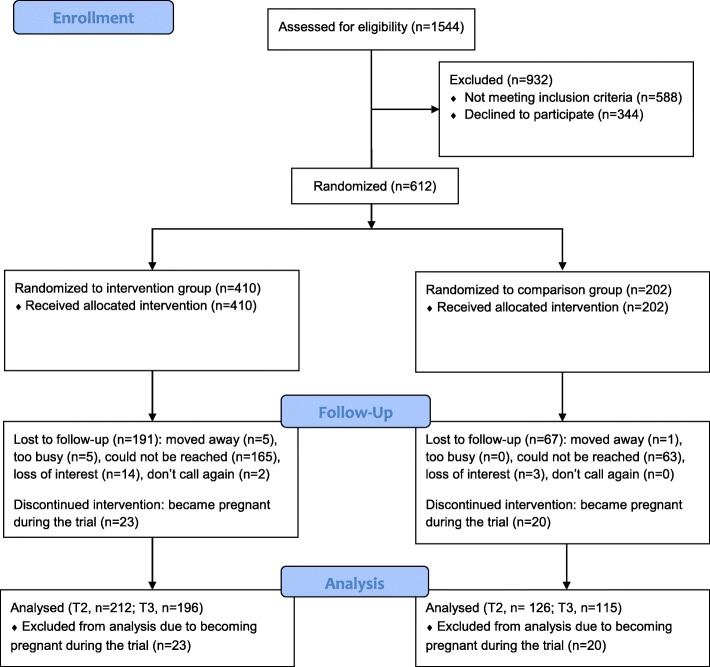
BACKGROUND: Mothers in Motion (MIM), a community-based intervention program, was designed to help young, low-income women with overweight or obesity prevent further weight gain by promoting stress management, healthy eating, and physical activity. This paper presents the MIM's intervention effect on self-efficacy to cope with stress, emotional coping response, social support for stress management, stress, depressive symptoms, and positive and negative affect. METHODS: Participants (N = 612) were recruited from the Special Supplemental Nutrition Program for Women, Infants, and Children in Michigan. They were randomly assigned to an intervention group (410 participants) or comparison group (202 participants). During the 16-week intervention, intervention participants watched ten video lessons at home and joined ten peer support group teleconferences. Surveys with established validity and reliability were used to measure self-efficacy to cope with stress, emotional coping response, and social support for stress management. The Perceived Stress Scale, Center for Epidemiologic Studies Depression Scale, and Positive and Negative Affect Scale were used to measure stress, depressive symptoms, and positive and negative affect, respectively. A general linear mixed model was applied to test the intervention effect at the end of the 16-week intervention (T2, n = 338) and at three-month follow-up (T3, n = 311). RESULTS: At T2, the intervention group reported significantly higher self-efficacy to cope with stress (effect size [Cohen's d] = 0.53), better emotional coping response (d = 0.38), less stress (d = 0.34), fewer depressive symptoms (d = - 0.27), and more positive affect (d = 0.31) than the comparison group. However, there were no significant differences in social support for stress management and negative affect between these two groups. At T3, the intervention group still reported significantly higher self-efficacy to cope with stress (d = 0.32) and better emotional coping response (d = 0.34) than the comparison group but did not report significantly higher social support for stress management, stress, depressive symptoms, and positive and negative affect. CONCLUSIONS: To help young, low-income women with overweight or obesity manage stress, researchers and program planners may consider focusing on building self-efficacy to cope with stress. TRIAL REGISTRATION: Clinical Trials NCT01839708 ; registered February 28, 2013.
Overview
The claims and statistics of this paper haven’t been checked yet.
Free: it reads the open-access text and checks the first 5 claims that cite a source we can check. Create a free account to check every claim.
Integrity signals
Registry
Cites
Statistics
Figures
Verification
Claims the paper makes
The claims and statistics of this paper haven’t been checked yet.
Free: it reads the open-access text and checks the first 5 claims that cite a source we can check. Create a free account to check every claim.
Claims other papers make about this one
Each is checked against this paper’s own text: does it say what the citing paper says it does?
The source backs part of the claim, not all of it — or backs it for a different population, condition or comparison.
In the citing paper
“The outcomes of studies conducted by Chang et al. (45), Kim et al. (47), and Young et al. (42) showed that a multidimensional approach with human feedback and support based on elements of the CBT and SCT are most effective in the treatment of depression symptoms in individuals with obesity.”
From Efficacy of eHealth interventions to reduce depression symptoms in individuals with obesity: a systematic review of randomized controlled trials (2024) · cites this paper as Chang et al. (45)
Experimental — accuracy not yet measuredThe source backs part of the claim, not all of it — or backs it for a different population, condition or comparison.
In the citing paper
“more variation in intervention content, modes of delivery and sequence of intervention messages correlated with lower post-intervention depressive scores (45).”
From Efficacy of eHealth interventions to reduce depression symptoms in individuals with obesity: a systematic review of randomized controlled trials (2024) · cites this paper as [45]
Experimental — accuracy not yet measuredThe cited source says what the claim attributes to it.
In the citing paper
“The outcomes of the study by Chang et al. (45) which included elements of the SCT in order to guide the intervention, showed that participants in the intervention group reported significant less depression symptoms than the control group.”
From Efficacy of eHealth interventions to reduce depression symptoms in individuals with obesity: a systematic review of randomized controlled trials (2024) · cites this paper as Chang et al. (45)
Self-check
Percentages, sums and reported differences re-computed from the paper’s own numbers.
The self-check needs the paper’s full text.
Citations
Cites
The CES-D Scale: A Self-Report Depression Scale for Research in the General Population
Radloff, L. S. (1977) · Applied Psychological Measurement · doi:10.1177/014662167700100306 · Cited by 53,267
A Global Measure of Perceived Stress
Cohen, S., Kamarck, T., & Mermelstein, R. (1983) · Journal of Health and Social Behavior · doi:10.2307/2136404 · Cited by 32,807
Development and validation of brief measures of positive and negative affect: The PANAS scales.
Watson, D., Clark, L. A., & Tellegen, A. (1988) · Journal of Personality and Social Psychology · doi:10.1037/0022-3514.54.6.1063 · Cited by 32,433
Health Behavior and Health Education: Theory, Research, and Practice
(1992) · Annals of Internal Medicine · doi:10.7326/0003-4819-116-4-350_1 · Cited by 13,207
How individuals, environments, and health behaviors interact: Social cognitive theory.
Perry, C. L., Baranowski, T., & Parcel, G. S. (1990) · Cited by 1,078
Emotional eating, depressive symptoms and self-reported food consumption. A population-based study.
Konttinen, H., Männistö, S., Sarlio-Lähteenkorva, S., Silventoinen, K., & Haukkala, A. (2010) · Appetite · doi:10.1016/j.appet.2010.01.014 · Cited by 546
Associations of Weight Gain From Early to Middle Adulthood With Major Health Outcomes Later in Life
Zheng, Y., Manson, J. E., Yuan, C., Liang, M. H., Grodstein, F., Stampfer, M. J., Willett, W. C., & Hu, F. B. (2017) · JAMA · doi:10.1001/jama.2017.7092 · Cited by 521
Keum, N., Greenwood, D. C., Lee, D. H., Kim, R., Aune, D., Ju, W., Hu, F. B., & Giovannucci, E. L. (2015) · JNCI: Journal of the National Cancer Institute · doi:10.1093/jnci/djv088 · Cited by 395
Chakraborty, H. (2009) · doi:10.3768/rtipress.2009.mr.0009.0903 · Cited by 298
Stress and salivary cortisol during pregnancy
Obel, C., Hedegaard, M., Henriksen, T. B., Secher, N. J., Olsen, J., & Levine, S. (2005) · Psychoneuroendocrinology · doi:10.1016/j.psyneuen.2004.11.006 · Cited by 291
Research works printed but not linked: 1
- USDA Women, infants, and children (WIC) participant and program characteristics 2014
Cited by
Berding, K., Bastiaanssen, T. F. S., Moloney, G. M., Boscaini, S., Strain, C. R., Anesi, A., Long-Smith, C., Mattivi, F., Stanton, C., Clarke, G., et al. (2023) · Molecular Psychiatry · doi:10.1038/s41380-022-01817-y · Cited by 153
“Regarding interventional studies, lifestyle approaches, some in combination with a dietary component [40, 41], and single nutrient or food supplementation [42] demonstrated reductions in perceived stress in participants, and dietary interventions have successfully reduced symptoms of depression [10], even in nonclinic…”
BackgroundThe Effect of Peer Support on Individuals with Overweight and Obesity: A Meta-Analysis
Chen, Y., Li, Z., Yang, Q., Yang, S., Dou, C., Zhang, T., & Guan, B. (2021) · Iranian Journal of Public Health · doi:10.18502/ijph.v50i12.7926 · Cited by 35
Henriksen, L., Kısa, S., Lukasse, M., Flaathen, E. M., Mortensen, B. M., Karlsen, E., & Garnweidner-Holme, L. M. (2021) · Trauma Violence & Abuse · doi:10.1177/15248380211021788 · Cited by 33
Ling, J., Zahry, N. R., & Liu, C.-C. (2021) · International Journal of Nursing Studies · doi:10.1016/j.ijnurstu.2021.103954 · Cited by 23
Sleep and weight loss in low-income overweight or obese postpartum women
Chang, M., Tan, A., Schaffir, J., & Wegener, D. T. (2019) · BMC Obesity · doi:10.1186/s40608-019-0236-6 · Cited by 10
Self-citation
Metadata
- Authors
- Chang, M.-W., Nitzke, S., & Brown, R.
- Affiliations
- The Ohio State University (US)
- University of Wisconsin–Madison (US)
- Corresponding author
- Chang, Mei-Wei
- Venue
- BMC Public Health
- Published
- 2019-01-14
- Volume
- 19
- Issue
- 1
- Pages
- 56-56
- ISSN
- 1471-2458 (ISSN-L)
- PMC
- PMC6332663
- OpenAlex
- W2946985220
- Cited by
- 19
- References
- 33
- Citations by year
- 2025: 2 · 2024: 3 · 2023: 3 · 2022: 4 · 2021: 3 · 2020: 2 · 2019: 2
- FWCI
- 2.53
- Type
- journal article
- Language
- en
- Open access
- gold
- doi.org
- Licence
- cc-by
- creativecommons.org/licenses/by/4.0/ (tdm)
- creativecommons.org/licenses/by/4.0/ (vor)
- Locations
- BMC Public Health (publishedVersion, cc-by)
- Europe PMC (PubMed Central) (publishedVersion, other-oa)
- PubMed Central (publishedVersion, cc-by)
- PubMed (publishedVersion)
- DOAJ (DOAJ: Directory of Open Access Journals) (submittedVersion)
- Funders
- National Institutes of Health (R18-DK-083934-01)
- Topics
- Health Sciences › Medicine › Public Health, Environmental and Occupational Health › Obesity, Physical Activity, Diet
- Health Sciences › Medicine › Public Health, Environmental and Occupational Health › Physical Activity and Health
- Health Sciences › Nursing › Nutrition and Dietetics › Nutrition, Health and Food Behavior
- Keywords
- young women, low-income women, overweight, obesity, stress management, emotional coping, depressive symptoms, positive affect, negative affect, social support, peer support, teleconferencing, WIC program, community-based intervention, weight gain prevention, psychosocial health, healthy eating, physical activity, stress buffering
- MeSH terms
- Adaptation, Psychological, Adult, Affect, Depression, Female, Health Promotion, Humans, Michigan, Mothers, Obesity, Poverty, Social Support, Stress, Psychological, Reproducibility of Results, Exercise, Self Efficacy, Overweight, Young Adult, Food Assistance
About these checks
Registry, retraction, Cites and statistics results are computed, not judged, with one exception: a printed reference that no index lists is read once by a model before it counts as a citation error. Claims are extracted by a model and kept only when their quote appears verbatim in the text; each cited source is then checked, with a model’s help, for whether it says what the claim relies on. Those verdicts can be wrong — read the claim’s quote and the cited source before relying on one.
Statistics and arithmetic are recomputed, not judged.
Confidence bands are shown only for fields calibrated on our annotated test set. None is calibrated yet, so no band is shown.
What counts as a claim ›How we measure confidence ›How we check this ›
Are you an author, or do you see a problem with this page? Request a review
How to cite
Cite CoChat for the checks on this page, and the paper for its own findings.
- This page
- CoChat. (2026). Citation check: Mothers In Motion intervention effect on psychosocial health in young, low-income women with overweight or obesity. https://app.cochat.ai/papers/10.1186/s12889-019-6404-2
- The paper
- Chang, M.-W., Nitzke, S., & Brown, R. (2019). Mothers In Motion intervention effect on psychosocial health in young, low-income women with overweight or obesity. BMC Public Health. https://doi.org/10.1186/s12889-019-6404-2
Data sources
Bibliographic data: Semantic Scholar, OpenAlex, Crossref.
Contains information from the Semantic Scholar Academic Graph Datasets, made available under the ODC Attribution License (ODC-BY 1.0).
Semantic Scholar’s data is described in: Kinney, R., et al. (2023). The Semantic Scholar Open Data Platform. arXiv:2301.10140.
