

Systematic review of burnout among healthcare providers in sub-Saharan Africa
Open accessThe DOI matches its Crossref record; 145 of the 145 references it cites were found in a registry or an index.
Abstract
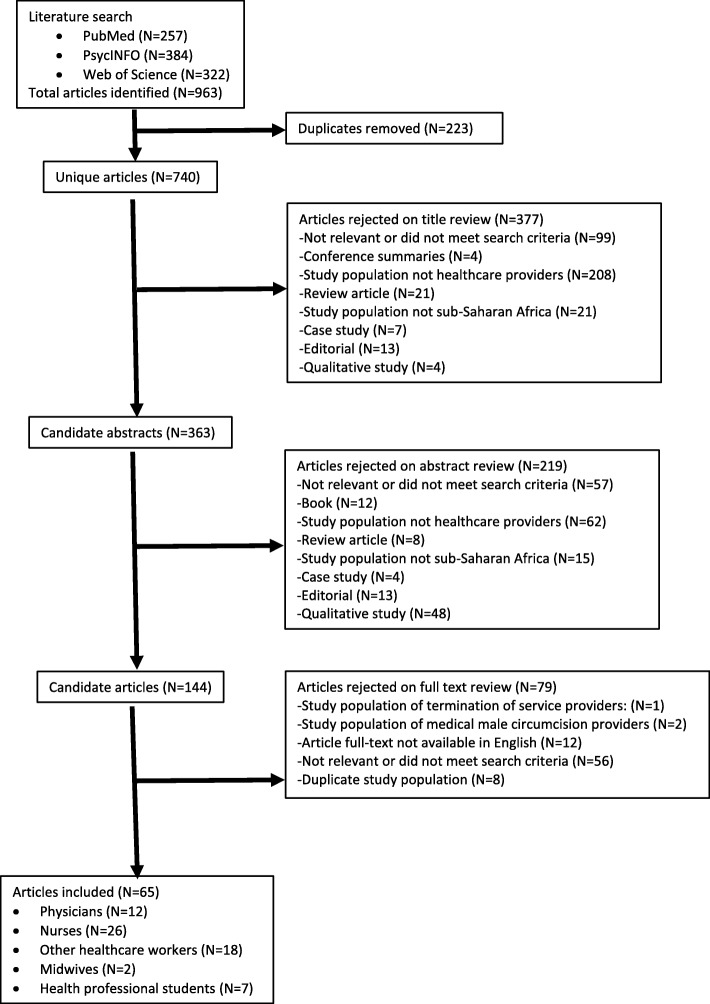
Background: Burnout is characterized by physical and emotional exhaustion from long-term exposure to emotionally demanding work. Burnout affects interpersonal skills, job performance, career satisfaction, and psychological health. However, little is known about the burden of burnout among healthcare providers in sub-Saharan Africa. Methods: Relevant articles were identified through a systematic review of PubMed, Web of Science (Thomson Reuters), and PsycINFO (EBSCO). Studies were selected for inclusion if they examined a quantitative measure of burnout among healthcare providers in sub-Saharan Africa. Results: A total of 65 articles met our inclusion criteria for this systematic review. Previous studies have examined burnout in sub-Saharan Africa among physicians ( N = 12 articles), nurses ( N = 26), combined populations of healthcare providers ( N = 18), midwives ( N = 2), and medical or nursing students ( N = 7). The majority of studies assessed burnout using the Maslach Burnout Inventory. The highest levels of burnout were reported among nurses, although all healthcare providers showed high burnout. Burnout among healthcare providers is associated with their work environments, interpersonal and professional conflicts, emotional distress, and low social support. Conclusions: Available studies on this topic are limited by several methodological challenges. More rigorously designed epidemiologic studies of burnout among healthcare providers are warranted. Health infrastructure improvements will eventually be essential, though difficult to achieve, in under-resourced settings. Programs aimed at raising awareness and coping with burnout symptoms through stress management and resilience enhancement trainings are also needed.
Overview
The claims and statistics of this paper haven’t been checked yet.
Free: it reads the open-access text and checks the first 5 claims that cite a source we can check. Create a free account to check every claim.
Integrity signals
Registry
Cites
Statistics
Figures
Verification
Claims the paper makes
The claims and statistics of this paper haven’t been checked yet.
Free: it reads the open-access text and checks the first 5 claims that cite a source we can check. Create a free account to check every claim.
Claims other papers make about this one
Each is checked against this paper’s own text: does it say what the citing paper says it does?
The source backs part of the claim, not all of it — or backs it for a different population, condition or comparison.
In the citing paper
“Collectively, the findings demonstrate that burnout management in the region is multifaceted, shaped by the interplay between organizational support, interpersonal relationships, individual burnout management strategies, and culturally grounded practices (12–14, 19).”
From Management strategies for healthcare worker burnout in Sub-Saharan Africa: an integrative review (2026) · cites this paper as [12]
Experimental — accuracy not yet measuredThe source backs part of the claim, not all of it — or backs it for a different population, condition or comparison.
In the citing paper
“These findings echo broader regional evidence that burnout in Sub-Saharan Africa is driven primarily by structural conditions rather than individual weakness (12, 38).”
From Management strategies for healthcare worker burnout in Sub-Saharan Africa: an integrative review (2026) · cites this paper as [12]
Experimental — accuracy not yet measuredThe cited source says what the claim attributes to it.
In the citing paper
“There is a striking lack of intervention studies addressing burnout within the SSA region (9, 12).”
From Management strategies for healthcare worker burnout in Sub-Saharan Africa: an integrative review (2026) · cites this paper as [12]
The cited source says what the claim attributes to it.
In the citing paper
“Intra- and inter-professional conflicts in healthcare settings have been reported elsewhere in Sub-Saharan Africa in relation to staff burnout [24], but not previously in relation to implementation of health programmes.”
From Scale-up of a novel vital signs alert device to improve maternity care in Sierra Leone: a mixed methods evaluation of adoption (2023) · cites this paper as [24]
The cited source says what the claim attributes to it.
In the citing paper
“Evidence remains scattered across small-scale studies and often lacks evaluation of effectiveness, highlighting the need for a comprehensive synthesis of available burnout management strategies in SSA (12).”
From Management strategies for healthcare worker burnout in Sub-Saharan Africa: an integrative review (2026) · cites this paper as [12]
1 more claim about this paper
Create a free account to see every claim other papers make about this one.
Self-check
Percentages, sums and reported differences re-computed from the paper’s own numbers.
The self-check needs the paper’s full text.
Citations
Cites
Preferred Reporting Items for Systematic Reviews and Meta-Analyses: the PRISMA statement
Moher, D., Liberati, A., Tetzlaff, J., Altman, D. G., & for the PRISMA Group (2009) · BMJ · doi:10.1136/bmj.b2535 · Cited by 83,823
The Cochrane Collaboration's tool for assessing risk of bias in randomised trials
Higgins, J. P. T., Altman, D. G., Gotzsche, P. C., Juni, P., Moher, D., Oxman, A. D., Savovic, J., Schulz, K. F., Weeks, L., Sterne, J. A. C., et al. (2011) · BMJ · doi:10.1136/bmj.d5928 · Cited by 33,817
Dermyshi, E., Wang, Y., Yan, C., Hong, W., Qiu, G., Gong, X., & Zhang, T. (2017) · Neonatology · doi:10.1159/000454668 · Cited by 24,451
(2014) · Medical Entomology and Zoology · Cited by 17,633
The measurement of experienced burnout
Maslach, C., & Jackson, S. E. (1981) · Journal of Organizational Behavior · doi:10.1002/job.4030020205 · Cited by 14,496 · cited 1×
“Burnout is a psychological syndrome involving emotional exhaustion, feelings of helplessness, depersonalization, negative attitudes towards work and life, and reduced personal accomplishment [1].”
BackgroundPreferred reporting items for systematic reviews and meta-analyses: The PRISMA statement
Moher, D., Liberati, A., Tetzlaff, J., & Altman, D. G. (2010) · International Journal of Surgery · doi:10.1016/j.ijsu.2010.02.007 · Cited by 12,156
Hospital Nurse Staffing and Patient Mortality, Nurse Burnout, and Job Dissatisfaction
Aiken, L. H. (2002) · JAMA · doi:10.1001/jama.288.16.1987 · Cited by 5,226
The Copenhagen Burnout Inventory: A new tool for the assessment of burnout
Kristensen, T. S., Borritz, M., Villadsen, E., & Christensen, K. B. (2005) · Work & Stress · doi:10.1080/02678370500297720 · Cited by 3,136 · cited 1×
“Concerns have been raised about how the MBI operationalizes burnout [133].”
BackgroundShanafelt, T. D., Hasan, O., Dyrbye, L. N., Sinsky, C., Satele, D., Sloan, J., & West, C. P. (2015) · Mayo Clinic Proceedings · doi:10.1016/j.mayocp.2015.08.023 · Cited by 2,885 · cited 2×
“Studies conducted in the United States show 54% of physicians [7], 35% of hospital nurses [11], and 35.”
BackgroundEarly predictors of job burnout and engagement.
Maslach, C., & Leiter, M. P. (2008) · Journal of Applied Psychology · doi:10.1037/0021-9010.93.3.498 · Cited by 2,397
Research works printed but not linked: 3
- Olley B The executive burnout scale: construction and validation Niger J Clin Couns Psychol 1998 4 149 158
- Engelbrecht M van den Berg H Bester C Burnout and compassion fatigue: the case of professional nurses in primary health care facilities in the Free State Province, South Africa Psychology of Burnout: Predictors and Coping Mechanisms: Psychology Research Progress 2009 Hauppage Nova Science Publishers 1 38
- Jha AK Iliff AR Chaoui AA Defossez S Bombaugh MC MIller YR A crisis in healthcare: a call to action on physician burnout 2019 Boston Massachuetts Medical Society
Cited by
Items 101–200 of 418
Nurses navigating moral distress, resilience, and team dynamics: A literature review
Ansari, N., Warner, E. L., Taylor-Swanson, L. J., Wilson, R. D., Epps, J. V., Iacob, E., & Supiano, K. P. (2024) · Nursing Ethics · doi:10.1177/09697330241277992 · Cited by 12
Molebatsi, K., Musindo, O., Bojosi, K., Wambua, G. N., & Olashore, A. A. (2024) · SAGE Open Medicine · doi:10.1177/20503121241272636 · Cited by 12
“6,35 Our findings were, however, comparable to a study conducted by Engelbrecht et al. 36 in South Africa, where 98.1% of the respondents scored high on the assessment of depersonalization.”
ResultInfluentialTupps, C., Curry, D. W., Edwards, A. J., Bazant, E., Moen, A. C., Mounts, A. W., & Bresee, J. (2025) · PLOS Global Public Health · doi:10.1371/journal.pgph.0004417 · Cited by 13
“Burnout and turnover, especially in low-resource settings, are pervasive issues compounded by the effects of the COVID-19 pandemic [29].”
Porkodi, S., & Pundhir, S. (2025) · Quality & Quantity · doi:10.1007/s11135-025-02187-7 · Cited by 12
“…have explored related factors such as burnout, compassion fatigue, compassion satisfaction (van Mol et al. 2015; Lluch et al. 2022), burnout and well-being (Johnson et al. 2017; Selič-Zupančič et al. 2023), stress (Friganović et al. 2019), and job satisfaction (Lu et al. 2019; Dubale et al. 2019).”
Guo, K., Zhang, J., & Ansari, H. W. A. (2025) · Acta Psychologica · doi:10.1016/j.actpsy.2025.105977 · Cited by 12
Burnout among community service doctors in South Africa
Purbrick, G. M., Morar, T., & Kooverjee, J. (2024) · African Journal of Primary Health Care & Family Medicine · doi:10.4102/phcfm.v16i1.4436 · Cited by 11
“7 This was prior to the requirement of a year of community service for South African medical graduates.”
BackgroundSouth Africa’s mental health human resources dilemma: from shortage to solution
Wolvaardt, G. G., Stein, D. J., & Mumbauer, A. E. (2025) · South African Health Review · doi:10.61473/001c.142351 · Cited by 11
Phiri, K., Songo, J., Whitehead, H. S., Chikuse, E., Moucheraud, C., Dovel, K. L., Phiri, S., Hoffman, R. M., & van Oosterhout, J. J. (2023) · PLOS Global Public Health · doi:10.1371/journal.pgph.0001887 · Cited by 11
“Workload may contribute to burnout [4].”
BackgroundRapa, E., Hanna, J. R., Pollard, T., Santos-Paulo, S., Gogay, Y., Ambler, J., Namukwaya, E., Kavuma, D., Nabirye, E., Kemigisha, R. M., et al. (2023) · BMJ Open · doi:10.1136/bmjopen-2022-064741 · Cited by 11
Fadle, A. A., Khalifa, A. A., Mahran, D. G., Khidr, S. S., Said, H. G., & Farouk, O. A. (2022) · International Journal of Social Psychiatry · doi:10.1177/00207640221104698 · Cited by 10
“…khalifaahmed8486@yahoo.com recent years, the prevalence of BOS among healthcare professionals was studied thoroughly and was shown to affect between 40% and 75% of healthcare professionals among various specialties (Chemali et al., 2019; Dubale et al., 2019; Galaiya et al., 2020).”
BackgroundFathuse, N., Hlongwana, K. W., & Ginindza, T. G. (2023) · International Journal of Environmental Research and Public Health · doi:10.3390/ijerph20085451 · Cited by 10
“However, in this study, we did not explore the relationship between work experience and burnout, but consistent with the literature, high workload, staff shortages and limited resources were important factors in burnout [3,11,24,36].”
BackgroundResultOluwadiya, K. S., Olasinde, A. A., Adeoti, A. O., Adeoye, O., Oluwadiya, I. O., & Kadiri, I. A. (2023) · BMC Health Services Research · doi:10.1186/s12913-023-10366-1 · Cited by 10
“Compared to other parts of the world, there have been very few reported studies on burnout among physicians from Africa in general and Nigeria in particular [7, 13].”
BackgroundA mindful approach to physician self-care
Kirby, J. M., Milligan, P. D., Conradie, H. H., & McIntosh, B. (2024) · South African Family Practice · doi:10.4102/safp.v66i1.5836 · Cited by 10
Watt, M. H., Marchand, V., Barabara, M. L., Minja, L., Stephens, M. J., Hanson, O. R., Mlay, P. S., Olomi, G. A., Kiwia, J., Mmbaga, B. T., et al. (2024) · AIDS and Behavior · doi:10.1007/s10461-024-04283-5 · Cited by 10
“Respectful and non-stigmatizing care by L&D providers improves the childbirth experience and can promote women’s continued commitment to HIV care [7, 14].”
Oluwadiya, K. S., Owoeye, O. K., & Adeoti, A. O. (2024) · Scientific Reports · doi:10.1038/s41598-024-61310-0 · Cited by 10
Banerjee, S. C., Asuzu, C. C., Mapayi, B. M., Olunloyo, B. O., Odiaka, E., Daramola, O. B., Gilliland, J. L., Owoade, I. A., Kingham, T. P., Alatise, O. I., et al. (2024) · JNCI Monographs · doi:10.1093/jncimonographs/lgae006 · Cited by 10
Impact of burnout on depression among nurses at a private hospital in Johannesburg, South Africa
Dyasi, O., Agbenyeku, E. E. O., Kuhudzai, A. G., & Moloi, T. A. (2024) · South African Family Practice · doi:10.4102/safp.v66i1.5906 · Cited by 10
“…by all categories of healthcare workers, including doctors, nurses, midwives, and health professional students alike, as reviewed by Dubale et al. 10 As the data for this study were collected just after the coronavirus disease 2019 (COVID-19) global pandemic, involving healthcare workers who…”
Sharif, S., Liaqat, F., Javed, I., Ashiq, N., Javed, Z., & Chattha, H. N. (2024) · FRONTIERS IN CHEMICAL SCIENCES · doi:10.52700/fcs.v5i1.79 · Cited by 10
Konlan, K. D., Pwavra, J. B. P., Armah‐Mensah, M. A. S., Konlan, K. D., Aryee, R., & Narkotey, S. (2022) · Nursing Open · doi:10.1002/nop2.1296 · Cited by 10
Yost, M. T., Carvalho, M., Mbuh, L., Dissak‐Delon, F. N., Oke, R. A., Guidam, D., Nlong, R. M., Mbengawoh, N. Z., Mekolo, D., Banaken, L. H., et al. (2023) · PLOS Global Public Health · doi:10.1371/journal.pgph.0001761 · Cited by 10
“burnout and excessive workload contributes to poor patient outcomes [32, 33].”
BackgroundAlJahwari, B., AlKamli, A., Al‐Huseini, S., Chan, M. F., AlMahroqi, B., Saadoon, M. A., Ambusaidi, A., Ganesh, A., & Al‐Adawi, S. (2022) · Middle East Current Psychiatry · doi:10.1186/s43045-022-00214-z · Cited by 9
“[45] reported that perceived occupational stress among healthcare providers in sub-Saharan Africa was strongly related to organizational lack of support and “toxic” work environments, leading to caustic work relationships.”
BackgroundMixed methods evaluation of the Caring for Providers to Improve Patient Experience intervention
Afulani, P. A., Getahun, M., Okiring, J., Ogolla, B. A., Oboke, E. N., Kinyua, J., Oluoch, I., Odiase, O. J., Ochiel, D., Mendes, W. B., et al. (2023) · International Journal of Gynecology & Obstetrics · doi:10.1002/ijgo.15301 · Cited by 9
Lawrence, E. R., Parekh, B. J., Owusu‐Antwi, R., Newman, N., Russell, C. B., Beyuo, T. K., Yeboah, M., Oppong, S. A., & Moyer, C. A. (2024) · International Journal of Women s Health · doi:10.2147/ijwh.s440224 · Cited by 9
Depression and Burnout among Health Extension Workers in Ethiopia: A Cross-Sectional Study
Birhane, R., Medhin, G., Demissie, M., Tassew, B., Gebru, T., Tadesse, B., Jebena, M. G., Teklu, A. M., & Deyessa, N. (2023) · Ethiopian Journal of Health Sciences · doi:10.4314/ejhs.v33i2.7s · Cited by 9
Mengistie, B. A., Endale, Z. M., Azene, Z. N., Haile, T. T., Tsega, A. G., Demeke, M., Wassie, Y. A., Abiy, S. A., Taye, E. B., Aragaw, G. M., et al. (2024) · Women and Birth · doi:10.1016/j.wombi.2024.101654 · Cited by 9
GARY, R. A., Rogers, M., Demisse, L. B., Hayes, R. K., & McCauley, L. (2020) · Journal of Professional Nursing · doi:10.1016/j.profnurs.2020.08.004 · Cited by 9
de la Fuente, L., Figueroa-Romero, A., Fernández, S. M., Augusto, O. J., López‐Varela, E., Bernardo, E. L., Saura‐Lázaro, A., Vaz, P., Wei, S. C., Kerndt, P. R., et al. (2023) · BMC Health Services Research · doi:10.1186/s12913-023-09865-y · Cited by 9
“…PLHIV, may result from factors such as burn-out syndrome among healthcare workers [20], which has been widely reported in sub-Saharan Africa [21, 22], or misun-derstanding stemming from ineffective communication between healthcare providers and PLHIV who may have received a previous diagnosis…”
BackgroundA Systematic Review of Employee Turnover Antecedents in the Construction Industry
Kasmuri, S. H. M., Ismail, Z., Nordin, R. M., & Hashim, N. (2020) · Environment-Behaviour Proceedings Journal · doi:10.21834/e-bpj.v5i13.2100 · Cited by 9
To advance global surgery and anaesthesia, train more advocates
Jumbam, D. T., Bustamante, A., Alayande, B. T., Ayala, R., Kouam, J., Dzirasa, I. D., Segura, C., Kum, F. V., Muhumuza, A., Riviello, R. R., et al. (2023) · BMJ Global Health · doi:10.1136/bmjgh-2023-012848 · Cited by 9
Maina, M., Molyneux, S. C., Were, F., Oluoch, D., Mutua, E., Gathara, D., English, M., Imam, A., Ngaiza, G., Rababeh, A., et al. (2025) · Global Health Action · doi:10.1080/16549716.2025.2558267 · Cited by 8
“Although the need for robust knowledge in such settings is crucial, the research itself may be a further imposition on under-resourced and over-burdened healthcare staff [3].”
Readiness for the Realities of Internship: An Ethnographic Study Using Legitimation Code Theory
Pattinson, S. R., Savelberg, H. H. C. M., & Atherley, A. (2025) · Perspectives on Medical Education · doi:10.5334/pme.1802 · Cited by 8
“High levels of burnout among South African interns [24, 25] suggest that many graduates in this context find the transition to internship a threat to well-being and professional progression.”
Veronese, G., & Pepe, A. (2022) · Mental Health Religion & Culture · doi:10.1080/13674676.2021.2021872 · Cited by 9
“decreased job satisfaction, job withdrawal, absenteeism, sick leave, and higher rates of turnover; individual functioning may also be affected, with the appearance of somatic and psychological symptoms (Dubale et al., 2019; Sargent et al., 2016).”
BackgroundLele, E. C. B., Ndongo, J. M., Ashu-akoh, A. V., Ahmadou, Ngalagou, P. T. M., Guyot, J., Bongué, B., Tendongfor, N., Ayina, C. N. A., Tanga, M. Y. L., et al. (2023) · AIMS Public Health · doi:10.3934/publichealth.2023054 · Cited by 8
“Among healthcare professions, the prevalence ranges between 7% to 80%, with the highest prevalence reported among medical doctors [11].”
BackgroundAmede, A. F., Bilchut, A. H., & Teferi, B. B. (2023) · Mathews Journal of Psychiatry & Mental Health · doi:10.30654/mjpmh.10040 · Cited by 8
“This finding is consistent with a Systematic Review and Meta-Analysis in an international setting, Systematic review in sub-Saharan Africa and Swedish [11,20,30].”
BackgroundResultInfluentialBrückner, T. Y., Heemelaar, S., Endjala, T., & van den Akker, T. (2024) · BMC Health Services Research · doi:10.1186/s12913-024-10845-z · Cited by 8
“If not successfully managed, it can lead to burnout, as can long-term exposure to emotionally demanding work [4].”
BackgroundInfluentialA review of burnout among doctors in South Africa: Pre-, during and post-COVID-19 pandemic
Khan, S., Ntatamala, I., & Adams, S. (2024) · South African Family Practice · doi:10.4102/safp.v66i1.6002 · Cited by 8
“9,33 As a result of burnout being defined as an occupational phenomenon 1 rather than a clinical diagnosis, it has been described mainly as a research domain topic with the lack of a standardised measurement tool contributing to the variability of burnout prevalence estimates.”
BackgroundInfluentialDangal, R. K., Studer, E., Gupta, T. K., Nguyen, K., Suneja, A., Khadka, K., Shrestha, S. B., & Acharya, B. (2025) · BMC Health Services Research · doi:10.1186/s12913-025-12294-8 · Cited by 8
Experiences of Nurses Regarding Self‐Care: A Qualitative Systematic Review and Meta‐Synthesis
Bay, B. R. Z., Chua, J. Y. X., & Shorey, S. (2025) · Nursing and Health Sciences · doi:10.1111/nhs.70044 · Cited by 8
Depression and Burnout among Health Extension Workers in Ethiopia: A Cross-Sectional Study.
Birhane, R., Medhin, G., Demissie, M., Tassew, B., Gebru, T., Tadesse, B. A., Jebena, M. G., Teklu, A. M., & Deyessa, N. (2023) · PubMed Central · doi:10.4314/ejhs.v33i1.7s · Cited by 8
“The prevalence of burnout among HCWs in sub-Saharan Africa ranges from 40% to 80% (34) and 3.8% to 36.7% (28, 35-38) in Ethiopia .”
BackgroundResultInfluentialRisk factors for physician burnout: a perspective from Tanzania
Iyer, S., Suleman, S., Qiu, Y., & Platt, S. L. (2022) · Pan African Medical Journal · doi:10.11604/pamj.2022.41.298.31055 · Cited by 9
Theron, E., Erasmus, H. C., Wylie, C., Khan, W., Geduld, H. I., & Stassen, W. (2022) · African Journal of Emergency Medicine · doi:10.1016/j.afjem.2022.08.004 · Cited by 8
“Even before the pandemic, high burnout amongst physicians and prehospital providers was reported [ 9 – 11 ].”
USING MINDFULNESS-BASED PRACTICE TO REDUCE WORK-RELATED STRESS AND BURNOUT AMONG PSYCHIATRIC NURSES
Gbeddy, G. A. (2021) · Carolina Digital Repository (University of North Carolina at Chapel Hill) · doi:10.17615/9znk-jr21 · Cited by 8
Burnout is a predictor of high ten-year risk of cardiovascular disease among health workers in Ghana
Konlan, K. D. (2025) · BMC Public Health · doi:10.1186/s12889-025-23834-6 · Cited by 7
Minchalo, M. J. C., Caicedo, E. V. A., & Bravo, E. M. G. (2025) · RECIMUNDO · doi:10.26820/recimundo/9.(4).oct.2025.76-90 · Cited by 7
Horwood, C. M., Haskins, L., Filippi, V., Penn‐Kekana, L., Manda, S., Mapumulo, S., Luthuli, S., Petrus, R., & Doherty, T. (2025) · SSM - Health Systems · doi:10.1016/j.ssmhs.2025.100081 · Cited by 7
Werner, A. M., Schmalbach, B., Zenger, M., Brähler, E., Hinz, A., Kruse, J., & Kampling, H. (2022) · BMC Public Health · doi:10.1186/s12889-022-12961-z · Cited by 8
Demuyakor, I., Li, Y., Wang, Y., Jiang, D., Liu, C., Fan, C., Boah, M., Xie, Y., Ma, M., Shan, L., et al. (2024) · BMC Psychology · doi:10.1186/s40359-024-01628-6 · Cited by 7
RetractedRabie, S., Laurenzi, C. A., Field, S., Skeen, S., & Honikman, S. (2022) · SSM - Mental Health · doi:10.1016/j.ssmmh.2022.100154 · Cited by 7
Teruya, K. Y., Cohrs, C. R., Hasegawa, S. M., Kita, V. Y., & Miura, C. R. M. (2021) · Brazilian Journal of Health Review · doi:10.34119/bjhrv4n2-219 · Cited by 7
Not a “first world problem”—Care of the anesthetist in East and Southern Africa
Workneh, R. S., Tuyishime, E., Mumbwe, M. C., Igaga, E. N., & Bould, M. D. (2020) · Pediatric Anesthesia · doi:10.1111/pan.14054 · Cited by 7
Continuing professional development training needs for primary care doctors in central Uganda
Namatovu, J. F., Buwembo, W., Nakigudde, J., Kiguli, S., & Mubuuke, A. G. (2023) · African Journal of Primary Health Care & Family Medicine · doi:10.4102/phcfm.v15i1.3983 · Cited by 6
“36 The current deployment of at least two doctors at the HC IVs, in this study setting, was to partially address the risk of burnout.”
BackgroundMakina-Zimalirana, N., Bisnauth, M. A., Shangase, N., Davies, N., Jiyane, A., Buthelezi, F., & Rees, K. (2023) · Frontiers in Public Health · doi:10.3389/fpubh.2023.1220301 · Cited by 6
“Concerns have been raised about how the MBI-HSS operationalizes burnout and there may be different cultural interpretations of questions related to the construct of burnout (8).”
BackgroundJafari, H., Marzband, R., Kamali, M., Moosazadeh, M., Vajargah, P. G., Karkhah, S., Osuji, J. C., & Davaribina, B. (2023) · PubMed Central · doi:10.30476/beat.2023.98919.1444 · Cited by 6
“A systematic review showed that OB was associated with work setting [7] and that the prevalence of OB among emergency nurses was high [8].”
BackgroundOsei, H. V., Arthur, J., Aseibu, F., Osei-Kwame, D., Fiakeye, R., & Abama, C. (2024) · Journal of Health Organization and Management · doi:10.1108/jhom-03-2023-0089 · Cited by 6
Boussayala, G., Tannoubi, A., Hagan, J. E., Amoadu, M., Srem‐Sai, M., Bonsaksen, T., Henchiri, H., Chtioui, M. K., Bouguerra, L., & Azaiez, F. (2025) · Behavioral Sciences · doi:10.3390/bs15030385 · Cited by 6
“While great research has been conducted about burnout in different contexts such as health care providers (Dubale et al., 2019; Hassankhani et al., 2024; Henchiri et al., 2025; Méndez et al., 2024; Pradas-Hernández et al., 2018), teachers (García-Carmona et al., 2019; Wang et al., 2025), and…”
Staff burnout and its risk factors at King Faisal Hospital Rwanda: a cross-sectional survey
Nyirigira, G., Bailey, J. G., Rutayisire, F., Neil, K. L., Bould, M. D., Kwizera, R., Ndekezi, J. K., Gatera, M. R., Tuyishime, E., Uwurukundo, B. S., et al. (2025) · BMC Health Services Research · doi:10.1186/s12913-025-12638-4 · Cited by 6
“Furthermore, it is consistent with broader SSA studies indicating burnout rates as high as 81% among physicians in South African rural hospitals and 65.2% in southern Ethiopia [3].”
InfluentialAhmed, M. B. M., Ahmed, A. B. M., Alrawa, S. S. K., Mustafa, L. E. E., Ali, M. E. M., Abdalla, M. O. O., & Ahmed, S. M. M. (2025) · Journal of Occupational Medicine and Toxicology · doi:10.1186/s12995-025-00472-7 · Cited by 6
“This contrasts with findings from other studies that report higher levels of burnout among nurses [30, 31].”
Assessment of Burnout among Healthcare Practitioners in India: A Survey-based Nationwide Study
Maheshwari, A., Srivastava, A., Murthy, L. S., Manohar, K. N., Srivastava, S., Prabhu, M. M., Agarwal, P., Gupta, A. S., Kedia, A. K., Hiremath, V. S., et al. (2025) · Journal of the Association of Physicians of India · doi:10.59556/japi.73.1036 · Cited by 6
How to do no harm: empowering local leaders to make care safer in low-resource settings
Vincent, C. A., Mboga, M., Gathara, D., Were, F., Amalberti, R., & English, M. (2021) · Archives of Disease in Childhood · doi:10.1136/archdischild-2020-320631 · Cited by 6
Lohmann, J., John, D., & Dzay, A. (2022) · Wellcome Open Research · doi:10.12688/wellcomeopenres.17916.1 · Cited by 6
Bould, M. D., Tuyishime, E., Nkurunziza, C., Mpirimbanyi, C., Mutabezi, G., Wiwchar, L., Yilma, L., Charles, C., & Rangel, C. (2024) · British Journal of Anaesthesia · doi:10.1016/j.bja.2024.07.018 · Cited by 6
Okeke, T., Kassy, C. W., Chime, O. H., Ogugua, I. J., & Shu, E. (2024) · Nigerian Journal of Clinical Practice · doi:10.4103/njcp.njcp_164_24 · Cited by 7
Harri, B. I., Ogunboye, I., Okonkwo, A., Yakubu, A., Kung, J. Y. C., Fofah, J. G., Ojo, T. M., & Eboreime, E. (2025) · Cambridge Prisms Global Mental Health · doi:10.1017/gmh.2025.19 · Cited by 6
“This stress primarily emanates from factors such as extended working hours, heavy workloads and limited resources (Dubale et al., 2019).”
Assessment of Burnout: A Pilot Study of International Women Physicians
Haffizulla, F. S., Newman, C. B., Kaushal, S., Williams, C. A., Haffizulla, A., Hardigan, P. C., & Templeton, K. (2020) · The Permanente Journal · doi:10.7812/tpp/20.028 · Cited by 6
“Up to 80% of physicians in the included African countries reported burnout, and many of the studies found differences in prevalence based on sex.(1) e differences found in the present study may be explained by varying work environments and resources in these regions.”
BackgroundResultInfluentialFisseha, H., Mulatu, H. A., Kassu, R. A., Yimer, S. N., & Woldeyes, E. (2021) · Ethiopian Medical Journal · Cited by 6
Assessment of Cynicism and Burnout Syndrome Among Nurses; A Descriptive Study
Akyurt, G., & Doğan, S. (2023) · Medical Science and Discovery · doi:10.36472/msd.v10i10.1084 · Cited by 6
“Other factors include job insecurity, low interest in the profession, poor relationship status with managers, and fear of contracting infection or illness (12).”
BackgroundAkpor, O. A., Aina, V. O., & Akpor, O. B. (2023) · The Open Pain Journal · doi:10.2174/18763863-v16-230223-2022-11 · Cited by 6
Spirituality, Resilience and Vicarious Posttraumatic Growth Among Orthopedic Nurses in Nigeria
Chukwuorji, J. C., Aluma, L. C., Ibeagha, P. N., Eze, J. E., Agbo, A. A., Muomah, R. C., Okere, A. V., & Zacchaeus, E. A. (2024) · Journal of Religion and Health · doi:10.1007/s10943-024-02167-5 · Cited by 5
“…materials, denial by other professionals, blame for mistakes of other health professionals, poor remu-nerations, delayed career advancement/promotions, and ineffective healthcare policy (Dubale et al., 2019; Faremi et al., 2019; Hanson et al., 2017; Kaburi et al., 2019; Okwaraji & Aguwa, 2014).”
Franke, M. A., Neumann, A., Nordmann, K., Suleymanova, D., Ravololohanitra, O. G., Knauß, S., & Emmrich, J. (2025) · BMC Health Services Research · doi:10.1186/s12913-025-12354-z · Cited by 5
“Given that the workload for HCPs across SSA often already exceeds providers’ capacity and is a key risk factor for HCP burnout in the region [39, 40], this is an essential negative unintended effect to consider.”
Rezuan, N. A., Jalil, A. A. A., & Noordin, Z. M. (2025) · Malaysian Family Physician · doi:10.51866/oa.755 · Cited by 5
“13 The lives and health of patients are particularly important to professionals working in the medical field.”
Spiritual Health and Job Satisfaction are Inversely related to Nurse Burnout
Amiri, M., Zafari, A. R., & Khosravi, A. (2023) · The Open Public Health Journal · doi:10.2174/18749445-v16-230727-2023-95 · Cited by 5
Ideal Clinic Realisation and Maintenance programme implementation in rural KwaZulu-Natal
Mhlungu, D. T., Boersema, G. C., & Ramukumba, M. M. (2024) · African Journal of Primary Health Care & Family Medicine · doi:10.4102/phcfm.v16i1.4586 · Cited by 5
“44,45 The budgets for resources and staff should accommodate the increasing client volumes at rural PHC clinics.”
BackgroundCohen, S. R., Marchand, V., Calkins, K., Stephens, M. J., Barabara, M. L., Minja, L., Olomi, G. A., Mlay, J., Mlay, P. S., Hanson, O. R., et al. (2025) · Evaluation and Program Planning · doi:10.1016/j.evalprogplan.2025.102550 · Cited by 5
Sonographers' experiences in coping with stress in the workplace in Gauteng, South Africa
Vorster, M., Casmod, Y., & Hajat, A. (2025) · Radiography · doi:10.1016/j.radi.2025.102960 · Cited by 5
Feliciano, P., Mootz, J. J., Suleman, A., Su, A. Y., Khan, S., Gouveia, L., Santos, P., Wainberg, M. L., & Sweetland, A. C. (2022) · Frontiers in Public Health · doi:10.3389/fpubh.2022.951270 · Cited by 5
“However, authors have noted a high degree of variability between individual studies, as well as a significantly lower rate of burnout symptoms in Sub-Saharan Africa when compared to North Africa (16), suggesting heterogeneity of burnout symptoms across the continent.”
BackgroundInfluentialTheofilou, P., Chasapi, A., Vlastos, D. D., & Tsironi, M. (2023) · Academia Medicine · doi:10.20935/acadmed6113 · Cited by 5
Hubbard, J., Mphande, M., Robson, I., Balakasi, K. T., Phiri, K., Chikuse, E., Thorp, M., Phiri, S., Choko, A. T., Cornell, M., et al. (2024) · BMJ Public Health · doi:10.1136/bmjph-2024-001100 · Cited by 5
Deng, H., Li, X., Abulimiti, X., Mutailifu, Z., Zheng, S., Lin, X., & Li, F. (2021) · Research Square · doi:10.21203/rs.3.rs-368800/v1 · Cited by 5
Exploring coping mechanisms of nurses against burnout in a psychiatric hospital in Botswana
Masoloko, A., Magdalena, Koen, P., Maserapelo, & Serapelwane, G. (2024) · International Journal of Africa Nursing Sciences · doi:10.1016/j.ijans.2024.100684 · Cited by 4
Exploring nurses’ experiences and challenges in managing diabetic amputations: a qualitative study
Atinga, B.-E., Henyo, A., Ayamga, C. A., Perekuu, T., & Braimah, R. (2025) · BMC Nursing · doi:10.1186/s12912-025-03143-4 · Cited by 4
“In contrast, structured interventions such as counseling services, peer support groups, and employee assistance programs (EAPs) help mitigate emotional distress in developed countries [17].”
Asiedu, C., Akoto-Buabeng, W., Erzuah, I. A., Quansah, P., Yankey, B. E., Yankyera, D., & Asiedu, E. F. O. (2025) · Reproductive Health · doi:10.1186/s12978-025-02205-9 · Cited by 4
“Moreover, weak infrastructure, policy inefficiencies, and gaps in professional recognition contribute to the fragility, reducing both workforce morale and patient outcomes [16].”
Leonforte, F., Sapienza, M., Ilardo, M., Komici, K., Madaudo, C., Sanfilippo, C., Nicosia, V., Raciti, F., Mistretta, A., Pavone, V., et al. (2026) · Healthcare · doi:10.3390/healthcare14040454 · Cited by 4
“Burnout has severe implications for healthcare systems, including reduced job performance, lower career satisfaction, and increased vulnerability among healthcare workers [9,12].”
Ojeogwu, C. I., Aboloje, E. A., Afamefuna, F. U., Osuvwe, C. O., & Israel, O. E. (2024) · African Journal of Tropical Medicine and Biomedical Research · doi:10.4314/ajtmbr.v6i2.5 · Cited by 4
Yost, M. T., Driban, M., Dissak‐Delon, F. N., Mbianyor, M. A., Kinge, T. N., Njock, R., Nkusu, D. N., Tsiagadigui, J. G., Carvalho, M., Oke, R. A., et al. (2024) · Trauma Surgery & Acute Care Open · doi:10.1136/tsaco-2023-001290 · Cited by 4
“40 41 Multiple imputation for missing variables tends to become unreliable with data missingness greater than 10%.”
Emotional dimensions of nurses’ daily work in newborn units in Kenya: a qualitative study
Sen, D., Boga, M., Musitia, P. M., Oluoch, D., Adeniji, Y. R., Odinga, N., Waithira, C., Ngaiza, G., Fuller, S., Nzinga, J., et al. (2025) · BMC Public Health · doi:10.1186/s12889-025-24832-4 · Cited by 4
“Two recent reviews suggest high rates of health worker stress and burnout across a range of geographical and clinical settings in sub-Saharan Africa, and significant communication challenges between staff and families [5, 7].”
Gugulethu, J. (2024) · International Journal of Physical Education Recreation and Sports · doi:10.47604/ijpers.2279 · Cited by 4
“The highest levels of burnout were reported among nurses (Dubale, 2019).”
BackgroundAkbulut, A. A., Demirel, A. K., Saçlı, Y., Satıcı, S., Kartal, A., & Çiprut, A. (2024) · American Journal of Audiology · doi:10.1044/2024_aja-24-00120 · Cited by 4
Burnout Among Labor and Birth Providers in Northern Tanzania: A Mixed‐Methods Study
Marchand, V., Watt, M. H., Minja, L., Barabara, M. L., Hanson, O. R., Mlay, J., Stephens, M. J., Mmbaga, B. T., & Cohen, S. R. (2024) · Public Health Challenges · doi:10.1002/puh2.70014 · Cited by 4
“During the training, we realized that most participants had not previously heard of the concept of burnout, consistent with previous reports of the under-identification of burnout in LMIC [12].”
InfluentialElsehrawy, M. G., El-Sakhawy, M. A.-M., Abousoliman, A. D., & Elgazzar, S. E. (2025) · Salud Ciencia y Tecnología · doi:10.56294/saludcyt20251527 · Cited by 4
Physician burnout and patient care practices in Sierra Leone
Jalloh, M. B., Naveed, A., Johnson, S. A. A., Bah, A. K., Barrie, F. B., Jegede, O. G., Sengeh, J. V., & Sillah, A. (2025) · Discover Public Health · doi:10.1186/s12982-025-00700-9 · Cited by 4
“This is in line with findings from a systematic review of healthcare providers in sub-Saharan Africa, where high levels of emotional exhaustion were prevalent among physicians [16].”
InfluentialA Roadmap to Address Burnout in the Cybersecurity Profession: Outcomes from a Multifaceted Workshop
Rangarajan, A., Nobles, C., Dykstra, J., Cunningham, M., Robinson, N., Hollis, T., Paul, C. L., & Gulotta, C. (2025) · Lecture notes in computer science · doi:10.1007/978-3-031-92833-8_8 · Cited by 7
Prevalence of burnout syndrome in the Portuguese Army
Matias, M., & Rosa, P. J. (2025) · Military Psychology · doi:10.1080/08995605.2025.2521950 · Cited by 4
“Burnout is a phenomenon observed across various communities, including healthcare providers (Chemali et al., 2019; Dubale et al., 2019), teachers (Kariou et al., 2021), students (Madigan & Kim, 2021), law enforcement personnel (McCarty et al., 2019; Russell et al., 2014), and military personnel…”
Developing a male-specific counselling curriculum for HIV treatment in Malawi
Mphande, M., Robson, I., Hubbard, J., Lungu, E., Chikuse, E., Phiri, K., Cornell, M., Phiri, S., Coates, T. J., & Dovel, K. L. (2025) · Gates Open Research · doi:10.12688/gatesopenres.16357.1 · Cited by 4
“65,66 With a biomedical and didactic approach, the current MoH counselling fails to provide client-centered counselling.”
Lawrence, E. R., Stabnick, A., Arthur‐Komeh, J., Moyer, C. A., & Yeboah, M. (2020) · International Journal of Gynecology & Obstetrics · doi:10.1002/ijgo.13537 · Cited by 4
Compassion Fatigue in Oncology Nurses: An Integrative Review
Alipio, J., Florendo, M. G., Montilla, M. G., & Narvaez, R. A. (2023) · World Journal of Cancer and Oncology Research · doi:10.31586/wjcor.2023.732 · Cited by 4
Kyei, E., & Takyi, S. A. (2024) · Research Square · doi:10.21203/rs.3.rs-3847310/v1 · Cited by 4
The prevalence of working stress and emotional burnout among health workers
Sibgatullin, I. Y., Fatkhutdinova, L. M., & Бадамшина, Г. Г. (2023) · Hygiene and Sanitation · doi:10.47470/0016-9900-2023-102-11-1182-1185 · Cited by 3
Brain drain in African healthcare: A systematic review and policy implications
Orewa, G. N., Edevbie, N., Ajaiyeoba, I. O., Smeigh, S., & Osuji, J. O. (2025) · Africa Journal of Management · doi:10.1080/23322373.2025.2582446 · Cited by 3
“Resource limitations compromise patient outcomes and lead to frustration and burnout among healthcare workers (Dubale et al., 2019; Simuyemba & Mathole, 2020).”
Mba, I. N., Basil, B., & Myke-Mbata, B. K. (2026) · PubMed Central · doi:10.71480/nmj.v66i5.1086 · Cited by 3
Effects of Toxic Leadership Behavior and Emotional Exhaustion on Patient Safety Incident Reporting
Poku, C. A., Ahiadzese, Y. A., Oyortey, H. K., Lamptey, S. N. O., Asante, J. K., Lumor, D. A., & Hagan, D. (2026) · Journal of Nursing Management · doi:10.1155/jonm/5547937 · Cited by 3
“In Africa, although research on EE among African nurses is limited, Dubale et al. [19] found that 45.8% of nurses reported EE symptoms.”
Influential
Metadata
- Authors
- Dubale, B. W., Friedman, L. E., Chemali, Z., Denninger, J. W., Mehta, D. H., Alem, A., Fricchione, G. L., Dossett, M. L., & Gelaye, B.
- Affiliations
- Addis Ababa University (ET)
- Harvard University (US)
- Corresponding author
- Gelaye, Bizu
- ORCID
- Venue
- BMC Public Health
- Published
- 2019-09-11
- Volume
- 19
- Issue
- 1
- Pages
- 1247-1247
- ISSN
- 1471-2458 (ISSN-L)
- PMC
- PMC6737653
- OpenAlex
- W2973061283
- Cited by
- 327
- References
- 145
- Citations by year
- 2026: 47 · 2025: 59 · 2024: 61 · 2023: 56 · 2022: 35 · 2021: 48 · 2020: 20 · 2019: 1
- FWCI
- 4.81
- Type
- journal article
- Language
- en
- Open access
- gold
- doi.org
- Licence
- cc-by
- creativecommons.org/licenses/by/4.0/ (tdm)
- creativecommons.org/licenses/by/4.0/ (vor)
- Locations
- BMC Public Health (publishedVersion, cc-by)
- PubMed Central (publishedVersion, cc-by)
- PubMed (publishedVersion)
- DOAJ (DOAJ: Directory of Open Access Journals) (submittedVersion, cc-by-sa)
- Funders
- National Center for Complementary and Integrative Health (K23AT009218)
- Topics
- Health Sciences › Health Professions › General Health Professions › Healthcare professionals’ stress and burnout
- Health Sciences › Medicine › Public Health, Environmental and Occupational Health › Occupational Health and Burnout
- Social Sciences › Psychology › Social Psychology › Stress and Burnout Research
- Keywords
- burnout, healthcare workers, nurses, physicians, midwives, medical students, Maslach Burnout Inventory, emotional exhaustion, work environment, social support, occupational stress, sub-Saharan Africa
- MeSH terms
- Occupational Stress, Adaptation, Psychological, Adult, Burnout, Professional, Female, Health Personnel, Humans, Job Satisfaction, Male, Physicians, Workplace, Africa South of the Sahara
About these checks
Registry, retraction, Cites and statistics results are computed, not judged, with one exception: a printed reference that no index lists is read once by a model before it counts as a citation error. Claims are extracted by a model and kept only when their quote appears verbatim in the text; each cited source is then checked, with a model’s help, for whether it says what the claim relies on. Those verdicts can be wrong — read the claim’s quote and the cited source before relying on one.
Statistics and arithmetic are recomputed, not judged.
Confidence bands are shown only for fields calibrated on our annotated test set. None is calibrated yet, so no band is shown.
What counts as a claim ›How we measure confidence ›How we check this ›
Are you an author, or do you see a problem with this page? Request a review
Data sources
Bibliographic data: Semantic Scholar, OpenAlex, Crossref.
Contains information from the Semantic Scholar Academic Graph Datasets, made available under the ODC Attribution License (ODC-BY 1.0).
Semantic Scholar’s data is described in: Kinney, R., et al. (2023). The Semantic Scholar Open Data Platform. arXiv:2301.10140.
