

Systematic review of burnout among healthcare providers in sub-Saharan Africa
Open accessThe DOI matches its Crossref record; 145 of the 145 references it cites were found in a registry or an index.
Abstract
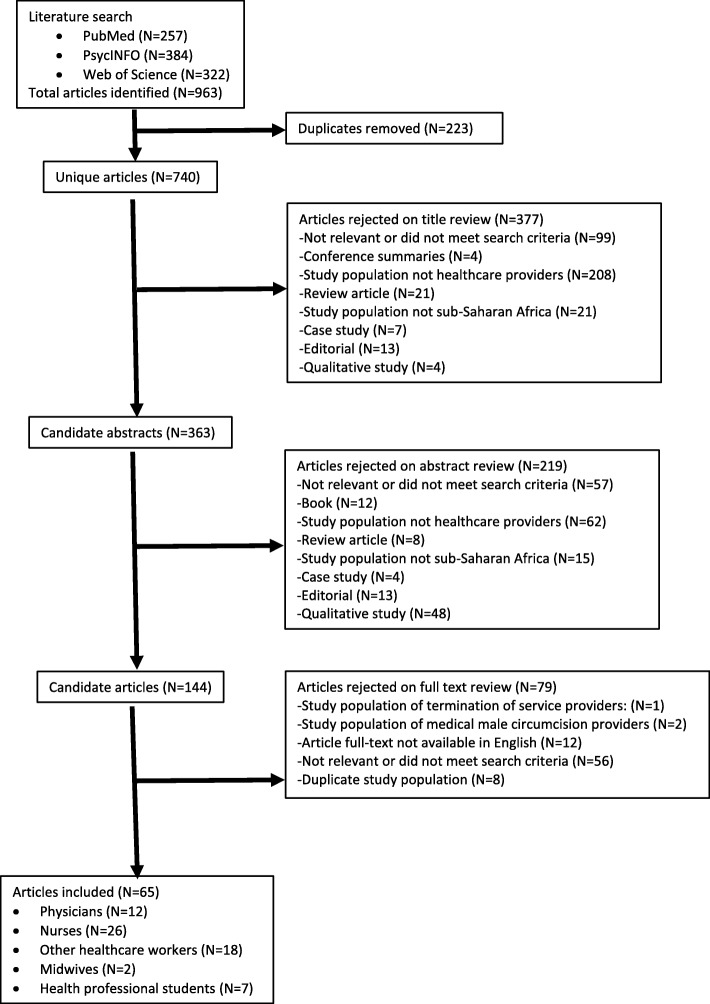
Background: Burnout is characterized by physical and emotional exhaustion from long-term exposure to emotionally demanding work. Burnout affects interpersonal skills, job performance, career satisfaction, and psychological health. However, little is known about the burden of burnout among healthcare providers in sub-Saharan Africa. Methods: Relevant articles were identified through a systematic review of PubMed, Web of Science (Thomson Reuters), and PsycINFO (EBSCO). Studies were selected for inclusion if they examined a quantitative measure of burnout among healthcare providers in sub-Saharan Africa. Results: A total of 65 articles met our inclusion criteria for this systematic review. Previous studies have examined burnout in sub-Saharan Africa among physicians ( N = 12 articles), nurses ( N = 26), combined populations of healthcare providers ( N = 18), midwives ( N = 2), and medical or nursing students ( N = 7). The majority of studies assessed burnout using the Maslach Burnout Inventory. The highest levels of burnout were reported among nurses, although all healthcare providers showed high burnout. Burnout among healthcare providers is associated with their work environments, interpersonal and professional conflicts, emotional distress, and low social support. Conclusions: Available studies on this topic are limited by several methodological challenges. More rigorously designed epidemiologic studies of burnout among healthcare providers are warranted. Health infrastructure improvements will eventually be essential, though difficult to achieve, in under-resourced settings. Programs aimed at raising awareness and coping with burnout symptoms through stress management and resilience enhancement trainings are also needed.
Overview
The claims and statistics of this paper haven’t been checked yet.
Free: it reads the open-access text and checks the first 5 claims that cite a source we can check. Create a free account to check every claim.
Integrity signals
Registry
Cites
Statistics
Figures
Verification
Claims the paper makes
The claims and statistics of this paper haven’t been checked yet.
Free: it reads the open-access text and checks the first 5 claims that cite a source we can check. Create a free account to check every claim.
Claims other papers make about this one
Each is checked against this paper’s own text: does it say what the citing paper says it does?
The source backs part of the claim, not all of it — or backs it for a different population, condition or comparison.
In the citing paper
“Collectively, the findings demonstrate that burnout management in the region is multifaceted, shaped by the interplay between organizational support, interpersonal relationships, individual burnout management strategies, and culturally grounded practices (12–14, 19).”
From Management strategies for healthcare worker burnout in Sub-Saharan Africa: an integrative review (2026) · cites this paper as [12]
Experimental — accuracy not yet measuredThe source backs part of the claim, not all of it — or backs it for a different population, condition or comparison.
In the citing paper
“These findings echo broader regional evidence that burnout in Sub-Saharan Africa is driven primarily by structural conditions rather than individual weakness (12, 38).”
From Management strategies for healthcare worker burnout in Sub-Saharan Africa: an integrative review (2026) · cites this paper as [12]
Experimental — accuracy not yet measuredThe cited source says what the claim attributes to it.
In the citing paper
“There is a striking lack of intervention studies addressing burnout within the SSA region (9, 12).”
From Management strategies for healthcare worker burnout in Sub-Saharan Africa: an integrative review (2026) · cites this paper as [12]
The cited source says what the claim attributes to it.
In the citing paper
“Intra- and inter-professional conflicts in healthcare settings have been reported elsewhere in Sub-Saharan Africa in relation to staff burnout [24], but not previously in relation to implementation of health programmes.”
From Scale-up of a novel vital signs alert device to improve maternity care in Sierra Leone: a mixed methods evaluation of adoption (2023) · cites this paper as [24]
The cited source says what the claim attributes to it.
In the citing paper
“Evidence remains scattered across small-scale studies and often lacks evaluation of effectiveness, highlighting the need for a comprehensive synthesis of available burnout management strategies in SSA (12).”
From Management strategies for healthcare worker burnout in Sub-Saharan Africa: an integrative review (2026) · cites this paper as [12]
1 more claim about this paper
Create a free account to see every claim other papers make about this one.
Self-check
Percentages, sums and reported differences re-computed from the paper’s own numbers.
The self-check needs the paper’s full text.
Citations
Cites
Preferred Reporting Items for Systematic Reviews and Meta-Analyses: the PRISMA statement
Moher, D., Liberati, A., Tetzlaff, J., Altman, D. G., & for the PRISMA Group (2009) · BMJ · doi:10.1136/bmj.b2535 · Cited by 83,823
The Cochrane Collaboration's tool for assessing risk of bias in randomised trials
Higgins, J. P. T., Altman, D. G., Gotzsche, P. C., Juni, P., Moher, D., Oxman, A. D., Savovic, J., Schulz, K. F., Weeks, L., Sterne, J. A. C., et al. (2011) · BMJ · doi:10.1136/bmj.d5928 · Cited by 33,817
Dermyshi, E., Wang, Y., Yan, C., Hong, W., Qiu, G., Gong, X., & Zhang, T. (2017) · Neonatology · doi:10.1159/000454668 · Cited by 24,451
(2014) · Medical Entomology and Zoology · Cited by 17,633
The measurement of experienced burnout
Maslach, C., & Jackson, S. E. (1981) · Journal of Organizational Behavior · doi:10.1002/job.4030020205 · Cited by 14,496 · cited 1×
“Burnout is a psychological syndrome involving emotional exhaustion, feelings of helplessness, depersonalization, negative attitudes towards work and life, and reduced personal accomplishment [1].”
BackgroundPreferred reporting items for systematic reviews and meta-analyses: The PRISMA statement
Moher, D., Liberati, A., Tetzlaff, J., & Altman, D. G. (2010) · International Journal of Surgery · doi:10.1016/j.ijsu.2010.02.007 · Cited by 12,156
Hospital Nurse Staffing and Patient Mortality, Nurse Burnout, and Job Dissatisfaction
Aiken, L. H. (2002) · JAMA · doi:10.1001/jama.288.16.1987 · Cited by 5,226
The Copenhagen Burnout Inventory: A new tool for the assessment of burnout
Kristensen, T. S., Borritz, M., Villadsen, E., & Christensen, K. B. (2005) · Work & Stress · doi:10.1080/02678370500297720 · Cited by 3,136 · cited 1×
“Concerns have been raised about how the MBI operationalizes burnout [133].”
BackgroundShanafelt, T. D., Hasan, O., Dyrbye, L. N., Sinsky, C., Satele, D., Sloan, J., & West, C. P. (2015) · Mayo Clinic Proceedings · doi:10.1016/j.mayocp.2015.08.023 · Cited by 2,885 · cited 2×
“Studies conducted in the United States show 54% of physicians [7], 35% of hospital nurses [11], and 35.”
BackgroundEarly predictors of job burnout and engagement.
Maslach, C., & Leiter, M. P. (2008) · Journal of Applied Psychology · doi:10.1037/0021-9010.93.3.498 · Cited by 2,397
Research works printed but not linked: 3
- Olley B The executive burnout scale: construction and validation Niger J Clin Couns Psychol 1998 4 149 158
- Engelbrecht M van den Berg H Bester C Burnout and compassion fatigue: the case of professional nurses in primary health care facilities in the Free State Province, South Africa Psychology of Burnout: Predictors and Coping Mechanisms: Psychology Research Progress 2009 Hauppage Nova Science Publishers 1 38
- Jha AK Iliff AR Chaoui AA Defossez S Bombaugh MC MIller YR A crisis in healthcare: a call to action on physician burnout 2019 Boston Massachuetts Medical Society
Cited by
Kulkarni, A., Khasne, R. W., Dhakulkar, B. S., & Mahajan, H. C. (2020) · Indian Journal of Critical Care Medicine · doi:10.5005/jp-journals-10071-23518 · Cited by 307
Chemali, Z., Ezzeddine, F. L., Gelaye, B., Dossett, M. L., Salameh, J., Bizri, M., Dubale, B., & Fricchione, G. (2019) · BMC Public Health · doi:10.1186/s12889-019-7713-1 · Cited by 245
Self-citationZhang, X.-J., Song, Y., Jiang, T., Ding, N., & Shi, T.-Y. (2020) · Medicine · doi:10.1097/md.0000000000020992 · Cited by 233
“The highest levels of burnout were reported among nurses, although all healthcare providers showed high burnout,([4]) and the prevalence has been increasing in recent years.”
Determinants of Burnout among Teachers: A Systematic Review of Longitudinal Studies
Mijakoski, D., Cheptea, D., Marca, S. C., Shoman, Y., Çağlayan, Ç., Bugge, M., Gnesi, M., Godderis, L., Kıran, S., McElvenny, D. M., et al. (2022) · International Journal of Environmental Research and Public Health · doi:10.3390/ijerph19095776 · Cited by 223
Impacts of Nursing Student Burnout on Psychological Well-Being and Academic Achievement
Wei, H., Dorn, A. N., Hutto, H., Corbett, R. W., Haberstroh, A. L., & Larson, K. L. (2021) · Journal of Nursing Education · doi:10.3928/01484834-20210616-02 · Cited by 173
Afulani, P. A., Gyamerah, A. O., Nutor, J. J., Laar, A. K., Aborigo, R., Malechi, H., Sterling, M., & Awoonor‐Williams, J. K. (2021) · PLoS ONE · doi:10.1371/journal.pone.0250294 · Cited by 158
“High stress and burnout among health workers in Ghana is not surprising given global evidence prior to the pandemic of provider stress and burnout—including in Ghana and other African countries [25, 47, 48].”
Burnout in Hospital-Based Healthcare Workers during COVID-19
Maunder, R., Heeney, N. D., Strudwick, G., Shin, H. D., O’Neill, B. G., Young, N., Jeffs, L. P., Barrett, K. A., Bodmer, N. S., Born, K. B., et al. (2021) · doi:10.47326/ocsat.2021.02.46.1.0 · Cited by 141
Batanda, I. (2024) · npj Mental Health Research · doi:10.1038/s44184-024-00061-2 · Cited by 122
“Careful allocation of duties within hospitals is critical for balancing workloads and together with adequate staf fi ng may lower distress and improve work experience 44,46 , which can minimize stress and improve staff performance and ef fi ciency in the functioning of health care systems.”
InfluentialCorreia, I. F., & Almeida, A. E. (2020) · Frontiers in Psychology · doi:10.3389/fpsyg.2020.566139 · Cited by 120
Afulani, P. A., Ongeri, L., Kinyua, J., Temmerman, M., Mendes, W. B., & Weiss, S. J. (2021) · BMC Public Health · doi:10.1186/s12889-021-10453-0 · Cited by 109
Incidence and factors associated with burnout in radiologists: A systematic review
Ashraf, N., Tahir, M. J., Saeed, A., Ghosheh, M. J., Alsheikh, T., Ahmed, A., Lee, K. Y., & Yousaf, Z. (2023) · European Journal of Radiology Open · doi:10.1016/j.ejro.2023.100530 · Cited by 99
Robertson, L. J., Maposa, I., Somaroo, H., & Johnson, O. (2020) · South African Medical Journal · doi:10.7196/samj.2020.v110i10.15022 · Cited by 81
“(2019)[42] found rates of 62% in Malawi, 91% in Ethiopia and 95% in Kenya.”
BackgroundInfluentialFactors affecting healthcare workers burnout and their conceptual models: scoping review
Nagle, E., Griskevica, I., Rajevska, O., Ivanovs, A., Mihailova, S., & Skruzkalne, I. (2024) · BMC Psychology · doi:10.1186/s40359-024-02130-9 · Cited by 85
Interventions to reduce burnout among clinical nurses: systematic review and meta-analysis
Lee, M., & Cha, C. (2023) · Scientific Reports · doi:10.1038/s41598-023-38169-8 · Cited by 84
The burnout construct with reference to healthcare providers: A narrative review
Khammissa, R. A. G., Nemutandani, S. M., Shangase, S. L., Feller, G., Lemmer, J., & Feller, L. (2022) · SAGE Open Medicine · doi:10.1177/20503121221083080 · Cited by 79
“…additional overnight and weekend call duties, dealing with patients’ suffering, pain and death, ambiguity, role conflict and never-ending clerical work, 6,12,27,55,64,65 and this may be why substance abuse, depressive symptoms and reduced quality of life are not uncommon among burned-out persons.”
Eltaybani, S., Yamamoto-Mitani, N., Ninomiya, A., & Igarashi, A. (2021) · BMC Nursing · doi:10.1186/s12912-021-00552-z · Cited by 35
Sweileh, W. M. (2020) · Journal of Occupational Medicine and Toxicology · doi:10.1186/s12995-020-00274-z · Cited by 68
Burnout, compassion fatigue, and resilience among healthcare professionals
Thapa, D. K., Levett-Jones, T. L., West, S., & Cleary, M. L. (2021) · Nursing and Health Sciences · doi:10.1111/nhs.12843 · Cited by 66
Physician burnout in Nigeria: a multicentre, cross-sectional study
Nwosu, A. D. G., Ossai, E. N., Mba, U. C., Anikwe, I., Ewah, R. L., Obande, B. O., & Achor, J. U. (2020) · BMC Health Services Research · doi:10.1186/s12913-020-05710-8 · Cited by 62
“By far the MBI has been the predominant instrument for measuring burnout [11, 12] and has historically been regarded as the gold standard.”
BackgroundDeterminants of emotional exhaustion among nursing workforce in urban Ghana: a cross-sectional study
Poku, C. A., Donkor, E. S., & Naab, F. (2020) · BMC Nursing · doi:10.1186/s12912-020-00512-z · Cited by 62
“Most nurses have increased chances of exhaustion relative to other health care providers [30, 31].”
BackgroundResultAlahmari, M. A., Moaleem, M. M. A., Hamdi, B. A., Hamzi, M. A., Aljadaani, A. T., Khormi, F. A. H., Darraj, M. A., Shrwani, R. J., Alomar, A. A., Tahhah, M. K., et al. (2022) · Medical Science Monitor · doi:10.12659/msm.938798 · Cited by 63
“Other reviews included studies that utilized the MBI scale and thoroughly examined the prevalence of burnout among healthcare professionals from different specialties to support the personal and professional development of healthcare workers [14-23].”
Amoadu, M., Agyare, D. F., Doe, P. F., & Abraham, S. A. (2025) · BMC Health Services Research · doi:10.1186/s12913-025-12254-2 · Cited by 62
“The healthcare environment, characterised by high demands [2], complex patient needs [3], and often limited resources [2, 4], poses significant challenges to the psychological health and safety of its workforce.”
Huang, Z., Huang, F., Liang, Q., Liao, F.-Z., Tang, C.-Z., Luo, M.-L., Lu, S.-L., Lian, J.-J., Li, S.-E., Wei, S.-Q., et al. (2023) · BMC Nursing · doi:10.1186/s12912-023-01380-z · Cited by 61
Smoktunowicz, E., Lesnierowska, M., Carlbring, P., Andersson, G., & Cieslak, R. (2021) · Journal of Medical Internet Research · doi:10.2196/21445 · Cited by 49
“Although it is difficult to assess the prevalence of occupational issues such as job stress and job burnout among medical professionals, there is evidence to show that these problems are encountered globally, including in the cultural West [5,46], sub-Saharan Africa [47], and Japan [48].”
Deng, D., & Naslund, J. A. (2021) · doi:10.54111/0001/z1 · Cited by 59
“Burnout can have a variety of negative consequences that threaten the well-being of health workers including physical health problems such as cardiovascular diseases, the hypothalamic–pituitary–adrenal (HPA) axis dysregulation and chronic fatigue, as well as psychological health problems such as suicidality, depressio…”
BackgroundNwosu, A. D. G., Ossai, E. N., Onwuasoigwe, O., Ezeigweneme, M., & Okpamen, J. (2021) · Journal of Public Health Research · doi:10.4081/jphr.2021.1900 · Cited by 58
The item network and domain network of burnout in Chinese nurses
Wu, L., Ren, L., Wang, Y., Zhang, K., Fang, P., Liu, X., Yang, Q., Wang, X., Wu, S., & Peng, J. (2021) · BMC Nursing · doi:10.1186/s12912-021-00670-8 · Cited by 55
“With the increasing pressure of medical industry, relatively insufficient proportion of nurses, stressful work, frequent three shifts, high work standards, high level of risks, many emergencies, and long-term high vigilance contribute to the high incidence of burnout [5, 6].”
BackgroundBurnout syndrome among healthcare workers during COVID-19 Pandemic in Accra, Ghana
Konlan, K. D., Asampong, E., Dako‐Gyeke, P., & Glozah, F. N. (2022) · PLoS ONE · doi:10.1371/journal.pone.0268404 · Cited by 56
“Burnout syndrome was assessed using an adapted 22-item Maslach Burnout Inventory– Human Services Survey tool (MBI-HSS) [3, 23, 25].”
BackgroundMethodResultInfluentialMengist, B., Amha, H., Ayenew, T., Gedfew, M., Akalu, T. Y., Assemie, M. A., Alene, M., & Desta, M. (2021) · Archives of Rehabilitation Research and Clinical Translation · doi:10.1016/j.arrct.2021.100125 · Cited by 52
“It is a psychological syndrome involving emotional exhaustion, feelings of helplessness, depersonalization, negative attitudes toward work and life, and reduced personal accomplishments and is emerging as a prolonged response to chronic interpersonal stressors at work.(4,5) Job-related stresses and burnout predispose…”
BackgroundResultYuan, Z., Yu, D., Zhao, H., Wang, Y., Jiang, W., Chen, D., Liu, X., & Li, X. (2021) · International Journal of Public Health · doi:10.3389/ijph.2021.599831 · Cited by 52
“According to previous reports, the prevalence of burnout among healthcare workers in most regions exceeds 50% [6, 7].”
BackgroundUdho, S., & Kabunga, A. (2022) · BioMed Research International · doi:10.1155/2022/8231564 · Cited by 52
“This di ff erence could be attributed to the di ff erences in health systems across countries and the composition of the sample where some studies involved all healthcare workers including doctors, nurses, midwives, and other cadres [6].”
Impact of COVID-19 on the neglected tropical diseases: a scoping review
Butala, C. B., Cave, R. N. R., Fyfe, J., Coleman, P. G., Yang, G.-J., & Welburn, S. C. (2024) · Infectious Diseases of Poverty · doi:10.1186/s40249-024-01223-2 · Cited by 50
Burnout among Nurses Working in Ethiopia
Hailay, A., Aberhe, W., Mebrahtom, G., Zereabruk, K., Asefa, G. G., & Haile, T. G. (2020) · Behavioural Neurology · doi:10.1155/2020/8814557 · Cited by 45
Prevalence of depression, anxiety and burnout in medical students at the University of Namibia
Mhata, N. T., Ntlantsana, V., Tomita, A. M., Mwambene, K., & Saloojee, S. (2023) · South African Journal of Psychiatry · doi:10.4102/sajpsychiatry.v29i0.2044 · Cited by 43
Burnout among Military Personnel: A systematic Review
Hosseini, S. M., Hesam, S., & Hosseini, S. A. (2023) · Iranian Journal of Psychiatry · doi:10.18502/ijps.v18i2.12371 · Cited by 43
van Zyl-Cillié, M., Bührmann, J. H., Blignaut, A. J., Demirtas, D., & Coetzee, S. K. (2024) · BMC Health Services Research · doi:10.1186/s12913-024-12184-5 · Cited by 43
Nowrouzi‐Kia, B., Dong, J., Gohar, B., & Hoad, M. (2022) · The International Journal of Health Planning and Management · doi:10.1002/hpm.3460 · Cited by 40
Temporal Stages of Burnout: How to Design Prevention?
Leclercq, C., & Hansez, I. (2024) · International Journal of Environmental Research and Public Health · doi:10.3390/ijerph21121617 · Cited by 40
“Globally, burnout is also prevalent, particularly in developing regions [17].”
Jensen, N., Lund, C., & Abrahams, Z. (2022) · Global Health Research and Policy · doi:10.1186/s41256-022-00242-6 · Cited by 40
Sienra-Monge, J. J. L., Luna, D., Figuerola-Escoto, R. P., Hernández-Roque, A., Soria-Magaña, A., Hernández‐Corral, S., & Toledano‐Toledano, F. (2023) · Healthcare · doi:10.3390/healthcare11233042 · Cited by 36
“Hence, the need to view burnout as a public health problem calls for both preventive and corrective interventions [40].”
BackgroundTools for measuring medical internship experience: a scoping review
Zhao, Y., Musitia, P. M., Boga, M., Gathara, D., Nicodemo, C., & English, M. (2021) · Human Resources for Health · doi:10.1186/s12960-021-00554-7 · Cited by 34
Impact of Physical Workload and Mental Workload on Nurse Performance: A Path Analysis
Pamungkas, R. A., Ruga, F. B. P., Kusumapradja, R., & Kusumapradja, R. (2022) · International Journal of Nursing and Health Services (IJNHS) · doi:10.35654/ijnhs.v5i2.604 · Cited by 33
Dinh, J., Schweissing, E. J., Venkatesh, A., Traylor, A., Kilcullen, M., Perez, J. A., & Salas, E. (2021) · Frontiers in Communication · doi:10.3389/fcomm.2021.617928 · Cited by 32
“Previous research indicates that interpersonal conflict is associated with burnout in healthcare (Abrahamson et al., 2009; Dubale et al., 2019).”
BackgroundKonlan, K. D., Asampong, E., Dako‐Gyeke, P., & Glozah, F. N. (2022) · BMC Health Services Research · doi:10.1186/s12913-022-08539-5 · Cited by 31
“This is further compounded in SSA where health workers are engaged in one of the most challenging work environment due to the limited material and human resources for work [5].”
BackgroundMethodInfluentialAlhassan, M. A., Alarabi, M., Alhassan, S. A., Albalawi, W. M., & AlRabiah, E. S. (2025) · Frontiers in Psychology · doi:10.3389/fpsyg.2025.1539105 · Cited by 31
Lwiza, A. F., & Lugazia, E. (2023) · Health Science Reports · doi:10.1002/hsr2.1256 · Cited by 31
“This has been attributed to the difference in the two settings, with Africa having a higher patient‐to‐ healthcare worker ratio, so healthcare workers are overwhelmed with workloads and poor working environments.(5) Several demographic factors have been cited to be associated with an increased risk of burnout among he…”
BackgroundMethodResultInfluentialHealthcare and Disease Burden in Africa: The Impact of Socioeconomic Factors on Public Health
Niohuru, I. (2023) · SpringerBriefs in economics · doi:10.1007/978-3-031-19719-2 · Cited by 30
Burnout among healthcare professionals in Qatar: A systematic review
Albazoon, F., Khogali, F., Burjaq, R., Chandra, P., Alabdulla, M., Abdulaziz, M., & Hammoudeh, S. (2023) · Asian Journal of Psychiatry · doi:10.1016/j.ajp.2023.103601 · Cited by 29
Servant Leadership, Third‐Party Behavior, and Emotional Exhaustion of Followers
Obi, I. O., Bollen, K., Aaldering, H., Robijn, W., & Euwema, M. C. (2020) · Negotiation and Conflict Management Research · doi:10.1111/ncmr.12184 · Cited by 28
The impact of nurse manager caring behaviors and work environment on burnout syndrome among nurses
Putra, K. R., Sutadi, H., Setyowati, S., & Hariyati, R. T. S. (2021) · Kontakt · doi:10.32725/kont.2021.019 · Cited by 27
“Healthcare professionals often experience burnout (Chemali et al., 2019; Dubale et al., 2019).”
Burnout: A Mindful Framework for the Radiologist
Spieler, B. M., & Baum, N. H. (2021) · Current Problems in Diagnostic Radiology · doi:10.1067/j.cpradiol.2021.08.005 · Cited by 26
Nutor, J. J., Aborigo, R., Okiring, J., Kuwolamo, I., Dorzie, J. B. K., Getahun, M., Mendes, W. B., & Afulani, P. A. (2022) · PLoS ONE · doi:10.1371/journal.pone.0278457 · Cited by 26
“Further, stress and burnout has been shown to lead to anxiety [8], depression [9, 10], substance abuse and suicidal ideation [10, 11], gastrointestinal disorders [12, 13], cardiovascular diseases [13], poor quality of life, and premature death [13, 14].”
BackgroundHuang, Y., Yao, D., Zhou, H., Xi, X., Wang, Y., & Yao, W. (2021) · Journal of the American Pharmacists Association · doi:10.1016/j.japh.2021.01.011 · Cited by 26
Molyneux, S. C., Sukhtankar, P., Thitiri, J., Njeru, R. W., Muraya, K., Sanga, G., Walson, J. L., Berkley, J. A., Kelley, M. C., & Marsh, V. (2021) · BMJ Global Health · doi:10.1136/bmjgh-2021-004937 · Cited by 26
“In many settings, health research team members will be juggling research and healthcare responsibilities and struggling to cope in what can be structurally and emotionally extremely challenging contexts, 56 now significantly exacerbated by the stresses associated with the COVID-19 pandemic.”
BackgroundMasale, R., Barkhuizen, E. N., Schutte, N. E., & van der Sluis, L. E. C. (2021) · SA Journal of Industrial Psychology · doi:10.4102/sajip.v47i0.1832 · Cited by 27
Ahmed, F., Hawulte, B., Yuya, M., Birhanu, S., & Oljira, L. (2022) · Frontiers in Public Health · doi:10.3389/fpubh.2022.836654 · Cited by 25
“Burnout is becoming more common among healthcare providers, who have been classified as a high-risk category (3).”
BackgroundBurnout and resilience at work among health professionals serving in tertiary hospitals, in Ethiopia
Gelaw, Y. M., Kashtan, H., & Adini, B. B. (2023) · Frontiers in Public Health · doi:10.3389/fpubh.2023.1118450 · Cited by 25
“Differences in a study setting might contribute to the differences; the aforementioned studies were conducted among primary healthcare professionals while the current study focused on healthcare workers employed in hospitals, characterized by relatively high workloads (54, 55).”
ResultImplementation of Online Research Training and Mentorship for Sub-Saharan African Family Physicians
McGuire, C. M., Fatusin, B. B., Kodicherla, H., Yakubu, K., Ameh, P. O., van Waes, A., Rhoad, E., Jack, B. W., & Scott, N. (2021) · Annals of Global Health · doi:10.5334/aogh.3171 · Cited by 25
Hain, S., Tomita, A. M., Milligan, P. D., & Chiliza, B. (2021) · South African Medical Journal · doi:10.7196/samj.2021.v111i12.15841 · Cited by 25
“Some international and South African (SA) studies have found high rates of burnout,[1-10] depression[5,9,11-16] and anxiety[9,17] in medical doctors.”
BackgroundBurnout among primary health care workers in Brazil: results of a multilevel analysis
da Silva, A. T. C., Lopes, C. D. S., Susser, E., Coutinho, L. M. S., Germani, A. C. C. G., & Menezes, P. R. (2021) · International Archives of Occupational and Environmental Health · doi:10.1007/s00420-021-01709-8 · Cited by 24
Veigh, C. M., Reid, J., Carswell, C., Ace, L., Walsh, I., Graham-Wisener, L., Rej, S., Potes, A., Atkinson, K., Edginton, T., et al. (2021) · BMC Nursing · doi:10.1186/s12912-021-00783-0 · Cited by 23
“Burnout within the workplace can have a negative impact on the biopsychosocial well-being of nursing staff, as well as impacting patient care, and career satisfaction [25].”
BackgroundAlhomoud, I. S., & Alrasheedy, A. A. (2024) · Healthcare · doi:10.3390/healthcare12181834 · Cited by 23
Sahebi, A., Golitaleb, M., & Jahangiri, K. (2021) · Iranian Journal of Nursing and Midwifery Research · doi:10.4103/ijnmr.ijnmr_175_20 · Cited by 23
“Also, burnout may be associated with adverse health consequences such as insomnia, depression, and hypertension.[9,10] The study of Khatiban et al, showed that Iranian EMTs have a high level of emotional exhaustion and depersonalization.”
BackgroundThe Effects of Nurse Burnout on Patient Experiences
Richemond, D. J., Needham, M., & Jean, K. (2022) · Open Journal of Business and Management · doi:10.4236/ojbm.2022.105139 · Cited by 23
Burnout and coping mechanisms among healthcare professionals in Central Uganda
Kabunga, A., Kigongo, E., Okalo, P., Udho, S., Grace, A. A., Tumwesigye, R., Akello, A. R., Musinguzi, M., Acup, W., Nabaziwa, J., et al. (2024) · Frontiers in Psychiatry · doi:10.3389/fpsyt.2024.1373743 · Cited by 21
Mfuru, G. H., Ubuguyu, O., & Yahya-Malima, K. I. (2024) · BMJ Open · doi:10.1136/bmjopen-2024-094520 · Cited by 21
Awosoga, O., Odunaiya, N. A., Oyewole, O. O., Ogunlana, M. O., Mbada, C. E., Onyeso, O. K., Adegoke, O. M., Ayodeji, A. F., & Odole, A. C. (2022) · BMC Health Services Research · doi:10.1186/s12913-022-08808-3 · Cited by 21
Odole, A. C., Ogunlana, M. O., Odunaiya, N. A., Oyewole, O. O., Mbada, C. E., Onyeso, O. K., Ayodeji, A. F., Adegoke, O. M., Odole, I. P., Sanuade, C. T., et al. (2023) · Scientific Reports · doi:10.1038/s41598-022-25057-w · Cited by 21
Mijakoski, D., Atanasovska, A., Bislimovska, D., Brborović, H., Brborović, O., Kezunović, L. C., Milošević, M., Минов, Ј., Önal, B., Pranjić, N., et al. (2023) · Frontiers in Psychology · doi:10.3389/fpsyg.2023.1258226 · Cited by 22
Efa, A. G., Lombebo, A. A., Nuriye, S., & Facha, W. (2024) · Scientific Reports · doi:10.1038/s41598-024-82703-1 · Cited by 20
“In sub-Saharan Africa, the highest levels of burnout were recorded among nurses ranging from 40 to 80% 31 .”
Handle with Care: Transformative Learning as Pedagogy in an Under-Resourced Health Care Context
Müller, J. V., Meyer, R., Bantjes, J. R., Archer, E., & Couper, I. D. (2024) · Teaching and Learning in Medicine · doi:10.1080/10401334.2024.2332885 · Cited by 20
Stabnick, A., Yeboah, M., Arthur‐Komeh, J., Ankobea, F. K., Moyer, C. A., & Lawrence, E. R. (2022) · BMC Pregnancy and Childbirth · doi:10.1186/s12884-022-04535-z · Cited by 20
“The importance of workplace culture in mediating responses to workplace stress, and the tendency toward negative environments in medicine, is commonly cited in the literature [31].”
BackgroundAlsararatee, H. H., Kawser, A., & Elachola, M. (2025) · British Journal of Hospital Medicine · doi:10.12968/hmed.2025.0145 · Cited by 19
“Dubale et al (2019) reviewed burnout among healthcare providers in sub-Saharan Africa but did not focus on nursing students.”
Sobczuk, P., Gawlik-Urban, A., Sigorski, D., Kiszka, J., Osmola, M., Machulska-Ciuraj, K., Wilk, M., & Brodziak, A. (2024) · ESMO Open · doi:10.1016/j.esmoop.2023.102230 · Cited by 19
Predictors of Burnout and Depression in Surgeons Practicing in East, Central, and Southern Africa
Commander, S. J., Ellis, D. I., Williamson, H. V., Grabski, D. F., Sallah, A. Y., Derbew, M., & Fitzgerald, T. N. (2020) · Journal of Surgical Research · doi:10.1016/j.jss.2020.04.038 · Cited by 19
West, R. L., Lippman, S. A., Twine, R., Maritze, M., Kahn, K., & Leslie, H. H. (2021) · Journal of Global Health Science · doi:10.35500/jghs.2021.3.e1 · Cited by 19
Musitia, P. M., Boga, M., Oluoch, D., Haaland, A., Nzinga, J., English, M., & Molyneux, S. C. (2022) · Wellcome Open Research · doi:10.12688/wellcomeopenres.18006.1 · Cited by 18
Burnout in emergency department staff: The prevalence and barriers to intervention
Naidoo, R., & Schoeman, R. (2023) · South African Journal of Psychiatry · doi:10.4102/sajpsychiatry.v29i0.2095 · Cited by 17
“24 In addition, this study found high mean EE (30.98 vs. 22.15) and DP (11.75 vs. 7.22) scores with similar PA (34.95 vs. 34.5) scores to a national survey of nurses.”
BackgroundResultInfluentialCousin, L., Beo, V. D., Marcellin, F., Rousset‐Torrente, O., Mahé, V., Valderas, J. M., Chassany, O., Carrieri, P., & Duracinský, M. (2023) · BMC Health Services Research · doi:10.1186/s12913-023-09101-7 · Cited by 17
Geremias, R. L., Lopes, M. P., & Sotomayor, A. M. (2024) · Administrative Sciences · doi:10.3390/admsci14080177 · Cited by 17
“On the other hand, different authors have highlighted that organizational commitment may contribute to discouraging negative results, such as intent to turnover (Ramalho Luz et al. 2018; Tetteh et al. 2020) and burnout (e.g., Dubale et al. 2019).”
BackgroundShrivastava, R., Singh, A., Khan, A., Choubey, S., Haney, J. R., Karyotaki, E., Tugnawat, D. K., Bhan, A., & Naslund, J. A. (2023) · SSM - Mental Health · doi:10.1016/j.ssmmh.2023.100230 · Cited by 17
Prevalence and determinants of burnout among South African doctors during the COVID-19 pandemic
Khan, S., Ntatamala, I., Baatjies, R., & Adams, S. (2024) · South African Journal of Psychiatry · doi:10.4102/sajpsychiatry.v30i0.2225 · Cited by 16
“10,12 The prevalence of burnout in this study is consistent with the 75.5 % found in a cross-sectional study conducted in Nigeria, prior to the pandemic, which also used the OLBI and matching cut-off scales.”
BackgroundResultInfluentialMitchell, L. M., Anand, A., Muke, S. S., Hollon, S. D., Joshi, U., Khan, A., Haney, J. R., Shrivastava, R., Singh, A., Singla, D. R., et al. (2024) · BMJ Public Health · doi:10.1136/bmjph-2024-001257 · Cited by 16
Agbobli, Y. A., Konu, Y. R., Gbeasor‐Komlanvi, F. A., Sadio, A. J., Tchankoni, M. K., Anani, J., Akliku, N., Bakoubayi, A. W., & Ekouévi, D. K. (2022) · Archives of Environmental & Occupational Health · doi:10.1080/19338244.2022.2042172 · Cited by 16
“Burnout among health care providers was associated with their work environment, interpersonal and professional conflict, emotional distress, and low social support.(30) A study in India reported a higher prevalence of burnout during the pandemic compared with the pre-pandemic period.”
BackgroundAsefa, A., Hanlon, C., Marchal, B., Homer, C., Gebremedhin, S., Tunçalp, Ö., Sarkar, N. D. P., Délamou, A., McNab, S., & Beňová, L. (2024) · BMJ Global Health · doi:10.1136/bmjgh-2024-015820 · Cited by 16
“31 32 Alongside this, in light of the very high levels of burnout among health workers in under-resourced health systems, 33 we underscore that caring for health workers in general and their mental health in particular should be an integral part of perinatal mental health interventions.”
Getahun, M., Oboke, E. N., Ogolla, B. A., Kinyua, J., Ongeri, L., Sterling, M., Oluoch, I., Lyndon, A., & Afulani, P. A. (2023) · PLOS Global Public Health · doi:10.1371/journal.pgph.0001341 · Cited by 16
“3,9–11 57 58 While high stress and burnout among healthcare workers is a recognized global 59 crises,(12) providers in sub-Saharan Africa (SSA) are doubly burdened due to the additional 60 stressors of working in resource-limited settings.(13) In addition to similar on-the-job stressors 61 as providers in resource-ric…”
BackgroundMéndez, R. M. Y., Sánchez-Broncano, J., Ramírez, G. D. M., & Villarreal‐Zegarra, D. (2024) · Heliyon · doi:10.1016/j.heliyon.2024.e30125 · Cited by 15
“Moreover, this problem has been exacerbated by the COVID-19 pandemic, during which the prevalence of BS among healthcare professionals increased significantly [8,14 – 17].”
BackgroundPattinson, S. R., Savelberg, H. H. C. M., & Atherley, A. (2024) · Advances in Health Sciences Education · doi:10.1007/s10459-024-10380-w · Cited by 16
“Considering that high levels of stress (Sun et al., 2008 ), depression (Naidu et al., 2019 ) and burnout (Dubale et al., 2019 ) have been found among South African interns, there is a concern that graduates may not be well prepared to thrive in their new role.”
Kanyanta, M. M., Makukula, M. K., & Wahila, R. (2023) · Journal of Biosciences and Medicines · doi:10.4236/jbm.2023.112007 · Cited by 15
Luangapichart, P., Saisavoey, N., & Viravan, N. (2022) · Healthcare · doi:10.3390/healthcare10122532 · Cited by 14
“The causes of burnout and stress included heavy workloads, inadequate staffing, difficult work conditions, low career satisfaction, and interpersonal and professional conflicts [8].”
BackgroundAlemu, S. S., Hajure, M., Agago, M. T., Hassen, F. H., Gesisa, H. I., Teferi, S. M., Yohanes, D., & Wedajo, L. F. (2024) · Frontiers in Public Health · doi:10.3389/fpubh.2024.1422915 · Cited by 14
“While burnout among midwives has a wide range of impacts, ranging from an effect on personal life to a great contribution to maternal and neonatal death, the quality of maternity care, and others, not much is known regarding burnout among Ethiopian and other sub-Saharan African midwives.”
BackgroundMohamed, N. A., Mohamed, Y. A., Mohamud, R. Y. H., & Gabow, A. A. (2025) · World Journal of Psychiatry · doi:10.5498/wjp.v15.i2.98496 · Cited by 14
Omotosho, T. F., Omotosho, T. O. A., & Bass, P. (2025) · International Journal of Africa Nursing Sciences · doi:10.1016/j.ijans.2025.100842 · Cited by 14
Osei, H. V., Arthur, J., Aseibu, F., & Osei-Kwame, D. (2023) · International Journal of Healthcare Management · doi:10.1080/20479700.2023.2217566 · Cited by 14
“This fi nding supports other empirical studies on the high levels of burnout in the health sector and among other frontline workers in other sectors(e.g. [ 49,77]).”
Zeinolabedini, M., Heidarnia, A., Shakerinejad, G., & Motlagh, M. E. (2022) · BMJ Open · doi:10.1136/bmjopen-2022-061925 · Cited by 15
Clarke, M., Frecklington, M., & Stewart, S. (2024) · Occupational Health Science · doi:10.1007/s41542-024-00189-9 · Cited by 13
“Similarly, higher rates of burnout have also been reported among healthcare workers in Africa which has been associated with less support or resources to management workloads (Levert et al., 200 0; Dubale et al., 2019 ).”
Kabunga, A., Kigongo, E., Musinguzi, M., Tumwesigye, R., Akello, A. R., Acup, W., Asiimwe, M. G., & Nalwoga, V. (2024) · PLoS ONE · doi:10.1371/journal.pone.0309701 · Cited by 13
“In sub-Saharan Africa, including Uganda, unique contextual factors contribute to the prevalence of burnout among healthcare workers [2].”
BackgroundChang, W., Cohen, J. L., Mwesigwa, B., Waiswa, P., & Rokicki, S. (2022) · Human Resources for Health · doi:10.1186/s12960-022-00722-3 · Cited by 13
“Recent systematic reviews have associated poor physical work conditions with high levels of health worker burnout [21, 22].”
BackgroundBright, S., Moses, F., Ridout, A., Sam, B., Momoh, M., Goodhart, V., Smart, F., Mannah, M., Issa, S., Herm-Singh, S., et al. (2023) · Reproductive Health · doi:10.1186/s12978-022-01551-2 · Cited by 12
“Intra- and inter-professional conflicts in healthcare settings have been reported elsewhere in Sub-Saharan Africa in relation to staff burnout [24], but not previously in relation to implementation of health programmes.”
BackgroundFactors associated with burnout among healthcare providers in a rural context, South Africa
Moses, A. C., Dreyer, A. R., & Robertson, L. (2024) · African Journal of Primary Health Care & Family Medicine · doi:10.4102/phcfm.v16i1.4163 · Cited by 12
“According to Dubale et al., adequate social support was found to be a protective factor against burnout among HCP. 4 Increased social support in the forms of being married and being local to the area, thereby having an entrenched network of support, emerged as reducing the experience of Emotional…”
BackgroundInfluential
Metadata
- Authors
- Dubale, B. W., Friedman, L. E., Chemali, Z., Denninger, J. W., Mehta, D. H., Alem, A., Fricchione, G. L., Dossett, M. L., & Gelaye, B.
- Affiliations
- Addis Ababa University (ET)
- Harvard University (US)
- Corresponding author
- Gelaye, Bizu
- ORCID
- Venue
- BMC Public Health
- Published
- 2019-09-11
- Volume
- 19
- Issue
- 1
- Pages
- 1247-1247
- ISSN
- 1471-2458 (ISSN-L)
- PMC
- PMC6737653
- OpenAlex
- W2973061283
- Cited by
- 327
- References
- 145
- Citations by year
- 2026: 47 · 2025: 59 · 2024: 61 · 2023: 56 · 2022: 35 · 2021: 48 · 2020: 20 · 2019: 1
- FWCI
- 4.81
- Type
- journal article
- Language
- en
- Open access
- gold
- doi.org
- Licence
- cc-by
- creativecommons.org/licenses/by/4.0/ (tdm)
- creativecommons.org/licenses/by/4.0/ (vor)
- Locations
- BMC Public Health (publishedVersion, cc-by)
- PubMed Central (publishedVersion, cc-by)
- PubMed (publishedVersion)
- DOAJ (DOAJ: Directory of Open Access Journals) (submittedVersion, cc-by-sa)
- Funders
- National Center for Complementary and Integrative Health (K23AT009218)
- Topics
- Health Sciences › Health Professions › General Health Professions › Healthcare professionals’ stress and burnout
- Health Sciences › Medicine › Public Health, Environmental and Occupational Health › Occupational Health and Burnout
- Social Sciences › Psychology › Social Psychology › Stress and Burnout Research
- Keywords
- burnout, healthcare workers, nurses, physicians, midwives, medical students, Maslach Burnout Inventory, emotional exhaustion, work environment, social support, occupational stress, sub-Saharan Africa
- MeSH terms
- Occupational Stress, Adaptation, Psychological, Adult, Burnout, Professional, Female, Health Personnel, Humans, Job Satisfaction, Male, Physicians, Workplace, Africa South of the Sahara
About these checks
Registry, retraction, Cites and statistics results are computed, not judged, with one exception: a printed reference that no index lists is read once by a model before it counts as a citation error. Claims are extracted by a model and kept only when their quote appears verbatim in the text; each cited source is then checked, with a model’s help, for whether it says what the claim relies on. Those verdicts can be wrong — read the claim’s quote and the cited source before relying on one.
Statistics and arithmetic are recomputed, not judged.
Confidence bands are shown only for fields calibrated on our annotated test set. None is calibrated yet, so no band is shown.
What counts as a claim ›How we measure confidence ›How we check this ›
Are you an author, or do you see a problem with this page? Request a review
Data sources
Bibliographic data: Semantic Scholar, OpenAlex, Crossref.
Contains information from the Semantic Scholar Academic Graph Datasets, made available under the ODC Attribution License (ODC-BY 1.0).
Semantic Scholar’s data is described in: Kinney, R., et al. (2023). The Semantic Scholar Open Data Platform. arXiv:2301.10140.
