

The relationship between screen-based sedentary behaviors and symptoms of depression and anxiety in youth: a systematic review of moderating variables
Open accessThe DOI matches its Crossref record; 129 of the 129 references it cites were found in a registry or an index.
Abstract
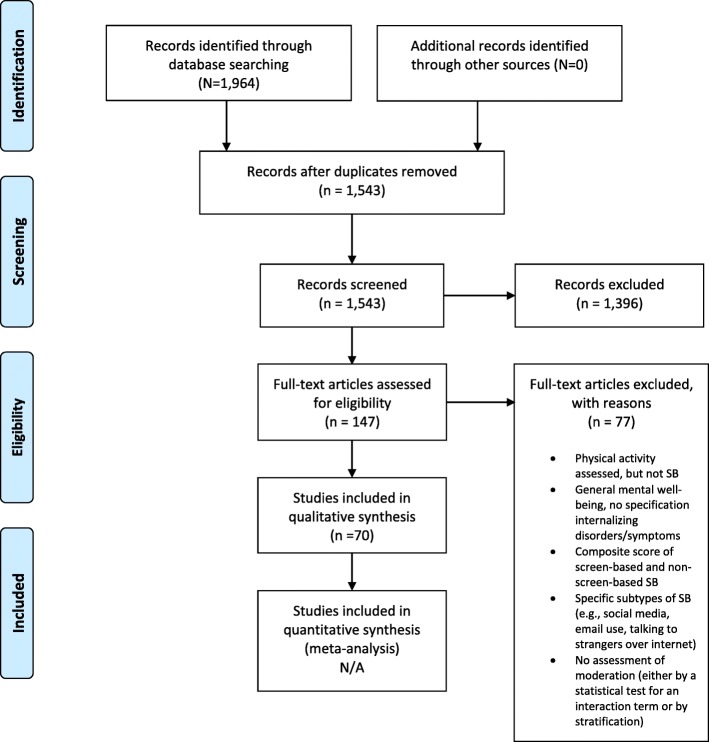
Background: To elucidate the populations and conditions where screen-based sedentary behaviors (SB) and internalizing symptoms are coupled, this review synthesized the evidence for factors that may moderate the associations between screen-based SB, depressive symptoms, and anxiety symptoms among youth. Methods: Two independent researchers conducted a systematic literature search of the Medline, psycINFO, and Scopus electronic databases in late 2018 for observational studies assessing moderators of the association between screen-based SB and depressive and anxiety symptoms. Studies among children and adolescents were eligible if moderation was assessed by statistical test (interaction) or stratification; and a narrative synthesis of eligible studies was conducted in accordance with PRISMA guidelines. Results: Seventy empirical studies (46 cross-sectional, 19 longitudinal, and 5 both) of 13 different moderating variables of screen-based SB-internalizing symptom associations met the eligibility criteria. Of these, 40 studies were of depressive symptoms, 2 were of anxiety symptoms, and 28 studies assessed symptoms of both. The most consistent evidence of moderation was for screen-type, such that TV viewing was not as strongly associated with internalizing symptoms compared to other forms of screen-based SB. There was also inconsistent evidence for physical activity buffering screen-based SB-internalizing symptom associations and for female sex amplifying screen-based SB-internalizing symptom associations. In general, the body of evidence for anxiety symptoms was more limited than that for depressive symptoms, and were therefore more inconsistent. Conclusions: Screen-type, physical activity, and sex may influence the magnitude of screen-based SB-internalizing symptom coupling; highlighting potential sources of heterogeneity of screen-based SB-internalizing symptom associations. Additional studies aimed at understanding potential mechanistic explanations for the above moderators are needed prior to the development of tailored intervention strategies designed to decouple screen-based SB and internalizing symptoms among youth.
Overview
The claims and statistics of this paper haven’t been checked yet.
Free: it reads the open-access text and checks the first 5 claims that cite a source we can check. Create a free account to check every claim.
Integrity signals
Registry
Cites
Statistics
Figures
Verification
Claims the paper makes
The claims and statistics of this paper haven’t been checked yet.
Free: it reads the open-access text and checks the first 5 claims that cite a source we can check. Create a free account to check every claim.
Claims other papers make about this one
Each is checked against this paper’s own text: does it say what the citing paper says it does?
The cited source doesn’t support the claim as written.
In the citing paper
“Furthermore, it remains unclear whether specific modalities of screen time (e.g., device type, digital media type, and specific websites and applications) are differentially associated with adolescent mental health outcomes, prompting a call for researchers to conduct more nuanced measurements and analyses of screen use that focus on the contents, contexts, and environments in which digital media”
From Screen time and mental health: a prospective analysis of the Adolescent Brain Cognitive Development (ABCD) Study (2024) · cites this paper as [51]
Checked by a reasoning model — may be wrong.
Experimental — accuracy not yet measuredThe source backs part of the claim, not all of it — or backs it for a different population, condition or comparison.
In the citing paper
“The current review is consistent with other reviews that concluded that the type, use and content of the screen influences the relationship between mental health problems and ST [11, 13, 72].”
From The associations between screen time and mental health in adolescents: a systematic review (2023) · cites this paper as [72]
Experimental — accuracy not yet measuredIn the citing paper
“Prior studies have identified sex differences in the relationship between screen time and mental health outcomes, but this evidence remains inconsistent across studies [11, 12, 51], calling for additional longitudinal analyses to provide further insight into the moderating effect of sex.”
From Screen time and mental health: a prospective analysis of the Adolescent Brain Cognitive Development (ABCD) Study (2024) · cites this paper as [51]
Self-check
Percentages, sums and reported differences re-computed from the paper’s own numbers.
The self-check needs the paper’s full text.
Citations
Cites
Preferred Reporting Items for Systematic Reviews and Meta-Analyses: the PRISMA statement
Moher, D., Liberati, A., Tetzlaff, J., Altman, D. G., & for the PRISMA Group (2009) · BMJ · doi:10.1136/bmj.b2535 · Cited by 83,823
Preferred reporting items for systematic reviews and meta-analyses: the PRISMA Statement.
(2009) · PubMed Central · Cited by 44,859
Preferred reporting items for systematic reviews and meta-analyses: The PRISMA statement
Moher, D., Liberati, A., Tetzlaff, J., Altman, D. G., & the PRISMA Group* (2009) · Annals of Internal Medicine · doi:10.7326/0003-4819-151-4-200908180-00135 · Cited by 37,554
Interrater reliability: The kappa statistic
McHugh, M. L. (2012) · Biochemia Medica · doi:10.11613/bm.2012.031 · Cited by 19,877
Ecological momentary assessment
Shiffman, S., Stone, A. A., & Hufford, M. R. (2008) · Annual Review of Clinical Psychology · doi:10.1146/annurev.clinpsy.3.022806.091415 · Cited by 6,454
Merikangas, K. R., He, J.-P., Burstein, M., Swanson, S. A., Avenevoli, S., Cui, L., Benjet, C., Georgiades, K., & Swendsen, J. (2010) · Journal of the American Academy of Child & Adolescent Psychiatry · doi:10.1016/j.jaac.2010.05.017 · Cited by 6,278 · cited 1×
“9%, respectively [6], but the incidence of subclinical depression and anxiety levels is much higher [7, 8].”
BackgroundThe benefits of playing video games.
Granic, I., Lobel, A., & Engels, R. C. M. E. (2014) · American Psychologist · doi:10.1037/a0034857 · Cited by 2,456
Thapar, A., Collishaw, S., Pine, D. S., & Thapar, A. K. (2012) · The Lancet · doi:10.1016/s0140-6736(11)60871-4 · Cited by 2,365
Twenge, J. M., Joiner, T. E., Rogers, M. L., & Martin, G. N. (2018) · Clinical Psychological Science · doi:10.1177/2167702617723376 · Cited by 1,705 · cited 5×
“Social media was also a screen-based SB that was investigated in two studies; both demonstrated that social media use was more strongly related to depressive symptoms compared to other forms of screen-based SB [50, 84].”
BackgroundInfluentialBeesdo, K., Knappe, S., & Pine, D. S. (2009) · Psychiatric Clinics of North America · doi:10.1016/j.psc.2009.06.002 · Cited by 1,703
Research works printed but not linked: 1
- Thomas H Quality assessment tool for quantitative studies 2003 Toronto Effective Public Health Practice Project McMaster University
Cited by
Items 101–105 of 105
Chen, Y., Guo, X., & Zhao, W. (2026) · BMC Psychology · doi:10.1186/s40359-026-04889-5
“…prolonged screen time related to entertainment or social media—has been linked to increased social comparison, reduced offline social support and poorer interpersonal functioning, and is now recognised as a major risk factor for anxiety and depression among young people [15, 16].”
Guo, J., Chen, F., Chen, C., Dai, Y., Xu, X., Yongyi, C., & Mengying, H. (2026) · JMIR mhealth and uhealth · doi:10.2196/81378
Wu, J., Gao, Y., Chi, X., Feng, H., Yu, Q., Chen, Y., 秦洁琼, & Yang, Y. (2026) · Health and Quality of Life Outcomes · doi:10.1186/s12955-026-02611-y
“SB, especially screen-based SB common among adolescents, has been linked to depressive and anxiety symptoms [38].”
Siegmund, A., Chrapczyńska, M., Filarecka, A., Przybyszewski, P., Przybyszewska, E., Gatniejewska, J., Sienicka, M., Prudzic, P., Winiarska, W., & Bełcikowska-Skowron, W. R. (2026) · International Journal of Innovative Technologies in Social Science · doi:10.31435/ijitss.3(51).2026.5871
Lu, W., Shi, S., & Chen, J. (2026) · Behavioral Sciences · doi:10.3390/bs16101774
“…and anxiety or broader internalizing outcomes (Stanczykiewicz et al., 2019; Kerr et al., 2025; Fassi et al., 2024; Yoshizawa et al., 2026; Ahmed et al., 2024; Saleem et al., 2024; Tang et al., 2021; Stiglic & Viner, 2019; Zink et al., 2020; Zhang et al., 2022; Mougharbel & Goldfield, 2020).”
Metadata
- Authors
- Zink, J., Belcher, B. R., Imm, K., & Leventhal, A. M.
- Affiliations
- University of Southern California (US)
- Corresponding author
- Belcher, Britni R.
- Venue
- BMC Public Health
- Published
- 2020-04-10
- Volume
- 20
- Issue
- 1
- Pages
- 472-472
- ISSN
- 1471-2458 (ISSN-L)
- PMC
- PMC7147040
- OpenAlex
- W3015711792
- Semantic Scholar
- a01635fa0745bb6bf183dcdf298a724386c9d886
- Cited by
- 105
- References
- 129
- Citations by year
- 2026: 12 · 2025: 14 · 2024: 21 · 2023: 15 · 2022: 22 · 2021: 16 · 2020: 4
- FWCI
- 1.82
- Type
- journal article
- Language
- en
- Open access
- gold
- doi.org
- Licence
- cc-by
- creativecommons.org/licenses/by/4.0/ (tdm)
- creativecommons.org/licenses/by/4.0/ (vor)
- Locations
- BMC Public Health (publishedVersion, cc-by)
- PubMed Central (publishedVersion, cc-by)
- PubMed (publishedVersion)
- DOAJ (DOAJ: Directory of Open Access Journals) (submittedVersion, cc-by-sa)
- Funders
- National Cancer Institute (T32 CA009492)
- Topics
- Health Sciences › Medicine › Public Health, Environmental and Occupational Health › Physical Activity and Health
- Social Sciences › Education › Child Development and Digital Technology
- Social Sciences › Sociology and Political Science › Impact of Technology on Adolescents
- Keywords
- screen-based sedentary behavior, depressive symptoms, anxiety symptoms, internalizing problems, youth, children and adolescents, television viewing, physical activity, sex differences, moderators
- MeSH terms
- Screen Time, Adolescent, Anxiety, Child, Depression, Humans, Risk Factors, Sedentary Behavior
About these checks
Registry, retraction, Cites and statistics results are computed, not judged, with one exception: a printed reference that no index lists is read once by a model before it counts as a citation error. Claims are extracted by a model and kept only when their quote appears verbatim in the text; each cited source is then checked, with a model’s help, for whether it says what the claim relies on. Those verdicts can be wrong — read the claim’s quote and the cited source before relying on one.
Statistics and arithmetic are recomputed, not judged.
Confidence bands are shown only for fields calibrated on our annotated test set. None is calibrated yet, so no band is shown.
What counts as a claim ›How we measure confidence ›How we check this ›
Are you an author, or do you see a problem with this page? Request a review
Data sources
Bibliographic data: Semantic Scholar, OpenAlex, Crossref.
Contains information from the Semantic Scholar Academic Graph Datasets, made available under the ODC Attribution License (ODC-BY 1.0).
Semantic Scholar’s data is described in: Kinney, R., et al. (2023). The Semantic Scholar Open Data Platform. arXiv:2301.10140.
