

The relationship between screen-based sedentary behaviors and symptoms of depression and anxiety in youth: a systematic review of moderating variables
Open accessThe DOI matches its Crossref record; 129 of the 129 references it cites were found in a registry or an index.
Abstract
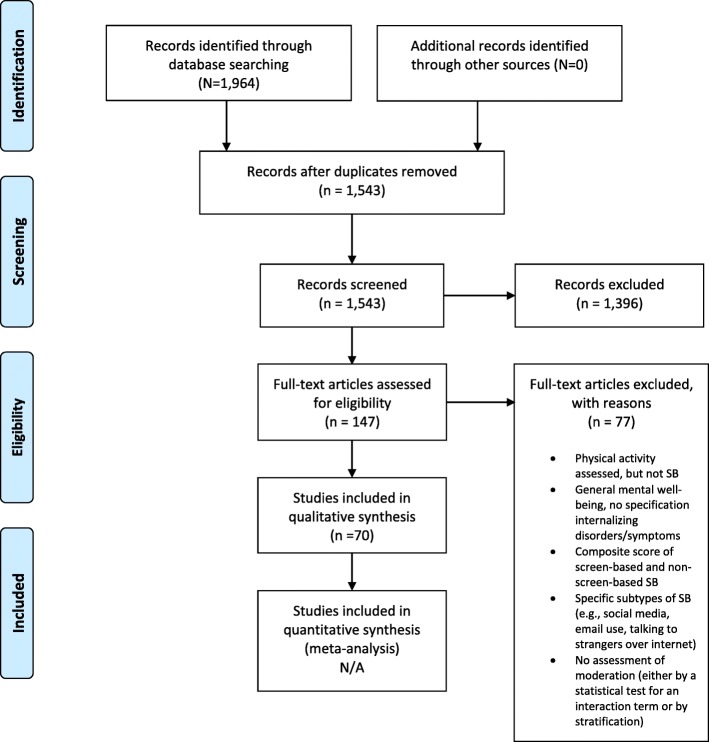
Background: To elucidate the populations and conditions where screen-based sedentary behaviors (SB) and internalizing symptoms are coupled, this review synthesized the evidence for factors that may moderate the associations between screen-based SB, depressive symptoms, and anxiety symptoms among youth. Methods: Two independent researchers conducted a systematic literature search of the Medline, psycINFO, and Scopus electronic databases in late 2018 for observational studies assessing moderators of the association between screen-based SB and depressive and anxiety symptoms. Studies among children and adolescents were eligible if moderation was assessed by statistical test (interaction) or stratification; and a narrative synthesis of eligible studies was conducted in accordance with PRISMA guidelines. Results: Seventy empirical studies (46 cross-sectional, 19 longitudinal, and 5 both) of 13 different moderating variables of screen-based SB-internalizing symptom associations met the eligibility criteria. Of these, 40 studies were of depressive symptoms, 2 were of anxiety symptoms, and 28 studies assessed symptoms of both. The most consistent evidence of moderation was for screen-type, such that TV viewing was not as strongly associated with internalizing symptoms compared to other forms of screen-based SB. There was also inconsistent evidence for physical activity buffering screen-based SB-internalizing symptom associations and for female sex amplifying screen-based SB-internalizing symptom associations. In general, the body of evidence for anxiety symptoms was more limited than that for depressive symptoms, and were therefore more inconsistent. Conclusions: Screen-type, physical activity, and sex may influence the magnitude of screen-based SB-internalizing symptom coupling; highlighting potential sources of heterogeneity of screen-based SB-internalizing symptom associations. Additional studies aimed at understanding potential mechanistic explanations for the above moderators are needed prior to the development of tailored intervention strategies designed to decouple screen-based SB and internalizing symptoms among youth.
Overview
The claims and statistics of this paper haven’t been checked yet.
Free: it reads the open-access text and checks the first 5 claims that cite a source we can check. Create a free account to check every claim.
Integrity signals
Registry
Cites
Statistics
Figures
Verification
Claims the paper makes
The claims and statistics of this paper haven’t been checked yet.
Free: it reads the open-access text and checks the first 5 claims that cite a source we can check. Create a free account to check every claim.
Claims other papers make about this one
Each is checked against this paper’s own text: does it say what the citing paper says it does?
The cited source doesn’t support the claim as written.
In the citing paper
“Furthermore, it remains unclear whether specific modalities of screen time (e.g., device type, digital media type, and specific websites and applications) are differentially associated with adolescent mental health outcomes, prompting a call for researchers to conduct more nuanced measurements and analyses of screen use that focus on the contents, contexts, and environments in which digital media”
From Screen time and mental health: a prospective analysis of the Adolescent Brain Cognitive Development (ABCD) Study (2024) · cites this paper as [51]
Checked by a reasoning model — may be wrong.
Experimental — accuracy not yet measuredThe source backs part of the claim, not all of it — or backs it for a different population, condition or comparison.
In the citing paper
“The current review is consistent with other reviews that concluded that the type, use and content of the screen influences the relationship between mental health problems and ST [11, 13, 72].”
From The associations between screen time and mental health in adolescents: a systematic review (2023) · cites this paper as [72]
Experimental — accuracy not yet measuredIn the citing paper
“Prior studies have identified sex differences in the relationship between screen time and mental health outcomes, but this evidence remains inconsistent across studies [11, 12, 51], calling for additional longitudinal analyses to provide further insight into the moderating effect of sex.”
From Screen time and mental health: a prospective analysis of the Adolescent Brain Cognitive Development (ABCD) Study (2024) · cites this paper as [51]
Self-check
Percentages, sums and reported differences re-computed from the paper’s own numbers.
The self-check needs the paper’s full text.
Citations
Cites
Preferred Reporting Items for Systematic Reviews and Meta-Analyses: the PRISMA statement
Moher, D., Liberati, A., Tetzlaff, J., Altman, D. G., & for the PRISMA Group (2009) · BMJ · doi:10.1136/bmj.b2535 · Cited by 83,823
Preferred reporting items for systematic reviews and meta-analyses: the PRISMA Statement.
(2009) · PubMed Central · Cited by 44,859
Preferred reporting items for systematic reviews and meta-analyses: The PRISMA statement
Moher, D., Liberati, A., Tetzlaff, J., Altman, D. G., & the PRISMA Group* (2009) · Annals of Internal Medicine · doi:10.7326/0003-4819-151-4-200908180-00135 · Cited by 37,554
Interrater reliability: The kappa statistic
McHugh, M. L. (2012) · Biochemia Medica · doi:10.11613/bm.2012.031 · Cited by 19,877
Ecological momentary assessment
Shiffman, S., Stone, A. A., & Hufford, M. R. (2008) · Annual Review of Clinical Psychology · doi:10.1146/annurev.clinpsy.3.022806.091415 · Cited by 6,454
Merikangas, K. R., He, J.-P., Burstein, M., Swanson, S. A., Avenevoli, S., Cui, L., Benjet, C., Georgiades, K., & Swendsen, J. (2010) · Journal of the American Academy of Child & Adolescent Psychiatry · doi:10.1016/j.jaac.2010.05.017 · Cited by 6,278 · cited 1×
“9%, respectively [6], but the incidence of subclinical depression and anxiety levels is much higher [7, 8].”
BackgroundThe benefits of playing video games.
Granic, I., Lobel, A., & Engels, R. C. M. E. (2014) · American Psychologist · doi:10.1037/a0034857 · Cited by 2,456
Thapar, A., Collishaw, S., Pine, D. S., & Thapar, A. K. (2012) · The Lancet · doi:10.1016/s0140-6736(11)60871-4 · Cited by 2,365
Twenge, J. M., Joiner, T. E., Rogers, M. L., & Martin, G. N. (2018) · Clinical Psychological Science · doi:10.1177/2167702617723376 · Cited by 1,705 · cited 5×
“Social media was also a screen-based SB that was investigated in two studies; both demonstrated that social media use was more strongly related to depressive symptoms compared to other forms of screen-based SB [50, 84].”
BackgroundInfluentialBeesdo, K., Knappe, S., & Pine, D. S. (2009) · Psychiatric Clinics of North America · doi:10.1016/j.psc.2009.06.002 · Cited by 1,703
Adolescent Brain Development: A Period of Vulnerabilities and Opportunities. Keynote Address
DAHL, R. E. (2004) · Annals of the New York Academy of Sciences · doi:10.1196/annals.1308.001 · Cited by 1,667 · cited 1×
“Paralleling the rising rates of screen-based SB, the adolescent developmental period is also a high-risk period for the onset of internalizing symptoms and disorders [5].”
BackgroundRodriguez-Ayllon, M., Cadenas-Sánchez, C., Estévez-López, F., Muñoz, N. E., Mora-Gonzalez, J., Migueles, J. H., Molina-García, P., Henriksson, H., Mena-Molina, A., Martínez-Vizcaíno, V., et al. (2019) · Sports Medicine · doi:10.1007/s40279-019-01099-5 · Cited by 1,360 · cited 1×
“Consistent with previous systematic reviews [19, 20], if 0–33% of studies of a particular moderating variable provided evidence of significant moderation, then the summary result was classified as null; if 34–59% of studies of a particular moderating variable provided evidence for significant moderation, then the summ…”
ResultHilpert, M., Brockmeier, K., Dordel, S., Koch, B., Weiß, V., Ferrari, N., Tokarski, W., & Graf, C. (2017) · Obesity Facts · doi:10.1159/000464105 · Cited by 1,185
Hyde, J. S., Mezulis, A. H., & Abramson, L. Y. (2008) · Psychological Review · doi:10.1037/0033-295x.115.2.291 · Cited by 1,146
Passive Facebook usage undermines affective well-being: Experimental and longitudinal evidence.
Verduyn, P., Lee, D. S., Park, J., Shablack, H., Orvell, A., Bayer, J., Ybarra, O., Jonides, J., & Kross, E. (2015) · Journal of Experimental Psychology: General · doi:10.1037/xge0000057 · Cited by 988
Lemola, S., Perkinson-Gloor, N., Brand, S., Dewald-Kaufmann, J. F., & Grob, A. (2015) · Journal of Youth and Adolescence · doi:10.1007/s10964-014-0176-x · Cited by 940
Cooper, A. R., Goodman, A., Page, A. S., Sherar, L. B., Esliger, D. W., van Sluijs, E. M., Andersen, L. B., Anderssen, S., Cardon, G., Davey, R., et al. (2015) · International Journal of Behavioral Nutrition and Physical Activity · doi:10.1186/s12966-015-0274-5 · Cited by 828
Smith, J. J., Eather, N., Morgan, P. J., Plotnikoff, R. C., Faigenbaum, A. D., & Lubans, D. R. (2014) · Sports Medicine · doi:10.1007/s40279-014-0196-4 · Cited by 795
Nesi, J., & Prinstein, M. J. (2015) · Journal of Abnormal Child Psychology · doi:10.1007/s10802-015-0020-0 · Cited by 758
Longitudinal physical activity and sedentary behavior trends
Gordon-Larsen, P., Nelson, M. C., & Popkin, B. M. (2004) · American Journal of Preventive Medicine · doi:10.1016/j.amepre.2004.07.006 · Cited by 708
Prevalence of and Risk Factors for Depressive Symptoms Among Young Adolescents
Saluja, G., Iachan, R., Scheidt, P. C., Overpeck, M. D., Sun, W., & Giedd, J. N. (2004) · Archives of Pediatrics & Adolescent Medicine · doi:10.1001/archpedi.158.8.760 · Cited by 701
Hoare, E., Milton, K., Foster, C., & Allender, S. (2016) · International Journal of Behavioral Nutrition and Physical Activity · doi:10.1186/s12966-016-0432-4 · Cited by 616
Trends in Sedentary Behavior Among the US Population, 2001-2016
Yang, L., Cao, C., Kantor, E. D., Nguyen, L. H., Zheng, X., Park, Y., Giovannucci, E. L., Matthews, C. E., Colditz, G. A., & Cao, Y. (2019) · JAMA · doi:10.1001/jama.2019.3636 · Cited by 593
Frison, E., & Eggermont, S. (2016) · Social Science Computer Review · doi:10.1177/0894439314567449 · Cited by 519
Sedentary behaviour and the risk of depression: a meta-analysis
Zhai, L., Zhang, Y., & Zhang, D. (2015) · British Journal of Sports Medicine · doi:10.1136/bjsports-2014-093613 · Cited by 500
Not so doomed: computer game play and positive adolescent development
Durkin, K., & Barber, B. (2002) · Journal of Applied Developmental Psychology · doi:10.1016/s0193-3973(02)00124-7 · Cited by 443
Cyber and Traditional Bullying: Differential Association with Depression
Wang, J., Nansel, T. R., & Iannotti, R. J. (2011) · Journal of Adolescent Health · doi:10.1016/j.jadohealth.2010.07.012 · Cited by 436
Screen time is associated with depression and anxiety in Canadian youth
Maras, D., Flament, M. F., Murray, M., Buchholz, A., Henderson, K. A., Obeid, N., & Goldfield, G. S. (2015) · Preventive Medicine · doi:10.1016/j.ypmed.2015.01.029 · Cited by 406
Selfhout, M. H. W., Branje, S. J. T., Delsing, M., ter Bogt, T. F. M., & Meeus, W. H. J. (2009) · Journal of Adolescence · doi:10.1016/j.adolescence.2008.10.011 · Cited by 375
Pate, R. R., Mitchell, J. A., Byun, W., & Dowda, M. (2011) · British Journal of Sports Medicine · doi:10.1136/bjsports-2011-090192 · Cited by 375
Desai, R. A., Krishnan-Sarin, S., Cavallo, D., & Potenza, M. N. (2010) · Pediatrics · doi:10.1542/peds.2009-2706 · Cited by 372 · cited 1×
“Only seven studies in adolescents found that female sex acted as a buffer of screen-based SB-depressive symptom associations [36, 46, 50, 67, 73, 82, 83].”
BackgroundLiu, M., Wu, L., & Yao, S. (2016) · British Journal of Sports Medicine · doi:10.1136/bjsports-2015-095084 · Cited by 364 · cited 1×
“While the abovementioned systematic reviews and meta-analyses were critical for identifying potentially positive associations between screen-based SB and internalizing symptoms, they also highlighted inconsistencies in the findings across the individual studies [12, 14].”
ResultThe association between sedentary behaviour and risk of anxiety: a systematic review
Teychenne, M., Costigan, S. A., & Parker, K. (2015) · BMC Public Health · doi:10.1186/s12889-015-1843-x · Cited by 351
Thorisdottir, I. E., Sigurvinsdottir, R., Asgeirsdottir, B. B., Allegrante, J. P., & Sigfusdottir, I. D. (2019) · Cyberpsychology, Behavior, and Social Networking · doi:10.1089/cyber.2019.0079 · Cited by 347
Babiss, L. A., & Gangwisch, J. E. (2009) · Journal of Developmental & Behavioral Pediatrics · doi:10.1097/dbp.0b013e3181b33659 · Cited by 294
Impact of Teen Depression on Academic, Social, and Physical Functioning
Jaycox, L. H., Stein, B. D., Paddock, S., Miles, J. N. V., Chandra, A., Meredith, L. S., Tanielian, T., Hickey, S., & Burnam, M. A. (2009) · Pediatrics · doi:10.1542/peds.2008-3348 · Cited by 288 · cited 1×
“Depression and anxiety in youth – even at levels below the threshold of a psychiatric diagnosis – increase risk for suicide, substance misuse, obesity [9, 10], poorer social development, and worse academic performance [11].”
BackgroundPhysical activity, leisure-time screen use and depression among children and young adolescents
Kremer, P., Elshaug, C., Leslie, E., Toumbourou, J. W., Patton, G. C., & Williams, J. (2014) · Journal of Science and Medicine in Sport · doi:10.1016/j.jsams.2013.03.012 · Cited by 287
Schmitz, K. H., Lytle, L. A., Phillips, G. A., Murray, D. M., Birnbaum, A. S., & Kubik, M. Y. (2002) · Preventive Medicine · doi:10.1006/pmed.2001.0982 · Cited by 274
Brodersen, N. H., Steptoe, A., Williamson, S., & Wardle, J. (2005) · Annals of Behavioral Medicine · doi:10.1207/s15324796abm2901_2 · Cited by 253 · cited 3×
“found female sex as an amplifier of screen-based SBanxiety symptom associations [29, 43, 69, 70, 87]; while one study found that sedentary boys had more symptoms of anxiety compared to sedentary girls [67].”
BackgroundMistry, K. B., Minkovitz, C. S., Strobino, D. M., & Borzekowski, D. L. G. (2007) · Pediatrics · doi:10.1542/peds.2006-3573 · Cited by 251
Depressive symptomatology, youth Internet use, and online interactions: A national survey
Ybarra, M. L., Alexander, C., & Mitchell, K. J. (2005) · Journal of Adolescent Health · doi:10.1016/j.jadohealth.2003.10.012 · Cited by 244
Fulkerson, J. A., Sherwood, N. E., Perry, C. L., Neumark-Sztainer, D., & Story, M. (2004) · Preventive Medicine · doi:10.1016/j.ypmed.2003.12.028 · Cited by 228
Internet use and video gaming predict problem behavior in early adolescence
Holtz, P., & Appel, M. (2011) · Journal of Adolescence · doi:10.1016/j.adolescence.2010.02.004 · Cited by 227
Physical Activity and Sedentary Behaviors and Health-Related Quality of Life in Adolescents
Gopinath, B., Hardy, L. L., Baur, L. A., Burlutsky, G., & Mitchell, P. (2012) · Pediatrics · doi:10.1542/peds.2011-3637 · Cited by 223
Game-based digital interventions for depression therapy: a systematic review and meta-analysis
Li, J., Theng, Y.-L., & Foo, S. (2014) · Cyberpsychology, Behavior, and Social Networking · doi:10.1089/cyber.2013.0481 · Cited by 219
The Effect of Exercise on Depressive Symptoms in Adolescents: A Systematic Review and Meta-Analysis
Carter, T., Morres, I. D., Meade, O., & Callaghan, P. (2016) · Journal of the American Academy of Child & Adolescent Psychiatry · doi:10.1016/j.jaac.2016.04.016 · Cited by 213
Screen time, physical activity and mental health among urban adolescents in China
Cao, H., Qian, Q., Weng, T., Yuan, C., Sun, Y., Wang, H., & Tao, F. (2011) · Preventive Medicine · doi:10.1016/j.ypmed.2011.09.002 · Cited by 211
Bélair, M.-A., Kohen, D. E., Kingsbury, M., & Colman, I. (2018) · BMJ Open · doi:10.1136/bmjopen-2017-021119 · Cited by 211
Early Childhood Electronic Media Use as a Predictor of Poorer Well-being: A Prospective Cohort Study
Hinkley, T., Verbestel, V., Ahrens, W., Lissner, L., Molnár, D., Moreno, L. A., Pigeot, I., Pohlabeln, H., Reisch, L. A., Russo, P., et al. (2014) · JAMA Pediatrics · doi:10.1001/jamapediatrics.2014.94 · Cited by 209
Video Gaming and Children’s Psychosocial Wellbeing: A Longitudinal Study
Lobel, A., Engels, R. C. M. E., Stone, L. L., Burk, W. J., & Granic, I. (2017) · Journal of Youth and Adolescence · doi:10.1007/s10964-017-0646-z · Cited by 204
Gunnell, K. E., Flament, M. F., Buchholz, A., Henderson, K. A., Obeid, N., Schubert, N., & Goldfield, G. S. (2016) · Preventive Medicine · doi:10.1016/j.ypmed.2016.04.002 · Cited by 196
Electronic Media Use and Adolescent Health and Well-Being: Cross-Sectional Community Study
Mathers, M., Canterford, L., Olds, T., Hesketh, K., Ridley, K., & Wake, M. (2009) · Academic Pediatrics · doi:10.1016/j.acap.2009.04.003 · Cited by 195
Wolitzky-Taylor, K., Bobova, L., Zinbarg, R. E., Mineka, S., & Craske, M. G. (2012) · Addictive Behaviors · doi:10.1016/j.addbeh.2012.03.026 · Cited by 195
Parkes, A., Sweeting, H., Wight, D., & Henderson, M. (2013) · Archives of Disease in Childhood · doi:10.1136/archdischild-2011-301508 · Cited by 194 · cited 6×
“Lastly, four studies found that each form of screenbased SB assessed was unrelated to symptoms of anxiety [24, 71, 72, 92].”
BackgroundInfluentialHankin, B. L. (2009) · Journal of Clinical Child & Adolescent Psychology · doi:10.1080/15374410902976288 · Cited by 188
A U-Shaped Association Between Intensity of Internet Use and Adolescent Health
Bélanger, R. E., Akre, C., Berchtold, A., & Michaud, P.-A. (2011) · Pediatrics · doi:10.1542/peds.2010-1235 · Cited by 176
Davison, K. K., Werder, J. L., Trost, S. G., Baker, B. L., & Birch, L. L. (2007) · Social Science & Medicine · doi:10.1016/j.socscimed.2007.02.033 · Cited by 173 · cited 1×
“For girls in particular, puberty tends to be a time of high psychological distress, low self-esteem, and body-discontentment [17].”
BackgroundRubin, K. H., & Burgess, K. B. (2001) · The Developmental Psychopathology of Anxiety · doi:10.1093/med:psych/9780195123630.003.0018 · Cited by 173 · cited 1×
“For example, the social withdrawal theory postulates that engaging in screen-based SB can lead to social isolation, which may increase risk for internalizing symptoms [15].”
BackgroundDo, Y. K., Shin, E., Bautista, M. A., & Foo, K. (2013) · Sleep Medicine · doi:10.1016/j.sleep.2012.09.004 · Cited by 167
Houghton, S., Lawrence, D., Hunter, S. C., Rosenberg, M., Zadow, C., Wood, L., & Shilton, T. (2018) · Journal of Youth and Adolescence · doi:10.1007/s10964-018-0901-y · Cited by 162
Hrafnkelsdottir, S. M., Brychta, R. J., Rognvaldsdottir, V., Gestsdottir, S., Chen, K. Y., Johannsson, E., Guðmundsdottir, S. L., & Arngrimsson, S. A. (2018) · PLOS ONE · doi:10.1371/journal.pone.0196286 · Cited by 159 · cited 2×
“Two found that vigorous PA weakened screenbased SB-anxiety symptom associations [30, 51], while one did not provide evidence for leisure-time PA moderating screen-based SB-anxiety symptom associations [26].”
BackgroundVirtually impossible: limiting Australian children and adolescents daily screen based media use
Houghton, S., Hunter, S. C., Rosenberg, M., Wood, L., Zadow, C., Martin, K., & Shilton, T. (2015) · BMC Public Health · doi:10.1186/1471-2458-15-5 · Cited by 154
Romer, D., Bagdasarov, Z., & More, E. (2013) · Journal of Adolescent Health · doi:10.1016/j.jadohealth.2012.11.012 · Cited by 145 · cited 1×
“Four studies (one among a clinical sample) with smaller sample sizes found that age was not a significant moderator of screen-based SB-depressive symptom associations [61, 72, 74, 76].”
BackgroundMedia Use and Adolescent Psychological Adjustment: An Examination of Gender Differences
Ohannessian, C. M. (2009) · Journal of Child and Family Studies · doi:10.1007/s10826-009-9261-2 · Cited by 142
Hinkley, T., Teychenne, M., Downing, K. L., Ball, K., Salmon, J., & Hesketh, K. D. (2014) · Preventive Medicine · doi:10.1016/j.ypmed.2014.02.007 · Cited by 141 · cited 2×
“Finally, seven studies (one among a clinical sample) found that engagement in each screen-type (including computer use) was unrelated to depressive symptoms [24, 69, 71, 72, 74, 85, 92].”
BackgroundThomas, G., Bennie, J. A., De Cocker, K., Castro, O., & Biddle, S. J. H. (2020) · Child Indicators Research · doi:10.1007/s12187-019-09663-1 · Cited by 139 · cited 1×
“Even more concerning, the prevalence of screenbased SB increases across childhood and adolescence [2].”
BackgroundYan, H., Zhang, R., Oniffrey, T., Chen, G., Wang, Y., Wu, Y., Zhang, X., Wang, Q., Ma, L., Li, R., et al. (2017) · International Journal of Environmental Research and Public Health · doi:10.3390/ijerph14060596 · Cited by 137 · cited 3×
“On non-school days, however, only social networking sites were related to symptoms of anxiety in this sample [88].”
BackgroundResultInfluentialMedia use and depression: exposure, household rules, and symptoms among young adolescents in the USA
Bickham, D. S., Hswen, Y., & Rich, M. (2015) · International Journal of Public Health · doi:10.1007/s00038-014-0647-6 · Cited by 134
Self-regulation, rumination, and vulnerability to depression in adolescent girls
PAPADAKIS, A. A., PRINCE, R. P., JONES, N. P., & STRAUMAN, T. J. (2006) · Development and Psychopathology · doi:10.1017/s0954579406060408 · Cited by 128
EEG, HRV and Psychological Correlates while Playing Bejeweled II: A Randomized Controlled Study.
Russoniello, C., O'Brien, K. F., & Parks, J. M. (2009) · PubMed · Cited by 122
Patterns of Physical Activity, Sedentary Behavior, and Diet in U.S. Adolescents
Iannotti, R. J., & Wang, J. (2013) · Journal of Adolescent Health · doi:10.1016/j.jadohealth.2013.03.007 · Cited by 117
Rumination mediates the association between cyber-victimization and depressive symptoms
Feinstein, B. A., Bhatia, V., & Davila, J. (2014) · Journal of Interpersonal Violence · doi:10.1177/0886260513511534 · Cited by 115
Depressive symptoms in adolescence: the association with multiple health risk behaviors
Katon, W., Richardson, L., Russo, J., McCarty, C. A., Rockhill, C., McCauley, E., Richards, J., & Grossman, D. C. (2010) · General Hospital Psychiatry · doi:10.1016/j.genhosppsych.2010.01.008 · Cited by 111
Alloy, L. B., Hamilton, J. L., Hamlat, E. J., & Abramson, L. Y. (2016) · Clinical Psychological Science · doi:10.1177/2167702616643008 · Cited by 111
Hayward, J., Jacka, F. N., Skouteris, H., Millar, L., Strugnell, C., Swinburn, B. A., & Allender, S. (2016) · Australian & New Zealand Journal of Psychiatry · doi:10.1177/0004867416671596 · Cited by 111 · cited 1×
“Only seven studies in adolescents found that female sex acted as a buffer of screen-based SB-depressive symptom associations [36, 46, 50, 67, 73, 82, 83].”
BackgroundReciprocal Associations between Electronic Media Use and Behavioral Difficulties in Preschoolers
Poulain, T., Vogel, M., Neef, M., Abicht, F., Hilbert, A., Genuneit, J., Körner, A., & Kiess, W. (2018) · International Journal of Environmental Research and Public Health · doi:10.3390/ijerph15040814 · Cited by 111 · cited 10×
“Lastly, four studies found that each form of screenbased SB assessed was unrelated to symptoms of anxiety [24, 71, 72, 92].”
BackgroundInfluentialPhysical Activity, Affect, and Cognition in Children With Symptoms of ADHD
Gawrilow, C., Stadler, G., Langguth, N., Naumann, A., & Boeck, A. (2016) · Journal of Attention Disorders · doi:10.1177/1087054713493318 · Cited by 109
Media use and health outcomes in adolescents: findings from a nationally representative survey.
Casiano, H., Kinley, J., Katz, L. Y., Chartier, M., & Sareen, J. (2012) · Europe PMC (PubMed Central) · Cited by 95
Greaves‐Lord, K., Ferdinand, R. F., Sondeijker, F., Dietrich, A., Oldehinkel, A. J., Rosmalen, J. G. M., Ormel, J., & Verhulst, F. C. (2007) · Journal of Affective Disorders · doi:10.1016/j.jad.2006.12.009 · Cited by 94
Griffiths, L. J., Dowda, M., Dezateux, C., & Pate, R. (2010) · International Journal of Behavioral Nutrition and Physical Activity · doi:10.1186/1479-5868-7-30 · Cited by 93
Park, S. (2009) · Women s Studies International Forum · doi:10.1016/j.wsif.2009.03.009 · Cited by 93 · cited 1×
“Further, the online environment may be especially hostile for adolescent girls, who report being exposed to more unintentional negative online content (sexual content, slander) compared to boys [95].”
BackgroundPhysical Activity, Sedentary Behavior, and Depressive Symptoms Among Adolescents
Hume, C., Timperio, A., Veitch, J., Salmon, J., Crawford, D., & Ball, K. (2011) · Journal of Physical Activity and Health · doi:10.1123/jpah.8.2.152 · Cited by 90
Sport participation and anxiety in children with ADHD
Kiluk, B. D., Weden, S., & Culotta, V. P. (2009) · Journal of Attention Disorders · doi:10.1177/1087054708320400 · Cited by 90
A prospective study of screen time in adolescence and depression symptoms in young adulthood
Grøntved, A., Singhammer, J., Froberg, K., Møller, N. C., Pan, A., Pfeiffer, K. A., & Kristensen, P. L. (2015) · Preventive Medicine · doi:10.1016/j.ypmed.2015.08.009 · Cited by 85 · cited 2×
“another screen-based SB (depressive symptoms: n = 29; anxiety symptoms: n = 12) Of the 29 studies that assessed the relationship between computer use and depressive symptoms, five determined that computer use was more weakly associated with depressive symptoms compared to at least one other form of screen-based SB [35…”
BackgroundDaily Violent Video Game Playing and Depression in Preadolescent Youth
Tortolero, S. R., Peskin, M. F., Baumler, E. R., Cuccaro, P. M., Elliott, M. N., Davies, S. L., Lewis, T. H., Banspach, S. W., Kanouse, D. E., & Schuster, M. A. (2014) · Cyberpsychology Behavior and Social Networking · doi:10.1089/cyber.2014.0091 · Cited by 85
SINGER, M. I., SLOVAK, K., FRIERSON, T., & YORK, P. (1998) · Journal of the American Academy of Child & Adolescent Psychiatry · doi:10.1097/00004583-199810000-00014 · Cited by 79
After-school time use in Taiwan: effects on educational achievement and well-being.
Chen, S., & Lu, L. (2009) · PubMed · Cited by 78
(2015) · Europe PMC (PubMed Central) · Cited by 78
Omorou, A. Y., Langlois, J., Lecomte, E., Briançon, S., & Vuillemin, A. (2015) · Quality of Life Research · doi:10.1007/s11136-015-1172-7 · Cited by 77
Allen, M. S., & Vella, S. A. (2015) · Mental Health and Physical Activity · doi:10.1016/j.mhpa.2015.10.002 · Cited by 75
McVeigh, J., Smith, A., Howie, E., & Straker, L. (2016) · PLOS ONE · doi:10.1371/journal.pone.0152879 · Cited by 70
Wu, X., Bastian, K., Öhinmaa, A., & Veugelers, P. J. (2017) · Annals of Epidemiology · doi:10.1016/j.annepidem.2017.12.002 · Cited by 66
Lifestyle and demographic correlates of poor mental health in early adolescence
Robinson, M., Kendall, G. E., Jacoby, P., Hands, B., Beilin, L. J., Silburn, S. R., Zubrick, S. R., & Oddy, W. H. (2011) · Journal of Paediatrics and Child Health · doi:10.1111/j.1440-1754.2010.01891.x · Cited by 63
Reciprocal associations between screen time and emotional disorder symptoms during adolescence
Zink, J., Belcher, B. R., Kechter, A., Stone, M. D., & Leventhal, A. M. (2019) · Preventive Medicine Reports · doi:10.1016/j.pmedr.2019.01.014 · Cited by 62
Self-citationRottenberg, J., Yaroslavsky, I., Carney, R. M., Freedland, K. E., George, C. J., Baji, I., Dochnal, R., Gádoros, J., Halas, K., Kapornai, K., et al. (2014) · Psychosomatic Medicine · doi:10.1097/psy.0000000000000028 · Cited by 61
Screen time is associated with depressive symptomatology among obese adolescents: a HEARTY study
Goldfield, G. S., Murray, M., Maras, D., Wilson, A. L., Phillips, P., Kenny, G. P., Hadjiyannakis, S., Alberga, A., Cameron, J. D., Tulluch, H., et al. (2016) · European Journal of Pediatrics · doi:10.1007/s00431-016-2720-z · Cited by 55
Ohannessian, C. M. (2018) · Journal of Affective Disorders · doi:10.1016/j.jad.2017.10.009 · Cited by 54
Electronic screen use and mental well-being of 10-12-year-old children
Yang, F., Helgason, A. R., Sigfusdottir, I. D., & Kristjansson, A. L. (2013) · The European Journal of Public Health · doi:10.1093/eurpub/cks102 · Cited by 52
Understanding low adherence to an exercise program for adolescents with obesity: the HEARTY trial
Alberga, A. S., Sigal, R. J., Sweet, S. N., Doucette, S. P., Russell‐Mayhew, S., Tulloch, H. E., Kenny, G. P., Prud’homme, D., Hadjiyannakis, S., & Goldfield, G. S. (2019) · Obesity Science & Practice · doi:10.1002/osp4.357 · Cited by 52 · cited 1×
“Adherence to PA programs steadily decreases over time, especially among those with depressive symptoms [120].”
BackgroundLiu, M., Ming, Q., Yi, J., Wang, X., & Yao, S. (2016) · Frontiers in Psychology · doi:10.3389/fpsyg.2016.00574 · Cited by 50 · cited 3×
“Four studies (two among clinical samples) found that computer use was positively associated with symptoms of anxiety, and that computer use was more strongly related to symptoms of anxiety than other forms of screen-based SB [62, 69, 86, 87]; whereas one study found that computer use was protective against symptoms of…”
BackgroundBarcaccia, B., Balestrini, V., Saliani, A. M., Baiocco, R., Mancini, F., & Schneider, B. H. (2017) · Brazilian Journal of Psychiatry · doi:10.1590/1516-4446-2016-2200 · Cited by 50
Suchert, V., Hanewinkel, R., Isensee, B., & läuft Study Group (2015) · Journal of Adolescence · doi:10.1016/j.adolescence.2015.03.014 · Cited by 49
Castillo, F. B., Francis, L. A., Wylie‐Rosett, J., & Isasi, C. R. (2014) · Childhood Obesity · doi:10.1089/chi.2014.0042 · Cited by 44
Straker, L., Smith, A., Hands, B., Olds, T., & Abbott, R. (2013) · BMC Public Health · doi:10.1186/1471-2458-13-1174 · Cited by 43
Kim, J. Y. (2012) · Journal of Preventive Medicine & Public Health · doi:10.3961/jpmph.2012.45.1.37 · Cited by 43 · cited 2×
“Furthermore, the majority (11 of the 14, one among a clinical sample) of these studies were conducted in large samples of over 1500 participants, including children and those in early- and mid- adolescence [29, 39, 40, 43, 56, 62, 81, 84, 87, 89, 90].”
BackgroundCultural Orientations, Daily Activities, and Adjustment in Mexican American Youth
McHale, S. M., Updegraff, K. A., Kim, J.-Y., & Cansler, E. (2009) · Journal of Youth and Adolescence · doi:10.1007/s10964-008-9321-8 · Cited by 41
LGBTQ Youths' School Athletic Experiences: A 40-Year Content Analysis in Nine Flagship Journals
Greenspan, S. B., Griffith, C., & Murtagh, E. F. (2017) · Journal of LGBTQ Issues in Counseling · doi:10.1080/15538605.2017.1346492 · Cited by 39
Marques, A., Sallis, J. F., Martins, J., Diniz, J. A., & da Costa, F. C. (2014) · American Journal of Human Biology · doi:10.1002/ajhb.22535 · Cited by 38
Computer/gaming station use in youth: Correlations among use, addiction and functional impairment
BAER, S., Saran, K., & Green, D. A. (2012) · Paediatrics & Child Health · doi:10.1093/pch/17.8.427 · Cited by 38
Primack, B. A., Silk, J. S., DeLozier, C. R., Shadel, W. G., Dillman Carpentier, F. R., Dahl, R. E., & Switzer, G. E. (2011) · Archives of Pediatrics & Adolescent Medicine · doi:10.1001/archpediatrics.2011.27 · Cited by 37
Association of after school sedentary behaviour in adolescence with mental wellbeing in adulthood
Hamer, M., Yates, T., Sherar, L. B., Clemes, S. A., & Shankar, A. (2016) · Preventive Medicine · doi:10.1016/j.ypmed.2016.02.021 · Cited by 37
The Association Between Electronic Media and Emotional and Behavioral Problems in Late Childhood
Mundy, L. K., Canterford, L., Olds, T., Allen, N. B., & Patton, G. C. (2017) · Academic Pediatrics · doi:10.1016/j.acap.2016.12.014 · Cited by 36
Hoare, E., Millar, L., Fuller-Tyszkiewicz, M., Skouteris, H., Nichols, M., Jacka, F., Swinburn, B., Chikwendu, C., & Allender, S. (2014) · Journal of Epidemiology and Community Health · doi:10.1136/jech-2013-203562 · Cited by 35
Liao, Y., Intille, S., Wolch, J., Pentz, M. A., & Dunton, G. F. (2014) · Journal of Physical Activity and Health · doi:10.1123/jpah.2011-0363 · Cited by 34
Kleppang, A. L., Thurston, M., Hartz, I., & Hagquist, C. (2019) · Scandinavian Journal of Public Health · doi:10.1177/1403494817716374 · Cited by 33 · cited 1×
“2009) influenced the strength of screen-based SB-internalizing symptom associations and found no evidence of moderation [58].”
BackgroundWhiteley, L., Brown, L. K., Swenson, R. R., Römer, D., DiClemente, R. J., Salazar, L. F., Vanable, P. A., Carey, M. P., & Valois, R. F. (2011) · PubMed · Cited by 30
Association Between Media Use in Adolescence and Depression in Young Adulthood: A Longitudinal Study
Primack, B. A., Swanier, B., Georgiopoulos, A. M., Land, S. R., & Fine, M. J. (2009) · Archives of General Psychiatry · doi:10.1001/archgenpsychiatry.2008.532 · Cited by 30
Khan, A., & Burton, N. W. (2017) · Mental Health and Physical Activity · doi:10.1016/j.mhpa.2017.03.001 · Cited by 27
Wu, X., Kirk, S., Öhinmaa, A., & Veugelers, P. J. (2017) · BMC Psychology · doi:10.1186/s40359-017-0208-x · Cited by 27
Secular Trends in Sedentary Behavior Among High School Students in the United States, 2003 to 2015
Ryu, S., Kim, H., Kang, M., Pedišić, Ž., & Loprinzi, P. D. (2019) · American Journal of Health Promotion · doi:10.1177/0890117119854043 · Cited by 26
Nakamura, H., Ohara, K., Kouda, K., Fujita, Y., Mase, T., Miyawaki, C., Okita, Y., & Ishikawa, T. (2012) · BMC Public Health · doi:10.1186/1471-2458-12-432 · Cited by 25
Longitudinal Changes in Children’s Accelerometer-derived Activity Pattern Metrics
DUNTON, G. F., YANG, C.-H., ZINK, J., DZUBUR, E., & BELCHER, B. R. (2020) · Medicine & Science in Sports & Exercise · doi:10.1249/mss.0000000000002247 · Cited by 25
Self-citationKrejčí, M., Wada, K., Nakade, M., Takeuchi, H., Noji, T., & Harada, T. (2011) · Psychology · doi:10.4236/psych.2011.27103 · Cited by 22
Characteristics associated with media use in early adolescence
Godinho, J., Araújo, J., Barros, H., & Ramos, E. (2014) · Cadernos de Saúde Pública · doi:10.1590/0102-311x00100313 · Cited by 16
Kim, H. H., & Ahn, S. J. (2016) · Cyberpsychology Behavior and Social Networking · doi:10.1089/cyber.2016.0155 · Cited by 14
Cho, D., & Park, C. L. (2016) · Preventive Medicine · doi:10.1016/j.ypmed.2016.12.047 · Cited by 13
Obesogenic Behaviors, Self-Efficacy, and Depressive Symptoms in American Indian Children
Dennison-Farris, M. E., Sisson, S. B., Stephens, L. D., Morris, A. S., & Dickens, R. D. (2017) · American Indian and Alaska Native Mental Health Research · doi:10.5820/aian.2402.2017.18 · Cited by 7
Schreck, M. C., Althoff, R. R., Bartels, M., de Geus, E. J. C., Sibold, J., Giummo, C. A., Rubin, D. H., & Hudziak, J. J. (2016) · Journal of Clinical Sport Psychology · doi:10.1123/jcsp.2015-0031 · Cited by 5
Fish, M. T. (2011) · The Scholarship East Carolina University's Institutional Repository (East Carolina University) · Cited by 4
Research works printed but not linked: 1
- Thomas H Quality assessment tool for quantitative studies 2003 Toronto Effective Public Health Practice Project McMaster University
Cited by
The associations between screen time and mental health in adolescents: a systematic review
Santos, R. M. S., Mendes, C. G., Sen Bressani, G. Y., de Alcantara Ventura, S., de Almeida Nogueira, Y. J., de Miranda, D. M., & Romano-Silva, M. A. (2023) · BMC Psychology · doi:10.1186/s40359-023-01166-7 · Cited by 311
Tang, S., Werner-Seidler, A., Torok, M., Mackinnon, A. J., & Christensen, H. (2021) · Clinical Psychology Review · doi:10.1016/j.cpr.2021.102021 · Cited by 284
Screen Use and Mental Health Symptoms in Canadian Children and Youth During the COVID-19 Pandemic
Li, X., Vanderloo, L. M., Keown-Stoneman, C. D. G., Cost, K. T., Charach, A., Maguire, J. L., Monga, S., Crosbie, J., Burton, C., Anagnostou, E., et al. (2021) · JAMA Network Open · doi:10.1001/jamanetworkopen.2021.40875 · Cited by 135
Nagata, J. M., Al-Shoaibi, A. A. A., Leong, A. W., Zamora, G., Testa, A., Ganson, K. T., & Baker, F. C. (2024) · BMC Public Health · doi:10.1186/s12889-024-20102-x · Cited by 103
“…mixed findings that are difficult to collectively interpret [75, 105, 106], highlighting the need to consider different modalities of screen time [11, 51, 87, 89, 90], control for demographic variables and other potential confounders [107], and include more longitudinal perspectives [75, 108, 109].”
BackgroundResultInfluentialZhang, J., Yang, S. X., Wang, L., Han, L. H., & Wu, X. (2022) · Journal of Affective Disorders · doi:10.1016/j.jad.2022.03.018 · Cited by 108
Metadata
- Authors
- Zink, J., Belcher, B. R., Imm, K., & Leventhal, A. M.
- Affiliations
- University of Southern California (US)
- Corresponding author
- Belcher, Britni R.
- Venue
- BMC Public Health
- Published
- 2020-04-10
- Volume
- 20
- Issue
- 1
- Pages
- 472-472
- ISSN
- 1471-2458 (ISSN-L)
- PMC
- PMC7147040
- OpenAlex
- W3015711792
- Semantic Scholar
- a01635fa0745bb6bf183dcdf298a724386c9d886
- Cited by
- 105
- References
- 129
- Citations by year
- 2026: 12 · 2025: 14 · 2024: 21 · 2023: 15 · 2022: 22 · 2021: 16 · 2020: 4
- FWCI
- 1.82
- Type
- journal article
- Language
- en
- Open access
- gold
- doi.org
- Licence
- cc-by
- creativecommons.org/licenses/by/4.0/ (tdm)
- creativecommons.org/licenses/by/4.0/ (vor)
- Locations
- BMC Public Health (publishedVersion, cc-by)
- PubMed Central (publishedVersion, cc-by)
- PubMed (publishedVersion)
- DOAJ (DOAJ: Directory of Open Access Journals) (submittedVersion, cc-by-sa)
- Funders
- National Cancer Institute (T32 CA009492)
- Topics
- Health Sciences › Medicine › Public Health, Environmental and Occupational Health › Physical Activity and Health
- Social Sciences › Education › Child Development and Digital Technology
- Social Sciences › Sociology and Political Science › Impact of Technology on Adolescents
- Keywords
- screen-based sedentary behavior, depressive symptoms, anxiety symptoms, internalizing problems, youth, children and adolescents, television viewing, physical activity, sex differences, moderators
- MeSH terms
- Screen Time, Adolescent, Anxiety, Child, Depression, Humans, Risk Factors, Sedentary Behavior
About these checks
Registry, retraction, Cites and statistics results are computed, not judged, with one exception: a printed reference that no index lists is read once by a model before it counts as a citation error. Claims are extracted by a model and kept only when their quote appears verbatim in the text; each cited source is then checked, with a model’s help, for whether it says what the claim relies on. Those verdicts can be wrong — read the claim’s quote and the cited source before relying on one.
Statistics and arithmetic are recomputed, not judged.
Confidence bands are shown only for fields calibrated on our annotated test set. None is calibrated yet, so no band is shown.
What counts as a claim ›How we measure confidence ›How we check this ›
Are you an author, or do you see a problem with this page? Request a review
Data sources
Bibliographic data: Semantic Scholar, OpenAlex, Crossref.
Contains information from the Semantic Scholar Academic Graph Datasets, made available under the ODC Attribution License (ODC-BY 1.0).
Semantic Scholar’s data is described in: Kinney, R., et al. (2023). The Semantic Scholar Open Data Platform. arXiv:2301.10140.
