

The relationship between screen-based sedentary behaviors and symptoms of depression and anxiety in youth: a systematic review of moderating variables
Open accessThe DOI matches its Crossref record; 129 of the 129 references it cites were found in a registry or an index.
Abstract
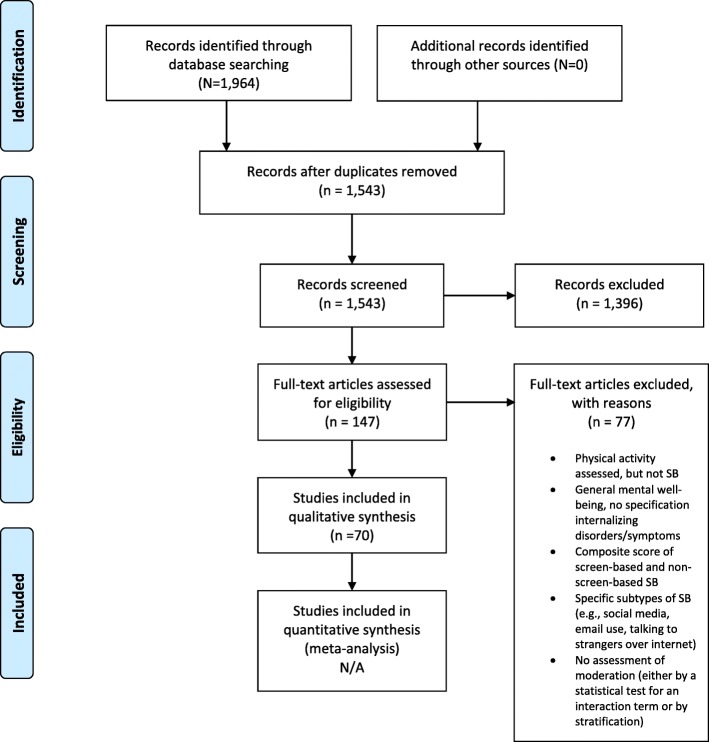
Background: To elucidate the populations and conditions where screen-based sedentary behaviors (SB) and internalizing symptoms are coupled, this review synthesized the evidence for factors that may moderate the associations between screen-based SB, depressive symptoms, and anxiety symptoms among youth. Methods: Two independent researchers conducted a systematic literature search of the Medline, psycINFO, and Scopus electronic databases in late 2018 for observational studies assessing moderators of the association between screen-based SB and depressive and anxiety symptoms. Studies among children and adolescents were eligible if moderation was assessed by statistical test (interaction) or stratification; and a narrative synthesis of eligible studies was conducted in accordance with PRISMA guidelines. Results: Seventy empirical studies (46 cross-sectional, 19 longitudinal, and 5 both) of 13 different moderating variables of screen-based SB-internalizing symptom associations met the eligibility criteria. Of these, 40 studies were of depressive symptoms, 2 were of anxiety symptoms, and 28 studies assessed symptoms of both. The most consistent evidence of moderation was for screen-type, such that TV viewing was not as strongly associated with internalizing symptoms compared to other forms of screen-based SB. There was also inconsistent evidence for physical activity buffering screen-based SB-internalizing symptom associations and for female sex amplifying screen-based SB-internalizing symptom associations. In general, the body of evidence for anxiety symptoms was more limited than that for depressive symptoms, and were therefore more inconsistent. Conclusions: Screen-type, physical activity, and sex may influence the magnitude of screen-based SB-internalizing symptom coupling; highlighting potential sources of heterogeneity of screen-based SB-internalizing symptom associations. Additional studies aimed at understanding potential mechanistic explanations for the above moderators are needed prior to the development of tailored intervention strategies designed to decouple screen-based SB and internalizing symptoms among youth.
Overview
The claims and statistics of this paper haven’t been checked yet.
Free: it reads the open-access text and checks the first 5 claims that cite a source we can check. Create a free account to check every claim.
Integrity signals
Registry
Cites
Statistics
Figures
Verification
Claims the paper makes
The claims and statistics of this paper haven’t been checked yet.
Free: it reads the open-access text and checks the first 5 claims that cite a source we can check. Create a free account to check every claim.
Claims other papers make about this one
Each is checked against this paper’s own text: does it say what the citing paper says it does?
The cited source doesn’t support the claim as written.
In the citing paper
“Furthermore, it remains unclear whether specific modalities of screen time (e.g., device type, digital media type, and specific websites and applications) are differentially associated with adolescent mental health outcomes, prompting a call for researchers to conduct more nuanced measurements and analyses of screen use that focus on the contents, contexts, and environments in which digital media”
From Screen time and mental health: a prospective analysis of the Adolescent Brain Cognitive Development (ABCD) Study (2024) · cites this paper as [51]
Checked by a reasoning model — may be wrong.
Experimental — accuracy not yet measuredThe source backs part of the claim, not all of it — or backs it for a different population, condition or comparison.
In the citing paper
“The current review is consistent with other reviews that concluded that the type, use and content of the screen influences the relationship between mental health problems and ST [11, 13, 72].”
From The associations between screen time and mental health in adolescents: a systematic review (2023) · cites this paper as [72]
Experimental — accuracy not yet measuredIn the citing paper
“Prior studies have identified sex differences in the relationship between screen time and mental health outcomes, but this evidence remains inconsistent across studies [11, 12, 51], calling for additional longitudinal analyses to provide further insight into the moderating effect of sex.”
From Screen time and mental health: a prospective analysis of the Adolescent Brain Cognitive Development (ABCD) Study (2024) · cites this paper as [51]
Self-check
Percentages, sums and reported differences re-computed from the paper’s own numbers.
The self-check needs the paper’s full text.
Citations
Cites
Preferred Reporting Items for Systematic Reviews and Meta-Analyses: the PRISMA statement
Moher, D., Liberati, A., Tetzlaff, J., Altman, D. G., & for the PRISMA Group (2009) · BMJ · doi:10.1136/bmj.b2535 · Cited by 83,823
Preferred reporting items for systematic reviews and meta-analyses: the PRISMA Statement.
(2009) · PubMed Central · Cited by 44,859
Preferred reporting items for systematic reviews and meta-analyses: The PRISMA statement
Moher, D., Liberati, A., Tetzlaff, J., Altman, D. G., & the PRISMA Group* (2009) · Annals of Internal Medicine · doi:10.7326/0003-4819-151-4-200908180-00135 · Cited by 37,554
Interrater reliability: The kappa statistic
McHugh, M. L. (2012) · Biochemia Medica · doi:10.11613/bm.2012.031 · Cited by 19,877
Ecological momentary assessment
Shiffman, S., Stone, A. A., & Hufford, M. R. (2008) · Annual Review of Clinical Psychology · doi:10.1146/annurev.clinpsy.3.022806.091415 · Cited by 6,454
Merikangas, K. R., He, J.-P., Burstein, M., Swanson, S. A., Avenevoli, S., Cui, L., Benjet, C., Georgiades, K., & Swendsen, J. (2010) · Journal of the American Academy of Child & Adolescent Psychiatry · doi:10.1016/j.jaac.2010.05.017 · Cited by 6,278 · cited 1×
“9%, respectively [6], but the incidence of subclinical depression and anxiety levels is much higher [7, 8].”
BackgroundThe benefits of playing video games.
Granic, I., Lobel, A., & Engels, R. C. M. E. (2014) · American Psychologist · doi:10.1037/a0034857 · Cited by 2,456
Thapar, A., Collishaw, S., Pine, D. S., & Thapar, A. K. (2012) · The Lancet · doi:10.1016/s0140-6736(11)60871-4 · Cited by 2,365
Twenge, J. M., Joiner, T. E., Rogers, M. L., & Martin, G. N. (2018) · Clinical Psychological Science · doi:10.1177/2167702617723376 · Cited by 1,705 · cited 5×
“Social media was also a screen-based SB that was investigated in two studies; both demonstrated that social media use was more strongly related to depressive symptoms compared to other forms of screen-based SB [50, 84].”
BackgroundInfluentialBeesdo, K., Knappe, S., & Pine, D. S. (2009) · Psychiatric Clinics of North America · doi:10.1016/j.psc.2009.06.002 · Cited by 1,703
Research works printed but not linked: 1
- Thomas H Quality assessment tool for quantitative studies 2003 Toronto Effective Public Health Practice Project McMaster University
Cited by
The associations between screen time and mental health in adolescents: a systematic review
Santos, R. M. S., Mendes, C. G., Sen Bressani, G. Y., de Alcantara Ventura, S., de Almeida Nogueira, Y. J., de Miranda, D. M., & Romano-Silva, M. A. (2023) · BMC Psychology · doi:10.1186/s40359-023-01166-7 · Cited by 311
Tang, S., Werner-Seidler, A., Torok, M., Mackinnon, A. J., & Christensen, H. (2021) · Clinical Psychology Review · doi:10.1016/j.cpr.2021.102021 · Cited by 284
Screen Use and Mental Health Symptoms in Canadian Children and Youth During the COVID-19 Pandemic
Li, X., Vanderloo, L. M., Keown-Stoneman, C. D. G., Cost, K. T., Charach, A., Maguire, J. L., Monga, S., Crosbie, J., Burton, C., Anagnostou, E., et al. (2021) · JAMA Network Open · doi:10.1001/jamanetworkopen.2021.40875 · Cited by 135
Nagata, J. M., Al-Shoaibi, A. A. A., Leong, A. W., Zamora, G., Testa, A., Ganson, K. T., & Baker, F. C. (2024) · BMC Public Health · doi:10.1186/s12889-024-20102-x · Cited by 103
“…mixed findings that are difficult to collectively interpret [75, 105, 106], highlighting the need to consider different modalities of screen time [11, 51, 87, 89, 90], control for demographic variables and other potential confounders [107], and include more longitudinal perspectives [75, 108, 109].”
BackgroundResultInfluentialZhang, J., Yang, S. X., Wang, L., Han, L. H., & Wu, X. (2022) · Journal of Affective Disorders · doi:10.1016/j.jad.2022.03.018 · Cited by 108
Marciano, L., Lin, J., Sato, T., Saboor, S., & Viswanath, K. (2024) · SSM - Mental Health · doi:10.1016/j.ssmmh.2024.100331 · Cited by 80
Screen time in children and youth during the pandemic: A systematic review and meta-analysis
Choi, E. J., King, G. K. C., & Duerden, E. G. (2023) · Global Pediatrics · doi:10.1016/j.gpeds.2023.100080 · Cited by 106
Associations Among Screen Time, Sleep Duration and Depressive Symptoms Among Chinese Adolescents
Wang, W., Du, X., Guo, Y., Li, W., Zhang, S., Zhang, W., McIntyre, R. S., Tamura, J. K., Guo, L., & Lu, C. (2021) · Journal of Affective Disorders · doi:10.1016/j.jad.2021.01.082 · Cited by 80
Mougharbel, F., Chaput, J., Sampasa‐Kanyinga, H., Colman, I., Leatherdale, S. T., Patte, K. A., & Goldfield, G. S. (2023) · Frontiers in Public Health · doi:10.3389/fpubh.2023.1101594 · Cited by 80
“For example, television viewing was shown to be more weakly associated with depression than other types of screen use, such as using a computer or video gaming (13, 14, 24).”
Understanding low adherence to an exercise program for adolescents with obesity: the HEARTY trial
Alberga, A. S., Sigal, R. J., Sweet, S. N., Doucette, S. P., Russell‐Mayhew, S., Tulloch, H. E., Kenny, G. P., Prud’homme, D., Hadjiyannakis, S., & Goldfield, G. S. (2019) · Obesity Science & Practice · doi:10.1002/osp4.357 · Cited by 52
Screen media activity in youth: A critical review of mental health and neuroscience findings
Paulus, M. P., Zhao, Y., Potenza, M. N., Aupperle, R. L., Bagot, K. S., & Tapert, S. F. (2023) · Journal of Mood and Anxiety Disorders · doi:10.1016/j.xjmad.2023.100018 · Cited by 68
“While SMA does not seem to be a strong predictor of life satisfaction across the adolescent population [20], there have been small, negative associations found between SMA and adolescent well-being [19,56].”
Isolamento social: consequências físicas e mentais da inatividade física em crianças e adolescentes
Júnior, P. G. F., Paiano, R., & Costa, A. D. S. (2020) · Revista Brasileira de Atividade Física & Saúde · doi:10.12820/rbafs.25e0115 · Cited by 40
Lu, S., Cheval, B., Yu, Q., Hossain, M. M., Chen, S., Taylor, A., Bao, R., Doig, S. R., Li, J., Wang, T., et al. (2021) · Healthcare · doi:10.3390/healthcare9111532 · Cited by 47
“Such a newly developed research paradigm can help researchers to understand the association of meeting the 24-HMB guidelines with health outcomes in a more comprehensive manner [11,12,23].”
BackgroundThe relationships between screen time and mental health problems among Chinese adults
Zhang, Y., Li, Q., Hu, W., Zhan, N., Zou, J., Wang, J., & Geng, F. (2021) · Journal of Psychiatric Research · doi:10.1016/j.jpsychires.2021.11.017 · Cited by 46
Forte, C., O’Sullivan, D., McDowell, C. P., Hallgren, M., Woods, C. B., & Herring, M. P. (2023) · European Child & Adolescent Psychiatry · doi:10.1007/s00787-022-02080-w · Cited by 30
“The limited amount of research that has considered PA and ST has provided inconclusive evidence for the moderating influence of PA on the ST–mental health relationship among young people [18].”
BackgroundAssociations of Passive and Active Screen Time With Psychosomatic Complaints of Adolescents
Khan, A., Lee, E., Janssen, I., & Tremblay, M. S. (2022) · American Journal of Preventive Medicine · doi:10.1016/j.amepre.2022.01.008 · Cited by 42
“A recent review indicated the impact of TV viewing on anxiety and depression may not be as strong as other types of ST; however, the results were largely mixed.(18) Evidence suggests that passive ST was associated with mood and anxiety disorders, whereas mentally active ST was not.”
ResultChen, S., Clark, C. C. T., & Ren, Z. (2022) · Frontiers in Public Health · doi:10.3389/fpubh.2022.918234 · Cited by 28
“evidence regarding sex differences in the associations between specific types of SSBs and anxiety symptoms, it is currently infeasible to report an overarching view (26).”
BackgroundSmout, S., Gardner, L. A., Newton, N. C., & Champion, K. E. (2023) · Australian and New Zealand Journal of Public Health · doi:10.1016/j.anzjph.2022.100010 · Cited by 33
Different Types of Screen Behavior and Depression in Children and Adolescents
Kidokoro, T., Shikano, A., Tanaka, R., Tanabe, K., Imai, N., & Noi, S. (2022) · Frontiers in Pediatrics · doi:10.3389/fped.2021.822603 · Cited by 26
The Associations Between Screen Time and Mental Health in Adults: A Systematic Review
Santos, R. M. S., Ventura, S. D. A., Nogueira, Y. J. D. A., Mendes, C. G., de Paula, J. J., de Miranda, D. M., & Romano‐Silva, M. A. (2024) · Journal of Technology in Behavioral Science · doi:10.1007/s41347-024-00398-7 · Cited by 46
“In general, the body of evidence was even more limited for anxiety symptoms than for depressive symptoms (Tey-chenne et al., 2015; Zink et al., 2020), including the absence of statistically significant associations between time screen time and anxiety (Feng et al., 2014).”
Zink, J., O’Connor, S. G., Blachman-Demner, D. R., Wolff‐Hughes, D. L., & Berrigan, D. A. (2023) · Journal of Adolescent Health · doi:10.1016/j.jadohealth.2023.09.001 · Cited by 31
Self-citationBalanzá‐Martínez, V., & Cervera-Martínez, J. (2022) · International Journal of Environmental Research and Public Health · doi:10.3390/ijerph19095094 · Cited by 25
“More longitudinal studies and RCTs are warranted to establish the directionality of the associations observed between ST and depression [64].”
BackgroundFrielingsdorf, H., Fomichov, V., Rystedt, I., Lindstrand, S., Korhonen, L., & Henriksson, H. (2025) · Scientific Reports · doi:10.1038/s41598-024-83951-x · Cited by 32
“Previous studies have suggested a joint or bidirectional relationship between screen time and adverse health outcomes 63 .”
Li, T. M. H., Chan, N. Y., Li, C.-T., Chen, J., Chan, J. W. Y., Liu, Y., Li, S. X., Li, A. M., Zhang, J., & Wing, Y. K. (2022) · Frontiers in Psychiatry · doi:10.3389/fpsyt.2022.892583 · Cited by 32
Hökby, S., Alvarsson, J., Westerlund, J., Carli, V., & Hadlaczky, G. (2025) · PLOS Global Public Health · doi:10.1371/journal.pgph.0004262 · Cited by 43
“A systematic review [9], and two previous studies of depression in this participant pool [43,48] have indicated main but no interacting effects of socioeconomic status on depression.”
InfluentialHuang, T., Zheng, K., Li, S., Yang, Y., Kong, L., & Zhao, Y. (2022) · Frontiers in Public Health · doi:10.3389/fpubh.2022.994612 · Cited by 23
“Although the findings are still mixed, those studies indicated that screen type moderated the strength of the associations between screen-based sedentary behaviors and mental health (19).”
ResultTsou, M.-T. (2022) · International Journal of Environmental Research and Public Health · doi:10.3390/ijerph19073770 · Cited by 19
Electronic media use and symptoms of depression among adolescents in Norway
Kleppang, A. L., Steigen, A. M., Ma, L., Finbråten, H. S., & Hagquist, C. (2021) · PLoS ONE · doi:10.1371/journal.pone.0254197 · Cited by 28
“According to Zink et al.[22], previous studies provide inconsistent results for moderating effect of gender, friendship, physical activity, social context, cultural characteristics, age, parental factors, and no moderating effect of socioeconomic status.”
BackgroundResultInfluentialAssociation of screen time, quality of sleep and dry eye in college-going women of Northern India
Gupta, P. C., Rana, M., Ratti, M., Duggal, M., Agarwal, A. K., Khurana, S., Jugran, D., Bhargava, N., & Ram, J. (2021) · Indian Journal of Ophthalmology · doi:10.4103/ijo.ijo_1691_21 · Cited by 27
“[23] These ill effects on the health/lifestyle include depression and anxiety,[24] sedentary behavior and obesity,[25] headache, neck/shoulder pain, backache,[1,26,27] shorter sleep duration,[28] and dry eye.”
BackgroundLiebherr, M., Heyder, A., Brailovskaia, J., Burkardt, T. M., Latrouite, C., Montag, C., & Antons, S. (2025) · Journal of Behavioral Addictions · doi:10.1556/2006.2025.00007 · Cited by 28
“In contrast, games with violent content have been associated with depressive symptoms, while non-violent games did not show this association (Zink et al., 2020).”
Choi, E. J., Christiaans, E., & Duerden, E. G. (2025) · Computers in Human Behavior · doi:10.1016/j.chb.2025.108688 · Cited by 31
Wu, X., Veugelers, P. J., & Öhinmaa, A. (2021) · Frontiers in Nutrition · doi:10.3389/fnut.2021.638259 · Cited by 20
“Watching educational TV programsmay have beneficial effects for mental health (55, 56), whereas exposure to some stress- or anxiety-stimulating contents of TV programs such as violent shows or games may exacerbate children’ emotional stress and anxiety (57).”
BackgroundPredictors of Adolescent Depressive Symptoms
Malinauskiene, V. A., & Малинаускас, Р. К. (2021) · International Journal of Environmental Research and Public Health · doi:10.3390/ijerph18094508 · Cited by 24
“The relationship between screen-based sedentary behaviors and symptoms of depression has been established [19] and those who were active in sports were significantly less likely to report symptoms of depression [20].”
BackgroundChen, M., Padmapriya, N., Chua, X. H., Escobosa, L. L. T., Tay, A. E., Tai, B. C., Petrunoff, N., & Müller‐Riemenschneider, F. (2024) · BMC Public Health · doi:10.1186/s12889-024-19608-1 · Cited by 28
“However, it also brings about greater workloads and competition, potentially leading to poorer mental wellbeing [72].”
BackgroundHökby, S., Westerlund, J., Alvarsson, J., Carli, V., & Hadlaczky, G. (2023) · International Journal of Environmental Research and Public Health · doi:10.3390/ijerph20043771 · Cited by 25
“A systematic review [35] of 43 studies found that, out of 20 studies wherein significant gender differences were observed, 14 studies found female gender to be a significant effect moderator of that association.”
Background#KidsAnxiety and the Digital World
Glover, J., Ariefdjohan, M. W., & Fritsch, S. L. (2021) · Child and Adolescent Psychiatric Clinics of North America · doi:10.1016/j.chc.2021.06.004 · Cited by 18
Klinger, D., Plener, P. L., Marboe, G., Karwautz, A. F. K., Kothgassner, O. D., & Dienlin, T. (2024) · Child and Adolescent Psychiatry and Mental Health · doi:10.1186/s13034-024-00797-x · Cited by 24
“Contrary to this, traditional television consumption was inversely related to depressive symptoms, suggesting a potentially less harmful, or even beneficial, role of non-interactive media in the lives of these youths [54, 55].”
BackgroundProspective Association of Sedentary Behavior With Psychological Distress Among Adolescents
Werneck, A. O., Hallgren, M. Å., & Stubbs, B. (2024) · Journal of Adolescent Health · doi:10.1016/j.jadohealth.2024.10.019 · Cited by 17
Yu, W., Abbey, C., Qian, Y., Wang, H., Rozelle, S., & Singh, M. K. (2022) · Healthcare · doi:10.3390/healthcare10091642 · Cited by 13
“Past research has shown that screen time may be linked to both adolescent externalizing and adolescent internalizing behavior problem symptoms [96,97], while participation in group-based, extracurricular activities is generally associated with a lower prevalence of behavioral problems [98].”
BackgroundHe, X., Hu, J., Yin, M., Zhang, W., & Qiu, B. (2023) · Brain Sciences · doi:10.3390/brainsci13101452 · Cited by 18
“A systematic review of moderating variables underlying the associations between screen media use and internalizing symptoms suggested that compared to other forms of screen media use, TV viewing was more weakly associated with internalizing symptoms [32].”
BackgroundPippi, R., Buratta, L., Germani, A., Fanelli, C. G., & Mazzeschi, C. (2020) · International Journal of Environmental Research and Public Health · doi:10.3390/ijerph17176067 · Cited by 17
“The World Health Organization (WHO) published a new global action plan on physical activity (PA) [1] to counteract a decrease in the time spent in PA and an increase in sedentary behaviors among children and adolescents that strongly predicts future adverse health outcomes [2].”
BackgroundChen, X., Gao, H., Shu, B., & Zou, Y. (2022) · PLoS ONE · doi:10.1371/journal.pone.0269237 · Cited by 14
Screen Time Correlates of Bullying Perpetration and Victimization in Brazilian Adolescents
de Oliveira, B. N., dos Santos, P. C., da Costa, B. G. G., Malheiros, L. E. A., Lopes, M. V. V., & da Silva, K. S. (2023) · Journal of Child & Adolescent Trauma · doi:10.1007/s40653-023-00515-3 · Cited by 13
“In systematic review studies, researchers found inconsistencies in their findings, which suggest new investigations on this possible interaction, as there is a cultural difference in the formation and development of boys and girls that can influence such behavior (Pigozi et al., 2015; Zink et al., 2020).”
BackgroundMelkam, M., Demilew, D., Kassew, T., Fanta, B., Yitayih, S., Alemu, K., Yesuf, Y. M., Getnet, B., Abetu, E., Tarekegn, G. E., et al. (2024) · PLoS ONE · doi:10.1371/journal.pone.0300927 · Cited by 8
“Anxiety disorders are characterized by a diffuse, unpleasant, vague sense of appre-hension that is frequently accompanied by autonomic symptoms like headache, perspiration, palpitations, tightness in the chest, mild stomach discomfort, and restlessness [2,3].”
BackgroundLiu, Y., Sun, Y., Zheng, K., Zheng, J., Kong, L., Gu, J., & Huang, T. (2023) · Cyberpsychology Behavior and Social Networking · doi:10.1089/cyber.2022.0373 · Cited by 9
Patterns of Objectively Measured Sedentary Time and Emotional Disorder Symptoms Among Youth
Zink, J., Yang, C., McAlister, K. L., Huh, J., Pentz, M. A., Page, K. A., Belcher, B. R., & Dunton, G. F. (2022) · Journal of Pediatric Psychology · doi:10.1093/jpepsy/jsac014 · Cited by 8
Self-citationFrei, E., Frei, O., Jaholkowski, P. P., Parker, N., Parekh, P., Shadrin, A. A., Hagen, E., Bakken, N. R., Birkenæs, V., Ask, H., et al. (2025) · Psychiatry Research · doi:10.1016/j.psychres.2025.116761 · Cited by 8
Trending: A Systematic Review of Social Media Use’s Influence on Adolescent Anxiety and Depression
Damodar, S., Lokemoen, C., Gurusamy, V., Takhi, M., Bishev, D., Parrill, A., Deviney, M., Shirendeb, U. P., Korie, I., & Branch, R. (2022) · Adolescent Psychiatry · doi:10.2174/2210676612666220225122720 · Cited by 13
Forte, C., McDowell, C. P., Woods, C. B., Hallgren, M. Å., O’Brien, W., Belton, S., MURPHY, M. H., Powell, C., & Herring, M. P. (2022) · International Journal of Behavioral Medicine · doi:10.1007/s12529-022-10133-2 · Cited by 7
“Computer and internet content is relatively open and the potential to be exposed to unintentional negative information (slander, sexual content) is much higher [20, 52].”
BackgroundCross-Sectional Associations of Lifestyle Behaviors with Depressive Symptoms in Adolescents
Kong, W., & Gu, J. (2022) · International Journal of Mental Health Promotion · doi:10.32604/ijmhp.2022.022123 · Cited by 8
Deng, Q., Sha, L., Hou, J., Zhao, X., Xiang, R., Zhu, J., Qu, Y., Zhou, J., Yu, T., Song, X. Y., et al. (2026) · Journal of Medical Internet Research · doi:10.2196/80737 · Cited by 12
“One possible explanation is that screen-based activities displace time for other beneficial activities, such as PA [44], a well-established factor protecting against mental health disorders [45,46].”
Wang, M., Xiao, D.-M., Liu, M., Yuan-An, L. U., & He, Q. (2020) · PLoS ONE · doi:10.1371/journal.pone.0241303 · Cited by 11
“Recent studies found that avoiding sedentary behaviour can alleviate or prevent anxiety symptoms in youth [9].”
BackgroundOrgilés, M., Amorós-Reche, V., Francisco, R., Godinho, C. I. A., Delvecchio, E., Mazzeschi, C., Pedro, M. F., Morales, A., & Espada, J. P. (2025) · European Journal of Pediatrics · doi:10.1007/s00431-025-06458-1 · Cited by 9
“…childhood and adolescence is associated with better mental health outcomes [23] and that certain forms of screen use are linked to poorer mental health [29], the prevention of unhealthy behaviors should be a public health priority, which includes promoting alternative and screen-free activities.”
Bozzola, E., Irrera, M., Barni, S., Caruso, C., Leccese, B., Franzese, E., Fioretti, L., Bernardelli, L., Scarpato, E., Cupertino, V., et al. (2026) · The Italian Journal of Pediatrics/Italian journal of pediatrics · doi:10.1186/s13052-026-02198-6 · Cited by 13
“Research shows that high levels of screen use can displace crucial face-to-face interactions, impairing the development of emotional understanding and self-control [2, 3, 9, 16, 24, 31, 52, 54, 56, 58, 65, 69, 72, 78].”
Park, K. S. (2023) · Journal of Korean Academy of Psychiatric and Mental Health Nursing · doi:10.12934/jkpmhn.2023.32.4.363 · Cited by 5
“체계 적 문헌고찰에서 청소년의 장시간의 좌식행동은 불안을 악화 시키기도 하나 [15] 다른 체계적 문헌고찰에서는 좌식행동과 불안의 관계성을 확인한 연구가 부족하며 좌식행동과 불안 사 이에 일관성이 없다고 보고하기도 하였다 [16].”
Novikova, I. I., Romanenko, S. P., Lobkis, M., Ivleva, G. P., Zubtsovskaya, N. A., Savchenko, O. A., & Sorokina, A. V. (2020) · Science for Education Today · doi:10.15293/2658-6762.2005.10 · Cited by 6
“181 сформированной информационной зависимости [21] и психоэмоционального перенапряжения в виде неконтролируемого использования источника доступа в сети Интернет 8 [22].”
Zeng, Y., Song, J., Zhang, Y., Guo, X., Xu, X., Fan, L., Zhao, L., Song, H., & Jiang, L. (2024) · European Child & Adolescent Psychiatry · doi:10.1007/s00787-024-02533-4 · Cited by 6
“Meanwhile, the lack of variety in screen use was proven to be associated with mental health symptoms [56, 57].”
Xia, Z., Tan, T. C., Liu, Y., Zheng, J., Li, Z., Gu, Q., & Huang, T. (2024) · Physiology & Behavior · doi:10.1016/j.physbeh.2024.114796 · Cited by 8
Bueno, M. R. D. O., Werneck, A. O., Zambrin, L. F., da Silva, K. S., Serassuelo, H., Romanzini, M., & Ronque, Ê. R. V. (2021) · Mental health and physical activity · doi:10.1016/j.mhpa.2021.100430 · Cited by 6
McAlister, K. L., Zhang, D., Moore, K., Chapman, T. M., Zink, J., & Belcher, B. R. (2022) · Pediatric Exercise Science · doi:10.1123/pes.2022-0029 · Cited by 5
Self-citationHu, X., Drenowatz, C. J., Duncan, M. J., Bao, R., Chen, S., He, J., & Tang, Y. (2023) · Frontiers in Public Health · doi:10.3389/fpubh.2023.1100958 · Cited by 8
McAlister, K. L., Chapman, T. M., Kanning, M. K., Lange, J.-P., Lopez, N. V., Moore, K., Papini, N. M., Yi, L., Dunton, G. F., & Belcher, B. R. (2022) · Elsevier eBooks · doi:10.1016/b978-0-12-818872-9.00141-2 · Cited by 5
Self-citationLiu, R., Nagao, H., & Kennedy, J. J. (2025) · Social Indicators Research · doi:10.1007/s11205-025-03575-0 · Cited by 5
“Existing research indicates that physical activities may mitigate the negative impact of screen exposure (Zink et al., 2020).”
Zink, J., Yang, C., Alves, J. M., McAlister, K. L., Huh, J., Pentz, M. A., Page, K. A., Dunton, G. F., & Belcher, B. R. (2022) · JMIR Formative Research · doi:10.2196/37743 · Cited by 3
“Prior cross-sectional and longitudinal research suggests that compared with other forms of screen-based SB, television viewing is not as strongly related to emotional outcomes (and vice versa), perhaps because of its passive nature [37].”
BackgroundSelf-citationMa, R., Romano, E., Aldisi, D. A., Al‐Daghri, N. M., Sabico, S., Baca, A., Sánchez, G. F. L., Smith, L., Zou, L., López‐Gil, J. F., et al. (2025) · Journal of Physical Activity and Health · doi:10.1123/jpah.2024-0788 · Cited by 4
Kim, E., Park, C., Lee, H., Lee, M. Y., & Cho, S. J. (2024) · Brain Sciences · doi:10.3390/brainsci14070729 · Cited by 3
Șipoș, R., Văidean, T., Răpciuc, A.-M., Poetar, C.-R., & Predescu, E. (2024) · Journal of Clinical Medicine · doi:10.3390/jcm13237461 · Cited by 4
“The differentiation of digital activities is crucial, as their distinct effects on mental health have been recognized by several systematic reviews [8,18–20].”
How to Reduce Sedentary Behavior at All Life Domains
Torres, O. L., Lobo, P., Baigún, V., & Roia, G. F. D. (2021) · IntechOpen eBooks · doi:10.5772/intechopen.97040 · Cited by 10
“Sedentary activities in front of the screen in free time, in addition to adverse effects on physical health, are related to adverse effects on mental health, mainly in minors [45].”
BackgroundSpecific Types of Screen-Based Sedentary Time and Depressive Symptoms in Adolescents
Shande, L. (2022) · International Journal of Mental Health Promotion · doi:10.32604/ijmhp.2022.018542 · Cited by 1
Improving Diagnostic Strategies for Pediatric Anxiety Disorders: Advice for the Clinician
Hilliard, W., Kearney, K. D., Lucas, S. H., & Flores, M. A. (2024) · Psychology Research and Behavior Management · doi:10.2147/prbm.s431337 · Cited by 2
Imai, S., Close, A., Jones, T., & Jones, K. T. (2025) · Healthcare · doi:10.3390/healthcare13222833 · Cited by 3
“Research has examined and demonstrated associations among high school students between elevated screen time and poor mental health [2–5] and suicidal ideation [6,7].”
Guan, D., Wang, J., Yang, Q., & Qiao, Z. (2026) · Mental health and physical activity · doi:10.1016/j.mhpa.2026.100766 · Cited by 1
Carcelén‐Fraile, M. D. C., Aibar‐Almazán, A., Hita‐Contreras, F., & Castellote‐Caballero, Y. (2026) · Children · doi:10.3390/children13030419 · Cited by 1
“As such, screen time represents a relevant contextual variable that may influence the complex interplay between sleep, physical activity, and emotional regulation [30].”
Guan, K., Zhang, Z., Liu, Z., Pindus, D. M., Hillman, C. H., Yu, Q., Kramer, A. F., Kuang, J., Erickson, K. I., Herold, F., et al. (2026) · npj Science of Learning · doi:10.1038/s41539-026-00424-8 · Cited by 1
“Previous studies have shown that screen-basedSBarelinkedtohigherlevelsofanxietyanddepressioninboth childrenandadultsandtherebyfurtherin fl uencing cognitive development and academic performance, including mathematics ability 80,81 .”
Abirami, S. (2022) · International Journal of Clinicopathological Correlation · doi:10.56501/intjclinicopatholcorrel.v6i2.672 · Cited by 2
Hubungan Aktivitas Fisik dengan Tingkat Stres dan Kecemasan pada Day Traders Indonesia
Purnama, D., Kusnaedi, K., & Ramania, N. S. (2023) · Jurnal Sains Keolahragaan dan Kesehatan · doi:10.5614/jskk.2023.8.1.4 · Cited by 1
Social Media and the Risk of Poor Mental Health Among Young Adults
Dave, P. (2024) · Asian Journal of Dental and Health Sciences · doi:10.22270/ajdhs.v4i2.74 · Cited by 1
Matias, L. C., Leite, D. C. F., da Silva, A. R. C., da Silva, M. S. R. C., Floriano, T. V. N., Farias, M. G. N., de Oliveira, M. M. S., Toledo, Y. M., Oliveira, A. T., & Lima, L. M. N. (2022) · Research Society and Development · doi:10.33448/rsd-v11i11.33921
Souza, M. A., & Ostolin, T. L. V. D. P. (2021) · ABCS Health Sciences · doi:10.7322/abcshs.2020089.1486 · Cited by 1
RELAÇÕES ENTRE COVID-19 E A OBESIDADE INFANTIL: REVISÃO INTEGRATIVA DA LITERATURA
Araújo, L. B. D. S., Sousa, F. V. V., de Paula, S. L., Martins, Y. C., Filho, J. C. D., Luz, D. D. J. S., Ramalho, M. F., da Silva, J. C. P., Fernandes, J. D. L., Costa, Y. X. A., et al. (2021) · Instituto Produzir eBooks · doi:10.4322/978-65-995353-4-5.c12
E-book - Pesquisa e Tecnologia: Protagonismo e Inovações
Santana, G. D. M., da Silva, J. C. P., & Santana, L. D. M. (2021) · Instituto Produzir eBooks · doi:10.4322/978-65-995353-4-5 · Cited by 1
Forte, C., O'Sullivan, D. T., McDowell, C. P., Hallgren, M. Å., Woods, C. B., & Herring, M. P. (2022) · Research Square · doi:10.21203/rs.3.rs-2096875/v1 · Cited by 1
O impacto da pandemia da Covid-19 frente à obesidade infantil: uma revisão de literatura
Frazão, J. C. M., Miranda, K. C. D., Penna, L. M., Queiroz, G. C. M., Santos, V. C. B., Silva, B. R. S. D. M., Penna, E. M., Silva, G. V. D., Vieira, A. R., Sousa, D. D. S., et al. (2023) · Brazilian Journal of Development · doi:10.34117/bjdv9n5-086
Matsuo, K., Tateno, M., Katsuki, R., Nakao, T., & Kato, T. A. (2023) · Psychiatry International · doi:10.3390/psychiatryint4030020
“Multiple studies have reported that sedentary time using the Internet on a computer is positively correlated with depressive symptoms and anxiety [16].”
BackgroundGenç, A., & Demirci, Ü. (2024) · doi:10.2196/preprints.66767
Gao, D., Yang, G., Shen, J., Wu, F., & Ji, C. (2024) · Frontiers in Computational Neuroscience · doi:10.3389/fncom.2024.1478193 · Cited by 1
Youth Anxiety in the Digital Age: Present Status and Future Considerations
Ariefdjohan, M. W., Nesi, J. L., Mullin, B. C., Pesko, M. J., & Fritsch, S. L. (2024) · Springer eBooks · doi:10.1007/978-3-031-69362-5_18 · Cited by 2
Opikova, G., Reile, R., Konstabel, K., & Kask, K. (2025) · Nordic Journal of Psychiatry · doi:10.1080/08039488.2025.2557632
“Several systematic reviews and meta-analyses have shown that mental disorders are associated with behavioural risk factors [1–5].”
Ren, Z., Cai, Y., Mo, Q., Cheng, J., Tan, J., Huang, B., Gao, Y., & Zhang, D. (2025) · Journal of Sports Sciences · doi:10.1080/02640414.2025.2567791 · Cited by 1
“Additionally, girls may be more prone to prolonged screen use and unhealthy sedentary patterns (Zink et al., 2020), consistent with our findings showing significantly higher sedentary time and total screen time in girls compared to boys.”
Santos, R. M. S., Mendes, C. G., Sen Bressani, G. Y., de Alcantara Ventura, S., de Almeida Nogueira, Y. J., de Miranda, D. M., & Romano-Silva, M. A. (2024) · Figshare · doi:10.6084/m9.figshare.26583915
Santos, R. M. S., Mendes, C. G., Sen Bressani, G. Y., de Alcantara Ventura, S., de Almeida Nogueira, Y. J., de Miranda, D. M., & Romano-Silva, M. A. (2024) · Figshare · doi:10.6084/m9.figshare.26583921
Santos, R. M. S., Mendes, C. G., Sen Bressani, G. Y., de Alcantara Ventura, S., de Almeida Nogueira, Y. J., de Miranda, D. M., & Romano-Silva, M. A. (2024) · Figshare · doi:10.6084/m9.figshare.26583912
Santos, R. M. S., Mendes, C. G., Sen Bressani, G. Y., de Alcantara Ventura, S., de Almeida Nogueira, Y. J., de Miranda, D. M., & Romano-Silva, M. A. (2024) · Figshare · doi:10.6084/m9.figshare.26583918
Genç, A., & Demirci, Ü. (2024) · JMIR Formative Research · doi:10.2196/66767
Kolat, F. N., Tugen, S. A., Karakuş, S. N., & Saraç, S. (2025) · Çocuk ve Gelişim Dergisi · doi:10.36731/cg.1806406
Heyder, A., Brailovskaia, J., Liebherr, M., & Antons, S. (2026) · Current Psychology · doi:10.1007/s12144-026-09217-z · Cited by 2
“Whether violent games actually increase aggression and are therefore dysfunctional for adolescents’ well-being is still under debate with some reviews stressing detrimental (Zink et al., 2020) and some beneficial effects (Halbrook et al., 2019).”
Recreational sports as a strategy for anxiety reduction in adolescent students
Bălan, V., MIHALCEA, C., Mitrache, G., Mujea, A. M., Koutsouki, D., Ασωνίτου, Κ., Charitou, S., & Brăneț, C. (2025) · Discobolul · doi:10.35189/dpeskj.2025.64.4.4
Lin, Y., Huang, J., Hu, Z.-B., Rankin, R., McDonald, S., Ding, K.-Q., Gong, Q., & Bian, G.-L. (2026) · Frontiers in Psychiatry · doi:10.3389/fpsyt.2026.1747059
Zhou, Y., Wang, L., Liu, X., Zhang, X., Zhang, Y. J., 廖涟漪, Guo, Y., & Yang, M. (2026) · European Child & Adolescent Psychiatry · doi:10.1007/s00787-026-03066-8
“Notably, screen-based sedentary behavior has been specifically associated with cognitive fatigue, reduced social interaction, and a higher risk of depressive symptoms [8 ].”
Metadata
- Authors
- Zink, J., Belcher, B. R., Imm, K., & Leventhal, A. M.
- Affiliations
- University of Southern California (US)
- Corresponding author
- Belcher, Britni R.
- Venue
- BMC Public Health
- Published
- 2020-04-10
- Volume
- 20
- Issue
- 1
- Pages
- 472-472
- ISSN
- 1471-2458 (ISSN-L)
- PMC
- PMC7147040
- OpenAlex
- W3015711792
- Semantic Scholar
- a01635fa0745bb6bf183dcdf298a724386c9d886
- Cited by
- 105
- References
- 129
- Citations by year
- 2026: 12 · 2025: 14 · 2024: 21 · 2023: 15 · 2022: 22 · 2021: 16 · 2020: 4
- FWCI
- 1.82
- Type
- journal article
- Language
- en
- Open access
- gold
- doi.org
- Licence
- cc-by
- creativecommons.org/licenses/by/4.0/ (tdm)
- creativecommons.org/licenses/by/4.0/ (vor)
- Locations
- BMC Public Health (publishedVersion, cc-by)
- PubMed Central (publishedVersion, cc-by)
- PubMed (publishedVersion)
- DOAJ (DOAJ: Directory of Open Access Journals) (submittedVersion, cc-by-sa)
- Funders
- National Cancer Institute (T32 CA009492)
- Topics
- Health Sciences › Medicine › Public Health, Environmental and Occupational Health › Physical Activity and Health
- Social Sciences › Education › Child Development and Digital Technology
- Social Sciences › Sociology and Political Science › Impact of Technology on Adolescents
- Keywords
- screen-based sedentary behavior, depressive symptoms, anxiety symptoms, internalizing problems, youth, children and adolescents, television viewing, physical activity, sex differences, moderators
- MeSH terms
- Screen Time, Adolescent, Anxiety, Child, Depression, Humans, Risk Factors, Sedentary Behavior
About these checks
Registry, retraction, Cites and statistics results are computed, not judged, with one exception: a printed reference that no index lists is read once by a model before it counts as a citation error. Claims are extracted by a model and kept only when their quote appears verbatim in the text; each cited source is then checked, with a model’s help, for whether it says what the claim relies on. Those verdicts can be wrong — read the claim’s quote and the cited source before relying on one.
Statistics and arithmetic are recomputed, not judged.
Confidence bands are shown only for fields calibrated on our annotated test set. None is calibrated yet, so no band is shown.
What counts as a claim ›How we measure confidence ›How we check this ›
Are you an author, or do you see a problem with this page? Request a review
Data sources
Bibliographic data: Semantic Scholar, OpenAlex, Crossref.
Contains information from the Semantic Scholar Academic Graph Datasets, made available under the ODC Attribution License (ODC-BY 1.0).
Semantic Scholar’s data is described in: Kinney, R., et al. (2023). The Semantic Scholar Open Data Platform. arXiv:2301.10140.
