

Human fertility in relation to education, economy, religion, contraception, and family planning programs
Open accessThe DOI matches its Crossref record; 104 of the 113 references it cites were found in a registry or an index; 19 of the 64 sources its claims cite were checked for support.
Abstract
Background: The world population is expected to increase greatly this century, aggravating current problems related to climate, health, food security, biodiversity, energy and other vital resources. Population growth depends strongly on total fertility rate (TFR), but the relative importance of factors that influence fertility needs more study. Methods: We analyze recent levels of fertility in relation to five factors: education (mean school years for females), economy (Gross Domestic Product, GDP, per capita), religiosity, contraceptive prevalence rate (CPR), and strength of family planning programs. We compare six global regions: E Europe, W Europe and related countries, Latin America and the Caribbean, the Arab States, Sub-Saharan Africa, and Asia. In total, 141 countries are included in the analysis. We estimate the strength of relationships between TFR and the five factors by correlation or regression and present the results graphically. Results: In decreasing order of strength, fertility (TFR) correlates negatively with education, CPR, and GDP per capita, and positively with religiosity. Europe deviates from other regions in several ways, e.g. TFR increases with education and decreases with religiosity in W Europe. TFR decreases with increasing strength of family planning programs in three regions, but only weakly so in a fourth, Sub-Saharan Africa (the two European regions lacked such programs). Most factors correlated with TFR are also correlated with each other. In particular, education correlates positively with GDP per capita but negatively with religiosity, which is also negatively related to contraception and GDP per capita. Conclusions: These results help identify factors of likely importance for TFR in global regions and countries. More work is needed to establish causality and relative importance of the factors. Our novel quantitative analysis of TFR suggests that religiosity may counteract the ongoing decline of fertility in some regions and countries.
Overview
CoChat Summary
TL;DR
This study analyzes recent total fertility rate (TFR) across 141 countries in six global regions in relation to female education, GDP per capita, religiosity, contraceptive prevalence, and family planning program strength. It finds TFR generally declines with education, contraception, GDP, and stronger family planning programs, and rises with religiosity, with Western Europe deviating from several patterns.
Key findings
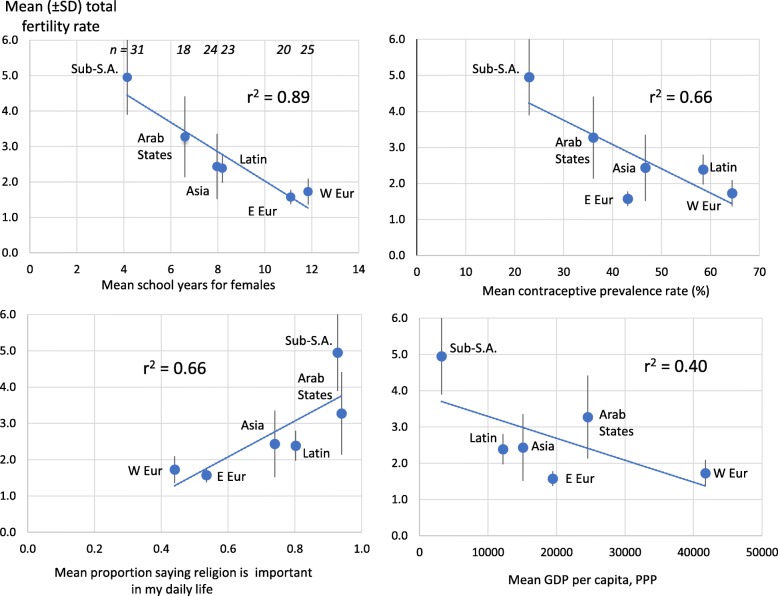
- Among regions, TFR was lowest in E Europe (mean 1.57) and highest in Sub-Saharan Africa (4.95); Arab States had the second highest TFR (3.27), while W Europe and related countries averaged 1.73, Latin America 2.39, and Asia 2.44.
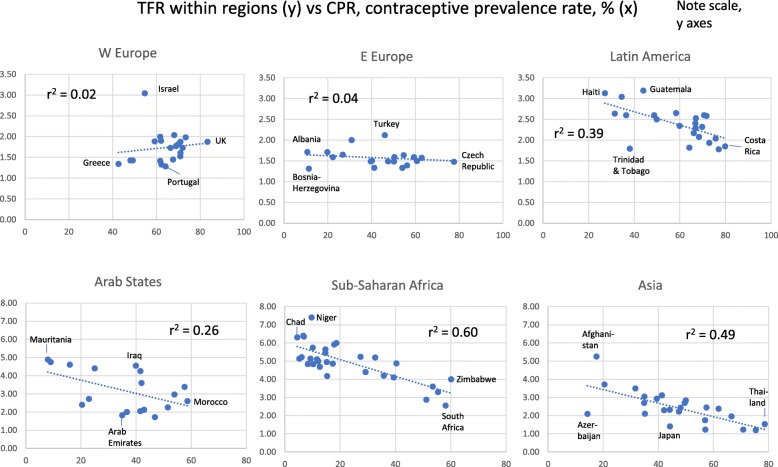
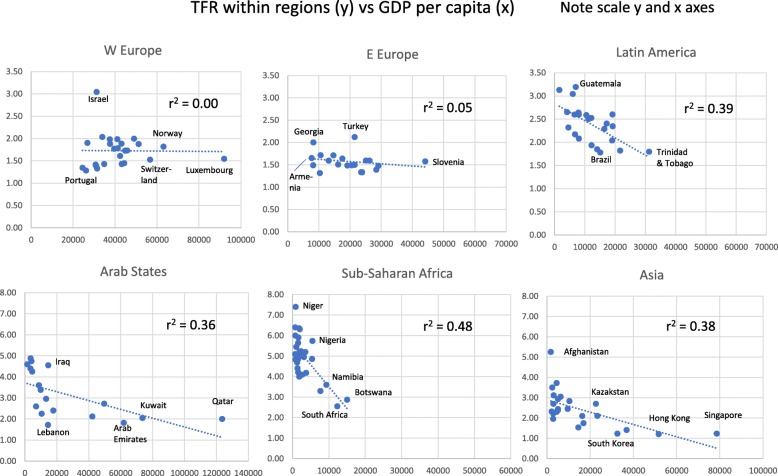
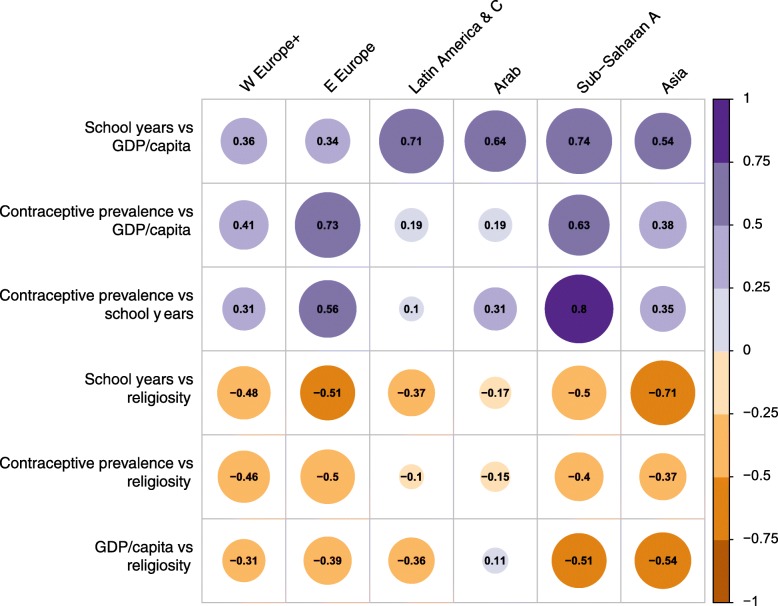
- Across regions, TFR declined with female school years (r² = 0.89), contraceptive prevalence rate (CPR; r² = 0.66), and GDP per capita (r² = 0.40), and increased with religiosity (r² = 0.66).
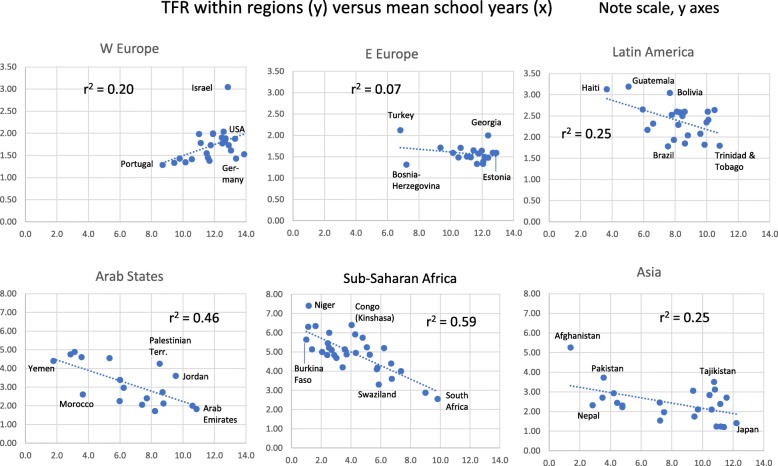
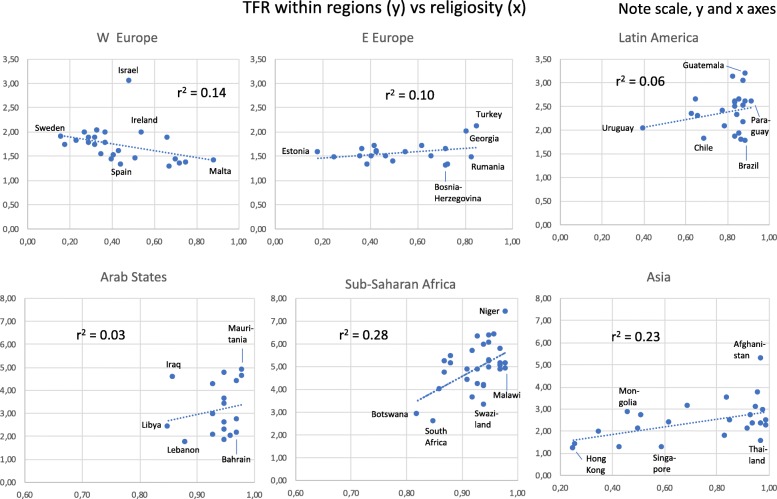
- Within regions, TFR decreased with school years in five regions but increased with school years in W Europe; TFR increased with religiosity in five regions but decreased with religiosity in W Europe.
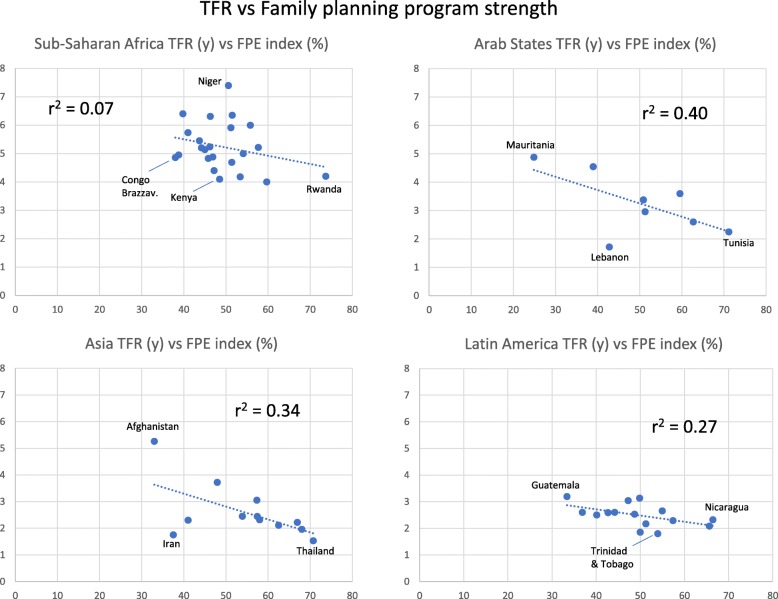
- TFR was negatively associated with family planning program strength in four regions, with r² from 0.07 in Sub-Saharan Africa to 0.27–0.40 in the other three regions; mean program strength ranged only from 49.5% to 54.5%.
Methods
- The authors compared six global regions—E Europe, W Europe and related countries, Latin America and the Caribbean, Arab States, Sub-Saharan Africa, and Asia—using 141 countries with available data for education, economy, religion, and contraception.
- They related TFR to five factors: female mean school years, GDP per capita, religiosity, CPR, and family planning program strength; family planning data were available for only four regions.
- They used simple correlation, regression, and graphical analysis rather than statistical testing or multivariate modeling, treating countries as units within regions and avoiding formal significance tests because countries may not be independent sample units.
Limitations
- The paper states that more work is needed to establish causality and the relative importance of the factors, and that it did not analyze infant and child mortality, gender roles, or female labor force participation rates.
- The paper notes that CPR data exclude sexually active unmarried women and those not in unions, include only modern methods, and that family planning program data were unavailable for the two European regions and were not representative of the full country sample.
- Evident from the text: the analysis is observational and correlational, regional groupings are partly based on judgment, and the authors deliberately refrain from statistical testing, so the reported relationships cannot by themselves establish direction or causation.
Model-written summary. Check it against the paper before relying on it.
Integrity signals
Registry
Cites
Statistics
Figures
Verification
Claims the paper makes
13 Valid · 2 Not valid · 16 Not checked · 86 Own results and interpretations
The cited sources support only part of this claim — read each source’s verdict below.
In the paper
“countries may not be statistically independent units.”
§ Human fertility in relation to education, economy, religion, contraception, and family planning programs > Methods > Analytical approach
What the sources say
- Not checked — no full text of the sourcecites [48] Maoz Z. Networks of nations: the evolution, structure, and impact of international networks: Cambridge: Cambridge University Press; 2010. 10.1017/CBO9780511762659. source
- Not checked — no full text of the sourcecites [49] Korotayev A Zinkina J Goldstone J Shulgin S Explaining current fertility dynamics in tropical Africa from an anthropological perspective Cross-Cultural Res 2016 50 251 280 10.1177/1069397116644158 source
- Not checked — no full text of the sourcecites [50] Hurlbert SH Pseudoreplication and the design of ecological field experiments Ecol Monogr 1984 54 187 211 10.2307/1942661 source
- Partly supportedcites [51] Lazic SE Clarke-Williams CJ Munafò MR What exactly is ‘N’ in cell culture and animal experiments? PLoS Biol 2018 16 e2005282 10.1371/journal.pbio.2005282 29617358 PMC5902037 sourceExperimental — accuracy not yet measured
In “Requirements for genuine replication” (Box 2; page unavailable), the paper explains that units influencing one another are not independent. Its examples concern animals and students, not countries, so it supports the statistical principle but does not establish that countries may be dependent units. (LLM, conf=0.84)
hedged- Asserted: passes — The authors put it forward as true.
- Checkable: passes — It can be checked against evidence.
- Load-bearing: passes — The paper’s conclusions depend on it.
- Based: passes — The paper gives a reason why it holds.
The sources with a verdict support this claim; the rest weren’t checked yet, have no full text we could read, or their verdicts aren’t rated yet.
In the paper
“Increased education (school years) of girls and women is associated with declining fertility in many countries.”
§ Human fertility in relation to education, economy, religion, contraception, and family planning programs > Background > Education
What the sources say
- Supportedcites [16] Colleran H Jasienska G Nenko I Galbarczyk A Mace R Community-level education accelerates the cultural evolution of fertility decline Proc R Soc B Biol Sci 2014 281 20132732 10.1098/rspb.2013.2732 PMC3924072 24500166 sourceExperimental — accuracy not yet measured
The Introduction identifies women’s education as a key predictor of fertility decline and discusses it in the context of demographic transitions across countries. The Results also report an association between higher education and lower fertility in the communities studied, supporting the citing sentence’s broad association rather than a causal claim. (LLM, conf=0.87)
- Not checked — no full text of the sourcecites [17] Jejeebhoy S Women’s education, autonomy, and reproductive behaviour: experience from developing countries 1995 Oxford Clarendon Press source
- Supportedcites [18] KC S, Lutz W. The human core of the shared socioeconomic pathways: population scenarios by age, sex and level of education for all countries to 2100. Glob Environ Chang. 2017;42:181–92. 10.1016/j.gloenvcha.2014.06.004. PMC5310112 28239237 sourceExperimental — accuracy not yet measured
The “Key dimensions considered in population projections” section says that more educated women have lower fertility in virtually all populations, particularly those undergoing demographic transition. The Results section reiterates this near-universal association. Page numbers were not supplied. (LLM, conf=0.94)
- Not checked — no full text of the sourcecites [19] Wang Q Sun X The role of socio-political and economic factors in fertility decline: a cross-country analysis World Dev 2016 87 360 370 10.1016/j.worlddev.2016.07.004 source
plainstates an association- Asserted: passes — The authors put it forward as true.
- Checkable: passes — It can be checked against evidence.
- Load-bearing: passes — The paper’s conclusions depend on it.
- Based: passes — The paper gives a reason why it holds.
- Supported
The cited sources support only part of this claim — read each source’s verdict below.
In the paper
“Lower TFR may therefore favor economic development, rather than the other way around [28, 29].”
§ Human fertility in relation to education, economy, religion, contraception, and family planning programs > Background > Economy
What the sources say
- Partly supportedcites [28] Casey G Galor O Is faster economic growth compatible with reductions in carbon emissions? The role of diminished population growth Environ Res Lett 2017 12 014003 10.1088/1748-9326/12/1/014003 PMC7015536 32051690 sourceExperimental — accuracy not yet measured
The Results report higher income per capita under the low-fertility scenario, supporting the claim that lower TFR may favor economic development (page unavailable in our copy). The Discussion also says that economic policies can influence fertility, so the paper does not establish the claim’s contrast with the reverse direction. (LLM, conf=0.84)
- Not matchedcites [29] O’Sullivan J. Revisiting demographic transition: correlation and causation in the rate of development and fertility decline, vol. 27: Pap Present 27th IUSSP Int Popul Conf Korea; 2013. https://espace.library.uq.edu.au/view/UQ:368450.
We searched by its title and found no matching paper.
hedgedstates a possible cause- Asserted: passes — The authors put it forward as true.
- Checkable: passes — It can be checked against evidence.
- Load-bearing: passes — The paper’s conclusions depend on it.
- Based: passes — The paper gives a reason why it holds.
- Partly supported
The cited sources support only part of this claim — read each source’s verdict below.
In the paper
“Most studies analyze single factors and groups of countries [11, 14, 21, 47].”
§ Human fertility in relation to education, economy, religion, contraception, and family planning programs > Methods > Analytical approach
What the sources say
- Not checked — no full text of the sourcecites [11] Bongaarts J The causes of stalling fertility transitions Stud Fam Plan 2006 37 1 16 10.1111/j.1728-4465.2006.00079.x 16570726 source
- Partly supportedcites [14] Balbo N Billari FC Mills M Fertility in advanced societies: review of research Eur J Popul 2013 29 1 38 10.1007/s10680-012-9277-y 23440941 PMC3576563 sourceExperimental — accuracy not yet measured
The Policy Measures section describes cross-national studies involving countries with differing policies, and the Discussion says European and North American fertility research often remain separate. These passages support the reference to groups of countries, but the paper does not establish that most studies analyze single factors. (LLM, conf=0.78)
- Not checked yetcites [21] Bongaarts J Trends in the age at reproductive transitions in the developing world: The role of education Popul Stud (NY) 2017 71 139 154 10.1080/00324728.2017.1291986 28397543 source
Checked before — its earlier verdict is held back until a new check runs.
- Not checked — no full text of the sourcecites [47] Martin TC Women’s education and fertility: results from 26 demographic and health surveys Stud Fam Plan 1995 26 187 202 10.2307/2137845 7482677 source
plain- Asserted: passes — The authors put it forward as true.
- Checkable: passes — It can be checked against evidence.
- Load-bearing: passes — The paper’s conclusions depend on it.
- Based: passes — The paper gives a reason why it holds.
The cited sources support only part of this claim — read each source’s verdict below.
In the paper
“Other factors, such as education and religiosity, also influence contraceptive use (e.g. [44, 45]).”
§ Human fertility in relation to education, economy, religion, contraception, and family planning programs > Background > Contraceptives and family planning programs
What the sources say
- Partly supportedcites [44] Hossain M Khan M Ababneh F Shaw J Identifying factors influencing contraceptive use in Bangladesh: evidence from BDHS 2014 data BMC Public Health 2018 18 192 10.1186/s12889-018-5098-1 29378546 PMC5789662 sourceExperimental — accuracy not yet measured
The Results (Factors associated with contraceptive use; page unavailable) identify husbands’ education and women’s religious affiliation as associated with contraceptive use in Bangladesh. The Discussion links religious beliefs to contraceptive use, but the study measured religious affiliation rather than religiosity; it also found no significant association for women’s education. (LLM, conf=0.82)
- Partly supportedcites [45] Rutaremwa G, Kabagenyi A, Wandera SO, Jhamba T, Akiror E, Nviiri HL. Predictors of modern contraceptive use during the postpartum period among women in Uganda: a population-based cross-sectional study. BMC Public Health. 2015;15:1–9. 10.1186/s12889-015-1611-y. PMC4372233 25885372 sourceExperimental — accuracy not yet measured
The Conclusions identify education and Protestant religion as predictors of postpartum contraceptive use among women in Uganda. However, the Methods measure religious affiliation, not religiosity (the degree of religious belief or practice), and the findings concern postpartum use rather than contraceptive use generally. (LLM, conf=0.82)
plainstates an association- Asserted: passes — The authors put it forward as true.
- Checkable: passes — It can be checked against evidence.
- Load-bearing: unclear — It is unclear whether the paper’s conclusions depend on it.
- Based: passes — The paper gives a reason why it holds.
- Partly supported
54 more claims · 2 with their cited sources checked
Create a free account to see all 117 claims and to verify the 8 references still open.
- Probably not a substantial claim. 13
- It may state two separate claims as one. 50
Claims other papers make about this one
Each is checked against this paper’s own text: does it say what the citing paper says it does?
The source backs part of the claim, not all of it — or backs it for a different population, condition or comparison.
In the citing paper
“Our projections suggest that improving access to modern contraceptives and female education—the two primary drivers of fertility4, 84, 85, 86—would reduce fertility rates in higher-fertility countries and territories, limiting the increasing concentration of livebirths in these areas.”
From Global fertility in 204 countries and territories, 1950–2021, with forecasts to 2100: a comprehensive demographic analysis for the Global Burden of Disease Study 2021 (2024) · cites this paper as [84]
Experimental — accuracy not yet measured
Self-check
Percentages, sums and reported differences re-computed from the paper’s own numbers.
Each contradiction between two passages listed here was confirmed by an independent check.
Rated minor: it would not touch a result — a value no result rests on, a p-value that stays on the same side of the significance level, or a conflict that is clerical, resolved elsewhere in the paper, or outside its own findings.
In the paper
§ Human fertility in relation to education, economy, religion, contraception, and family planning programs > Methods > Regions and countries
“We included countries with available data for education, economy, religion and contraception (for FP programs, see below).”
§ Human fertility in relation to education, economy, religion, contraception, and family planning programs > Methods > Data
“Three of the 25 W Europe countries lacked CPR data (Cyprus, Iceland, Luxembourg) but had data for school years, GDP per capita and religiosity. They were included in analyses of these factors.”
Citations
Cites
Correspondence - Tranexamic acid for traumatic brain injury
(2005) · London School of Economics and Political Science Theses Online (London School of Economics and Political Science) · doi:10.1016/s0140-6736 · Cited by 11,894
Pseudoreplication and the Design of Ecological Field Experiments
Hurlbert, S. H. (1984) · Ecological Monographs · doi:10.2307/1942661 · Cited by 8,377
Human Capital, Fertility, and Economic Growth
Becker, G. S., Murphy, K. M., & Tamura, R. (1990) · Journal of Political Economy · doi:10.1086/261723 · Cited by 1,988
The Emergence of Lowest‐Low Fertility in Europe During the 1990s
Kohler, H., Billari, F. C., & Ortega, J. A. (2002) · Population and Development Review · doi:10.1111/j.1728-4457.2002.00641.x · Cited by 1,451 · cited 1×
“History, postSoviet economic uncertainty and low GDP per capita may account for higher mean mother’s age at childbirth in E Europe ([74]; see also [75]).”
BackgroundKC, S., & Lutz, W. (2017) · Global Environmental Change · doi:10.1016/j.gloenvcha.2014.06.004 · Cited by 1,337 · cited 1×
“Human fertility rate has critical consequences for the entire biosphere [2, 6, 12, 108], but conclusions about the main factors that determine TFR vary markedly between researchers (see for instance [8, 18, 66]).”
BackgroundThe global burden of women's cancers: a grand challenge in global health
Ginsburg, O., Bray, F., Coleman, M. P., Vanderpuye, V., Eniu, A., Kotha, S. R., Sarker, M., Huong, T. T., Allemani, C., Dvaladze, A., et al. (2017) · The Lancet · doi:10.1016/s0140-6736(16)31392-7 · Cited by 1,127
The Cultural Context of High Fertility in sub-Saharan Africa
Caldwell, J. C., & Caldwell, P. (1987) · Population and Development Review · doi:10.2307/1973133 · Cited by 830
Sacred and Secular: Religion and Politics Worldwide
Norris, P., & Inglehart, R. (2011) · doi:10.1017/cbo9780511894862 · Cited by 814
Advances in development reverse fertility declines
Myrskylä, M., Kohler, H.-P., & Billari, F. C. (2009) · Nature · doi:10.1038/nature08230 · Cited by 782
The interaction of human population, food production, and biodiversity protection
Crist, E., Mora, C., & Engelman, R. (2017) · Science · doi:10.1126/science.aal2011 · Cited by 733 · cited 1×
“Human fertility rate has critical consequences for the entire biosphere [2, 6, 12, 108], but conclusions about the main factors that determine TFR vary markedly between researchers (see for instance [8, 18, 66]).”
Background
Research works printed but not linked: 9
- UN, United Nations, Department of Economic and Social Affairs PD. World Population Prospects: The 2019 Revision | Multimedia Library - United Nations Department of Economic and Social Affairs, vol. 9; 2019. p. 1–13. https://population.un.org/wpp/Download/Standard/Population/.
- IPCC Climate change: mitigation of climate change. Contribution of working group III to the fifth assessment report of the intergovernmental panel on climate change 2014 Cambridge Cambridge University Press
- Roser M Fertility rate. Our World in Data Webpage 2017
- Calderisi R Earthy mission. The Catholic church and world development 2013 New Haven Yale University Press
- UN, United Nations, Department of Economic and Social Affairs PD World Population Prospects: The 2017 Revision | Multimedia Library - United Nations Department of Economic and Social Affairs 2017
- Sokal RR Rohlf FJ Biometry 1995 3 New York Freeman
- Winckler OA Arab political demography, Vol 1. Population growth and natalist policies 2005 Brighton Sussex Academic Press
- Ryerson W The crucial distinction between “unmet need” and “unmet demand.” Blue Planet United 2012
- Ryerson W The hidden gem of the Cairo consensus: helping to end population growth with entertainment media Popul Sustain 2019 2 51 61
Cited by
Items 101–200 of 224
Uwigiciro, A., Ndaluka, T., Karanja, A. C., et al. (2025) · Reproductive Health · doi:10.1186/s12978-025-01996-1 · Cited by 2
“Additionally, FP offers the added benefit of improving the economic security of women, their families, and their communities [19].”
Has the New Natalism Reduced the Religious Fertility Advantage?
DeRose, L. F., Wilcox, W. B., Townsend, P. L., Brito, J. R., & James, S. L. (2021) · Journal for the Scientific Study of Religion · doi:10.1111/jssr.12747 · Cited by 2
Sohail, A., Abbasi, B. N., Abdelsalam, M. K., & Waemustafa, W. (2024) · Journal of the Knowledge Economy · doi:10.1007/s13132-024-02414-w · Cited by 5
“Götmark and Andersson (2020) conducted a comparative analysis across six global regions (141 countries), examining fertility rates in relation to five factors: education, economy (GDP, per capita), contraceptive prevalence rate (CPR), family planning program quality, and religiosity.”
InfluentialFertility Beliefs and Outcomes: the Role of Relationship Status and Attractiveness
Gong, Y., Skura, T., Stinebrickner, R., & Stinebrickner, T. R. (2024) · The Economic Journal · doi:10.1093/ej/ueae104 · Cited by 3
Trends in population health and demography – Authors' reply
Vollset, S. E., Smith, A. E., Bisignano, C., & Murray, C. J. L. (2021) · The Lancet · doi:10.1016/s0140-6736(21)01049-7 · Cited by 2
Henry, A., Sher, A. A., & Primack, R. B. (2023) · Elsevier eBooks · doi:10.1016/b978-0-12-822562-2.00131-6 · Cited by 2
Kwabaho, J. M., Mukasa, N., & Nyakato, V. N. (2023) · Open Journal of Social Sciences · doi:10.4236/jss.2023.1112018 · Cited by 2
Motsima, T. (2024) · Journal of Psychosexual Health · doi:10.1177/26318318241265412 · Cited by 1
Intrauterine Device Use and Perceptions Among Women in Tanzania—A Mixed Methods Study
Massay, C. S., Lafontan, S. R., Rogathi, J. J., et al. (2024) · SAGE Open Nursing · doi:10.1177/23779608241305782 · Cited by 1
Education as a Driver of Innovative Recovery and Economic Development of Ukraine
Luchyk, S., Luchyk, V., Manachynska, Y., & Luchyk, M. (2025) · Lecture notes on data engineering and communications technologies · doi:10.1007/978-3-031-81557-7_9 · Cited by 2
Family Formation and Ideal Number of Children in the Arabian Gulf: A Case Study of the UAE
Karabchuk, T., Omar, S., Abdalla, Z., Diab, K., & Jeddou, M. B. (2025) · Gulf Studies · doi:10.1007/978-981-96-3412-5_3 · Cited by 1
Petrakis, P. E., Vasilis, G., & Kanzola, A.-М. (2025) · Springer eBooks · doi:10.1007/978-3-031-86437-7_11 · Cited by 1
Keetile, M., Masisi, B. K., Lefadola, P., et al. (2025) · Contraception and Reproductive Medicine · doi:10.1186/s40834-025-00386-z · Cited by 1
Ortiz-Rios, A. M., Ponce-Santillán, M. A., Avalos-Garcia, B. R., Galindo-Calvillo, E. A., Corral-Trujillo, M. E., Treviño-Sanchez, C., Salinas-Rodriguez, S. L., Pola-Lobo, L. M., Ramirez-Cantu, D. A., Ortiz-Palafox, J. M., et al. (2025) · Rheumatology International · doi:10.1007/s00296-025-05956-7 · Cited by 1
“This is consistent with the study by Kudesai et al, where medical trainees scored low in the infertility treatments, with only 50% of correct answers [3].”
The relationship between life satisfaction and the number of children in the family
Kalinin, A. R., & Yustratov, D. V. (2025) · Economics and Management · doi:10.35854/1998-1627-2025-7-882-892 · Cited by 1
Martinez, R. M. G. (2025) · Studies in Nonlinear Dynamics and Econometrics · doi:10.1515/snde-2025-0048 · Cited by 1
“Understanding the potential positive and negative impacts of catastrophic events can improve stakeholder coordination, guide stress testing exercises, and inform policymakers’ decisions on emergency actions.”
Moomin, S. T., Sidik, M. G., Ahmed, S. D., Gawusu, S., Jamatutu, S. A., & Abdul-Fatawu, M. (2025) · World Development Sustainability · doi:10.1016/j.wds.2025.100250 · Cited by 2
Knowledge of family planning among muslim women of reproductive age in Garissa County
Ahmed, M. M., Nyagero, J. M., & Karama, M. (2025) · International Journal of Reproduction Contraception Obstetrics and Gynecology · doi:10.18203/2320-1770.ijrcog20253065 · Cited by 1
Mei, R., Tan, M., Liu, M., & Lin, L. K. (2025) · BMC Public Health · doi:10.1186/s12889-025-25842-y · Cited by 4
“Studies worldwide have shown a lower fertility rate in women with higher educational attainment [17, 18].”
Essis, E. M. L., Cissé, K., & Kpebo, D. O. D. (2026) · BMC Public Health · doi:10.1186/s12889-025-25974-1 · Cited by 1
Chvaja, R., Shaver, J. H., & Bulbulia, J. A. (2026) · Scientific Reports · doi:10.1038/s41598-025-34358-9 · Cited by 1
Determinants of Life Expectancy in Developing Countries: A Comparative Analysis 2012–2022
Aung, N. (2026) · Health and population. Perspectives and issues · doi:10.5005/hppi-11041-0033 · Cited by 1
Ma, X.-Z., & Wei-hong, X. (2026) · Studies in Higher Education · doi:10.1080/03075079.2026.2626020 · Cited by 2
Determinants of children ever born among women in Somalia: a national survey study
Ahmed, M. M., Omar, M. A., Hassan, Y. S. A., & Ali, A. S. (2026) · Archives of Public Health · doi:10.1186/s13690-026-01980-6 · Cited by 1
“Education enhances health literacy, providing women with knowledge of reproductive biology and contraception for informed family planning [5].”
Kirkegaard, E. O. W., & Dutton, E. (2022) · Evolutionary Psychological Science · doi:10.1007/s40806-022-00327-y · Cited by 1
Factors that Influence Economic Growth: Empirical Evidence from Albania
Çekrezi, A. (2022) · WSEAS TRANSACTIONS ON BUSINESS AND ECONOMICS · doi:10.37394/23207.2022.19.126 · Cited by 1
Sabii, I., Matviienko, A., Mazurenko, O., et al. (2022) · Scientific Horizons · doi:10.48077/scihor.25(7).2022.65-73 · Cited by 1
KEPERAWATAN MATERNITAS DAN KELUARGA BERENCANA
Rizky, A. (2023) · Repository Alungcipta · doi:10.59000/ra.v1i1.2 · Cited by 1
Klu, D., & Agyekum, P. (2023) · SN Social Sciences · doi:10.1007/s43545-023-00702-x · Cited by 3
“2008; Götmark and Andersson 2020; Turner 2021).”
Passano, P., Choi, M. A., & Matusiewicz, M. (2023) · The Journal of Population and Sustainability · doi:10.3197/jps.63799953906869 · Cited by 5
Clustering Couples of Childbearing Age to Get Family Planning Counseling Using K-Means Method
Farida, Y., Khariri, A. F., Yuliati, D., & Khaulasari, H. (2022) · Matrik Jurnal Manajemen Teknik Informatika dan Rekayasa Komputer · doi:10.30812/matrik.v22i1.1888 · Cited by 1
Abbani, A. Y., Yinusa, R. A., Niazi, H., Usman, M. G., & Boku, U. I. (2024) · Journal of Population and Social Studies · doi:10.25133/jpssv322024.048 · Cited by 3
Sah, T., & Valeriani, D. (2024) · Jurnal Keluarga Berencana · doi:10.37306/xx8dpw51 · Cited by 3
“Countries with higher average levels of female education, greater GDP per capita, increased accessibility to contraceptives, and more comprehensive family planning programs tend to exhibit lower total fertility (Go tmark & Andersson, 2020).”
BackgroundA handmaid’s tale? Support for surrogacy reform: experimental evidence from Britain
Turnbull-Dugarte, S. J. (2024) · European Journal of Politics and Gender · doi:10.1332/25151088y2024d000000044 · Cited by 1
Are population policies in Arab countries largely ineffective? Past and present perspectives
Nadan, A. (2024) · Digest of Middle East Studies · doi:10.1111/dome.12338 · Cited by 1
Elnour, A. A. M. (2025) · Springer eBooks · doi:10.1007/978-981-97-8518-6_5 · Cited by 1
Standing at the Edge of the ‘Demographic Cliff’
Park, M. S. (2022) · Journal of Korean Medical Science · doi:10.3346/jkms.2022.37.e318 · Cited by 1
Ökoteológia a „web of science” által referált tudományos publikációk tükrében
Mics, F., & Hufnágel, L. (2023) · Opuscula Theologica et Scientifica · doi:10.59531/ots.2023.1.1.1-27 · Cited by 1
Whittaker, A. M. (2023) · Wiley eBooks · doi:10.1002/9781119845379.ch28 · Cited by 1
SOCIOLOGICAL ANALYSIS OF EDUCATION AND REDUCTION IN FAMILY SIZE IN KHYBER PAKHTUNKHWA-PAKISTAN
Jawad, M., Ullah, A., Sarir, S., Zubair, S., & Khan, A. (2021) · Humanities & Social Sciences Reviews · doi:10.18510/hssr.2021.9217
“…with more awareness, access to family planning services, and adoption of family planning methods are the major causes of population control in the world (Götmark & Andersson, 2020; Mandl, 2019; Steer & Wathne, 2010; Tropf & Mandemakers, 2017; Ullah, Ashraf, Tariq, Aziz, Sikandar, et al., 2021).”
BackgroundSheikh, Q. A., Meraj, M., Shamim, M. A., & Zia, S. (2021) · Humanities & Social Sciences Reviews · doi:10.18510/hssr.2021.9252
Access of Family Planning Services among Urban Poor Women in the City of Yogyakarta
Matahari, R., Utami, F. P., Sugiharti, S., et al. (2021) · Trends in Sciences · doi:10.48048/tis.2021.30
“Poverty (economic problems) is one of the factors that affect the rate of population growth (fertility), along with education, religiosity, use of contraceptive methods and family planning programs [3].”
BackgroundHow Low Will It Go? Projecting Future Fertility
Skirbekk, V. (2022) · Springer eBooks · doi:10.1007/978-3-030-91611-4_17
Afzali, M., & Rostovskaya, T. K. (2022) · Socialʹnye i gumanitarnye znania · doi:10.18255/2412-6519-2022-1-70-85 · Cited by 1
“bear if they survived to the end of reproductive life and have the same probability of child‐ bearing in each age interval as currently prevails across the population” [2].”
BackgroundREMOVED DUE TO POLICY VIOLATIONSPreprint
Krämer, M. D., van Scheppingen, M. A., Chopik, W. J., et al. (2022) · doi:10.31234/osf.io/87emk
Barriers to Fertility Regulation in Nigeria: A Literature Review
Jacob, T., & Goodluck, A. (2022) · International Journal of Research Publications · doi:10.47119/ijrp1001091920223898
Tliashinova, I. A., Volkova, O., & Мингазова, Э. Н. (2022) · Problems of Social Hygiene Public Health and History of Medicine · doi:10.32687/0869-866x-2022-30-s1-1135-1143
“Различия показателей и ключевых детерминант рождаемости в регионах с высокой рождаемостью, а также географическая кластеризация высокой рождаемости в странах с низкими и средними доходами представляют большой исследовательский интерес [1, 4, 5].”
InfluentialA qualitative study on contraceptive use among young female university students: What still matters?
Zulu, B., Maharaj, P., & Dunn, S. (2023) · Journal of African Population Studies · doi:10.59147/mnxkp8xx
“From a global perspective, Götmark, and Andersson [25] suggest that more work is needed to establish the relative importance of the factors associated with fertility.”
BackgroundNiohuru, I. (2023) · SpringerBriefs in economics · doi:10.1007/978-3-031-19719-2_7
Factori asociați cu nivelul scăzut al fertilității în Republica Moldova
Grigoras, E. (2022) · International Scientific Conference: Economic Growth in the Face of Global Challenges · doi:10.36004/nier.cdr.2022.16.20
Statistical Analysis of Effect of Population on Economic Growth in Uganda (2000-2020)
Siifa, B., Teniola, B. B., & Zayyad, M. A. (2023) · Technology and Investment · doi:10.4236/ti.2023.142006
Media Exposure and Its Impact on Women's Knowledge in Family Planning Program in Indonesia
Hapsari, D. R., Sulistiawati, A., & Rahmadhony, A. (2023) · Jurnal Komunikasi Pembangunan · doi:10.46937/21202344408
“Hal ini sejalan dengan kemunculan digital divide, menurut Hadi (2018) terkait dengan perbedaan karakteristik individu termasuk tingkatan sosial ekonomi mengenai akses penggunaan perangkat digital.”
BackgroundBodaukhan, K., Zhanerke, K., Darima, Z., et al. (2023) · Research Square · doi:10.21203/rs.3.rs-3241259/v1
Retracted- Retracted
Uzobo, E., & Major, I. (2023) · WILBERFORCE JOURNAL OF THE SOCIAL SCIENCES · doi:10.36108/wjss/3202.80.0230
Religiositas dan Fertilitas Perempuan Muslim Milenial dalam Penggunaan Alat Kontrasepsi
Kusnali, A. (2022) · Jurnal Sosiologi Agama · doi:10.14421/jsa.2022.161-05 · Cited by 3
Goda, E. T., Degefa, T., & Ketema, M. (2023) · Global Sustainability Research · doi:10.56556/gssr.v2i4.600
“…of this study also confirms that there is a negative association between women's income and fertility, and this is in agreement with other studies (Götmark & Andersson, 2020; James et al., 2011; Shiferaw et al., 2019), but opposes a study conducted in the east of Iran (Azmoude et al., 2017),…”
ResultBasak, M., & Rukhsana, R. (2023) · Springer eBooks · doi:10.1007/978-3-031-40128-2_23
Özdemir, R., & Dinç, G. (2023) · Research Square · doi:10.21203/rs.3.rs-3701025/v1
Götmark, F., & Wetzler, N. S. (2023) · The Journal of Population and Sustainability · doi:10.3197/jps.63799953906874
Self-citationZheng, Y. (2024) · Highlights in Business Economics and Management · doi:10.54097/q08sew40
“1 World: Total Population This phenomenon might be caused by the longer education time for women which can bring about empowerment of women, later marriage, later onset of childbearing, and smaller family size [11].”
BackgroundFactors influencing India’s fertility patterns and differential of women
Brahma, J., & Basumatary, K. (2024) · Journal of Social Economics Research · doi:10.18488/35.v11i1.3612
Kooshk, M., Shariati, L., Majidpour, F., et al. (2024) · Research Square · doi:10.21203/rs.3.rs-3881150/v1
Wale, A., Kassie, A., Solomon, N., et al. (2024) · Research Square · doi:10.21203/rs.3.rs-2686145/v1
Grigoras, E. (2023) · International Scientific Conference: Economic Growth in the Face of Global Challenges · doi:10.36004/nier.cdr.v.2023.17.34
“…demonstrate that having children at young ages usually leads to a higher number of children born during the reproductive life (Frejka, Calot, 2001; Götmark, Andersson, 2020) while postponing childbearing to older ages is one of the leading causes of the decrease in the number of children born…”
BackgroundFertility Beliefs and Outcomes: The Role of Relationship Status and Attractiveness
Gong, Y., Skura, T., Stinebrickner, R., & Stinebrickner, T. R. (2024) · National Bureau of Economic Research · doi:10.3386/w32578
Fertility Beliefs and Outcomes: The Role of Relationship Status and AttractivenessPreprint
Gong, Y., Skura, T., Stinebrickner, R., et al. (2024) · SSRN Electronic Journal · doi:10.2139/ssrn.4867442
Amini, N. W., Suaedi, F., & Setijaningrum, E. (2024) · Social Sciences · doi:10.3390/socsci13060325 · Cited by 4
“Several factors influence the TFR, including economic development (Cheng et al. 2022; Pourreza et al. 2021), female literacy (Götmark and Andersson 2020), and age at marriage (Onagoruwa and Wodon 2018), as women who gain access to education and employment opportunities tend to delay marriage and…”
BackgroundAlfana, M. A. F. (2024) · Populasi · doi:10.22146/jp.97547
Özdemir, R., & Dinç, G. (2024) · Research Square · doi:10.21203/rs.3.rs-3701025/v2
Forces Reshaping Work and Workforces
Hunt, S. T. (2022) · Wiley eBooks · doi:10.1002/9781394320783.ch1
Hunt, S. T. (2022) · Wiley eBooks · doi:10.1002/9781394320783.ref
Time Series Analysis in Reproductive Health Data
Sharma, P., Gupta, T., Kulshrestha, S., Gupta, P., Choudhury, A., Modi, D. N., & Sengupta, A. (2024) · Springer eBooks · doi:10.1007/978-981-97-7451-7_9
Sun, X., Xu, Y. W., Gu, S., et al. (2024) · Research Square · doi:10.21203/rs.3.rs-5305005/v1
Hsu, T.-K., & Pan, K.-H. (2024) · WSEAS TRANSACTIONS ON ENVIRONMENT AND DEVELOPMENT · doi:10.37394/232015.2024.20.56
Kumari, S. (2024) · African Journal of Biomedical Research · doi:10.53555/ajbr.v27i4s.4766
“The plant material was authenticated at the Department of Botany, University of Rajasthan, Jaipur, India, where a herbar-ium specimen was deposited (RUBL 21230).”
InfluentialThe trend in China’s urban housing affordability and its impact on the total fertility rate
Qiu, T. (2024) · ANU Press eBooks · doi:10.22459/crgmp.2024.08
Declining fertility trends: a cause for concern
Lyngdoh, T., Kandpal, V., Shukla, V., Priyanka, K. Y., Mukherjee, R., & Kulkarni, B. (2024) · International Journal of Community Medicine and Public Health · doi:10.18203/2394-6040.ijcmph20244078 · Cited by 1
Linkages Between Women’s Education and Family Planning
Saha, J., & Roy, A. (2024) · Springer eBooks · doi:10.1007/978-981-97-8418-9_7
Ileanu, B. V. (2025) · Biodemography and Social Biology · doi:10.1080/19485565.2025.2465547
“One part of the authors try to explain the demographic decline by socioeconomic aspects (Jowet 1986, Gotmark and Andersson 2020), or by education reasons (Gotmark and Andersson 2020), religious behavior (Hayford and Morgan 2008, Herteliu et al. (2015), public health policies, sudden shocks, events…”
Gumanneh, H., Bowers, S. F., Miyaye, E., et al. (2025) · Global Public Health · doi:10.1080/17441692.2025.2473455
“…country’s religiosity and its total fertility rates, likely driven by a combination of factors, including religious texts, worldviews of different faiths and denominations, and teachings by some influential religious leaders against the use of FP (Götmark & Andersson, 2020; Turner & Götmark, 2023).”
Çağlayan, E. K., & Simavlı, S. A. (2025) · Celal Bayar Üniversitesi Sağlık Bilimleri Enstitüsü Dergisi · doi:10.34087/cbusbed.1552960
Modelling of childbearing progression among women living with HIV in Ibadan, Nigeria
Olagunju, A., Akinyemi, J. O., Afolabi, R. F., & Awolude, O. A. (2025) · BMC Research Notes · doi:10.1186/s13104-025-07193-4
“This aligns with other findings in Europe [27, 28].”
Huang, J., Man, Y., Shi, Z., et al. (2025) · SSRN Electronic Journal · doi:10.2139/ssrn.5200004
The Contribution of Education to Population Growth in Rwanda
Cyiza, E., Ngoga, E., Uwase, I., Uwanyirigira, I., Kayijuka, I., & Muremyi, R. (2025) · African Journal Of Applied Research · doi:10.26437/ajar.v11i2.1035 · Cited by 2
“Fertility is the average number of children a woman would have if she experienced current age-specific fertility (Götmark & Andersson, 2020) .”
Unpacking the post-COVID association between unexpected births and excess deaths
Coleman, L. (2025) · Journal of Medical Economics · doi:10.1080/13696998.2025.2500825
Varas, G. V. V., & Borsa, J. C. (2025) · Psico-USF · doi:10.1590/1413-8271202530e279599
العوامل الاجتماعية والاقتصادية المؤثرة في الخصوبة واتجاهاتها المستقبلية بالمملكة العربية السعودية
القرني, ع. م. أ. م. ا. ع. م. أ. م. (2025) · Journal of King Abdulaziz University Arts and Humanities · doi:10.4197/art.32-6-14
Utjecaj religioznosti i obiteljske pozadine na fertilitetne namjere
Komušanac, M. (2025) · Bogoslovska smotra · doi:10.53745/bs.95.1.8
Figueredo, E. E. S., Lage, V. K. D. S., Silva, L. S. B. V., et al. (2025) · Caderno Pedagógico · doi:10.54033/cadpedv22n8-153
Segala, F. V., Guido, G., Occa, E., Chambisse, E., Cavallin, F., Cobre, R., Gelfi, G., Moniz, J., Chitnis, K., Marotta, C., et al. (2025) · Acta Tropica · doi:10.1016/j.actatropica.2025.107725
The role of restrictive abortion laws on modern contraceptive use in Sub Saharan Africa
Kumbeni, M. T., Bovbjerg, M. L., Harvey, S. M., Chi, C., & Luck, J. (2025) · PLOS Global Public Health · doi:10.1371/journal.pgph.0004875 · Cited by 1
Advancing fertility education to address changing societal and demographic trends
Serdarogullari, M., Liperis, G., Makieva, S., Massarotti, C., Fraire-Zamora, J. J., Sharma, K., Grace, B., Fincham, A., Pedro, J., & Ali, Z. E. (2025) · Human Reproduction · doi:10.1093/humrep/deaf125
Sinulingga, N. N., Pratiwi, E. R., & Hasibuan, W. A. (2025) · Pharos Journal of Theology · doi:10.46222/pharosjot.106.4012
Al-Masaeid, M. (2025) · SSRN Electronic Journal · doi:10.2139/ssrn.5360933
Individual and community effects and adolescent reproductive health transitions in West Africa
Avogo, W. A. (2025) · Discover Public Health · doi:10.1186/s12982-025-00902-1 · Cited by 2
You, W. (2025) · Future Science OA · doi:10.1080/20565623.2025.2550897 · Cited by 2
“…at the population level, parity often aligns with national birth rates, with higher average parity typically associated with higher birth rates [11,41,42]. studies examining the link between parity and dementia risk in women have produced mixed results, reflecting variations in study design,…”
Ghimire, D. R., & Samir, K. C. (2025) · medRxiv · doi:10.1101/2025.09.03.25335049
Metadata
- Authors
- Götmark, F., & Andersson, M.
- Affiliations
- University of Gothenburg (SE)
- Corresponding author
- Götmark, Frank
- Venue
- BMC Public Health
- Published
- 2020-02-22
- Volume
- 20
- Issue
- 1
- Pages
- 265-265
- ISSN
- 1471-2458 (ISSN-L)
- PMC
- PMC7036237
- OpenAlex
- W3012630157
- Cited by
- 230
- References
- 113
- Citations by year
- 2026: 26 · 2025: 60 · 2024: 49 · 2023: 45 · 2022: 32 · 2021: 15 · 2020: 2
- FWCI
- 17.60
- Type
- journal article
- Language
- en
- Open access
- gold
- doi.org
- Licence
- cc-by
- creativecommons.org/licenses/by/4.0/ (tdm)
- creativecommons.org/licenses/by/4.0/ (vor)
- Locations
- BMC Public Health (publishedVersion, cc-by)
- PubMed Central (publishedVersion, cc-by)
- PubMed (publishedVersion)
- DOAJ (DOAJ: Directory of Open Access Journals) (submittedVersion, cc-by-sa)
- Funders
- Global Challenges Foundation (Protocol 3/2017)
- Topics
- Health Sciences › Medicine › Public Health, Environmental and Occupational Health › Reproductive Health and Contraception
- Social Sciences › Gender Studies › Demographic Trends and Gender Preferences
- Social Sciences › Demography › Family Dynamics and Relationships
- Keywords
- total fertility rate, fertility determinants, women's education, GDP per capita, religiosity, contraceptive prevalence, family planning programs, global population growth, cross-national comparison, Europe, sub-Saharan Africa
- MeSH terms
- Asia, Birth Rate, Contraception, Educational Status, Europe, Family Planning Services, Female, Humans, Latin America, Religion, Caribbean Region, Africa South of the Sahara, Arab World, Gross Domestic Product
About these checks
Registry, retraction, Cites and statistics results are computed, not judged, with one exception: a printed reference that no index lists is read once by a model before it counts as a citation error. Claims are extracted by a model and kept only when their quote appears verbatim in the text; each cited source is then checked, with a model’s help, for whether it says what the claim relies on. Those verdicts can be wrong — read the claim’s quote and the cited source before relying on one.
The claim verdicts this report counts are experimental: their accuracy is not yet measured.
A language model drew the claims from the paper on 2026-09-28, under version 3 of the claim definition (prompt extract-v3).
A second model labelled each claim on 2026-09-28 (model jev-1.13-20260917, definition revision gold-guideline-v0.2).
Cited sources are checked with a language model’s help (gpt-6-sol).
Statistics and arithmetic are recomputed, not judged.
Confidence bands are shown only for fields calibrated on our annotated test set. None is calibrated yet, so no band is shown.
What counts as a claim ›How we measure confidence ›How we check this ›
Are you an author, or do you see a problem with this page? Request a review
Data sources
Bibliographic data: Semantic Scholar, OpenAlex, Crossref.
Contains information from the Semantic Scholar Academic Graph Datasets, made available under the ODC Attribution License (ODC-BY 1.0).
Semantic Scholar’s data is described in: Kinney, R., et al. (2023). The Semantic Scholar Open Data Platform. arXiv:2301.10140.
