

Human fertility in relation to education, economy, religion, contraception, and family planning programs
Open accessThe DOI matches its Crossref record; 104 of the 113 references it cites were found in a registry or an index; 19 of the 64 sources its claims cite were checked for support.
Abstract
Background: The world population is expected to increase greatly this century, aggravating current problems related to climate, health, food security, biodiversity, energy and other vital resources. Population growth depends strongly on total fertility rate (TFR), but the relative importance of factors that influence fertility needs more study. Methods: We analyze recent levels of fertility in relation to five factors: education (mean school years for females), economy (Gross Domestic Product, GDP, per capita), religiosity, contraceptive prevalence rate (CPR), and strength of family planning programs. We compare six global regions: E Europe, W Europe and related countries, Latin America and the Caribbean, the Arab States, Sub-Saharan Africa, and Asia. In total, 141 countries are included in the analysis. We estimate the strength of relationships between TFR and the five factors by correlation or regression and present the results graphically. Results: In decreasing order of strength, fertility (TFR) correlates negatively with education, CPR, and GDP per capita, and positively with religiosity. Europe deviates from other regions in several ways, e.g. TFR increases with education and decreases with religiosity in W Europe. TFR decreases with increasing strength of family planning programs in three regions, but only weakly so in a fourth, Sub-Saharan Africa (the two European regions lacked such programs). Most factors correlated with TFR are also correlated with each other. In particular, education correlates positively with GDP per capita but negatively with religiosity, which is also negatively related to contraception and GDP per capita. Conclusions: These results help identify factors of likely importance for TFR in global regions and countries. More work is needed to establish causality and relative importance of the factors. Our novel quantitative analysis of TFR suggests that religiosity may counteract the ongoing decline of fertility in some regions and countries.
Overview
CoChat Summary
TL;DR
This study analyzes recent total fertility rate (TFR) across 141 countries in six global regions in relation to female education, GDP per capita, religiosity, contraceptive prevalence, and family planning program strength. It finds TFR generally declines with education, contraception, GDP, and stronger family planning programs, and rises with religiosity, with Western Europe deviating from several patterns.
Key findings
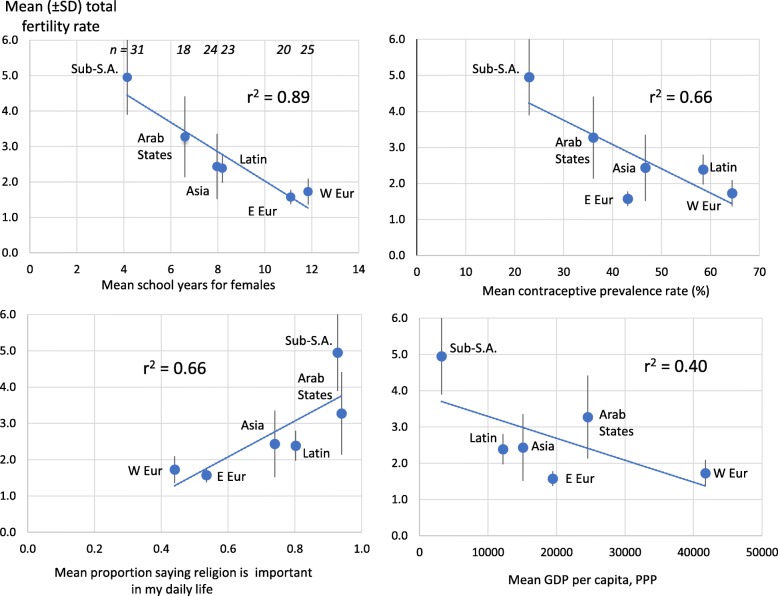
- Among regions, TFR was lowest in E Europe (mean 1.57) and highest in Sub-Saharan Africa (4.95); Arab States had the second highest TFR (3.27), while W Europe and related countries averaged 1.73, Latin America 2.39, and Asia 2.44.
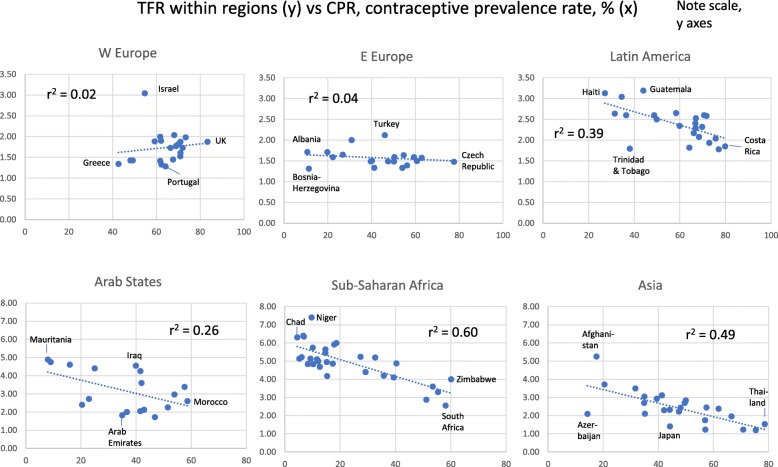
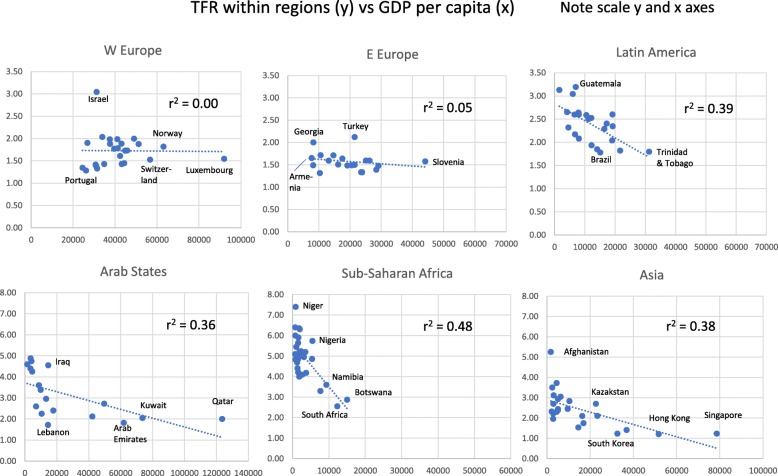
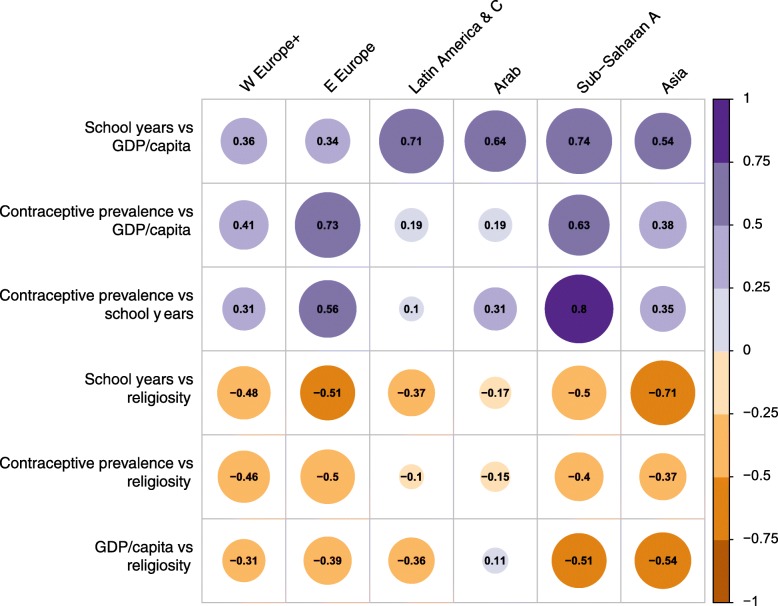
- Across regions, TFR declined with female school years (r² = 0.89), contraceptive prevalence rate (CPR; r² = 0.66), and GDP per capita (r² = 0.40), and increased with religiosity (r² = 0.66).
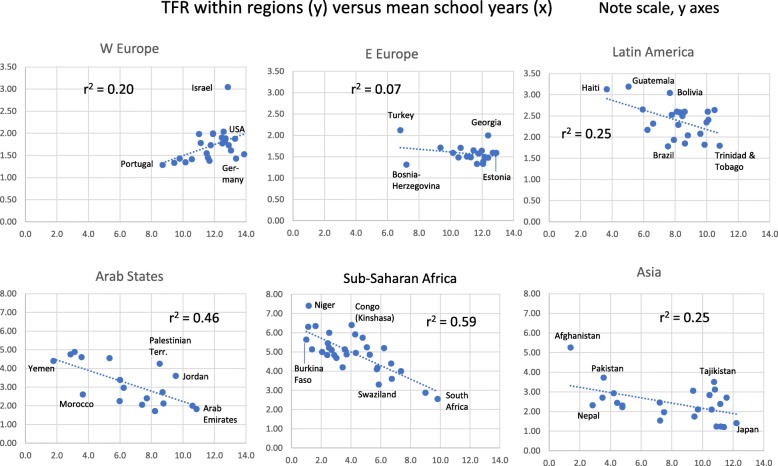
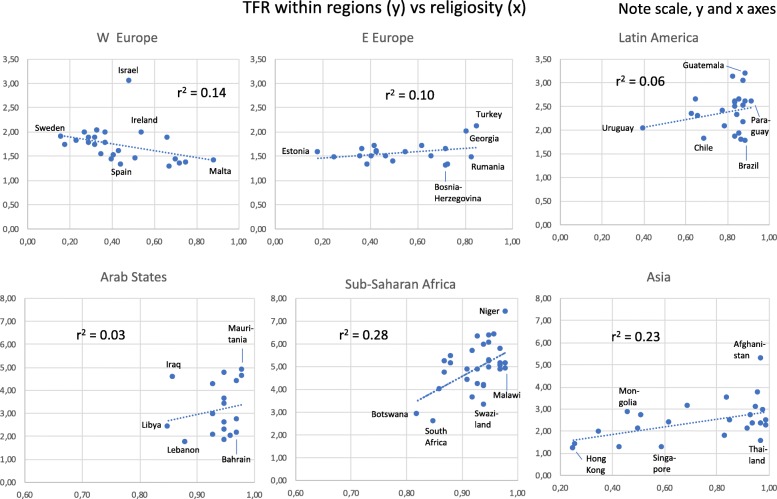
- Within regions, TFR decreased with school years in five regions but increased with school years in W Europe; TFR increased with religiosity in five regions but decreased with religiosity in W Europe.
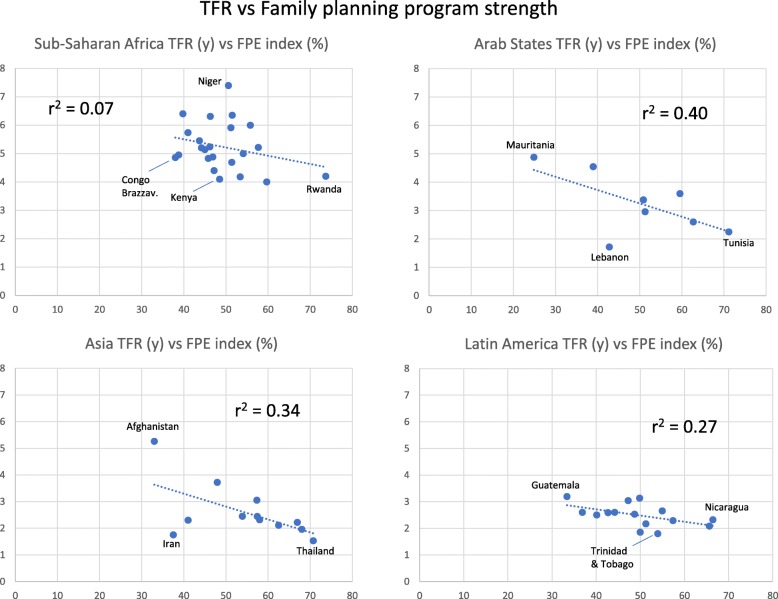
- TFR was negatively associated with family planning program strength in four regions, with r² from 0.07 in Sub-Saharan Africa to 0.27–0.40 in the other three regions; mean program strength ranged only from 49.5% to 54.5%.
Methods
- The authors compared six global regions—E Europe, W Europe and related countries, Latin America and the Caribbean, Arab States, Sub-Saharan Africa, and Asia—using 141 countries with available data for education, economy, religion, and contraception.
- They related TFR to five factors: female mean school years, GDP per capita, religiosity, CPR, and family planning program strength; family planning data were available for only four regions.
- They used simple correlation, regression, and graphical analysis rather than statistical testing or multivariate modeling, treating countries as units within regions and avoiding formal significance tests because countries may not be independent sample units.
Limitations
- The paper states that more work is needed to establish causality and the relative importance of the factors, and that it did not analyze infant and child mortality, gender roles, or female labor force participation rates.
- The paper notes that CPR data exclude sexually active unmarried women and those not in unions, include only modern methods, and that family planning program data were unavailable for the two European regions and were not representative of the full country sample.
- Evident from the text: the analysis is observational and correlational, regional groupings are partly based on judgment, and the authors deliberately refrain from statistical testing, so the reported relationships cannot by themselves establish direction or causation.
Model-written summary. Check it against the paper before relying on it.
Integrity signals
Registry
Cites
Statistics
Figures
Verification
Claims the paper makes
13 Valid · 2 Not valid · 16 Not checked · 86 Own results and interpretations
The cited sources support only part of this claim — read each source’s verdict below.
In the paper
“countries may not be statistically independent units.”
§ Human fertility in relation to education, economy, religion, contraception, and family planning programs > Methods > Analytical approach
What the sources say
- Not checked — no full text of the sourcecites [48] Maoz Z. Networks of nations: the evolution, structure, and impact of international networks: Cambridge: Cambridge University Press; 2010. 10.1017/CBO9780511762659. source
- Not checked — no full text of the sourcecites [49] Korotayev A Zinkina J Goldstone J Shulgin S Explaining current fertility dynamics in tropical Africa from an anthropological perspective Cross-Cultural Res 2016 50 251 280 10.1177/1069397116644158 source
- Not checked — no full text of the sourcecites [50] Hurlbert SH Pseudoreplication and the design of ecological field experiments Ecol Monogr 1984 54 187 211 10.2307/1942661 source
- Partly supportedcites [51] Lazic SE Clarke-Williams CJ Munafò MR What exactly is ‘N’ in cell culture and animal experiments? PLoS Biol 2018 16 e2005282 10.1371/journal.pbio.2005282 29617358 PMC5902037 sourceExperimental — accuracy not yet measured
In “Requirements for genuine replication” (Box 2; page unavailable), the paper explains that units influencing one another are not independent. Its examples concern animals and students, not countries, so it supports the statistical principle but does not establish that countries may be dependent units. (LLM, conf=0.84)
hedged- Asserted: passes — The authors put it forward as true.
- Checkable: passes — It can be checked against evidence.
- Load-bearing: passes — The paper’s conclusions depend on it.
- Based: passes — The paper gives a reason why it holds.
The sources with a verdict support this claim; the rest weren’t checked yet, have no full text we could read, or their verdicts aren’t rated yet.
In the paper
“Increased education (school years) of girls and women is associated with declining fertility in many countries.”
§ Human fertility in relation to education, economy, religion, contraception, and family planning programs > Background > Education
What the sources say
- Supportedcites [16] Colleran H Jasienska G Nenko I Galbarczyk A Mace R Community-level education accelerates the cultural evolution of fertility decline Proc R Soc B Biol Sci 2014 281 20132732 10.1098/rspb.2013.2732 PMC3924072 24500166 sourceExperimental — accuracy not yet measured
The Introduction identifies women’s education as a key predictor of fertility decline and discusses it in the context of demographic transitions across countries. The Results also report an association between higher education and lower fertility in the communities studied, supporting the citing sentence’s broad association rather than a causal claim. (LLM, conf=0.87)
- Not checked — no full text of the sourcecites [17] Jejeebhoy S Women’s education, autonomy, and reproductive behaviour: experience from developing countries 1995 Oxford Clarendon Press source
- Supportedcites [18] KC S, Lutz W. The human core of the shared socioeconomic pathways: population scenarios by age, sex and level of education for all countries to 2100. Glob Environ Chang. 2017;42:181–92. 10.1016/j.gloenvcha.2014.06.004. PMC5310112 28239237 sourceExperimental — accuracy not yet measured
The “Key dimensions considered in population projections” section says that more educated women have lower fertility in virtually all populations, particularly those undergoing demographic transition. The Results section reiterates this near-universal association. Page numbers were not supplied. (LLM, conf=0.94)
- Not checked — no full text of the sourcecites [19] Wang Q Sun X The role of socio-political and economic factors in fertility decline: a cross-country analysis World Dev 2016 87 360 370 10.1016/j.worlddev.2016.07.004 source
plainstates an association- Asserted: passes — The authors put it forward as true.
- Checkable: passes — It can be checked against evidence.
- Load-bearing: passes — The paper’s conclusions depend on it.
- Based: passes — The paper gives a reason why it holds.
- Supported
The cited sources support only part of this claim — read each source’s verdict below.
In the paper
“Lower TFR may therefore favor economic development, rather than the other way around [28, 29].”
§ Human fertility in relation to education, economy, religion, contraception, and family planning programs > Background > Economy
What the sources say
- Partly supportedcites [28] Casey G Galor O Is faster economic growth compatible with reductions in carbon emissions? The role of diminished population growth Environ Res Lett 2017 12 014003 10.1088/1748-9326/12/1/014003 PMC7015536 32051690 sourceExperimental — accuracy not yet measured
The Results report higher income per capita under the low-fertility scenario, supporting the claim that lower TFR may favor economic development (page unavailable in our copy). The Discussion also says that economic policies can influence fertility, so the paper does not establish the claim’s contrast with the reverse direction. (LLM, conf=0.84)
- Not matchedcites [29] O’Sullivan J. Revisiting demographic transition: correlation and causation in the rate of development and fertility decline, vol. 27: Pap Present 27th IUSSP Int Popul Conf Korea; 2013. https://espace.library.uq.edu.au/view/UQ:368450.
We searched by its title and found no matching paper.
hedgedstates a possible cause- Asserted: passes — The authors put it forward as true.
- Checkable: passes — It can be checked against evidence.
- Load-bearing: passes — The paper’s conclusions depend on it.
- Based: passes — The paper gives a reason why it holds.
- Partly supported
The cited sources support only part of this claim — read each source’s verdict below.
In the paper
“Most studies analyze single factors and groups of countries [11, 14, 21, 47].”
§ Human fertility in relation to education, economy, religion, contraception, and family planning programs > Methods > Analytical approach
What the sources say
- Not checked — no full text of the sourcecites [11] Bongaarts J The causes of stalling fertility transitions Stud Fam Plan 2006 37 1 16 10.1111/j.1728-4465.2006.00079.x 16570726 source
- Partly supportedcites [14] Balbo N Billari FC Mills M Fertility in advanced societies: review of research Eur J Popul 2013 29 1 38 10.1007/s10680-012-9277-y 23440941 PMC3576563 sourceExperimental — accuracy not yet measured
The Policy Measures section describes cross-national studies involving countries with differing policies, and the Discussion says European and North American fertility research often remain separate. These passages support the reference to groups of countries, but the paper does not establish that most studies analyze single factors. (LLM, conf=0.78)
- Not checked yetcites [21] Bongaarts J Trends in the age at reproductive transitions in the developing world: The role of education Popul Stud (NY) 2017 71 139 154 10.1080/00324728.2017.1291986 28397543 source
Checked before — its earlier verdict is held back until a new check runs.
- Not checked — no full text of the sourcecites [47] Martin TC Women’s education and fertility: results from 26 demographic and health surveys Stud Fam Plan 1995 26 187 202 10.2307/2137845 7482677 source
plain- Asserted: passes — The authors put it forward as true.
- Checkable: passes — It can be checked against evidence.
- Load-bearing: passes — The paper’s conclusions depend on it.
- Based: passes — The paper gives a reason why it holds.
The cited sources support only part of this claim — read each source’s verdict below.
In the paper
“Other factors, such as education and religiosity, also influence contraceptive use (e.g. [44, 45]).”
§ Human fertility in relation to education, economy, religion, contraception, and family planning programs > Background > Contraceptives and family planning programs
What the sources say
- Partly supportedcites [44] Hossain M Khan M Ababneh F Shaw J Identifying factors influencing contraceptive use in Bangladesh: evidence from BDHS 2014 data BMC Public Health 2018 18 192 10.1186/s12889-018-5098-1 29378546 PMC5789662 sourceExperimental — accuracy not yet measured
The Results (Factors associated with contraceptive use; page unavailable) identify husbands’ education and women’s religious affiliation as associated with contraceptive use in Bangladesh. The Discussion links religious beliefs to contraceptive use, but the study measured religious affiliation rather than religiosity; it also found no significant association for women’s education. (LLM, conf=0.82)
- Partly supportedcites [45] Rutaremwa G, Kabagenyi A, Wandera SO, Jhamba T, Akiror E, Nviiri HL. Predictors of modern contraceptive use during the postpartum period among women in Uganda: a population-based cross-sectional study. BMC Public Health. 2015;15:1–9. 10.1186/s12889-015-1611-y. PMC4372233 25885372 sourceExperimental — accuracy not yet measured
The Conclusions identify education and Protestant religion as predictors of postpartum contraceptive use among women in Uganda. However, the Methods measure religious affiliation, not religiosity (the degree of religious belief or practice), and the findings concern postpartum use rather than contraceptive use generally. (LLM, conf=0.82)
plainstates an association- Asserted: passes — The authors put it forward as true.
- Checkable: passes — It can be checked against evidence.
- Load-bearing: unclear — It is unclear whether the paper’s conclusions depend on it.
- Based: passes — The paper gives a reason why it holds.
- Partly supported
54 more claims · 2 with their cited sources checked
Create a free account to see all 117 claims and to verify the 7 references still open.
- Probably not a substantial claim. 13
- It may state two separate claims as one. 50
Claims other papers make about this one
Each is checked against this paper’s own text: does it say what the citing paper says it does?
The source backs part of the claim, not all of it — or backs it for a different population, condition or comparison.
In the citing paper
“Our projections suggest that improving access to modern contraceptives and female education—the two primary drivers of fertility4, 84, 85, 86—would reduce fertility rates in higher-fertility countries and territories, limiting the increasing concentration of livebirths in these areas.”
From Global fertility in 204 countries and territories, 1950–2021, with forecasts to 2100: a comprehensive demographic analysis for the Global Burden of Disease Study 2021 (2024) · cites this paper as [84]
Experimental — accuracy not yet measured
Self-check
Percentages, sums and reported differences re-computed from the paper’s own numbers.
Each contradiction between two passages listed here was confirmed by an independent check.
Rated minor: it would not touch a result — a value no result rests on, a p-value that stays on the same side of the significance level, or a conflict that is clerical, resolved elsewhere in the paper, or outside its own findings.
In the paper
§ Human fertility in relation to education, economy, religion, contraception, and family planning programs > Methods > Regions and countries
“We included countries with available data for education, economy, religion and contraception (for FP programs, see below).”
§ Human fertility in relation to education, economy, religion, contraception, and family planning programs > Methods > Data
“Three of the 25 W Europe countries lacked CPR data (Cyprus, Iceland, Luxembourg) but had data for school years, GDP per capita and religiosity. They were included in analyses of these factors.”
Citations
Cites
Correspondence - Tranexamic acid for traumatic brain injury
(2005) · London School of Economics and Political Science Theses Online (London School of Economics and Political Science) · doi:10.1016/s0140-6736 · Cited by 11,894
Pseudoreplication and the Design of Ecological Field Experiments
Hurlbert, S. H. (1984) · Ecological Monographs · doi:10.2307/1942661 · Cited by 8,377
Human Capital, Fertility, and Economic Growth
Becker, G. S., Murphy, K. M., & Tamura, R. (1990) · Journal of Political Economy · doi:10.1086/261723 · Cited by 1,988
The Emergence of Lowest‐Low Fertility in Europe During the 1990s
Kohler, H., Billari, F. C., & Ortega, J. A. (2002) · Population and Development Review · doi:10.1111/j.1728-4457.2002.00641.x · Cited by 1,451 · cited 1×
“History, postSoviet economic uncertainty and low GDP per capita may account for higher mean mother’s age at childbirth in E Europe ([74]; see also [75]).”
BackgroundKC, S., & Lutz, W. (2017) · Global Environmental Change · doi:10.1016/j.gloenvcha.2014.06.004 · Cited by 1,337 · cited 1×
“Human fertility rate has critical consequences for the entire biosphere [2, 6, 12, 108], but conclusions about the main factors that determine TFR vary markedly between researchers (see for instance [8, 18, 66]).”
BackgroundThe global burden of women's cancers: a grand challenge in global health
Ginsburg, O., Bray, F., Coleman, M. P., Vanderpuye, V., Eniu, A., Kotha, S. R., Sarker, M., Huong, T. T., Allemani, C., Dvaladze, A., et al. (2017) · The Lancet · doi:10.1016/s0140-6736(16)31392-7 · Cited by 1,127
The Cultural Context of High Fertility in sub-Saharan Africa
Caldwell, J. C., & Caldwell, P. (1987) · Population and Development Review · doi:10.2307/1973133 · Cited by 830
Sacred and Secular: Religion and Politics Worldwide
Norris, P., & Inglehart, R. (2011) · doi:10.1017/cbo9780511894862 · Cited by 814
Advances in development reverse fertility declines
Myrskylä, M., Kohler, H.-P., & Billari, F. C. (2009) · Nature · doi:10.1038/nature08230 · Cited by 782
The interaction of human population, food production, and biodiversity protection
Crist, E., Mora, C., & Engelman, R. (2017) · Science · doi:10.1126/science.aal2011 · Cited by 733 · cited 1×
“Human fertility rate has critical consequences for the entire biosphere [2, 6, 12, 108], but conclusions about the main factors that determine TFR vary markedly between researchers (see for instance [8, 18, 66]).”
Background
Research works printed but not linked: 9
- UN, United Nations, Department of Economic and Social Affairs PD. World Population Prospects: The 2019 Revision | Multimedia Library - United Nations Department of Economic and Social Affairs, vol. 9; 2019. p. 1–13. https://population.un.org/wpp/Download/Standard/Population/.
- IPCC Climate change: mitigation of climate change. Contribution of working group III to the fifth assessment report of the intergovernmental panel on climate change 2014 Cambridge Cambridge University Press
- Roser M Fertility rate. Our World in Data Webpage 2017
- Calderisi R Earthy mission. The Catholic church and world development 2013 New Haven Yale University Press
- UN, United Nations, Department of Economic and Social Affairs PD World Population Prospects: The 2017 Revision | Multimedia Library - United Nations Department of Economic and Social Affairs 2017
- Sokal RR Rohlf FJ Biometry 1995 3 New York Freeman
- Winckler OA Arab political demography, Vol 1. Population growth and natalist policies 2005 Brighton Sussex Academic Press
- Ryerson W The crucial distinction between “unmet need” and “unmet demand.” Blue Planet United 2012
- Ryerson W The hidden gem of the Cairo consensus: helping to end population growth with entertainment media Popul Sustain 2019 2 51 61
Cited by
Bhattacharjee, N. V., Schumacher, A. E., Aali, A., Abate, Y. H., Abbasgholizadeh, R., Abbasian, M., Abbasi-Kangevari, M., Abbastabar, H., Abd ElHafeez, S., Abd-Elsalam, S., et al. (2024) · The Lancet · doi:10.1016/s0140-6736(24)00550-6 · Cited by 629
Agarwal, A. K., Rosas, I. M., Anagnostopoulou, C., Cannarella, R., Boitrelle, F., Villar, L., Finelli, R., Durairajanayagam, D., Henkel, R., & Saleh, R. A. (2022) · Antioxidants · doi:10.3390/antiox11030477 · Cited by 165
“Such an increase may be caused by several factors, including socio-economic [2] and environmental factors [3].”
BackgroundPopulation growth and climate change: addressing the overlooked threat multiplier
Dodson, J. C., Dérer, P., Cafaro, P., & Götmark, F. (2020) · Science of The Total Environment · doi:10.1016/j.scitotenv.2020.141346 · Cited by 122
“, 2013), child mortality (Angeles, 2010), cultural factors including religion (Akintunde et al., 2013; Götmark and Andersson, 2020), social norms regarding ideal family size (Ryerson, 2018; Barrett et al.”
BackgroundSelf-citationStalls in Africa’s fertility decline partly result from disruptions in female education
Kebede, E., Goujon, A., & Lutz, W. (2019) · Proceedings of the National Academy of Sciences · doi:10.1073/pnas.1717288116 · Cited by 104
Cheng, H., Luo, W., Si, S., Xin, X., Peng, Z., Zhou, H., Liu, H., & Yu, Y. (2022) · BMC Public Health · doi:10.1186/s12889-022-13656-1 · Cited by 142
“Based on the previous study [4], we divided the countries into six regions (Western Europe and related countries, Eastern Europe, Latin America and the Caribbean, Arab States, Sub-Saharan Africa and Asia), as shown in Table S1.”
BackgroundResultInfluentialConcentrating vs. spreading our footprint: how to meet humanity's needs at least cost to nature
Balmford, A. P. (2021) · Journal of Zoology · doi:10.1111/jzo.12920 · Cited by 123
Ahinkorah, B. O., Seidu, A., Armah‐Ansah, E. K., Budu, E., Ameyaw, E. K., Agbaglo, E., & Yaya, S. (2020) · BMC Pregnancy and Childbirth · doi:10.1186/s12884-020-03470-1 · Cited by 88
“This finding is comparable to previous studies [34, 35].”
BackgroundResultAitken, R. J. (2024) · Frontiers in Reproductive Health · doi:10.3389/frph.2024.1364352 · Cited by 84
“One of the hallmarks of an advanced civilised society committed to gender equality, is the education of women and their entry into the modern workplace (16, 45).”
BackgroundAhinkorah, B. O., Seidu, A., Armah‐Ansah, E. K., Ameyaw, E. K., Budu, E., & Yaya, S. (2021) · Reproductive Health · doi:10.1186/s12978-020-01057-9 · Cited by 68
Chowdhury, S., Rahman, M. M., & Haque, M. A. (2023) · AJOG Global Reports · doi:10.1016/j.xagr.2023.100239 · Cited by 59
Xu, J. L., Li, L., Ma, X., Zhang, M., Qiao, J., Redding, S. R., Wang, R., & Ouyang, Y. (2022) · Journal of Pediatric and Adolescent Gynecology · doi:10.1016/j.jpag.2022.07.015 · Cited by 50
Huang, J., Man, Y., Shi, Z., Fu, X., Shi, W., & Liang, X. (2025) · BMC Public Health · doi:10.1186/s12889-025-23814-w · Cited by 41
“Decomposition analysis of changes in maternal mortality reveals that aging has a more pronounced effect on deaths from maternal hemorrhage and hypertensive disorders compared to other causes, suggesting a shift in fertility patterns and structural demographic changes [35–37].”
Population decline: where demography, social science, and biology intersect
Aitken, R. J. (2024) · Reproduction · doi:10.1530/rep-24-0070 · Cited by 33
“Globally, there is a strong negative correlation between contraceptive use and TFR (Götmark & Andersson 2020).”
BackgroundDenton, K. K., Kendal, J. R., 井原, 泰., & Feldman, M. W. (2023) · Theoretical Population Biology · doi:10.1016/j.tpb.2023.06.001 · Cited by 30
Murewanhema, G. (2021) · Pan African Medical Journal · doi:10.11604/pamj.2021.38.336.28953 · Cited by 25
“Some religious entities, especially of the apostolic sects, widespread in Africa, place a central role on childbearing and dissuade their congregants from taking contraceptives, in order to be ‘fruitful and multiply ́ [11].”
BackgroundRahman, A., Hossain, Z., Rahman, M. L., & Kabir, E. (2022) · BMJ Open · doi:10.1136/bmjopen-2021-055223 · Cited by 26
Jansen, L., Schwettmann, L., Behr, C., Eberle, A., Holleczek, B., Justenhoven, C., Kajüter, H., Manz, K. M., Peters, F., Pritzkuleit, R., et al. (2023) · International Journal of Cancer · doi:10.1002/ijc.34662 · Cited by 31
Shasha, L., Phiri, M., Namayawa, S., Sikaluzwe, M., Nakazwe, C., Lemba, M., & Muhanga, M. I. (2023) · BMC Women s Health · doi:10.1186/s12905-023-02581-z · Cited by 27
“These factors often include increased urbanisation, improved education for women, greater access to contraception, and changes in cultural and social norms [28, 29].”
BackgroundDeterminants of fertility in Malawi: Does women autonomy dimension matter?
Forty, J., Navaneetham, K., & Letamo, G. (2022) · BMC Women s Health · doi:10.1186/s12905-022-01926-4 · Cited by 29
Protective role of parenthood on age-related brain function in mid- to late-life
Orchard, E. R., Chopra, S., Ooi, L. Q. R., Chen, P., An, L., Jamadar, S. D., Yeo, B. T. T., Rutherford, H. J. V., & Holmes, A. J. (2025) · Proceedings of the National Academy of Sciences · doi:10.1073/pnas.2411245122 · Cited by 26
“…is influenced by biology [i.e., fertility/virility ( 20 , 21 )] and sociocultural factors, including their desire to be a parent ( 104 ), cultural norms surrounding birth timing (parental age at each pregnancy) and family size ( 25 ), and access to contraception and reproductive healthcare ( 105 ).”
InfluentialHealthcare and Disease Burden in Africa: The Impact of Socioeconomic Factors on Public Health
Niohuru, I. (2023) · SpringerBriefs in economics · doi:10.1007/978-3-031-19719-2 · Cited by 30
Dodson, J. C., Dérer, P., Cafaro, P., & Götmark, F. (2022) · International Environmental Agreements Politics Law and Economics · doi:10.1007/s10784-022-09573-8 · Cited by 22
“As a result, Togo will need to meet the challenge of providing decent jobs to that population, once it hits the labor market” 1 3 (see Götmark & Andersson, 2020, p. 6 for detailed arguments), we avoid probability testing, instead presenting descriptive estimates (means ± SD) and graphics.”
BackgroundSelf-citationGötmark, F., & Andersson, M. (2022) · Sustainable Development · doi:10.1002/sd.2470 · Cited by 31
Self-citationDemographic transition in South Korea: implications of falling birth rates
Kim, C. Y., & Chung, S.-H. (2024) · Korean Journal of Pediatrics · doi:10.3345/cep.2023.01599 · Cited by 41
Jensen, P., Sørensen, M., & Weiner, J. (2021) · International Journal of Biometeorology · doi:10.1007/s00484-021-02140-x · Cited by 20
“The impact of religiousness and financial stability has also been shown to be variable, however (Mosher et al. 1992; Kharkova and Andreev 2000), and in some cases, religiousness has had a negative association with fertility (Götmark and Andersson 2020).”
BackgroundTire, B., & Öztürk, S. (2023) · Journal of Ovarian Research · doi:10.1186/s13048-023-01211-4 · Cited by 19
“As couples delay childbearing due to socioeconomic reasons [73], ART gains importance.”
BackgroundSamad, N., Das, P., Dilshad, S., Banna, H. A., Rabbani, G., Sodunke, T. E., Hardcastle, T. C., Haq, M. A., Afroz, K. A., Ahmad, R., et al. (2022) · AIMS Public Health · doi:10.3934/publichealth.2022017 · Cited by 18
Artificial intelligence and socioeconomic forces: transforming the landscape of religion
He, Y. (2024) · Humanities and Social Sciences Communications · doi:10.1057/s41599-024-03137-8 · Cited by 32
“Firstly, studies by Qayyum et al. (2020), Götmark and Andersson (2020), and Bentzen and Gokmen (2023) suggest that the level of economic development signi fi cantly impacts the availability of resources for arti fi cial intelligence development and its ethical management, thereby in fl uencing…”
Roga, E. Y., Bekele, G. G., Moti, B. E., et al. (2023) · Clinical Epidemiology and Global Health · doi:10.1016/j.cegh.2023.101242 · Cited by 14
Kaombe, T. M. (2024) · BMC Women s Health · doi:10.1186/s12905-024-02891-w · Cited by 15
“However , in The age at which a woman has her first child, her household’s wealth status, her parents’ education, birth intervals, age at first marriage, religion, and first sexual experience are all factors that can affect both her fertility and education [3, 4, 11, 27, 30, 45, 55, 64, 73].”
BackgroundHellwig, F., Coll, C. V. N., Blumenberg, C., Ewerling, F., Kabiru, C. W., & Barros, A. J. D. (2021) · Frontiers in Global Women s Health · doi:10.3389/fgwh.2021.674227 · Cited by 17
Identify Affecting Factors on Total Fertility Rate: A Systematic Review
Borzoiepour, S., Alizadeh, G., Jafary, H., & Zarnaq, R. K. (2024) · Health Scope · doi:10.5812/healthscope-139351 · Cited by 28
Wang, H., Yu, B., Chen, X., & Yan, H. (2023) · Global Health Journal · doi:10.1016/j.glohj.2023.02.003 · Cited by 17
“People in the countries with longer years of schooling have more access to enhance health literacy, which may affect the vaccination progress.(9) However, to the”
Psychiatric Considerations of Infertility
Hwang, Y. J., Lee, J., Hwang, J., Sim, H.-H., Kim, N., & Kim, T. (2024) · Psychiatry Investigation · doi:10.30773/pi.2024.0239 · Cited by 17
Maftei, A., Holman, A. C., & Marchiș, M. (2021) · Current Psychology · doi:10.1007/s12144-021-02446-4 · Cited by 15
“Religiosity was extensively documented and identified as a significant factor related to fertility behavior worldwide (e.g., Götmark & Andersson, 2020; Peri-Rotem, 2016; Pinter et al., 2016).”
BackgroundSani, J., Halane, S. A., Ahmed, A. M., & Ahmed, M. M. (2025) · Scientific Reports · doi:10.1038/s41598-025-04704-y · Cited by 16
Diet and recreational drug use in relation to male reproductive health
LaPointe, S., Mehta, A., & Gaskins, A. J. (2023) · Fertility and Sterility · doi:10.1016/j.fertnstert.2023.10.013 · Cited by 15
Kamulegeya, L. H., Bwanika, J. M., Banonya, J., Atuhaire, J., Musinguzi, D., Nakate, V., Kyenkya, J., Namatende, L., Horvath, K. J., & Kiragga, A. N. (2022) · JMIR Formative Research · doi:10.2196/34424 · Cited by 9
“The use of mobile SMS for the dissemination of health information on family planning and antenatal attendance reminders for pregnant women has been piloted in sub-Saharan Africa and has made a positive impact [11,12].”
BackgroundInfluentialDas, M., Verma, M., Barman, P., & Behera, D. K. (2024) · BMJ Open · doi:10.1136/bmjopen-2023-073395 · Cited by 16
Sengupta, P., & Dutta, S. (2024) · Medical Review · doi:10.1515/mr-2024-0024 · Cited by 10
Kumar, R. C., Anwar, M., Naeem, N., et al. (2024) · Scientific Reports · doi:10.1038/s41598-024-79550-5 · Cited by 10
Krämer, M. D., van Scheppingen, M. A., Chopik, W. J., & Richter, D. (2022) · European Journal of Personality · doi:10.1177/08902070221118443 · Cited by 15
“…fi ed the inclusion of religion as a covariate with its relation to fertility (Hayford & Morgan, 2008; Zhang, 2008), which is often passed down to the child ’ s family (G¨otmark & Andersson, 2020), and its relation to the Big Five and life satisfaction (Diener et al., 2018; Gebauer et al., 2014).”
Afshari, P., Abedi, P., & Beheshtinasab, M. (2022) · Frontiers in Psychology · doi:10.3389/fpsyg.2022.993122 · Cited by 10
“While factors such as higher educational attainment, availability of contraceptive methods, and Gross Domestic Products (GDP) may be negatively correlated with fertility decision, religion seems to have a positive impact on it (Götmark and Andersson, 2020).”
BackgroundDelacroix, C., & Owoo, N. S. (2023) · World · doi:10.3390/world4040048 · Cited by 11
“There are many just ways to influence population trajectories, including by advancing reproductive rights, gender equity, and education [12].”
BackgroundNigatu, M. (2024) · BMC Women s Health · doi:10.1186/s12905-024-02883-w · Cited by 12
“The study done in 141 countries including the Sub-Saharan African countries indicated that fertility rate is inversely correlated with educational level [22].”
BackgroundThe application of machine learning approaches to classify and predict fertility rate in Ethiopia
Kassaw, E. A., Abate, B. B., Enyew, B. M., & Sendekie, A. K. (2025) · Scientific Reports · doi:10.1038/s41598-025-85695-8 · Cited by 18
Sani, J., Alabi, O. O., Wali, I. G., et al. (2025) · Contraception and Reproductive Medicine · doi:10.1186/s40834-025-00342-x · Cited by 9
Prevalence and Sociodemographic Profiles of Grand Multipara in Abu Dhabi, United Arab Emirates
Taha, Z., Ktaibi, F. E., Dhaheri, A. I. A., Papandreou, D., & Hassan, A. A. (2022) · Nutrients · doi:10.3390/nu14214686 · Cited by 10
“In addition, human fertility is related to education, the economy, religion, contraception, and family planning programs [14].”
BackgroundDahir, G., Kulane, A., Omar, B., et al. (2023) · Sexual & Reproductive Healthcare · doi:10.1016/j.srhc.2023.100828 · Cited by 9
Shah, A. A., Sang, A., & Ibupoto, M. H. (2025) · American Journal of Human Biology · doi:10.1002/ajhb.70003 · Cited by 8
“Götmark and Andersson (2020) found a significant negative correlation between women's education and fertility, indicating that increased educational attainment is linked to lower fertility rates.”
Olowolafe, T. A., Adebowale, A. S., Fagbamigbe, A. F., Onwusaka, O., Aderinto, N., Olawade, D. B., & Wada, O. Z. (2025) · BMC Women s Health · doi:10.1186/s12905-025-03636-z · Cited by 13
Sani, J., & Ahmed, M. M. (2025) · Contraception and Reproductive Medicine · doi:10.1186/s40834-025-00365-4 · Cited by 8
“Education not only enhances knowledge of reproductive health but also empowers women to make autonomous contraceptive decisions [17, 39, 40].”
Globalization, economic and social development, and fertility decline in Bangladesh
Maitra, B. (2024) · Oxford Development Studies · doi:10.1080/13600818.2024.2416186 · Cited by 8
“Götmark and Andersson (2020) have found that fertility rate is negatively associated with female education, contraceptive prevalence rate, and income per capita but positively with religiosity in a sample of 141 countries.”
Does Voluntary Family Planning Contribute to Food Security? Evidence from Ethiopia
Assefa, G. M., Muluneh, M. D., Tsegaye, S., Abebe, S., Makonnen, M., Kidane, W., Negash, K., Getaneh, A., & Stulz, V. M. (2023) · Nutrients · doi:10.3390/nu15051081 · Cited by 11
“Food insecurity is common in less-developed countries, including Ethiopia [13,14].”
BackgroundDoes club convergence matter in health outcomes? Evidence from Indian states
Nag, A., Přívara, A., Gavurová, B., & Pradhan, J. (2023) · BMC Public Health · doi:10.1186/s12889-023-16972-2 · Cited by 14
“…and total fertility rate are essential elements of human health and vital indicators of economic, social, medical, and technological advancements [1–7], which reflect the economic development and social well-being, disease rates, environmental quality, and technological advancement in a country…”
BackgroundPetrakis, P. E., Kostis, P. C., Kafka, K. I., et al. (2023) · The political economy of Greek growth up to 2030 · doi:10.1007/978-3-031-26872-4_4 · Cited by 7
Melaku, M. S., Yohannes, L., Sharew, B., Derseh, M. H., & Taye, E. A. (2025) · BMC Public Health · doi:10.1186/s12889-025-23242-w · Cited by 10
Xiang, J., & Sun, X. (2025) · PLoS ONE · doi:10.1371/journal.pone.0327570 · Cited by 10
Chenyun, Z., Zhou, Y., Ke, Y., Zhang, W., Qin, M., Alias, H., & Wong, L. P. (2025) · Frontiers in Public Health · doi:10.3389/fpubh.2025.1674687 · Cited by 11
“Numerous previous reports (36) and a recent study of six global regions, including Asia, similarly reported that fertility rates correlate negatively with education (37).”
Delgado‐Ron, J. A., & Janus, M. (2023) · PLOS Global Public Health · doi:10.1371/journal.pgph.0002636 · Cited by 11
Unintended pregnancy and gender inequality worldwide: an ecological analysis
Sedgh, G., & Bearak, J. (2025) · BMJ Global Health · doi:10.1136/bmjgh-2024-016573 · Cited by 10
“25 We add to this evidence by demonstrating that gender disparities in schooling and educational attainment for females net of schooling for males, are inversely correlated with women’s ability to avoid unintended pregnancies and unplanned births.”
Putri, D. U. P., Mahmudiono, T., Indriani, D. A. A., & Lisatriana, B. (2023) · Journal of Public Health in Africa · doi:10.4081/jphia.2023.2544 · Cited by 7
Lass, A., & Lass, G. (2021) · Journal of Medical Economics · doi:10.1080/13696998.2021.1917863 · Cited by 6
Regional fertility predictors based on socioeconomic determinants in Slovakia
Dická, J. N., & Lipták, F. (2024) · Journal of Population Research · doi:10.1007/s12546-024-09340-3 · Cited by 9
“Götmark and Andersson (2020) support this finding in Eastern European countries, where there was no or a weak relation between education and fertility outcomes.”
How investment in children shape fertility choices of families: Evidence from Pakistan
Naz, O., Nayab, Ibrahim, M., Khan, A., & Khan, A. A. (2024) · PLOS Global Public Health · doi:10.1371/journal.pgph.0003957 · Cited by 6
Tadese, Z. B., Nimani, T. D., Mare, K. U., Arage, F. G., Wali, I. G., & Sani, J. (2025) · Frontiers in Digital Health · doi:10.3389/fdgth.2024.1495382 · Cited by 12
Shi, G., Chen, S., Shentu, J., Liu, N., Luo, H., Li, C., Chen, L., Luo, K., Chen, Q., Zhang, Q., et al. (2025) · Circulation · doi:10.1161/circulationaha.125.074298 · Cited by 5
Пруцкова, Е., Павлюткин, И. В., & Борисова, О. Н. (2023) · Monitoring obŝestvennogo mneniâ: èkonomičeskie i socialʹnye peremeny · doi:10.14515/monitoring.2023.2.2359 · Cited by 12
Doing a PhD in a Low-Income Country: Motivations and Prospects
Griffin, G. (2023) · Higher Education Studies · doi:10.5539/hes.v13n4p136 · Cited by 7
“This two-children pattern replicates findings that show that the more highly educated people are, the fewer children they are likely to have (Bongaarts, 2020; Götmark & Andersson, 2020).”
BackgroundDalessandro, C., Thorpe, R., & Sanders, J. N. (2021) · The Journal of Sex Research · doi:10.1080/00224499.2021.1958194 · Cited by 6
“Besides gender, scholars have also long pointed out that additional macro factors – such as religious influence – can impact contraceptive use and access (Davidson et al., 2010; Götmark & Andersson, 2020; Schalet, 2011; Srikanthan & Reid, 2008).”
BackgroundMeo, S. A., Shaikh, N., & Meo, A. S. (2024) · Saudi Medical Journal · doi:10.15537/smj.2024.45.9.20240437 · Cited by 7
Factors Affecting Fertility Intention Among People Living with HIV in Kunming, China
Guo, Y., Du, Y., Lerkiatbundit, S., Liu, J., Bai, J., Yang, Y., Yang, Y., Wu, A., & Chongsuvivatwong, V. (2022) · HIV/AIDS - Research and Palliative Care · doi:10.2147/hiv.s365467 · Cited by 6
“Therefore, social norms may exert a strong effect on fertility intention in Eastern cultures.(17,18) Previous studies in Vietnam and Thailand found that fertility intention was expressed by the interests of the family, social pressure, continuity, or heredity.”
BackgroundKarri, B., & Mathew, G. S. (2022) · Cogent Social Sciences · doi:10.1080/23311886.2022.2106649 · Cited by 8
“…socioeconomic and cultural factors have a significant influence on the fertility (Anh et al., 1998; Bhagat & Chattopadhyay, 2004; Chaudhry, 1990; Gotmark & Andersson, 2020; Gupta, 2011; Kazembe, 2009; Mairiga et al., 2010; Nanda, 2005; Saha & Verma, 2006; P. Singh, 2002; Singh & Singh, 2012;…”
BackgroundOkui, T. (2024) · BMC Pregnancy and Childbirth · doi:10.1186/s12884-024-06382-6 · Cited by 11
“Some studies showed that the total fertility rate negatively correlates with female education [10, 13].”
BackgroundGender equality as attitude or context: what matters for fertility ideals?
Paul, P. L., & Grönlund, A. (2024) · Journal of Family Studies · doi:10.1080/13229400.2024.2330456 · Cited by 6
“While actual fertility or fertility intentions can provide useful information on an individual’s fertility behaviour, they are often influenced by a number of socio-demographic, economic and cultural factors (Götmark & Andersson, 2020).”
A meta-model for understanding ‘green-red loop’ social-water interactions at a global scale
Liu, L., Chun, K. P., & Mijić, A. (2024) · Journal of Cleaner Production · doi:10.1016/j.jclepro.2024.143064 · Cited by 4
Taye, B. A., Yirsaw, B. G., Belete, A. K., & Weldearegay, B. Y. (2024) · Journal of Health Population and Nutrition · doi:10.1186/s41043-024-00659-4 · Cited by 8
Birth Rate as a Determinant of Dementia Incidence: A Comprehensive Global Analysis
You, W. (2025) · American Journal of Alzheimer s Disease & Other Dementias® · doi:10.1177/15333175241287677 · Cited by 8
Dinamika fertilitas dan prevalensi kontrasepsi di Indonesia
Listyaningsih, U., & Satiti, S. (2022) · Jurnal Kependudukan Indonesia · doi:10.14203/jki.v16i2.595 · Cited by 30
NeJhaddadgar, N., Ziapour, A., Jafarzadeh, M., Ezzati, F., Rezaei, F., & Darabı, F. (2023) · Health Science Reports · doi:10.1002/hsr2.1606 · Cited by 5
“Studies indicate that it is not possible to achieve health goals without obtaining cultural changes in many countries.(38) Targeted education and giving people an effective identity are very important points in removing these barriers.”
BackgroundRizkianti, A., Kistiana, S., Fajarningtiyas, D. N., Hutasoit, E. F., Baskoro, A. A., Maryani, H., Titisari, A. S., Sari, D. P., Naibaho, M. M. P., Melissa, M., et al. (2024) · BMJ Open · doi:10.1136/bmjopen-2023-083241 · Cited by 17
Low, but not too low, fertility can represent a positive development
Skirbekk, V. (2023) · Vienna Yearbook of Population Research · doi:10.1553/p-cmbb-hheg · Cited by 8
Dilan, Y. A. R., ULAŞ, S., & Yılmaz, M. (2023) · Uluslararası İnsan Çalışmaları Dergisi · doi:10.35235/uicd.1221639 · Cited by 3
Gajanayake, C., Munasinghe, P. M., Kalubowila, K. C., Gunathilake, J., Denawaka, C., & Kahangamage, D. (2024) · Sri Lankan Journal of Medical Administration · doi:10.4038/sljma.v24i2.5431 · Cited by 4
“However, Frank Gotmark and others have stated that longer period of education particularly involvement of higher education pave the way to later marriage, later child bearing and smaller in family size [22] .”
BackgroundZhang, J., Chen, W., Weng, W., Li, M., Zhu, Y., Xiao, X., Zhang, R., Jiang, D., Li, S., Ma, J., et al. (2025) · BMC Public Health · doi:10.1186/s12889-025-23037-z · Cited by 8
Bwalya, B. B., Odimegwu, C. O., Lukuni, M., & Mapoma, C. C. (2025) · Journal of Population Research · doi:10.1007/s12546-025-09386-x · Cited by 4
“Moreover, gender-equitable societies tend to invest more in education and healthcare, which can further contribute to reduced desire for additional children and ultimately lower fertility rates (Bongaarts, 2020; Götmark & Andersson, 2020; Kim, 2023).”
Jafari, H., Pourreza, A., Sadeghi, A., Alizadeh, G., & Zarnaq, R. K. (2021) · Quality & Quantity · doi:10.1007/s11135-021-01273-w · Cited by 5
“Cairo Conference on population, Vatican leaders and Muslims opposed family planning aspects, particularly women’s autonomy in abortion (Götmark and Andersson 2020).”
BackgroundDemographic Changes in the Older Population
Clayton, T. W. (2022) · BDJ clinician's guides · doi:10.1007/978-3-031-10224-0_1 · Cited by 3
Wang, H., Yu, B., Chen, X., et al. (2022) · SSRN Electronic Journal · doi:10.2139/ssrn.4046662 · Cited by 3
Goda, E. T., Degefa, B. T., & Ketema, A. M. (2023) · International Journal of Women s Health and Wellness · doi:10.23937/2474-1353/1510157 · Cited by 2
Exploring the Interwoven Pathways of Water Sustainability and Poverty: Insights From a 2SLS Analysis
Redhu, S., & Jain, P. (2025) · World Water Policy · doi:10.1002/wwp2.70006 · Cited by 3
Falck, F., Smart, B. D., Frisén, L., & Bränström, R. (2025) · International Journal of Transgender Health · doi:10.1080/26895269.2025.2537879 · Cited by 2
“Access to contraception, societal and religious norms, a gendered division of labor, the average living standard, and social security sys-tem all influence childbearing among cis women (Götmark & Andersson, 2020).”
Sikdar, R., & Bansod, D. W. (2025) · PLoS ONE · doi:10.1371/journal.pone.0329375 · Cited by 3
“The decline is indicative of broader socio-economic transformation, including increased access to education, improved healthcare services, and enhanced economic opportunities for women [13–20].”
Cultural inheritance is driving a transition in human evolution
Waring, T. M., & Wood, Z. T. (2025) · BioScience · doi:10.1093/biosci/biaf094 · Cited by 24
Merera, A. M., Lelisho, M. E., & Sheferaw, W. E. (2025) · Scientific Reports · doi:10.1038/s41598-025-19153-w · Cited by 2
“Previous studies have identified age, residence, wealth, education, parity, early marriage, and fertility preference as key factors influencing contraceptive use in 61 countries 4,9,13,14,16,18–21 .”
Liu, X., Cheng, L., ZHANG, T., et al. (2026) · Acta Psychologica · doi:10.1016/j.actpsy.2025.106169 · Cited by 2
König-Castillo, D. M., Ott, J., König, D., Hager, M., Kahr, M. K., & Dorffner, G. (2022) · Journal of Clinical Medicine · doi:10.3390/jcm11051152 · Cited by 3
“While some studies reported a positive effect of increasing GDP on fertility rates [2], others reported a negative effect on fertility [11,12].”
BackgroundCan cancer go green? It’s up to us
Epstein, R. J., Gu, Y., & Lin, F. P. Y. (2023) · Frontiers in Oncology · doi:10.3389/fonc.2023.1074091 · Cited by 2
“On the positive side, this greater longevity partly reflects improved disease prevention and wellness (19) (“healthy aging”, “delayed aging”), just as falling fertility may arise to some extent from more effective contraception (20).”
BackgroundBektay, M. Y., DEMİRCİ, P. N., & Atak, M. (2023) · Hitit Medical Journal · doi:10.52827/hititmedj.1345245 · Cited by 2
Langoday, T. O., & Man, S. (2024) · Journal of Law and Sustainable Development · doi:10.55908/sdgs.v12i2.3011 · Cited by 8
Metadata
- Authors
- Götmark, F., & Andersson, M.
- Affiliations
- University of Gothenburg (SE)
- Corresponding author
- Götmark, Frank
- Venue
- BMC Public Health
- Published
- 2020-02-22
- Volume
- 20
- Issue
- 1
- Pages
- 265-265
- ISSN
- 1471-2458 (ISSN-L)
- PMC
- PMC7036237
- OpenAlex
- W3012630157
- Cited by
- 230
- References
- 113
- Citations by year
- 2026: 26 · 2025: 60 · 2024: 49 · 2023: 45 · 2022: 32 · 2021: 15 · 2020: 2
- FWCI
- 17.60
- Type
- journal article
- Language
- en
- Open access
- gold
- doi.org
- Licence
- cc-by
- creativecommons.org/licenses/by/4.0/ (tdm)
- creativecommons.org/licenses/by/4.0/ (vor)
- Locations
- BMC Public Health (publishedVersion, cc-by)
- PubMed Central (publishedVersion, cc-by)
- PubMed (publishedVersion)
- DOAJ (DOAJ: Directory of Open Access Journals) (submittedVersion, cc-by-sa)
- Funders
- Global Challenges Foundation (Protocol 3/2017)
- Topics
- Health Sciences › Medicine › Public Health, Environmental and Occupational Health › Reproductive Health and Contraception
- Social Sciences › Gender Studies › Demographic Trends and Gender Preferences
- Social Sciences › Demography › Family Dynamics and Relationships
- Keywords
- total fertility rate, fertility determinants, women's education, GDP per capita, religiosity, contraceptive prevalence, family planning programs, global population growth, cross-national comparison, Europe, sub-Saharan Africa
- MeSH terms
- Asia, Birth Rate, Contraception, Educational Status, Europe, Family Planning Services, Female, Humans, Latin America, Religion, Caribbean Region, Africa South of the Sahara, Arab World, Gross Domestic Product
About these checks
Registry, retraction, Cites and statistics results are computed, not judged, with one exception: a printed reference that no index lists is read once by a model before it counts as a citation error. Claims are extracted by a model and kept only when their quote appears verbatim in the text; each cited source is then checked, with a model’s help, for whether it says what the claim relies on. Those verdicts can be wrong — read the claim’s quote and the cited source before relying on one.
The claim verdicts this report counts are experimental: their accuracy is not yet measured.
A language model drew the claims from the paper on 2026-09-28, under version 3 of the claim definition (prompt extract-v3).
A second model labelled each claim on 2026-09-28 (model jev-1.13-20260917, definition revision gold-guideline-v0.2).
Cited sources are checked with a language model’s help (gpt-6-sol).
Statistics and arithmetic are recomputed, not judged.
Confidence bands are shown only for fields calibrated on our annotated test set. None is calibrated yet, so no band is shown.
What counts as a claim ›How we measure confidence ›How we check this ›
Are you an author, or do you see a problem with this page? Request a review
Data sources
Bibliographic data: Semantic Scholar, OpenAlex, Crossref.
Contains information from the Semantic Scholar Academic Graph Datasets, made available under the ODC Attribution License (ODC-BY 1.0).
Semantic Scholar’s data is described in: Kinney, R., et al. (2023). The Semantic Scholar Open Data Platform. arXiv:2301.10140.
