

Effects of a school-based physical activity intervention on academic performance in 14-year old adolescents: a cluster randomized controlled trial – the School in Motion study
Open accessThe DOI matches its Crossref record; 26 of the 26 references it cites were found in a registry or an index; 18 of the 32 sources its claims cite were checked for support.
Abstract
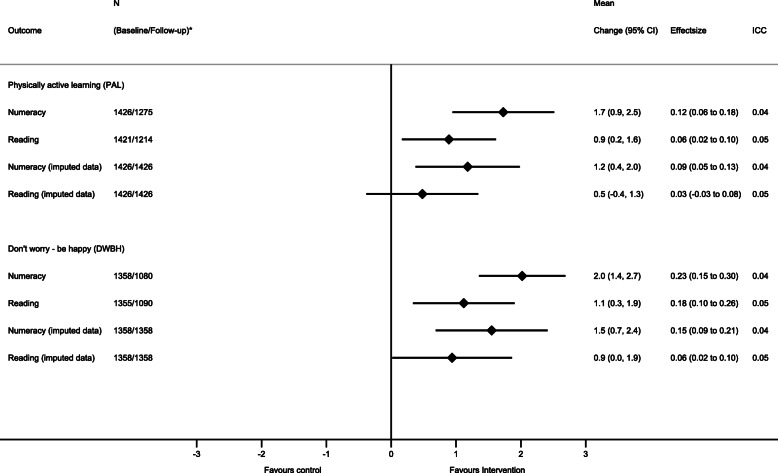
BACKGROUND: School-based physical activity interventions evaluating the effect on academic performance usually includes children. We aimed to investigate the effect of a nine-month, school-based physical activity intervention titled School in Motion (ScIM) on academic performance in adolescents. METHODS: Thirty secondary schools in Norway were cluster-randomized into three groups: the Physically active learning (PAL) group (n = 10), the Don't worry - Be Happy (DWBH) group (n = 10) or control (n = 10). Target dose in both intervention groups was 120 min/week of additional PA during school hours. Parental consent was obtained from 2084 adolescent students (76%). Standardized national tests in reading and numeracy was conducted at baseline and at the end of the intervention. We used linear mixed model to test intervention effects. We found significant intervention effects in numeracy and reading among students in both interventions when compared with controls. RESULTS: The mean difference in change in numeracy was 1.7 (95% CI: 0.9 to 2.5; Cohen's d = 0.12) and 2.0 (95% CI: 1.4 to 2.7; Cohen's d = 0.23) points in favour of students in the PAL and DWBH intervention, respectively. Similar results were found for reading, where the mean difference in change was 0.9 (95% CI 0.2 to 1.6; Cohen's d = 0.06) and 1.1 (95% CI 0.3 to 1.9; Cohen's d = 0.18) points in favour of students in the PAL and DWBH intervention, respectively. When conducting intention to treat analysis with imputed data the estimates were attenuated and some no longer significant. CONCLUSION: The ScIM study demonstrates that two different school-based PA interventions providing approximately 120 min of additional PA weekly over nine months, significantly improved numeracy and reading performance in 14-year old students compared with controls. However, the results should be interpreted with caution as the effect sizes reported were very small or small and the estimates were attenuated when conducting intention to treat analysis. Despite this, our results are still positive and suggest that PA interventions are viable models to increase academic performance among adolescents. TRIAL REGISTRATION: Retrospectively registered (25/01/2019): NCT03817047 .
Overview
CoChat Summary
TL;DR
In a nine-month Norwegian cluster randomized controlled trial, two school-based physical activity interventions (PAL and DWBH) targeting approximately 120 min/week of additional PA improved 14-year-olds’ numeracy and reading scores compared with controls. The main effects were statistically significant but very small or small, and estimates were attenuated in intention-to-treat imputation analyses, with some losing significance.
Key findings
- Numeracy mean difference in change favored PAL by 1.7 points (95% CI 0.9 to 2.5; Cohen’s d = 0.12) and DWBH by 2.0 points (95% CI 1.4 to 2.7; Cohen’s d = 0.23).
- Reading mean difference in change favored PAL by 0.9 points (95% CI 0.2 to 1.6; Cohen’s d = 0.06) and DWBH by 1.1 points (95% CI 0.3 to 1.9; Cohen’s d = 0.18).
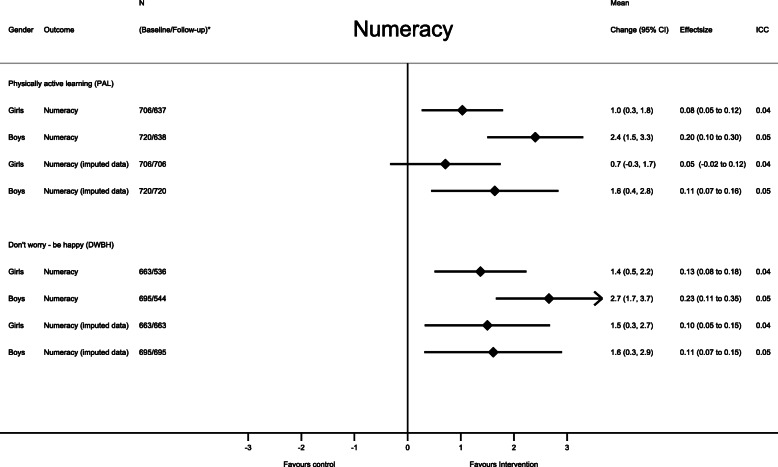
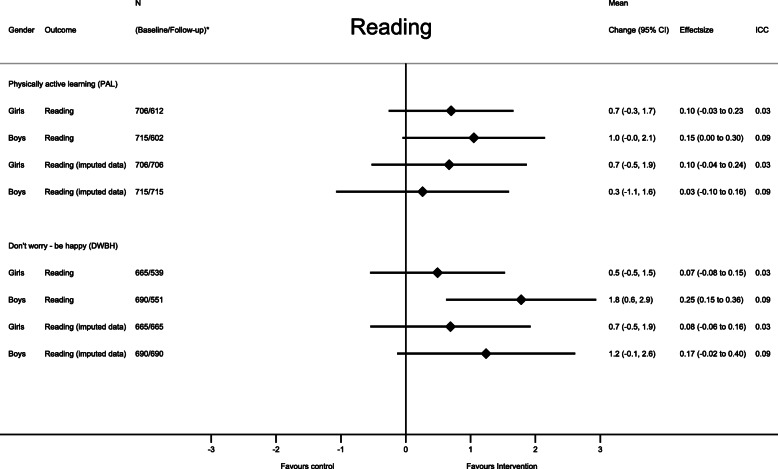
- Sex-stratified numeracy effects were larger among boys: PAL girls 1.0 points (95% CI 0.3 to 1.8) and boys 2.4 points (95% CI 1.5 to 3.3); DWBH girls 1.4 points (95% CI 0.5 to 2.2) and boys 2.7 points (95% CI 1.7 to 3.7). For reading, the only significant sex-stratified effect was among boys in DWBH.
- Intervention adherence was 83% for PAL and 78% for DWBH, corresponding to an average of 100 min/week and 94 min/week of additional PA, respectively.
Methods
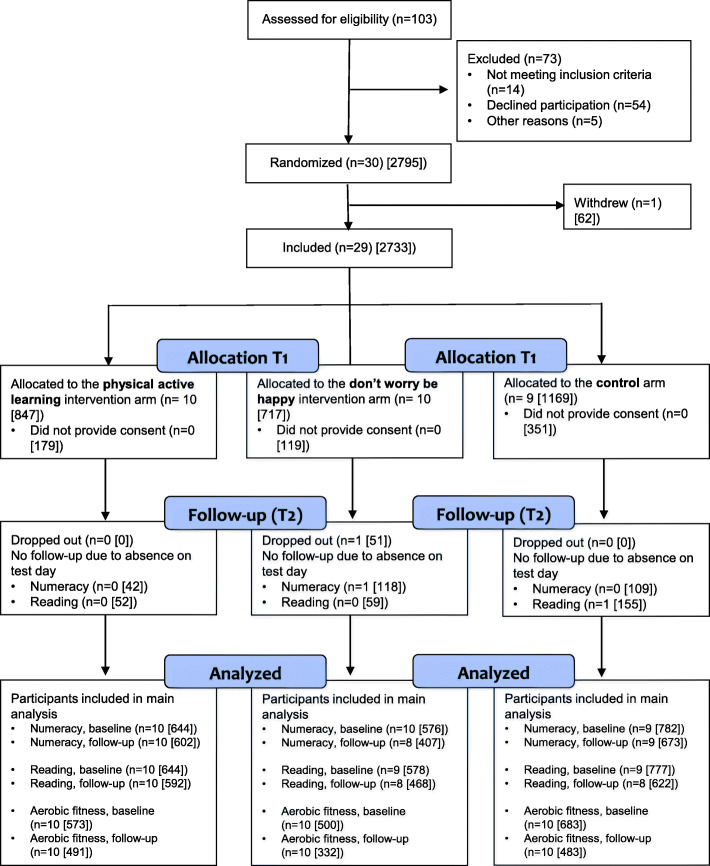
- Thirty Norwegian secondary schools were cluster-randomized 1:1:1 to PAL (n = 10), DWBH (n = 10), or control (n = 10); one control school withdrew after randomization, leaving nine control schools. Parental consent was obtained from 2084 adolescent students (76% of 2733 eligible).
- Both interventions aimed to provide approximately 120 min/week of additional PA during school hours over nine months. Academic performance was measured with standardized national computer-based tests in reading and numeracy at baseline and follow-up, standardized to T-scores with mean 50 and SD 10.
- Linear mixed models tested intervention effects, including fixed effects for intervention, time, and intervention × time, with random effects for school, class, and subject ID, adjusted for sex. Sex interaction was significant (p < 0.001 for interaction), so analyses were stratified by sex; sensitivity analyses used intention-to-treat multiple imputation, and per-protocol analyses included schools with >80% adherence.
Limitations
- Stated: the study did not include measures of cognition or biological pathways; national tests lack validation studies; effect sizes were very small or small (d = 0.06 to 0.23); the nine-month intervention may be too short to show fuller effects; intention-to-treat estimates were attenuated and some became non-significant; multiple imputation with mixed models can lead to unstable results.
- Stated: neither participants, schools, testing personnel, nor researchers were blinded; adherence was self-reported by teachers and could be subject to bias.
- Evident from the text: one DWBH school withdrew after three months, one DWBH school could not complete the numeracy test, one control school could not complete the reading test, and follow-up data were missing due to absences (reading n = 269; numeracy n = 266).
Model-written summary. Check it against the paper before relying on it.
Integrity signals
Registry
Cites
Statistics
Figures
Verification
Claims the paper makes
10 Valid · 0 Not valid · 7 Not checked · 45 Own results and interpretations
The sources with a verdict support this claim; the rest weren’t checked yet, have no full text we could read, or their verdicts aren’t rated yet.
In the paper
“Our findings are in line with recent intervention results suggesting a beneficial intervention effect of school-based PA on academic performance [7–9].”
§ Effects of a school-based physical activity intervention on academic performance in 14-year old adolescents: a cluster randomized controlled trial – the School in Motion study > Discussion
What the sources say
- Supportedcites [7] Donnelly JE Greene JL Gibson CA Smith BK Washburn RA Sullivan DK DuBose K Mayo MS Schmelzle KH Ryan JJ Jacobsen DJ Williams SL Physical activity across the curriculum (PAAC): a randomized controlled trial to promote physical activity and diminish overweight and obesity in elementary school children Prev Med 2009 49 4 336 341 10.1016/j.ypmed.2009.07.022 19665037 PMC2766439 source
The Results (Academic achievement) report significantly greater improvements in composite, reading, math, and spelling scores in PAAC schools than in control schools over three years. The Discussion identifies PAAC as a longitudinal randomized controlled trial and describes its academic-achievement finding as positive, supporting the citing sentence’s cautious wording. (LLM, conf=0.93)
- Not checked — no full text of the sourcecites [8] Mullender-Wijnsma MJ Physically active math and language lessons improve academic achievement: a cluster randomized controlled trial Pediatrics 2016 137 3 e20152743 10.1542/peds.2015-2743 26912206 source
- Not checked — no full text of the sourcecites [9] Lubans DR School physical activity intervention effect on adolescents’ performance in mathematics Med Sci Sports Exerc 2018 50 12 2442 2450 10.1249/MSS.0000000000001730 30067590 source
hedgedstates a cause- Asserted: passes — The authors put it forward as true.
- Checkable: passes — It can be checked against evidence.
- Load-bearing: unclear — It is unclear whether the paper’s conclusions depend on it.
- Based: passes — The paper gives a reason why it holds.
- Supported
Every source the paper cites for this claim was checked and supports it.
In the paper
“Third, the PAL intervention resulted in better daily PA development over time than the control group [14].”
§ Effects of a school-based physical activity intervention on academic performance in 14-year old adolescents: a cluster randomized controlled trial – the School in Motion study > Discussion
What the sources say
- Supportedcites [14] Kolle E The effect of a school-based intervention on physical activity, cardiorespiratory fitness and muscle strength: the School in Motion cluster randomized trial Int J Behav Nutr Phys Act 2020 17 1 154 10.1186/s12966-020-01060-0 33243246 PMC7690135 source
The Daily PA section reports a significantly better change in daily physical activity in the PAL arm than in controls: activity declined in both groups, but less in the PAL arm. The Conclusions likewise describe a smaller decrease over the nine-month intervention period. Thus, “better development” means a smaller decline, not an absolute increase. (LLM, conf=0.94)
plainstates a cause- Asserted: passes — The authors put it forward as true.
- Checkable: passes — It can be checked against evidence.
- Load-bearing: passes — The paper’s conclusions depend on it.
- Based: passes — The paper gives a reason why it holds.
- Supported
The cited sources support only part of this claim — read each source’s verdict below.
In the paper
“In ScIM, both interventions included additional PE, which LCoMotion, The Active Smarter Kids and Academic Achievement and Physical Activity Across the Curriculum study did not.”
§ Effects of a school-based physical activity intervention on academic performance in 14-year old adolescents: a cluster randomized controlled trial – the School in Motion study > Discussion
What the sources say
- Supportedcites [10] Donnelly JE Hillman CH Greene JL Hansen DM Gibson CA Sullivan DK Poggio J Mayo MS Lambourne K Szabo-Reed AN Herrmann SD Honas JJ Scudder MR Betts JL Henley K Hunt SL Washburn RA Physical activity and academic achievement across the curriculum: results from a 3-year cluster-randomized trial Prev Med 2017 99 140 145 10.1016/j.ypmed.2017.02.006 28193490 PMC6148354 source
The Results (Intervention delivery; page not provided) say that time devoted to physical education was similar in A+PAAC and control schools. The Methods describe the added activity as classroom lessons, not additional PE. This confirms the claim as it concerns A+PAAC; this source does not need to establish what the other named studies did. (LLM, conf=0.93)
- Supportedcites [11] Resaland GK Aadland E Moe VF Aadland KN Skrede T Stavnsbo M Suominen L Steene-Johannessen J Glosvik Ø Andersen JR Kvalheim OM Engelsrud G Andersen LB Holme IM Ommundsen Y Kriemler S van Mechelen W McKay HA Ekelund U Anderssen SA Effects of physical activity on schoolchildren's academic performance: the active smarter kids (ASK) cluster-randomized controlled trial Prev Med 2016 91 322 328 10.1016/j.ypmed.2016.09.005 27612574 source
Section 2.3 describes ASK’s added intervention time as physically active lessons, activity breaks, and homework—not additional PE. It says intervention pupils also attended the curriculum-prescribed 90 minutes of PE per week, while control schools provided the usual PA/PE curriculum. This supports the claim as it concerns ASK; the passage does not establish what the other named studies did. (LLM, conf=0.93)
- Partly supportedcites [12] Tarp J Domazet SL Froberg K Hillman CH Andersen LB Bugge A Effectiveness of a school-based physical activity intervention on cognitive performance in Danish adolescents: LCoMotion-learning, cognition and motion - a cluster randomized controlled trial PLoS One 2016 11 6 e0158087 10.1371/journal.pone.0158087 27341346 PMC4920412 sourceExperimental — accuracy not yet measured
The Methods section’s intervention-components table lists LCoMotion activities in academic subjects, at recess, at home and through active transportation, but no additional PE. The Discussion describes PAAC activity during academic subjects; it does not establish whether PAAC or The Active Smarter Kids included additional PE. This paper also does not address ScIM’s interventions. (LLM, conf=0.84)
plain- Asserted: passes — The authors put it forward as true.
- Checkable: passes — It can be checked against evidence.
- Load-bearing: unclear — It is unclear whether the paper’s conclusions depend on it.
- Based: passes — The paper gives a reason why it holds.
- Supported
Every source the paper cites for this claim was checked and supports it.
In the paper
“Although our results align with some studies, other studies do not support our findings [10–12].”
§ Effects of a school-based physical activity intervention on academic performance in 14-year old adolescents: a cluster randomized controlled trial – the School in Motion study > Discussion
What the sources say
- Supportedcites [10] Donnelly JE Hillman CH Greene JL Hansen DM Gibson CA Sullivan DK Poggio J Mayo MS Lambourne K Szabo-Reed AN Herrmann SD Honas JJ Scudder MR Betts JL Henley K Hunt SL Washburn RA Physical activity and academic achievement across the curriculum: results from a 3-year cluster-randomized trial Prev Med 2017 99 140 145 10.1016/j.ypmed.2017.02.006 28193490 PMC6148354 source
The Discussion reports no significant difference in academic achievement between children in physically active lesson schools and control schools over three years. It also describes findings across studies as inconsistent, supporting the cited sentence’s general point that some studies do not align with the citing authors’ findings. (LLM, conf=0.85)
- Supportedcites [11] Resaland GK Aadland E Moe VF Aadland KN Skrede T Stavnsbo M Suominen L Steene-Johannessen J Glosvik Ø Andersen JR Kvalheim OM Engelsrud G Andersen LB Holme IM Ommundsen Y Kriemler S van Mechelen W McKay HA Ekelund U Anderssen SA Effects of physical activity on schoolchildren's academic performance: the active smarter kids (ASK) cluster-randomized controlled trial Prev Med 2016 91 322 328 10.1016/j.ypmed.2016.09.005 27612574 source
The Results report no significant effect of the physical-activity intervention on any academic performance measure in the intention-to-treat analyses. The Conclusion likewise reports no significant overall effect, while noting a benefit for numeracy among children who initially performed poorest. The paper therefore serves as an example of a study not finding an overall academic benefit, though the citing sentence does not specify what its own findings were. (LLM, conf=0.86)
- Supportedcites [12] Tarp J Domazet SL Froberg K Hillman CH Andersen LB Bugge A Effectiveness of a school-based physical activity intervention on cognitive performance in Danish adolescents: LCoMotion-learning, cognition and motion - a cluster randomized controlled trial PLoS One 2016 11 6 e0158087 10.1371/journal.pone.0158087 27341346 PMC4920412 source
The Conclusions report no evidence that the 20-week intervention improved executive-function or mathematics-test performance in Danish adolescents, so this paper can serve as an example of a study with non-supportive results. The same section cautions that the intervention did not change physical activity levels and therefore cannot establish whether increased physical activity affects performance. (LLM, conf=0.85)
plain- Asserted: passes — The authors put it forward as true.
- Checkable: passes — It can be checked against evidence.
- Load-bearing: unclear — It is unclear whether the paper’s conclusions depend on it.
- Based: passes — The paper gives a reason why it holds.
- Supported
Every source the paper cites for this claim was checked and supports it.
In the paper
“We recently reported a favourable effect on the daily PA level and the time spent in moderate-to-vigorous intensity physical activity (MVPA) among adolescents in one of the intervention arms compared with controls [14].”
§ Effects of a school-based physical activity intervention on academic performance in 14-year old adolescents: a cluster randomized controlled trial – the School in Motion study > Background
What the sources say
- Supportedcites [14] Kolle E The effect of a school-based intervention on physical activity, cardiorespiratory fitness and muscle strength: the School in Motion cluster randomized trial Int J Behav Nutr Phys Act 2020 17 1 154 10.1186/s12966-020-01060-0 33243246 PMC7690135 source
The Daily PA section reports significant between-group differences in daily physical activity and MVPA favoring adolescents in the PAL intervention arm over controls. Both measures declined during the intervention, but declined less in that arm; the Conclusions likewise describe a smaller decrease rather than an absolute increase. (LLM, conf=0.94)
plainstates a cause- Asserted: passes — The authors put it forward as true.
- Checkable: passes — It can be checked against evidence.
- Load-bearing: unclear — It is unclear whether the paper’s conclusions depend on it.
- Based: passes — The paper gives a reason why it holds.
- Supported
24 more claims · 1 with their cited sources checked
Create a free account to see all 62 claims and every source verdict.
- Probably not a substantial claim. 20
- It may state two separate claims as one. 19
Self-check
Percentages, sums and reported differences re-computed from the paper’s own numbers.
Each contradiction between two passages listed here was confirmed by an independent check.
Rated minor: it would not touch a result — a value no result rests on, a p-value that stays on the same side of the significance level, or a conflict that is clerical, resolved elsewhere in the paper, or outside its own findings.
In the paper
§ Effects of a school-based physical activity intervention on academic performance in 14-year old adolescents: a cluster randomized controlled trial – the School in Motion study > Abstract > Conclusion
“The ScIM study demonstrates that two different school-based PA interventions providing approximately 120 min of additional PA weekly over nine months, significantly improved numeracy and reading performance in 14-year old students compared with controls.”
§ Effects of a school-based physical activity intervention on academic performance in 14-year old adolescents: a cluster randomized controlled trial – the School in Motion study > Results > Intervention adherence
“Thus, the PAL-group delivered an average of 100 min/week of additional PA, and the DWBH-group delivered an average of 94 min/week of additional PA.”
Citations
Cites
An ecological perspective on health promotion programs
McLeroy, K. R., Bibeau, D., Steckler, A., & Glanz, K. (1988) · Health Education Quarterly · doi:10.1177/109019818801500401 · Cited by 8,502
Consort 2010 statement: extension to cluster randomised trials
Campbell, M. K., Piaggio, G., Elbourne, D. R., Altman, D. G., & for the CONSORT Group (2012) · BMJ · doi:10.1136/bmj.e5661 · Cited by 3,510
Fedewa, A. L., & Ahn, S. (2011) · Research Quarterly for Exercise and Sport · doi:10.1080/02701367.2011.10599785 · Cited by 624
Donnelly, J. E., Greene, J. L., Gibson, C. A., Smith, B. K., Washburn, R. A., Sullivan, D. K., DuBose, K., Mayo, M. S., Schmelzle, K. H., Ryan, J. J., et al. (2009) · Preventive Medicine · doi:10.1016/j.ypmed.2009.07.022 · Cited by 595 · cited 4×
“However, neither did Physical Activity Across the Curriculum study [7] or the Fit & Vardig op School intervention [8], making it difficult to conclude which components of school-based PA are most effective.”
BackgroundResultInfluentialSingh, A. S., Saliasi, E., van den Berg, V., Uijtdewilligen, L., de Groot, R. H. M., Jolles, J., Andersen, L. B., Bailey, R., Chang, Y.-K., Diamond, A., et al. (2019) · British Journal of Sports Medicine · doi:10.1136/bjsports-2017-098136 · Cited by 588 · cited 1×
“Finally, a recent systematic review on the effects of PA interventions on academic performance in 3–16 years olds concluded that strong evidence exist of the beneficial effects of PA on numeracy performance, but the evidence is inconclusive for overall academic performance [13].”
BackgroundTwisk, J., de Boer, M., de Vente, W., & Heymans, M. (2013) · Journal of Clinical Epidemiology · doi:10.1016/j.jclinepi.2013.03.017 · Cited by 568 · cited 1×
“Multiple imputation when performing mixed models analyses can lead to unstable results [26], and when the analysis was rerun on the imputed data the estimates were attenuated and some no longer significant.”
MethodProcesses, Relations, and Relational‐Developmental‐Systems
Overton, W. F. (2015) · Handbook of Child Psychology and Developmental Science · doi:10.1002/9781118963418.childpsy102 · Cited by 471 · cited 1×
“approach to human development, promoting mutually beneficial relationships for everyone involved [17].”
BackgroundAcademic Achievement and Physical Activity: A Meta-analysis
Álvarez-Bueno, C., Pesce, C., Cavero-Redondo, I., Sánchez-López, M., Garrido-Miguel, M., & Martínez-Vizcaíno, V. (2017) · Pediatrics · doi:10.1542/peds.2017-1498 · Cited by 391
Chaddock, L., Pontifex, M. B., Hillman, C. H., & Kramer, A. F. (2011) · Journal of the International Neuropsychological Society · doi:10.1017/s1355617711000567 · Cited by 369 · cited 2×
“Furthermore, PA can affect the brain’s physiology by increasing the cerebral capillary growth, blood flow and nerve cells in the hippocampus, supporting learning and memory related to academic performance [19, 20].”
BackgroundSchmidt, M., Jäger, K., Egger, F., Roebers, C. M., & Conzelmann, A. (2015) · Journal of Sport and Exercise Psychology · doi:10.1123/jsep.2015-0069 · Cited by 329
Norris, E., van Steen, T., Direito, A., & Stamatakis, E. (2020) · British Journal of Sports Medicine · doi:10.1136/bjsports-2018-100502 · Cited by 293
Cognitively challenging physical activity benefits executive function in overweight children
Crova, C., Struzzolino, I., Marchetti, R., Masci, I., Vannozzi, G., Forte, R., & Pesce, C. (2014) · Journal of Sports Sciences · doi:10.1080/02640414.2013.828849 · Cited by 215 · cited 1×
“Studies have reported that PE enriched with social interaction improves inhibition [22, 23].”
BackgroundAssociations between Physical Activity, Fitness, and Academic Achievement
Kwak, L., Kremers, S. P. J., Bergman, P., Ruiz, J. R., Rizzo, N. S., & Sjöström, M. (2009) · The Journal of Pediatrics · doi:10.1016/j.jpeds.2009.06.019 · Cited by 198
Resaland, G. K., Aadland, E., Moe, V. F., Aadland, K. N., Skrede, T., Stavnsbo, M., Suominen, L., Steene-Johannessen, J., Glosvik, Ø., Andersen, J. R., et al. (2016) · Preventive Medicine · doi:10.1016/j.ypmed.2016.09.005 · Cited by 187
Self-citationMullender-Wijnsma, M. J., Hartman, E., de Greeff, J. W., Doolaard, S., Bosker, R. J., & Visscher, C. (2016) · Pediatrics · doi:10.1542/peds.2015-2743 · Cited by 187 · cited 3×
“However, neither did Physical Activity Across the Curriculum study [7] or the Fit & Vardig op School intervention [8], making it difficult to conclude which components of school-based PA are most effective.”
BackgroundBooth, J. N., Leary, S. D., Joinson, C., Ness, A. R., Tomporowski, P. D., Boyle, J. M., & Reilly, J. J. (2014) · British Journal of Sports Medicine · doi:10.1136/bjsports-2013-092334 · Cited by 177
Donnelly, J. E., Hillman, C. H., Greene, J. L., Hansen, D. M., Gibson, C. A., Sullivan, D. K., Poggio, J., Mayo, M. S., Lambourne, K., Szabo-Reed, A. N., et al. (2017) · Preventive Medicine · doi:10.1016/j.ypmed.2017.02.006 · Cited by 135
van der Niet, A. G., Smith, J., Scherder, E. J. A., Oosterlaan, J., Hartman, E., & Visscher, C. (2015) · Journal of Science and Medicine in Sport · doi:10.1016/j.jsams.2014.09.006 · Cited by 125
van der Niet, A. G., Smith, J., Oosterlaan, J., Scherder, E. J. A., Hartman, E., & Visscher, C. (2016) · Pediatric Exercise Science · doi:10.1123/pes.2015-0084 · Cited by 95 · cited 1×
“Studies have reported that PE enriched with social interaction improves inhibition [22, 23].”
BackgroundSneck, S., Viholainen, H., Syväoja, H., Kankaapää, A., Hakonen, H., Poikkeus, A.-M., & Tammelin, T. (2019) · International Journal of Behavioral Nutrition and Physical Activity · doi:10.1186/s12966-019-0866-6 · Cited by 90
Tarp, J., Domazet, S. L., Froberg, K., Hillman, C. H., Andersen, L. B., & Bugge, A. (2016) · PLOS ONE · doi:10.1371/journal.pone.0158087 · Cited by 89 · cited 8×
“Studies with adolescents have focused only on PE lessons [9] or have relatively short intervention period [12].”
BackgroundMethodResultInfluentialThe associations between physical activity, sedentary behaviour and academic performance
Maher, C., Lewis, L., Katzmarzyk, P. T., Dumuid, D., Cassidy, L., & Olds, T. (2016) · Journal of Science and Medicine in Sport · doi:10.1016/j.jsams.2016.02.010 · Cited by 80
A Review of Childhood Physical Activity, Brain, and Cognition: Perspectives on the Future
Hillman, C. H., & Biggan, J. R. (2017) · Pediatric Exercise Science · doi:10.1123/pes.2016-0125 · Cited by 68
Kolle, E., Solberg, R. B., Säfvenbom, R., Dyrstad, S. M., Berntsen, S., Resaland, G. K., Ekelund, U., Anderssen, S. A., Steene-Johannessen, J., & Grydeland, M. (2020) · International Journal of Behavioral Nutrition and Physical Activity · doi:10.1186/s12966-020-01060-0 · Cited by 41 · cited 2×
“development over time than the control group [14].”
BackgroundSelf-citationSchool Physical Activity Intervention Effect on Adolescents’ Performance in Mathematics
LUBANS, D. R., BEAUCHAMP, M. R., DIALLO, T. M. O., PERALTA, L. R., BENNIE, A., WHITE, R. L., OWEN, K., & LONSDALE, C. (2018) · Medicine & Science in Sports & Exercise · doi:10.1249/mss.0000000000001730 · Cited by 40 · cited 2×
“These results also correspond with the Activity and Motivation in Physical Education trail findings, where the authors reported significant intervention effects on numeracy performance [9].”
BackgroundResultHaapala, E. A., Haapala, H. L., Syväoja, H., Tammelin, T. H., Finni, T., & Kiuru, N. (2020) · Journal of Sport and Health Science · doi:10.1016/j.jshs.2019.07.003 · Cited by 24
Cited by
Peiris, D. L. I. H. K., Duan, Y., Vandelanotte, C., Liang, W., Yang, M., & Baker, J. S. (2022) · International Journal of Environmental Research and Public Health · doi:10.3390/ijerph19159479 · Cited by 46
“Furthermore, total intensity of intervention may be correlated with the intervention effects on academic performance and health outcomes [75,90].”
BackgroundAyala, A. M. C., Parker, K. E., Mazzoli, E., Lander, N., Ridgers, N. D., Timperio, A. F., Lubans, D. R., Abbott, G., Koorts, H., & Salmon, J. (2024) · Sports Medicine - Open · doi:10.1186/s40798-024-00688-7 · Cited by 62
Browne, J., Walker, T., Brown, A. D., Sherriff, S., Christidis, R., Egan, M., Versace, V. L., Allender, S. E., & Backholer, K. (2021) · SSM - Population Health · doi:10.1016/j.ssmph.2021.100874 · Cited by 42
Physical activity: associations with health and summary of guidelines
Borodulin, K., & Anderssen, S. A. (2023) · Food & Nutrition Research · doi:10.29219/fnr.v67.9719 · Cited by 51
Self-citationMartín-Martínez, C., Valenzuela, P. L., Martinez‐Zamora, M. D., & Martínez‐de‐Quel, Ó. (2022) · Journal of science and medicine in sport · doi:10.1016/j.jsams.2022.12.007 · Cited by 31
Metadata
- Authors
- Solberg, R. B., Steene-Johannessen, J., Anderssen, S. A., Ekelund, U., Säfvenbom, R., Haugen, T., Berntsen, S., Åvitsland, A., Lerum, Ø., Resaland, G. K., & Kolle, E.
- Affiliations
- Norwegian School of Sport Sciences (NO)
- University of Agder (NO)
- University of Stavanger (NO)
- Western Norway University of Applied Sciences (NO)
- Corresponding author
- Solberg, Runar Barstad
- ORCID
- Venue
- BMC Public Health
- Published
- 2021-05-06
- Volume
- 21
- Issue
- 1
- Pages
- 871-871
- ISSN
- 1471-2458 (ISSN-L)
- PMC
- PMC8101111
- OpenAlex
- W3158493454
- Cited by
- 37
- References
- 26
- Citations by year
- 2026: 9 · 2025: 8 · 2024: 11 · 2023: 3 · 2022: 4 · 2021: 2
- FWCI
- 3.29
- Type
- journal article
- Language
- en
- Open access
- gold
- doi.org
- Licence
- cc-by
- creativecommons.org/licenses/by/4.0/ (tdm)
- creativecommons.org/licenses/by/4.0/ (vor)
- Locations
- BMC Public Health (publishedVersion, cc-by)
- PubMed Central (publishedVersion, cc-by)
- PubMed (publishedVersion)
- DOAJ (DOAJ: Directory of Open Access Journals) (submittedVersion, cc-by-sa)
- NORA - Norwegian Open Research Archives (submittedVersion, cc-by)
- Topics
- Health Sciences › Medicine › Public Health, Environmental and Occupational Health › Physical Activity and Health
- Health Sciences › Medicine › Public Health, Environmental and Occupational Health › School Health and Nursing Education
- Social Sciences › Education › Physical Education and Pedagogy
- Keywords
- school-based physical activity intervention, academic performance, adolescents, numeracy, reading achievement, high school students, physically active learning, parental consent, mental health promotion
- MeSH terms
- Academic Performance, Adolescent, Child, Humans, Norway, School Health Services, Schools, Students, Exercise
About these checks
Registry, retraction, Cites and statistics results are computed, not judged, with one exception: a printed reference that no index lists is read once by a model before it counts as a citation error. Claims are extracted by a model and kept only when their quote appears verbatim in the text; each cited source is then checked, with a model’s help, for whether it says what the claim relies on. Those verdicts can be wrong — read the claim’s quote and the cited source before relying on one.
The claim verdicts this report counts are experimental: their accuracy is not yet measured.
A language model drew the claims from the paper on 2026-10-10, under version 3 of the claim definition (model deepseek-v4.1-flash, prompt extract-v3).
A second model labelled each claim on 2026-10-10 (model jev-1.13-20260917, definition revision gold-guideline-v0.2).
Cited sources are checked with a language model’s help (gpt-6-sol).
Statistics and arithmetic are recomputed, not judged.
Confidence bands are shown only for fields calibrated on our annotated test set. None is calibrated yet, so no band is shown.
What counts as a claim ›How we measure confidence ›How we check this ›
Are you an author, or do you see a problem with this page? Request a review
Data sources
Bibliographic data: Semantic Scholar, OpenAlex, Crossref.
Contains information from the Semantic Scholar Academic Graph Datasets, made available under the ODC Attribution License (ODC-BY 1.0).
Semantic Scholar’s data is described in: Kinney, R., et al. (2023). The Semantic Scholar Open Data Platform. arXiv:2301.10140.
