

Feasibility and acceptability of “active” classroom workstations among French university students and lecturers: a pilot study
Open accessThe DOI matches its Crossref record; 31 of the 33 references it cites were found in a registry or an index.
Abstract
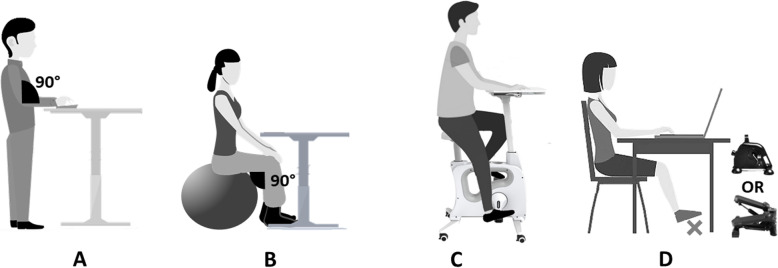
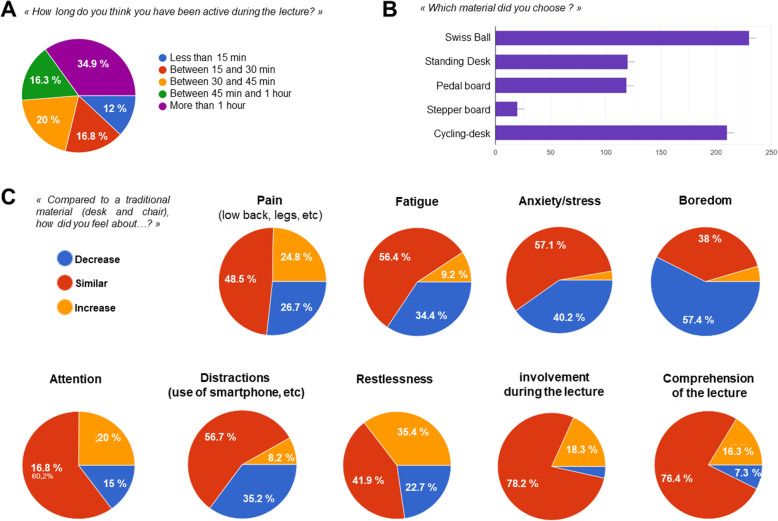
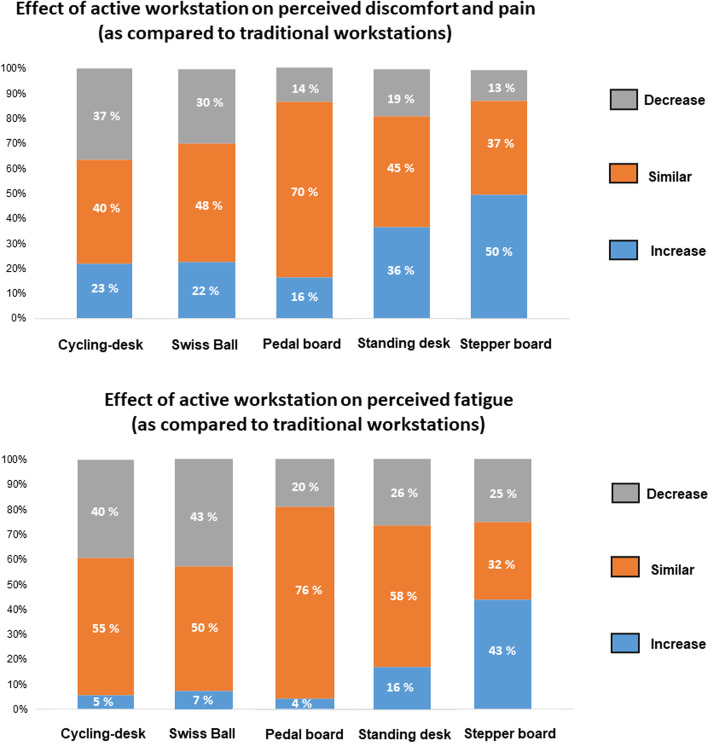
Background: Sedentary lifestyles plague today’s society in terms of physical, psychosocial and cognitive health. Students are particularly at risk because they spend most of their daily time sitting and inactive. The current pedagogical model must be rethought in order to promote students’ health, well-being and therefore their success. The objective of this project was to equip one classroom of the sport science department at a university with various active workstations (standing desks, Swiss balls, cycling desks, pedal- or stepper-board) and to evaluate the feasibility and influence of these types of active workstations on the cognitive and psychological factors of the students, and to collect the feedback of lecturers during this experience. Methods: Participation in the study was voluntary and students had the opportunity to choose or not to use an active workstation during lectures. A total of 663 students and 14 lecturers completed a survey to evaluate subjective feelings about physical, psycho-cognitive and academic aspects after their first experience with active workstations in the classroom. Results: The majority of students and lecturers reported positive effects of active workstations in reducing fatigue, distraction, and boredom. The preferred active workstations were the cycling desks and the Swiss balls. Finally, 89.4% of students favoured using active workstations in future lectures if they had the option, as well as 71% of lecturers, demonstrating the acceptance of such active workstations. Conclusion: The present study brings promising results toward a more general implementation of active workstations in universities. Once a familiarisation period is observed, having such workstations in the classroom could help prevent the deleterious effect of sedentary behaviour and promote a more active daily life for the future.
Overview
The claims and statistics of this paper haven’t been checked yet.
Free: it reads the open-access text and checks the first 5 claims that cite a source we can check. Create a free account to check every claim.
Integrity signals
Registry
Cites
Statistics
Figures
Verification
Claims the paper makes
The claims and statistics of this paper haven’t been checked yet.
Free: it reads the open-access text and checks the first 5 claims that cite a source we can check. Create a free account to check every claim.
Claims other papers make about this one
Each is checked against this paper’s own text: does it say what the citing paper says it does?
The cited source doesn’t support the claim as written.
In the citing paper
“Seven studies addressed sustained attention, five of which found significant improvements [22, 23, 25, 27, 34] and two reported no effect [29, 33], resulting in relatively strong evidence strength (71.4%).”
From Effect of classroom physical activity breaks on learning behaviors and academic achievements in university students: a systematic review (2026) · cites this paper as [33]
Checked by a reasoning model — may be wrong.
Experimental — accuracy not yet measuredThe source backs part of the claim, not all of it — or backs it for a different population, condition or comparison.
In the citing paper
“However, instructors consistently reported that active workstations significantly reduce students’ off-task behaviors, such as chatting or using mobile phones during class [33].”
From Effect of classroom physical activity breaks on learning behaviors and academic achievements in university students: a systematic review (2026) · cites this paper as [33]
Experimental — accuracy not yet measuredThe source backs part of the claim, not all of it — or backs it for a different population, condition or comparison.
In the citing paper
“Two studies investigated negative emotions, with one indicating reductions [33] and one indicating an increase [32].”
From Effect of classroom physical activity breaks on learning behaviors and academic achievements in university students: a systematic review (2026) · cites this paper as [33]
Experimental — accuracy not yet measuredThe source backs part of the claim, not all of it — or backs it for a different population, condition or comparison.
In the citing paper
“Specifically, physical activity breaks in classroom lectures enhance students’ enjoyment and well-being [14, 22], reduce the frequency of mobile phone use, and alleviate negative emotional states such as stress and boredom [33, 34], compared to traditional sedentary classroom formats.”
From Effect of classroom physical activity breaks on learning behaviors and academic achievements in university students: a systematic review (2026) · cites this paper as [33]
Experimental — accuracy not yet measuredThe cited source says what the claim attributes to it.
In the citing paper
“Three studies investigated behavioral engagement, with two showing improvements [25, 34] and one reporting no effect [33], yielding unclear evidence (66.7%) in this review.”
From Effect of classroom physical activity breaks on learning behaviors and academic achievements in university students: a systematic review (2026) · cites this paper as [33]
Self-check
Percentages, sums and reported differences re-computed from the paper’s own numbers.
The self-check needs the paper’s full text.
Citations
Cites
Biswas, A., Oh, P. I., Faulkner, G. E., Bajaj, R. R., Silver, M. A., Mitchell, M. S., & Alter, D. A. (2015) · Annals of Internal Medicine · doi:10.7326/m14-1651 · Cited by 2,726 · cited 1×
“intensity activities) is beneficial for physical, psychological and cognitive health and attenuates the negative health consequences of sedentary time [23].”
BackgroundHealy, G. N., Dunstan, D. W., Salmon, J., Cerin, E., Shaw, J. E., Zimmet, P. Z., & Owen, N. (2008) · Diabetes Care · doi:10.2337/dc07-2046 · Cited by 1,465
Emerging adulthood and college-aged youth: An overlooked age for weight-related behavior change
Nelson, M. C., Story, M., Larson, N. I., Neumark‐Sztainer, D., & Lytle, L. A. (2008) · Obesity · doi:10.1038/oby.2008.365 · Cited by 1,314
The evolving definition of “sedentary.”
Pate, R. R., O'Neill, J. R., & Lobelo, F. (2008) · Exercise and Sport Sciences Reviews · doi:10.1097/jes.0b013e3181877d1a · Cited by 1,280 · cited 2×
“Indeed, sedentary behaviours (i.e. activities that do not increase energy expenditure substantially above the resting level, namely 1.6 Metabolic Equivalent of Task [3]) are a feature of our current society with dramatic consequences in terms of health.”
BackgroundInfluentialYoung, D. R., Hivert, M.-F., Alhassan, S., Camhi, S. M., Ferguson, J. F., Katzmarzyk, P. T., Lewis, C. E., Owen, N., Perry, C. K., Siddique, J., et al. (2016) · Circulation · doi:10.1161/cir.0000000000000440 · Cited by 791
A Meta-Analysis of College Students' Physical Activity Behaviors
Keating, X. D., Guan, J., Piñero, J. C., & Bridges, D. M. (2005) · Journal of American College Health · doi:10.3200/jach.54.2.116-126 · Cited by 763
Friedenreich, C. M., Ryder‐Burbidge, C., & McNeil, J. (2021) · Molecular Oncology · doi:10.1002/1878-0261.12772 · Cited by 661
The Descriptive Epidemiology of Sitting
Bauman, A., Ainsworth, B. E., Sallis, J. F., Hagströmer, M., Craig, C. L., Bull, F. C., Pratt, M., Venugopal, K., Chau, J., & Sjöström, M. (2011) · American Journal of Preventive Medicine · doi:10.1016/j.amepre.2011.05.003 · Cited by 605
Deliens, T., Deforche, B., De Bourdeaudhuij, I., & Clarys, P. (2015) · BMC Public Health · doi:10.1186/s12889-015-1553-4 · Cited by 412
Workplace interventions for reducing sitting at work
Shrestha, N., Kukkonen-Harjula, K. T., Verbeek, J. H., Ijaz, S., Hermans, V., & Bhaumik, S. (2016) · Cochrane Database of Systematic Reviews · doi:10.1002/14651858.cd010912.pub3 · Cited by 385
Deforche, B., Van Dyck, D., Deliens, T., & De Bourdeaudhuij, I. (2015) · International Journal of Behavioral Nutrition and Physical Activity · doi:10.1186/s12966-015-0173-9 · Cited by 372
Effects of breaking up prolonged sitting on skeletal muscle gene expression
Latouche, C., Jowett, J. B. M., Carey, A. L., Bertovic, D. A., Owen, N., Dunstan, D. W., & Kingwell, B. A. (2013) · Journal of Applied Physiology · doi:10.1152/japplphysiol.00978.2012 · Cited by 153
Syväoja, H. J., Tammelin, T. H., Ahonen, T., Kankaanpää, A., & Kantomaa, M. T. (2014) · PLoS ONE · doi:10.1371/journal.pone.0103559 · Cited by 149
Classroom Standing Desks and Sedentary Behavior: A Systematic Review
Minges, K. E., Chao, A. M., Irwin, M. L., Owen, N., Park, C., Whittemore, R., & Salmon, J. (2016) · Pediatrics · doi:10.1542/peds.2015-3087 · Cited by 138
Mehta, R. K., Shortz, A. E., & Benden, M. E. (2015) · International Journal of Environmental Research and Public Health · doi:10.3390/ijerph13010059 · Cited by 119
Sedentary behaviour as a new behavioural target in the prevention and treatment of type 2 diabetes
Henson, J., Dunstan, D. W., Davies, M. J., & Yates, T. (2016) · Diabetes/Metabolism Research and Reviews · doi:10.1002/dmrr.2759 · Cited by 113
Clemes, S. A., Barber, S. E., Bingham, D. D., Ridgers, N. D., Fletcher, E., Pearson, N., Salmon, J., & Dunstan, D. W. (2016) · Journal of Public Health · doi:10.1093/pubmed/fdv084 · Cited by 109
Rouse, P. C., & Biddle, S. J. H. (2010) · Health Education Journal · doi:10.1177/0017896910363145 · Cited by 107
Time spent in sedentary posture is associated with waist circumference and cardiovascular risk
Tigbe, W. W., Granat, M. H., Sattar, N. A., & Lean, M. (2017) · International Journal of Obesity · doi:10.1038/ijo.2017.30 · Cited by 71
López-Vicente, M., García‐Aymerich, J., Torrent-Pallicer, J., Forns, J., Ibarluzea, J. M., Lertxundi, N., González, L., Valera‐Gran, D., Torrent, M., Dadvand, P., et al. (2017) · The Journal of Pediatrics · doi:10.1016/j.jpeds.2017.05.079 · Cited by 67
Workplace interventions for reducing sitting at work
Shrestha, N., Ijaz, S., Kukkonen-Harjula, K. T., Kumar, S., & Nwankwo, C. P. (2015) · Cochrane Database of Systematic Reviews · doi:10.1002/14651858.cd010912.pub2 · Cited by 63
Guirado, T., Chambonnière, C., Chaput, J., Metz, L., Thivel, D., & Duclos, M. (2021) · International Journal of Environmental Research and Public Health · doi:10.3390/ijerph18062828 · Cited by 62
Grace, M. S., Dempsey, P. C., Sethi, P., Mundra, P. A., Mellett, N. A., Weir, J. M., Owen, N., Dunstan, D. W., Meikle, P. J., & Kingwell, B. A. (2017) · The Journal of Clinical Endocrinology & Metabolism · doi:10.1210/jc.2016-3926 · Cited by 54
Felez-Nobrega, M., Hillman, C. H., Cirera, E., & Puig-Ribera, A. (2017) · European Journal of Public Health · doi:10.1093/eurpub/ckx021 · Cited by 49
Sedentary Time, Physical Activity, and Executive Function in a Longitudinal Study of Youth
Wickel, E. E. (2016) · Journal of Physical Activity and Health · doi:10.1123/jpah.2016-0200 · Cited by 48
Introducing sit-stand desks increases classroom standing time among university students
Jerome, M., Janz, K. F., Baquero, B., & Carr, L. J. (2017) · Preventive Medicine Reports · doi:10.1016/j.pmedr.2017.10.019 · Cited by 42 · cited 4×
“Questions on subjective feelings have been adapted from a study by Jerome et al. (2017), and students were asked to report whether the utilisation of active workstations during the lecture “decreased”, “increased” or “did not change” each aspect considered compared with a similar lecture attended…”
BackgroundInfluentialBenzo, R., Gremaud, A., Jerome, M., & Carr, L. (2016) · International Journal of Environmental Research and Public Health · doi:10.3390/ijerph13080823 · Cited by 41 · cited 4×
“Similarly, a Canadian study showed the feasibility of implementing standing or pedal-operated workstations in university libraries [27], while Benzo and colleagues reported the overall acceptability of university students and lecturers of introducing standing desks in classrooms [16].”
BackgroundResultInfluentialThe time spent sitting does not always mean a low level of physical activity
Matusiak‐Wieczorek, E., Lipert, A., Kochan, E., & Jegier, A. (2020) · BMC Public Health · doi:10.1186/s12889-020-8396-3 · Cited by 36
Oyeyemi, A. L., Muhammed, S., Oyeyemi, A. Y., & Adegoke, B. O. A. (2017) · PLoS ONE · doi:10.1371/journal.pone.0190124 · Cited by 31
Yoong, S. L., Jones, J. Z., Pearson, N., Swindle, T., Barnes, C., Delaney, T. M., Lum, M., Golley, R. K., Matwiejczyk, L., Kelly, B., et al. (2021) · International Journal of Environmental Research and Public Health · doi:10.3390/ijerph18052745 · Cited by 24
Bastien Tardif, C., Cantin, M., Sénécal, S., Léger, P.-M., Labonté-Lemoyne, É., Begon, M., & Mathieu, M.-E. (2018) · International Journal of Environmental Research and Public Health · doi:10.3390/ijerph15061242 · Cited by 21 · cited 1×
“Similarly, a Canadian study showed the feasibility of implementing standing or pedal-operated workstations in university libraries [27], while Benzo and colleagues reported the overall acceptability of university students and lecturers of introducing standing desks in classrooms [16].”
Background985 EFFECTS OF BREAKING UP PROLONGED SITTING ON SKELETAL MUSCLE GENE EXPRESSION
Latouche, C., Dunstan, D. W., Carey, A. L., Healy, G. N., Bertovic, D., Owen, N., & Kingwell, B. A. (2012) · Journal of Hypertension · doi:10.1097/01.hjh.0000420939.58192.b2
Cited by
Lynch, J., O’Donoghue, G., & Peiris, C. L. (2022) · International Journal of Environmental Research and Public Health · doi:10.3390/ijerph19137775 · Cited by 44
“Three of the PAL studies used a portable peddle machine or static cycling desk [45,51,52], two used a standing desk or sit to stand desk [58,59], and three included both cycling and standing”
BackgroundMethodInfluentialVisier‐Alfonso, M. E., Sánchez‐López, M., Bizzozero‐Peroni, B., Goñi, V. D., Cekrezi, S., Galdames, I. S., & Martínez‐Vizcaíno, V. (2025) · BMC Public Health · doi:10.1186/s12889-025-22912-z · Cited by 7
Isacco, L., Gimenez, P., Ennequin, G., Mourot, L., & Grosprêtre, S. (2022) · European Journal of Applied Physiology · doi:10.1007/s00421-022-04954-y · Cited by 4
Self-citationDeng, Q., Wu, C., & Yang, L. (2026) · International Journal of Behavioral Nutrition and Physical Activity · doi:10.1186/s12966-026-01936-7
“Seven studies addressed sustained attention, five of which found significant improvements [22, 23, 25, 27, 34] and two reported no effect [29, 33], resulting in relatively strong evidence strength (71.4%).”
InfluentialLi, Z., Liu, X., Cheng, J., Yuan, Y., & Yue, M. (2023) · Advances in Computer and Engineering Technology Research · doi:10.61935/acetr.1.1.2023.p174
Metadata
- Authors
- Grosprêtre, S., Ennequin, G., Peseux, S., & Isacco, L.
- Affiliations
- Université Bourgogne Franche-Comté (FR)
- Université Clermont Auvergne (FR)
- Corresponding author
- Grosprêtre, Sidney
- Venue
- BMC Public Health
- Published
- 2021-05-27
- Volume
- 21
- Issue
- 1
- Pages
- 1001-1001
- ISSN
- 1471-2458 (ISSN-L)
- PMC
- PMC8161641
- OpenAlex
- W3136272462
- Cited by
- 10
- References
- 33
- Citations by year
- 2026: 3 · 2025: 3 · 2024: 1 · 2023: 1 · 2022: 2
- FWCI
- 0.63
- Type
- journal article
- Language
- en
- Open access
- gold
- doi.org
- Licence
- cc-by
- creativecommons.org/licenses/by/4.0 (tdm)
- creativecommons.org/licenses/by/4.0 (vor)
- Locations
- BMC Public Health (publishedVersion, cc-by)
- PubMed Central (publishedVersion, cc-by)
- PubMed (publishedVersion)
- DOAJ (DOAJ: Directory of Open Access Journals) (submittedVersion, cc-by-sa)
- Funders
- Agence Nationale de la Recherche (ANR-17-NCUN-0003, ANR-17)
- Topics
- Health Sciences › Medicine › Public Health, Environmental and Occupational Health › Physical Activity and Health
- Social Sciences › Human Factors and Ergonomics › Ergonomics and Musculoskeletal Disorders
- Health Sciences › Medicine › Public Health, Environmental and Occupational Health › School Health and Nursing Education
- Keywords
- active workstations, sedentary behavior, university students, lecturers, standing desks, Swiss ball, student well-being, fatigue, distraction, boredom, feasibility, acceptability, physical activity in education, sports science education
- MeSH terms
- Standing Position, Feasibility Studies, Humans, Pilot Projects, Students, Universities, Workplace
About these checks
Registry, retraction, Cites and statistics results are computed, not judged, with one exception: a printed reference that no index lists is read once by a model before it counts as a citation error. Claims are extracted by a model and kept only when their quote appears verbatim in the text; each cited source is then checked, with a model’s help, for whether it says what the claim relies on. Those verdicts can be wrong — read the claim’s quote and the cited source before relying on one.
Statistics and arithmetic are recomputed, not judged.
Confidence bands are shown only for fields calibrated on our annotated test set. None is calibrated yet, so no band is shown.
What counts as a claim ›How we measure confidence ›How we check this ›
Are you an author, or do you see a problem with this page? Request a review
Data sources
Bibliographic data: Semantic Scholar, OpenAlex, Crossref.
Contains information from the Semantic Scholar Academic Graph Datasets, made available under the ODC Attribution License (ODC-BY 1.0).
Semantic Scholar’s data is described in: Kinney, R., et al. (2023). The Semantic Scholar Open Data Platform. arXiv:2301.10140.
