

The DOI matches its Crossref record; 74 of the 74 references it cites were found in a registry or an index; none of the 226 sources its claims cite is checked for support yet.
Mediators of socioeconomic inequalities in preterm birth: a systematic review
Open accessAbstract
Background: Rates of preterm birth are substantial with significant inequalities. Understanding the role of risk factors on the pathway from maternal socioeconomic status (SES) to preterm birth can help inform interventions and policy. This study therefore aimed to identify mediators of the relationship between maternal SES and preterm birth, assess the strength of evidence, and evaluate the quality of methods used to assess mediation. Methods: Using Scopus, Medline OVID, “Medline In Process & Other Non-Indexed Citation”, PsycINFO, and Social Science Citation Index (via Web of Science), search terms combined variations on mediation, socioeconomic status, and preterm birth. Citation and advanced Google searches supplemented this. Inclusion criteria guided screening and selection of observational studies Jan-2000 to July-2020. The metric extracted was the proportion of socioeconomic inequality in preterm birth explained by each mediator (e.g. ‘proportion eliminated’). Included studies were narratively synthesised. Results: Of 22 studies included, over one-half used cohort design. Most studies had potential measurement bias for mediators, and only two studies fully adjusted for key confounders. Eighteen studies found significant socioeconomic inequalities in preterm birth. Studies assessed six groups of potential mediators: maternal smoking; maternal mental health; maternal physical health (including body mass index (BMI)); maternal lifestyle (including alcohol consumption); healthcare; and working and environmental conditions. There was high confidence of smoking during pregnancy (most frequently examined mediator) and maternal physical health mediating inequalities in preterm birth. Significant residual inequalities frequently remained. Difference-of-coefficients between models was the most common mediation analysis approach, only six studies assessed exposure-mediator interaction, and only two considered causal assumptions. Conclusions: The substantial socioeconomic inequalities in preterm birth are only partly explained by six groups of mediators that have been studied, particularly maternal smoking in pregnancy. There is, however, a large residual direct effect of SES evident in most studies. Despite the mediation analysis approaches used limiting our ability to make causal inference, these findings highlight potential ways of intervening to reduce such inequalities. A focus on modifiable socioeconomic determinants, such as reducing poverty and educational inequality, is probably necessary to address inequalities in preterm birth, alongside action on mediating pathways.
Overview
CoChat Summary
TL;DR
This systematic review of 22 observational studies found that socioeconomic inequalities in preterm birth are only partly explained by six groups of mediators, most consistently maternal smoking and maternal physical health. A large residual direct effect of socioeconomic status remained in most studies, and methodological limitations constrain causal inference.
Key findings
- Of 22 included studies, 18 found significant socioeconomic inequalities in preterm birth; six mediator groups were assessed: maternal smoking, mental health, physical health (including BMI), lifestyle (including alcohol), healthcare, and working/environmental conditions.
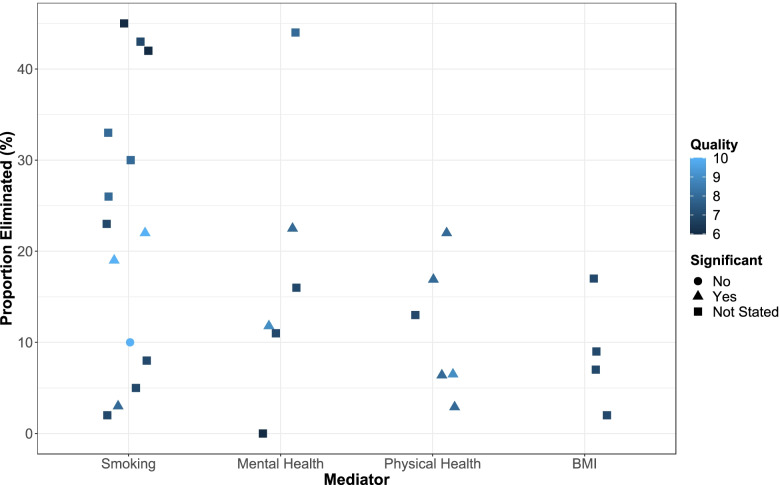
- There was high confidence that smoking during pregnancy mediates inequalities: 16 estimates of proportion eliminated ranged from 2% to 45%, with the largest study (1,390,742 singleton births) reporting 26% for extremely preterm, 33% for very preterm, and 30% for moderately preterm births.
- There was high confidence for maternal physical health as a mediator, with proportion eliminated ranging from 3% to 22% for physical health measures; evidence for mental health was mixed, and alcohol, working/environmental conditions, and healthcare had low to moderate or inconsistent evidence.
- Most studies showed a substantial residual direct effect of SES; complete mediation was unlikely by individual variables, though three studies found composites removed statistical significance for SES measures.
Methods
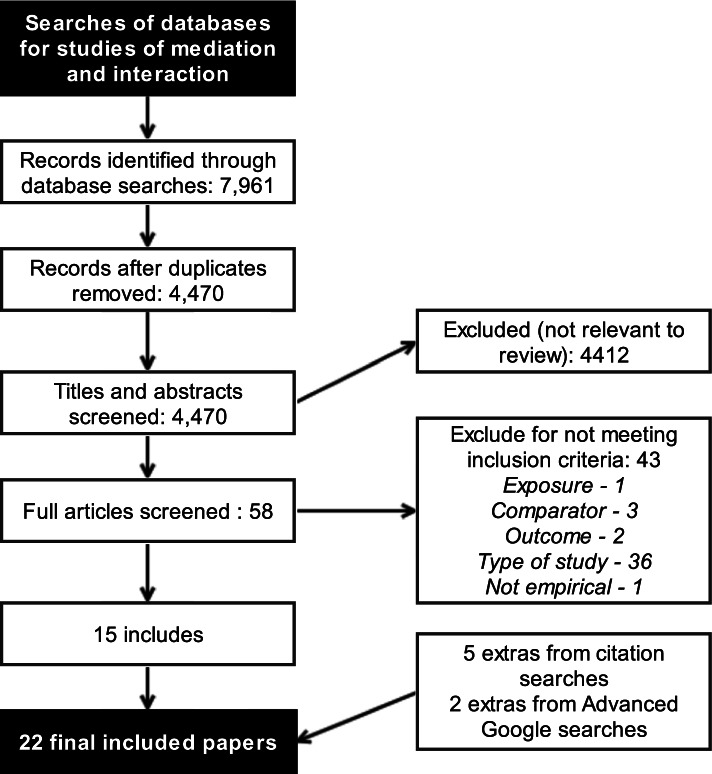
- Systematic review registered with PROSPERO (CRD42020203613), searching Scopus, Medline OVID, Medline In Process, PsycINFO, and Social Science Citation Index, plus citation and advanced Google searches; inclusion criteria covered observational studies from Jan 2000 to July 2020.
- After screening, 22 studies were included; data were dual-extracted, quality-assessed using a hybrid approach (risk of bias plus mediation-specific criteria), and narratively synthesised because meta-analysis was not appropriate.
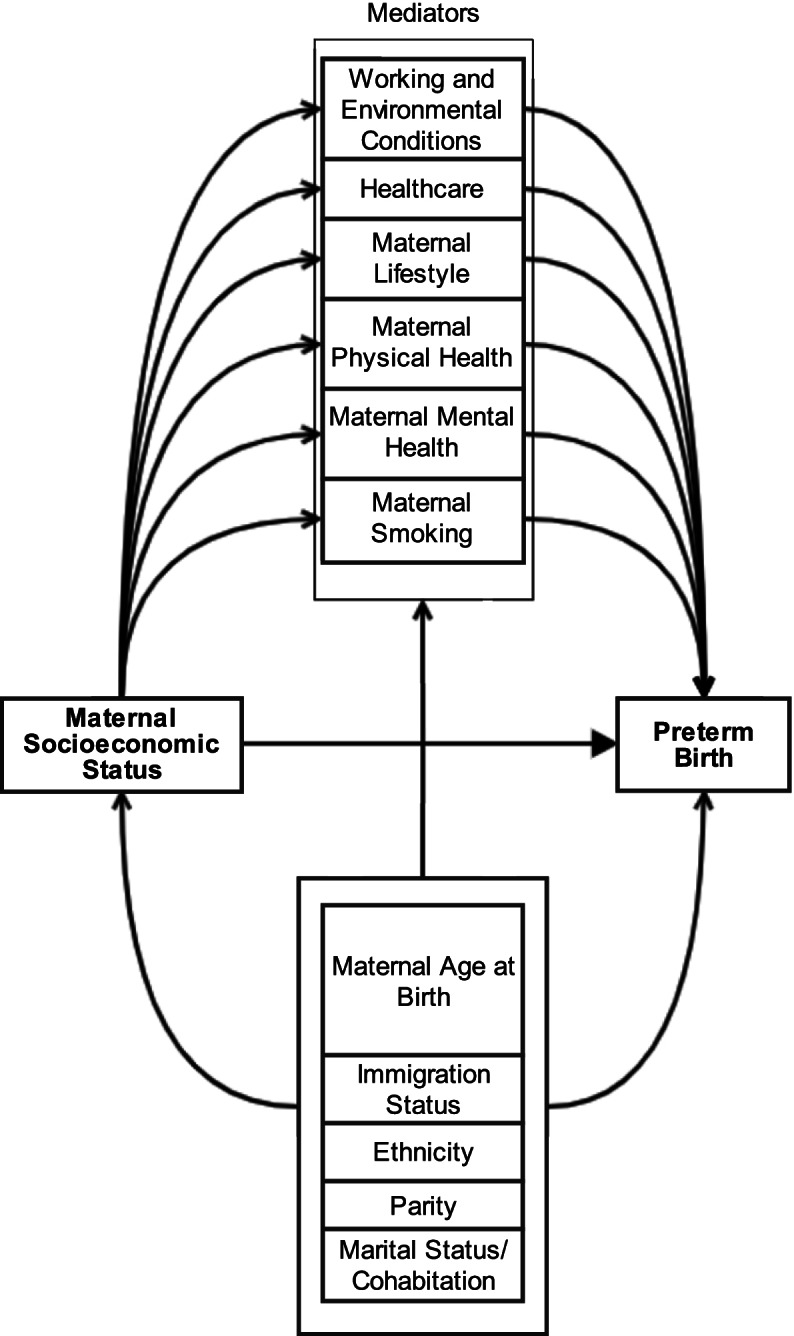
- The main metric extracted was proportion eliminated; certainty of evidence was assessed considering sample size, quality score, and consistency, with a harvest plot and DAG used to display and integrate findings.
Limitations
- The review states that different SES measures are potentially not comparable, only eight studies made clear that exposure was measured before outcome, and the search focused on studies explicitly examining mediation, potentially missing extractable mediated effects.
- The review also states data limitations: some plausible mediators were not examined (e.g., air pollution, urbanicity, domestic violence), mediator measurement was often problematic, preterm birth was mostly treated as homogeneous, and many studies did not estimate confidence intervals or mediator significance.
- Evident from the text: only two studies fully adjusted for all three key confounders (maternal age, parity, race/ethnicity), only two explicitly considered causal assumptions, and only six assessed exposure-mediator interaction, limiting causal interpretation.
Model-written summary. Check it against the paper before relying on it.
Integrity signals
Registry
Cites
Statistics
Figures
Verification
Claims the paper makes
0 Valid · 0 Not valid · 101 Not checked · 111 Own results and interpretations
A result the paper states — it cites no source for it, so there is none to check. The quote shows it is in the paper.
In the paper
“Significant residual inequalities frequently remained.”
§ Mediators of socioeconomic inequalities in preterm birth: a systematic review > Abstract > Results
plain- Asserted: passes — The authors put it forward as true.
- Checkable: passes — It can be checked against evidence.
- Load-bearing: passes — The paper’s conclusions depend on it.
- Based: passes — The paper gives a reason why it holds.
A result the paper reports from its own data — it cites no other source for it, so there is none to check. The quote shows it is in the paper.
In the paper
“Studies assessed six groups of potential mediators: maternal smoking; maternal mental health; maternal physical health (including body mass index (BMI)); maternal lifestyle (including alcohol consumption); healthcare; and working and environmental conditions.”
§ Mediators of socioeconomic inequalities in preterm birth: a systematic review > Abstract > Results
plain- Asserted: passes — The authors put it forward as true.
- Checkable: passes — It can be checked against evidence.
- Load-bearing: unclear — It is unclear whether the paper’s conclusions depend on it.
- Based: passes — The paper gives a reason why it holds.
A result the paper states — it cites no source for it, so there is none to check. The quote shows it is in the paper.
In the paper
“There is, however, a large residual direct effect of SES evident in most studies.”
§ Mediators of socioeconomic inequalities in preterm birth: a systematic review > Abstract > Conclusions
plainstates a cause- Asserted: passes — The authors put it forward as true.
- Checkable: passes — It can be checked against evidence.
- Load-bearing: passes — The paper’s conclusions depend on it.
- Based: passes — The paper gives a reason why it holds.
None of the sources cited for this claim have been checked yet.
In the paper
“only six studies assessed exposure-mediator interaction”
- Also stated in: § Mediation approach · plain
“six studies examined exposure-mediator interaction in their analysis”
§ Mediators of socioeconomic inequalities in preterm birth: a systematic review > Abstract > Results
What the sources say
- Not checked yetcites [33] Poulsen G, Andersen AMN, Jaddoe VWV, Magnus P, Raat H, Stoltenberg C, et al. Does smoking during pregnancy mediate educational disparities in preterm delivery? Findings from three large birth cohorts. Paediatr Perinat Epidemiol. 2019;33(2):164–71. source
- Not matchedcites [37] Dooley P. Examining individual and neighborhood-level risk factors for delivering a preterm infant. Doctor of Philosophy (PhD) thesis. Cincinnati: University of Cincinnati; 2009:189.
Couldn’t be matched to a paper in Crossref, so it can’t be checked.
- Not checked yetcites [38] Mehra R, Shebl FM, Cunningham SD, Magriples U, Barrette E, Herrera C, et al. Area-level deprivation and preterm birth: results from a national, commercially-insured population. BMC Public Health. 2019;19(1):236. source
- Not checked yetcites [39] Meng G, Thompson ME, Hall GB. Pathways of neighbourhood-level socio-economic determinants of adverse birth outcomes. Int J Health Geogr. 2013;12(1):32. source
- Not checked yetcites [42] Nkansah-Amankra S, Luchok KJ, Hussey JR, Watkins K, Liu X. Effects of maternal stress on low birth weight and preterm birth outcomes across neighborhoods of South Carolina, 2000–2003. Matern Child Health J. 2010;14(2):215–26. source
- Not checked yetcites [44] Ahern J, Pickett KE, Selvin S, Abrams B. Preterm birth among African American and white women: a multilevel analysis of socioeconomic characteristics and cigarette smoking. J Epidemiol Community Health. 2003;57(8):606–11. source
plain- Asserted: passes — The authors put it forward as true.
- Checkable: passes — It can be checked against evidence.
- Load-bearing: unclear — It is unclear whether the paper’s conclusions depend on it.
- Based: passes — The paper gives a reason why it holds.
- Also stated in: § Mediation approach · plain
A result the paper reports from its own data — it cites no other source for it, so there is none to check. The quote shows it is in the paper.
In the paper
“There was high confidence of smoking during pregnancy (most frequently examined mediator) and maternal physical health mediating inequalities in preterm birth.”
§ Mediators of socioeconomic inequalities in preterm birth: a systematic review > Abstract > Results
boostedstates a cause- Asserted: passes — The authors put it forward as true.
- Checkable: passes — It can be checked against evidence.
- Load-bearing: passes — The paper’s conclusions depend on it.
- Based: passes — The paper gives a reason why it holds.
107 more claims
Create a free account to see all 212 claims and to verify the 215 references still open.
- Probably not a substantial claim. 48
- It may state two separate claims as one. 66
- The quote only partly states this claim. 1
Self-check
Percentages, sums and reported differences re-computed from the paper’s own numbers.
Each contradiction between two passages listed here was confirmed by an independent check.
Rated minor: it would not touch a result — a value no result rests on, a p-value that stays on the same side of the significance level, or a conflict that is clerical, resolved elsewhere in the paper, or outside its own findings.
In the paper
§ Mediators of socioeconomic inequalities in preterm birth: a systematic review > Results > Mediation approach
“measurement of the exposure preceded that of the outcome in nine studies [35, 38, 40, 42, 46, 47, 49–51].”
§ Mediators of socioeconomic inequalities in preterm birth: a systematic review > Discussion > Limitations of the review
“Second, only eight studies made clear that the exposure was measured before the outcome, yet temporality is a requirement for causal interpretation.”
Rated minor: it would not touch a result — a value no result rests on, a p-value that stays on the same side of the significance level, or a conflict that is clerical, resolved elsewhere in the paper, or outside its own findings.
In the paper
§ Mediators of socioeconomic inequalities in preterm birth: a systematic review > Results > Mediation approach
“The ‘difference method’ was the most frequently used approach to assess mediation (14 studies) [33, 41–53], estimating the ‘controlled direct effect’ [14]. Other approaches used product of coefficients (seven, with path analysis in five) [34–40] and, in one, structural equation modelling not specified as path analysis [54]. Only one of the studies using the difference method estimated the statistical significance of the mediating effect,”
§ Mediators of socioeconomic inequalities in preterm birth: a systematic review > Discussion > Limitations of the data
“11 studies did not estimate mediator significance (all used the difference method) [76]”
Citations
Cites
A comparison of methods to test mediation and other intervening variable effects
MacKinnon, D. P., Lockwood, C. M., Hoffman, J. M., West, S. G., & Sheets, V. (2002) · Psychological Methods · doi:10.1037/1082-989x.7.1.83 · Cited by 9,406
Synthesis without meta-analysis (SWiM) in systematic reviews: reporting guideline
Campbell, M., McKenzie, J. E., Sowden, A., Katikireddi, S. V., Brennan, S. E., Ellis, S., Hartmann-Boyce, J., Ryan, R., Shepperd, S., Thomas, J., et al. (2020) · BMJ · doi:10.1136/bmj.l6890 · Cited by 4,628 · cited 3×
“Criteria for publication bias and imprecision could not be calculated [25].”
BackgroundMethodInfluentialChawanpaiboon, S., Vogel, J. P., Moller, A.-B., Lumbiganon, P., Petzold, M., Hogan, D., Landoulsi, S., Jampathong, N., Kongwattanakul, K., Laopaiboon, M., et al. (2019) · The Lancet Global Health · doi:10.1016/s2214-109x(18)30451-0 · Cited by 2,572
Explanation in Causal Inference: Methods for Mediation and Interaction
VanderWeele, T. J. (2015) · Cited by 1,540
Long-Term Medical and Social Consequences of Preterm Birth
Moster, D., Lie, R. T., & Markestad, T. (2008) · New England Journal of Medicine · doi:10.1056/nejmoa0706475 · Cited by 1,402
Bekkar, B., Pacheco, S., Basu, R., & DeNicola, N. (2020) · JAMA Network Open · doi:10.1001/jamanetworkopen.2020.8243 · Cited by 791
Maternal Nutrition and Birth Outcomes
Abu-Saad, K., & Fraser, D. (2010) · Epidemiologic Reviews · doi:10.1093/epirev/mxq001 · Cited by 704
Socioeconomic Disparities in Adverse Birth Outcomes
Blumenshine, P., Egerter, S., Barclay, C. J., Cubbin, C., & Braveman, P. A. (2010) · American Journal of Preventive Medicine · doi:10.1016/j.amepre.2010.05.012 · Cited by 688
The harvest plot: A method for synthesising evidence about the differential effects of interventions
Ogilvie, D., Fayter, D., Petticrew, M. P., Sowden, A. J., Thomas, S., Whitehead, M. M., & Worthy, G. (2008) · BMC Medical Research Methodology · doi:10.1186/1471-2288-8-8 · Cited by 423
Effect of neighbourhood income and maternal education on birth outcomes: a population-based study
Luo, Z.-C. (2006) · Canadian Medical Association Journal · doi:10.1503/cmaj.051096 · Cited by 382
Socio‐economic disparities in preterm birth: causal pathways and mechanisms
Kramer, M. S., Goulet, L., Lydon, J., Séguin, L., McNamara, H., Dassa, C., Platt, R. W., Fong Chen, M., Gauthier, H., Genest, J., et al. (2001) · Paediatric and Perinatal Epidemiology · doi:10.1046/j.1365-3016.2001.00012.x · Cited by 252
Psychosocial Stress in Pregnancy and Preterm Birth: Associations and Mechanisms
Shapiro, G. D., Fraser, W. D., Frasch, M. G., & Séguin, J. R. (2013) · jpme · doi:10.1515/jpm-2012-0295 · Cited by 240
Ncube, C. N., Enquobahrie, D. A., Albert, S. M., Herrick, A. L., & Burke, J. G. (2016) · Social Science & Medicine · doi:10.1016/j.socscimed.2016.02.014 · Cited by 233
Donovan, B., Spracklen, C., Schweizer, M., Ryckman, K., & Saftlas, A. (2016) · BJOG: An International Journal of Obstetrics & Gynaecology · doi:10.1111/1471-0528.13928 · Cited by 230
Amjad, S., MacDonald, I., Chambers, T., Osornio‐Vargas, A., Chandra, S., Voaklander, D., & Ospina, M. B. (2019) · Paediatric and Perinatal Epidemiology · doi:10.1111/ppe.12529 · Cited by 212
Ferguson, K., McCann, M., Katikireddi, S. V., Thomson, H., Green, M. J., Smıth, D. J., & Lewsey, J. (2019) · International Journal of Epidemiology · doi:10.1093/ije/dyz150 · Cited by 198
Subramanian, S. V., Chen, J. T., Rehkopf, D. H., Waterman, P. D., & Krieger, N. (2006) · American Journal of Epidemiology · doi:10.1093/aje/kwj313 · Cited by 192
Ruiz, M., Goldblatt, P., Morrison, J., Kukla, L., Švancara, J., Riitta-Järvelin, M., Taanila, A., Saurel-Cubizolles, M.-J., Lioret, S., Bakoula, C., et al. (2015) · Journal of Epidemiology and Community Health · doi:10.1136/jech-2014-205387 · Cited by 188
Jardine, J., Walker, K., Gurol-Urganci, I., Webster, K., Muller, P., Hawdon, J., Khalil, A., Harris, T., & van der Meulen, J. (2021) · The Lancet · doi:10.1016/s0140-6736(21)01595-6 · Cited by 187
Sleep and Pain: A Systematic Review of Studies of Mediation
Whibley, D., AlKandari, N., Kristensen, K., Barnish, M., Rzewuska, M., Druce, K. L., & Tang, N. K. Y. (2019) · The Clinical Journal of Pain · doi:10.1097/ajp.0000000000000697 · Cited by 178
Neighborhood context and reproductive health
Culhane, J. F., & Elo, I. T. (2005) · American Journal of Obstetrics and Gynecology · doi:10.1016/j.ajog.2005.01.071 · Cited by 177
Metcalfe, A., Lail, P., Ghali, W. A., & SAUVE, R. S. (2011) · Paediatric and Perinatal Epidemiology · doi:10.1111/j.1365-3016.2011.01192.x · Cited by 171
Moss, J. L., Johnson, N. J., Yu, M., Altekruse, S. F., & Cronin, K. A. (2021) · Population Health Metrics · doi:10.1186/s12963-020-00244-x · Cited by 165
Nkansah-Amankra, S., Luchok, K. J., Hussey, J. R., Watkins, K., & Liu, X. (2010) · Maternal and Child Health Journal · doi:10.1007/s10995-009-0447-4 · Cited by 160
Thomson, K., Moffat, M., Arisa, O., Jesurasa, A., Richmond, C., Odeniyi, A., Bambra, C., Rankin, J., Brown, H., Bishop, J., et al. (2021) · BMJ Open · doi:10.1136/bmjopen-2020-042753 · Cited by 154
Morgen, C. S., Bjork, C., Andersen, P. K., Mortensen, L. H., & Nybo Andersen, A.-M. (2008) · International Journal of Epidemiology · doi:10.1093/ije/dyn112 · Cited by 137
Policy-Relevant Proportions for Direct Effects
VanderWeele, T. J. (2013) · Epidemiology · doi:10.1097/ede.0b013e3182781410 · Cited by 123
Testing a sociomedical model for preterm delivery
Misra, D. P., O'Campo, P., & Strobino, D. (2001) · Paediatric and Perinatal Epidemiology · doi:10.1046/j.1365-3016.2001.00333.x · Cited by 117
Ahern, J., Pickett, K. E., Selvin, S., & Abrams, B. (2003) · Journal of Epidemiology and Community Health · doi:10.1136/jech.57.8.606 · Cited by 113
Ronzi, S., Orton, L., Pope, D., Valtorta, N. K., & Bruce, N. G. (2018) · Systematic Reviews · doi:10.1186/s13643-018-0680-2 · Cited by 112
Pardo-Crespo, M. R., Narla, N. P., Williams, A. R., Beebe, T. J., Sloan, J., Yawn, B. P., Wheeler, P. H., & Juhn, Y. J. (2013) · Journal of Epidemiology and Community Health · doi:10.1136/jech-2012-201742 · Cited by 111
Low-educated women have an increased risk of gestational diabetes mellitus: the Generation R Study
Bouthoorn, S. H., Silva, L. M., Murray, S. E., Steegers, E. A. P., Jaddoe, V. W. V., Moll, H., Hofman, A., Mackenbach, J. P., & Raat, H. (2015) · Acta Diabetologica · doi:10.1007/s00592-014-0668-x · Cited by 110
Socioeconomic Status, Preeclampsia Risk and Gestational Length in Black and White Women
Ross, K. M., Dunkel Schetter, C., McLemore, M. R., Chambers, B. D., Paynter, R. A., Baer, R., Feuer, S. K., Flowers, E., Karasek, D., Pantell, M., et al. (2019) · Journal of Racial and Ethnic Health Disparities · doi:10.1007/s40615-019-00619-3 · Cited by 106
Preterm Birth and Social Support during Pregnancy: a Systematic Review and Meta‐Analysis
Hetherington, E., Doktorchik, C. T. A., Premji, S., McDonald, S., Tough, S., & SAUVE, R. S. (2015) · Paediatric and Perinatal Epidemiology · doi:10.1111/ppe.12225 · Cited by 101
Traffic-related air pollution and risk of preterm birth in the San Joaquin Valley of California
Padula, A. M., Mortimer, K. M., Tager, I. B., Hammond, S. K., Lurmann, F. W., Yang, W., Stevenson, D. K., & Shaw, G. M. (2014) · Annals of Epidemiology · doi:10.1016/j.annepidem.2014.10.004 · Cited by 99
What contributes to disparities in the preterm birth rate in European countries?
Delnord, M., Blondel, B., & Zeitlin, J. (2015) · Current Opinion in Obstetrics & Gynecology · doi:10.1097/gco.0000000000000156 · Cited by 98
Residential greenness: current perspectives on its impact on maternal health and pregnancy outcomes
Banay, R. F., Bezold, C. P., James, P., Hart, J. E., & Laden, F. (2017) · International Journal of Women s Health · doi:10.2147/ijwh.s125358 · Cited by 97
Räisänen, S., Gissler, M., Saari, J., Kramer, M., & Heinonen, S. (2013) · PLoS ONE · doi:10.1371/journal.pone.0060660 · Cited by 89
Henderson, J. J., McWilliam, O. A., Newnham, J. P., & Pennell, C. E. (2012) · The Journal of Maternal-Fetal & Neonatal Medicine · doi:10.3109/14767058.2011.597899 · Cited by 84
Register based monitoring shows decreasing socioeconomic differences in Finnish perinatal health
Gissler, M., Meriläinen, J., Vuori, E., & Hemminki, E. (2003) · Journal of Epidemiology and Community Health · doi:10.1136/jech.57.6.433 · Cited by 82
Explaining educational inequalities in preterm birth: the generation r study
Jansen, P. W., Tiemeier, H., Jaddoe, V. W. V., Hofman, A., Steegers, E. A. P., Verhulst, F. C., Mackenbach, J. P., & Raat, H. (2009) · Archives of Disease in Childhood - Fetal and Neonatal Edition · doi:10.1136/adc.2007.136945 · Cited by 74
Pennington, A., Orton, L., Nayak, S., Ring, A., Petticrew, M. P., Sowden, A. J., White, M. J., & Whitehead, M. M. (2018) · Health & Place · doi:10.1016/j.healthplace.2018.02.001 · Cited by 69
Self-citationThe influence of socioeconomic status on gestational weight gain: a systematic review
O'Brien, E. C., Alberdi, G., & McAuliffe, F. M. (2018) · Journal of Public Health · doi:10.1093/pubmed/fdx038 · Cited by 67
Straatmann, V. S., Lai, E., Lange, T., Campbell, M. C., Wickham, S., Andersen, A.-M. N., Strandberg-Larsen, K., & Taylor-Robinson, D. (2019) · Journal of Epidemiology and Community Health · doi:10.1136/jech-2019-212367 · Cited by 61
Self-citationGray, R., Bonellie, Sr., Chalmers, J., Greer, I., Jarvis, S., & Williams, C. (2008) · BJOG: An International Journal of Obstetrics & Gynaecology · doi:10.1111/j.1471-0528.2007.01582.x · Cited by 58
Financial incentives for smoking cessation in pregnancy: multicentre randomised controlled trial
Berlin, I., Berlin, N., Malecot, M., Breton, M., Jusot, F., & Goldzahl, L. (2021) · BMJ · doi:10.1136/bmj-2021-065217 · Cited by 57
Pathways of neighbourhood-level socio-economic determinants of adverse birth outcomes
Meng, G., Thompson, M. E., & Hall, G. B. (2013) · International Journal of Health Geographics · doi:10.1186/1476-072x-12-32 · Cited by 53
Salihu, H. M., Mbah, A. K., Alio, A. P., Clayton, H. B., & Lynch, O. (2009) · European Journal of Obstetrics & Gynecology and Reproductive Biology · doi:10.1016/j.ejogrb.2009.02.047 · Cited by 51
Joseph, K., Fahey, J., Shankardass, K., Allen, V. M., O’Campo, P., Dodds, L., Liston, R. M., & Allen, A. C. (2014) · BMC Pregnancy and Childbirth · doi:10.1186/1471-2393-14-117 · Cited by 48
Area-level deprivation and preterm birth: results from a national, commercially-insured population
Mehra, R., Shebl, F. M., Cunningham, S. D., Magriples, U., Barrette, E., Herrera, C., Kozhimannil, K. B., & Ickovics, J. R. (2019) · BMC Public Health · doi:10.1186/s12889-019-6533-7 · Cited by 47
Reime, B., Ratner, P. A., Tomaselli-Reime, S. N., Kelly, A., Schuecking, B. A., & Wenzlaff, P. (2006) · Social Science & Medicine · doi:10.1016/j.socscimed.2005.08.017 · Cited by 44
Mirabzadeh, A., Dolatian, M., Forouzan, A. S., Sajjadi, H., Majd, H. A., & Mahmoodi, Z. (2013) · Iranian Red Crescent Medical Journal · doi:10.5812/ircmj.11271 · Cited by 44
Heo, S., Fong, K. C., & Bell, M. L. (2019) · Environmental Research Letters · doi:10.1088/1748-9326/ab4cd0 · Cited by 42
van den Berg, G., van Eijsden, M., Vrijkotte, T. G. M., & Gemke, R. J. B. J. (2012) · PLoS ONE · doi:10.1371/journal.pone.0037002 · Cited by 41
Clayborne, Z. M., Giesbrecht, G. F., Bell, R. C., & Tomfohr-Madsen, L. M. (2017) · Social Science & Medicine · doi:10.1016/j.socscimed.2016.12.041 · Cited by 40
Asta, F., Michelozzi, P., Cesaroni, G., De Sario, M., Badaloni, C., Davoli, M., & Schifano, P. (2019) · International Journal of Environmental Research and Public Health · doi:10.3390/ijerph16142497 · Cited by 40
Auger, N., Authier, M., Martinez, J., & Daniel, M. (2009) · The Journal of Rural Health · doi:10.1111/j.1748-0361.2009.00242.x · Cited by 37
Kane, J. B., Miles, G., Yourkavitch, J., & King, K. E. (2017) · SSM - Population Health · doi:10.1016/j.ssmph.2017.08.003 · Cited by 37
Amegah, A. K., Damptey, O. K., Sarpong, G. A., Duah, E., Vervoorn, D. J., & Jaakkola, J. J. K. (2013) · PLoS ONE · doi:10.1371/journal.pone.0069181 · Cited by 34
Nakamura, A., Pryor, L., Ballon, M., Lioret, S., Heude, B., Charles, M.-A., Melchior, M., & El-Khoury Lesueur, F. (2020) · European Journal of Public Health · doi:10.1093/eurpub/ckaa076 · Cited by 29
The contribution of maternal working conditions to socio-economic inequalities in birth outcome
Gisselmann, M. D., & Hemström, Ö. (2008) · Social Science & Medicine · doi:10.1016/j.socscimed.2007.11.036 · Cited by 26
Adhikari, K., Patten, S. B., Williamson, T., Patel, A. B., Premji, S., Tough, S., Letourneau, N., Giesbrecht, G., & Metcalfe, A. (2020) · BMJ Open · doi:10.1136/bmjopen-2019-031035 · Cited by 26
Snelgrove, J. W., & Murphy, K. E. (2015) · Acta Obstetricia et Gynecologica Scandinavica · doi:10.1111/aogs.12648 · Cited by 25
Disadvantage in early-life and persistent asthma in adolescents: a UK cohort study
Creese, H., Lai, E., Mason, K., Schlüter, D. K., Saglani, S., Taylor-Robinson, D., & Saxena, S. (2022) · Thorax · doi:10.1136/thoraxjnl-2021-217312 · Cited by 23
Self-citationScime, N. V., Chaput, K. H., Faris, P. D., Quan, H., Tough, S. C., & Metcalfe, A. (2020) · Acta Obstetricia et Gynecologica Scandinavica · doi:10.1111/aogs.13769 · Cited by 22
Oliveira, A. A. D., Almeida, M. F. D., Silva, Z. P. D., Assunção, P. L. D., Silva, A. M. R., Santos, H. G. D., & Alencar, G. P. (2019) · Cadernos de Saúde Pública · doi:10.1590/0102-311x00211917 · Cited by 20
Auger, N., Abrahamowicz, M., Wynant, W., & Lo, E. (2014) · European Journal of Obstetrics & Gynecology and Reproductive Biology · doi:10.1016/j.ejogrb.2014.02.035 · Cited by 19
Poulsen, G., Andersen, A. N., Jaddoe, V. W. V., Magnus, P., Raat, H., Stoltenberg, C., Osler, M., & Mortensen, L. H. (2019) · Paediatric and Perinatal Epidemiology · doi:10.1111/ppe.12544 · Cited by 19
Quispel, C., Bangma, M., Kazemier, B. M., Steegers, E. A. P., Hoogendijk, W. J. G., Papatsonis, D. N. M., Paarlberg, K. M., Lambregtse-Van Den Berg, M. P., & Bonsel, G. J. (2014) · Midwifery · doi:10.1016/j.midw.2014.03.008 · Cited by 13
Disparities and relative risk ratio of preterm birth in six Central and Eastern European centers
Arora, C. P., Kacerovsky, M., Zinner, B., Ertl, T., Ceausu, I., Rusnak, I., Shurpyak, S., Sandhu, M., Hobel, C. J., Dumesic, D. A., et al. (2015) · Croatian Medical Journal · doi:10.3325/cmj.2015.56.119 · Cited by 12
Niedhammer, I., Murrin, C., O'Mahony, D., Daly, S., Morrison, J. J., Kelleher, C. C., & the Lifeways Cross-Generation Cohort Study Steering Group (2012) · The European Journal of Public Health · doi:10.1093/eurpub/ckr089 · Cited by 11
Items for consideration in a reporting guideline for mediation analyses: a Delphi study
Cashin, A. G., McAuley, J. H., Lamb, S., Hopewell, S., Kamper, S. J., Williams, C. M., Henschke, N., & Lee, H. (2021) · BMJ Evidence-Based Medicine · doi:10.1136/bmjebm-2020-111406 · Cited by 7
McCall, S. J., Green, D. R., Macfarlane, G. J., & Bhattacharya, S. (2020) · Journal of Public Health · doi:10.1093/pubmed/fdz042 · Cited by 6
(2014) · PubMed Central
Research works printed but not linked: 2
- Thomas J, Brunton J, Graziosi S. EPPI-Reviewer 4: software for research synthesis, EPPI-Centre Software. London: Social Science Research Unit, UCL Institute of Education; 2010.
- Dooley P. Examining individual and neighborhood-level risk factors for delivering a preterm infant. Doctor of Philosophy (PhD) thesis. Cincinnati: University of Cincinnati; 2009:189.
Cited by
Unravelling the respiratory health path across the lifespan for survivors of preterm birth
Simpson, S. J., Berry, C. D., Evans, D. J., Gibbons, J. T. D., Vollsæter, M., Halvorsen, T., Gruber, K. F., Lombardi, E., Stanojevic, S., Hurst, J. R., et al. (2023) · The Lancet Respiratory Medicine · doi:10.1016/s2213-2600(23)00272-2 · Cited by 86
Rogne, T., Gill, D., Liew, Z., Shi, X., Stensrud, V. H., Nilsen, T. I. L., & Burgess, S. (2024) · JAMA Network Open · doi:10.1001/jamanetworkopen.2023.51166 · Cited by 72
Jelliffe‐Pawlowski, L. L., Baer, R. J., Oltman, S. P., McKenzie‐Sampson, S., Afulani, P. A., Amsalu, R., Bell, A. J., Blebu, B. E., Blackman, K. C. A., Chambers, C., et al. (2024) · JAMA Network Open · doi:10.1001/jamanetworkopen.2024.35887 · Cited by 26
Kayode, G. A., Howell, A., Burden, C., Margelyte, R., Cheng, V. C., Viner, M., Sandall, J., Carter, J., Brigante, L., Winter, C., et al. (2024) · BMC Medicine · doi:10.1186/s12916-024-03493-x · Cited by 24
Klumper, J., Ravelli, A. C. J., Roos, C., Abu–Hanna, A., & Oudijk, M. A. (2023) · Acta Obstetricia Et Gynecologica Scandinavica · doi:10.1111/aogs.14684 · Cited by 19
Metadata
- Authors
- McHale, P., Maudsley, G., Pennington, A., Schlüter, D. K., Barr, B., Paranjothy, S., & Taylor-Robinson, D.
- Affiliations
- University of Liverpool (GB)
- University of Aberdeen (GB)
- Corresponding author
- McHale, Philip
- ORCID
- Venue
- BMC Public Health
- Published
- 2022-06-07
- Volume
- 22
- Issue
- 1
- Pages
- 1134-1134
- ISSN
- 1471-2458 (ISSN-L)
- PMC
- PMC9172189
- OpenAlex
- W4281739443
- Semantic Scholar
- 2c90ab8a6c19600a35278c80b4d16a99dc4e9aef
- Cited by
- 89
- References
- 74
- Citations by year
- 2026: 27 · 2025: 21 · 2024: 21 · 2023: 16 · 2022: 3
- FWCI
- 3.46
- Type
- journal article
- Language
- en
- Open access
- gold
- doi.org
- Locations
- BMC Public Health (publishedVersion, cc-by)
- PubMed (publishedVersion)
- PubMed Central (publishedVersion, cc-by)
- Aberdeen University Research Archive (Aberdeen University) (submittedVersion)
- DOAJ (DOAJ: Directory of Open Access Journals) (submittedVersion, cc-by-sa)
- Funders
- National Institute for Health and Care Research
- Medical Research Council (MR/P008577/1, MR/T00794X/1)
- Topics
- Health Sciences › Medicine › Pediatrics, Perinatology and Child Health › Maternal and Neonatal Healthcare
- Health Sciences › Medicine › Pediatrics, Perinatology and Child Health › Infant Development and Preterm Care
- Social Sciences › Health › Health disparities and outcomes
- Keywords
- preterm birth, socioeconomic disparities, maternal socioeconomic status, mediation analysis, maternal smoking, maternal mental health, maternal physical health, body mass index, alcohol consumption, health care access, working conditions, environmental factors, poverty, educational inequality
- MeSH terms
- Female, Humans, Infant, Newborn, Pregnancy, Social Class, Socioeconomic Factors, Cohort Studies, Body Mass Index, Premature Birth
About these checks
Registry, retraction, Cites and statistics results are computed, not judged, with one exception: a printed reference that no index lists is read once by a model before it counts as a citation error. Claims are extracted by a model and kept only when their quote appears verbatim in the text; each cited source is then checked, with a model’s help, for whether it says what the claim relies on. Those verdicts can be wrong — read the claim’s quote and the cited source before relying on one.
A language model drew the claims from the paper on 2026-11-13, under version 3 of the claim definition (model deepseek-v4.1-flash, prompt extract-v3).
A second model labelled each claim on 2026-11-13 (model jev-1.13-20260917, definition revision gold-guideline-v0.2).
Statistics and arithmetic are recomputed, not judged.
Confidence bands are shown only for fields calibrated on our annotated test set. None is calibrated yet, so no band is shown.
What counts as a claim ›How we measure confidence ›How we check this ›
Are you an author, or do you see a problem with this page? Request a review
Data sources
Bibliographic data: Semantic Scholar, OpenAlex, Crossref.
Contains information from the Semantic Scholar Academic Graph Datasets, made available under the ODC Attribution License (ODC-BY 1.0).
Semantic Scholar’s data is described in: Kinney, R., et al. (2023). The Semantic Scholar Open Data Platform. arXiv:2301.10140.
