

Modifiable factors influencing attention performance in healthy children: insights from a comprehensive school nutrition study
Open accessThe DOI matches its Crossref record; 54 of the 54 references it cites were found in a registry or an index.
Abstract
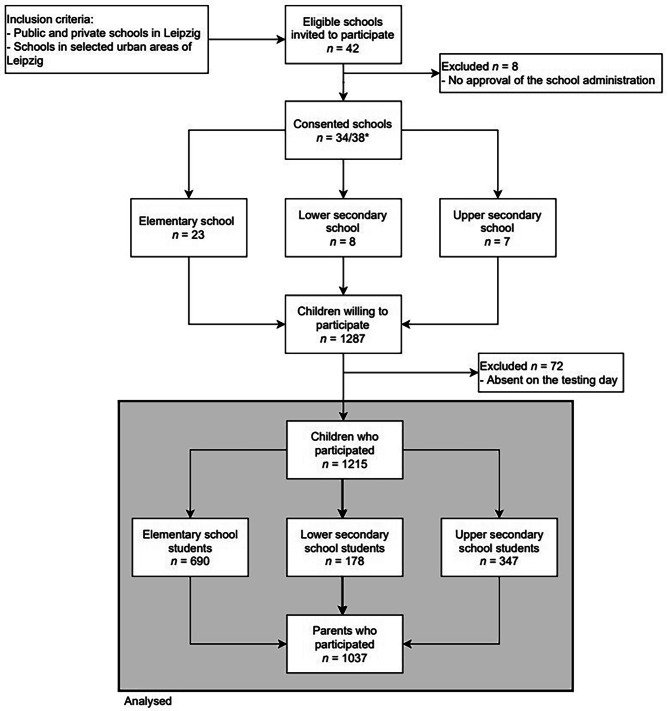
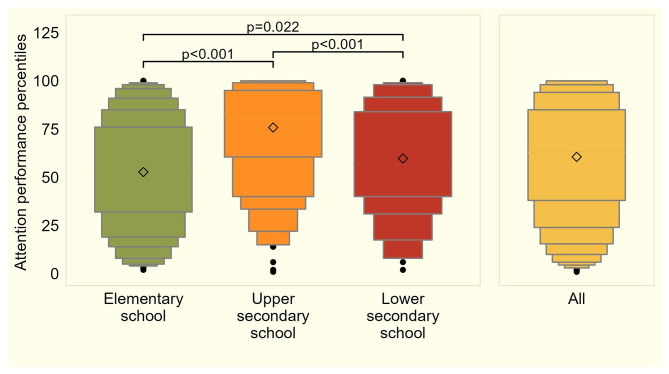
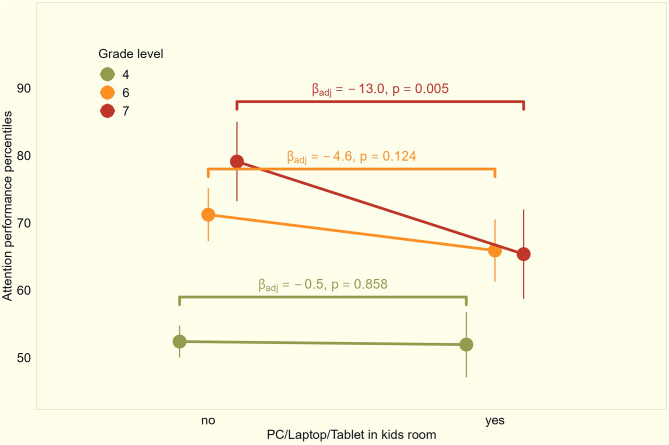
Background: There is inconclusive evidence for the effects of various leisure activities on attention performance in children. The literature reports inconsistent associations between activities such as physical activities or media use. To date, no study has thoroughly examined the various factors influencing attentional performance in a larger cohort of healthy children. This study aims to close this research gap. Methods: From 2018 to 2019, the Leipzig School Nutrition Study collected data from 1215 children and their families. The children report their dietary behavior (using CoCu- Questionnaire), especially their participation in school lunch and their breakfast habits, through a paper questionnaire. Furthermore, attention performance was assessed using a validated test (FAIR-2) at school. Data on physical activity, media consumption, family eating habits and socio-economic status (SES) were collected from parents using questionnaires. Associations between attention and influencing factors were estimated using hierarchical linear regression. Analyses were adjusted for age, SES, and school type. Results: Attending upper secondary schools (ß adj= 23.6, p < 0.001) and having a higher SES (ß= 1.28, p < 0.001) was associated with higher attention performance. Children doing leisure-time sports (ß adj= 4.18, p = 0.046) or reading books for at least one hour/weekday showed better attention performance (ß adj= 3.8, p = 0.040). Attention performance was also better in children having no electronic devices in the bedroom (ß adj= 13.0, p = 0.005) and in children whose parents limited their children’s Internet access (ß adj= 5.2, p = 0.012). We did not find any association between nutritional habits and attention performance. Conclusions: We found that fostering modifiable habits such as reading and physical activity could enhance attention performance. These findings have substantial implications for the development of prevention and intervention programs that aim to improve attention in schoolchildren. It is important to note, however, that social status as a hardly modifiable factor also impacts attention performance. Therefore, interventions should address personal habits in a systemic approach considering the child’s social status. Trial registration: The study is retrospectively registered with the German Clinical Trials Register (DRKS00017317, registration: 05-29-2019).
Overview
The claims and statistics of this paper haven’t been checked yet.
Free: it reads the open-access text and checks the first 5 claims that cite a source we can check. Create a free account to check every claim.
Integrity signals
Registry
Cites
Statistics
Figures
Verification
Claims the paper makes
The claims and statistics of this paper haven’t been checked yet.
Free: it reads the open-access text and checks the first 5 claims that cite a source we can check. Create a free account to check every claim.
Self-check
Percentages, sums and reported differences re-computed from the paper’s own numbers.
The self-check needs the paper’s full text.
Citations
Cites
The REDCap consortium: building an international community of software platform partners
Harris, P. A., Taylor, R., Minor, B. L., Elliott, V., Fernandez, M., O'Neal, L., McLeod, L., Delacqua, G., Delacqua, F., Kirby, J., et al. (2019) · Journal of Biomedical Informatics · doi:10.1016/j.jbi.2019.103208 · Cited by 24,013 · cited 1×
“Study data were collected and managed using RED-Cap electronic data capture tools [32].”
MethodBundesgesundheitsblatt - Gesundheitsforschung - Gesundheitsschutz
(2013) · Bundesgesundheitsblatt - Gesundheitsforschung - Gesundheitsschutz · doi:10.1007/103.1437-1588 · Cited by 11,796
Exercise training increases size of hippocampus and improves memory
Erickson, K. I., Voss, M. W., Prakash, R. S., Basak, C., Szabo, A., Chaddock, L., Kim, J. S., Heo, S., Alves, H., White, S. M., et al. (2011) · Proceedings of the National Academy of Sciences · doi:10.1073/pnas.1015950108 · Cited by 4,855 · cited 1×
“Potential social and metabolic mechanisms behind this effect including improvement of neuroplasticity are discussed elsewhere [12, 13].”
BackgroundDonnelly, J. E., Hillman, C. H., Castelli, D., Etnier, J. L., Lee, S., Tomporowski, P., Lambourne, K., & Szabo-Reed, A. N. (2016) · Medicine & Science in Sports & Exercise · doi:10.1249/mss.0000000000000901 · Cited by 1,864 · cited 2×
“They see fitness as an important promoter of cognitive function and cognitive health in children [46, 47].”
BackgroundResultThe Handbook of aging and cognition
(1993) · Choice Reviews Online · doi:10.5860/choice.30-3520 · Cited by 1,587
International Standard Classification of Education (ISCED) 2011
UNESCO Institute for Statistics (2012) · doi:10.15220/978-92-9189-123-8-en · Cited by 1,129
Early television exposure and subsequent attentional problems in children
Christakis, D. A., Zimmerman, F. J., DiGiuseppe, D. L., & McCarty, C. A. (2004) · Pediatrics · doi:10.1542/peds.113.4.708 · Cited by 926 · cited 1×
“These studies emphasize the importance of monitoring and limiting children´s media use to promote healthy attention development [4].”
BackgroundSarsour, K., Sheridan, M., Jutte, D., Nuru-Jeter, A., Hinshaw, S., & Boyce, W. T. (2011) · Journal of the International Neuropsychological Society · doi:10.1017/s1355617710001335 · Cited by 556 · cited 1×
“In line with previous studies, we found a strong positive association between social status and attention performance [51, 52], which is also true for the relationship between SES and intelligence and academic performance.”
ResultLawson, G. M., Hook, C. J., & Farah, M. J. (2018) · Developmental Science · doi:10.1111/desc.12529 · Cited by 556 · cited 1×
“In line with previous studies, we found a strong positive association between social status and attention performance [51, 52], which is also true for the relationship between SES and intelligence and academic performance.”
ResultA meta-analysis on the relation between reading and working memory
Peng, P., Barnes, M., Wang, C., Wang, W., Li, S., Swanson, H. L., Dardick, W., & Tao, S. (2018) · Psychological Bulletin · doi:10.1037/bul0000124 · Cited by 521 · cited 2×
“Reading books for at least one hour a day was positively related to attention, which aligns with several studies [7, 34, 40].”
BackgroundResult
Research works printed but not linked: 5
- Eissing G Einfluss der Frühstücksqualität auf die mentale Leistung EM - Ernähr Med 2011 26 22 7
- Igel U Gausche R Lück M Molis D Lipek T Schubert K Community-based health promotion for prevention of childhood obesity. Study design of a project in Leipzig-Grünau ErnährungsUmschau 2016 63 8 15
- Moosbrugger H Jens O Frankfurter Aufmerksamkeits-Inventar 2: FAIR-2. 2., überarbeitete, ergänzte und normenaktualisierte auflage des FAIR, 1996 2016 Bern Huber
- Kim B-Y Bae M-J A study on the stress reduction effect of reading aloud the Book using HRV Int J Eng Res Technol 2019 12 1457 61
- Rizzolo D Zipp GP Stiskal D Simpkins S Stress management strategies for students: the Immediate effects of yoga, humor, and reading on stress J Coll Teach Learn TLC 2009 6 79 88
Cited by
AlYousef, N. H., Alhakeem, F. M., AlNasser, K. A., AlSinan, Z. H., Alessa, Z. K., AlDawood, F. M., Shafey, M. M., & Al-Johani, W. M. (2025) · Journal of Family and Community Medicine · doi:10.4103/jfcm.jfcm_223_25 · Cited by 4
“[2,3] Mindfulness, which is defined as intentionally directing one’s attention toward the present moment and consciously observing one’s thoughts, feelings, and experiences, [4,5] has been proposed as a potential method for improving attentional control.”
InfluentialComparative Study on Attention Span among Undergraduate Students
Jacildo, J. A. L. C., Lopez, J. C. C., Leon, M. Q. J. M. D., Almario, M. R. I., Vergara, J. Q., & Cantilero, K. A. S. (2025) · International Journal of Multidisciplinary Applied Business and Education Research · doi:10.11594/ijmaber.06.08.25 · Cited by 3
Free nutritious school meals: Effects on student well-being and learning
Dedy, Danim, S., & Khairi, A. (2026) · Indonesian Journal of Educational Development (IJED) · doi:10.59672/ijed.v6i4.6048 · Cited by 2
Poulain, T., Schmidt, R., Kieß, W., Krause, S., Golz, S., & Meigen, C. (2025) · BMC Pediatrics · doi:10.1186/s12887-025-06260-w · Cited by 2
Self-citationFoster, J. D., Li, E., Juarez, A., Pelkmans, J. L., Fluellen, S., Li, K., Lee, J., Muñoz, L., Rohith, S., Krustrup, P., et al. (2026) · Frontiers in Sports and Active Living · doi:10.3389/fspor.2026.1765167 · Cited by 1
Metadata
- Authors
- Ober, P., Poulain, T., Meigen, C., Spielau, U., Sobek, C., Kiess, W., Igel, U., Lipek, T., & Vogel, M.
- Affiliations
- IFB Adiposity Diseases (DE)
- Leipzig University (DE)
- University of Applied Sciences Erfurt (DE)
- Corresponding author
- Ober, Peggy
- Venue
- BMC Public Health
- Published
- 2024-06-19
- Volume
- 24
- Issue
- 1
- Pages
- 1629-1629
- ISSN
- 1471-2458 (ISSN-L)
- PMC
- PMC11186167
- OpenAlex
- W4399799568
- Semantic Scholar
- 328a2999d088f9bee2be31425845db286efbca7c
- Cited by
- 6
- References
- 54
- Citations by year
- 2026: 2 · 2025: 4
- FWCI
- 1.76
- Type
- journal article
- Language
- en
- Open access
- gold
- doi.org
- Licence
- cc-by
- creativecommons.org/licenses/by/4.0 (tdm)
- creativecommons.org/licenses/by/4.0 (vor)
- Locations
- BMC Public Health (publishedVersion, cc-by)
- PubMed Central (publishedVersion, cc-by)
- PubMed (publishedVersion)
- Informationszentrum Lebenswissenschaften (ZB MED) (submittedVersion, cc-by)
- DOAJ (DOAJ: Directory of Open Access Journals) (submittedVersion)
- Funders
- Universität Leipzig
- Topics
- Health Sciences › Medicine › Psychiatry and Mental health › Attention Deficit Hyperactivity Disorder
- Health Sciences › Medicine › Public Health, Environmental and Occupational Health › Obesity, Physical Activity, Diet
- Health Sciences › Medicine › Public Health, Environmental and Occupational Health › School Health and Nursing Education
- Keywords
- attentional performance, children, school meals, breakfast habits, recreational sports, reading, physical activity, media use, socioeconomic status, school level
- MeSH terms
- Adolescent, Attention, Child, Feeding Behavior, Female, Germany, Humans, Leisure Activities, Male, Surveys and Questionnaires, Schools, Exercise
About these checks
Registry, retraction, Cites and statistics results are computed, not judged, with one exception: a printed reference that no index lists is read once by a model before it counts as a citation error. Claims are extracted by a model and kept only when their quote appears verbatim in the text; each cited source is then checked, with a model’s help, for whether it says what the claim relies on. Those verdicts can be wrong — read the claim’s quote and the cited source before relying on one.
Statistics and arithmetic are recomputed, not judged.
Confidence bands are shown only for fields calibrated on our annotated test set. None is calibrated yet, so no band is shown.
What counts as a claim ›How we measure confidence ›How we check this ›
Are you an author, or do you see a problem with this page? Request a review
How to cite
Cite CoChat for the checks on this page, and the paper for its own findings.
- This page
- CoChat. (2026). Citation check: Modifiable factors influencing attention performance in healthy children: insights from a comprehensive school nutrition study. https://app.cochat.ai/papers/10.1186/s12889-024-19059-8
- The paper
- Ober, P., Poulain, T., Meigen, C., Spielau, U., Sobek, C., Kiess, W., Igel, U., Lipek, T., & Vogel, M. (2024). Modifiable factors influencing attention performance in healthy children: insights from a comprehensive school nutrition study. BMC Public Health. https://doi.org/10.1186/s12889-024-19059-8
Data sources
Bibliographic data: Semantic Scholar, OpenAlex, Crossref.
Contains information from the Semantic Scholar Academic Graph Datasets, made available under the ODC Attribution License (ODC-BY 1.0).
Semantic Scholar’s data is described in: Kinney, R., et al. (2023). The Semantic Scholar Open Data Platform. arXiv:2301.10140.
