

Scale up of the learning circles: a participatory action approach to support local food systems in four diverse First Nations school communities within Canada
Open accessThe DOI matches its Crossref record; 43 of the 44 references it cites were found in a registry or an index; 27 of the 51 sources its claims cite were checked for support.
Abstract
Background: Addressing Indigenous food security and food sovereignty calls for community-driven strategies to improve access to and availability of traditional and local food. Participatory approaches that integrate Indigenous leadership have supported successful program implementation. Learning Circles: Local Healthy Food to School is a participatory program that convenes a range of stakeholders including food producers, educators and Knowledge Keepers to plan, implement and monitor local food system action. Pilot work (2014–2015) in Haida Gwaii, British Columbia (BC), showed promising results of the Learning Circles (LC) approach in enhancing local and traditional food access, knowledge and skills among youth and adolescents. The objective of the current evaluation was therefore to examine the process of scaling-up the LC vertically within the Haida Nation; and horizontally across three diverse First Nations contexts: Gitxsan Nation, Hazelton /Upper Skeena, BC; Ministikwan Lake Cree Nation, Saskatchewan; and Black River First Nation, Manitoba between 2016 and 2019. Methods: An implementation science framework, Foster-Fishman and Watson’s (2012) ABLe Change Framework, was used to understand the LC as a participatory approach to facilitate community capacity building to strengthen local food systems. Interviews ( n = 52), meeting summaries ( n = 44) and tracking sheets ( n = 39) were thematically analyzed. Results: The LC facilitated a collaborative process to: (1) build on strengths and explore ways to increase readiness and capacity to reclaim traditional and local food systems; (2) strengthen connections to land, traditional knowledge and ways of life; (3) foster community-level action and multi-sector partnerships; (4) drive actions towards decolonization through revitalization of traditional foods; (5) improve availability of and appreciation for local healthy and traditional foods in school communities; and (6) promote holistic wellness through steps towards food sovereignty and food security. Scale-up within Haida Gwaii supported a growing, robust local and traditional food system and enhanced Haida leadership. The approach worked well in other First Nations contexts, though baseline capacity and the presence of champions were enabling factors. Conclusions: Findings highlight LC as a participatory approach to build capacity and support iterative planning-to-action in community food systems. Identified strengths and challenges support opportunities to expand, adopt and modify the LC approach in other Indigenous communities with diverse food systems.
Overview
CoChat Summary
TL;DR
This qualitative evaluation used the ABLe Change Framework to examine scale-up of the Learning Circles: Local Healthy Food to School participatory approach in four First Nations school communities in Canada from 2016–2019. It found that Learning Circles supported community-driven food-system planning, capacity building, and action, with baseline capacity and local champions as enabling factors.
Key findings
- Across the four communities, the Learning Circles facilitated six main outcomes: building on strengths and readiness/capacity to reclaim traditional and local food systems; strengthening connections to land, traditional knowledge, and ways of life; fostering community-level action and multi-sector partnerships; driving decolonization through traditional food revitalization; improving availability of and appreciation for local healthy and traditional foods in schools; and promoting holistic wellness toward food sovereignty and food security.
- Scale-up within Haida Gwaii supported a growing, robust local and traditional food system and enhanced Haida leadership; horizontal scale-up across Gitxsan Nation, Ministikwan Lake Cree Nation, and Black River First Nation worked well, though baseline capacity and the presence of champions were enabling factors.
- The paper identifies key implementation elements for other communities: a Learning Circle facilitator with community knowledge and established relationships; local champions; support of local leadership and advisors; and strong partnerships.
- Examples of action included two food pantries in Haida Gwaii, school gardens and a local food salad bar in Hazelton/Upper Skeena, a single garden in Ministikwan Lake, and fruit-tree planting in Black River.
Methods
- Design: qualitative process evaluation using Foster-Fishman and Watson’s ABLe Change Framework, adapted with a decolonizing lens, within a participatory community-based approach across four First Nations communities: Haida Nation, Haida Gwaii, BC; Gitxsan Nation, Hazelton/Upper Skeena, BC; Ministikwan Lake Cree Nation, SK; and Black River First Nation, MB, from 2016–2019.
- Data: interviews (n = 52; 37 participants; annual interview sets conducted between 2015 and 2018), meeting summaries (n = 44), activity tracking reports (n = 39), and reports (n = 11), including documents developed by Learning Circle facilitators and Annual Gatherings.
- Analysis: thematic analysis following Braun and Clarke’s phased approach, with deductive coding guided by the ABLe Change Framework; independent coding by BZ, LWM, and RV, deeper analysis by AD, team discussion for consensus, triangulation across data sources, and NVivo 12 Pro software.
Limitations
- Paper-stated: ABLe Change falls short in centring Indigenous self-determination and equity; the authors call for Indigenous-led models or frameworks, and note that using ABLe Change at the grassroots/community level would require reconceptualization to align with community-specific principles and values.
- Paper-stated: no mechanism was presently in place for assessing the level of capacity of willing participating schools and related partners; reliance on a small number of champions came with challenges, including burnout, and smaller communities such as Black River may not have had the range of food-system actors or capacity to hire a community member as the Learning Circle facilitator.
- Evident from the text: this is a qualitative process evaluation based on thematic synthesis across diverse community contexts, without quantitative outcome measures or a comparison group; findings are not presented as generalizable effect estimates.
Model-written summary. Check it against the paper before relying on it.
Integrity signals
Registry
Cites
Statistics
Figures
Verification
Claims the paper makes
10 Valid · 3 Not valid · 9 Not checked · 156 Own results and interpretations
At least one cited source doesn’t support this claim or points to a different paper, and none confirmed it — see the verdicts below.
In the paper
“In planning the current study, we scanned the implementation science literature and found that a limitation of all available frameworks was that they did not provide guidance for sustainable implementation of health promoting and equity-focused programs and services intended to serve communities [54], let alone Indigenous communities.”
§ Scale up of the learning circles: a participatory action approach to support local food systems in four diverse First Nations school communities within Canada > Discussion
What the sources say
- Disputedcites [54] Davison CM, Ndumbe-Eyoh S, Clement C. Critical examination of knowledge to action models and implications for promoting health equity. Int J Equity Health. 2015;14(1):1–1. 26022369 10.1186/s12939-015-0178-7 PMC4460698 sourceExperimental — accuracy not yet measured
Split into 2 atoms — 0 confirmed, 1 partially supported, 1 disputed, 0 misattributed, 0 unverifiable. Expand the claim to see per-atom verdicts.
Checked by a reasoning model — may be wrong.
plain- Asserted: passes — The authors put it forward as true.
- Checkable: passes — It can be checked against evidence.
- Load-bearing: passes — The paper’s conclusions depend on it.
- Based: passes — The paper gives a reason why it holds.
- Disputed
The cited sources that could be checked couldn’t confirm or dispute this claim.
In the paper
“For the LC in Upper Skeena, partnerships were established between the Storytellers’ Foundation, a non-governmental organization based in the community since 1994, and members of the Gitxsan Government Commission (GGC) tribal council that provided direction and advisory support for the project [17].”
§ Scale up of the learning circles: a participatory action approach to support local food systems in four diverse First Nations school communities within Canada > Results > Power dynamics
What the sources say
- Could not verifycites [17] McEachern LW, Yessis J, Yovanovich J, Crack S, Zupko B, Hanning RM. Implementation of the Learning Circle: local food to School initiative in the island communities of Haida Gwaii, British Columbia, Canada – A descriptive case study. Curr Developments Nutr. 2022;6(6):27. 10.1093/cdn/nzac090 PMC9817256 36628170 sourceExperimental — accuracy not yet measured
The Methods (Context and Ethics) and Results (LC initiative 2016–2019) describe a Learning Circle in Haida Gwaii, with support from Haida organizations and an advisory committee. Searches for Upper Skeena, the Storytellers’ Foundation, and the Gitxsan Government Commission found no passage addressing the partnerships claimed for Upper Skeena. (LLM, conf=0.76)
plainSingle case- Asserted: passes — The authors put it forward as true.
- Checkable: passes — It can be checked against evidence.
- Load-bearing: unclear — It is unclear whether the paper’s conclusions depend on it.
- Based: passes — The paper gives a reason why it holds.
- Could not verify
The cited sources support only part of this claim — read each source’s verdict below.
In the paper
“Through such connections, local procured foods from farmers were integrated into school food programs [17, 18].”
§ Scale up of the learning circles: a participatory action approach to support local food systems in four diverse First Nations school communities within Canada > Discussion
What the sources say
- Partly supportedcites [17] McEachern LW, Yessis J, Yovanovich J, Crack S, Zupko B, Hanning RM. Implementation of the Learning Circle: local food to School initiative in the island communities of Haida Gwaii, British Columbia, Canada – A descriptive case study. Curr Developments Nutr. 2022;6(6):27. 10.1093/cdn/nzac090 PMC9817256 36628170 sourceExperimental — accuracy not yet measured
The Results > Activities section reports that local farmers supplied food purchased by pantries, that schools sourced pantry food, and that school salad bars used produce purchased from local farmers. Those findings concern Haida Gwaii; this paper does not establish that the same integration occurred through connections in Hazelton/Upper Skeena. (LLM, conf=0.86)
- Supportedcites [18] McEachern LW, Harris S, Valaitis R, Watson A, Yessis J, Zupko B, Hanning RM. Learning circles: a Collaborative Approach to Enhance Local, Healthy and Traditional Foods for Youth in the Northerly Community of Hazelton/Upper Skeena, British Columbia, Canada. Int J Environ Res Public Health. 2022;19(23):15878. 36497954 10.3390/ijerph192315878 PMC9737344 source
The Results (section 3.5, page not provided) say a directory connecting children and teachers with farmers helped procure local foods for school food programs. This supports the claim about connections bringing locally procured food into those programs, though the paper also notes affordability challenges. (LLM, conf=0.87)
plainstates a causeSingle case- Asserted: passes — The authors put it forward as true.
- Checkable: passes — It can be checked against evidence.
- Load-bearing: unclear — It is unclear whether the paper’s conclusions depend on it.
- Based: passes — The paper gives a reason why it holds.
- Partly supported
Every source the paper cites for this claim was checked and supports it.
In the paper
“community collaboration and partnerships [27]”
§ Scale up of the learning circles: a participatory action approach to support local food systems in four diverse First Nations school communities within Canada > Background
What the sources say
- Supportedcites [27] Bulthuis SE, Kok MC, Raven J, Dieleman MA. Factors influencing the scale-up of public health interventions in low-and middle-income countries: a qualitative systematic literature review. Health Policy Plann. 2020;35(2):219–34. 10.1093/heapol/czz140 PMC7050685 31722382 source
The Results section identifies community participation and partnerships as forms of collaboration important for scaling up public health interventions. It also says collaboration with community members can sustain behaviour change after implementing partners leave. (LLM, conf=0.93)
plain- Asserted: passes — The authors put it forward as true.
- Checkable: passes — It can be checked against evidence.
- Load-bearing: passes — The paper’s conclusions depend on it.
- Based: passes — The paper gives a reason why it holds.
- Supported
A result the paper states — it cites no source for it, so there is none to check. The quote shows it is in the paper.
In the paper
“This collaborative work enabled LCF to leverage relationships with people committed to championing community food priorities and projects of interest.”
§ Scale up of the learning circles: a participatory action approach to support local food systems in four diverse First Nations school communities within Canada > Results > Components of the system
plainstates a cause- Asserted: passes — The authors put it forward as true.
- Checkable: passes — It can be checked against evidence.
- Load-bearing: unclear — It is unclear whether the paper’s conclusions depend on it.
- Based: passes — The paper gives a reason why it holds.
102 more claims
Create a free account to see all 178 claims and to verify the 1 reference still open.
- Probably not a substantial claim. 41
- It may state two separate claims as one. 37
Self-check
Percentages, sums and reported differences re-computed from the paper’s own numbers.
Each contradiction between two passages listed here was confirmed by an independent check.
Rated minor: it would not touch a result — a value no result rests on, a p-value that stays on the same side of the significance level, or a conflict that is clerical, resolved elsewhere in the paper, or outside its own findings.
In the paper
§ Scale up of the learning circles: a participatory action approach to support local food systems in four diverse First Nations school communities within Canada > Methods > ABLe Change Framework
“Adapted and modified with permission from Foster-Fishman & Watson (2012) [25]”
§ Scale up of the learning circles: a participatory action approach to support local food systems in four diverse First Nations school communities within Canada > References
“25. Di Ruggiero E, Edwards N. The interplay between participatory health research and implementation research: Canadian research funding perspectives.”
Citations
Cites
Research Design: Qualitative, Quantitative, and Mixed Methods Approaches
Creswell, J. W. (1994) · Cited by 35,503
Braun, V., & Clarke, V. (2012) · APA handbook of research methods in psychology, Vol 2: Research designs: Quantitative, qualitative, neuropsychological, and biological. · doi:10.1037/13620-004 · Cited by 10,299
REVIEW OF COMMUNITY-BASED RESEARCH: Assessing Partnership Approaches to Improve Public Health
Israel, B. A., Schulz, A. J., Parker, E. A., & Becker, A. B. (1998) · Annual Review of Public Health · doi:10.1146/annurev.publhealth.19.1.173 · Cited by 5,893 · cited 1×
“This greater movement towards fostering strong relationships and co-development has been supported by participatory approaches, which emphasize collaboration and co-production of knowledge to advance social change and health equity [10–13].”
BackgroundUsing Community-Based Participatory Research to Address Health Disparities
Wallerstein, N. B., & Duran, B. (2006) · Health Promotion Practice · doi:10.1177/1524839906289376 · Cited by 2,243
Theme development in qualitative content analysis and thematic analysis
Vaismoradi, M., Jones, J., Turunen, H., & Snelgrove, S. (2016) · Journal of Nursing Education and Practice · doi:10.5430/jnep.v6n5p100 · Cited by 1,994
An introduction to implementation science for the non-specialist
Bauer, M. S., Damschroder, L., Hagedorn, H., Smith, J., & Kilbourne, A. M. (2015) · BMC Psychology · doi:10.1186/s40359-015-0089-9 · Cited by 1,611 · cited 1×
“Implementation science provides a suite of models, frameworks and theories to mobilize knowledge into practice [37, 38].”
BackgroundThe Quality Implementation Framework: A Synthesis of Critical Steps in the Implementation Process
Meyers, D. C., Durlak, J. A., & Wandersman, A. (2012) · American Journal of Community Psychology · doi:10.1007/s10464-012-9522-x · Cited by 1,102 · cited 1×
“Implementation science provides a suite of models, frameworks and theories to mobilize knowledge into practice [37, 38].”
BackgroundJull, J., Giles, A., & Graham, I. D. (2017) · Implementation Science · doi:10.1186/s13012-017-0696-3 · Cited by 651 · cited 1×
“Implementation science scholars have often pointed to the importance of understanding context for change and for the process to be informed by the people such changes are intended to serve [5, 28, 53, 54].”
BackgroundConversation Method in Indigenous Research
Kovach, M. (2020) · First Peoples Child & Family Review · doi:10.7202/1069060ar · Cited by 599
Dietary Change and Traditional Food Systems of Indigenous Peoples
Kuhnlein, H. V., & Receveur, O. (1996) · Annual Review of Nutrition · doi:10.1146/annurev.nu.16.070196.002221 · Cited by 595 · cited 1×
“This greater movement towards fostering strong relationships and co-development has been supported by participatory approaches, which emphasize collaboration and co-production of knowledge to advance social change and health equity [10–13].”
BackgroundIndigenous Ways of Knowing: Implications for Participatory Research and Community
Cochran, P. A. L., Marshall, C. A., Garcia-Downing, C., Kendall, E., Cook, D., McCubbin, L., & Gover, R. M. S. (2008) · American Journal of Public Health · doi:10.2105/ajph.2006.093641 · Cited by 589 · cited 1×
“This participatory project with First Nations communities responds to the broader call made by scholars which emphasize the importance of decolonizing approaches to Indigenous health research [42, 43, 56, 57].”
BackgroundEcological Foundations of Health Promotion
Green, L. W., Richard, L., & Potvin, L. (1996) · American Journal of Health Promotion · doi:10.4278/0890-1171-10.4.270 · Cited by 577 · cited 1×
“…social and cultural context in which interventions are implemented to foster reciprocal relationships between the program and its context [5, 25, 26], co-governance mechanisms to ensure transparency and accountability in decision making [25], community collaboration and partnerships [27], and…”
BackgroundUnderstanding pathways for scaling up health services through the lens of complex adaptive systems
Paina, L., & Peters, D. H. (2012) · Health Policy and Planning · doi:10.1093/heapol/czr054 · Cited by 534 · cited 1×
“Little is known about scaling-up initiatives in Indigenous contexts with diverse traditions, governance structures and relationships that influence readiness and capacity for community food actions [23, 24].”
BackgroundBarker, P. M., Reid, A., & Schall, M. W. (2015) · Implementation Science · doi:10.1186/s13012-016-0374-x · Cited by 400 · cited 2×
“Scale-up has been described as efforts to increase the impact of a successfully evaluated intervention to benefit more people and to foster maintenance and sustainability [22].”
BackgroundIndigenous Research Methods: A Systematic Review
Drawson, A. S., Toombs, E., & Mushquash, C. J. (2017) · International Indigenous Policy Journal · doi:10.18584/iipj.2017.8.2.5 · Cited by 315
Scaling up in international health: what are the key issues?
Mangham, L. J., & Hanson, K. (2010) · Health Policy and Planning · doi:10.1093/heapol/czp066 · Cited by 303 · cited 1×
“Little is known about scaling-up initiatives in Indigenous contexts with diverse traditions, governance structures and relationships that influence readiness and capacity for community food actions [23, 24].”
BackgroundIndigenous Storytelling, Truth-telling, and Community Approaches to Reconciliation
Corntassel, J., & T’lakwadzi, T. (2009) · ESC: English Studies in Canada · doi:10.1353/esc.0.0163 · Cited by 268 · cited 2×
“For example, the Framework’s emphasis on collaboration is particularly relevant to work involving Indigenous communities which requires relational-based approaches to information gathering such as large group conversational processes [45–47].”
BackgroundPotvin, L., Cargo, M., McComber, A. M., Delormier, T., & Macaulay, A. C. (2003) · Social Science & Medicine · doi:10.1016/s0277-9536(02)00129-6 · Cited by 234 · cited 7×
“Implementation science scholars have often pointed to the importance of understanding context for change and for the process to be informed by the people such changes are intended to serve [5, 28, 53, 54].”
BackgroundMethodInfluentialLeeuw, S. D., Cameron, E. S., & Greenwood, M. L. (2012) · Canadian Geographies / Géographies canadiennes · doi:10.1111/j.1541-0064.2012.00434.x · Cited by 226 · cited 3×
“Such attention to decolonizing approaches of inquiry, has also been highlighted by scholars who emphasize the importance of research with Indigenous communities to be centred on self-determination, engagement and collaboration to navigate power dynamics and prioritize community voices [11].”
BackgroundInfluentialImproving health research among Indigenous Peoples in Canada
Hyett, S., Marjerrison, S., & Gabel, C. (2018) · Canadian Medical Association Journal · doi:10.1503/cmaj.171538 · Cited by 177 · cited 1×
“This participatory project with First Nations communities responds to the broader call made by scholars which emphasize the importance of decolonizing approaches to Indigenous health research [42, 43, 56, 57].”
BackgroundBulthuis, S. E., Kok, M. C., Raven, J., & Dieleman, M. A. (2020) · Health Policy and Planning · doi:10.1093/heapol/czz140 · Cited by 165 · cited 1×
“…[5, 25, 26], co-governance mechanisms to ensure transparency and accountability in decision making [25], community collaboration and partnerships [27], and integration of a dynamic and process-oriented approach that can guide and foster community participation in planning, implementation and…”
BackgroundSkinner, K., Hanning, R. M., Desjardins, E., & Tsuji, L. J. (2013) · BMC Public Health · doi:10.1186/1471-2458-13-427 · Cited by 135 · cited 1×
“Such considerations of settler-colonial relations and how they have disrupted Indigenous food systems including connections to the land has been emphasized as important for addressing food security [1, 3, 7, 8].”
BackgroundSelf-citationSmylie, J., Kaplan-Myrth, N., McShane, K., Métis Nation of Ontario-Ottawa Council, Pikwakanagan First Nation, & Tungasuvvingat Inuit Family Resource Centre (2009) · Health Promotion Practice · doi:10.1177/1524839907307993 · Cited by 121 · cited 2×
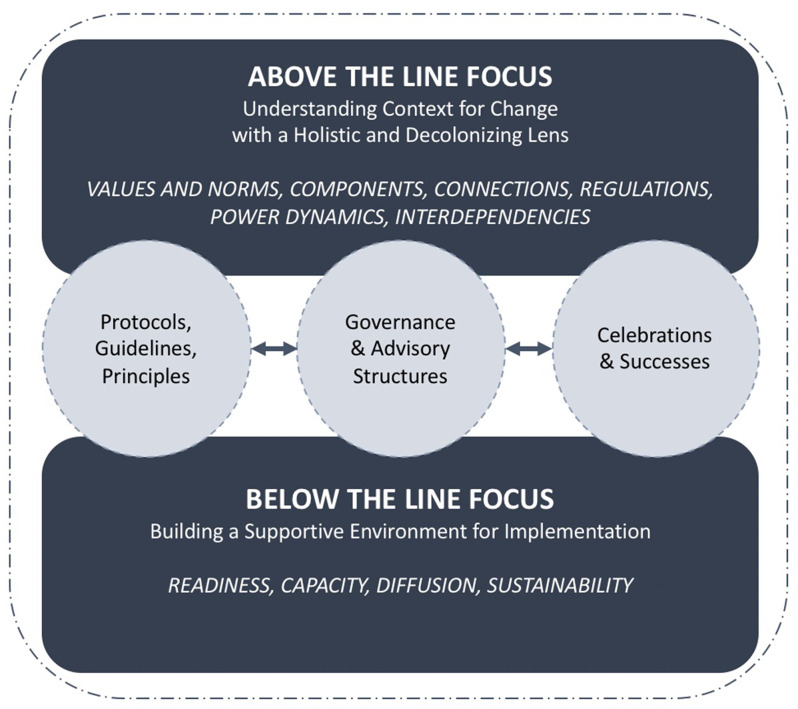
“Within the Framework, we modified the Above the Line focus on “initiatives theory of change infused with a systemic lens” to “understanding context for change with a holistic and decolonizing lens” - a process regarded as essential to any work conducted with Indigenous communities [39–44].”
BackgroundMethodLemke, S., & Delormier, T. (2017) · Maternal & Child Nutrition · doi:10.1111/mcn.12499 · Cited by 110 · cited 2×
“We need to work together to demonstrate that projects need to be centred around Indigenous ways of knowing and adequately support First Nations health and well-being” [Annual Gathering participant 7].”
BackgroundSharing What we Know About Living a Good Life: Indigenous Approaches to Knowledge Translation
Smylie, J., Olding, M., & Ziegler, C. (2014) · Journal of the Canadian Health Libraries Association / Journal de l'Association des bibliothèques de la santé du Canada · doi:10.5596/c14-009 · Cited by 93 · cited 1×
“This is consistent with the call for decol-onizing approaches to community research and knowledge mobilization [5, 54, 58–61].”
MethodThe ABLe Change Framework: A Conceptual and Methodological Tool for Promoting Systems Change
Foster-Fishman, P. G., & Watson, E. R. (2012) · American Journal of Community Psychology · doi:10.1007/s10464-011-9454-x · Cited by 75 · cited 8×
“Both Above and Below the Line components are expected to work together to support an environment for transformative change [28].”
BackgroundMethodInfluentialCritical examination of knowledge to action models and implications for promoting health equity
Davison, C. M., Ndumbe-Eyoh, S., & Clement, C. (2015) · International Journal for Equity in Health · doi:10.1186/s12939-015-0178-7 · Cited by 72
Decolonizing Research Practice: Indigenous Methodologies, Aboriginal Methods, and Knowledge/Knowing
Evans, M., Miller, A., Hutchinson, P. J., & Dingwall, C. (2014) · Oxford University Press eBooks · doi:10.1093/oxfordhb/9780199811755.013.019 · Cited by 58
Knowledge translation in the context of Aboriginal health.
Estey, E. A., Kmetic, A. M., & Reading, J. (2008) · PubMed · Cited by 49
Commission of Canada, T. A. R. (2015) · aboriginal policy studies · doi:10.5663/aps.v5i1.25647 · Cited by 41
Building Healthy Community Relationships Through Food Security and Food Sovereignty
Delormier, T., & Marquis, K. (2019) · Current Developments in Nutrition · doi:10.1093/cdn/nzy088 · Cited by 39 · cited 4×
“Successful implementation of such endeavors has valued community engagement and centred Indigenous perspectives and strengths in program planning [1–9].”
BackgroundInfluentialWesche, S. D., O'Hare-Gordon, M. A. F., Robidoux, M. A., & Mason, C. W. (2016) · Canadian Food Studies / La Revue canadienne des études sur l'alimentation · doi:10.15353/cfs-rcea.v3i2.161 · Cited by 33
Morton Ninomiya, M. E., Hurley, N., & Penashue, J. (2020) · Critical Public Health · doi:10.1080/09581596.2018.1541228 · Cited by 32 · cited 1×
“This participatory project with First Nations communities responds to the broader call made by scholars which emphasize the importance of decolonizing approaches to Indigenous health research [42, 43, 56, 57].”
BackgroundSafe Food, Dangerous Lands? Traditional Foods and Indigenous Peoples in Canada
Robin, T., Burnett, K., Parker, B., & Skinner, K. (2021) · Frontiers in Communication · doi:10.3389/fcomm.2021.749944 · Cited by 28
Self-citationDecolonizing Research Practice: Indigenous Methodologies, Aboriginal Methods, and Knowledge/Knowing
Evans, M., Miller, A., Hutchinson, P., & Dingwall, C. (2020) · Oxford University Press eBooks · doi:10.1093/oxfordhb/9780190847388.013.18 · Cited by 28
Estey, E. A., Kmetic, A. M., & Reading, J. L. (2010) · Canadian Journal of Public Health · doi:10.1007/bf03405569 · Cited by 24
Skinner, K., Hanning, R., Metatawabin, J., & Tsuji, L. (2014) · Rural and Remote Health · doi:10.22605/rrh2545 · Cited by 17
Self-citationDi Ruggiero, E., & Edwards, N. (2018) · BioMed Research International · doi:10.1155/2018/1519402 · Cited by 16 · cited 5×
“…between the program and its context [5, 25, 26], co-governance mechanisms to ensure transparency and accountability in decision making [25], community collaboration and partnerships [27], and integration of a dynamic and process-oriented approach that can guide and foster community…”
BackgroundMethodInfluentialDomingo, A., Yessis, J., Charles, K.-A., Skinner, K., & Hanning, R. M. (2023) · Implementation Science · doi:10.1186/s13012-023-01291-2 · Cited by 16 · cited 4×
“While champions proved to be key enablers for program planning, relying on a small number of people in the community also came with challenges [17–21].”
BackgroundMethodInfluentialSelf-citationMcEachern, L. W., Yessis, J., Zupko, B., Yovanovich, J., Valaitis, R., & Hanning, R. M. (2022) · Applied Physiology, Nutrition, and Metabolism · doi:10.1139/apnm-2021-0776 · Cited by 12 · cited 4×
“The people of Haida Nation embrace a strong relationship with the land and surrounding waters and are committed to strengthening relationships between the environment and wellness [15, 19, 31].”
BackgroundInfluentialSelf-citationMcEachern, L. W., Yessis, J., Yovanovich, J., Crack, S., Zupko, B., Valaitis, R., & Hanning, R. M. (2022) · Current Developments in Nutrition · doi:10.1093/cdn/nzac090 · Cited by 11 · cited 6×
“While champions proved to be key enablers for program planning, relying on a small number of people in the community also came with challenges [17–21].”
BackgroundMethodInfluentialSelf-citationRobidoux, M. A., Winnepetonga, D., Santosa, S., & Haman, F. (2021) · Applied Physiology, Nutrition, and Metabolism · doi:10.1139/apnm-2020-0951 · Cited by 10 · cited 2×
““[Our] project is not only having a positive impact on the participating community, but the effects are spreading out, especially with [Tribal Council] being connected to 9 communities, circles are extending” [LCF 3].”
BackgroundValaitis, R. F., McEachern, L. W., Harris, S., Dick, T., Yovanovich, J., Yessis, J., Zupko, B., Corbett, K. K., & Hanning, R. M. (2022) · Applied Physiology, Nutrition, and Metabolism · doi:10.1139/apnm-2021-0780 · Cited by 8
Self-citationMcEachern, L. W., Harris, S., Valaitis, R., Watson, A., Yessis, J., Zupko, B., & Hanning, R. M. (2022) · International Journal of Environmental Research and Public Health · doi:10.3390/ijerph192315878 · Cited by 8 · cited 3×
“Through such connections, local procured foods from farmers were integrated into school food programs [17, 18].”
BackgroundSelf-citation
Research works printed but not linked: 2
- Mills A, George P. Sacred Land and coming back: how Gitxsan and Witsuwit’en Reincarnation stretches western boundaries. Can J Native Stud. 2001;21(2):309–1.
- Wilson S. What is an indigenous research methodology? Can J Native Educ. 2001;25(2):175–9.
Cited by
Nurti, Y., & Saputra, N. (2025) · Cogent Food & Agriculture · doi:10.1080/23311932.2025.2596401 · Cited by 5
“…of institutions from various nations, including Minzu University of china (Fang et al., 2024; liu et al., 2023), the University of guelph (domingo et al., 2024; Sarapura–escobar & hoddy, 2022), and the Ministry of education of the People’s Republic of china (liu et al., 2021; luo et al.,…”
Desta, G., Tebeje, A. K., Melesse, M. B., et al. (2025) · SSRN Electronic Journal · doi:10.2139/ssrn.5157791
Michnik, K. (2026) · Health Promotion International · doi:10.1093/heapro/daag062
Elshahat, S., Moffat, T., Newbold, K. B., Jafri, Y., Shafiq, B., Amir, T., Donoian, L., Helali, M., Klioueva, N., Patel, A., et al. (2026) · Food Quality and Preference · doi:10.1016/j.foodqual.2026.106067
Sadanand, A., Dubey, V. K., Pushpalatha, R., & Sankaranarayanan, K. (2026) · Frontiers in Sustainable Food Systems · doi:10.3389/fsufs.2026.1882546
Metadata
- Authors
- Domingo, A., Yessis, J., Zupko, B., McEachern, L. W., Valaitis, R., Skinner, K., & Hanning, R. M.
- Affiliations
- University of Waterloo (CA)
- Western University (CA)
- Corresponding author
- Domingo, Ashleigh
- ORCID
- Venue
- BMC Public Health
- Published
- 2024-08-15
- Volume
- 24
- Issue
- 1
- Pages
- 2222-2222
- ISSN
- 1471-2458 (ISSN-L)
- PMC
- PMC11325755
- OpenAlex
- W4401620384
- Cited by
- 6
- References
- 44
- Citations by year
- 2026: 4 · 2025: 2
- FWCI
- 2.71
- Type
- journal article
- Language
- en
- Open access
- gold
- doi.org
- Licence
- cc-by
- creativecommons.org/licenses/by/4.0 (tdm)
- creativecommons.org/licenses/by/4.0 (vor)
- Locations
- BMC Public Health (publishedVersion, cc-by)
- PubMed Central (publishedVersion, cc-by)
- PubMed (publishedVersion)
- DOAJ (DOAJ: Directory of Open Access Journals) (submittedVersion, cc-by-sa)
- Topics
- Social Sciences › Health › Indigenous Health, Education, and Rights
- Social Sciences › Education › Indigenous and Place-Based Education
- Social Sciences › Anthropology › Indigenous Studies and Ecology
- Keywords
- study circles, local food systems, Indigenous food sovereignty, food security, scale-up, participatory action research, community capacity building, traditional food, decolonization, intersectoral collaboration, knowledge keepers, holistic well-being, Haida Gwaii
- MeSH terms
- Food Security, Indigenous Canadians, Adolescent, British Columbia, Canada, Child, Community Participation, Food Supply, Humans, Schools, Community-Based Participatory Research, Capacity Building
About these checks
Registry, retraction, Cites and statistics results are computed, not judged, with one exception: a printed reference that no index lists is read once by a model before it counts as a citation error. Claims are extracted by a model and kept only when their quote appears verbatim in the text; each cited source is then checked, with a model’s help, for whether it says what the claim relies on. Those verdicts can be wrong — read the claim’s quote and the cited source before relying on one.
The claim verdicts this report counts are experimental: their accuracy is not yet measured.
A language model drew the claims from the paper on 2026-10-10, under version 3 of the claim definition (model deepseek-v4.1-flash, prompt extract-v3).
A second model labelled each claim on 2026-10-10 (model jev-1.13-20260917, definition revision gold-guideline-v0.2).
Cited sources are checked with a language model’s help (gpt-6-sol).
Statistics and arithmetic are recomputed, not judged.
Confidence bands are shown only for fields calibrated on our annotated test set. None is calibrated yet, so no band is shown.
What counts as a claim ›How we measure confidence ›How we check this ›
Are you an author, or do you see a problem with this page? Request a review
Data sources
Bibliographic data: Semantic Scholar, OpenAlex, Crossref.
Contains information from the Semantic Scholar Academic Graph Datasets, made available under the ODC Attribution License (ODC-BY 1.0).
Semantic Scholar’s data is described in: Kinney, R., et al. (2023). The Semantic Scholar Open Data Platform. arXiv:2301.10140.
