

Effectiveness of naloxone distribution in community settings to reduce opioid overdose deaths among people who use drugs: a systematic review and meta-analysis
Open accessThe DOI matches its Crossref record; 54 of the 55 references it cites were found in a registry or an index; 15 of the 26 sources its claims cite were checked for support.
Abstract
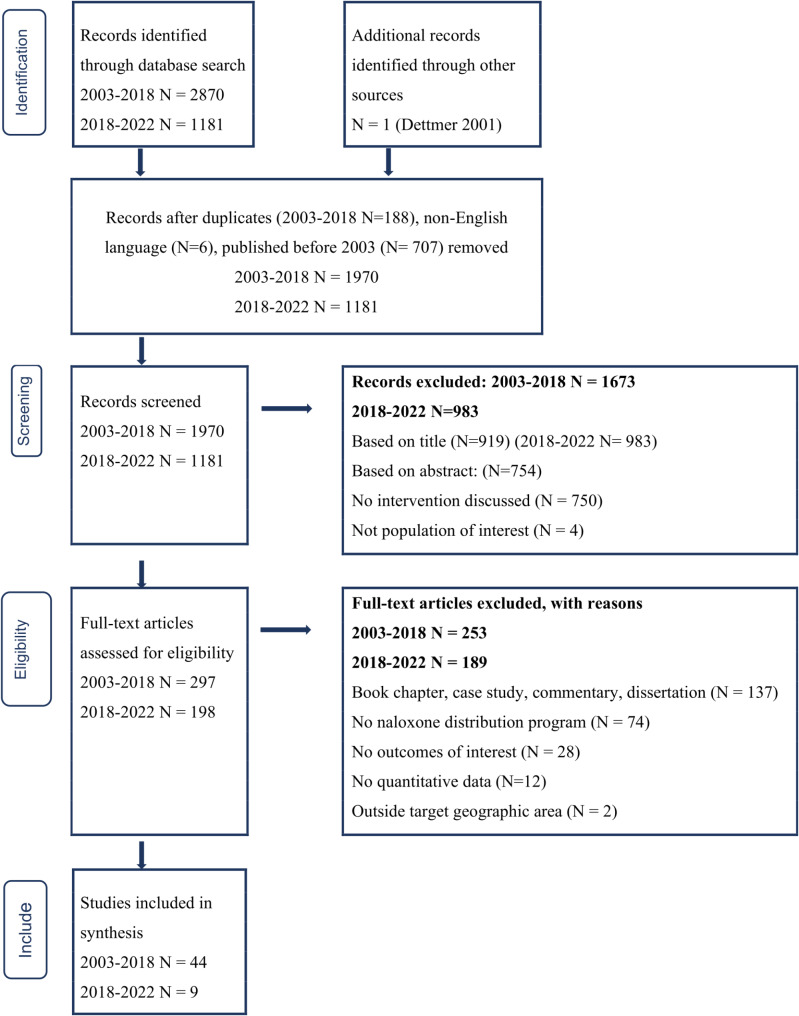
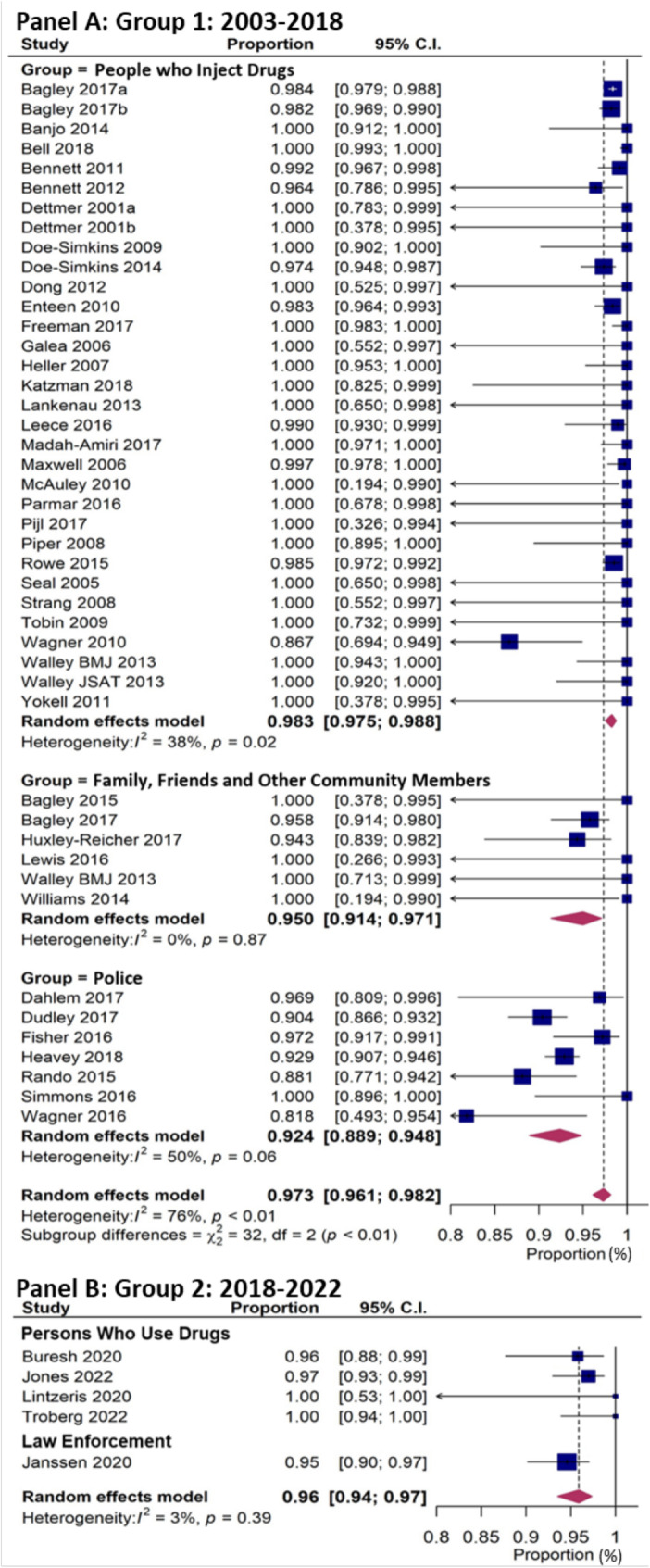
Background: It is estimated that over 111,000 people in the U.S. died from a drug overdose in the twelve-month period ending in July 2023. More than three-quarters of those deaths were attributed to opioids. Naloxone has long been available in healthcare facilities to reverse opioid overdose rapidly and safely but is not universally accessible for use in community settings where overdoses occur. We conducted a systematic literature review and meta-analysis to assess the effectiveness of overdose education and naloxone distribution (OEND) programs in three types of community settings to reduce overdose deaths among people who use opioids nonmedically. Methods: We systematically searched electronic databases, including Medline (OVID), Embase (OVID), Psycinfo (OVID), and Global Health (OVID), for peer-reviewed studies of OEND programs published during 2003–2018 (Group 1) that reported overdose outcomes individual level survivals or deaths immediately following naloxone administration. The PRISMA checklist guided screening, quality assessment, and data abstraction. We later identified studies published during 2018–2022 (Group 2), when drug usage and fentanyl-related overdose deaths notably increased, differed from earlier ones. We conducted meta-analyses on both Groups using random effects models to estimate summary survival proportions. Results: Among the 44 Group 1 studies published during 2003–2018, survival did not differ by time (year), location, naloxone dose, or route of administration, but studies of OEND programs serving people who use drugs reported 98.3% (95% CI: 97.5–98.8) survival; those serving family of people who use drugs or other community members reported 95.0% (95% CI: 91.4–97.1) survival; and those for police reported 92.4% (95% CI: 88.9–94.8) survival ( p < 0.01). Five Group 2 studies (2018–2022) yielded similar results. Conclusions: Community-based naloxone distribution programs can be effective in preventing opioid overdose deaths. The paper demonstrates that in the face of increasing overdose deaths over time, survival after naloxone administration has been sustained. The very high survival rates provide clear evidence for public health to continue efforts to expand channels for naloxone distribution in community settings.
Overview
CoChat Summary
## TL;DR
This systematic review and meta-analysis found that community naloxone distribution programs were associated with very high immediate survival after overdose, including in updated studies from 2018–2022. The paper concludes that community-based naloxone distribution can prevent opioid overdose deaths and should be expanded.
## Key findings
- In 41 Group 1 studies (2003–2018), 74,114 participants reported outcomes after 10,328 naloxone administrations.
- Random-effects meta-analysis found overall survival of 97.3% (95% CI 96.1–98.3) in Group 1; subgroup survival was 98.3% for programs serving people who use drugs, 95.0% for family/community members, and 92.4% for police.
- In 5 Group 2 studies (2018–2022), survival was 96.0% (95% CI 94–97), with very little heterogeneity (I² = 3%, p = 0.39).
- Community-level studies also suggested benefit: one Chicago program reported a 30% reduction in deaths after implementation, Massachusetts saw 27% and 46% reductions in opioid overdose mortality in low- and high-implementing communities versus no implementation, and Scotland reported a 36% reduction in opioid-related deaths among prisoners in the 4 weeks after release.
## Methods
- Systematic review and meta-analysis of peer-reviewed English-language studies of community-based overdose education and naloxone distribution (OEND) programs in the U.S., Canada, Australia, and Europe.
- Two search periods were analyzed: 2003–2018 (Group 1) using multiple databases, and 2018–2022 (Group 2) using PubMed; no protocol was registered.
- Primary outcome was immediate survival or death after naloxone administration; survival proportions were pooled with random-effects models, and study quality was assessed for Group 1 only.
## Limitations
- The paper states that follow-up was low in many studies, so overdose event outcomes were likely underestimated; this is a stated limitation.
- The authors note possible publication or small-study bias, though funnel/trim-and-fill analyses found little evidence of it; they also did not review unpublished reports. The text makes these limitations evident.
- Many evaluations were not independent, often involving people running the programs or collaborating with them. The paper states this limitation.
- The review could not determine how many overdoses would have been fatal without OEND because most studies had no comparison groups; the text makes this limitation evident.
Model-written summary. Check it against the paper before relying on it.
Integrity signals
Registry
Cites
Statistics
Figures
Verification
Claims the paper makes
11 Valid · 0 Not valid · 5 Not checked · 23 Own results and interpretations
Every source the paper cites for this claim was checked and supports it.
In the paper
“A before (2006-10) -after (2011-13) comparison of Scotland’s National Naloxone Programme found a 36% reduction in the proportion of opioid-related deaths in prisoners during the 4 weeks following their release from prison after the program was initiated [39].”
§ Effectiveness of naloxone distribution in community settings to reduce opioid overdose deaths among people who use drugs: a systematic review and meta-analysis > Results > Studies reporting community-level outcomes (N = 5)
What the sources say
- Supportedcites [39] Bird SM, McAuley A, Parry S, Hunter C. Effectiveness of Scotland’s National Naloxone Programme for reducing opioid-related deaths: a before (2006-10) versus after (2011-13) comparison. Addiction 2016;111(5):883 − 91. https://onlinelibrary.wiley.com/doi/full/10.1111/add.13265 PMC4982071 26642424 source
The Abstract Conclusions report a 36% reduction in the proportion of opioid-related deaths occurring within four weeks of prison release after the programme began. The Abstract Findings give the before-and-after proportions as 9.8% and 6.3%. (LLM, conf=0.94)
plainstates a cause- Asserted: passes — The authors put it forward as true.
- Checkable: passes — It can be checked against evidence.
- Load-bearing: passes — The paper’s conclusions depend on it.
- Based: passes — The paper gives a reason why it holds.
- Supported
The cited sources support only part of this claim — read each source’s verdict below.
In the paper
“In the only study in our review to enroll PWUD, family members, other community members, and police all in the same study, the odds of PWUD administering naloxone to someone to reverse an overdose were more than 8 times the odds that people in the other groups did so [33].”
§ Effectiveness of naloxone distribution in community settings to reduce opioid overdose deaths among people who use drugs: a systematic review and meta-analysis > Results > Group 2 studies reporting individual-level outcomes, 2018–2022
What the sources say
- Partly supportedcites [33] Thylstrup B, Hesse M, Jorgensen M, Thiesen H. One opioid user saving another: the first study of an opioid overdose-reversal and naloxone distribution program addressing hard-to-reach drug scenes in Denmark. Harm Reduct J. 2019;16(1):66. 10.1186/s12954-019-0328-0. PMID: 31,805,969. PMCID: PMC6896775. 10.1186/s12954-019-0328-0 PMC6896775 31805969 sourceExperimental — accuracy not yet measured
The Abstract (Results) reports that people who used opioids had 8.50 times the adjusted odds of treating an overdose compared with other participants. But the Results (Treatment of ODs) say only 65% of those who treated an overdose reported administering naloxone; the paper does not report an 8.50 odds ratio specifically for administering naloxone. (LLM, conf=0.90)
plainstates an association- Asserted: passes — The authors put it forward as true.
- Checkable: passes — It can be checked against evidence.
- Load-bearing: unclear — It is unclear whether the paper’s conclusions depend on it.
- Based: passes — The paper gives a reason why it holds.
- Partly supported
Every source the paper cites for this claim was checked and supports it.
In the paper
“Nonfatal opioid overdoses are often witnessed by companions who also use opioids [7].”
§ Effectiveness of naloxone distribution in community settings to reduce opioid overdose deaths among people who use drugs: a systematic review and meta-analysis > Introduction
What the sources say
- Supportedcites [7] Seal KH, Downing M, Kral AH, Singleton-Banks S, Hammond JP, Lorvick J, Ciccarone D, Edlin BR. Attitudes about prescribing take-home Naloxone to injection drug users for the management of heroin overdose: a survey of street-recruited injectors in the San Francisco Bay area. J Urban Health. 2003;80(2):291–301. 10.1093/jurban/jtg032. PMID: 12791805; PMCID: PMC3456285. 12791805 PMC3456285 source
The Conclusion (page not provided) states that most overdoses in this study were witnessed by injecting companions. The Responses to Overdose section (page not provided) reports that 89% of the surveyed injectors had witnessed an overdose and describes their efforts to resuscitate peers, supporting the citing sentence’s general point. (LLM, conf=0.88)
plain- Asserted: passes — The authors put it forward as true.
- Checkable: passes — It can be checked against evidence.
- Load-bearing: passes — The paper’s conclusions depend on it.
- Based: passes — The paper gives a reason why it holds.
- Supported
The cited sources support only part of this claim — read each source’s verdict below.
In the paper
“The sixth study estimated that naloxone distribution in North Carolina averted 352 overdose deaths over a three-year period, at a cost of $1,605 per life saved [34].”
§ Effectiveness of naloxone distribution in community settings to reduce opioid overdose deaths among people who use drugs: a systematic review and meta-analysis > Discussion
What the sources say
- Partly supportedcites [34] Naumann RB, Durrance CP, Ranapurwala SI, Proescholdbell S, Childs R, Marshall SW, et al. Impact of a community-based naloxone distribution program on opioid overdose death rates. Drug Alcohol Depend. 2019;204:107536. 10.1016/j.drugalcdep.2019.06.038. PMCID: PMC8107918. PMID: 31,494,440 PMC8107918 31494440 sourceExperimental — accuracy not yet measured
The Results > Cost-benefit analysis estimates approximately 352 deaths avoided from August 2013 through December 2016. It reports $1,605 per death avoided only for 2015–2016, when an estimated 255 deaths were avoided; the claim incorrectly pairs that cost with the longer period and its 352-death estimate. (LLM, conf=0.93)
hedgedstates a cause- Asserted: passes — The authors put it forward as true.
- Checkable: passes — It can be checked against evidence.
- Load-bearing: unclear — It is unclear whether the paper’s conclusions depend on it.
- Based: passes — The paper gives a reason why it holds.
- Partly supported
Every source the paper cites for this claim was checked and supports it.
In the paper
“After adjusting for community level demographics and substance use factors, authors found 27% and 46% reductions in opioid overdose mortality rates in the low- and high-implementing communities, respectively, when compared with communities with no OEND implementation [37].”
§ Effectiveness of naloxone distribution in community settings to reduce opioid overdose deaths among people who use drugs: a systematic review and meta-analysis > Results > Studies reporting community-level outcomes (N = 5)
What the sources say
- Supportedcites [37] Walley AY (2013), Xuan ZM, Hackman HH, Quinn E, Doe-Simkins M, Sorensen-Alawad, A, et al. Opioid overdose rates and implementation of overdose education and nasal naloxone distribution in massachusetts: interrupted time series analysis. BMJ 2013;346(f174) PMC4688551 23372174 source
The Results (Adjusted models: OEND implementation and fatal overdose rates) report adjusted rate ratios of 0.73 and 0.54 for low- and high-implementation community-year strata versus no implementation—equivalent to 27% and 46% lower rates. The Discussion says the models adjusted for demographics, addiction-treatment use, and doctor shopping. The study describes these as observational associations, not proof of causation. (LLM, conf=0.94)
plainstates a cause- Asserted: passes — The authors put it forward as true.
- Checkable: passes — It can be checked against evidence.
- Load-bearing: passes — The paper’s conclusions depend on it.
- Based: passes — The paper gives a reason why it holds.
- Supported
18 more claims · 1 with their cited sources checked
Create a free account to see all 39 claims and to verify the 2 references still open.
- It may state two separate claims as one. 12
- Probably not a substantial claim. 5
Self-check
Percentages, sums and reported differences re-computed from the paper’s own numbers.
Each contradiction between two passages listed here was confirmed by an independent check.
Rated minor: it would not touch a result — a value no result rests on, a p-value that stays on the same side of the significance level, or a conflict that is clerical, resolved elsewhere in the paper, or outside its own findings.
In the paper
§ Effectiveness of naloxone distribution in community settings to reduce opioid overdose deaths among people who use drugs: a systematic review and meta-analysis > Results > Group 1 studies reporting individual-level outcomes (N = 41), 2003–2018
“Overall, most reports contained clear descriptions of the population served (n = 36); more than half provided a thorough or very thorough description of OEND training, including information about naloxone preparation (n = 23)”
§ Effectiveness of naloxone distribution in community settings to reduce opioid overdose deaths among people who use drugs: a systematic review and meta-analysis > Abstract > Results
“Among the 44 Group 1 studies published during 2003–2018, survival did not differ by time (year), location, naloxone dose, or route of administration, but studies of OEND programs serving people who use drugs reported 98.3% (95% CI: 97.5–98.8) survival”
Citations
Cites
Preferred reporting items for systematic reviews and meta-analyses: The PRISMA statement
Moher, D., Liberati, A., Tetzlaff, J., & Altman, D. G. (2010) · International Journal of Surgery · doi:10.1016/j.ijsu.2010.02.007 · Cited by 12,156 · cited 1×
“Reporting We used the Preferred Reporting Items for Systematic Reviews and Meta-Analyses (PRISMA) reporting checklist to guide the reporting of this review [25].”
Sanderson, S., Tatt, I. D., & Higgins, J. P. (2007) · International Journal of Epidemiology · doi:10.1093/ije/dym018 · Cited by 1,531 · cited 1×
“We report results separately for each question because assigning a value to the relative importance of each item would have been arbitrary or subjective [24].”
Walley, A. Y., Xuan, Z., Hackman, H. H., Quinn, E., Doe-Simkins, M., Sorensen-Alawad, A., Ruiz, S., & Ozonoff, A. (2013) · BMJ · doi:10.1136/bmj.f174 · Cited by 999
Shi, L., & Lin, L. (2019) · Medicine · doi:10.1097/md.0000000000015987 · Cited by 818 · cited 1×
“Using funnel plots to further examine robustness, we found that our first funnel plot (See Additional file 1, Supplement, Figure S1A) indicated that there may be missing studies with lower survival and higher variance (bottom left-hand quadrant) [35].”
(2022) · doi:10.15620/cdc:122556 · Cited by 562
A Systematic Review of Community Opioid Overdose Prevention and Naloxone Distribution Programs
Clark, A. K., Wilder, C. M., & Winstanley, E. L. (2014) · Journal of Addiction Medicine · doi:10.1097/adm.0000000000000034 · Cited by 488 · cited 2×
“This review updates previous reviews [16, 17, 18, 19, 20, 21], which generally found naloxone to be successful at reversing overdoses, and expands the literature base by adding a meta-analysis comparing the effectiveness of naloxone distribution across three distinct populations: people who use…”
McDonald, R., & Strang, J. (2016) · Addiction · doi:10.1111/add.13326 · Cited by 471 · cited 2×
“This review updates previous reviews [16, 17, 18, 19, 20, 21], which generally found naloxone to be successful at reversing overdoses, and expands the literature base by adding a meta-analysis comparing the effectiveness of naloxone distribution across three distinct populations: people who use…”
Zaza, S., Wright-De Agüero, L. K., Briss, P. A., Truman, B. I., Hopkins, D. P., Hennessy, M. H., Sosin, D. M., Anderson, L., Carande-Kulis, V. G., Teutsch, S. M., et al. (2000) · American Journal of Preventive Medicine · doi:10.1016/s0749-3797(99)00122-1 · Cited by 464 · cited 1×
“The Community Guide methodology to assess intervention effectiveness informed our approach to assess study quality [23].”
Opioid Overdose Prevention Programs Providing Naloxone to Laypersons - United States, 2014.
(2015) · PubMed Central · Cited by 426
Drug Overdose Deaths in the United States, 1999-2017.
Hedegaard, H., Miniño, A., & Warner, M. (2018) · PubMed · Cited by 313
Research works printed but not linked: 3
- Szalavitz M. Undoing overdose. Undoing drugs: the untold story of harm reduction and the future of addiction. New York, NY: Hachette Books. 2021;161–72.
- Dasgupta N. “Catch up on what’s happening with the naloxone shortage. [Infographic].” Nov 3, 2021, 11:06 AM. Tweet. https://twitter.com/nabarund/status/1455914223641497610
- Harm Reduction Therapeutics (HRT). FDA approval of RiVIVE™ is a critical milestone in making emergency treatment of opioid overdose more widely available (Press Release). 28 July 2023. https://www.harmreductiontherapeutics.org/wp-content/uploads/2023/08/HRT-RiVive-Press-Release-July-28-FINAL_DATED.pdf
Cited by
Medications for Opioid Use Disorder, Opioid Withdrawal, and Opioid Overdose: A Review
Harris, M. T. H., Weinstein, Z., & Walley, A. Y. (2026) · JAMA · doi:10.1001/jama.2025.26348 · Cited by 44
Naloxone Use, 911 Calls, and Emergency Visits After Nonfatal Overdose
Saloner, B. K., Fredericks, P. J., Byrne, L., Hurst, A., Kerins, L., Hulsey, E. G., Rwan, J., & Bandara, S. N. (2025) · JAMA Network Open · doi:10.1001/jamanetworkopen.2025.37678 · Cited by 12
Adolescent-Led Opioid Education and Naloxone Distribution in a High School
Agostini, T., Herrera, A., Cope, M., Neufeld-Kaiser, J., Buresh, C. T., & Campbell, K. (2026) · PEDIATRICS · doi:10.1542/peds.2025-073766 · Cited by 4
Suzetrigine for Acute Pain in the Emergency Department: A First-in-Class NaV1.8 Blocker
Bradshaw, J. C., Lester, L., & Leon, D. A. (2026) · Journal of the American College of Emergency Physicians Open · doi:10.1016/j.acepjo.2026.100337 · Cited by 6
“Smart” harm reduction vending machines to improve public health: Evaluating the utilization
Zhang, A., Murphy, J., Griffin, P. M., Goodman-Hinnershitz, M., Pinto, C. N., Ballard, S. M., Grigson, P. S., Kawasaki, S. S., Tuan, W., & Zgierska, A. E. (2026) · Journal of Substance Use and Addiction Treatment · doi:10.1016/j.josat.2026.209991 · Cited by 4
Alexander, S. P., Shelton, E., Lee, M., Tharp, G., McNeil, M. P., Bernitz, M., Graves, K., Metsch, L. R., & Shelton, R. C. (2026) · Harm Reduction Journal · doi:10.1186/s12954-025-01379-6 · Cited by 3
“A 2025 systematic review and meta-analysis found that community-based OEND programs effectively reduce opioid overdose deaths at individual, city, county, and state levels [23].”
Reported outcomes from a community naloxone training and distribution program
Frederiks, K., Everett, M., Powell, K. G., Peterson, N. A., Borys, S. V., Hallcom, D. K., & Cooperman, N. A. (2025) · Drug and Alcohol Dependence Reports · doi:10.1016/j.dadr.2025.100341 · Cited by 2
Lynch, P. S., Gamalski, L., Roys, V., Albers, A. E., Burk, K., Durán, S., & Facente, S. N. (2025) · Harm Reduction Journal · doi:10.1186/s12954-025-01333-6 · Cited by 2
“The most effective strategies have been shown to be those designed to distribute naloxone directly to people at highest risk of overdosing, with little to no restriction [8, 18].”
Sondhi, A., Best, D. W., Leidi, A., Belanger, M. J., Best, J. M., Bunaciu, A., & White, W. L. (2026) · International Journal of Drug Policy · doi:10.1016/j.drugpo.2026.105218 · Cited by 1
Khezri, M., Holm, J., Dahlen, A., Johnson, C. E., Agyabeng, K., Lei, F., Pagán, J. R. C., Healton, C. G., & Farhat, T. (2026) · Health Affairs Scholar · doi:10.1093/haschl/qxag074 · Cited by 3
Irvine, M. A., Ge, W., Liu, L., Williams, S., Lock, K., Palis, H., & Kinniburgh, B. A. (2026) · Medical Decision Making · doi:10.1177/0272989x261436841 · Cited by 1
McNeilage, A. G., Roxburgh, A., Nielsen, S., & Picco, L. (2026) · International Journal of Drug Policy · doi:10.1016/j.drugpo.2026.105354 · Cited by 1
Sibley, A. L., Joniak-Grant, E., Colston, D. C., Bell, A., Doe-Simkins, M., Wheeler, E. J., & Dasgupta, N. (2026) · Social Science & Medicine · doi:10.1016/j.socscimed.2026.119560 · Cited by 3
Tas, B., Beer, L. J. Z., Appiah‐Kusi, E., Lawn, W., Belov, I., Radcliffe, P., Radley, A., Henderson, B., Meredith, O., Cowan, C., et al. (2025) · PLoS ONE · doi:10.1371/journal.pone.0326482
“Traditional harm reduction approaches, including supervised drug consumption facilities and naloxone distribution, have been introduced as initiatives to reduce overdose mortality [9–11]; however, their reach remains limited due to geographic, legal, and social barriers.”
Wu, X., Fitzpatrick, T., Wu, G., Chen, Y., Fu, L., & Zou, H. (2025) · Journal of Addiction Medicine · doi:10.1097/adm.0000000000001587
From fairytale to clinical practice: A response to commentaries
Utrilla, M. G., Chesney, E., Neale, J., et al. (2025) · Addiction · doi:10.1111/add.70206
“Recent analyses of naloxone distribution programmes have provided valuable insights into usage patterns and outcomes that can inform future product development [17].”
Beyond MAT expansion: A mathematical modeling analysis of opioid use disorder intervention efficacy
Akram, M. Z., Blondino, C., & Wares, J. R. (2026) · Mathematical Biosciences · doi:10.1016/j.mbs.2026.109686
Kieck, D. M., Middleton, N. A., Cherinka, E., et al. (2025) · Journal of the American Pharmacists Association · doi:10.1016/j.japh.2025.102982
Effectiveness, acceptability, and feasibility of naloxone in carceral settings: a scoping review
Ravichandran, N., Cullen, W., Hout, M. C. V., Smyth, J., & Crowley, D. (2025) · Harm Reduction Journal · doi:10.1186/s12954-025-01358-x
“Similarly, Chicago’s OEND initiative achieved a 30% reduction in deaths after implementation [62].”
Cooper, S., Fougnies, L. V., Juntilla, A. M., Lister, H. H., Hilton, K., & Lister, J. J. (2025) · Addictive Behaviors Reports · doi:10.1016/j.abrep.2025.100653
“…to expand access in these areas to naloxone and other harm reduction interventions through overdose education and naloxone distribution (OEND) programs which have been found to be widely effective at reducing overdose mortality (Fischer et al., 2025; Razaghizad et al., 2020; Walley et al., 2013).”
Beeler, S., Golan, O. K., Call, A., et al. (2026) · BMC Public Health · doi:10.1186/s12889-026-26921-4
“In summary, the study adds to a growing base of evidence indicating that distributing naloxone is cost-effective and saves lives [11, 17].”
Hull, I., Shang, M., Krans, E. E., Stewart, E., Ritter, M., Narbey, L. T., Mayo, S., & Jawa, R. (2026) · Pregnancy · doi:10.1002/pmf2.70274
Claypool, E. (2026) · Social Service Review · doi:10.1086/740216 · Cited by 2
Stimulant Toxicity as Acute-on-Chronic Cardiovascular Death: How Cardiovascular Care Needs to Adapt
Slavin, S. D., & Walley, A. Y. (2026) · Circulation Population Health and Outcomes · doi:10.1161/circoutcomes.126.013320
Smart First Aid: A Systematic Review of High-Technology Medical Devices for Emergency Response
Elrasheed, F. E., Ibrahim, M. M., Elkheir, A., et al. (2026) · Crescent Journal of Medical and Biological Sciences · doi:10.34172/cjmb.2026.3902
“Overdose-Response Technologies: Potency vs. Tolerability Recent evaluations of intranasal naloxone dosing suggest that higher potency (8 mg) does not confer survival advantages over standard 4 mg doses when administered by law enforcement (16).”
Lieberman, A. J., Davis, C. S., & Newman, A. (2026) · The Journal of Law Medicine & Ethics · doi:10.1017/jme.2026.10233
“29 Having PWUD in the room when decisions are being made about the services provided to them is the most direct way of creating policy that is reflective of the drug-using community ’ s needs.”
Valades, T., Ruiz-Iniesta, A., Domingo-Espiñeira, J., Chart‐Pascual, J. P., Fraile‐Μartinez, O., García-Montero, C., Álvarez-Mon, M., Morales, I., Mora, F., Quintero, J., et al. (2026) · BMC Medical Research Methodology · doi:10.1186/s12874-026-02850-z
“…in multiple studies, which show that public and media narratives tend to prioritize perceived danger and immediate health impact, whereas preventive and therapeutic strategies—such as community naloxone distribution and harm-reduction programs—receive comparatively limited visibility [55–57].”
Quon, S., Truong, I., Morren, E., & Zheng, K. (2026) · Saudi Journal of Health Systems Research · doi:10.1159/000552350
Preventing overdose deaths with effective naloxone inventory distribution
Anzoom, R., Kang, H., Nagi, R., & Vogiatzis, C. (2026) · IISE Transactions on Healthcare Systems Engineering · doi:10.1080/24725579.2026.2663284
“This research focuses on the distribution system of naloxone donation programs, which have demonstrated substantial public health benefits (Fischer et al., 2025; Naumann et al., 2019).”
Treatments for Opioid Overdose—Reply
Harris, M. T. H., Weinstein, Z. M., & Walley, A. Y. (2026) · JAMA · doi:10.1001/jama.2026.5604
Harm Reduction for the Primary Care Clinician
Pannu, A., Patel, H., & McGuirk, R. (2026) · Primary Care Clinics in Office Practice · doi:10.1016/j.pop.2026.03.008
Wakeman, S., Bachireddy, C., Campbell, A., Danovitch, I., Englander, H., Fuller, D., Herring, A., McCollough, M., Lindsay, D. L., Norrington, J., et al. (2026) · Journal of Addiction Medicine · doi:10.1097/adm.0000000000001729
A scoping review of emergency department take-home naloxone on patient and health outcomes
Arbour, J., Ma, J. A., & Feder, K. A. (2026) · Canadian Journal of Emergency Medicine · doi:10.1007/s43678-026-01208-0
Naloxone availability on commercial flights: a gap in travel medicine preparedness
Carter, B. J., & Fuentes, R. J. C. (2026) · Journal of Travel Medicine · doi:10.1093/jtm/taag051
Cassie, D., Warnock, B., Akhtar, F. N., McCloskey, D., & Wyatt, D. J. (2026) · Clinical and Translational Science · doi:10.1111/cts.70640
Bertin, C., Dupouy, J., Authier, N., Michenot, N., Verdier, S., Chappuy, M., & Trouvin, A. (2026) · Pain and Therapy · doi:10.1007/s40122-026-00852-9
Whiteside, L., Lovett, K., Nye, E., Engstrom, A., Hall, J., Field, C. A., Haegerty, P., Palinkas, L. A., McGovern, M. P., Banta‐Green, C. J., et al. (2026) · Contemporary Clinical Trials · doi:10.1016/j.cct.2026.108400
Prada, L. R., Lester, P. R., Runjaic, S., de la Guardia, M. E. B., & Miller, H. L. (2026) · Journal for Healthcare Quality · doi:10.1097/jhq.0000000000000534
Ledingham, E. M., Shin, J., Reichley, N., McKenzie, M., McCray, E., John, K., & Hallowell, B. D. (2026) · Substance Use & Addiction Journal · doi:10.1177/29767342261464479
Ray, B. R., Gillenwater, L. A., Dir, A. L., Ouyang, F., Monahan, P. O., McGladrey, M., Reda, K., & Aalsma, M. C. (2026) · Drug and Alcohol Dependence · doi:10.1016/j.drugalcdep.2026.113287
Barriers and Facilitators to Naloxone Access for Adolescents: A Narrative Review
Ramos, C. R., Krause, K. H., Joseph, V., Beinenson, D., Patton, S. C., Torrey, K., Chaubey, M., Mathias, J. E., Cummings, J. R., & Welsh, J. W. (2026) · Substance Use Research and Treatment · doi:10.1177/29768357261472425 · Cited by 1
“32,75 Restricting the use of MOUD in these populations would not only increases overdose risk, 10 but potentially diminishes a primary healthcare channel for distributing overdose reversal tools such as naloxone to high-risk adolescents.”
Paudel, K., Gautam, K., Pagoto, S., Xu, R., Wickersham, J. A., Altice, F. L., Bhusal, S., Sujan, M. S. H., Copenhaver, M. M., Hong, C., et al. (2026) · PLoS ONE · doi:10.1371/journal.pone.0354745
“Participation in naloxone training programs in these settings may also foster a sense of agency and self-efficacy by equipping individuals with the skills to prevent overdoses and help others in crisis [48].”
Improving peer naloxone knowledge and overdose response: A quality improvement project
Nwashili, C. R. (2026) · InnovAiT Education and inspiration for general practice · doi:10.1177/17557380261471138
Campaign Message Elements for Changing Opioid-Related Behavioral Intent
Bagley, B. H., & Coombs, H. (2026) · Springer eBooks · doi:10.1007/978-3-032-31162-7_6
Katru, P. (2026) · International Journal of Ayurveda360 · doi:10.63247/3048-7390.v3i1.guest-editorial
Opioid Addiction and Management with Naloxone: Emerging Concepts in Clinical Care
Jones, C., Cooper, H. D., Neuchat, E. E., WITT, A. B. D., Hirsch, J. D., Shekoohi, S., & Kaye, A. D. (2026) · Springer eBooks · doi:10.1007/978-3-032-25214-2_9
Nolan, N. S., Sherbuk, J., Maximos, M., Egbert, S. C., Cappiello, M., Cooper, J. D., Garg, R., Bradford, W., Lahey, T., Liebman, S. T., et al. (2026) · The American Journal of Medicine · doi:10.1016/j.amjmed.2026.07.049
Arsdale, W. V., Sacca, L., Barajas, S., Flothe, N., Nelson, L., & de Grubb, M. C. M. (2026) · Drug and Alcohol Dependence · doi:10.1016/j.drugalcdep.2026.113336
Opioid overdose detection and reversal with closed-loop systems
Angelone, L. M., & Koustova, E. (2026) · Nature Reviews Bioengineering · doi:10.1038/s44222-026-00492-w · Cited by 1
“Useability must be compatible with operation without clinical supervision, and distribution models should extend beyond clinics to community channels 40,70 .”
Hao, C., Xie, K., He, J., et al. (2026) · Journal of Drug Delivery Science and Technology · doi:10.1016/j.jddst.2026.108932
Predictors of Naloxone Carriage Among People Who Use Opioids in Maine
Slavin-Hall, S. A., & Glover, R. W. (2026) · Substance Use & Misuse · doi:10.1080/10826084.2026.2729567
Harm reduction vending machines as safer supply-supporting infrastructure
Rife, T. (2026) · Frontiers in Psychiatry · doi:10.3389/fpsyt.2026.1955152
Danovitch, I., Truman, K. A., Brown, H., Miller, M., Shah, S. R., Totlani, J., Kaidbay, D.-H. N., Tessema, K. K., Minasyan, Z., IsHak, W. W., et al. (2026) · CNS Drugs · doi:10.1007/s40263-026-01334-4
Miura, H., Miyao, M., Furukawa, S., Kawai, C., Tateno, M., Ayatollahi, P. S., Abiru, H., Nagai, H., Minami, H., Tomohisa, A., et al. (2026) · Legal Medicine · doi:10.1016/j.legalmed.2026.103018
Metadata
- Authors
- Fischer, L. S., Asher, A., Stein, R., Becasen, J., Doreson, A., Mermin, J., Meltzer, M. I., & Edlin, B. R.
- Affiliations
- National Center for Emerging and Zoonotic Infectious Diseases (US)
- National Center for Injury Prevention and Control (US)
- National Center for HIV/AIDS Viral Hepatitis STD and TB Prevention (US)
- Substance Abuse and Mental Health Services Administration (US)
- Corresponding author
- Fischer, Leah S.
- Venue
- BMC Public Health
- Published
- 2025-03-25
- Volume
- 25
- Issue
- 1
- Pages
- 1135-1135
- ISSN
- 1471-2458 (ISSN-L)
- PMC
- PMC11934755
- OpenAlex
- W4408828505
- Semantic Scholar
- 7f85bd7a3992daa1568be2fe8f76e673f36ed7aa
- Cited by
- 59
- References
- 55
- Citations by year
- 2026: 49 · 2025: 10
- FWCI
- 11.21
- Type
- journal article
- Language
- en
- Open access
- gold
- doi.org
- Licence
- cc-by
- creativecommons.org/licenses/by/4.0 (tdm)
- creativecommons.org/licenses/by/4.0 (vor)
- Locations
- BMC Public Health (publishedVersion, cc-by)
- Europe PMC (PubMed Central) (publishedVersion, cc-by)
- PubMed Central (publishedVersion, cc-by)
- PubMed (publishedVersion)
- DOAJ (DOAJ: Directory of Open Access Journals) (submittedVersion, cc-by-sa)
- Topics
- Health Sciences › Medicine › Public Health, Environmental and Occupational Health › Opioid Use Disorder Treatment
- Health Sciences › Medicine › Epidemiology › HIV, Drug Use, Sexual Risk
- Health Sciences › Medicine › Epidemiology › Substance Abuse Treatment and Outcomes
- Keywords
- naloxone distribution, overdose education and naloxone distribution, opioid overdose deaths, drug users, fentanyl overdose, harm reduction services, overdose prevention
- MeSH terms
- Opiate Overdose, Humans, Naloxone, Narcotic Antagonists, Drug Overdose
About these checks
Registry, retraction, Cites and statistics results are computed, not judged, with one exception: a printed reference that no index lists is read once by a model before it counts as a citation error. Claims are extracted by a model and kept only when their quote appears verbatim in the text; each cited source is then checked, with a model’s help, for whether it says what the claim relies on. Those verdicts can be wrong — read the claim’s quote and the cited source before relying on one.
The claim verdicts this report counts are experimental: their accuracy is not yet measured.
A language model drew the claims from the paper on 2026-10-09, under version 3 of the claim definition (model deepseek-v4.1-flash, prompt extract-v3).
A second model labelled each claim on 2026-10-09 (model jev-1.13-20260917, definition revision gold-guideline-v0.2).
Cited sources are checked with a language model’s help (gpt-6-sol).
Statistics and arithmetic are recomputed, not judged.
Confidence bands are shown only for fields calibrated on our annotated test set. None is calibrated yet, so no band is shown.
What counts as a claim ›How we measure confidence ›How we check this ›
Are you an author, or do you see a problem with this page? Request a review
Data sources
Bibliographic data: Semantic Scholar, OpenAlex, Crossref.
Contains information from the Semantic Scholar Academic Graph Datasets, made available under the ODC Attribution License (ODC-BY 1.0).
Semantic Scholar’s data is described in: Kinney, R., et al. (2023). The Semantic Scholar Open Data Platform. arXiv:2301.10140.
