

Pathways from parental trauma exposure to Syrian and Iraqi refugee youth mental health symptoms: a multi-level mediation analysis
Open accessThe DOI matches its Crossref record; 49 of the 49 references it cites were found in a registry or an index.
Abstract
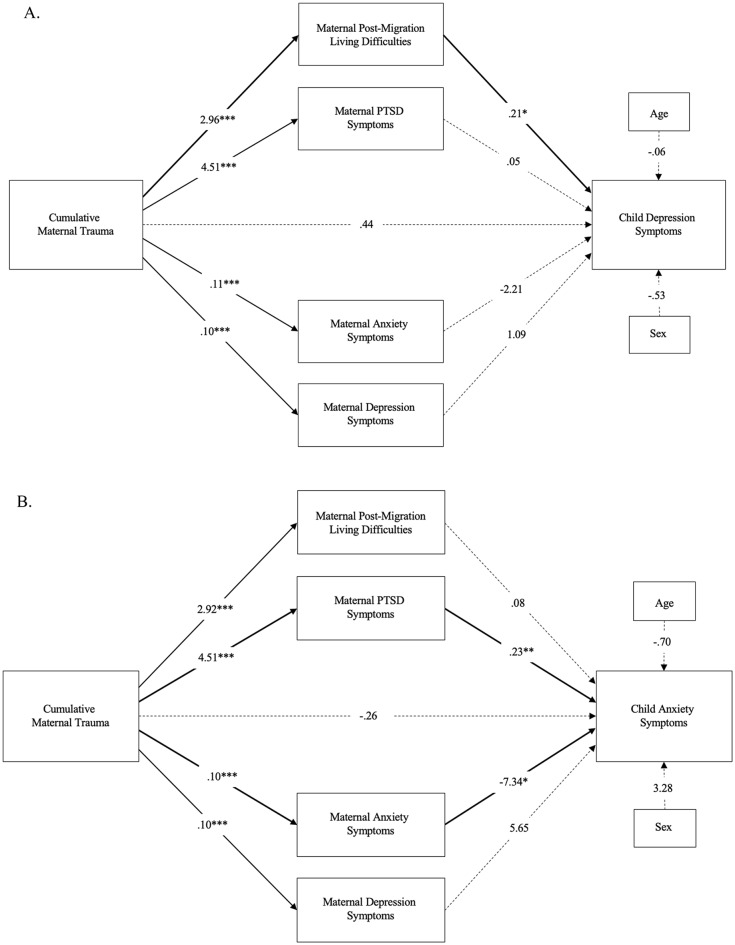
BACKGROUND: Trauma experienced by one generation has potential to impact those that follow. Refugee youth in particular are vulnerable to trauma and its intergenerational effects. By examining trauma subtypes, the impact of parental trauma, and post-/pre-migration stressors, this study investigated pathways linking parental trauma to psychological symptoms in Syrian and Iraqi refugee youth. METHODS: Participants included 165 minors from Syria and Iraq, and their 107 parents (56 mothers, 51 fathers), all of whom experienced forced migration due to war and resettled as refugees in southeast Michigan. Linear mixed-effects modeling and multi-level mediation analyses were employed to investigate pathways from parental trauma exposure to child symptoms (anxiety, depressive, and somatic), as well as possible explanatory mediators. RESULTS: Maternal cumulative trauma and death threat trauma were associated with child depressive symptoms (cumulative: b = 1.64, p =.007; death threat: b = 2.70, p =.020) and somatic burden (cumulative: b = 0.56, p =.032; death threat: b = 1.04, p =.041). Anxiety models also revealed an association between maternal cumulative trauma and child anxiety (b = 1.79, p =.034). Maternal post-migration living difficulties fully mediated the observed association between maternal cumulative trauma and child depression, though this effect was trending in sensitivity analyses. No paternal trauma variables were associated with child symptoms. CONCLUSION: Findings indicate that maternal trauma exposure in particular-as well as elevated post-migration stressors for mothers-may contribute to mental health risk in refugee youth. These insights may be leveraged towards early identification of youth at high risk, and to direct focused intervention towards modifiable targets-including living difficulties (e.g., financial difficulties, access to health care and transportation) experienced by parents post-migration. CLINICAL TRIAL NUMBER: Not applicable.
Overview
The claims and statistics of this paper haven’t been checked yet.
Free: it reads the open-access text and checks the first 5 claims that cite a source we can check. Create a free account to check every claim.
Integrity signals
Registry
Cites
Statistics
Figures
Verification
Claims the paper makes
The claims and statistics of this paper haven’t been checked yet.
Free: it reads the open-access text and checks the first 5 claims that cite a source we can check. Create a free account to check every claim.
Claims other papers make about this one
Each is checked against this paper’s own text: does it say what the citing paper says it does?
The check wasn’t confident either way, so it gives no verdict — never disputed.
In the citing paper
“When children translate sensitive adult content, such as medical information, financial matters, or traumatic narratives, they are at risk of secondary traumatization and premature loss of childhood [4,5].”
From Interpreter Child Syndrome Leading to Parentification and Anxiety in a Refugee Girl: A Case Report (2025) · cites this paper as [4]
Experimental — accuracy not yet measured
Self-check
Percentages, sums and reported differences re-computed from the paper’s own numbers.
The self-check needs the paper’s full text.
Citations
Cites
Baron, R. M., & Kenny, D. A. (1986) · Journal of Personality and Social Psychology · doi:10.1037/0022-3514.51.6.1173 · Cited by 91,532 · cited 1×
“1) [47].”
A general and simple method for obtaining R 2 from generalized linear mixed‐effects models
Nakagawa, S., & Schielzeth, H. (2013) · Methods in Ecology and Evolution · doi:10.1111/j.2041-210x.2012.00261.x · Cited by 10,356 · cited 1×
“…A models test cumulative trauma score as a predictor, while B models include the three trauma subtype variables as predictors, yielding the following: Models 1 A, 1B, 2A, 2B, 3 A, and 3B. Marginal and conditional pseudo-R 2 values were used to assess variance explained in final models [45].”
The Hopkins Symptom Checklist (HSCL): A self-report symptom inventory
Derogatis, L. R., Lipman, R. S., Rickels, K., Uhlenhuth, E. H., & Covi, L. (1974) · Behavioral Science · doi:10.1002/bs.3830190102 · Cited by 4,604 · cited 1×
“Mean scores were separately calculated for 10 items related to anxiety, as well as 15 items related to depression, with higher scores signifying greater symptom severity [31].”
Kessler, R. C., Petukhova, M., Sampson, N. A., Zaslavsky, A. M., & Wittchen, H. (2012) · International Journal of Methods in Psychiatric Research · doi:10.1002/mpr.1359 · Cited by 2,947 · cited 1×
“PTSD prevalence amongst refugee youth between the ages of 16 to 18 averages up to 42% [4]—a notably higher proportion than the average reported 3.9% prevalence in adolescents aged 13 to 18 in the United States [5].”
InfluentialBIRMAHER, B., KHETARPAL, S., BRENT, D., CULLY, M., BALACH, L., KAUFMAN, J., & NEER, S. M. (1997) · Journal of the American Academy of Child & Adolescent Psychiatry · doi:10.1097/00004583-199704000-00018 · Cited by 2,846 · cited 1×
“The SCARED prompts respondents to indicate the extent to which each item is true for them, with the sum of all items comprising a scale score [36].”
Bovin, M. J., Marx, B. P., Weathers, F. W., Gallagher, M. W., Rodriguez, P., Schnurr, P. P., & Keane, T. M. (2016) · Psychological Assessment · doi:10.1037/pas0000254 · Cited by 2,532 · cited 1×
“This measure has well-documented validity across multiple types of trauma exposure, populations, and cultures [29, 30], and demonstrated high reliability in the current sample (α = 0.95).”
InfluentialSchweitzer, R., Melville, F., Steel, Z., & Lacherez, P. (2006) · Australian & New Zealand Journal of Psychiatry · doi:10.1080/j.1440-1614.2006.01766.x · Cited by 759
Silove, D., Sinnerbrink, I., Field, A., Manicavasagar, V., & Steel, Z. (1997) · British Journal of Psychiatry · doi:10.1192/bjp.170.4.351 · Cited by 749 · cited 1×
“Content for the PMLD was originally determined based on conversations with refugee and immigrant communities [33], and transcultural validity has since been documented [34, 35].”
Li, S. S. Y., Liddell, B. J., & Nickerson, A. (2016) · Current Psychiatry Reports · doi:10.1007/s11920-016-0723-0 · Cited by 746 · cited 3×
“…PMLDs in regard to inter-generational trauma transmission is aligned with many studies indicating the role of PMLDs in refugee mental health [2, 20–22]; our findings extend upon this by clarifying the influence of post-migration stress in mediating maternal trauma exposure’s impact on depression…”
The Somatic Symptom Scale–8 (SSS-8): A Brief Measure of Somatic Symptom Burden
Gierk, B., Kohlmann, S., Kroenke, K., Spangenberg, L., Zenger, M., Brähler, E., & Löwe, B. (2014) · JAMA Internal Medicine · doi:10.1001/jamainternmed.2013.12179 · Cited by 740
Scales to Assess Child and Adolescent Depression: Checklists, Screens, and Nets
COSTELLO, E. J., & ANGOLD, A. (1988) · Journal of the American Academy of Child & Adolescent Psychiatry · doi:10.1097/00004583-198811000-00011 · Cited by 730 · cited 2×
“…average severity of symptoms related to depression (M = 11.03, SD = 9.21) and somatic burden (M = 4.56, SD = 4.33) was low-to-moderate, while anxiety symptom severity was more severe, with a mean approaching the diagnostic cut-off (≥ 25) [37] for a probable anxiety disorder (M = 24.29, SD = 14.46).”
InfluentialIntergenerational transmission of trauma effects: putative role of epigenetic mechanisms
Yehuda, R., & Lehrner, A. (2018) · World Psychiatry · doi:10.1002/wps.20568 · Cited by 730 · cited 1×
“The likelihood of intergenerational impact of trauma has emerged in regard to the children of Holocaust survivors, veterans, indigenous peoples, and other trauma-exposed groups [17].”
Ashbaugh, A. R., Houle-Johnson, S., Herbert, C., El-Hage, W., & Brunet, A. (2016) · PLOS ONE · doi:10.1371/journal.pone.0161645 · Cited by 625 · cited 1×
“This measure has well-documented validity across multiple types of trauma exposure, populations, and cultures [29, 30], and demonstrated high reliability in the current sample (α = 0.95).”
InfluentialChild trauma exposure and psychopathology: Mechanisms of risk and resilience
McLaughlin, K. A., & Lambert, H. K. (2017) · Current Opinion in Psychology · doi:10.1016/j.copsyc.2016.10.004 · Cited by 441 · cited 3×
“Both family and trauma dynamics also vary depending on cultural and ethnic background, indicating that findings in one cultural group may not generalize across populations [1, 50].”
Burleson Daviss, W., Birmaher, B., Melhem, N. A., Axelson, D. A., Michaels, S. M., & Brent, D. A. (2006) · Journal of Child Psychology and Psychiatry · doi:10.1111/j.1469-7610.2006.01646.x · Cited by 370 · cited 1×
“The MFQ is valid across many cultures, symptom levels, and populations [38–40], and internal reliability in this sample was also excellent (α = 0.92).”
InfluentialIntergenerational Trauma in Refugee Families: A Systematic Review
Sangalang, C. C., & Vang, C. (2017) · Journal of Immigrant and Minority Health · doi:10.1007/s10903-016-0499-7 · Cited by 344 · cited 7×
“…from a variety of backgrounds, studies have found that post-migration stressors, such as reduced social integration, time-consuming barriers to resettlement, weakened social networks, and loss of support systems within a shared culture, are linked to negative mental health outcomes [2, 20–22].”
InfluentialGender differences in trauma and posttraumatic stress disorder.
Breslau, N. (2002) · PubMed · Cited by 264
Gleeson, C., Frost, R., Sherwood, L., Shevlin, M., Hyland, P., Halpin, R., Murphy, J., & Silove, D. (2020) · European Journal of Psychotraumatology · doi:10.1080/20008198.2020.1793567 · Cited by 220
Differentiating between mixed-effects and latent-curve approaches to growth modeling
McNeish, D., & Matta, T. H. (2017) · Behavior Research Methods · doi:10.3758/s13428-017-0976-5 · Cited by 193 · cited 1×
“LMM is a robust statistical technique for non-independent data, while accounting for inter-individual variation of baseline symptoms and handling missing data suitably using maximum likelihood estimation [44].”
Development of mental health problems - a follow-up study of unaccompanied refugee minors
Jensen, T. K., Skårdalsmo, E. M., & Fjermestad, K. W. (2014) · Child and Adolescent Psychiatry and Mental Health · doi:10.1186/1753-2000-8-29 · Cited by 148 · cited 1×
“Future studies may also compare these findings to pathways of symptom development in unaccompanied refugee youth, to gain insight into latent parental protective factors [49].”
Knipscheer, J. W., Sleijpen, M., Mooren, T. T. M., ter Heide, F. J. J., & van der Aa, N. (2015) · BJPsych Bulletin · doi:10.1192/pb.bp.114.047951 · Cited by 133 · cited 3×
“As earlier research has clearly established, the refugee community has had on average a higher rate of exposure to trauma [2, 3].”
Acculturation and post-migration psychological symptoms among Iraqi refugees: A path analysis.
LeMaster, J. W., Broadbridge, C. L., Lumley, M. A., Arnetz, J. E., Arfken, C. L., Fetters, M. D., Jamil, H. J., Pole, N., & Arnetz, B. B. (2018) · American Journal of Orthopsychiatry · doi:10.1037/ort0000240 · Cited by 126
Morris, M. C., & Rao, U. (2013) · Asian Journal of Psychiatry · doi:10.1016/j.ajp.2012.07.012 · Cited by 100 · cited 1×
“Studies across populations have indicated the likelihood for trauma exposure to exacerbate the impact of later stressors—regarding both neurobiological and psychological mechanisms (e.g., altered stress reactivity; changes to stress coping) [48].”
Javanbakht, A., Rosenberg, D., Haddad, L., & Arfken, C. L. (2018) · Journal of the American Academy of Child & Adolescent Psychiatry · doi:10.1016/j.jaac.2018.01.013 · Cited by 99 · cited 1×
“…between child exposure to specific trauma subtypes and child PTSD symptoms in Syrian and Iraqi refugees—though has been unable to explain a high prevalence of child anxiety (up to 40.3%, and often a more common outcome than PTSD in refugee youth) [8, 23] through child trauma exposure alone [14].”
InfluentialSelf-citationLima, E. D. P., Vasconcelos, A. G., Berger, W. L., Kristensen, C. H., do Nascimento, E., Figueira, I. L. D. V., & Mendlowicz, M. V. (2016) · Trends in Psychiatry and Psychotherapy · doi:10.1590/2237-6089-2015-0074 · Cited by 96 · cited 1×
“The LEC-5 is widely used, valid, and reliable across cultures [25, 26].”
Clusters of trauma types as measured by the Life Events Checklist for DSM–5.
Contractor, A. A., Weiss, N. H., Batley, P. N., & Elhai, J. D. (2020) · International Journal of Stress Management · doi:10.1037/str0000179 · Cited by 90 · cited 6×
“…project was to organize and examine the responses of trauma-exposed refugee parents by the classifications defined by Contractor et al. (2020) [13], as prior studies in refugee youth yielded variable findings regarding links between child trauma exposure and child anxiety, depressive, or…”
InfluentialNils Johan Lavik, E. H. (1999) · Nordic Journal of Psychiatry · doi:10.1080/080394899426666 · Cited by 86 · cited 1×
“Prior works have attested to the validity of the HSCL-25 in refugee populations [32], and reliability for the anxiety (α = 0.87) and depression (α = 0.91) sub-scales was excellent in this sample.”
InfluentialTraumatic Experiences and Mental Health Risk for Refugees
Schlaudt, V. A., Bosson, R. S., Williams, M. T., German, B. T., Hooper, L. M., Frazier, V., Carrico, R., & Ramírez, J. A. (2020) · International Journal of Environmental Research and Public Health · doi:10.3390/ijerph17061943 · Cited by 82 · cited 1×
“…has been strongly linked to trauma symptomatology in both refu-gee and non-refugee populations—including in Syrian and Iraqi refugee groups [7, 52, 53]—the lack of reported exposure to assault-related events (whether due to a true lack of exposure or underreporting) limits investigation into this…”
Vallejo-Martín, M., Sancha, A. S., & Canto, J. M. (2021) · International Journal of Environmental Research and Public Health · doi:10.3390/ijerph18094806 · Cited by 75 · cited 1×
“…has been strongly linked to trauma symptomatology in both refu-gee and non-refugee populations—including in Syrian and Iraqi refugee groups [7, 52, 53]—the lack of reported exposure to assault-related events (whether due to a true lack of exposure or underreporting) limits investigation into…”
East, P. L., Gahagan, S., & Al‐Delaimy, W. K. (2017) · Journal of Immigrant and Minority Health · doi:10.1007/s10903-017-0624-2 · Cited by 74 · cited 1×
“Further, in children of Somali refugee mothers, while no direct association was found between maternal trauma and child well-being, maternal PTSD and depressive symptoms mediated the effect of maternal physical trauma (i.e., torture) on child adjustment [19].”
Alemi, Q., James, S., & Montgomery, S. (2016) · Transcultural Psychiatry · doi:10.1177/1363461516660937 · Cited by 66 · cited 1×
“Content for the PMLD was originally determined based on conversations with refugee and immigrant communities [33], and transcultural validity has since been documented [34, 35].”
Solberg, Ø., Nissen, A., Vaez, M., Cauley, P., Eriksson, A.-K., & Saboonchi, F. (2020) · Conflict and Health · doi:10.1186/s13031-020-00311-y · Cited by 65 · cited 1×
“PTSD prevalence amongst refugee youth between the ages of 16 to 18 averages up to 42% [4]—a notably higher proportion than the average reported 3.9% prevalence in adolescents aged 13 to 18 in the United States [5].”
InfluentialArnetz, B. B., Broadbridge, C. L., Jamil, H. J., Lumley, M. A., Pole, N., Barkho, E., Fakhouri, M., Talia, Y. R., & Arnetz, J. E. (2014) · Journal of Immigrant and Minority Health · doi:10.1007/s10903-014-9995-9 · Cited by 59 · cited 5×
“While cumulative trauma is often correlated with trauma-related symptoms, recent research has demonstrated that stratifying trauma by the specific type of event experienced may have stronger predictive value for psychological outcomes [7–10].”
InfluentialSengoelge, M., Nissen, A., & Solberg, Ø. (2022) · International Journal of Environmental Research and Public Health · doi:10.3390/ijerph19052509 · Cited by 51 · cited 4×
“…understanding that PMLDs—such as lack of community supports, language barriers, and loss of social networks—following maternal trauma contribute to depression in youth could guide family-based support and advocacy efforts geared towards mitigating the impact of intergenerational trauma [20–22].”
InfluentialLong‐term effects of childhood trauma subtypes on adult brain function
Cai, J., Li, J., Liu, D., Gao, S., Zhao, Y., Zhang, J., & Liu, Q. (2023) · Brain and Behavior · doi:10.1002/brb3.2981 · Cited by 47 · cited 2×
“Other studies have found comparable results [7, 11, 12].”
InfluentialThe Arabic Mood and Feelings Questionnaire: Psychometrics and Validity in a Clinical Sample
Tavitian, L., Atwi, M., Bawab, S., Hariz, N., Zeinoun, P. A., Khani, M., & Maalouf, F. T. (2013) · Child Psychiatry & Human Development · doi:10.1007/s10578-013-0406-6 · Cited by 36 · cited 1×
“The MFQ is valid across many cultures, symptom levels, and populations [38–40], and internal reliability in this sample was also excellent (α = 0.92).”
InfluentialThe Polish adaptation of the Life Events Checklist (LEC-5) for PTSD criteria from DSM-5
Rzeszutek, M., Lis‐Turlejska, M., Palich, H., & Szumiał, S. (2017) · Psychiatria Polska · doi:10.12740/pp/onlinefirst/69218 · Cited by 32 · cited 1×
“The LEC-5 is widely used, valid, and reliable across cultures [25, 26].”
Statistical Causal Inferences and Their Applications in Public Health Research
He, H., Wu, P., & Chen, D. (2016) · ICSA book series in statistics · doi:10.1007/978-3-319-41259-7 · Cited by 30 · cited 1×
“SEM as a statistical approach to multilevel mediation handles missing data well using Full Information Maximum Likelihood (FIML) estimation, while allowing for nested individual data within families [46].”
Grasser, L. R., Haddad, L., Manji, S., Assari, S., Arfken, C. L., & Javanbakht, A. (2021) · Frontiers in Psychology · doi:10.3389/fpsyg.2021.574368 · Cited by 30
Self-citationPerceived health, adversity, and posttraumatic stress disorder in Syrian and Iraqi refugees
Javanbakht, A., Grasser, L. R., Kim, S., Arfken, C. L., & Nugent, N. R. (2020) · International Journal of Social Psychiatry · doi:10.1177/0020764020978274 · Cited by 28
Self-citationDifferences Among Ethnic Groups in Trauma Type and PTSD Symptom Severity
Trepasso-Grullon, E. (2012) · Graduate Student Journal of Psychology · doi:10.52214/gsjp.v14i.10885 · Cited by 20
Kliem, S., Krieg, Y., Beller, J., Brähler, E., & Baier, D. (2021) · Journal of Psychosomatic Research · doi:10.1016/j.jpsychores.2021.110593 · Cited by 19 · cited 1×
“The SSS-8 is a valid tool to assess the presence and severity of somatic symptoms, a contruct operationalized by summing item scores to produce a scale score with higher values representing greater somatic burden [41, 42].”
Hinchey, L. M.-E., Grasser, L. R., Saad, B., Gorski, K., Pernice, F. M., & Javanbakht, A. (2022) · Journal of Immigrant and Minority Health · doi:10.1007/s10903-022-01407-8 · Cited by 16 · cited 3×
“…between child exposure to specific trauma subtypes and child PTSD symptoms in Syrian and Iraqi refugees—though has been unable to explain a high prevalence of child anxiety (up to 40.3%, and often a more common outcome than PTSD in refugee youth) [8, 23] through child trauma exposure alone [14].”
InfluentialSelf-citationWhat happened matters: Trauma type and cumulative trauma exposure in refugee youth psychopathology.
Hinchey, L. M.-E., Chammaa, M., Grasser, L. R., Saad, B., Gorski, K., & Javanbakht, A. (2023) · Psychological Trauma Theory Research Practice and Policy · doi:10.1037/tra0001618 · Cited by 16 · cited 6×
“…parents by the classifications defined by Contractor et al. (2020) [13], as prior studies in refugee youth yielded variable findings regarding links between child trauma exposure and child anxiety, depressive, or somatic symptoms (for findings related to child PTSD, see Hinchey et al., 2023) [14].”
InfluentialSelf-citationWrestling with the Ghosts from the Past in Exile: Assessing Trauma in Asylum Seekers
Wilson, J. P., & Drožđek, B. (2007) · Springer eBooks · doi:10.1007/978-0-387-70990-1_6 · Cited by 12 · cited 1×
“This may be particularly prevalent in refugee populations [3, 6] and in regard to reporting of assault-based traumas [51].”
Kim, H., Kim, K., & Kim, J.-W. (2020) · Child Psychiatry & Human Development · doi:10.1007/s10578-020-01026-0 · Cited by 12
Hinchey, L. M.-E., Alahmad, R., Gorski, K., & Javanbakht, A. (2024) · Psychological Trauma Theory Research Practice and Policy · doi:10.1037/tra0001698 · Cited by 12 · cited 4×
“Other studies have found comparable results [7, 11, 12].”
InfluentialSelf-citationHinchey, L. M.-E., Khalil, D., & Javanbakht, A. (2023) · Comprehensive Psychoneuroendocrinology · doi:10.1016/j.cpnec.2023.100217 · Cited by 11 · cited 4×
“This may be particularly prevalent in refugee populations [3, 6] and in regard to reporting of assault-based traumas [51].”
InfluentialSelf-citationProfile of childhood trauma subtypes associated with self-injurious thoughts and behaviors.
Liu, D., Qu, D., Xu, S., Wang, Y., & Chen, R. (2023) · Psychological Trauma Theory Research Practice and Policy · doi:10.1037/tra0001544 · Cited by 4 · cited 1×
“Other studies have found comparable results [7, 11, 12].”
Research works printed but not linked: 1
- Treatment, editor. C for SA. A review of the literature. Trauma-Informed care in behavioral health services. Substance Abuse and Mental Health Services Administration (US); 2014. https://www.ncbi.nlm.nih.gov/books/NBK207192/. 24901203
Cited by
Serdiuk, O., Burlaka, V., Markovska, A., Smith, C., Панок, В. Г., Klochkov, V., & Javanbakht, A. (2025) · Journal of Affective Disorders · doi:10.1016/j.jad.2025.119944 · Cited by 24
Self-citationPredictors of risk and resilience to psychopathology in refugee youth: A longitudinal study
Hinchey, L. M.-E., Alahmad, R., Gorski, K., Jenuwine, M., Nugent, N. R., Rosenberg, D. R., Mohiddin, T., & Javanbakht, A. (2025) · Development and Psychopathology · doi:10.1017/s0954579425100576 · Cited by 3
“Maternal post-migration living difficulties (PMLDs), for instance, have been shown to fully mediate the effect of maternal trauma exposure on youth depression in Syrian refugee families (ElFishawy et al., 2025).”
Self-citationColors of grief: Art for exploring emotions in Syrian adolescents after war loss
Kalthom, M., & Ghamarani, A. (2025) · Death Studies · doi:10.1080/07481187.2025.2559720 · Cited by 1
Interpreter Child Syndrome Leading to Parentification and Anxiety in a Refugee Girl: A Case Report
Yolal Karimov, E. (2025) · Cureus · doi:10.7759/cureus.99841
“When children translate sensitive adult content, such as medical information, financial matters, or traumatic narratives, they are at risk of secondary traumatization and premature loss of childhood [4,5].”
Cumulative war-related trauma in the MENA region: a systematic review
Abi‐Habib, R., Chahine, M., El‐Khoury, J., Choucair, N., Badr, E., abele, M., Moujabber, J. E., & Jamaleddin, J. M. (2026) · International Review of Psychiatry · doi:10.1080/09540261.2026.2629463 · Cited by 1
“…(such as assault, injury, or targeted violence) demonstrates a stronger association with depression and anxiety than other trauma categories adding further nuance to the exploration of dose-response relationship in the context of cumulative trauma (Elfishawy et al., 2025; Hinchey et al., 2025).”
Influential
Metadata
- Authors
- ElFishawy, S., Hinchey, L., Morrison, R., Sanad, M., & Javanbakht, A.
- Affiliations
- Wayne State University (US)
- Corresponding author
- Hinchey, Liza
- Venue
- BMC Public Health
- Published
- 2025-05-13
- Volume
- 25
- Issue
- 1
- Pages
- 1754-1754
- ISSN
- 1471-2458 (ISSN-L)
- PMC
- PMC12070672
- OpenAlex
- W4410339339
- Semantic Scholar
- fb8986896c613e6e002174ec66099f28e12d409b
- Cited by
- 7
- References
- 48
- Citations by year
- 2026: 3 · 2025: 4
- FWCI
- 8.27
- Type
- journal article
- Language
- en
- Open access
- gold
- doi.org
- Licence
- cc-by-nc-nd
- creativecommons.org/licenses/by-nc-nd/4.0 (tdm)
- creativecommons.org/licenses/by-nc-nd/4.0 (vor)
- Locations
- BMC Public Health (publishedVersion, cc-by-nc-nd)
- PubMed (publishedVersion)
- DOAJ (DOAJ: Directory of Open Access Journals) (submittedVersion, cc-by-sa)
- Funders
- Eunice Kennedy Shriver National Institute of Child Health and Human Development (R01HD099178)
- Topics
- Social Sciences › Psychology › Clinical Psychology › Migration, Health and Trauma
- Social Sciences › Psychology › Clinical Psychology › Posttraumatic Stress Disorder Research
- Social Sciences › Sociology and Political Science › Migration and Exile Studies
- Keywords
- refugee youth, Syrian refugees, Iraqi refugees, intergenerational trauma, cumulative trauma, maternal trauma, post-migration stressors, childhood anxiety, childhood depression, somatic symptoms, forced migration, resettled refugees, mediation pathways
- MeSH terms
- Mediation Analysis, Adolescent, Adult, Anxiety, Child, Depression, Female, Humans, Iraq, Male, Michigan, Parents, Refugees, Syria
About these checks
Registry, retraction, Cites and statistics results are computed, not judged, with one exception: a printed reference that no index lists is read once by a model before it counts as a citation error. Claims are extracted by a model and kept only when their quote appears verbatim in the text; each cited source is then checked, with a model’s help, for whether it says what the claim relies on. Those verdicts can be wrong — read the claim’s quote and the cited source before relying on one.
Statistics and arithmetic are recomputed, not judged.
Confidence bands are shown only for fields calibrated on our annotated test set. None is calibrated yet, so no band is shown.
What counts as a claim ›How we measure confidence ›How we check this ›
Are you an author, or do you see a problem with this page? Request a review
Data sources
Bibliographic data: Semantic Scholar, OpenAlex, Crossref.
Contains information from the Semantic Scholar Academic Graph Datasets, made available under the ODC Attribution License (ODC-BY 1.0).
Semantic Scholar’s data is described in: Kinney, R., et al. (2023). The Semantic Scholar Open Data Platform. arXiv:2301.10140.
