

The importance of the size of the trunk inclination angle in the early detection of scoliosis in children
Open accessThe DOI matches its Crossref record; 32 of the 32 references it cites were found in a registry or an index.
Abstract
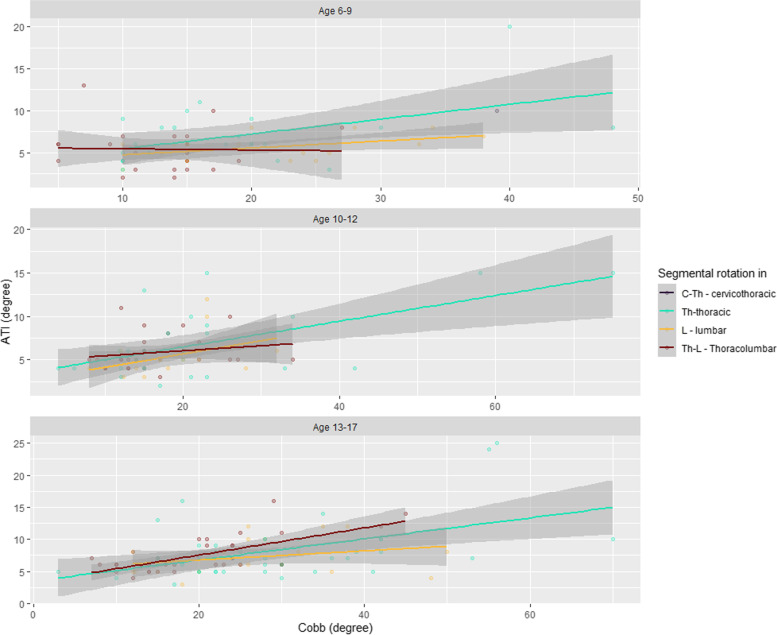
Background: Early detection of idiopathic scoliosis is one factor in determining treatment effectiveness. Therefore, the aim of this study was to assess the importance of the size of the trunk inclination angle (ATI) for the early detection of scoliosis in preschool- and school-age children, taking into account the location and size of the spine curvature. Methods: The study included a group of 216 children (mean age 11.54 years, standard deviation ± 3.05), who had previously untreated idiopathic scoliosis and a Cobb angle of ≥ 10°. The ATI values were compared with the corresponding Cobb angle values. The results of the ATI-Cobb correlation were compared to the ATI thresholds of 5° and 7°. Results: In the age groups 6–9, 10–12 and 13–17 years, the method sensitivity for the ATI ≥ 7° criterion was low at 33.90%, 27.69% and 51.29% (p < 0.05), respectively, while for the ATI ≥ 5° criterion, it was 67.8%, 69.23% and 93.48% (p < 0.05), respectively. With respect to location, significantly more frequent misdiagnoses (p < 0.05) were related to the lumbar and thoracolumbar (regions) sections of the spine in the groups aged 6–9 and 10–12 for ATI ≥ 7°; while no significant relationship was found at ATI ≥ 5°. For both ATI levels, the most frequent cases of mis- or undiagnosed scoliosis were observed among children with a Cobb angle of 10°-14° (p = 0.004). Conclusion: A low predictive ATI value was demonstrated regarding scoliosis detection for the ATI 7° criterion in children aged 6–9 and 10–12 years, particularly for the lumbar and thoracolumbar locations. Adoption of the threshold of ATI 5° in screening tests for children aged 6–12 years, as well as for lower locations of scoliosis, may be more effective in the early detection of scoliosis. Trial registration. This study was approved by the Jan Dlugosz University in Czestochowa Ethics Committee KE-U/7/2021, and conducted under the Declaration of Helsinki.
Overview
The claims and statistics of this paper haven’t been checked yet.
Free: it reads the open-access text and checks the first 5 claims that cite a source we can check. Create a free account to check every claim.
Integrity signals
Registry
Cites
Statistics
Figures
Verification
Claims the paper makes
The claims and statistics of this paper haven’t been checked yet.
Free: it reads the open-access text and checks the first 5 claims that cite a source we can check. Create a free account to check every claim.
Claims other papers make about this one
Each is checked against this paper’s own text: does it say what the citing paper says it does?
The source backs part of the claim, not all of it — or backs it for a different population, condition or comparison.
In the citing paper
“Scoliosis can be suspected when the trunk rotation angle is 5–7°; this result should be monitored, and possible progression should be checked.”
From Postural Differences in Speaking Versus Non-Speaking Children with Autism Spectrum Disorder (2025) · cites this paper as [16]
Experimental — accuracy not yet measuredThe check wasn’t confident either way, so it gives no verdict — never disputed.
In the citing paper
“The normal range is 3–4°, which does not require treatment.”
From Postural Differences in Speaking Versus Non-Speaking Children with Autism Spectrum Disorder (2025) · cites this paper as [16]
Experimental — accuracy not yet measuredThe check wasn’t confident either way, so it gives no verdict — never disputed.
In the citing paper
“The usual range of internal and external rotations is 30–45°.”
From Postural Differences in Speaking Versus Non-Speaking Children with Autism Spectrum Disorder (2025) · cites this paper as [16]
Experimental — accuracy not yet measured
Self-check
Percentages, sums and reported differences re-computed from the paper’s own numbers.
The self-check needs the paper’s full text.
Citations
Cites
Negrini, S., Donzelli, S., Aulisa, A. G., Czaprowski, D., Schreiber, S., de Mauroy, J. C., Diers, H., Grivas, T. B., Knott, P., Kotwicki, T., et al. (2018) · Scoliosis and Spinal Disorders · doi:10.1186/s13013-017-0145-8 · Cited by 1,174 · cited 3×
“The obtained results were compiled for three ranges of the Cobb angle: 10°-14°, 15°21° and above 21°, relating to the therapeutic procedures [1, 2, 21].”
MethodSelf-citationThe prediction of curve progression in untreated idiopathic scoliosis during growth.
Lonstein, J. E., & Carlson, J. M. (1984) · The Journal of Bone & Joint Surgery · doi:10.2106/00004623-198466070-00013 · Cited by 980
Adolescent idiopathic scoliosis: natural history and long term treatment effects
Asher, M. A., & Burton, D. C. (2006) · Scoliosis · doi:10.1186/1748-7161-1-2 · Cited by 620
Negrini, S., Aulisa, A. G., Aulisa, L., Circo, A. B., de Mauroy, J. C., Durmala, J., Grivas, T. B., Knott, P., Kotwicki, T., Maruyama, T., et al. (2012) · Scoliosis · doi:10.1186/1748-7161-7-3 · Cited by 585
An objective criterion for scoliosis screening.
Bunnell, W. P. (1984) · The Journal of Bone & Joint Surgery · doi:10.2106/00004623-198466090-00010 · Cited by 441 · cited 5×
“The obtained results were compiled for three ranges of the Cobb angle: 10°-14°, 15°21° and above 21°, relating to the therapeutic procedures [1, 2, 21].”
BackgroundMethodInfluentialA Study of the Diagnostic Accuracy and Reliability of the Scoliometer and Adamʼs Forward Bend Test
Côté, P., Kreitz, B. G., Cassidy, J. D., Dzus, A. K., & Martel, J. (1998) · Spine · doi:10.1097/00007632-199804010-00011 · Cited by 236 · cited 3×
“Thus, a clinical diagnosis of scoliosis is based on the putative ATI-Cobb correlation, which, in certain circumstances, may be prone to error [4, 11].”
BackgroundNegrini, S., Grivas, T. B., Kotwicki, T., Maruyama, T., Rigo, M., Weiss, H. R., & the members of the Scientific society On Scoliosis Orthopaedic and Rehabilitation Treatment (SOSORT) (2006) · Scoliosis · doi:10.1186/1748-7161-1-4 · Cited by 215
Voluntary school screening for scoliosis in Minnesota.
Lonstein, J. E., Bjorklund, S., Wanninger, M. H., & Nelson, R. P. (1982) · The Journal of Bone & Joint Surgery · doi:10.2106/00004623-198264040-00002 · Cited by 204
A Meta-Analysis of the Clinical Effectiveness of School Scoliosis Screening
Fong, D. Y. T., Lee, C. F., Cheung, K. M. C., Cheng, J. C. Y., Ng, B. K. W., Lam, T. P., Mak, K. H., Yip, P. S. F., & Luk, K. D. K. (2010) · Spine · doi:10.1097/brs.0b013e3181bcc835 · Cited by 204
Validity and Reliability Testing of the Scoliometer®
Amendt, L. E., Ause-Ellias, K. L., Eybers, J. L., Wadsworth, C. T., Nielsen, D. H., & Weinstein, S. L. (1990) · Physical Therapy · doi:10.1093/ptj/70.2.108 · Cited by 200
Research works printed but not linked: 4
- Suzuki N., Inami K., Ono T., Kohno K., Asher M.A.: Analysis of posterior trunk symmetry index (POTSI) in scoliosis. Part 1. Research into Spinal Deformities 2, 1999; 59:81–84.
- Wilson JMG Jungner G Principles and practice of screening for disease WHO Chron 1968 22 11 27 10.7326/0003-4819-69-5-1085-2 · doi:10.7326/0003-4819-69-5-1085-2
- Lee CF Fong DYT Cheung KMC Referral criteria for school scoliosis screening assessment and recommendations based on a large longitudinally followed cohort Spine 2010 35 25 E1492 E1498 10.1097/brs.0b013e3181ecf3fe 21102278 · DOI
- Kluszczyński M The incidence of posture defects and spine asymmetry in the population of rural children Polish Physiotherapy 2007 7 1 71 79
Cited by
Rahmaniar, W., Suzuki, K., & Lin, T.-L. (2023) · IEEE Transactions on Biomedical Engineering · doi:10.1109/tbme.2023.3313126 · Cited by 28
The Influence of the Dominant Leg in Body Asymmetries in Children and Adolescent Male Soccer Players
Theodorou, E., Grivas, T. B., & Hadjicharalambous, M. (2024) · Pediatric Reports · doi:10.3390/pediatric16030058 · Cited by 12
Effect of DiscoGel treatment of the intervertebral disc at MRI
Łątka, K., Kozłowska, K., Waligora, M., Kolodziej, W., & Łątka, D. (2023) · Clinical Radiology · doi:10.1016/j.crad.2023.07.023 · Cited by 11
Kluszczyński, M., Mosler, D., & Wąsik, J. (2022) · BMC Musculoskeletal Disorders · doi:10.1186/s12891-022-05878-6 · Cited by 7
“When analysing the differences in the morphology of scoliosis curvatures in relation to the location in the study, it should be emphasized that low-rotated curvatures were significantly more frequent in the lumbar and thoracolumbar sections, which is consistent with the data in the literature [2, 10, 24].”
BackgroundResultSelf-citationThe Effectiveness of Early Rehabilitation in Limiting the Progression of Idiopathic Scoliosis
Kluszczyński, M., Zaborowska-Sapeta, K. A., Kowalski, I. M., & Karpiel, I. S. (2024) · Journal of Clinical Medicine · doi:10.3390/jcm13051422 · Cited by 6
Self-citationSchool Scoliosis Screening: The Influence of Dominant Limbs and Gender
Theodorou, E., Hadjicharalambous, M., & Tryfonidis, M. (2024) · Adolescents · doi:10.3390/adolescents4010005 · Cited by 5
Form of physical training in educational institutions (club system)
Doskaraev, B. M., Искакова, А. М., & Syzdykova, S. (2023) · Retos · doi:10.47197/retos.v50.100247 · Cited by 5
Postural Differences in Speaking Versus Non-Speaking Children with Autism Spectrum Disorder
Będziechowska-Czyżewska, M., Malak, R., Romanowski, M., Andrusiewicz, M., Samborski, W., & Baum, E. (2025) · Children · doi:10.3390/children12020145 · Cited by 4
“The measurement consisted of bending over and checking the trunk rotation angle at four levels: proximal thoracic, main thoracic, lumbar, and pelvic [16].”
InfluentialParent, S., Roy‐Beaudry, M., Dufresne, J., Imbeault, R., Barchi, S., & Beauséjour, M. (2026) · Spine Deformity · doi:10.1007/s43390-026-01282-5 · Cited by 4
“More severe spinal deformities may not correspond to proportionally greater trunk rotation [20, 28, 29].”
Static sitting posture control during writing tasks in idiopathic scoliosis among freshmen
Xia, Q., Chen, X., Wei, H., Zhou, G., & Dong, J. (2023) · Journal of Orthopaedic Surgery and Research · doi:10.1186/s13018-023-04228-z · Cited by 3
“ATI was the main clinical index for detecting scoliosis [17].”
BackgroundShao, C., Liu, C., Mou, J., Liang, J., Sun, Y., Chen, X., Yu, B., Li, J., Zhu, H., Pan, Y., et al. (2025) · European Spine Journal · doi:10.1007/s00586-025-09154-8 · Cited by 2
Cui, W., & Bezmylov, M. M. (2024) · Epidemiologic Reviews · doi:10.1093/epirev/mxae004 · Cited by 2
Olson, C. V. L., Kachlík, D., & Al‐Redouan, A. (2023) · Informatics in Medicine Unlocked · doi:10.1016/j.imu.2023.101383 · Cited by 1
Yildiz, E., & Daş, M. T. (2024) · International Journal of Human-Computer Interaction · doi:10.1080/10447318.2024.2428855 · Cited by 1
“The early diagnosis of spinal disorders is critical for effective treatment (Kluszczy � nski et al., 2022).”
Učinak konzervativnog liječenja djece sa skoliozom
Lazić, M., Hadžiomerović, A. M., Buljugić, E., Alibegović, A., & Meholjic, A. (2022) · Sestrinski glasnik · doi:10.11608/sgnj.27.3.3
GENETIC RISK FACTOR FOR IDIOPATHIC SCOLIOSIS
Sokolova, I. V., Mustafina, D. A., Sadertdinova, A. G., Zagitova, A. N., Khusnullin, D. A., Sadertdinova, L. G., & Mescheryakov, N. A. (2023) · International Journal of Applied and Fundamental Research (Международный журнал прикладных и фундаментальных исследований) · doi:10.17513/mjpfi.13501
Kluszczyński, M., Zaborowska-Sapeta, K. A., Kowalski, I. M., & Karpiel, I. S. (2024) · Journal of Clinical Medicine · doi:10.3390/jcm13144044
“Based on the presented research results, the use of the GraviSpine device as an adjunct to PSSE and bracing in the treatment of children with mild and moderate scoliosis appears to improve treatment effectiveness.”
ResultSelf-citationPhysical and psychological rehabilitation for common weightlifting injuries
Yang, T. X., Wang, W., Kozlova, E., & Олешко, В. (2024) · SPORT TK-Revista EuroAmericana de Ciencias del Deporte · doi:10.6018/sportk.556801
“Its main advantages include simplicity, undemanding machine resources, and the ability to take into account the randomness characteristic of the phonocardiographic signal (Had et al., 2020; Kluszczynski et al., 2022).”
BackgroundKluszczyński, M., Karpiel, I. S., & Piechaczek, A. (2024) · Advances in Clinical and Experimental Medicine · doi:10.17219/acem/191598
Self-citationТкач, О. Ф., Konoplitskyi, V. S., & Korobko, Y. Y. (2024) · Paediatric Surgery Ukraine · doi:10.15574/ps.2024.4(85).111122
Dolor lumbar nnespecífico, a propósito de un caso clínico
César, G. G., & Bueno-Gracía, E. (2023) · Zaguan (Universidad de Zaragoza)
Danning, N., Liu, H., Liu, Y., Tao, Y., Mou, J., & Han, Y. (2026) · doi:10.2196/preprints.90903
EDUKASI DAN DETEKSI DINI SKOLIOSIS PADA SISWA SMP PUTRA MAJU DESA SUNGAI PINANG KABUPATEN BANYUASIN
Juliastuti, J. J. (2026) · Khidmah · doi:10.52523/khidmah.v8i1.574
Osser, B., Toth, C., Osser, G., Bondar, L. I., Pobirci, O. L., Marcu, F. M., Suciu, R. N., Paşcalău, N. A., Mincic, A. M., & Toderescu, C. D. (2026) · Diagnostics · doi:10.3390/diagnostics16101445
Aziza, A. J., Djawas, F. A., Noviana, M., Putri, F. F., & Saragih, H. L. W. (2026) · Media Fisioterapi Politeknik Kesehatan Makassar · doi:10.32382/fis.v18i1.2124
Metadata
- Authors
- Kluszczyński, M., Pilis, A., & Czaprowski, D.
- Affiliations
- Jan Długosz University (PL)
- Poznan University of Medical Sciences (PL)
- Corresponding author
- Kluszczyński, Marek
- Venue
- BMC Musculoskeletal Disorders
- Published
- 2022-01-03
- Volume
- 23
- Issue
- 1
- Pages
- 5-5
- ISSN
- 1471-2474 (ISSN-L)
- PMC
- PMC8725290
- OpenAlex
- W4206335624
- Cited by
- 21
- References
- 32
- Citations by year
- 2026: 3 · 2025: 2 · 2024: 8 · 2023: 6 · 2022: 2
- FWCI
- 4.30
- Type
- journal article
- Language
- en
- Open access
- gold
- doi.org
- Licence
- cc-by
- creativecommons.org/licenses/by/4.0 (tdm)
- creativecommons.org/licenses/by/4.0 (vor)
- Locations
- BMC Musculoskeletal Disorders (publishedVersion, cc-by)
- PubMed Central (publishedVersion, cc-by)
- PubMed (publishedVersion)
- Homo Politicus (Academy of Humanities and Economics in Lodz) (submittedVersion, cc-by-nc-nd)
- DOAJ (DOAJ: Directory of Open Access Journals) (submittedVersion, cc-by-sa)
- Funders
- Uniwersytet Humanistyczno-Przyrodniczy im. Jana Długosza w Częstochowie
- Topics
- Health Sciences › Medicine › Surgery › Scoliosis diagnosis and treatment
- Health Sciences › Medicine › Surgery › Pectus Deformity Diagnosis and Treatment
- Physical Sciences › Engineering › Biomedical Engineering › Medical Imaging and Analysis
- Keywords
- idiopathic scoliosis, trunk inclination angle, early detection, Cobb angle, scoliosis screening, children, diagnostic sensitivity, misdiagnosis, lumbar scoliosis, thoracolumbar scoliosis, screening thresholds, elementary school students, preschool children
- MeSH terms
- Child, Child, Preschool, Humans, Scoliosis, Spine, Torso
About these checks
Registry, retraction, Cites and statistics results are computed, not judged, with one exception: a printed reference that no index lists is read once by a model before it counts as a citation error. Claims are extracted by a model and kept only when their quote appears verbatim in the text; each cited source is then checked, with a model’s help, for whether it says what the claim relies on. Those verdicts can be wrong — read the claim’s quote and the cited source before relying on one.
Statistics and arithmetic are recomputed, not judged.
Confidence bands are shown only for fields calibrated on our annotated test set. None is calibrated yet, so no band is shown.
What counts as a claim ›How we measure confidence ›How we check this ›
Are you an author, or do you see a problem with this page? Request a review
Data sources
Bibliographic data: Semantic Scholar, OpenAlex, Crossref.
Contains information from the Semantic Scholar Academic Graph Datasets, made available under the ODC Attribution License (ODC-BY 1.0).
Semantic Scholar’s data is described in: Kinney, R., et al. (2023). The Semantic Scholar Open Data Platform. arXiv:2301.10140.
