

The DOI matches its Crossref record; 37 of the 37 references it cites were found in a registry or an index; 16 of the 38 sources its claims cite were checked for support.
Implant-supported fixed prosthodontic treatment for ectodermal dysplasia: a case report
Open accessPublished version of a preprint
Abstract
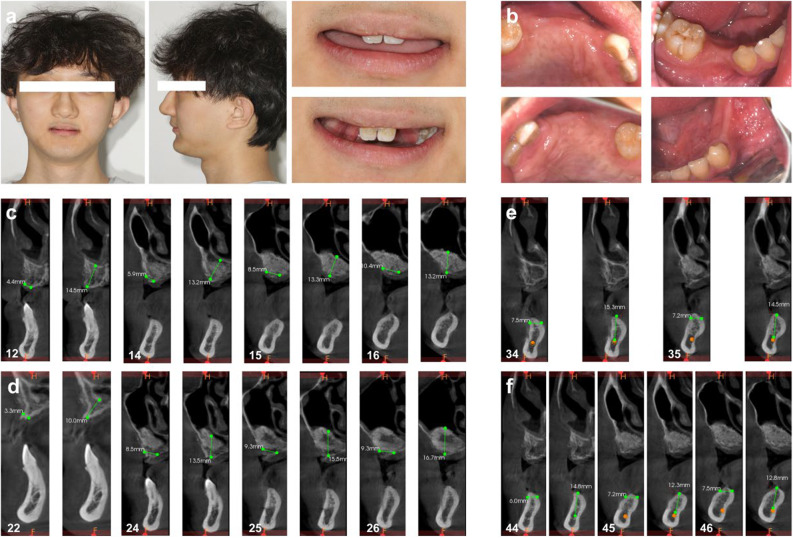
BACKGROUND: Ectodermal dysplasia (ED) often results in congenital tooth agenesis and severe developmental alveolar ridge defects, leading to functional impairments, reduced masticatory efficiency, and psychosocial challenges. Limited local blood supply and rapid bone resorption in ED patients pose significant challenges for predictable implant rehabilitation, highlighting the need for biologically guided, long-term restorative strategies. CASE PRESENTATION: An 18-year-old male patient with hypohidrotic ED (HED) presented with multiple congenitally missing teeth (FDI 12–16, 22–26, 34–35, 42, 44–46) and knife-edge alveolar ridges. Following two years of fixed orthodontic treatment and maxillary sinus augmentation at an external clinic, the patient underwent simultaneous alveolar ridge augmentation with implant placement at our institution. Subsequently, implant-supported fixed prostheses were delivered. Multidisciplinary sequential treatment achieved favorable clinical outcomes (Table 1). CONCLUSION: At one-year follow-up after final prosthesis placement, all implants demonstrated stable osseointegration, marginal bone loss < 0.5 mm, probing depths < 3 mm, and bleeding on probing < 15%. Masticatory function improved significantly, and PES/WES scores reached clinically acceptable aesthetic levels. This case illustrates the feasibility of a prosthetically guided implant-supported rehabilitation for severe ED-related alveolar ridge defects, using site-specific differential treatment (simultaneous anterior ridge augmentation, delayed posterior implant placement), dual L-PRF-assisted bone and soft tissue healing, and a prosthetic strategy involving reducing the buccolingual width and occlusal contact points of the implant-supported prostheses combined with light occlusal loading, emphasizing the value of individualized treatment planning in patients with developmental alveolar bone deficiency.
Overview
CoChat Summary
## TL;DR
This case report describes successful implant-supported fixed prosthodontic rehabilitation of an 18-year-old male with hypohidrotic ectodermal dysplasia using sequential orthodontic, ridge augmentation, implant placement, and prosthetic treatment. At 12 months, the implants were stable with minimal bone loss and improved function and esthetics.
## Key findings
- At 1-year follow-up after final prosthesis placement, all implants showed stable osseointegration, with marginal bone loss < 0.5 mm, probing depths < 3 mm, and bleeding on probing < 15%.
- Masticatory efficiency improved from 33.0% ± 2.1% preoperatively to 60.2% ± 3.5% after prosthesis delivery and to 67.1% ± 2.8% at follow-up, within the cited healthy reference range of 59% ± 25%.
- Immediate postoperative PES/WES scores at all implant sites exceeded 12, meeting the paper’s stated clinically acceptable threshold.
- The anterior maxillary ridge width increased from 3.3 mm preoperatively to 6.7 mm postoperatively, and all implants had ISQ values > 65 at the loading assessment.
## Methods
- Single-patient case report of an 18-year-old male with hypohidrotic ectodermal dysplasia and multiple congenitally missing teeth.
- Sequential multidisciplinary treatment: prior fixed orthodontics and sinus augmentation at an external clinic, then simultaneous anterior ridge augmentation with implant placement at the authors’ institution, followed by delayed posterior implant placement and definitive fixed prostheses.
- Main assessments included CBCT, implant stability quotient (ISQ), PES/WES esthetic scoring by two blinded attending clinicians, OHIP-14, and standardized sieve-method masticatory efficiency testing.
## Limitations
- The paper states that follow-up is only short-term (12 months), which is insufficient to evaluate long-term implant stability and prosthetic prognosis.
- The paper states that PES/WES esthetic indices are subjective and primarily designed for single-tooth evaluation, limiting assessment of multiple consecutive implants.
- Evident from the text: this is a single case report, so generalizability is inherently limited.
Model-written summary. Check it against the paper before relying on it.
Integrity signals
Registry
Cites
Statistics
Figures


Verification
Claims the paper makes
11 Valid · 4 Not valid · 10 Not checked · 37 Own results and interpretations
The cited sources support only part of this claim — read each source’s verdict below.
In the paper
“Tooth agenesis with insufficient bone volume presents substantial challenges for implant rehabilitation [4, 5].”
§ Implant-supported fixed prosthodontic treatment for ectodermal dysplasia: a case report > Background
What the sources say
- Not checked — no full text of the sourcecites [4] Cammarata-Scalisi F, Willoughby CE, El-Feghaly JR, Tadich AC, Castillo MA, Alkhatib S, et al. Main genetic entities associated with tooth agenesis. Clin Oral Investig. 2024;29(1):9. source
- Partly supportedcites [5] Dev A, Malhi K, Mahajan R. Ectodermal dysplasia-an overview and update. Indian Dermatol Online J. 2024;15(3):405–14. sourceExperimental — accuracy not yet measured
The section on assessing ectodermal dysplasia describes hypodontia with hypoplastic alveolar ridges, and Management discusses dental prostheses. Neither passage says that insufficient bone volume creates substantial challenges for implant rehabilitation; searches for implant rehabilitation and bone deficiency found no such discussion. (LLM, conf=0.78)
plainstates a cause- Asserted: passes — The authors put it forward as true.
- Checkable: passes — It can be checked against evidence.
- Load-bearing: passes — The paper’s conclusions depend on it.
- Based: passes — The paper gives a reason why it holds.
The cited sources support only part of this claim — read each source’s verdict below.
In the paper
“In patients with compromised alveolar foundations, strategies to enhance the stability of bone augmentation and reduce implant-bone interface stress are not yet standardized [7–9].”
§ Implant-supported fixed prosthodontic treatment for ectodermal dysplasia: a case report > Background
What the sources say
- Not checked — no full text of the sourcecites [7] Ali M, Noor S, Mohamad H, Ullah F, Javed F, Hamid ZAA. Advances in guided bone regeneration membranes: a comprehensive review of materials and techniques. Biomed Phys Eng Express. 2024;10(3):032003. source
- Partly supportedcites [8] Gaspar J, Mazor Z, Bonfante EA. Osseodensification technique in crestal maxillary sinus elevation-a narrative review. Clin Implant Dent Relat Res. 2025;27(1):e13399. sourceExperimental — accuracy not yet measured
The section “Implant Stability, Surgical Drilling, and Bone Quality” (page unavailable) says lower-density alveolar bone requires different planning and drilling procedures to improve implant stability, and reports varied thresholds used to define stability. It does not establish that strategies for stabilizing bone augmentation and reducing implant–bone interface stress are not standardized. (LLM, conf=0.78)
- Not checked — no full text of the sourcecites [9] Muddebihal F, Veetil RGA, Feroz SMA, Saini RS, Khan SS, Preethanath RS, et al. Guided bone regeneration-assisted bone augmentation and early implant placement protocols: a case report. J Clin Sci. 2025;22(1):51–6. source
plain- Asserted: passes — The authors put it forward as true.
- Checkable: passes — It can be checked against evidence.
- Load-bearing: passes — The paper’s conclusions depend on it.
- Based: passes — The paper gives a reason why it holds.
The cited sources support only part of this claim — read each source’s verdict below.
In the paper
“The porous fibrin scaffold of L-PRF provides mechanical support for soft tissue healing, helping to maintain peri-implant keratinized tissue stability [25].”
§ Implant-supported fixed prosthodontic treatment for ectodermal dysplasia: a case report > Discussion
What the sources say
- Partly supportedcites [25] Micko L, Salma I, Skadins I, Egle K, Salms G, Dubnika A. Can our blood help ensure antimicrobial and anti-inflammatory properties in oral and maxillofacial surgery? Int J Mol Sci. 2023;24(2):1073. sourceExperimental — accuracy not yet measured
The Introduction describes PRF as a three-dimensional structure that facilitates cell adhesion and proliferation, and §2.5 reports increased keratinized mucosa around implants after L-PRF membrane treatment. The paper does not establish that mechanical support from a porous fibrin scaffold maintains the long-term stability of peri-implant keratinized tissue; it reports a gain in tissue width at six months. (LLM, conf=0.85)
plainstates a cause- Asserted: passes — The authors put it forward as true.
- Checkable: passes — It can be checked against evidence.
- Load-bearing: passes — The paper’s conclusions depend on it.
- Based: passes — The paper gives a reason why it holds.
- Partly supported
The cited sources support only part of this claim — read each source’s verdict below.
In the paper
“In addition, the surface-sealing effect of L-PRF and its release of platelet-derived growth factors (PDGF) accelerate vascularization from the surface to deeper layers.”
§ Implant-supported fixed prosthodontic treatment for ectodermal dysplasia: a case report > Discussion
What the sources say
- Partly supportedcites [25] Micko L, Salma I, Skadins I, Egle K, Salms G, Dubnika A. Can our blood help ensure antimicrobial and anti-inflammatory properties in oral and maxillofacial surgery? Int J Mol Sci. 2023;24(2):1073. sourceExperimental — accuracy not yet measured
Section 4.2 reports that L-PRF membranes release PDGF-AB and describes proangiogenic effects of PRF in vitro. It does not establish a surface-sealing effect or show that these effects accelerate vascularization from the surface into deeper layers. (LLM, conf=0.84)
plainstates a cause- Asserted: passes — The authors put it forward as true.
- Checkable: passes — It can be checked against evidence.
- Load-bearing: passes — The paper’s conclusions depend on it.
- Based: passes — The paper gives a reason why it holds.
- Partly supported
The paper states this without a source or data behind it here, so there is nothing to check it against. The quote shows it is in the paper.
In the paper
“Intraoral examination, using the FDI tooth numbering system, revealed congenital tooth agenesis at positions 12–16, 22–26, 34–35, 42, and 44–46.”
§ Implant-supported fixed prosthodontic treatment for ectodermal dysplasia: a case report > Case presentation
Single case- Asserted: passes — The authors put it forward as true.
- Checkable: passes — It can be checked against evidence.
- Load-bearing: passes — The paper’s conclusions depend on it.
- Based: unclear — It is unclear why the paper says it holds.
19 more claims
Create a free account to see all 62 claims and every source verdict.
- It may state two separate claims as one. 32
- Probably not a substantial claim. 11
Citations
Cites
Determinants of masticatory performance in dentate adults
Hatch, J. P., Shinkai, R. S. A., Sakai, S., Rugh, J. D., & Paunovich, E. D. (2001) · Archives of Oral Biology · doi:10.1016/s0003-9969(01)00023-1 · Cited by 502 · cited 1×
“(Table 7) [10].”
Inherited disorders of NF-κB-mediated immunity in man
Puel, A., Picard, C., Ku, C.-L., Smahi, A., & Casanova, J.-L. (2004) · Current Opinion in Immunology · doi:10.1016/j.coi.2003.11.013 · Cited by 186
Etiology and pathogenesis of ectodermal dysplasias
Itin, P. H. (2014) · American Journal of Medical Genetics Part A · doi:10.1002/ajmg.a.36550 · Cited by 69
Shock absorbing behavior of five restorative materials used on implants
Gracis, S. E., Nicholls, J. I., Chalupnik, J. D., & Yuodelis, R. A. (1992) · Implant Dentistry · doi:10.1097/00008505-199200110-00016 · Cited by 64
Qiu, P., Cao, R., Li, Z., et al. (2024) · Heliyon · doi:10.1016/j.heliyon.2024.e26876 · Cited by 43 · cited 2×
“Intraoral examination, using the FDI tooth numbering system, revealed congenital tooth agenesis at positions 12–16, 22–26, 34–35, 42, and 44–46.”
InfluentialPeñarrocha-Diago, M., Aloy-Prósper, A., Peñarrocha-Oltra, D., Guirado, J. L. C., & Peñarrocha-Diago, M. (2013) · The International Journal of Oral & Maxillofacial Implants · doi:10.11607/jomi.2964 · Cited by 41 · cited 1×
“Evidence indicates that congenital tooth agenesis in ED often leads to alveolar bone resorption due to lack of occlusal loading and palatal mucosa displacement toward the labial side, significantly increasing the complexity of implant placement and maintenance [19].”
Suri, S., Carmichael, R. P., & Tompson, B. D. (2004) · The Journal of Prosthetic Dentistry · doi:10.1016/j.prosdent.2004.07.014 · Cited by 34 · cited 2×
“Specifically, Suri et al. [16] combined functional appliances with fixed orthodontics to modify the dental developmental pattern in ED patients, achieving tooth alignment that provided a solid foundation for subsequent restorative procedures.”
The EDA/EDAR/NF-κB pathway in non-syndromic tooth agenesis: A genetic perspective
Gao, Y., Jiang, X., Wei, Z., Long, H., & Lai, W. (2023) · Frontiers in Genetics · doi:10.3389/fgene.2023.1168538 · Cited by 33 · cited 1×
“Ectodermal dysplasia (ED) is a genetically inherited syndrome caused by mutations affecting ectodermal tissue development, often resulting in hypodontia or anodontia accompanied by severe alveolar bone deficiency [1–3].”
Dimililer, G., Küçükkurt, S., & Çeti̇ner, S. (2017) · Journal of Prosthetic Dentistry · doi:10.1016/j.prosdent.2017.03.016 · Cited by 33 · cited 1×
“…0.5 mm, superior to reported averages, potentially attributable to the dual L-PRF strategy and prosthetic design incorporating reduced buccolingual width, fewer occlusal contacts, and light occlusal loading; however, the sustainability of this advantage requires further long-term follow-up [33–35].”
InfluentialKılıç, E., & Doğanay, Ö. (2019) · Journal of Oral Implantology · doi:10.1563/aaid-joi-d-19-00066 · Cited by 32
Research works printed but not linked: 3
- Wimalarathna AAAK, Weerasekara WBMCRD, Herath EMUCK. Comprehensive management of ectodermal dysplasia with interceptive orthodontics in a young boy who was bullied at school. Case Rep Dent. 2020;2020:6691235.
- Yap AKW, Klineberg I. Dental implants in patients with ectodermal dysplasia and tooth agenesis: a critical review of the literature. Int J Prosthodont. 2009;22(3):268–76.
- RjCronin Jr, Oesterle LJ, Ranly DM. Mandibular implants and the growing patient. Int J Oral Maxillofac Implants. 1994;9(1):55–62.
Metadata
- Authors
- Wang, Y., Chen, S., & Zhou, Y.
- Affiliations
- Jilin University (CN)
- Corresponding author
- Chen, Siyu
- Zhou, Yanmin
- ORCID
- Wang, Yihan
- Venue
- BMC Oral Health
- Published
- 2026-04-21
- Volume
- 26
- Issue
- 1
- ISSN
- 1472-6831 (ISSN-L)
- PMC
- PMC13248472
- OpenAlex
- W7155077507
- Semantic Scholar
- fded80a0706762d4fa7fcbd626a7b85d4437bc24
- Cited by
- 0
- References
- 27
- FWCI
- 0.00
- Type
- journal article
- Language
- en
- Open access
- gold
- doi.org
- Licence
- cc-by-nc-nd
- creativecommons.org/licenses/by-nc-nd/4.0 (tdm)
- creativecommons.org/licenses/by-nc-nd/4.0 (vor, 49 d)
- Locations
- BMC Oral Health (publishedVersion, cc-by-nc-nd)
- Research Square (acceptedVersion, cc-by)
- PubMed (publishedVersion)
- PubMed Central (publishedVersion, cc-by-nc-nd)
- DOAJ (DOAJ: Directory of Open Access Journals) (submittedVersion, cc-by-sa)
- Funders
- National Natural Science Foundation of China (82371006)
- Topics
- Health Sciences › Dentistry › Oral Surgery › Dental Implant Techniques and Outcomes
- Health Sciences › Dentistry › General Dentistry › dental development and anomalies
- Health Sciences › Dentistry › General Dentistry › Dental materials and restorations
- Keywords
- ectodermal dysplasia, hypohidrotic ectodermal dysplasia, implant-supported fixed prosthesis, tooth agenesis, alveolar ridge defects, maxillary sinus floor elevation, L-PRF, mastication, osseointegration, marginal bone loss
- MeSH terms
- Adolescent, Alveolar Ridge Augmentation, Anodontia, Dental Implantation, Endosseous, Ectodermal Dysplasia, Humans, Male, Alveolar Bone Loss, Dental Prosthesis, Implant-Supported, Sinus Floor Augmentation
About these checks
Registry, retraction, Cites and statistics results are computed, not judged, with one exception: a printed reference that no index lists is read once by a model before it counts as a citation error. Claims are extracted by a model and kept only when their quote appears verbatim in the text; each cited source is then checked, with a model’s help, for whether it says what the claim relies on. Those verdicts can be wrong — read the claim’s quote and the cited source before relying on one.
The claim verdicts this report counts are experimental: their accuracy is not yet measured.
A language model drew the claims from the paper on 2026-10-11, under version 3 of the claim definition (model deepseek-v4.1-flash, prompt extract-v3).
A second model labelled each claim on 2026-10-11 (model jev-1.13-20260917, definition revision gold-guideline-v0.2).
Cited sources are checked with a language model’s help (gpt-6-sol).
Statistics and arithmetic are recomputed, not judged.
Confidence bands are shown only for fields calibrated on our annotated test set. None is calibrated yet, so no band is shown.
What counts as a claim ›How we measure confidence ›How we check this ›
Are you an author, or do you see a problem with this page? Request a review
How to cite
Cite CoChat for the checks on this page, and the paper for its own findings.
- This page
- CoChat. (2026). Citation check: Implant-supported fixed prosthodontic treatment for ectodermal dysplasia: a case report. https://app.cochat.ai/papers/10.1186/s12903-026-08326-2
- The paper
- Wang, Y., Chen, S., & Zhou, Y. (2026). Implant-supported fixed prosthodontic treatment for ectodermal dysplasia: a case report. BMC Oral Health. https://doi.org/10.1186/s12903-026-08326-2
Data sources
Bibliographic data: Semantic Scholar, OpenAlex, Crossref.
Contains information from the Semantic Scholar Academic Graph Datasets, made available under the ODC Attribution License (ODC-BY 1.0).
Semantic Scholar’s data is described in: Kinney, R., et al. (2023). The Semantic Scholar Open Data Platform. arXiv:2301.10140.
