

Perceived exercise barriers are reduced and benefits are improved with lifestyle modification in overweight and obese women with polycystic ovary syndrome: a randomised controlled trial
Open accessThe DOI matches its Crossref record; 31 of the 31 references it cites were found in a registry or an index.
Abstract
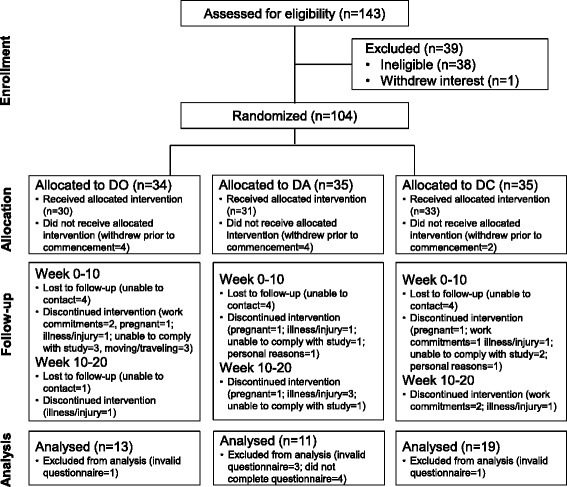
BACKGROUND: This study assessed the perceived benefits and barriers to exercise participation in overweight and obese women with polycystic ovary syndrome (PCOS) and monitored changes in response to a lifestyle intervention. METHODS: Forty-three overweight/obese PCOS women (Age, 30.3(6.2) yrs; BMI, 36.4(5.6) kg/m(2)) were randomised to one of three 20-week lifestyle programs: diet only (DO, n = 13), diet and aerobic exercise (DA, n = 11) and diet and combined aerobic-resistance exercise (DC, n = 19). Exercise Benefits/Barriers Scale (EBBS), weight, aerobic fitness, depression and PCOS specific health-related quality of life were measured. RESULTS: Barriers score was related to depression (r = 0.45, P = 0.002) and aerobic fitness (r = -0.32, P = 0.04), while benefits score was related to aerobic fitness (r = 0.41, P = 0.007). EBBS, benefits and barriers scores improved overtime (P ≤ 0.001). Benefits subscales psychological outlook and social interaction increased (P ≤ 0.001) and life enhancement and preventative health did not change (P ≥ 0.3). Physical performance increased only in DA (P = 0.009). There were no differences between treatments for any of the other subscales (P ≥ 0.2). Barriers subscales exercise milieu, time expenditure and physical exertion reduced (P ≤ 0.003) and family discouragement did not change (P = 0.6). CONCLUSIONS: This study demonstrated that lifestyle modification consisting of an energy-restricted diet with or without exercise training improved the perceived benefits from and barriers to exercise. TRIAL REGISTRATION: Australian New Zealand Clinical Trials Register ACTRN12606000198527, registered 26 May 2006.
Overview
The claims and statistics of this paper haven’t been checked yet.
Free: it reads the open-access text and checks the first 5 claims that cite a source we can check. Create a free account to check every claim.
Integrity signals
Registry
Cites
Statistics
Figures
Verification
Claims the paper makes
The claims and statistics of this paper haven’t been checked yet.
Free: it reads the open-access text and checks the first 5 claims that cite a source we can check. Create a free account to check every claim.
Claims other papers make about this one
Each is checked against this paper’s own text: does it say what the citing paper says it does?
The cited source says what the claim attributes to it.
In the citing paper
“SMD was also used to complete post-intervention sensitivity analysis for sample size; 2 trials (120 participants) [116, 117] were included, but the effect was lost.”
From Exercise, or exercise and diet for the management of polycystic ovary syndrome: a systematic review and meta-analysis (2019) · cites this paper as [116]
In the citing paper
“This is evidenced by previous research reporting that a major barrier to physical activity adoption among women with PCOS is the perceived barrier that exercise is tiring and hard work [121], and fear of injury [72].”
From Providing lifestyle advice to women with PCOS: an overview of practical issues affecting success (2021) · cites this paper as [121]
Self-check
Percentages, sums and reported differences re-computed from the paper’s own numbers.
The self-check needs the paper’s full text.
Citations
Cites
The CES-D Scale: A Self-Report Depression Scale for Research in the General Population
Radloff, L. S. (1977) · Applied Psychological Measurement · doi:10.1177/014662167700100306 · Cited by 53,267 · cited 1×
“Depression was assessed using the Centre for Epidemiologic Studies Depression Scale (CES-D), which is a selfreported scale that measures the presence and severity of depressive symptoms occurring in the past week [16].”
Method(2004) · Fertility and Sterility · doi:10.1016/j.fertnstert.2003.10.004 · Cited by 9,050
The Health Belief Model: a decade later.
Janz, N. K., & Becker, M. H. (1984) · Health Education Quarterly · doi:10.1177/109019818401100101 · Cited by 8,437 · cited 1×
“It has been suggested that barriers are the single most powerful predictor of health behaviour [19].”
BackgroundThe Rotterdam ESHRE/ASRM-sponsored PCOS consensus workshop group (2004) · Human Reproduction · doi:10.1093/humrep/deh098 · Cited by 6,138
Exercise, physical activity, and self-determination theory: A systematic review
Teixeira, P. J., Carraça, E. V., Markland, D., Silva, M. N., & Ryan, R. M. (2012) · International Journal of Behavioral Nutrition and Physical Activity · doi:10.1186/1479-5868-9-78 · Cited by 2,963
Azziz, R., Carmina, E., Chen, Z., Dunaif, A., Laven, J. S. E., Legro, R. S., Lizneva, D., Natterson-Horowtiz, B., Teede, H. J., & Yildiz, B. O. (2016) · Nature Reviews Disease Primers · doi:10.1038/nrdp.2016.57 · Cited by 2,005 · cited 1×
“Symptoms typically associated with PCOS include menstrual dysfunction, infertility, clinical and biochemical hyperandrogenism [3], and possible increased risk of diabetes and cardiovascular disease [4, 5].”
BackgroundMarch, W. A., Moore, V. M., Willson, K. J., Phillips, D. I. W., Norman, R. J., & Davies, M. J. (2010) · Human Reproduction · doi:10.1093/humrep/dep399 · Cited by 1,799 · cited 1×
“Polycystic ovary syndrome (PCOS) is the most common endocrine disorder in women of reproductive age, affecting 6–20 % of this population [1, 2].”
BackgroundNorman, R. J., Dewailly, D., Legro, R. S., & Hickey, T. E. (2007) · The Lancet · doi:10.1016/s0140-6736(07)61345-2 · Cited by 1,360
Health promotion in nursing practice
Pender, N. J., Murdaugh, C. L., & Parsons, M. A. (1982) · Prentice Hall eBooks · Cited by 1,324
Moran, L. J., Misso, M. L., Wild, R. A., & Norman, R. J. (2010) · Human Reproduction Update · doi:10.1093/humupd/dmq001 · Cited by 1,108 · cited 1×
“Symptoms typically associated with PCOS include menstrual dysfunction, infertility, clinical and biochemical hyperandrogenism [3], and possible increased risk of diabetes and cardiovascular disease [4, 5].”
Background
Cited by
Lifestyle changes in women with polycystic ovary syndrome
Lim, S. S., Hutchison, S. K., Van Ryswyk, E., Norman, R. J., Teede, H. J., & Moran, L. J. (2019) · Cochrane Database of Systematic Reviews · doi:10.1002/14651858.cd007506.pub4 · Cited by 725
Best, D., Avenell, A., & Bhattacharya, S. (2017) · Human Reproduction Update · doi:10.1093/humupd/dmx027 · Cited by 186
“Forty-three of the participants in the trial (DO = 13, DA = 11 and DC = 19) completed a validated Exercise Benefits/Barriers Scale at weeks 0, 10 and 20 (Thomson et al., 2016).”
MethodExercise Interventions in Polycystic Ovary Syndrome: A Systematic Review and Meta-Analysis
Patten, R. K., Boyle, R. A., Moholdt, T., Kiel, I., Hopkins, W. G., Harrison, C. L., & Stepto, N. K. (2020) · Frontiers in Physiology · doi:10.3389/fphys.2020.00606 · Cited by 163
Kite, C., Lahart, I. M., Afzal, I., Broom, D. R., Randeva, H., Kyrou, I., & Brown, J. E. (2019) · Systematic Reviews · doi:10.1186/s13643-019-0962-3 · Cited by 155
Cooney, L. G., Milman, L. W., Hantsoo, L., Kornfield, S., Sammel, M. D., Allison, K. C., Epperson, C. N., & Dokras, A. (2018) · Fertility and Sterility · doi:10.1016/j.fertnstert.2018.03.028 · Cited by 117
“and previous studies have shown an improvement in PCOSQ scores with LS alone (44, 45).”
ResultThe Role of Lifestyle Interventions in PCOS Management: A Systematic Review
Gautam, R., Maan, P., Jyoti, A., Kumar, A., Malhotra, N., & Arora, T. (2025) · Nutrients · doi:10.3390/nu17020310 · Cited by 115
“It enhanced perceived benefits, suggesting that lifestyle modification can make exercise more accessible and appealing for women with PCOS, potentially supporting better long-term health outcomes [151].”
Benham, J. L., Booth, J. E., Corenblum, B., Doucette, S., Friedenreich, C. M., Rabi, D. M., & Sigal, R. J. (2021) · Clinical Endocrinology · doi:10.1111/cen.14452 · Cited by 63
Providing lifestyle advice to women with PCOS: an overview of practical issues affecting success
Ee, C., Pirotta, S., Mousa, A., Moran, L., & Lim, S. (2021) · BMC Endocrine Disorders · doi:10.1186/s12902-021-00890-8 · Cited by 70
Pazzianotto‐Forti, E. M., Moreno, M. A., Plater, E. B., Baruki, S. B. S., Rasera, I., & Reid, W. D. (2020) · Physical Therapy · doi:10.1093/ptj/pzaa045 · Cited by 74
Krinski, K., Machado, D. G. D. S., Lirani, L. D. S., DaSilva, S. G., Costa, E. C., Hardcastle, S. J., & Elsangedy, H. M. (2017) · Journal of Sport and Exercise Psychology · doi:10.1123/jsep.2016-0220 · Cited by 69
Arentz, S., Smith, C. A., Abbott, J. A., & Bensoussan, A. (2021) · BMC Women s Health · doi:10.1186/s12905-021-01252-1 · Cited by 65
Patten, R. K., Pascoe, M. C., Moreno‐Asso, A., Boyle, R. A., Stepto, N. K., & Parker, A. G. (2021) · BMC Public Health · doi:10.1186/s12889-021-12280-9 · Cited by 66
Ribeiro, V. B., Kogure, G. S., Lopes, I. P., Silva, R. C., Pedroso, D. C. C., de Melo, A. S., de Souza, H. C. D., Ferriani, R. A., Furtado, C. L. M., & dos Reis, R. M. (2020) · Clinical Endocrinology · doi:10.1111/cen.14194 · Cited by 64
“mg/dL 116 (32) 108 (27) 112 (24) 102 (23) 112 (23) 106 (23)”
The Current Description and Future Need for Multidisciplinary PCOS Clinics
Wolf, W. M., Wattick, R. A., Kinkade, O. N., & Olfert, M. D. (2018) · Journal of Clinical Medicine · doi:10.3390/jcm7110395 · Cited by 49
“showed that diet and exercise alone are capable of significantly increasing health confidence, psychological outlook, and even social interaction [33].”
BackgroundExercise Recommendations for Women with Polycystic Ovary Syndrome: Is the Evidence Enough?
Stepto, N. K., Patten, R. K., Tassone, E. C., Misso, M. L., Brennan, L., Boyle, J. A., Boyle, R. A., Harrison, C. L., Hirschberg, A. L., Marsh, K. A., et al. (2019) · Sports Medicine · doi:10.1007/s40279-019-01133-6 · Cited by 55
Cavallo, M., Morgana, G., Dozzani, I., Gatti, A., Vandoni, M., Pippi, R., Pucci, G., Vaudo, G., & Fanelli, C. G. (2023) · Nutrients · doi:10.3390/nu15153473 · Cited by 49
“[33], it emerged that the perceived barriers are greater in those who have had only dietary intervention and have not performed any type of PA.”
BackgroundMcGowan, M., Garad, R. M., Wadhwani, G., Torkel, S., Rao, V. S., Maunder, A., Osei‐Safo, E. K., Moran, L., & Cowan, S. (2024) · Obesity Reviews · doi:10.1111/obr.13854 · Cited by 44
McGuire, A., Seib, C. A., Porter‐Steele, J., & Anderson, D. J. (2019) · Journal of Medical Internet Research · doi:10.2196/10963 · Cited by 28
“A more recent study investigated perceived benefits and barriers to exercise participation in n =43 overweight women with polycystic ovarian syndrome participating in a 3-arm 20-week lifestyle program, finding a significant improvement in increased benefit and decreased barrier perceptions [36].”
BackgroundPoorer positive affect in response to self-paced exercise among the obese
Elsangedy, H. M., do Nascimento, P. H. D., Machado, D. G. D. S., Krinski, K., Hardcastle, S. J., & DaSilva, S. G. (2018) · Physiology & Behavior · doi:10.1016/j.physbeh.2018.02.031 · Cited by 29
Koehn, S., & Amirabdollahian, F. (2021) · International Journal of Environmental Research and Public Health · doi:10.3390/ijerph18073516 · Cited by 26
“The EBBS research instrument, as employed by El-Ansari and Lovell [13], has been extensively used to investigate the perceived benefits and barriers of exercise in a range of settings, populations, and conditions, for instance in Mexican-American women [14], midlife Australian women [15], older African women [16], Ira…”
Methoddos Santos, Í. K., Pichini, G. S., Ferreira, C. D. D. M. L., Dantas, P. B., Browne, R. A. V., de Queirós, V. S., Soares, G. M., Gonçalves, A. K., Cabral, B. G. D. A. T., Maranhão, T. M. D. O., et al. (2022) · Frontiers in Physiology · doi:10.3389/fphys.2022.948414 · Cited by 26
“Positive changes related to clinical and metabolic exercise among women with PCOS have included improved control over glycemic levels, reduced adipose tissue, and improved depression and anxiety symptoms (Bruner et al., 2006; Thomson et al., 2016; Lopes et al., 2018; Stepto et al., 2019).”
BackgroundAccess to exercise for people with visual impairments during the Coronavirus-19 pandemic
Richardson, M., Petrini, K., & Proulx, M. J. (2022) · British Journal of Visual Impairment · doi:10.1177/02646196211067356 · Cited by 17
“, 2012) and people with mobility impairments (Stroud et al., 2009; Thomson et al., 2016), but to our knowledge, has not been specifically validated for people with visual impairments.”
BackgroundWright, P. J., Corbett, C. F., Pinto, B. M., Dawson, R. M., & Wirth, M. D. (2021) · Women s Health · doi:10.1177/17455065211065865 · Cited by 20
Bafghi, Z. R., Ahmadi, A., Mirzaee, F., & Ghazanfarpour, M. (2024) · BMC Psychiatry · doi:10.1186/s12888-024-06057-8 · Cited by 17
“This engagement can be crucial for women with PCOS, who might experience fatigue [20] or lack motivation [21] due to their condition.”
BackgroundJácomo, R. H., Alves, A. T., Garcia, P. A., da Silva, M. L., Matheus, L. B. G., Lorena, D. C. R., & de Sousa, J. B. (2020) · PLoS ONE · doi:10.1371/journal.pone.0227415 · Cited by 14
Xie, M., Yang, Y., & Zhang, J. (2024) · Frontiers in Endocrinology · doi:10.3389/fendo.2024.1297841 · Cited by 13
Brown, N., & Bowmer, Y. (2018) · Women in Sport and Physical Activity Journal · doi:10.1123/wspaj.2017-0045 · Cited by 13
Kite, C., Lahart, I. M., Randeva, H. S., Kyrou, I., & Brown, J. E. P. (2024) · Women s Reproductive Health · doi:10.1080/23293691.2023.2293968 · Cited by 12
Girgin, N., & Okudan, B. (2021) · Australian Journal of General Practice · doi:10.31128/ajgp-08-20-5572 · Cited by 7
Zhou, Y., Gao, X., Xu, J.-Y., Ding, X., Yuan, J., Du, S., Shi, X., & Wang, Y. (2024) · Heart & Lung · doi:10.1016/j.hrtlng.2023.12.006 · Cited by 7
Woodward, A., Klonizakis, M., Broom, D. R., Cholerton, R., & Piercy, H. (2024) · Health Education Research · doi:10.1093/her/cyae040 · Cited by 17
“In addition, evidence suggests that participating in a PA and lifestyle intervention can reduce perceived barriers to physical activity in PCOS [16].”
Ruslan, N.-H., Yasin, S. M., Nasir, N. M., & Isa, M. R. (2024) · Malaysian Journal of Medical Sciences · doi:10.21315/mjms2024.31.3.15 · Cited by 6
“In this context, the perceived benefit can also be the strongest predictor when establishing evidence for a positive intervention impact (23) that leads to a favourable outcome (24).”
BackgroundLi, F. (2025) · Frontiers in Sports and Active Living · doi:10.3389/fspor.2025.1600486 · Cited by 5
Bridging the Gap: Integrating Awareness of Polycystic Ovary Syndrome Into Mental Health Practice
Standeven, L. R., Ho, A., & Hantsoo, L. V. (2024) · FOCUS The Journal of Lifelong Learning in Psychiatry · doi:10.1176/appi.focus.20230024 · Cited by 6
Umamaheswar, M., & Bhatbolan, S. (2025) · BMJ Public Health · doi:10.1136/bmjph-2023-000707 · Cited by 5
“People who consulted the Shri Dharmasthala Manjunathesh-wara University physiotherapy department were unaware of the condition and the role physical activity plays in PCOS management.”
Rehabilitation Machine for Bariatric Individuals
Botta, A., Cavallone, P., Carbonari, L., Visconte, C., & Quaglia, G. (2020) · Machines · doi:10.3390/machines8030045 · Cited by 4
Rajaie, S. H., Soltani, S., Yazdanpanah, Z., Zohrabi, T., Beigrezaei, S., Mohseni‐Takalloo, S., Kaviani, M., Forbes, S. C., Baker, J. S., & Salehi‐Abargouei, A. (2022) · Quality of Life Research · doi:10.1007/s11136-022-03146-7 · Cited by 5
Exercise to Combat the Effect of Insulin Resistance in PCOS: A Narrative Review
Anwar, S., Shikalgar, N., Ashraf, N., & Khan, R. (2022) · Current Women s Health Reviews · doi:10.2174/1573404819666221128121141 · Cited by 4
Wright, P. J., Corbett, C. F., Pinto, B. M., Wirth, M. D., & Dawson, R. M. (2025) · Women s Health · doi:10.1177/17455057251357061 · Cited by 2
Safdar, I., Vettese, R., Hinz, H., Brink, H. V., Brennand, E. A., Dumanski, S. M., Yamamoto, J. M., & Benham, J. L. (2025) · Diabetes Technology and Obesity Medicine · doi:10.1177/29986702251388042 · Cited by 3
Zheng, Y., & Zhang, D.-Q. (2026) · Frontiers in Public Health · doi:10.3389/fpubh.2026.1802184 · Cited by 2
“However, evidence regarding the efficacy of exercise for depressive symptoms in women with PCOS remains limited in volume and not yet quantitatively synthesised in a sufficiently focused manner across randomised controlled trials (18–21).”
Impacto das mudanças de estilo de vida na Síndrome do Ovário Policístico – uma revisão integrativa
Gonçalves, G. C., Moreira, F. P., Fonseca, I. F., Borges, G. D., & de Siqueira, E. C. (2024) · Brazilian Journal of Health Review · doi:10.34119/bjhrv7n1-447 · Cited by 3
Rosá, F. P., Tozetto, W. R., Benedet, J., & Duca, G. F. D. (2024) · European Journal of Sport Science · doi:10.1002/ejsc.12030 · Cited by 1
“Unlikeotherstudiesthatevaluatedtheperceptionofbarriersfrom interventions in multiple behaviors (Call et al., 2019; Gallagher et al., 2006; Thomson et al., 2016), our study stands out for being an intervention exclusively with physical exercise, and, in addition,…”
BackgroundFujita, D., Kubo, Y., Tanaka, R., Imura, T., Ogura, R., & Mitsutake, T. (2025) · Phlebology The Journal of Venous Disease · doi:10.1177/02683555251410013 · Cited by 1
“As obese individuals have low aerobic capacity 51 and psychological barriers to exercise, 52,53 the FITT of exercise needs to be tailored on a case-by-case basis.”
Exploring lifestyle management in polycystic ovary syndrome through implementation frameworks
Mcgowan, M., Cowan, S., Tay, C. T., McGowan, M. Μ., & Ng, A. H. (2026) · Experimental Physiology · doi:10.1113/ep092880 · Cited by 1
Prasetyo, Y. B., Wardojo, S. S. I., & Pratiwi, I. (2017) · Health Science International Conference (HSIC) · doi:10.2991/hsic-17.2017.70 · Cited by 1
Shawley-Brzoska, S. (2018) · The Research Repository @ WVU (West Virginia University) · doi:10.33915/etd.7252 · Cited by 2
Perceived Barriers to Lifestyle Change in Obese, Low-Income Hispanic Women
Torchia, M. D. (2017) · ScholarWorks (Walden University)
Puigarnau, S. (2017) · RECERCAT (Consorci de Serveis Universitaris de Catalunya) · Cited by 1
Patten, R. K. (2021) · Victoria University Research Repository (Victoria University) · Cited by 5
(2021) · Australian Journal of Herbal and Naturopathic Medicine · doi:10.33235/ajhnm.33.3.104-106
McCausland, H. C., Hagerman, C. J., Ehmann, M. M., & Butryn, M. L. (2023) · Obesity Science & Practice · doi:10.1002/osp4.661 · Cited by 1
“For analyses regarding the relationship between depression scores and barriers to PA, this study's findings are similar to a previous study which found a positive association between baseline depressive symptoms and baseline exercise barriers as well as between changes in depressive symptoms and changes in exercise ba…”
Vizza, L. (2024) · Obstetrics and gynecology. · doi:10.5772/intechopen.113149 · Cited by 2
Polycystic ovary syndrome: pathogenic mechanisms and nutritional therapeutic strategies
Zhao, Y., Liu, B., Zhao, J., Liu, Y., Pan, H., Yuan, Y., Tian, X., Qiao, W., Zhang, Z., & Chen, L. (2024) · Food Science and Human Wellness · doi:10.26599/fshw.2024.9250269 · Cited by 1
Ranjan, P., Chopra, S., Malhotra, A., Kaloiya, G. S., Upadhyay, A. D., Siddhu, A., & Vikram, N. K. (2024) · Research Square · doi:10.21203/rs.3.rs-4592305/v1
Effectiveness of Physical Activity program on Symptom Management in Adolescents with PCOS
A.Chathurvedi, P., & Hemavathi, V. (2025) · Journal of Neonatal Surgery · doi:10.52783/jns.v14.2592
“Previous studies have demonstrated that increased physical activity may improve insulin sensitivity, which is tied to reductions in these visible symptoms of PCOS (Thomson et al., 2016).”
Alshaikh, A. M., Alshaikh, A. A., Alatawi, H. S., Alshaikh, J. A., Alshaikh, O. M., & Yusuf, M. H. (2025) · Cureus · doi:10.7759/cureus.86223
Khani, S., Shahhosseini, Z., Pourasghar, M., Nikbakht, R., & Hajimohammadreza, M. (2025) · Health Science Reports · doi:10.1002/hsr2.71608
Arentz, S., Smith, C. A., Abbott, J., & Bensoussan, A. (2021) · Figshare · doi:10.6084/m9.figshare.14235100
Arentz, S., Smith, C. A., Abbott, J., & Bensoussan, A. (2021) · Figshare · doi:10.6084/m9.figshare.14235097
Access to Exercise for People with Visual Impairments During the Coronavirus-19 PandemicPreprint
Petrini, K., Proulx, M., & Richardson, M. (2022) · OSF Preprints (OSF Preprints)
Dinas, P. C., Zalagkitis, C., Karaventza, M., Ntelis, N., Papagianni, M., Veskoukis, A. S., & Metsios, G. S. (2026) · American Journal of Lifestyle Medicine · doi:10.1177/15598276261453892
Deshmukh, S., Shembalkar, J., Sarda, S., Gajbhiye, R., & Chitanvis, P. (2026) · International Journal of Reproduction Contraception Obstetrics and Gynecology · doi:10.18203/2320-1770.ijrcog20262546
مدیریت بدن زنان مبتلا به یائسگی زودهنگام با تأکید بر اصلاح سبک زندگی در شهر تهران
Farzaneh, S., Baseri, A., Lavasani, Z., فرزانه, س., باصری, ع., & لواسانی, ز. (2026) · Psychology of Motivation Behavior and Health
Metadata
- Authors
- Thomson, R. L., Buckley, J. D., & Brinkworth, G. D.
- Affiliations
- University of South Australia (AU)
- Commonwealth Scientific and Industrial Research Organisation (AU)
- Corresponding author
- Thomson, Rebecca L.
- Venue
- BMC Women's Health
- Published
- 2016-03-09
- Volume
- 16
- Issue
- 1
- Pages
- 14-14
- ISSN
- 1472-6874 (ISSN-L)
- PMC
- PMC4784413
- OpenAlex
- W2295506886
- Cited by
- 60
- References
- 31
- Citations by year
- 2026: 4 · 2025: 8 · 2024: 12 · 2023: 3 · 2022: 5 · 2021: 11 · 2020: 5 · 2019: 4 · 2018: 5 · 2017: 3
- FWCI
- 5.32
- Type
- journal article
- Language
- en
- Open access
- gold
- doi.org
- Licence
- Locations
- BMC Women s Health (publishedVersion, cc-by)
- PubMed Central (publishedVersion, cc-by)
- PubMed (publishedVersion)
- UniSA Research Outputs Repository (University of South Australia) (submittedVersion)
- Adelaide Research & Scholarship (AR&S) (University of Adelaide) (submittedVersion, cc-by)
- Funders
- Medical Research Council
- National Health and Medical Research Council (401817)
- Topics
- Health Sciences › Medicine › Reproductive Medicine › Ovarian function and disorders
- Health Sciences › Medicine › Public Health, Environmental and Occupational Health › Physical Activity and Health
- Health Sciences › Medicine › Public Health, Environmental and Occupational Health › Obesity, Physical Activity, Diet
- Keywords
- polycystic ovary syndrome, barriers to exercise, perceived benefits of exercise, lifestyle modification, overweight women, obesity, hypocaloric diet, aerobic exercise, resistance training, depression, health-related quality of life, cardiorespiratory fitness
- MeSH terms
- Adult, Australia, Depression, Diet, Female, Health Surveys, Humans, Life Style, Obesity, Perception, Polycystic Ovary Syndrome, Quality of Life, Exercise, Body Mass Index, Overweight
About these checks
Registry, retraction, Cites and statistics results are computed, not judged, with one exception: a printed reference that no index lists is read once by a model before it counts as a citation error. Claims are extracted by a model and kept only when their quote appears verbatim in the text; each cited source is then checked, with a model’s help, for whether it says what the claim relies on. Those verdicts can be wrong — read the claim’s quote and the cited source before relying on one.
Statistics and arithmetic are recomputed, not judged.
Confidence bands are shown only for fields calibrated on our annotated test set. None is calibrated yet, so no band is shown.
What counts as a claim ›How we measure confidence ›How we check this ›
Are you an author, or do you see a problem with this page? Request a review
Data sources
Bibliographic data: Semantic Scholar, OpenAlex, Crossref.
Contains information from the Semantic Scholar Academic Graph Datasets, made available under the ODC Attribution License (ODC-BY 1.0).
Semantic Scholar’s data is described in: Kinney, R., et al. (2023). The Semantic Scholar Open Data Platform. arXiv:2301.10140.
