

Perceived exercise barriers are reduced and benefits are improved with lifestyle modification in overweight and obese women with polycystic ovary syndrome: a randomised controlled trial
Open accessThe DOI matches its Crossref record; 31 of the 31 references it cites were found in a registry or an index.
Abstract
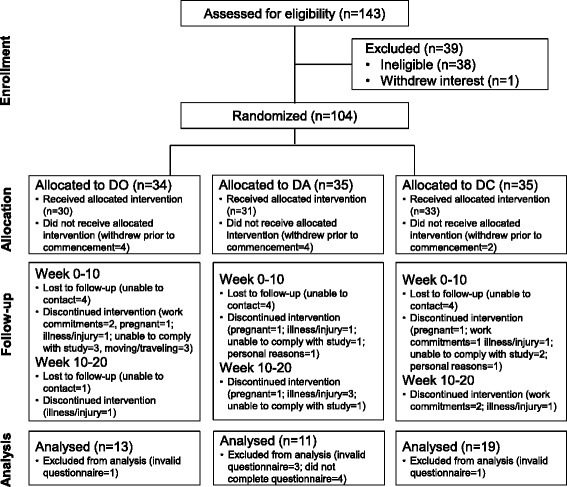
BACKGROUND: This study assessed the perceived benefits and barriers to exercise participation in overweight and obese women with polycystic ovary syndrome (PCOS) and monitored changes in response to a lifestyle intervention. METHODS: Forty-three overweight/obese PCOS women (Age, 30.3(6.2) yrs; BMI, 36.4(5.6) kg/m(2)) were randomised to one of three 20-week lifestyle programs: diet only (DO, n = 13), diet and aerobic exercise (DA, n = 11) and diet and combined aerobic-resistance exercise (DC, n = 19). Exercise Benefits/Barriers Scale (EBBS), weight, aerobic fitness, depression and PCOS specific health-related quality of life were measured. RESULTS: Barriers score was related to depression (r = 0.45, P = 0.002) and aerobic fitness (r = -0.32, P = 0.04), while benefits score was related to aerobic fitness (r = 0.41, P = 0.007). EBBS, benefits and barriers scores improved overtime (P ≤ 0.001). Benefits subscales psychological outlook and social interaction increased (P ≤ 0.001) and life enhancement and preventative health did not change (P ≥ 0.3). Physical performance increased only in DA (P = 0.009). There were no differences between treatments for any of the other subscales (P ≥ 0.2). Barriers subscales exercise milieu, time expenditure and physical exertion reduced (P ≤ 0.003) and family discouragement did not change (P = 0.6). CONCLUSIONS: This study demonstrated that lifestyle modification consisting of an energy-restricted diet with or without exercise training improved the perceived benefits from and barriers to exercise. TRIAL REGISTRATION: Australian New Zealand Clinical Trials Register ACTRN12606000198527, registered 26 May 2006.
Overview
The claims and statistics of this paper haven’t been checked yet.
Free: it reads the open-access text and checks the first 5 claims that cite a source we can check. Create a free account to check every claim.
Integrity signals
Registry
Cites
Statistics
Figures
Verification
Claims the paper makes
The claims and statistics of this paper haven’t been checked yet.
Free: it reads the open-access text and checks the first 5 claims that cite a source we can check. Create a free account to check every claim.
Claims other papers make about this one
Each is checked against this paper’s own text: does it say what the citing paper says it does?
The cited source says what the claim attributes to it.
In the citing paper
“SMD was also used to complete post-intervention sensitivity analysis for sample size; 2 trials (120 participants) [116, 117] were included, but the effect was lost.”
From Exercise, or exercise and diet for the management of polycystic ovary syndrome: a systematic review and meta-analysis (2019) · cites this paper as [116]
In the citing paper
“This is evidenced by previous research reporting that a major barrier to physical activity adoption among women with PCOS is the perceived barrier that exercise is tiring and hard work [121], and fear of injury [72].”
From Providing lifestyle advice to women with PCOS: an overview of practical issues affecting success (2021) · cites this paper as [121]
Self-check
Percentages, sums and reported differences re-computed from the paper’s own numbers.
The self-check needs the paper’s full text.
Citations
Cites
The CES-D Scale: A Self-Report Depression Scale for Research in the General Population
Radloff, L. S. (1977) · Applied Psychological Measurement · doi:10.1177/014662167700100306 · Cited by 53,267 · cited 1×
“Depression was assessed using the Centre for Epidemiologic Studies Depression Scale (CES-D), which is a selfreported scale that measures the presence and severity of depressive symptoms occurring in the past week [16].”
Method(2004) · Fertility and Sterility · doi:10.1016/j.fertnstert.2003.10.004 · Cited by 9,050
The Health Belief Model: a decade later.
Janz, N. K., & Becker, M. H. (1984) · Health Education Quarterly · doi:10.1177/109019818401100101 · Cited by 8,437 · cited 1×
“It has been suggested that barriers are the single most powerful predictor of health behaviour [19].”
BackgroundThe Rotterdam ESHRE/ASRM-sponsored PCOS consensus workshop group (2004) · Human Reproduction · doi:10.1093/humrep/deh098 · Cited by 6,138
Exercise, physical activity, and self-determination theory: A systematic review
Teixeira, P. J., Carraça, E. V., Markland, D., Silva, M. N., & Ryan, R. M. (2012) · International Journal of Behavioral Nutrition and Physical Activity · doi:10.1186/1479-5868-9-78 · Cited by 2,963
Azziz, R., Carmina, E., Chen, Z., Dunaif, A., Laven, J. S. E., Legro, R. S., Lizneva, D., Natterson-Horowtiz, B., Teede, H. J., & Yildiz, B. O. (2016) · Nature Reviews Disease Primers · doi:10.1038/nrdp.2016.57 · Cited by 2,005 · cited 1×
“Symptoms typically associated with PCOS include menstrual dysfunction, infertility, clinical and biochemical hyperandrogenism [3], and possible increased risk of diabetes and cardiovascular disease [4, 5].”
BackgroundMarch, W. A., Moore, V. M., Willson, K. J., Phillips, D. I. W., Norman, R. J., & Davies, M. J. (2010) · Human Reproduction · doi:10.1093/humrep/dep399 · Cited by 1,799 · cited 1×
“Polycystic ovary syndrome (PCOS) is the most common endocrine disorder in women of reproductive age, affecting 6–20 % of this population [1, 2].”
BackgroundNorman, R. J., Dewailly, D., Legro, R. S., & Hickey, T. E. (2007) · The Lancet · doi:10.1016/s0140-6736(07)61345-2 · Cited by 1,360
Health promotion in nursing practice
Pender, N. J., Murdaugh, C. L., & Parsons, M. A. (1982) · Prentice Hall eBooks · Cited by 1,324
Moran, L. J., Misso, M. L., Wild, R. A., & Norman, R. J. (2010) · Human Reproduction Update · doi:10.1093/humupd/dmq001 · Cited by 1,108 · cited 1×
“Symptoms typically associated with PCOS include menstrual dysfunction, infertility, clinical and biochemical hyperandrogenism [3], and possible increased risk of diabetes and cardiovascular disease [4, 5].”
Background(2016) · Dietetic and Nutrition Case Studies · doi:10.1002/9781119163411.ch73 · Cited by 1,013
Wild, R. A., Carmina, E., Diamanti-Kandarakis, E., Dokras, A., Escobar-Morreale, H. F., Futterweit, W., Lobo, R., Norman, R. J., Talbott, E., & Dumesic, D. A. (2010) · The Journal of Clinical Endocrinology & Metabolism · doi:10.1210/jc.2009-2724 · Cited by 1,010 · cited 1×
“Symptoms typically associated with PCOS include menstrual dysfunction, infertility, clinical and biochemical hyperandrogenism [3], and possible increased risk of diabetes and cardiovascular disease [4, 5].”
BackgroundLifestyle changes in women with polycystic ovary syndrome
Lim, S. S., Hutchison, S. K., Van Ryswyk, E., Norman, R. J., Teede, H. J., & Moran, L. J. (2019) · Cochrane Database of Systematic Reviews · doi:10.1002/14651858.cd007506.pub4 · Cited by 725
Yildiz, B. O., Bozdag, G., Yapici, Z., Esinler, I., & Yarali, H. (2012) · Human Reproduction · doi:10.1093/humrep/des232 · Cited by 704 · cited 1×
“Polycystic ovary syndrome (PCOS) is the most common endocrine disorder in women of reproductive age, affecting 6–20 % of this population [1, 2].”
BackgroundDevelopment and psychometric evaluation of the exercise benefits/barriers scale
Sechrist, K. R., Walker, S. N., & Pender, N. J. (1987) · Research in Nursing & Health · doi:10.1002/nur.4770100603 · Cited by 649 · cited 1×
“The EBBS was used to assess perceived benefits and barriers to exercise [15].”
MethodHealth promotion in nursing practice
Flew, A. (1988) · International Journal of Nursing Studies · doi:10.1016/0020-7489(88)90083-1 · Cited by 388
Cronin, L., Guyatt, G., Griffith, L., Wong, E., Azziz, R., Futterweit, W., Cook, D., & Dunaif, A. (1998) · The Journal of Clinical Endocrinology & Metabolism · doi:10.1210/jcem.83.6.4990 · Cited by 314 · cited 1×
“included 5 domains: emotions, hair growth, body weight, infertility problems and menstrual problems [17].”
BackgroundThomson, R. L., Buckley, J. D., Noakes, M., Clifton, P. M., Norman, R. J., & Brinkworth, G. D. (2008) · The Journal of Clinical Endocrinology & Metabolism · doi:10.1210/jc.2008-0751 · Cited by 277 · cited 2×
“Details of the study and intervention have been reported elsewhere [12, 13].”
BackgroundMethodSelf-citation(2022) · Cambridge University Press eBooks · doi:10.1017/9781108989831 · Cited by 254
Lovell, G. P., El Ansari, W., & Parker, J. K. (2010) · International Journal of Environmental Research and Public Health · doi:10.3390/ijerph7030784 · Cited by 215 · cited 2×
“This has also been reported previously in young female university students [20].”
BackgroundResultThomson, R. L., Buckley, J. D., Lim, S. S., Noakes, M., Clifton, P. M., Norman, R. J., & Brinkworth, G. D. (2010) · Fertility and Sterility · doi:10.1016/j.fertnstert.2009.11.001 · Cited by 207 · cited 2×
“Details of the study and intervention have been reported elsewhere [12, 13].”
BackgroundResultSelf-citationGrubbs, L., & Carter, J. (2002) · Family & Community Health · doi:10.1097/00003727-200207000-00009 · Cited by 163 · cited 3×
“Not surprisingly, it has been demonstrated in non-PCOS individuals that those who perceive more benefits and fewer barriers exercise regularly [8] and are * Correspondence: rebecca.”
BackgroundResultNahas, M. V., Goldfine, B. D., & Collins, M. A. (2003) · DigitalCommons - Kennesaw State University (Kennesaw State University) · Cited by 137
Fahrenwald, N. L., & Walker, S. N. (2003) · Public Health Nursing · doi:10.1046/j.1525-1446.2003.20408.x · Cited by 124
Physical activity and mental health in women with Polycystic Ovary Syndrome
Banting, L. K., Gibson-Helm, M., Polman, R., Teede, H. J., & Stepto, N. K. (2014) · BMC Women's Health · doi:10.1186/1472-6874-14-51 · Cited by 121 · cited 6×
“In a recent study, women with PCOS reported their motivators for physical activity were to control weight, improve health and increase energy [11].”
BackgroundResultInfluentialJones, M., & Nies (formerly Albrecht), M. A. (1996) · Public Health Nursing · doi:10.1111/j.1525-1446.1996.tb00233.x · Cited by 111 · cited 1×
“more active compared with those who perceive fewer benefits and more barriers [9, 10].”
BackgroundMalone, L. A., Barfield, J. P., & Brasher, J. D. (2012) · Disability and health journal · doi:10.1016/j.dhjo.2012.05.004 · Cited by 97 · cited 1×
“In agreement with other studies [8, 20, 21], the greatest and lowest perceived benefits were related to physical performance and social interaction, respectively.”
ResultNo Strain, No Gain: Psychosocial Predictors of Physical Activity Across the Adult Lifespan
Cotter, K. A., & Lachman, M. E. (2010) · Journal of Physical Activity and Health · doi:10.1123/jpah.7.5.584 · Cited by 71 · cited 1×
“Social factors, including support from family members or significant others can influence health by either promoting or undermining behaviour change [23].”
BackgroundImplementation of dietary and general lifestyle advice among women with polycystic ovarian syndrome
Humphreys, L., & Costarelli, V. (2008) · Journal of the Royal Society for the Promotion of Health · doi:10.1177/1466424008092230 · Cited by 47 · cited 1×
“Despite the well-established benefits of regular physical activity, and its recommendation as a cornerstone for PCOS management, many overweight women with PCOS do not engage in regular exercise [6].”
BackgroundThe Psychological Ramifications of Weight Management
MILLER-KOVACH, K., HERMANN, M., & WINICK, M. (1999) · Journal of Women's Health & Gender-Based Medicine · doi:10.1089/jwh.1.1999.8.477 · Cited by 20 · cited 1×
“The possibility these effects occurred in response to participating in a professionally supervised weight loss program cannot be ruled out [18] and absence of a non-dieting or exercising control group also limits the ability to determine the specific effects of dieting and exercise.”
BackgroundExercise as a health-promoting lifestyle choice
Bonheur, B., & Young, S. W. (1991) · Applied Nursing Research · doi:10.1016/s0897-1897(05)80045-x · Cited by 16
Cited by
Lifestyle changes in women with polycystic ovary syndrome
Lim, S. S., Hutchison, S. K., Van Ryswyk, E., Norman, R. J., Teede, H. J., & Moran, L. J. (2019) · Cochrane Database of Systematic Reviews · doi:10.1002/14651858.cd007506.pub4 · Cited by 725
Best, D., Avenell, A., & Bhattacharya, S. (2017) · Human Reproduction Update · doi:10.1093/humupd/dmx027 · Cited by 186
“Forty-three of the participants in the trial (DO = 13, DA = 11 and DC = 19) completed a validated Exercise Benefits/Barriers Scale at weeks 0, 10 and 20 (Thomson et al., 2016).”
MethodExercise Interventions in Polycystic Ovary Syndrome: A Systematic Review and Meta-Analysis
Patten, R. K., Boyle, R. A., Moholdt, T., Kiel, I., Hopkins, W. G., Harrison, C. L., & Stepto, N. K. (2020) · Frontiers in Physiology · doi:10.3389/fphys.2020.00606 · Cited by 163
Kite, C., Lahart, I. M., Afzal, I., Broom, D. R., Randeva, H., Kyrou, I., & Brown, J. E. (2019) · Systematic Reviews · doi:10.1186/s13643-019-0962-3 · Cited by 155
Cooney, L. G., Milman, L. W., Hantsoo, L., Kornfield, S., Sammel, M. D., Allison, K. C., Epperson, C. N., & Dokras, A. (2018) · Fertility and Sterility · doi:10.1016/j.fertnstert.2018.03.028 · Cited by 117
“and previous studies have shown an improvement in PCOSQ scores with LS alone (44, 45).”
Result
Metadata
- Authors
- Thomson, R. L., Buckley, J. D., & Brinkworth, G. D.
- Affiliations
- University of South Australia (AU)
- Commonwealth Scientific and Industrial Research Organisation (AU)
- Corresponding author
- Thomson, Rebecca L.
- Venue
- BMC Women's Health
- Published
- 2016-03-09
- Volume
- 16
- Issue
- 1
- Pages
- 14-14
- ISSN
- 1472-6874 (ISSN-L)
- PMC
- PMC4784413
- OpenAlex
- W2295506886
- Cited by
- 60
- References
- 31
- Citations by year
- 2026: 4 · 2025: 8 · 2024: 12 · 2023: 3 · 2022: 5 · 2021: 11 · 2020: 5 · 2019: 4 · 2018: 5 · 2017: 3
- FWCI
- 5.32
- Type
- journal article
- Language
- en
- Open access
- gold
- doi.org
- Licence
- Locations
- BMC Women s Health (publishedVersion, cc-by)
- PubMed Central (publishedVersion, cc-by)
- PubMed (publishedVersion)
- UniSA Research Outputs Repository (University of South Australia) (submittedVersion)
- Adelaide Research & Scholarship (AR&S) (University of Adelaide) (submittedVersion, cc-by)
- Funders
- Medical Research Council
- National Health and Medical Research Council (401817)
- Topics
- Health Sciences › Medicine › Reproductive Medicine › Ovarian function and disorders
- Health Sciences › Medicine › Public Health, Environmental and Occupational Health › Physical Activity and Health
- Health Sciences › Medicine › Public Health, Environmental and Occupational Health › Obesity, Physical Activity, Diet
- Keywords
- polycystic ovary syndrome, barriers to exercise, perceived benefits of exercise, lifestyle modification, overweight women, obesity, hypocaloric diet, aerobic exercise, resistance training, depression, health-related quality of life, cardiorespiratory fitness
- MeSH terms
- Adult, Australia, Depression, Diet, Female, Health Surveys, Humans, Life Style, Obesity, Perception, Polycystic Ovary Syndrome, Quality of Life, Exercise, Body Mass Index, Overweight
About these checks
Registry, retraction, Cites and statistics results are computed, not judged, with one exception: a printed reference that no index lists is read once by a model before it counts as a citation error. Claims are extracted by a model and kept only when their quote appears verbatim in the text; each cited source is then checked, with a model’s help, for whether it says what the claim relies on. Those verdicts can be wrong — read the claim’s quote and the cited source before relying on one.
Statistics and arithmetic are recomputed, not judged.
Confidence bands are shown only for fields calibrated on our annotated test set. None is calibrated yet, so no band is shown.
What counts as a claim ›How we measure confidence ›How we check this ›
Are you an author, or do you see a problem with this page? Request a review
Data sources
Bibliographic data: Semantic Scholar, OpenAlex, Crossref.
Contains information from the Semantic Scholar Academic Graph Datasets, made available under the ODC Attribution License (ODC-BY 1.0).
Semantic Scholar’s data is described in: Kinney, R., et al. (2023). The Semantic Scholar Open Data Platform. arXiv:2301.10140.
