

The DOI matches its Crossref record; 52 of the 52 references it cites were found in a registry or an index.
A qualitative exploration of cervical and breast cancer stigma in Karnataka, India
Open accessAbstract
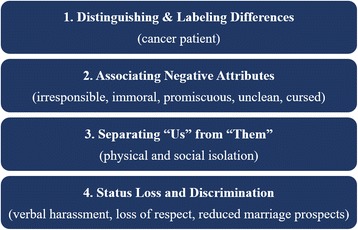
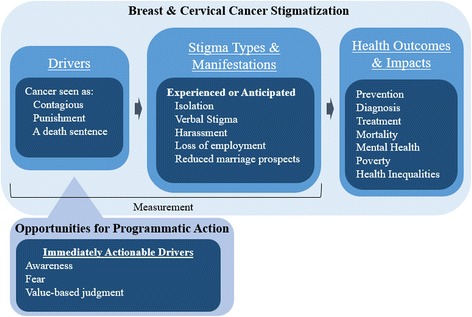
BACKGROUND: Breast and cervical cancer are two of the most common cancers among women worldwide and were the two leading causes of cancer related death for women in India in 2013. While it is recognized that psychosocial and cultural factors influence access to education, prevention, screening and treatment, the role of stigma related to these two cancers has received limited attention. METHODS: Two qualitative exploratory studies. One focusing on cervical cancer, the other on breast cancer, were conducted in Karnataka, India using in-depth interviews and focus group discussions. In the breast cancer study, 59 in-depth interviews were conducted with patients, primary caregivers and healthcare providers. In the cervical cancer study, 147 respondents were interviewed including older and younger women, husbands, healthcare providers and community leaders. While stigma was not the focus of either study, themes relating to stigma emerged and are the focus of this analysis. RESULTS: Cancer stigma emerged as a general theme across both data sets. It appeared throughout the transcripts as descriptions of how women with breast or cervical cancer would be treated and talked about by husbands, family and the community (manifestations of stigma) and the reasons for this behavior. Stigma as a theme also arose through discussions around managing disclosure of a cancer diagnosis. Stigma was juxtaposed with a narrative of support for women with cancer. Three major themes emerged as driving the manifestations of cancer stigma: fear of casual transmission of cancer; personal responsibility for having caused cancer, and; belief in and fear of the inevitability of disability and death with a cancer diagnosis. Manifestations of cancer stigma were described in terms of experienced (enacted) stigma, including isolation or verbal stigma, and anticipated (fear of) stigma, should a cancer diagnosis be disclosed. CONCLUSIONS: The presence in these communities of cancer stigma and its many forms emerged across both the cervical and breast cancer data sets. Stigma was a feared outcome of a cancer diagnosis and described as a barrier to screening, early diagnosis and treatment seeking for women with symptoms. While further research on cancer stigma is needed, this exploration of some of the driving factors provides insight for future programmatic efforts to reduce cancer stigma and improve access to information, screening and treatment.
Overview
The claims and statistics of this paper haven’t been checked yet.
Run the check — free, no account needed. It reads the open-access text and checks the sources it cites.
Integrity signals
Registry
Cites
Statistics
Figures
Verification
Claims the paper makes
The claims and statistics of this paper haven’t been checked yet.
Run the check — free, no account needed. It reads the open-access text and checks the sources it cites.
Claims other papers make about this one
Each is checked against this paper’s own text: does it say what the citing paper says it does?
The source backs part of the claim, not all of it — or backs it for a different population, condition or comparison.
In the citing paper
“While India’s current policy solution of Visual Inspection of the cervix with Acetic acid (VIA)2 is primarily based on affordability, the coverage achieved is low (1.9% ever screened)3 due to multiple provider and recipient-related barriers.4”
From Protocol for a cervical screening implementation trial comparing two approaches for delivering HPV self-collection in low-resource settings in India: a type 3 hybrid cluster randomised controlled trial (SHE-CAN) (2025) · cites this paper as [4]
Experimental — accuracy not yet measuredThe source backs part of the claim, not all of it — or backs it for a different population, condition or comparison.
In the citing paper
“Challenges to cancer screening in the Indian setting include a historical lack of a ‘culture of prevention’, inequality in healthcare access (especially for women), stigma and myths regarding cancer, all of which result in low uptake and follow-up, even when screening and treatment services are available.4”
From Protocol for a cervical screening implementation trial comparing two approaches for delivering HPV self-collection in low-resource settings in India: a type 3 hybrid cluster randomised controlled trial (SHE-CAN) (2025) · cites this paper as [4]
Experimental — accuracy not yet measured
Self-check
Percentages, sums and reported differences re-computed from the paper’s own numbers.
The self-check needs the paper’s full text.
Citations
Cites
PRISMA-P Group, Moher, D., Shamseer, L., Clarke, M., Ghersi, D., Liberati, A., Petticrew, M., Shekelle, P., & Stewart, L. A. (2015) · Systematic Reviews · doi:10.1186/2046-4053-4-1 · Cited by 26,223
Link, B. G., & Phelan, J. C. (2001) · Annual Review of Sociology · doi:10.1146/annurev.soc.27.1.363 · Cited by 8,848
Lippa, N. C., & Sanderson, S. C. (2013) · Human Heredity · doi:10.1159/000353712 · Cited by 6,095
Bowleg, L. (2012) · American Journal of Public Health · doi:10.2105/ajph.2012.300750 · Cited by 2,996
The Global Burden of Cancer 2013
Fitzmaurice, C., Dicker, D., Pain, A. W., Hamavid, H., Moradi‐Lakeh, M., MacIntyre, M. F., Allen, C., Hansen, G. M., Woodbrook, R., Wolfe, C. D. A., et al. (2015) · JAMA Oncology · doi:10.1001/jamaoncol.2015.0735 · Cited by 2,763
Stigma as a fundamental cause of population health inequalities
Hatzenbuehler, M. L., Phelan, J. C., & Link, B. G. (2013) · American Journal of Public Health · doi:10.2105/ajph.2012.301069 · Cited by 2,674
Establishing and maintaining healthy environments: Toward a social ecology of health promotion.
Stokols, D. (1992) · American Psychologist · doi:10.1037/0003-066x.47.1.6 · Cited by 2,107
Stigma in the HIV/AIDS epidemic: a review of the literature and recommendations for the way forward
Mahajan, A. P., Sayles, J. N., Patel, V. A., Remien, R. H., Sawires, S. R., Ortiz, D. J., Szekeres, G., & Coates, T. J. (2008) · AIDS · doi:10.1097/01.aids.0000327438.13291.62 · Cited by 1,404
Impact of HIV‐related stigma on treatment adherence: systematic review and meta‐synthesis
Katz, I. T., Ryu, A. E., Onuegbu, A. G., Psaros, C., Weiser, S. D., Bangsberg, D. R., & Tsai, A. C. (2013) · Journal of the International AIDS Society · doi:10.7448/ias.16.3.18640 · Cited by 1,126
Suicide mortality in India: a nationally representative survey
Patel, V., Ramasundarahettige, C. F., Vijayakumar, L., Thakur, J., Gajalakshmi, V., Gururaj, G., Suraweera, W., & Jha, P. (2012) · The Lancet · doi:10.1016/s0140-6736(12)60606-0 · Cited by 966
Stangl, A. L., Lloyd, J. K., Brady, L. M., Holland, C. E., & Baral, S. (2013) · Journal of the International AIDS Society · doi:10.7448/ias.16.3.18734 · Cited by 698
Cancer mortality in India: a nationally representative survey
Dikshit, R. P., Gupta, P. C., Ramasundarahettige, C. F., Gajalakshmi, V., Aleksandrowicz, L., Badwe, R. A., Kumar, R., Roy, S., Suraweera, W., Bray, F., et al. (2012) · The Lancet · doi:10.1016/s0140-6736(12)60358-4 · Cited by 539
Combating HIV stigma in health care settings: what works?
Nyblade, L. C., Stangl, A. L., Weiss, E., & Ashburn, K. (2009) · Journal of the International AIDS Society · doi:10.1186/1758-2652-12-15 · Cited by 536
Self-citationMusheke, M., Ntalasha, H., Gari, S., Mckenzie, O., Bond, V. A., Martin‐Hilber, A., & Merten, S. (2013) · BMC Public Health · doi:10.1186/1471-2458-13-220 · Cited by 433
Introduction: Understanding and Influencing Multilevel Factors Across the Cancer Care Continuum
Taplin, S. H., Price, R. A., Edwards, H. M., Foster, M. K., Breslau, E. S., Chollette, V. Y., Das, I. P., Clauser, S. B., Fennell, M. L., & Zapka, J. G. (2012) · JNCI Monographs · doi:10.1093/jncimonographs/lgs008 · Cited by 363
Measuring HIV stigma: Existing knowledge and gaps
Nyblade, L. C. (2006) · Psychology Health & Medicine · doi:10.1080/13548500600595178 · Cited by 334
Self-citationA review of breast cancer awareness among women in India: Cancer literate or awareness deficit?
Gupta, A., Shridhar, K., & Dhillon, P. K. (2015) · European Journal of Cancer · doi:10.1016/j.ejca.2015.07.008 · Cited by 316
Govindasamy, D., Meghji, J. Z., Negussie, E. K., Baggaley, R. C., Ford, N. P., & Kranzer, K. (2014) · Journal of the International AIDS Society · doi:10.7448/ias.17.1.19032 · Cited by 281
Cunningham, A. J., Edmonds, C. V. I., Jenkins, G., Pollack, H. B., Lockwood, G. A., & Warr, D. G. (1998) · Psycho-Oncology · doi:10.1002/(sici)1099-1611(199811/12)7:6 · Cited by 276
A method for the quantitative analysis of the layering of HIV-related stigma
Reidpath, D. D., & Chan, K. Y. (2005) · AIDS Care · doi:10.1080/09540120412331319769 · Cited by 268
HIV-Related Stigma among People with HIV and their Families: A Qualitative Analysis
Bogart, L. M., Cowgill, B. O., Kennedy, D. P., Ryan, G. W., Murphy, D. A., Elijah, J., & Schuster, M. A. (2007) · AIDS and Behavior · doi:10.1007/s10461-007-9231-x · Cited by 241
Disentangling HIV and AIDS Stigma in Ethiopia, Tanzania and Zambia
Nyblade, L. C., Pande, R. P., Mathur, S., MacQuarrie, K. L. D., Kidd, R., Banteyerga, H., Kidanu, A., Kilonzo, G. P., Mbwambo, J. K. K., & Bond, V. A. (2003) · IHI Repository · Cited by 223
Self-citationThe Stigma of Being HIV-Positive in Africa
Rankin, W. W., Brennan, S. P., Schell, E. S., Laviwa, J., & Rankin, S. H. (2005) · PLoS Medicine · doi:10.1371/journal.pmed.0020247 · Cited by 212
Reducing HIV-Related Stigma: Lessons Learned from Horizons Research and Programs
Pulerwitz, J., Michaelis, A. P., Weiss, E., Brown, L. F., & Mahendra, V. S. (2010) · Public Health Reports · doi:10.1177/003335491012500218 · Cited by 189
Kokane, A. M., Bansal, A., Pakhare, A. P., Kapoor, N., & Mehrotra, R. (2015) · Journal of Natural Science Biology and Medicine · doi:10.4103/0976-9668.159993 · Cited by 168
Chidyaonga-Maseko, F., Chirwa, M. L., & Muula, A. S. (2015) · Pan African Medical Journal · doi:10.11604/pamj.2015.21.231.6350 · Cited by 157
Zapka, J., Taplin, S. H., Anhang Price, R., Cranos, C., & Yabroff, R. (2010) · JNCI Monographs · doi:10.1093/jncimonographs/lgq009 · Cited by 145
Preventing breast cancer in LMICs via screening and/or early detection: The real and the surreal
Dey, S. (2014) · World Journal of Clinical Oncology · doi:10.5306/wjco.v5.i3.509 · Cited by 117
Rosser, J. I., Njoroge, B., & Huchko, M. J. (2015) · Patient Education and Counseling · doi:10.1016/j.pec.2015.03.017 · Cited by 111
Ekstrand, M. L., Bharat, S., Ramakrishna, J., & Heylen, E. (2011) · AIDS and Behavior · doi:10.1007/s10461-011-9888-z · Cited by 91
The blame game: Cervical cancer, knowledge of its link to human papillomavirus and stigma
Shepherd, M. A., & Gerend, M. A. (2013) · Psychology and Health · doi:10.1080/08870446.2013.834057 · Cited by 90
Nyblade, L. C., Stockton, M. A., Nyato, D., & Wamoyi, J. (2017) · Culture Health & Sexuality · doi:10.1080/13691058.2017.1293844 · Cited by 82
Self-citationArshad, S., Rothberg, M. B., Rastegar, D. A., Spooner, L. M., & Skiest, D. J. (2009) · Journal of the International AIDS Society · doi:10.1186/1758-2652-12-1 · Cited by 79
Karbani, G., Lim, J. N. W., Hewison, J., Atkin, K. M., Horgan, K. J., Lansdown, M., & Chu, C. E. (2011) · PubMed · Cited by 78
Epidemiological Correlates of Breast Cancer in South India
Babu, G. R., Lakshmi, S. B., & Thiyagarajan, J. A. (2013) · Asian Pacific Journal of Cancer Prevention · doi:10.7314/apjcp.2013.14.9.5077 · Cited by 75
Suwankhong, D., & Liamputtong, P. (2015) · Cancer Nursing · doi:10.1097/ncc.0000000000000255 · Cited by 73
Quality of Life determinants in women with breast cancer undergoing treatment with curative intent
Pandey, M., Thomas, B. C., SreeRekha, P., Ramdas, K., Ratheesan, K., Parameswaran, S., Mathew, B. S., & Rajan, B. (2005) · World Journal of Surgical Oncology · doi:10.1186/1477-7819-3-63 · Cited by 72
White, H. L., Mulambia, C., Sinkala, M., Mwanahamuntu, M., Parham, G. P., Moneyham, L. L., Grimley, D. M., & Chamot, E. (2012) · Social Science & Medicine · doi:10.1016/j.socscimed.2012.01.028 · Cited by 60
Reducing HIV Stigma Among Nursing Students
Shah, S. M., Heylen, E., Srinivasan, K., Pathrose, S. P., & Ekstrand, M. L. (2014) · Western Journal of Nursing Research · doi:10.1177/0193945914523685 · Cited by 60
Advancing Cervical Cancer Prevention in India: Implementation Science Priorities
Krishnan, S., Madsen, E., Porterfield, D. S., & Varghese, B. (2013) · The Oncologist · doi:10.1634/theoncologist.2013-0292 · Cited by 60
Self-citationMultiple Stakeholder Perspectives on Cancer Stigma in North India
Gupta, A., Dhillon, P. K., Govil, J., Bumb, D., Dey, S., & Krishnan, S. (2015) · Asian Pacific Journal of Cancer Prevention · doi:10.7314/apjcp.2015.16.14.6141 · Cited by 59
Self-citationHeunis, C., Wouters, E., Norton, W. E., Engelbrecht, M., Kigozi, G., Sharma, A., & Ragin, C. C. R. (2011) · Implementation Science · doi:10.1186/1748-5908-6-27 · Cited by 56
Broom, A. F., & Doron, A. (2011) · Health An Interdisciplinary Journal for the Social Study of Health Illness and Medicine · doi:10.1177/1363459311403949 · Cited by 55
Dey, S., Sharma, S., Mishra, A., Krishnan, S., Govil, J., & Dhillon, P. K. (2016) · Breast Cancer Basic and Clinical Research · doi:10.4137/bcbcr.s40358 · Cited by 55
Self-citationBreast cancer: Indian experience, data, and evidence
Gupta, S. (2016) · South Asian Journal of Cancer · doi:10.4103/2278-330x.187552 · Cited by 55
Parsons, J. A., Bond, V. A., & Nixon, S. (2015) · PLoS ONE · doi:10.1371/journal.pone.0127392 · Cited by 52
Rogers, S. J., Tureski, K., Cushnie, A., Brown, A., Bailey, A. E., & Palmer, Q. (2013) · AIDS Care · doi:10.1080/09540121.2013.844762 · Cited by 47
Dyer, K. E. (2010) · Human Organization · doi:10.17730/humo.69.4.a750670h0784521j · Cited by 38
Cervical cancer: Does our message promote screening? A pilot study in a South African context
Maree, J. E., & Wright, S. C. D. (2010) · European Journal of Oncology Nursing · doi:10.1016/j.ejon.2010.06.008 · Cited by 34
Nurses’ blame attributions towards different types of cancer: A cross-sectional study
Wang, L. D., Zhan, L., Zhang, J., & Xia, Z. (2015) · International Journal of Nursing Studies · doi:10.1016/j.ijnurstu.2015.06.005 · Cited by 18
Thapa, S., Hannes, K., Cargo, M., Buvé, A., & Matheï, C. (2015) · Systematic Reviews · doi:10.1186/s13643-015-0130-3 · Cited by 10
A qualitative exploration of parental experiences of stigma while living with HIV in Bangladesh
Islam, M. S., Scott, J., & Minichiello, V. (2015) · AIDS Care · doi:10.1080/09540121.2015.1074651 · Cited by 6
Research works printed but not linked: 2
- WHO. WHO India cancer country profile. Switzerland: WHO; 2014.
- Suwankhong D, Liamputtong P. Breast cancer treatment: experiences of changes and social stigma among Thai women in southern Thailand. Cancer Nurs. 2015; · DOI
Cited by
Sorted by citations
The Lancet Breast Cancer Commission
Coles, C. E., Earl, H. M., Anderson, B. O., Barrios, C. H., Bienz, M., Bliss, J. M., Cameron, D., Cardoso, F., Cui, W., Francis, P. A., et al. (2024) · The Lancet · doi:10.1016/s0140-6736(24)00747-5 · Cited by 209
Srinath, A., van Merode, F., Rao, S. V., & Pavlova, M. (2022) · Health Policy and Planning · doi:10.1093/heapol/czac104 · Cited by 194
Patient navigation services for cancer care in low-and middle-income countries: A scoping review
Dalton, M., Holzman, E., Erwin, E., Michelen, S., Rositch, A. F., Kumar, S., Vanderpuye, V. D. N. K., Yeates, K., Liebermann, E., & Ginsburg, O. (2019) · PLoS ONE · doi:10.1371/journal.pone.0223537 · Cited by 155
Non-Communicable Diseases-Related Stigma: A Mixed-Methods Systematic Review
Rai, S. S., Syurina, E. V., Peters, R. M. H., Putri, A. I., & Zweekhorst, M. B. M. (2020) · International Journal of Environmental Research and Public Health · doi:10.3390/ijerph17186657 · Cited by 89
Jacob, J., Palat, G., Verghese, N. R., Chandran, P., Rapelli, V., Kumari, S., Malhotra, C., Teo, I., Finkelstein, E. A., & Özdemir, S. (2019) · BMC Palliative Care · doi:10.1186/s12904-019-0465-y · Cited by 77
Metadata
- Authors
- Nyblade, L., Stockton, M., Travasso, S., & Krishnan, S.
- Affiliations
- RTI International (US)
- Corresponding author
- Nyblade, Laura
- Venue
- BMC Women's Health
- Published
- 2017-08-02
- Volume
- 17
- Issue
- 1
- Pages
- 58-58
- ISSN
- 1472-6874 (ISSN-L)
- PMC
- PMC5541646
- OpenAlex
- W2739620956
- Cited by
- 175
- References
- 52
- Citations by year
- 2026: 10 · 2025: 23 · 2024: 23 · 2023: 23 · 2022: 21 · 2021: 29 · 2020: 29 · 2019: 11 · 2018: 6
- FWCI
- 11.81
- Type
- journal article
- Language
- en
- Open access
- gold
- doi.org
- Locations
- BMC Women s Health (publishedVersion, cc-by)
- Europe PMC (PubMed Central) (publishedVersion, cc-by)
- PubMed Central (publishedVersion, cc-by)
- PubMed (publishedVersion)
- DOAJ (DOAJ: Directory of Open Access Journals) (submittedVersion, cc-by-sa)
- Funders
- National Cancer Institute (R01CA172542)
- Topics
- Health Sciences › Medicine › Public Health, Environmental and Occupational Health › Women's cancer prevention and management
- Health Sciences › Medicine › Oncology › Global Cancer Incidence and Screening
- Health Sciences › Medicine › Oncology › Cancer survivorship and care
- Keywords
- cancer stigma, cervical cancer, breast cancer, women's health, Karnataka, cancer diagnosis disclosure, enacted stigma, anticipated stigma, fear of transmission, social isolation, barriers to cancer screening, treatment seeking
- MeSH terms
- Adult, Breast Neoplasms, Uterine Cervical Neoplasms, Female, Humans, India, Health Knowledge, Attitudes, Practice, Male, Middle Aged, Patient Acceptance of Health Care, Physical Examination, Focus Groups, Qualitative Research, Early Detection of Cancer, Social Stigma
About these checks
Registry, retraction, Cites and statistics results are computed, not judged, with one exception: a printed reference that no index lists is read once by a model before it counts as a citation error. Claims are extracted by a model and kept only when their quote appears verbatim in the text; each cited source is then checked, with a model’s help, for whether it says what the claim relies on. Those verdicts can be wrong — read the claim’s quote and the cited source before relying on one.
Statistics and arithmetic are recomputed, not judged.
Confidence bands are shown only for fields calibrated on our annotated test set. None is calibrated yet, so no band is shown.
What counts as a claim ›How we measure confidence ›How we check this ›
Are you an author, or do you see a problem with this page? Request a review
