

Alternative preparation of propolis extracts: comparison of their composition and biological activities
Open accessThe DOI matches its Crossref record; 34 of the 34 references it cites were found in a registry or an index.
Abstract
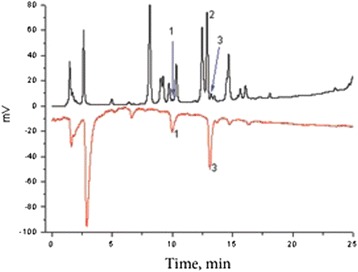
BACKGROUND: Propolis is the bee product noted for multiple biological effects, and therefore it is widely used for the prevention and treatment of a variety of diseases. The active substances of propolis are easily soluble in ethanol. However ethanolic extracts cannot be used in treatment of certain diseases encountered in ophthalmology, pediatrics, etc. Unfortunately, the main biologically active substances of propolis are scarcely soluble in water, oil and other solvents usually used in pharmaceutical industry. The aim of this study was to investigate chemical composition, radical scavenging and antimicrobial activity of propolis extracts differently made in nonethanolic solvents. METHODS: Total content of phenolic compounds in extracts was determined using Folin-Ciocalteu method. Chemical composition and radical scavenging activity of extracts were determined using HPLC system with free radical reaction detector. Antimicrobial activity of examined preparations was evaluated using the agar-well diffusion assay. RESULTS: Total amount of phenolic compounds in extracts made in polyethylene glycol 400 (PEG) and water mixture or in PEG, olive oil and water mixture at 70 °C was comparable to that of ethanolic extract. Predominantly identified compounds were phenolic acids, which contribute ca. 40 % of total radical scavenging activity. Investigated nonethanolic extracts inhibited the growth and reproduction of all tested microrganisms. Antimicrobial activity of some extracts was equal or exceeded the antimicrobial effect of ethanolic extract. Extracts made in pure water or oil only at room temperature, contained more than 5 - 10-fold lower amount of phenolic compounds, and demonstrated no antimicrobial activity. CONCLUSIONS: Nonethanolic solvent complex and the effect of higher temperature allows more effective extraction of active compounds from propolis. Concentration of total phenolic compounds in these extracts does not differ significantly from the concentration found in ethanolic extract. Propolis nonethanolic extracts have radical scavenging and antimicrobial activity.
Overview
The claims and statistics of this paper haven’t been checked yet.
Free: it reads the open-access text and checks the first 5 claims that cite a source we can check. Create a free account to check every claim.
Integrity signals
Registry
Cites
Statistics
Figures
Verification
Claims the paper makes
The claims and statistics of this paper haven’t been checked yet.
Free: it reads the open-access text and checks the first 5 claims that cite a source we can check. Create a free account to check every claim.
Claims other papers make about this one
Each is checked against this paper’s own text: does it say what the citing paper says it does?
The source backs part of the claim, not all of it — or backs it for a different population, condition or comparison.
In the citing paper
“it can be utilized as a preservative in foods such as fruit juice, meats, fruits and dairy foods as well as pharmaceutical and cosmetic products.”
From Effect of propolis extract as a natural preservative on quality and shelf life of marinated chicken breast (chicken Kebab) (2022) · cites this paper as Kubiliene et al., 2015
Experimental — accuracy not yet measuredThe source backs part of the claim, not all of it — or backs it for a different population, condition or comparison.
In the citing paper
“This amount of total phenol was lower than the total phenol obtained in the study of El-Deeb (2017) and Kubiliene et al. (2015).”
From Effect of propolis extract as a natural preservative on quality and shelf life of marinated chicken breast (chicken Kebab) (2022) · cites this paper as Kubiliene et al. (2015)
Experimental — accuracy not yet measuredThe cited source says what the claim attributes to it.
In the citing paper
“It can be used as a good alternative for chemical preservatives due to its antimicrobial and antioxidant features (Khezri, Rostami, Riseh, & Alizadeh, 2006;Kubiliene et al., 2015).”
From Effect of propolis extract as a natural preservative on quality and shelf life of marinated chicken breast (chicken Kebab) (2022) · cites this paper as Kubiliene et al., 2015
The check wasn’t confident either way, so it gives no verdict — never disputed.
In the citing paper
“The propolis is not toxic for human in normal concentrations”
From Effect of propolis extract as a natural preservative on quality and shelf life of marinated chicken breast (chicken Kebab) (2022) · cites this paper as Kubiliene et al., 2015
Experimental — accuracy not yet measured
Self-check
Percentages, sums and reported differences re-computed from the paper’s own numbers.
The self-check needs the paper’s full text.
Citations
Cites
National Committee for Clinical Laboratory Standards
Bruck, E. (1980) · Pediatrics · doi:10.1542/peds.65.1.187 · Cited by 14,751
Performance standards for antimicrobial susceptibility testing
Ferraro, M. J. (2001) · Cited by 9,667
Plant Products as Antimicrobial Agents
Cowan, M. M. (1999) · Clinical Microbiology Reviews · doi:10.1128/cmr.12.4.564 · Cited by 9,043
Handbook of Pharmaceutical Excipients
Rowe, R. C., Sheskey, P. J., & Quinn, M. E. (1994) · Cited by 3,493
Antimicrobial activity of flavonoids
Cushnie, T. P. T., & Lamb, A. J. (2005) · International Journal of Antimicrobial Agents · doi:10.1016/j.ijantimicag.2005.09.002 · Cited by 3,195
Screening of radical scavenging activity of some medicinal and aromatic plant extracts
Miliauskas, G., Venskutonis, P. R., & van Beek, T. A. (2004) · Food Chemistry · doi:10.1016/j.foodchem.2003.05.007 · Cited by 2,114
Antibacterial, antifungal and antiviral activity of propolis of different geographic origin
Kujumgiev, A., Tsvetkova, I., Serkedjieva, Y., Bankova, V, Christov, R., & Popov, S. (1999) · Journal of Ethnopharmacology · doi:10.1016/s0378-8741(98)00131-7 · Cited by 1,106
Antioxidant activity of propolis of various geographic origins
Kumazawa, S., Hamasaka, T., & Nakayama, T. (2004) · Food Chemistry · doi:10.1016/s0308-8146(03)00216-4 · Cited by 946
Phenolic compounds from Brazilian propolis with pharmacological activities
Marcucci, M. C., Ferreres, F., Garcı́a-Viguera, C., Bankova, V. S., De Castro, S. L., Dantas, A. P., Valente, P. H. M., & Paulino, N. (2001) · Journal of Ethnopharmacology · doi:10.1016/s0378-8741(00)00326-3 · Cited by 528
Preparation and antioxidant properties of water extract of propolis
Nagai, T., Inoue, R., Inoue, H., & Suzuki, N. (2003) · Food Chemistry · doi:10.1016/s0308-8146(02)00231-5 · Cited by 271
Research works printed but not linked: 1
- Farre R Frasquet I Sanchez A Propolis and human health Ars Pharmaceutica 2004 45 21 43
Cited by
Items 201–264 of 264
The cytotoxic effects of bio-transformed propolis on healthy and colon cancer cell lines
Günel, N. S., Oktay, L. M., Memmedov, H., Durmaz, B., Yildırım, H. K., & Sözmen, E. Y. (2025) · Ege Tıp Dergisi · doi:10.19161/etd.1524052 · Cited by 1
ATIVIDADE ANTIMICROBIANA DO EXTRATO DE PRÓPOLIS: UMA REVISÃO
de Queiroz, A. P. M., Rocha, E. L., Rocha, L. D. R., & Dias, R. M. F. (2021) · Revista Ciência (In) Cena · Cited by 1
EVALUACION DE DIFERENTES EXTRACTOS DE PROPOLEOS
Gallardo, D. G. (2022) · Revista CENIC. Ciencias biológicas · Cited by 1
Sanches, W. S. (2022) · Digital Library of Theses and Dissertations (Universidade de São Paulo) · doi:10.11606/d.100.2022.tde-04072022-111823 · Cited by 1
Evaluation of bioactivities of a propolis sample (Gerês) of Portuguese origin
Freitas, A. S. (2015) · Portuguese National Funding Agency for Science, Research and Technology (RCAAP Project by FCT)
VIII Congreso Nacional de Apicultura
Pharmaceutica, A. (2016) · Institutional Repository of the University of Granada (University of Granada)
Bitencourt, C. M. (2017) · Digital Library of Theses and Dissertations (Universidade de São Paulo) · doi:10.11606/t.74.2017.tde-16032017-101527
Jannah, M. (2019) · eTheses of Maulana Malik Ibrahim State Islamic University (Maulana Malik Ibrahim State Islamic University)
Maleckaitė, M. (2020) · Lithuanian University of Health Sciences
Efficacy of Syrian Propolis Against Several Bacterial Strains
Harfouch, R., Fead, R., Hammoud, L., & Harfouch, N. (2020) · Journal of Medicine and HealthCare · doi:10.47363/jmhc/2020(2)137
Колосова, С. Ф. (2017) · Zenodo (CERN European Organization for Nuclear Research) · doi:10.5281/zenodo.1036517
Effects of Water-Soluble Propolis on tert-Butyl Hydroperoxide-Induced Acute Oxidative Stress in Mice
Kim, H.-R., Kim, M. J., Noh, E., Hur, Y. K., & Kim, S. (2022) · Food Supplements and Biomaterials for Health · doi:10.52361/fsbh.2022.2.e6
Garcia, P. L., Stefani, L. M., Boiago, M. M., Araujo, D., França, A., Sponchiado, B. M., Nesi, D., Deolindo, G. L., Rampazzo, M., Migliorini, M. J., et al. (2022) · Research Square · doi:10.21203/rs.3.rs-1485683/v1
Propolis: The Role of Propolis in Cancer
Karaaslan, S., & Çínar, M. (2022) · International Journal of Veterinary and Animal Research (IJVAR) · doi:10.5281/zenodo.7443874
Lemos, J. D. O., Vieira, S. W. F., & Filho, A. A. D. O. (2022) · doi:10.51859/amplla.cco2452-35
CIRURGIA DE COLOCAÇÃO DE IMPLANTE DENTÁRIO GUIADA POR COMPUTADOR
Araújo, I. S., Pessoa, L. E. G., Lima, R. C., Barros, S. C. N., Brígido, K. G. R., & Brígido, J. A. (2022) · doi:10.51859/amplla.cco2452-6
PRÓTESE SOBRE IMPLANTE NA REABILITAÇÃO ORAL DE PACIENTES EDÊNTULOS: UMA REVISÃO DE LITERATURA
Ribeiro, E. G. M., da Silva, L. M. R., Barros, S. C. N., da Silva, S. Q. A., Brígido, K. G. R., & Brígido, J. A. (2022) · doi:10.51859/amplla.cco2452-28
FATORES ASSOCIADOS À CONDIÇÕES DE SAÚDE BUCAL DE PACIENTES INTERNADOS EM HOSPITAIS
de Brito, A. L. S., Mendes, G. M., da Silveira, P. D. A., Brígido, K. G. R., & Brígido, J. A. (2022) · doi:10.51859/amplla.cco2452-23
Determination of Major Active Components in the Iranian (Kurdistan) Propolis Extract by HPLC
Yousefinejad, V., Darvishi, N., Vahabzadeh, Z., Babahajian, A., & Davoodi, S. H. (2022) · Scientific Journal of Kurdistan University of Medical Sciences · doi:10.52547/sjku.27.2.38
Nur Diyana, A., Nurin Izzati, M. Z., Hasnan, N. Z. N., Koh, S. P., Mansor, A., & Jajuli, R. (2023) · Food Research · doi:10.26656/fr.2017.6(s2).023
Konsila, K., Chanchao, C., Phuwapraisirisan, P., & Assavalapsakul, W. (2022) · Chula Digiverse · doi:10.58837/chula.the.2022.30
Samanci, A. E. T., Muluk, N. B., Samancı, T., & Cingi, C. (2024) · Comprehensive ENT · doi:10.1007/978-3-031-68546-0_8
Comparison of immune response in beagles fed propolis concentrate and propolis/wet food mixture
Cho, H. (2024) · Korean Journal of Veterinary Service · doi:10.7853/kjvs.2024.47.3.165
Extraction of Tetragonula laeviceps Cerumen, Its Total Phenolic Content, and Antioxidant Activity
Chuttong, B., Chee, Y. J., Phongphisutthinant, R., Chaipoot, S., Danmek, K., Lim, B. G., Wiriyacharee, P., & Burgett, M. D. (2024) · Springer eBooks · doi:10.1007/978-3-031-43887-5_2
Bee pollen, from the flower to the harvest, and its potential therapeutic properties
Serri, E., Galosi, L., Rossi, G., Cerbo, A. D., Roncarati, A., & Angorini, A. (2024) · Elsevier eBooks · doi:10.1016/b978-0-443-13510-1.00006-2
Çakmak, Ö., Öztürk, M., Şimşek, A., Yalçın, H., Kan, F., Küçükkurt, İ., İnce, S., İstanbullugil, F. R., GÜRLER, Z., Soylu, A., et al. (2025) · Akademisyen Kitabevi eBooks · doi:10.37609/akya.3326
Cırrık, S., Kabartan, E., Hacıoğlu, G., & Peker, E. G. G. (2025) · Journal of Basic and Clinical Health Sciences · doi:10.30621/jbachs.1480780
Taşkin, M. K., & Tel, O. Y. (2025) · Journal of International Dental Sciences · doi:10.21306/dishekimligi.1654633
Brejchová, A., Králová, E., Strnad, O., Třešňáková, P., Habibullah, G., Kvirencová, J. R., Hrbek, V., Viktorová, J., Lizoňová, D., & Štĕpánek, F. (2025) · Journal of Drug Delivery Science and Technology · doi:10.1016/j.jddst.2025.107490
Sadikhov, T., Allahverdiyev, A., & Arda, N. (2025) · Journal of Drug Delivery Science and Technology · doi:10.1016/j.jddst.2025.107495
Nguyen, D.-T., Nguyen, T.-N., Vong, L. B., Le, M.-T., Nguyen, B. V. G., Vu, G. P., & Nguyen, P.-V. (2026) · Biomedical Materials · doi:10.1088/1748-605x/ae2cd6
Márquez, D. G. P., Ovalle, L. V. C., Maraschin, M., Schmitz, C., Díaz-Moreno, C., & Mahecha, H. S. (2023) · Research Square · doi:10.21203/rs.3.rs-3089391/v1
Santos, P. B. D. R. E. D. [. (2018) · Americanae (AECID Library)
Farklı propolis ekstraktlarının Lactobacillus sp. gelişimi üzerine etkilerinin incelenmesi
Eryılmaz, B. (2022) · Dspace Repository (Marmara Üniversitesi)
Bigiotti, G. (2019) · Florence Research (University of Florence)
Propolisten elde edilen ekstraktların ilaç koruyucu maddesi olarak kullanılması ve formülasyonu
Kurt, D. (2020) · DSpace - Düzce (Duzce University)
The Use of Natural Preservative Propolis and Hypericum perforatum Oil in Herbal Cream Production
Aydın, G., Şirin, N., Kekeçoğlu, M., Türken, T., SİPAHİ, N., & Göksu, H. (2020) · International Journal of Traditional and Complementary Medicine Research
Doğan, H., Özçimen, A. A., Alabaş, E., Sılıcı, S., Saygıdeğer, Y., & Ozdemir, B. (2025) · Analytical Cellular Pathology · doi:10.1155/ancp/7215006
Casagrande, M. (2019) · LA Referencia (Red Federada de Repositorios Institucionales de Publicaciones Científicas)
Yılmaz, Ş. M. (2023) · Hitit University Institutional Repository
Mockė, E. (2024) · Lithuanian University of Health Sciences
Antibacterial Activity of Propolis Collected in Different Regions of Lithuania
Kairytė, R. (2024) · Lithuanian University of Health Sciences
Klivečkaitė, M. (2024) · Lithuanian University of Health Sciences
Orjuela, L. A. G., & Moreno, M. I. V. (2025) · Repositorio Fundación Universitaria Agraria de Colombia
Calidad, perfil químico y actividad biológica de propóleos antioqueños
Ramírez, Z. A. B. (2021) · Repositorio CES
Phytochemical Investigation and Pharmacological Activities of Propolis
Shirish, L., Kalpana, K., Sravya, K., Manasa, L., & *, A. K. S. (2026) · Cancer Research and Cellular Therapeutics · doi:10.31579/2640-1053/257
Benaissa, C. (2022) · Dépôt Institutionnel de lUniversité de Tlemcen
Evaluation et compréhension des propriétés antifongiques des propolis
Dudoit, A. (2017) · theses.fr (ABES) · doi:10.70675/ca099d61z9c16z4a3cz9927z47b1b1a5b76b
A Comparative Study In Vitro of the Antimicrobial Activity of Oil and Aqueous Extracts of Propolis
Čalnarytė, M. (2023) · Lithuanian University of Health Sciences
AYGÜN, A., Çaprazlı, T., BİR, S., & Kekeçoğlu, M. (2026) · Journal of Apitherapy and Nature · doi:10.35206/jan.1955963
Ukrainian Food Journal. Vol. 13. Issue 3
National University of Food Technologies (2024) · Institutional Repository of National University of Food Technologies
MESCİ, E., Arserim‐Uçar, D. K., & Ayna, A. (2026) · Foods · doi:10.3390/foods15183251
Uran, H., Güneş, R., Kopuk, B., Palabıyık, İ., Albaş, M. G., & Demirci, A. Ş. (2026) · Journal of Food Measurement & Characterization · doi:10.1007/s11694-026-05002-5
Orzijonovna, N. N., Axadovich, S. A., & Akbarovich, A. A. (2025) · International Journal of Pediatrics and Genetics
Ergashovich, M. D., Akbarovich, A. A., & Abdurazakovich, F. U. (2025) · International Journal of Pediatrics and Genetics
Nizomitdinovich, N. D., Rajabovich, J. L., & Akbarovich, A. A. (2025) · International Journal of Cognitive Neuroscience and Psychology
Soffian, Y. (2026) · Universitas Pasundan institutional repositories & scientific journals (Universitas Pasundan)
Lettuce leaf optical properties : linking spectral characteristics to photosynthetic productivity
Kačiušis, M., & Samuolienė, G. (2017) · Vytautas Magnus University
Zohdi, R. M., Mukhtar, S. M., Ghani, N. A., Liong, C. J. C., Susanty, A., & Zaidi, N. F. M. (2026) · Malaysian Journal of Fundamental and Applied Sciences · doi:10.11113/mjfas.v22n4.4830
Lodienė, G., Kostenkova, A., Giedraitienė, A., Merkevičienė, L., Hosseinzadehfard, P., Umbrasas, D., Uogintaite, D., Marksa, M., Kriščiukaitis, A., Petrolis, R., et al. (2026) · Dental Traumatology · doi:10.1111/edt.70152
Celińska-Janowicz, K., Zaręba, I., Lazarek, U., Teul, J., Tomczyk, M., Pałka, J., & Miltyk, W. (2018) · doi:10.3389/fphar.2018.00336.s001
BİRİNCİ, P., Çakır, H. E., Şahin, H., Yıldız, O., Asadov, E., & Kolaylı, S. (2026) · Molecules · doi:10.3390/molecules31224169
Metadata
- Authors
- Kubiliene, L., Laugaliene, V., Pavilonis, A., Maruska, A., Majiene, D., Barcauskaite, K., Kubilius, R., Kasparaviciene, G., & Savickas, A.
- Affiliations
- Vytautas Magnus University (LT)
- Lithuanian University of Health Sciences (LT)
- ORCID
- Kubilius, Raimondas
- Venue
- BMC Complementary and Alternative Medicine
- Published
- 2015-05-27
- Volume
- 15
- Issue
- 1
- Pages
- 156-156
- ISSN
- 1472-6882 (ISSN-L)
- PMC
- PMC4443635
- OpenAlex
- W1899039537
- Cited by
- 216
- References
- 34
- Citations by year
- 2026: 11 · 2025: 22 · 2024: 15 · 2023: 34 · 2022: 38 · 2021: 22 · 2020: 23 · 2019: 20 · 2018: 10 · 2017: 14 · 2016: 5 · 2015: 1
- FWCI
- 10.63
- Type
- journal article
- Language
- en
- Open access
- gold
- doi.org
- Locations
- BMC Complementary and Alternative Medicine (publishedVersion, cc-by)
- Europe PMC (PubMed Central) (publishedVersion, cc-by)
- PubMed Central (publishedVersion, cc-by)
- PubMed (publishedVersion)
- Lithuanian University of Health Sciences (submittedVersion)
- Vytautas Magnus University (submittedVersion)
- Topics
- Life Sciences › Agricultural and Biological Sciences › Insect Science › Bee Products Chemical Analysis
- Health Sciences › Medicine › Pharmacology (medical) › Healthcare and Venom Research
- Life Sciences › Agricultural and Biological Sciences › Food Science › Essential Oils and Antimicrobial Activity
- Keywords
- propolis, propolis extraction, phenolic compounds, phenolic acids, free radical scavenging, antimicrobial activity, polyethylene glycol, olive oil, extraction temperature, chemical composition
- MeSH terms
- Olive Oil, Ethanol, Animals, Anti-Infective Agents, Antioxidants, Bees, Chemistry, Pharmaceutical, Chromatography, High Pressure Liquid, Phenols, Plant Oils, Propolis, Solubility, Solvents, Temperature, Water, Hydroxybenzoates
About these checks
Registry, retraction, Cites and statistics results are computed, not judged, with one exception: a printed reference that no index lists is read once by a model before it counts as a citation error. Claims are extracted by a model and kept only when their quote appears verbatim in the text; each cited source is then checked, with a model’s help, for whether it says what the claim relies on. Those verdicts can be wrong — read the claim’s quote and the cited source before relying on one.
Statistics and arithmetic are recomputed, not judged.
Confidence bands are shown only for fields calibrated on our annotated test set. None is calibrated yet, so no band is shown.
What counts as a claim ›How we measure confidence ›How we check this ›
Are you an author, or do you see a problem with this page? Request a review
Data sources
Bibliographic data: Semantic Scholar, OpenAlex, Crossref.
Contains information from the Semantic Scholar Academic Graph Datasets, made available under the ODC Attribution License (ODC-BY 1.0).
Semantic Scholar’s data is described in: Kinney, R., et al. (2023). The Semantic Scholar Open Data Platform. arXiv:2301.10140.
