

Validation and quantification of major biomarkers in ‘Mahasudarshan Churna’- an ayurvedic polyherbal formulation through high-performance thin-layer chromatography
Open accessThe DOI matches its Crossref record; 24 of the 25 references it cites were found in a registry or an index; 3 of the 11 sources its claims cite were checked for support.
Abstract
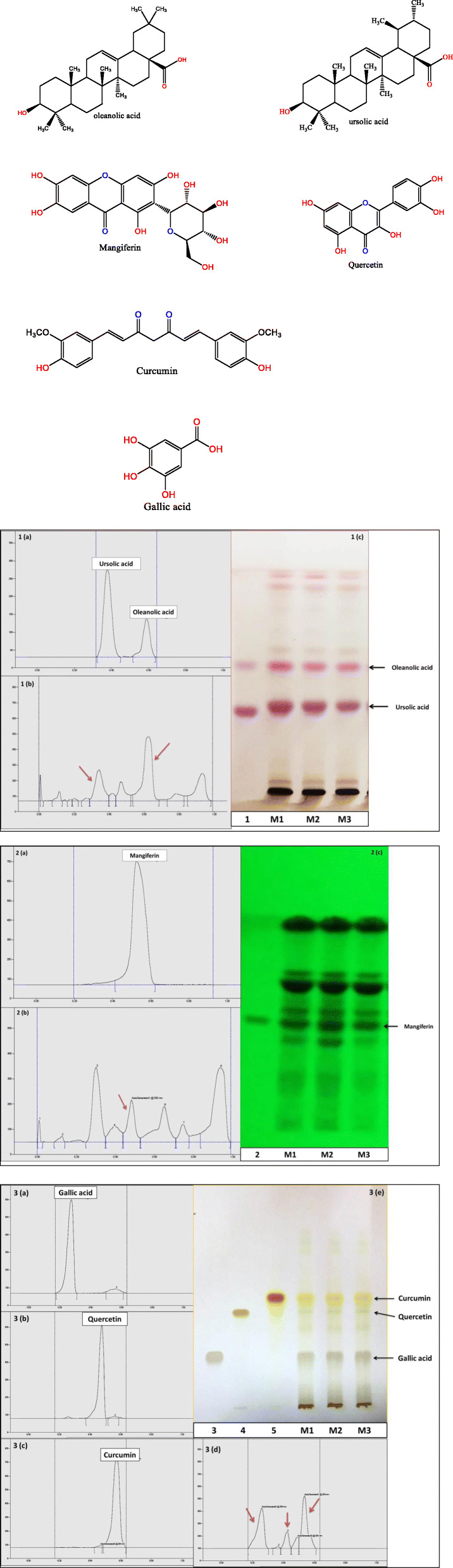
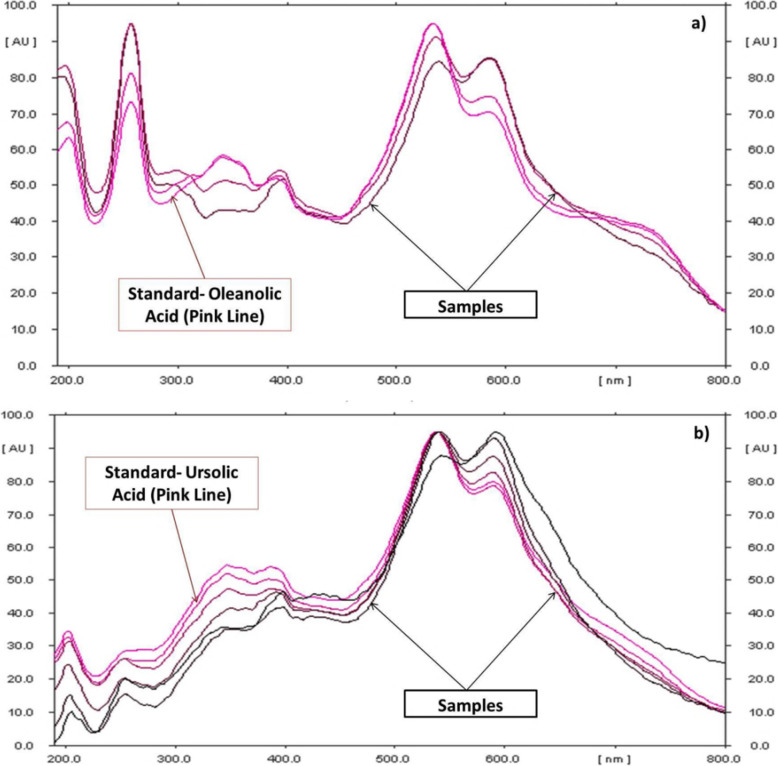
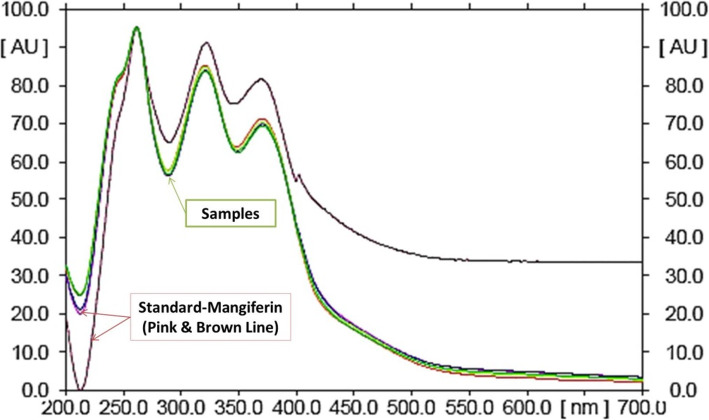
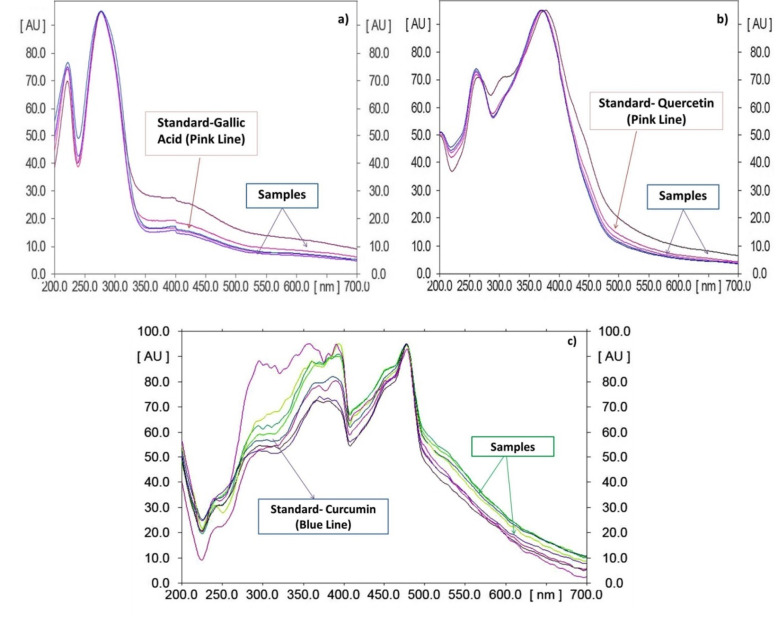
BACKGROUND: Mahasudarshan Churna (MC) is a polyherbal Ayurvedic medicine that is employed in fever (especially chronic type), cold and malaria, improvement of digestion and appetite, removes toxins from the blood, boosts immunity and protects against common bacterial infections. METHODS: Validation and quantification of oleanolic acid (OA), ursolic acid (UA), mangiferin (M), gallic acid (GA), quercetin (Q) and curcumin (C) in commercial MC formulations by HPTLC method. Mobile phase, hexane: ethyl acetate: acetone (16.4: 3.6: 0.2, v/v) was used for the separation of OA and UA; ethyl acetate: glacial acetic acid: formic acid: water (20: 2.2: 2.2: 5.2 v/v) for the development of M; and toluene: ethyl acetate: formic acid (13.5: 9: 0.6 v/v) for the separation of GA, Q and C in crude sample extracts. Visualization and scanning were performed at λ = 530 nm for OA and UA, at λ = 254 nm for M and at λ = 366 nm for GA, Q and C. In addition, HPLC-PDA analysis was used to confirm the HPTLC results. RESULTS: Major bio-active compounds in MC formulations were oleanolic acid (1.54-1.78%), mangiferin (1.38-1.52%) and gallic acid (1.01-1.15%); followed by ursolic acid (0.79-0.98%), curcumin (0.45-0.67%) and quercetin (0.22-0.34%). CONCLUSION: Analysis of bio-active compounds in the present study was performed using HPTLC methods and later HPTLC results were compared with HPLC. These two methods give comparable results and there was no statistically significant difference between the mean values for all extracts. Present study concluded that this HPTLC technique is low cost, fast, precise, and accurate which can be employed for the quantification of xanthonoid (M), triterpenoids (OA, UA) and phenolics (GA, Q and C) in samples/formulations. Furthermore, present HPTLC method can be conveniently employed for routine quality control analysis of all the six marker compounds in marketed Ayurvedic/herbal formulations.
Overview
CoChat Summary
TL;DR
This study developed and validated an HPTLC method to quantify six major biomarkers—oleanolic acid, ursolic acid, mangiferin, gallic acid, quercetin, and curcumin—in three commercial Mahasudarshan Churna formulations, with HPLC-PDA used to confirm selected results. The authors report comparable HPTLC and HPLC results and conclude the HPTLC method is suitable for routine quality-control analysis of these markers.
Key findings
- HPTLC quantification in commercial MC formulations (MC1–MC3) found oleanolic acid at 1.54–1.78%, mangiferin at 1.38–1.52%, gallic acid at 1.01–1.15%, ursolic acid at 0.79–0.98%, curcumin at 0.45–0.67%, and quercetin at 0.22–0.34%.
- HPLC-PDA confirmation for three compounds found mangiferin at 1.36–1.54%, gallic acid at 1.06–1.12%, and quercetin at 0.20–0.36%; the paper states the two methods gave comparable results with no statistically significant difference between mean values for all extracts.
- Method validation showed linearity ranges of 200–800 ng/band for mangiferin, 200–3000 ng/band for OA and UA, 500–2000 ng/band for gallic acid, 300–1500 ng/band for quercetin, and 100–1000 ng/band for curcumin, with correlation coefficients (r²) of 0.987–0.997.
- LOD values were 25–45 ng and LOQ values were 75–140 ng; recovery values were approximately 99.6–100.9% across the tested marker compounds.
Methods
- Three commercial brands of Mahasudarshan Churna—Dabur (MC1), Baidyanath (MC2), and Zandu (MC3)—were analyzed, along with authentic standards of mangiferin, oleanolic acid, ursolic acid, gallic acid, curcumin, and quercetin.
- Samples were extracted by microwave-assisted extraction in methanol; HPTLC separation used specific mobile phases for mangiferin, triterpenoids (OA, UA), and phenolics (GA, Q, C), with densitometric scanning and validation following ICH guidelines for precision, repeatability, accuracy, LOD/LOQ, and specificity.
- HPLC-PDA analysis was used to confirm HPTLC results for mangiferin, gallic acid, and quercetin using a C-18 column and isocratic elution.
Limitations
- The paper does not state a limitations section; no author-stated limitations are reported.
- Evident from the text: only three commercial brands from a single procurement location (Ludhiana, Punjab, India) were analyzed, limiting generalizability across the market.
- Evident from the text: HPLC-PDA confirmation covered only three of the six markers (mangiferin, gallic acid, quercetin), and the study reports analytical quantification rather than clinical or biological efficacy; the text also contains minor reporting inconsistencies, such as precision described as n = 6 in Methods but reported as n = 5 in Table 2, and detection wavelengths differing between the Abstract and Methods/Results.
Model-written summary. Check it against the paper before relying on it.
Integrity signals
Registry
Cites
Statistics
Figures
Verification
Claims the paper makes
3 Valid · 0 Not valid · 7 Not checked · 30 Own results and interpretations
A result the paper reports from its own data — it cites no other source for it, so there is none to check. The quote shows it is in the paper.
In the paper
“In this method, MC formulations (MC1, MC2 and MC3) were found to contain mangiferin (1.36–1.54%); gallic acid (1.06–1.12%) and quercetin (0.20–0.36%) content.”
§ Validation and quantification of major biomarkers in ‘Mahasudarshan Churna’- an ayurvedic polyherbal formulation through high-performance thin-layer chromatography > Results > Quantification of bioactive compounds in commercial Mahasudarshan Churna formulations by HPTLC and HPLC
plain- Asserted: passes — The authors put it forward as true.
- Checkable: passes — It can be checked against evidence.
- Load-bearing: passes — The paper’s conclusions depend on it.
- Based: passes — The paper gives a reason why it holds.
A result the paper reports from its own data — it cites no other source for it, so there is none to check. The quote shows it is in the paper.
In the paper
“MC formulations (MC1, MC2 and MC3) were found to contain oleanolic acid (1.54–1.78%), mangiferin (1.38–1.52%) and gallic acid (1.01–1.15%), followed by ursolic acid (0.79–0.98%), curcumin (0.45–0.67%) and quercetin (0.22–0.34%) content with HPTLC analytical method.”
§ Validation and quantification of major biomarkers in ‘Mahasudarshan Churna’- an ayurvedic polyherbal formulation through high-performance thin-layer chromatography > Results > Quantification of bioactive compounds in commercial Mahasudarshan Churna formulations by HPTLC and HPLC
plain- Asserted: passes — The authors put it forward as true.
- Checkable: passes — It can be checked against evidence.
- Load-bearing: passes — The paper’s conclusions depend on it.
- Based: passes — The paper gives a reason why it holds.
A result the paper reports from its own data — it cites no other source for it, so there is none to check. The quote shows it is in the paper.
In the paper
“In this method, MC formulations (MC1, MC2 and MC3) were found to contain mangiferin (1.36–1.54%); gallic acid (1.06–1.12%) and quercetin (0.20–0.36%) content.”
§ Validation and quantification of major biomarkers in ‘Mahasudarshan Churna’- an ayurvedic polyherbal formulation through high-performance thin-layer chromatography > Results > Quantification of bioactive compounds in commercial Mahasudarshan Churna formulations by HPTLC and HPLC
plain- Asserted: passes — The authors put it forward as true.
- Checkable: passes — It can be checked against evidence.
- Load-bearing: passes — The paper’s conclusions depend on it.
- Based: passes — The paper gives a reason why it holds.
17 more claims
Create a free account to see all 40 claims and to verify the 2 references still open.
- Probably not a substantial claim. 10
- It may state two separate claims as one. 11
Self-check
Percentages, sums and reported differences re-computed from the paper’s own numbers.
Each contradiction between two passages listed here was confirmed by an independent check.
Rated major: it would touch a result — a value a result rests on, reported and recomputed p-values on opposite sides of the significance level, two passages that conflict with no sign which is right, or a cited work retracted before this paper was published.
In the paper
§ Validation and quantification of major biomarkers in ‘Mahasudarshan Churna’- an ayurvedic polyherbal formulation through high-performance thin-layer chromatography > Methods > HPTLC method development and validation for mangiferin, oleanolic acid, ursolic acid, gallic acid, quercetin and curcumin
“λ = 254 nm for phenolics.”
§ Validation and quantification of major biomarkers in ‘Mahasudarshan Churna’- an ayurvedic polyherbal formulation through high-performance thin-layer chromatography > Abstract > Methods
“at λ = 366 nm for GA, Q and C.”
Rated major: it would touch a result — a value a result rests on, reported and recomputed p-values on opposite sides of the significance level, two passages that conflict with no sign which is right, or a cited work retracted before this paper was published.
In the paper
§ Validation and quantification of major biomarkers in ‘Mahasudarshan Churna’- an ayurvedic polyherbal formulation through high-performance thin-layer chromatography > Abstract > Methods
“Visualization and scanning were performed at λ = 530 nm for OA and UA”
§ Validation and quantification of major biomarkers in ‘Mahasudarshan Churna’- an ayurvedic polyherbal formulation through high-performance thin-layer chromatography > Methods > HPTLC method development and validation for mangiferin, oleanolic acid, ursolic acid, gallic acid, quercetin and curcumin
“scanning speed, 20 mm s− 1 at a wavelength of λ = 254 nm for xanthanoid, λ = 520 nm for triterpenoid”
Rated minor: it would not touch a result — a value no result rests on, a p-value that stays on the same side of the significance level, or a conflict that is clerical, resolved elsewhere in the paper, or outside its own findings.
In the paper
§ Validation and quantification of major biomarkers in ‘Mahasudarshan Churna’- an ayurvedic polyherbal formulation through high-performance thin-layer chromatography > Methods > HPLC analysis
“HPLC conditions were optimized with isocratic elution and 1 mL/min flow rate.”
§ Validation and quantification of major biomarkers in ‘Mahasudarshan Churna’- an ayurvedic polyherbal formulation through high-performance thin-layer chromatography > Methods > HPLC analysis
“using the following gradient program: 20–46% A (0–1.0 min); 46–46% A (1.0–2.5 min); 46–20% A (2.5–4.0 min) and 20–20% A (4.0–9.0 min).”
Rated minor: it would not touch a result — a value no result rests on, a p-value that stays on the same side of the significance level, or a conflict that is clerical, resolved elsewhere in the paper, or outside its own findings.
In the paper
§ Validation and quantification of major biomarkers in ‘Mahasudarshan Churna’- an ayurvedic polyherbal formulation through high-performance thin-layer chromatography > Method validation > Precision
“Precision was studied by analyzing six bands (n = 6) of both sample and standard solutions per plate”
§ Validation and quantification of major biomarkers in ‘Mahasudarshan Churna’- an ayurvedic polyherbal formulation through high-performance thin-layer chromatography > Results > Calibration curves of Mangiferin, Oleanolic acid, Ursolic acid, gallic acid, quercetin and Curcumin and their analysis in formulations
“| 1 | Intra-day RSD (%), n = 5 | 0.437 | 0.357 | 0.487 | 0.67 | 0.56 | 0.45 |”
Citations
Cites
Polyherbal formulation: Concept of ayurveda
Parasuraman, S., Thing, G., & Dhanaraj, S. (2014) · Pharmacognosy Reviews · doi:10.4103/0973-7847.134229 · Cited by 618
Current and future status of herbal medicines
Verma, S., & Singh, S. (2008) · Veterinary World · doi:10.5455/vetworld.2008.347-350 · Cited by 552
WHO guidelines for assessing quality of herbal medicines with reference to contaminants and residues
Solimene, U., Alkofahi, A., Allemann, C., Amigoni, M., Aspan, R., Azimova, S. S., Bloodworth, B. C., Caccialanza, G., Caizzi, A., Cheraghali, A. M., et al. (2007) · Cited by 476
A Review of Swertia chirayita (Gentianaceae) as a Traditional Medicinal Plant
Kumar, V., & Van Staden, J. (2016) · Frontiers in Pharmacology · doi:10.3389/fphar.2015.00308 · Cited by 216
Chemometrics: A new scenario in herbal drug standardization
Bansal, A., Chhabra, V., Rawal, R. K., & Sharma, S. (2014) · Journal of Pharmaceutical Analysis · doi:10.1016/j.jpha.2013.12.001 · Cited by 168
A New Concept on Quality Marker for Quality Assessment and Process Control of Chinese Medicines
Liu, C.-X., Cheng, Y.-Y., Guo, D.-A., Zhang, T.-J., Li, Y.-Z., Hou, W.-B., Huang, L.-Q., & Xu, H.-Y. (2017) · Chinese Herbal Medicines · doi:10.1016/s1674-6384(17)60070-4 · Cited by 128
Antibacterial activity of some Indian ayurvedic preparations against enteric bacterial pathogens
Tambekar, D., & Dahikar, S. (2011) · Journal of Advanced Pharmaceutical Technology & Research · doi:10.4103/2231-4040.79801 · Cited by 78
Current application of chemometrics in traditional Chinese herbal medicine research
Huang, Y., Wu, Z., Su, R., Ruan, G., Du, F., & Li, G. (2016) · Journal of Chromatography B · doi:10.1016/j.jchromb.2015.12.050 · Cited by 63
Kaur, P., Gupta, R. C., Dey, A., & Kumar Pandey, D. (2019) · Industrial Crops and Products · doi:10.1016/j.indcrop.2018.12.089 · Cited by 51 · cited 2×
“Xanthonoids (mangiferin), secoiridoids (swertiamarin and amarogentin) and triterpenoids (oleanolic acid and ursolic acid) are bio-markers compounds of Swertia genus [12, 13]; therefore, this study was designed for the qualitative and quantitative analysis of major bioactive compounds in MC.”
BackgroundSelf-citationKaur, P., Kumar Pandey, D., Gupta, R. C., & Dey, A. (2019) · Industrial Crops and Products · doi:10.1016/j.indcrop.2019.02.055 · Cited by 48 · cited 2×
“Xanthonoids (mangiferin), secoiridoids (swertiamarin and amarogentin) and triterpenoids (oleanolic acid and ursolic acid) are bio-markers compounds of Swertia genus [12, 13]; therefore, this study was designed for the qualitative and quantitative analysis of major bioactive compounds in MC.”
BackgroundSelf-citation
Cited by
Mechanisms and therapeutic potential of chinonin in nervous system diseases
Zhang, H., Wang, L., Xue-Qin, W., Deng, L., He, B., & Li, J.-M. (2024) · Journal of Asian Natural Products Research · doi:10.1080/10286020.2024.2371040 · Cited by 151
CRISPR/Cas genome editing to optimize pharmacologically active plant natural products
Dey, A. (2020) · Pharmacological Research · doi:10.1016/j.phrs.2020.105359 · Cited by 64
Self-citationWang, X., Huang, H., Gong, W., He, W.-Y., Li, X., Xu, Y., Gong, X., & Hu, J. (2022) · Biomacromolecules · doi:10.1021/acs.biomac.1c01616 · Cited by 57
Analysing Customers’ Trust in Ayurvedic Product Consumption: Development of Conceptual Model
BHARATHI, B., & Mahale, D. P. (2024) · International Journal of Case Studies in Business IT and Education · doi:10.47992/ijcsbe.2581.6942.0334 · Cited by 41
Effect of Ursolic and Oleanolic Acids on Lipid Membranes: Studies on MRSA and Models of Membranes
Verstraeten, S. L., Catteau, L., Boukricha, L., Quetin‐Leclercq, J., & Mingeot‐Leclercq, M. (2021) · Antibiotics · doi:10.3390/antibiotics10111381 · Cited by 25
“The concentration of UA from lysates was estimated by HPTLC and densitometric analysis, after liquid/liquid extraction with ethyl acetate [25,26].”
Method
Metadata
- Authors
- Kaur, P., Gupta, R. C., Dey, A., Malik, T., & Pandey, D. K.
- Affiliations
- Lovely Professional University (IN)
- Punjabi University (IN)
- Presidency University (IN)
- University of Gondar (ET)
- Corresponding author
- Malik, Tabarak
- Pandey, Devendra Kumar
- Venue
- BMC Complementary Medicine and Therapies
- Published
- 2020-06-11
- Volume
- 20
- Issue
- 1
- Pages
- 184-184
- ISSN
- 2662-7671 (ISSN-L)
- PMC
- PMC7291524
- OpenAlex
- W3035193034
- Cited by
- 28
- References
- 25
- Citations by year
- 2026: 1 · 2025: 4 · 2024: 6 · 2023: 6 · 2022: 4 · 2021: 6 · 2020: 1
- FWCI
- 2.20
- Type
- journal article
- Language
- en
- Open access
- gold
- doi.org
- Licence
- cc-by
- creativecommons.org/licenses/by/4.0 (tdm)
- creativecommons.org/licenses/by/4.0 (vor)
- Locations
- BMC Complementary Medicine and Therapies (publishedVersion, cc-by)
- PubMed Central (publishedVersion, cc-by)
- PubMed (publishedVersion)
- DOAJ (DOAJ: Directory of Open Access Journals) (submittedVersion, cc-by-sa)
- Funders
- Department of Biotechnology, Ministry of Science and Technology, India
- Lovely Professional University
- Topics
- Physical Sciences › Chemistry › Analytical Chemistry › Chromatography in Natural Products
- Physical Sciences › Chemistry › Analytical Chemistry › Analytical Methods in Pharmaceuticals
- Health Sciences › Medicine › Complementary and alternative medicine › Traditional Chinese Medicine Analysis
- Keywords
- Ayurvedic polyherbal formulation, oleanolic acid, ursolic acid, mangiferin, gallic acid, quercetin, curcumin, triterpenoids, xanthones, phenolic compounds, bioactive compound quantification, HPTLC method validation, herbal medicine quality control
- MeSH terms
- Chromatography, High Pressure Liquid, Chromatography, Thin Layer, India, Medicine, Ayurvedic, Plant Extracts, Quality Control, Biomarkers
About these checks
Registry, retraction, Cites and statistics results are computed, not judged, with one exception: a printed reference that no index lists is read once by a model before it counts as a citation error. Claims are extracted by a model and kept only when their quote appears verbatim in the text; each cited source is then checked, with a model’s help, for whether it says what the claim relies on. Those verdicts can be wrong — read the claim’s quote and the cited source before relying on one.
The claim verdicts this report counts are experimental: their accuracy is not yet measured.
A language model drew the claims from the paper on 2026-10-10, under version 3 of the claim definition (model deepseek-v4.1-flash, prompt extract-v3).
A second model labelled each claim on 2026-10-10 (model jev-1.13-20260917, definition revision gold-guideline-v0.2).
Statistics and arithmetic are recomputed, not judged.
Confidence bands are shown only for fields calibrated on our annotated test set. None is calibrated yet, so no band is shown.
What counts as a claim ›How we measure confidence ›How we check this ›
Are you an author, or do you see a problem with this page? Request a review
How to cite
Cite CoChat for the checks on this page, and the paper for its own findings.
- This page
- CoChat. (2026). Citation check: Validation and quantification of major biomarkers in ‘Mahasudarshan Churna’- an ayurvedic polyherbal formulation through high-performance thin-layer chromatography. https://app.cochat.ai/papers/10.1186/s12906-020-02970-z
- The paper
- Kaur, P., Gupta, R. C., Dey, A., Malik, T., & Pandey, D. K. (2020). Validation and quantification of major biomarkers in ‘Mahasudarshan Churna’- an ayurvedic polyherbal formulation through high-performance thin-layer chromatography. BMC Complementary Medicine and Therapies. https://doi.org/10.1186/s12906-020-02970-z
Data sources
Bibliographic data: Semantic Scholar, OpenAlex, Crossref.
Contains information from the Semantic Scholar Academic Graph Datasets, made available under the ODC Attribution License (ODC-BY 1.0).
Semantic Scholar’s data is described in: Kinney, R., et al. (2023). The Semantic Scholar Open Data Platform. arXiv:2301.10140.
