

Beyond silence: protocol for a randomized parallel-group trial comparing two approaches to workplace mental health education for healthcare employees
Open accessThe DOI matches its Crossref record; 41 of the 41 references it cites were found in a registry or an index.
Abstract
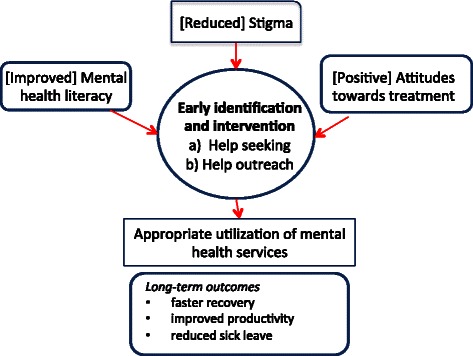
BACKGROUND: Mental illness is a significant and growing problem in Canadian healthcare organizations, leading to tremendous personal, social and financial costs for individuals, their colleagues, their employers and their patients. Early and appropriate intervention is needed, but unfortunately, few workers get the help that they need in a timely way due to barriers related to poor mental health literacy, stigma, and inadequate access to mental health services. Workplace education and training is one promising approach to early identification and support for workers who are struggling. Little is known, however, about what approach is most effective, particularly in the context of healthcare work. The purpose of this study is to compare the impact of a customized, contact-based education approach with standard mental health literacy training on the mental health knowledge, stigmatized beliefs and help-seeking/help-outreach behaviors of healthcare employees. METHODS/DESIGN: A multi-centre, randomized, two-group parallel group trial design will be adopted. Two hundred healthcare employees will be randomly assigned to one of two educational interventions: Beyond Silence, a peer-led program customized to the healthcare workplace, and Mental Health First Aid, a standardized literacy based training program. Pre, post and 3-month follow-up surveys will track changes in knowledge (mental health literacy), attitudes towards mental illness, and help-seeking/help-outreach behavior. An intent-to-treat, repeated measures analysis will be conducted to compare changes in the two groups over time in terms of the primary outcome of behavior change. Linear regression modeling will be used to explore the extent to which knowledge, and attitudes predict behavior change. Qualitative interviews with participants and leaders will also be conducted to examine process and implementation of the programs. DISCUSSION: This is one of the first experimental studies to compare outcomes of standard mental health literacy training to an intervention with an added anti-stigma component (using best-practices of contact-based education). Study findings will inform recommendations for designing workplace mental health education to promote early intervention for employees with mental health issues in the context of healthcare work. TRIAL REGISTRATION: May 2014 - ClinicalTrials.gov: NCT02158871.
Overview
The claims and statistics of this paper haven’t been checked yet.
Free: it reads the open-access text and checks the first 5 claims that cite a source we can check. Create a free account to check every claim.
Integrity signals
Registry
Cites
Statistics
Figures
Verification
Claims the paper makes
The claims and statistics of this paper haven’t been checked yet.
Free: it reads the open-access text and checks the first 5 claims that cite a source we can check. Create a free account to check every claim.
Claims other papers make about this one
Each is checked against this paper’s own text: does it say what the citing paper says it does?
The cited source says what the claim attributes to it.
In the citing paper
“Three studies were unpublished or ongoing [16, 20, 21].”
From Systematic review and meta-analysis of Mental Health First Aid training: Effects on knowledge, stigma, and helping behaviour (2018) · cites this paper as [20]
The check wasn’t confident either way, so it gives no verdict — never disputed.
In the citing paper
“We attempted to contact authors to resolve any uncertainties or to obtain missing information, and received information from 10 studies [13–22].”
From Systematic review and meta-analysis of Mental Health First Aid training: Effects on knowledge, stigma, and helping behaviour (2018) · cites this paper as [20]
Experimental — accuracy not yet measuredThe check wasn’t confident either way, so it gives no verdict — never disputed.
In the citing paper
“A final 18 studies were included in the review, with a total of 5936 participants [13–22, 42–49].”
From Systematic review and meta-analysis of Mental Health First Aid training: Effects on knowledge, stigma, and helping behaviour (2018) · cites this paper as [20]
Experimental — accuracy not yet measured
Self-check
Percentages, sums and reported differences re-computed from the paper’s own numbers.
The self-check needs the paper’s full text.
Citations
Cites
Baron, R. M., & Kenny, D. A. (1986) · Journal of Personality and Social Psychology · doi:10.1037/0022-3514.51.6.1173 · Cited by 91,532 · cited 2×
“Following recommendations by Baron and Kenny [42], we will initially explore whether changes in literacy occur in association with the interventions.”
(2001) · Statistics for Psychologists · doi:10.4324/9781410605542-11 · Cited by 6,877
Lost in knowledge translation: Time for a map?
Graham, I. D., Logan, J., Harrison, M. B., Straus, S. E., Tetroe, J., Caswell, W., & Robinson, N. (2006) · Journal of Continuing Education in the Health Professions · doi:10.1002/chp.47 · Cited by 4,705 · cited 1×
“developed in partnership with stakeholders and tailored to the needs of the target audience [31].”
Diggle, P. J., Heagerty, P. J., Liang, K.-Y., & Zeger, S. L. (2002) · doi:10.1093/oso/9780198524847.001.0001 · Cited by 3,384
Jorm, A. F., Korten, A. E., Jacomb, P. A., Christensen, H., Rodgers, B., & Pollitt, P. (1997) · Medical Journal of Australia · doi:10.5694/j.1326-5377.1997.tb140071.x · Cited by 2,585 · cited 1×
“Mental health literacy refers to the knowledge and skills required for recognition, management and/or prevention of mental disorders [19,20].”
Mental health literacy: Public knowledge and beliefs about mental disorders
Jorm, A. F. (2000) · British Journal of Psychiatry · doi:10.1192/bjp.177.5.396 · Cited by 2,114
The analytic challenge in interpretive description
Thorne, S., Kirkham, S. R., & O'Flynn-Magee, K. (2004) · International Journal of Qualitative Methods · doi:10.1177/160940690400300101 · Cited by 1,793 · cited 1×
“Next, notes from monthly meetings with the peer educators will be reviewed to identify implementation strengths and challenges from the perspective of the facilitators [43].”
Three Strategies for Changing Attributions about Severe Mental Illness
Corrigan, P. W., River, L. P., Lundin, R. K., Penn, D. L., Uphoff-Wasowski, K., Campion, J., Mathisen, J., Gagnon, C., Bergman, M., Goldstein, H., et al. (2001) · Schizophrenia Bulletin · doi:10.1093/oxfordjournals.schbul.a006865 · Cited by 783 · cited 2×
“Evaluation studies of CBE with a range of student groups have reported positive outcomes, including a significant reduction in prejudice and social intolerance [27,30].”
The impact of psychiatric disorders on work loss days
KESSLER, R. C., & FRANK, R. G. (1997) · Psychological Medicine · doi:10.1017/s0033291797004807 · Cited by 716 · cited 1×
“There is often a long lag time between the onset of symptoms and seeking treatment [11,12].”
Improving mental health literacy as a strategy to facilitate early intervention for mental disorders
Kelly, C. M., Jorm, A. F., & Wright, A. (2007) · Medical Journal of Australia · doi:10.5694/j.1326-5377.2007.tb01332.x · Cited by 598 · cited 1×
“Mental health literacy refers to the knowledge and skills required for recognition, management and/or prevention of mental disorders [19,20].”
Research works printed but not linked: 4
- Conference Board of Canada. Mental health issues in the labour force: Reducing the economic impact on Canada. 2012. http://www.conferenceboard.ca/e-library/abstract.aspx?DID=4957. Accessed Feb 2014.
- Statistics Canada 2005 national survey of the work and health of nurses (CIHI share file) 2006 Ottawa Statistics Canada and Canadian Institute for Health Information
- Canadian Institute for Health Information (CIHI) Canada’s healthcare providers: 2005 Chartbook 2005 Ottawa Author
- Attridge M A quiet crisis: the business case for managing employee mental health 2008 Vancouver, BC Wilson Banwell PROACT Human Solutions
Cited by
Morgan, A. J., Ross, A., & Reavley, N. J. (2018) · PLOS ONE · doi:10.1371/journal.pone.0197102 · Cited by 461
Reducing the stigma of mental illness
Stuart, H. (2016) · Global Mental Health · doi:10.1017/gmh.2016.11 · Cited by 300
“More detailed comparative research such as that proposed by Moll et al. (2015) will shed greater light on this issue.”
Self-citationMoll, S. E., Patten, S., Stuart, H., MacDermid, J. C., & Kirsh, B. (2018) · The Canadian Journal of Psychiatry · doi:10.1177/0706743718766051 · Cited by 72
Self-citationBeaulieu, T., Patten, S., Knaak, S., Weinerman, R., Campbell, H., & Lauria-Horner, B. (2017) · The Canadian Journal of Psychiatry · doi:10.1177/0706743716686919 · Cited by 51
Self-citationKing, A. J., Brophy, L. M., Fortune, T., & Byrne, L. (2020) · Psychiatric Services · doi:10.1176/appi.ps.201900606 · Cited by 70
Goh, Y., Ow Yong, Q. Y. J., & Tam, W. W. (2021) · International Journal of Mental Health Nursing · doi:10.1111/inm.12893 · Cited by 43
Mental Health First Aid as a tool for improving mental health and well-being
Richardson, R., Dale, H. E., Robertson, L., Meader, N., Wellby, G., McMillan, D., & Churchill, R. C. (2023) · Cochrane Database of Systematic Reviews · doi:10.1002/14651858.cd013127.pub2 · Cited by 64
Moll, S. E., Zanhour, M., Patten, S. B., Stuart, H. L., & MacDermid, J. C. (2017) · Journal of Occupational Rehabilitation · doi:10.1007/s10926-017-9695-0 · Cited by 45
Self-citationWorkplace Mental Health Training in Health Care: Key Ingredients of Implementation
Moll, S. E., VandenBussche, J., Brooks, K., Kirsh, B. H., Stuart, H. L., Patten, S. B., & MacDermid, J. C. (2018) · The Canadian Journal of Psychiatry · doi:10.1177/0706743718762100 · Cited by 53
Self-citationLaMontagne, A. D., Milner, A. J., Allisey, A., Page, K. M., Reavley, N. J., Martin, A. J., Tchernitskaia, I., Noblet, A. J., Purnell, L. J., Witt, K., et al. (2016) · BMC Psychiatry · doi:10.1186/s12888-016-0741-9 · Cited by 50
Review of Mental Health First Aid Programs
Costa, T. F. O., Sampaio, F. M. C., Sequeira, C., Ribeiro, I., & Parola, V. S. D. O. (2020) · Western Journal of Nursing Research · doi:10.1177/0193945920980743 · Cited by 28
Wulf, I. C. (2022) · Frontiers in Education · doi:10.3389/feduc.2022.856458 · Cited by 32
Interventions to reduce the stigma of mental health at work: a narrative review
Ramírez-Vielma, R., Vaccari, P., Félix Cova, S., Saldivia, S., Vielma-Aguilera, A., & Grandón, P. (2023) · Psicologia Reflexão e Crítica · doi:10.1186/s41155-023-00255-1 · Cited by 28
Cheung, J., Chan, C. Y., & Cheng, H. Y. (2023) · Journal of the American Psychiatric Nurses Association · doi:10.1177/10783903231194579 · Cited by 17
Mental Health Issues and Substance Use in the United States: Pulling the Power Levers
Beeber, L. S. (2018) · Journal of the American Psychiatric Nurses Association · doi:10.1177/1078390318811572 · Cited by 42
Huỳnh, C., Caron, J., & Fleury, M. (2016) · International Journal of Social Psychiatry · doi:10.1177/0020764016641906 · Cited by 15
The “Work” of Workplace Mental Health: An Institutional Ethnography
Malachowski, C., Boydell, K., Sawchuk, P. H., & Kirsh, B. H. (2016) · Society and Mental Health · doi:10.1177/2156869316642265 · Cited by 18
Self-citationLi, L., Xu, W., Wagner, A. L., Dong, X., Yin, J., Zhang, Y., & Boulton, M. L. (2018) · Journal of Infection and Public Health · doi:10.1016/j.jiph.2018.09.004 · Cited by 9
Risk communication about work-related stress disorders in healthcare workers: a scoping review
Emal, L. M., Tamminga, S. J., Daams, J. G., Kežić, S., Timmermans, D. R. M., Schaafsma, F. G., & van der Molen, H. F. (2022) · International Archives of Occupational and Environmental Health · doi:10.1007/s00420-022-01851-x · Cited by 13
Crisan, C., Dijk, P. A. V., Oxley, J. A., & de Silva, A. M. (2022) · BMJ Open · doi:10.1136/bmjopen-2021-056472 · Cited by 10
Kavanaugh, E. B. (2021) · Journal of Hospital Librarianship · doi:10.1080/15323269.2021.1860449 · Cited by 13
Confidentiality, anonymity and amnesty for midwives in distress seeking online support – Ethical?
Pezaro, S., Clyne, W., & Gerada, C. (2016) · Nursing Ethics · doi:10.1177/0969733016654315 · Cited by 11
A Developmental Perspective in Mental Health Services Use Among Adults with Mental Disorders
Huỳnh, C., Caron, J., Pelletier, M., Liu, A., & Fleury, M. (2017) · The Journal of Behavioral Health Services & Research · doi:10.1007/s11414-017-9562-y · Cited by 6
Mental health literacy for public employees
Buta, B. O., Mota, A. C. P., Couto, V. V. D., & Tabak, B. M. (2024) · BMC Public Health · doi:10.1186/s12889-024-19937-1 · Cited by 10
Workplace mental health: Current practice and support needs of Ontario occupational therapists
Moll, S. E., Heino, C. M., LeBlanc, A. H., Beck, L. B., & Kalef, L. (2018) · Canadian Journal of Occupational Therapy · doi:10.1177/0008417418822491 · Cited by 8
Self-citationO ato de cuidar em saúde mental: aspectos alinhados à cultura de segurança do paciente
de Lima, M. E. P., Cortez, E. A., de Almeida, V. L. A., Xavier, S. C. D. M., & Fernandes, F. C. (2021) · SMAD Revista Eletrônica Saúde Mental Álcool e Drogas (Edição em Português) · doi:10.11606/issn.1806-6976.smad.2021.168515 · Cited by 35
Fukita, S., Kawasaki, H., & Yorozuya, K. (2025) · Cureus · doi:10.7759/cureus.82935 · Cited by 4
Bai, Y., & Ma, Y. (2023) · Applied Mathematics and Nonlinear Sciences · doi:10.2478/amns.2023.2.00479 · Cited by 2
Beyond Biometrics: Including Mental Health Screenings in Annual Wellness Programs
Haughtigan, K. S., Link, K., Sturgeon, L. P., Garrett-Wright, D., Lartey, G. K., & Jones, M. S. (2021) · Journal of Psychosocial Nursing and Mental Health Services · doi:10.3928/02793695-20210513-03 · Cited by 2
Stuart, H. L., & Sartorius, N. (2022) · Oxford University Press eBooks · doi:10.1093/med/9780197555804.005.0001
Self-citationZaman, N., Rosyid, F. N. N., & Salmah, U. (2025) · Research Square · doi:10.21203/rs.3.rs-7012132/v1
Summerfield, J., & Leong, A. (2025) · Journal of Medical Radiation Sciences · doi:10.1002/jmrs.70021
Metadata
- Authors
- Moll, S., Patten, S. B., Stuart, H., Kirsh, B., & MacDermid, J. C.
- Affiliations
- McMaster University (CA)
- University of Calgary (CA)
- Queen's University (CA)
- University of Toronto (CA)
- Corresponding author
- Moll, Sandra
- Venue
- BMC Medical Education
- Published
- 2015-04-16
- Volume
- 15
- Issue
- 1
- Pages
- 78-78
- ISSN
- 1472-6920 (ISSN-L)
- PMC
- PMC4440553
- OpenAlex
- W2111854568
- Cited by
- 32
- References
- 41
- Citations by year
- 2025: 3 · 2024: 1 · 2023: 4 · 2022: 4 · 2021: 4 · 2020: 2 · 2018: 6 · 2017: 3 · 2016: 5
- FWCI
- 7.66
- Type
- journal article
- Language
- en
- Open access
- gold
- doi.org
- Locations
- BMC Medical Education (publishedVersion, cc-by)
- PubMed Central (publishedVersion, cc-by)
- PubMed (publishedVersion)
- TSpace (University of Toronto) (submittedVersion)
- Scholarship@Western (Western University) (submittedVersion, cc-by)
- Scholarship@Western (Western University) (submittedVersion)
- Funders
- Hamilton Health Sciences
- Topics
- Health Sciences › Medicine › Psychiatry and Mental health › Mental Health Treatment and Access
- Health Sciences › Medicine › Public Health, Environmental and Occupational Health › Workplace Health and Well-being
- Health Sciences › Medicine › Public Health, Environmental and Occupational Health › Occupational Health and Burnout
- Keywords
- mental health literacy, mental health stigma, help-seeking, mental health first aid, peer-led intervention, healthcare workers, early detection of mental disorders, attitudes toward mental illness
- MeSH terms
- Health Personnel, Humans, Health Knowledge, Attitudes, Practice, Mental Health, Mental Health Services, Occupational Health Services, Ontario, Workplace, Persons with Psychiatric Disorders, Mentally Ill Persons, Social Stigma
About these checks
Registry, retraction, Cites and statistics results are computed, not judged, with one exception: a printed reference that no index lists is read once by a model before it counts as a citation error. Claims are extracted by a model and kept only when their quote appears verbatim in the text; each cited source is then checked, with a model’s help, for whether it says what the claim relies on. Those verdicts can be wrong — read the claim’s quote and the cited source before relying on one.
Statistics and arithmetic are recomputed, not judged.
Confidence bands are shown only for fields calibrated on our annotated test set. None is calibrated yet, so no band is shown.
What counts as a claim ›How we measure confidence ›How we check this ›
Are you an author, or do you see a problem with this page? Request a review
Data sources
Bibliographic data: Semantic Scholar, OpenAlex, Crossref.
Contains information from the Semantic Scholar Academic Graph Datasets, made available under the ODC Attribution License (ODC-BY 1.0).
Semantic Scholar’s data is described in: Kinney, R., et al. (2023). The Semantic Scholar Open Data Platform. arXiv:2301.10140.
