

Virtual reality-based neurological examination teaching tool(VRNET) versus standardized patient in teaching neurological examinations for the medical students: a randomized, single-blind study
Open accessThe DOI matches its Crossref record; 28 of the 28 references it cites were found in a registry or an index.
Abstract
Background: The conventional methods for teaching neurological examination with real patients to medical students have some limitations if the patient with the symptom or disease is not available. Therefore, we developed a Virtual Reality-based Neurological Examination Teaching Tool (VRNET) and evaluated its usefulness in in teaching neurological examinations for the medical students. Methods: In this prospective, randomized, single-blind study, we recruited 98 medical students and divided them into two groups: 1) A standardized patient(SP) group that received the clinical performance examination utilizing standard patients complaining of dizziness was provided neurological findings using conventional method such as verbal description, photographs, and video clips; 2) A SP with VRNET group that was provided the neurological findings using the newly developed tool. Among the 98 students, 3 did not agree to participate, and 95 were enrolled in this study. The SP group comprised 39 students and the SP with VRNET group had 56 students. Results: There were no statistical differences in VRNET’s realness and student satisfaction between the SP and SP with VRNET groups. However, a statistically significant difference was found in the Neurologic Physical Exam (NPE) score (p = 0.043); the SP with VRNET group had higher NPE scores (3.81 ± 0.92) than the SP group (3.40 ± 1.01). Conclusions: VRNET is useful in teaching senior (graduating) medical students with SP with a neurologic problem.
Overview
The claims and statistics of this paper haven’t been checked yet.
Free: it reads the open-access text and checks the first 5 claims that cite a source we can check. Create a free account to check every claim.
Integrity signals
Registry
Cites
Statistics
Figures
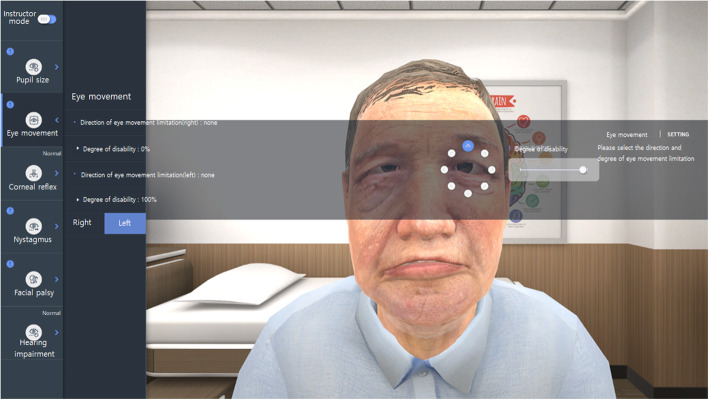
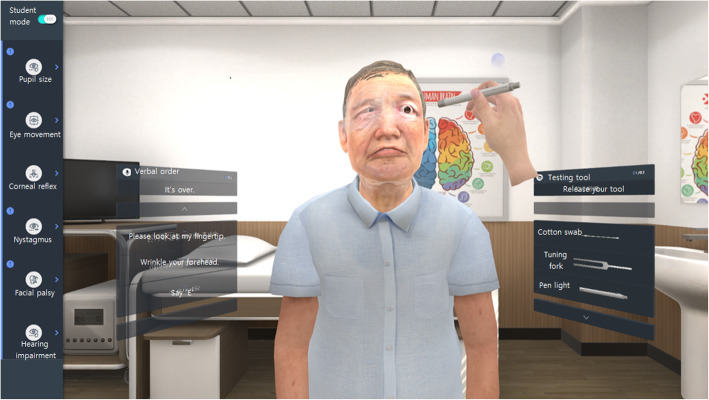
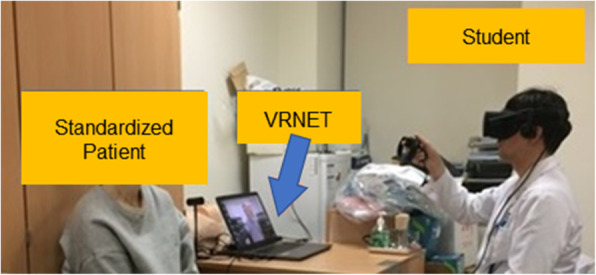
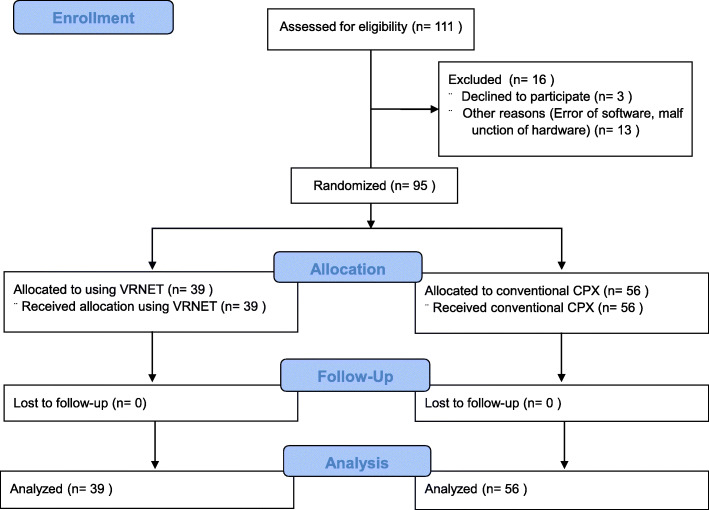
Verification
Claims the paper makes
The claims and statistics of this paper haven’t been checked yet.
Free: it reads the open-access text and checks the first 5 claims that cite a source we can check. Create a free account to check every claim.
Claims other papers make about this one
Each is checked against this paper’s own text: does it say what the citing paper says it does?
The source backs part of the claim, not all of it — or backs it for a different population, condition or comparison.
In the citing paper
“they can provide a more realistic experience with the aid of artificial intelligence (AI) and virtual reality (VR) when certain pathological findings cannot be readily expressed [16-18].”
From Effectiveness of Virtual Simulations Versus Mannequins and Real Persons in Medical and Nursing Education: Meta-Analysis and Trial Sequential Analysis of Randomized Controlled Trials (2024) · cites this paper as [16]
Experimental — accuracy not yet measured
Self-check
Percentages, sums and reported differences re-computed from the paper’s own numbers.
The self-check needs the paper’s full text.
Citations
Cites
Taylor, D. C. M., & Hamdy, H. (2013) · Medical Teacher · doi:10.3109/0142159x.2013.828153 · Cited by 1,176 · cited 1×
“The second is a transformative learning theory that critical reflection can be used to challenge the learner ’ s beliefs and assumptions when medical education using SP or VR coupled with feed-back and reflection [4].”
BackgroundThe effectiveness of virtual and augmented reality in health sciences and medical anatomy
Moro, C., Štromberga, Z., Raikos, A., & Stirling, A. (2017) · Anatomical Sciences Education · doi:10.1002/ase.1696 · Cited by 1,040
Virtual reality and the transformation of medical education
Pottle, J. (2019) · Future Healthcare Journal · doi:10.7861/fhj.2019-0036 · Cited by 985 · cited 2×
“VR can deliver the clinical scenario in a small space (2 × 2 m) with under 5 min of setup [5].”
BackgroundMethodSee One, Do One, Teach One: Advanced Technology in Medical Education
Vozenilek, J. A., Huff, J. S., Reznek, M. A., & Gordon, J. A. (2004) · Academic Emergency Medicine · doi:10.1111/j.1553-2712.2004.tb00698.x · Cited by 417
Cost: The missing outcome in simulation-based medical education research: A systematic review
Zendejas, B., Wang, A. T., Brydges, R., Hamstra, S. J., & Cook, D. A. (2013) · Surgery · doi:10.1016/j.surg.2012.06.025 · Cited by 396
Lloréns, R., Noé, E., Colomer, C., & Alcañiz, M. (2015) · Archives of Physical Medicine and Rehabilitation · doi:10.1016/j.apmr.2014.10.019 · Cited by 357
Virtual Reality Training for Health-Care Professionals
Mantovani, F., Castelnuovo, G., Gaggioli, A., & Riva, G. (2003) · CyberPsychology & Behavior · doi:10.1089/109493103322278772 · Cited by 356
Baniasadi, T., Ayyoubzadeh, S. M., & Mohammadzadeh, N. (2020) · Oman Medical Journal · doi:10.5001/omj.2020.43 · Cited by 328
May, W., Park, J. H., & Lee, J. P. (2009) · Medical Teacher · doi:10.1080/01421590802530898 · Cited by 257
A Discussion of Virtual Reality As a New Tool for Training Healthcare Professionals
Fertleman, C., Aubugeau-Williams, P., Sher, C., Lim, A.-N., Lumley, S., Delacroix, S., & Pan, X. (2018) · Frontiers in Public Health · doi:10.3389/fpubh.2018.00044 · Cited by 132 · cited 1×
“Moreover, basic VR-based medical education tools can allow medical students to perform infinite repetitive training, regardless of time and place [9].”
Background
Cited by
Virtual Simulation in Undergraduate Medical Education: A Scoping Review of Recent Practice
Wu, Q., Wang, Y., Lu, L., Chen, Y., Long, H., & Wang, J. (2022) · Frontiers in Medicine · doi:10.3389/fmed.2022.855403 · Cited by 184
“The second focus of VS-integrated learning contexts in undergraduate medical education was emergency and pediatric emergency medicine training, with 14 articles (10, 16–18, 29, 30, 34, 39, 51, 55, 68, 79, 93, 101) published recently.”
BackgroundInfluentialEffectiveness of Virtual Reality in Healthcare Education: Systematic Review and Meta-Analysis
Sung, H.-K., Kim, M., Park, J.-K., Shin, N., & Han, Y. (2024) · Sustainability · doi:10.3390/su16198520 · Cited by 166
Huai, P., Li, Y., Wang, X., Zhang, L., Liu, N., & Yang, H. (2024) · Nurse Education Today · doi:10.1016/j.nedt.2024.106189 · Cited by 106
Virtual reality for assessment in undergraduate nursing and medical education – a systematic review
Neher, A. N., Bühlmann, F., Müller, M., Berendonk, C., Sauter, T. C., & Birrenbach, T. (2025) · BMC Medical Education · doi:10.1186/s12909-025-06867-8 · Cited by 73
“Situ-ations that are difficult to recreate in real life, such as emergency scenarios [10, 11] can be replicated with VR without posing safety risks to patients and can be used location-independently [12].”
Fugate, J. M. B., Tonsager, M. J., & Macrine, S. L. (2025) · Behavioral Sciences · doi:10.3390/bs15040468 · Cited by 42
Virtual Reality-Integrated Immersion-Based Teaching to English Language Learning Outcome
Xie, Y., Liu, Y., Zhang, F., & Zhou, P. (2022) · Frontiers in Psychology · doi:10.3389/fpsyg.2021.767363 · Cited by 64
“Han et al. (2021) conducted the inspection and research of nervous system teaching tools based on VR.”
BackgroundJiang, N., Zhang, Y., Liang, S., Lyu, X., Chen, S., Huang, X., & Pan, H. (2024) · Journal of Medical Internet Research · doi:10.2196/56195 · Cited by 28
“…simulations (eg, mannequins and SPs), VSs can be undertaken flexibly with no limit of time and space [15]; they can provide a more realistic experience with the aid of artificial intelligence (AI) and virtual reality (VR) when certain pathological findings cannot be readily expressed [16-18].”
InfluentialJiang, Y., Fu, X., Wang, J., Liu, Q.-L., Wang, X., Liu, P.-J., Fu, R., Shi, J., & Wu, Y. (2024) · BMC Medical Education · doi:10.1186/s12909-024-06530-8 · Cited by 30
Immersive virtual reality simulation training for cesarean section: a randomized controlled trial
Kim, H. J., Lee, H. K., Jang, J. Y., Lee, K., Suh, D. H., Kong, H., Lee, S. H., & Park, J. Y. (2023) · International Journal of Surgery · doi:10.1097/js9.0000000000000843 · Cited by 25
Mendoza, G. A. A., Lewis, F., Plante, P., & Brassard, C. (2023) · Edutec Revista Electrónica de Tecnología Educativa · doi:10.21556/edutec.2023.84.2769 · Cited by 39
Design and application of VR-based college English game teaching
Xu, Y., Bao, G., & Duan, X. (2023) · Entertainment Computing · doi:10.1016/j.entcom.2023.100568 · Cited by 16
Zeng, J., Liang, S., Fu, X., Guo, J., Bai, Y., Zhou, S., Du, Q., Wang, Z., Zhang, X., Peng, S., et al. (2023) · BMC Medical Education · doi:10.1186/s12909-023-04198-0 · Cited by 16
Using Virtual Reality in the Care of Older Adults With Dementia: A Randomized Controlled Trial
Xie, Z., Chen, F., Zou, L., Wang, F., & Yang, L. (2023) · Journal of Gerontological Nursing · doi:10.3928/00989134-20231011-01 · Cited by 13
“In addition, due to the security and privacy rights of older adults (Han et al., 2021), students are essentially unable to obtain fi rst-hand experience caring for older adults with dementia through nursing scenarios during the theoretical study period on campus, which greatly reduces their…”
Yu, Z., Zhao, Z., Chen, X., Shi, J., Liang, Y., Zhang, X., Qu, M., Huang, M., Li, P., Li, D., et al. (2025) · BMJ Open · doi:10.1136/bmjopen-2024-095705 · Cited by 17
Impact of artificial intelligence on academic performance in medical education: A systematic review
Kalantarion, M., Heidari, M., Khajeali, N., Khorrami, Z., & Amini, M. (2025) · Journal of Education and Health Promotion · doi:10.4103/jehp.jehp_2071_23 · Cited by 17
“[14] Robot‑assisted vitreoretinal surgery improves precision and limits tissue damage.”
Medical simulation: an essential tool for training, diagnosis, and treatment in the 21st century
Muñoz, C. E. M., Salmerón-Escobar, F. J., Acosta, J. A. H., & León, M. F. C. (2025) · BMC Medical Education · doi:10.1186/s12909-025-07610-z · Cited by 13
“…students with real patients have some limitations, such as: the area of study and in some cases limited availability, therefore, tools such as teaching through virtual reality-based neurological examinations (VRNET) have been developed [13], which has been shown to improve student performance [14].”
Medical Education 4.0: A Neurology Perspective
Zafar, Z., Umair, M., Faheem, F., Bhatti, D., & Kalia, J. S. (2022) · Cureus · doi:10.7759/cureus.31668 · Cited by 22
“Systems like VR-based neurological examination teaching tools (VRNET) are being developed and tested [30].”
BackgroundExploring Emerging Technologies in Online Medical Education: A Survey of Women's Online University
Quraishi, T., Hakimi, M., Hakimi, N., Khani, A. M., Zahid, N., & Mohammadi, F. G. (2024) · Journal of Education Method and Learning Strategy · doi:10.59653/jemls.v2i02.650 · Cited by 17
New innovations and educational process in undergraduate neurology education in blended learning
Mu, S., Hu, J., Liu, F., Zhao, C., & Sun, Y. (2023) · Postgraduate Medicine · doi:10.1080/00325481.2023.2234273 · Cited by 10
“VRNET was developed by a Korean team in 2018–2019 as a VR-based neurological examination tool and it has been proven to be beneficial in reducing labor cost in neurology education [115].”
MethodClay, C. J., Budde, J. R., Hoang, A. Q., & Gushchyan, A. (2024) · Frontiers in Virtual Reality · doi:10.3389/frvir.2024.1402093 · Cited by 15
Burkhardt, V., Valette, M., Speck, I. K., Flayyih, O., Huber, C., Widder, A., Wunderlich, R., Everad, F., Offergeld, C., & Albrecht, T. (2025) · BMC Medical Education · doi:10.1186/s12909-025-06816-5 · Cited by 10
“VR simulations provide standardized and safe environments for learning medical skills [25, 27, 28].”
Lewis, F., Mendoza, G. A. A., Brassard, C., & Plante, P. (2023) · Médiations et médiatisations · doi:10.52358/mm.vi15.330 · Cited by 6
Applications of virtual reality and its effectiveness in healthcare training: a scoping review
Philip, G., & Savundranayagam, M. Y. (2024) · Health and Technology · doi:10.1007/s12553-024-00936-6 · Cited by 9
“These include tablet-based learning [21], physical equipment such as mannequins [22, 23, 25], video-based instruction [24], text-based learning [26], standardized patients [28], role play [31], and traditional reading, didactic teaching, online modules, low-fidelity simulations [35].”
Sampath, K. K., Arumugam, A., Yaghi, E., Fairs, E., & Andersen, P. (2023) · BMC Medical Education · doi:10.1186/s12909-023-04497-6 · Cited by 9
Real-Time Surface-Based Volume Constraints on Mass-Spring Model in Unity3D
Va, H., Choi, M., & Hong, M. (2023) · IEEE Access · doi:10.1109/access.2023.3245130 · Cited by 6
“VR technologies are well suited to medical education including treatment, rehabilitation, and especially virtual surgery [19], [20], [21], [22], [23], [24].”
BackgroundXie, Z., Zou, L., Wang, Q., Chen, Y., Li, L., Liao, Y., & Chen, F. (2024) · Geriatric Nursing · doi:10.1016/j.gerinurse.2024.06.003 · Cited by 5
Using HMD-based Hand Tracking Virtual Reality in Canine Anatomy Summative Assessment: a User Study
Xu, X., Pan, X., Kilroy, D. P., Kumar, A., Mangina, E., & Campbell, A. G. (2022) · Proceedings - International Symposium on Mixed and Augmented Reality, ISMAR · doi:10.1109/ismar55827.2022.00044 · Cited by 5
“The virtual patient shown in the virtual space could increase students’ learning outcomes while keeping the same satisfaction level as a standardized patient [13].”
BackgroundMethodPark, J. J. (2021) · Korean Medical Education Review · doi:10.17496/kmer.2021.23.3.147 · Cited by 6
Bass, D., Gupta, A., Weingartner, L., & de Paleville, D. T. (2026) · AJP Advances in Physiology Education · doi:10.1152/advan.00019.2025 · Cited by 2
Gholamalishahi, S., Barletta, V. I., Manai, M. V., Battisti, F., Centonze, L., Torre, G. L., & Mannocci, A. (2024) · Journal of Public Health · doi:10.1007/s10389-024-02268-1 · Cited by 5
“Studies by Gray et al.(2022), Han et al. (2021) and Ulrich et al. (Ulrich et al. 2021) also examine differences in LS between the two teaching approaches; in the first two, the results reported no significant difference between the control group and the experimental one, whereas in the third a…”
InfluentialKharidia, K. M., Lin, M. E., West, J. D., Sarode, D. N., Ma, H. J., Vanstrum, E. B., Wu, F. M., & Johns, M. M. E. (2022) · Annals of Otology Rhinology & Laryngology · doi:10.1177/00034894221139107 · Cited by 3
Conceptualizing VR - Integrated Lectures in Higher Education: A Lecture Structure Framework
Bisswang, N., Richter, S., & Heumüller, E. (2024) · IEEE International Conference on Engineering, Technology and Innovation (ICE/ITMC) · doi:10.1109/ice/itmc61926.2024.10794224 · Cited by 1
Trout, J., Roberts, M. H., Carver, D., & Martínez, P. (2025) · Neurology Education · doi:10.1212/ne9.0000000000200236 · Cited by 1
Manso, I. A., Gaminde, A. L., Tíscar-González, V., Ibero, I. V., García, E. A. P., Arnaiz, A. A., Román, I. A. S., & Totaricaguena, A. L. (2025) · Revista Española de Educación Médica · doi:10.6018/edumed.688741 · Cited by 1
From Virtual Patients to AI-Powered Training: The Evolution of Medical Simulation
Muñoz, C. E. M., Salmerón-Escobar, F. J., & Acosta, J. A. H. (2024) · Bionatura journal : · doi:10.70099/bj/2024.01.04.7 · Cited by 2
The Shadow-Side of the Neurological Evaluation
Pimentel, J. (2022) · Sinapse · doi:10.46531/sinapse/ed/220037/2022 · Cited by 1
Reiter-Campeau, S., Lubarsky, S., Chalk, C., Buyukkurt, A., Levesque‐Roy, M., Clouatre, A., Benea, D., Rahman, T., & Moore, F. G. A. (2023) · Neurology Education · doi:10.1212/ne9.0000000000200083 · Cited by 1
“10 A review of virtual, augmented, and alternate reality methods described their applicability for procedural and communication skills but not for the physical examination.”
BackgroundYang, S., Beom, J. H., Han, E. A., & Cho, J. (2023) · Research Square · doi:10.21203/rs.3.rs-2558405/v1
Self-citationNeher, A. N., Berendonk, C., Neubauer, F. B., Delahaye, M., Kannape, O. A., Sauter, T. C., & Birrenbach, T. (2024) · doi:10.2196/preprints.65086
Tom, O., Betty, K., Tibaijuka, L., Kaddumukasa, M., & Hanifah, N. (2025) · BMC Medical Education · doi:10.1186/s12909-025-07839-8 · Cited by 1
“Sim-ulations-based learning improve knowledge, critical care skills including neurological assessment, and retention after five months [31–33], but optimization of learning and long-term retention, can be achieved through a blended learning approaches that involves multiple touchpoints.”
Fatehi, V., Salahzadeh, Z., Farhoudi, M., Mohammadi, A. R., & Mohammadzadeh, Z. (2025) · Physiotherapy Research International · doi:10.1002/pri.70107
“Numerous research studies have been conducted on the use of VR in therapeutic exercises for various target groups, including those recovering from strokes (Henrique et al. 2019), cerebral palsy (Pereira et al. 2023), multiple sclerosis (Han et al. 2021), and Parkinson's disease (Wen et al. 2021).”
Enhancing Neurological Examination Education with a VR-Based Cranial Nerve Training System
Chen, C., Li, W.-J., Lu, W.-T., Shen, Y.-L., Chang, Y.-M., Wang, C., & Natanael, I. N. (2025) · IEEE Global Conference on Consumer Electronics (GCCE) · doi:10.1109/gcce65946.2025.11275251
“Moreover, previous studies have noted that certain neurological signs are inherently difficult for healthy individuals to mimic accurately [7], a limitation that was also echoed in our expert interviews.”
Kovanur Sampath, K., Arumugam, A., Yaghi, E., Fairs, E., & Andersen, P. (2024) · Figshare · doi:10.6084/m9.figshare.26604553
Teaching Neurology in a Busy Clinical Practice
Robertson, M. L., & Salas, R. M. E. (2026) · CONTINUUM Lifelong Learning in Neurology · doi:10.1212/cont.0000000000001661
Nagdy, H. M., Massoud, F. T., Moheyeldin, S. A., Basha, M. Y., Hassan, S. M., & El-Kassas, M. (2026) · BMC Medical Education · doi:10.1186/s12909-025-08536-2 · Cited by 1
Xu, D., Zhou, L., Zhang, Z., Fan, H., Qian, M., & Huang, X. (2026) · BMC Medical Education · doi:10.1186/s12909-026-09309-1
Abaszadeh, F., Boldaji, M. R., AMIRZADEH, S., Hayat, A. A., Zare, S., & Mottahedi, M. (2026) · Discover Education · doi:10.1007/s44217-026-02080-x · Cited by 2
“Several studies highlighted additional educational advantages of immersive VR, including the ability to simulate uncommon pathological findings, provide safe and repeatable practice, and facilitate learning of sensitive or difficult to access examinations [47, 50–54].”
Shin, I., Ryu, S., Han, M., Kim, S., & Kim, J. H. (2026) · Clinical Simulation in Nursing · doi:10.1016/j.ecns.2026.102093
Sarkar, D. K., Basu, S., Banerjee, R., Das, A. K., & Das, S. (2026) · Cureus · doi:10.7759/cureus.118734
Fatehi, V., Salahzadeh, Z., Mohammadzadeh, Z., & Taghizadeh, A. (2026) · Journal of Education and Health Promotion · doi:10.4103/jehp.jehp_959_25
Metadata
- Authors
- Han, S. G., Kim, Y. D., Kong, T. Y., & Cho, J.
- Affiliations
- Yonsei University (KR)
- Corresponding author
- Cho, Junho
- Venue
- BMC Medical Education
- Published
- 2021-09-15
- Volume
- 21
- Issue
- 1
- Pages
- 493-493
- ISSN
- 1472-6920 (ISSN-L)
- PMC
- PMC8444400
- OpenAlex
- W3200898460
- Semantic Scholar
- 94839e04eed328b80eaf3d8f5a1b40f49d0a69f6
- Cited by
- 50
- References
- 28
- Citations by year
- 2026: 8 · 2025: 11 · 2024: 13 · 2023: 11 · 2022: 6 · 2021: 1
- FWCI
- 4.86
- Type
- journal article
- Language
- en
- Open access
- gold
- doi.org
- Licence
- cc-by
- creativecommons.org/licenses/by/4.0 (tdm)
- creativecommons.org/licenses/by/4.0 (vor)
- Locations
- BMC Medical Education (publishedVersion, cc-by)
- Europe PMC (PubMed Central) (publishedVersion, other-oa)
- PubMed Central (publishedVersion, cc-by)
- PubMed (publishedVersion)
- DOAJ (DOAJ: Directory of Open Access Journals) (submittedVersion, cc-by-sa)
- YUHSpace (Yonsei University Medical Library) (submittedVersion, cc-by-nc-nd)
- Funders
- Yonsei University College of Medicine (1-2018-0111)
- Topics
- Social Sciences › Education › Simulation-Based Education in Healthcare
- Social Sciences › Education › Innovations in Medical Education
- Physical Sciences › Engineering › Biomedical Engineering › Anatomy and Medical Technology
- Keywords
- virtual reality, neurological examination, medical education, standardized patients, clinical skills training, dizziness, medical students, simulation-based teaching
- MeSH terms
- Virtual Reality, Clinical Competence, Education, Medical, Undergraduate, Humans, Neurologic Examination, Physical Examination, Prospective Studies, Students, Medical, Teaching, Single-Blind Method
About these checks
Registry, retraction, Cites and statistics results are computed, not judged, with one exception: a printed reference that no index lists is read once by a model before it counts as a citation error. Claims are extracted by a model and kept only when their quote appears verbatim in the text; each cited source is then checked, with a model’s help, for whether it says what the claim relies on. Those verdicts can be wrong — read the claim’s quote and the cited source before relying on one.
Statistics and arithmetic are recomputed, not judged.
Confidence bands are shown only for fields calibrated on our annotated test set. None is calibrated yet, so no band is shown.
What counts as a claim ›How we measure confidence ›How we check this ›
Are you an author, or do you see a problem with this page? Request a review
Data sources
Bibliographic data: Semantic Scholar, OpenAlex, Crossref.
Contains information from the Semantic Scholar Academic Graph Datasets, made available under the ODC Attribution License (ODC-BY 1.0).
Semantic Scholar’s data is described in: Kinney, R., et al. (2023). The Semantic Scholar Open Data Platform. arXiv:2301.10140.
