

The DOI matches its Crossref record; 27 of the 27 references it cites were found in a registry or an index.
Digital health competencies in medical school education: a scoping review and Delphi method study
Open accessAbstract
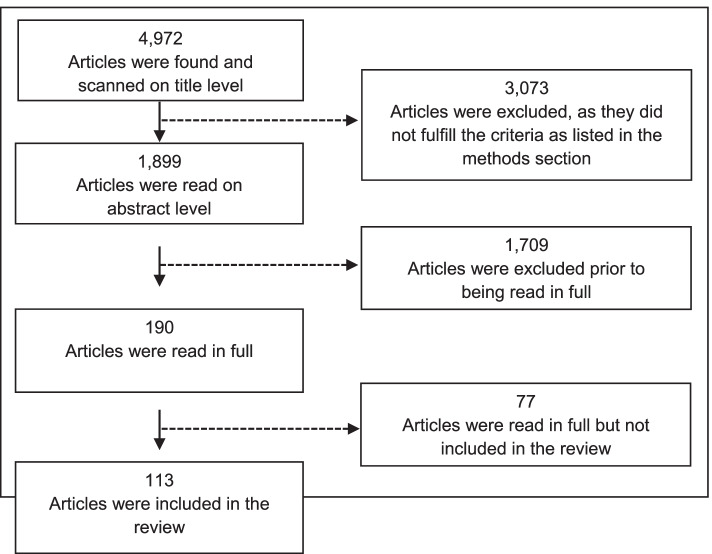
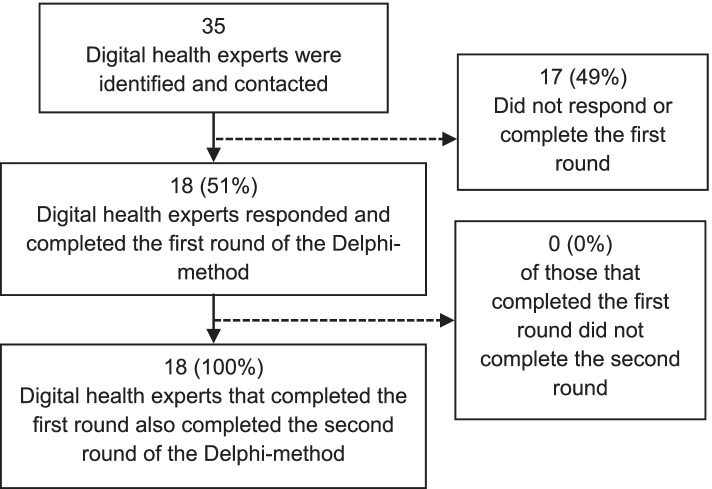
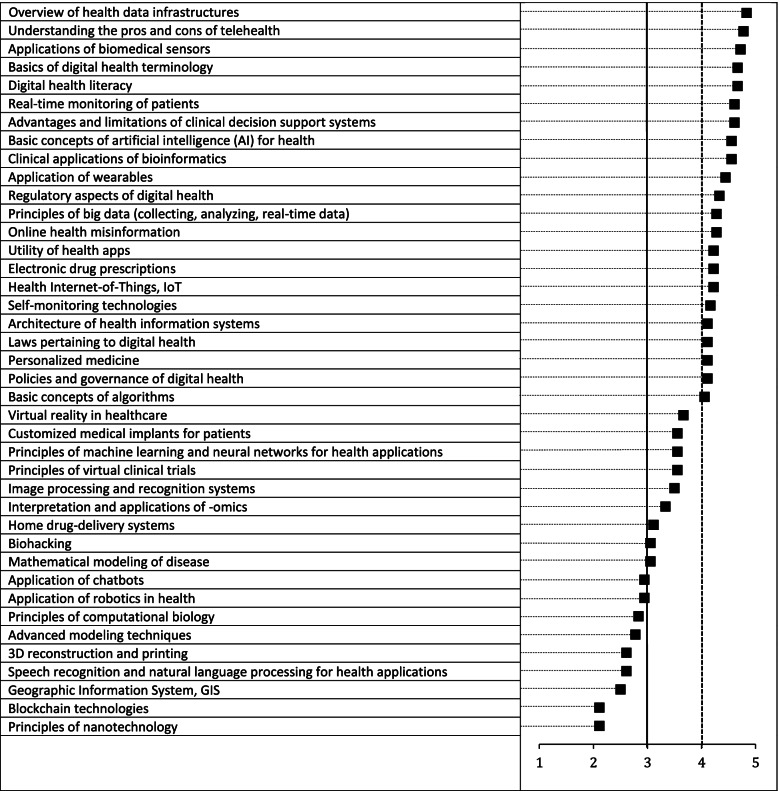
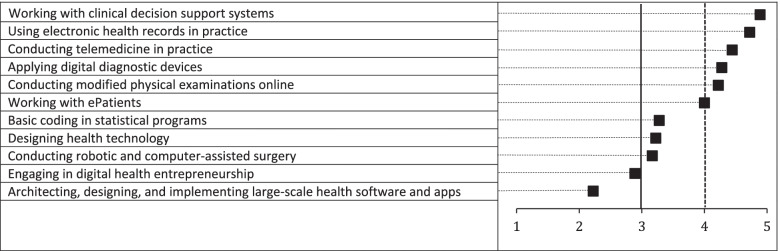
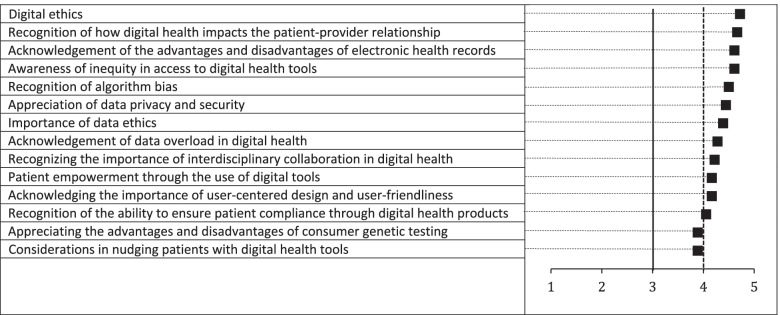
INTRODUCTION: In order to fulfill the enormous potential of digital health in the healthcare sector, digital health must become an integrated part of medical education. We aimed to investigate which knowledge, skills and attitudes should be included in a digital health curriculum for medical students through a scoping review and Delphi method study. METHODS: We conducted a scoping review of the literature on digital health relevant for medical education. Key topics were split into three sub-categories: knowledge (facts, concepts, and information), skills (ability to carry out tasks) and attitudes (ways of thinking or feeling). Thereafter, we used a modified Delphi method where experts rated digital health topics over two rounds based on whether topics should be included in the curriculum for medical students on a scale from 1 (strongly disagree) to 5 (strongly agree). A predefined cut-off of ≥4 was used to identify topics that were critical to include in a digital health curriculum for medical students. RESULTS: The scoping review resulted in a total of 113 included articles, with 65 relevant topics extracted and included in the questionnaire. The topics were rated by 18 experts, all of which completed both questionnaire rounds. A total of 40 (62%) topics across all three sub-categories met the predefined rating cut-off value of ≥4. CONCLUSION: An expert panel identified 40 important digital health topics within knowledge, skills, and attitudes for medical students to be taught. These can help guide medical educators in the development of future digital health curricula.
Overview
The claims and statistics of this paper haven’t been checked yet.
Run the check — free, no account needed. It reads the open-access text and checks the sources it cites.
Integrity signals
Registry
Cites
Statistics
Figures
Verification
Claims the paper makes
The claims and statistics of this paper haven’t been checked yet.
Run the check — free, no account needed. It reads the open-access text and checks the sources it cites.
Claims other papers make about this one
Each is checked against this paper’s own text: does it say what the citing paper says it does?
The check wasn’t confident either way, so it gives no verdict — never disputed.
In the citing paper
“It requires algorithmic validation, using techniques such as federated learning or subgroup analysis, to ensure they are controlled for bias [37,45]”
From An evidence-based approach to artificial intelligence education for medical students: A systematic review (2023) · cites this paper as [45]
Experimental — accuracy not yet measuredIn the citing paper
“Eleven studies suggest that physicians should understand the role of data science in AI [12,13,16,37,39,41,42,45].”
From An evidence-based approach to artificial intelligence education for medical students: A systematic review (2023) · cites this paper as [45]
In the citing paper
“Nine studies discuss the need for a fundamental understanding of AI ethics to improve the adoption of AI in medicine and ensure its safe use [12,13,16,37,39,45].”
From An evidence-based approach to artificial intelligence education for medical students: A systematic review (2023) · cites this paper as [45]
Self-check
Percentages, sums and reported differences re-computed from the paper’s own numbers.
The self-check needs the paper’s full text.
Citations
Cites
Scoping studies: towards a methodological framework
Arksey, H., & O'Malley, L. (2005) · International Journal of Social Research Methodology · doi:10.1080/1364557032000119616 · Cited by 36,742
An Experimental Application of the DELPHI Method to the Use of Experts
Dalkey, N., & Helmer, O. (1963) · Management Science · doi:10.1287/mnsc.9.3.458 · Cited by 6,061
Qualitative Research: Consensus methods for medical and health services research
Jones, J., & Hunter, D. (1995) · BMJ · doi:10.1136/bmj.311.7001.376 · Cited by 3,471
The role of telehealth during COVID-19 outbreak: a systematic review based on current evidence
Monaghesh, E., & Hajizadeh, A. (2020) · BMC Public Health · doi:10.1186/s12889-020-09301-4 · Cited by 1,941
The Delphi technique in health sciences education research
de Villiers, M., Villiers, P. J. T. D., & Kent, A. (2005) · Medical Teacher · doi:10.1080/13611260500069947 · Cited by 1,007
The Recent Progress and Applications of Digital Technologies in Healthcare: A Review
Senbekov, M., Saliev, T. M., Bukeyeva, Z., Almabayeva, A., Zhanaliyeva, M., Джамбуловна, А. Н., Toishibekov, Y., & Fakhradiyev, I. R. (2020) · International Journal of Telemedicine and Applications · doi:10.1155/2020/8830200 · Cited by 513
Using smartphones and health apps to change and manage health behaviors: a population-based survey
Ernsting, C., Dombrowski, S. U., Oedekoven, M., O´Sullivan, J. L., Kanzler, M., Kuhlmey, A., & Gellert, P. (2017) · Journal of Medical Internet Research · doi:10.2196/jmir.6838 · Cited by 400
The emerging clinical role of wearables: Factors for successful implementation in healthcare
Smuck, M., Odonkor, C. A., Wilt, J. K., Schmidt, N., & Swiernik, M. A. (2021) · npj Digital Medicine · doi:10.1038/s41746-021-00418-3 · Cited by 393
Guo, C., Ashrafian, H., Ghafur, S., Fontana, G., Gardner, C., & Prime, M. S. (2020) · npj Digital Medicine · doi:10.1038/s41746-020-00314-2 · Cited by 345
Reimagining Medical Education in the Age of AI
(2019) · AMA Journal of Ethics · doi:10.1001/amajethics.2019.146 · Cited by 263
What do medical students actually need to know about artificial intelligence?
McCoy, L. G., Nagaraj, S., Morgado, F., Harish, V., Das, S., & Celi, L. A. (2020) · npj Digital Medicine · doi:10.1038/s41746-020-0294-7 · Cited by 240
Bauer, M., Glenn, T., Geddes, J., Gitlin, M., Grof, P., Kessing, L. V., Monteith, S., Faurholt-Jepsen, M., Severus, E., & Whybrow, P. C. (2020) · International Journal of Bipolar Disorders · doi:10.1186/s40345-019-0164-x · Cited by 163
Shamout, F. E., Shen, Y., Wu, N., Kaku, A., Park, J., Makino, T., Jastrzȩbski, S., Witowski, J. S., Wang, D., Zhang, B., et al. (2021) · npj Digital Medicine · doi:10.1038/s41746-021-00453-0 · Cited by 161
Aungst, T. D., & Patel, R. (2020) · Journal of Medical Education and Curricular Development · doi:10.1177/2382120519901275 · Cited by 135
Bridging the digital divide in health care
Makri, A. (2019) · The Lancet Digital Health · doi:10.1016/s2589-7500(19)30111-6 · Cited by 130
Grime, M. M., & Wright, G. (2016) · Wiley StatsRef: Statistics Reference Online · doi:10.1002/9781118445112.stat07879 · Cited by 112
Poncette, A.-S., Glauert, D. L., Mosch, L. K., Braune, K., Balzer, F., & Back, D. A. (2020) · Journal of Medical Internet Research · doi:10.2196/22161 · Cited by 107
Digital health training programs for medical students: scoping review
Tudor Car, L., Kyaw, B. M., Nannan Panday, R. S., van der Kleij, R., Chavannes, N., Majeed, A., & Car, J. (2021) · JMIR Medical Education · doi:10.2196/28275 · Cited by 106
Sjoding, M. W., Taylor, D., Motyka, J., Lee, E., Co, I. N., Claar, D. D., McSparron, J. I., Ansari, S., Kerlin, M. P., Reilly, J. P., et al. (2021) · The Lancet Digital Health · doi:10.1016/s2589-7500(21)00056-x · Cited by 84
Strategies for coping with information overload
Smith, R. W. (2010) · BMJ · doi:10.1136/bmj.c7126 · Cited by 75
Harnessing the digital potential of the next generation of health professionals
Wong, B. L. H., Khurana, M. P., Smith, R. D., Omrani, O. E., Põld, A., Lotfi, A., O’Leary, C., & Saminarsih, D. S. (2021) · Human Resources for Health · doi:10.1186/s12960-021-00591-2 · Cited by 68
Self-citationJiang, Y., Liang, X., Han, Z., Wang, W., Xi, S., Li, T., Chen, C., Yuan, Q., Li, N., Yu, J., et al. (2021) · The Lancet Digital Health · doi:10.1016/s2589-7500(21)00065-0 · Cited by 58
Rono, H. K., Bastawrous, A., Macleod, D., Mamboleo, R., Bunywera, C., Wanjala, E., Gichuhi, S., & Burton, M. J. (2020) · The Lancet Digital Health · doi:10.1016/s2589-7500(21)00083-2 · Cited by 45
Chen, Y., & Banerjee, A. (2020) · Future Healthcare Journal · doi:10.7861/fhj.2020-0162 · Cited by 30
A Digital Health Preclinical Requirement for Medical Students
Chandrashekar, P. (2019) · Academic Medicine · doi:10.1097/acm.0000000000002685 · Cited by 24
Keeping Pace: The Need for Digital Health Education in Medical Schools
Khurana, M. (2020) · Academic Medicine · doi:10.1097/acm.0000000000003672 · Cited by 21
Self-citation“Digital Health” in Medical School
Rosenman, D. J., & Swanson, W. S. (2020) · Academic Medicine · doi:10.1097/acm.0000000000003359 · Cited by 2
Research works printed but not linked: 1
- National Videnskabsetisk Komité. Hvad skal jeg anmelde. 2020. Available from: https://www.nvk.dk/forsker/naar-du-anmelder/hvilke-projekter-skal-jeg-anmelde.
Cited by
Sorted by citations
The Digital Health Competencies in Medical Education Framework
Car, J., Ong, Q. C., Erlikh Fox, T., Leightley, D., Kemp, S. J., Švab, I., Tsoi, K. K. F., Sam, A. H., Kent, F. M., Hertelendy, A. J., et al. (2025) · JAMA Network Open · doi:10.1001/jamanetworkopen.2024.53131 · Cited by 155
Ejaz, H., McGrath, H., Wong, B. L., Guise, A., Vercauteren, T., & Shapey, J. (2022) · DIGITAL HEALTH · doi:10.1177/20552076221089099 · Cited by 105
Pupic, N., Ghaffari-zadeh, A., Hu, R., Singla, R., Darras, K., Karwowska, A., & Forster, B. B. (2023) · PLOS Digital Health · doi:10.1371/journal.pdig.0000255 · Cited by 79
Empowering Health Professionals with Digital Skills to Improve Patient Care and Daily Workflows
Ferreira, J. C., Elvas, L. B., Correia, R., & Mascarenhas, M. (2025) · Healthcare · doi:10.3390/healthcare13030329 · Cited by 71
Developing a Canadian artificial intelligence medical curriculum using a Delphi study
Singla, R., Pupic, N., Ghaffarizadeh, S.-A., Kim, C., Hu, R., Forster, B. B., & Hacihaliloglu, I. (2024) · npj Digital Medicine · doi:10.1038/s41746-024-01307-1 · Cited by 56
Metadata
- Authors
- Khurana, M. P., Raaschou-Pedersen, D. E., Kurtzhals, J., Bardram, J. E., Ostrowski, S. R., & Bundgaard, J. S.
- Affiliations
- University of Copenhagen (DK)
- Technical University of Denmark (DK)
- Copenhagen University Hospital (DK)
- Corresponding author
- Khurana, Mark P.
- ORCID
- Venue
- BMC Medical Education
- Published
- 2022-02-26
- Volume
- 22
- Issue
- 1
- Pages
- 129-129
- ISSN
- 1472-6920 (ISSN-L)
- PMC
- PMC8881190
- OpenAlex
- W4214484266
- Cited by
- 129
- References
- 27
- Citations by year
- 2026: 15 · 2025: 36 · 2024: 49 · 2023: 21 · 2022: 7
- FWCI
- 5.77
- Type
- journal article
- Language
- en
- Open access
- gold
- doi.org
- Locations
- BMC Medical Education (publishedVersion, cc-by)
- PubMed Central (publishedVersion, cc-by)
- PubMed (publishedVersion)
- Research at the University of Copenhagen (University of Copenhagen) (publishedVersion, cc-by)
- DOAJ (DOAJ: Directory of Open Access Journals) (submittedVersion, cc-by-sa)
- Technical University of Denmark, DTU Orbit (Technical University of Denmark, DTU) (submittedVersion, cc-by)
- Topics
- Social Sciences › Education › Innovations in Medical Education
- Health Sciences › Health Professions › General Health Professions › Health and Medical Education
- Health Sciences › Medicine › Health Informatics › Artificial Intelligence in Healthcare and Education
- Keywords
- digital health competencies, medical education, medical students, knowledge, skills and attitudes, expert consensus, digital health literacy
- MeSH terms
- Curriculum, Delphi Technique, Education, Medical, Humans, Schools, Medical, Students, Medical
About these checks
Registry, retraction, Cites and statistics results are computed, not judged, with one exception: a printed reference that no index lists is read once by a model before it counts as a citation error. Claims are extracted by a model and kept only when their quote appears verbatim in the text; each cited source is then checked, with a model’s help, for whether it says what the claim relies on. Those verdicts can be wrong — read the claim’s quote and the cited source before relying on one.
Statistics and arithmetic are recomputed, not judged.
Confidence bands are shown only for fields calibrated on our annotated test set. None is calibrated yet, so no band is shown.
What counts as a claim ›How we measure confidence ›How we check this ›
Are you an author, or do you see a problem with this page? Request a review
