

The DOI matches its Crossref record; 22 of the 24 references it cites were found in a registry or an index; none of the 40 sources its claims cite is checked for support yet.
Exploration of exposure to artificial intelligence in undergraduate medical education: a Canadian cross-sectional mixed-methods study
Open accessAbstract
Background: Emerging artificial intelligence (AI) technologies have diverse applications in medicine. As AI tools advance towards clinical implementation, skills in how to use and interpret AI in a healthcare setting could become integral for physicians. This study examines undergraduate medical students’ perceptions of AI, educational opportunities about of AI in medicine, and the desired medium for AI curriculum delivery. Methods: A 32 question survey for undergraduate medical students was distributed from May–October 2021 to students to all 17 Canadian medical schools. The survey assessed the currently available learning opportunities about AI, the perceived need for learning opportunities about AI, and barriers to educating about AI in medicine. Interviews were conducted with participants to provide narrative context to survey responses. Likert scale survey questions were scored from 1 (disagree) to 5 (agree). Interview transcripts were analyzed using qualitative thematic analysis. Results: We received 486 responses from 17 of 17 medical schools (roughly 5% of Canadian undergraduate medical students). The mean age of respondents was 25.34, with 45% being in their first year of medical school, 27% in their 2nd year, 15% in their 3rd year, and 10% in their 4th year. Respondents agreed that AI applications in medicine would become common in the future (94% agree) and would improve medicine (84% agree Further, respondents agreed that they would need to use and understand AI during their medical careers (73% agree; 68% agree), and that AI should be formally taught in medical education (67% agree). In contrast, a significant number of participants indicated that they did not have any formal educational opportunities about AI (85% disagree) and that AI-related learning opportunities were inadequate (74% disagree). Interviews with 18 students were conducted. Emerging themes from the interviews were a lack of formal education opportunities and non-AI content taking priority in the curriculum. Conclusion: A lack of educational opportunities about AI in medicine were identified across Canada in the participating students. As AI tools are currently progressing towards clinical implementation and there is currently a lack of educational opportunities about AI in medicine, AI should be considered for inclusion in formal medical curriculum.
Overview
AI snapshot
Written from the paper’s full text.
TL;DR
In a Canadian cross-sectional mixed-methods study, most surveyed undergraduate medical students believed AI would become common and improve medicine and wanted formal AI teaching, but most reported no formal AI education. Interviews echoed a lack of formal opportunities and concern that non-AI content would take curricular priority.
Key findings
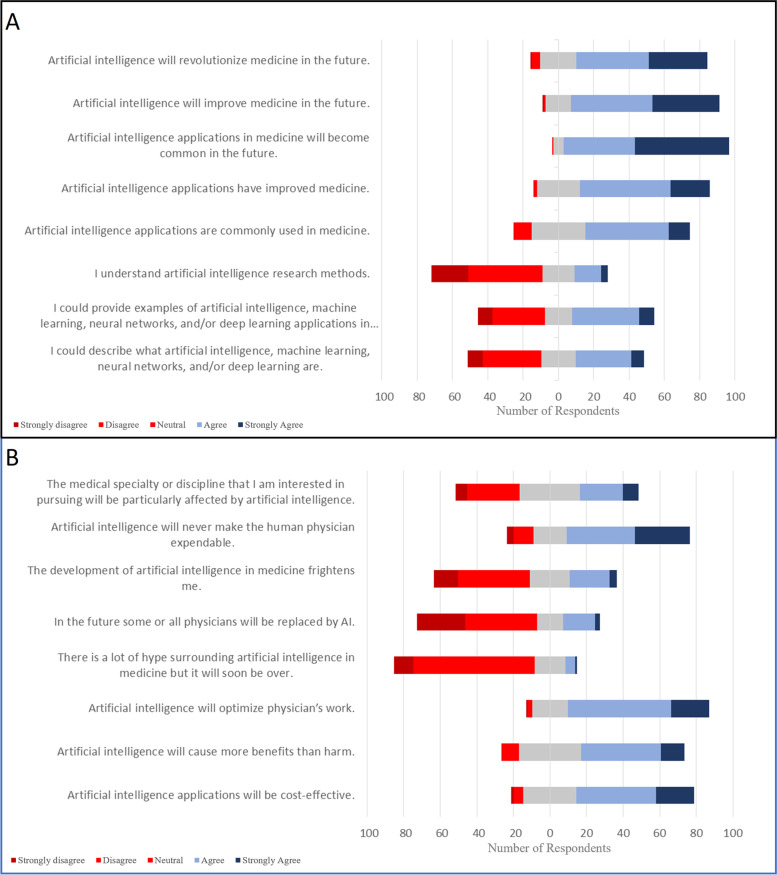
- Among 475 included survey respondents from all 17 Canadian medical schools, 94% agreed AI applications in medicine would become common, 84% agreed AI would improve medicine, 73% agreed they would need to use AI, 68% agreed they would need to understand AI, and 67% agreed AI should be formally taught in medical education.
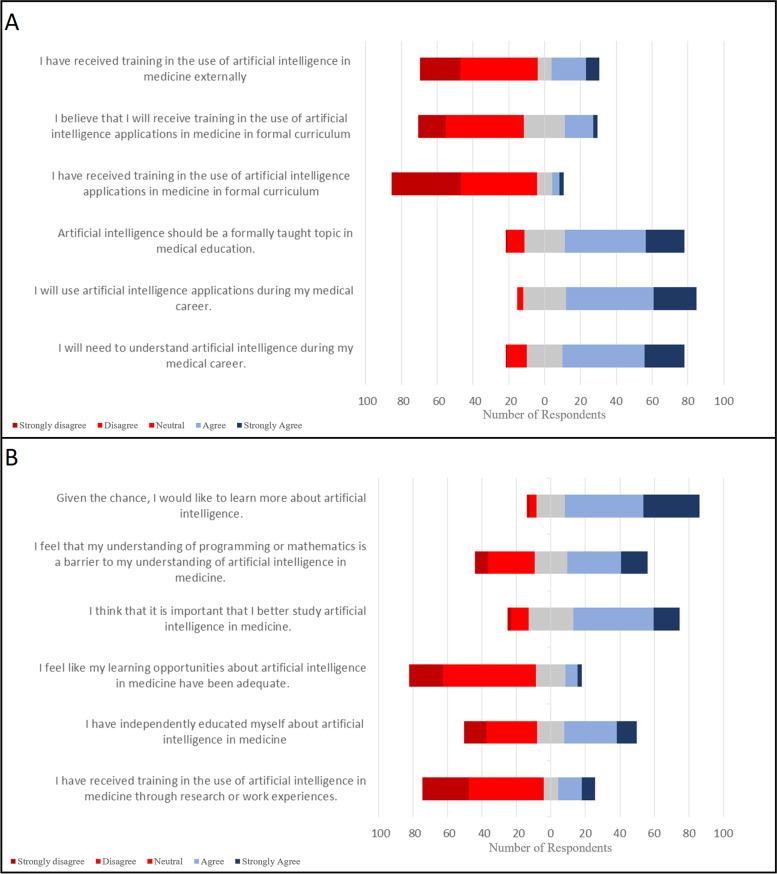
- 85% disagreed they had received formal curriculum training in AI, 74% disagreed AI-related learning opportunities were adequate, and 75.8% (360) reported no formal teaching about AI during medical school. Preferred formats were workshops (27.1%, 299), lectures (23.8%, 263), and collaborative activities with other departments such as computer science (17.3%, 191).
- Interviews yielded three major themes: a lack of existing learning opportunities about AI, the need to incorporate AI learning in medical curriculum, and positive sentiment about the future of AI in medicine. Subthemes included elective/informal learning, scarcity of formal opportunities, desired formats, barriers to curriculum development, excitement, and fear about misuse or poor stewardship.
- Students showed some cognitive dissonance: 74% agreed AI would revolutionize medicine, but only 31.7% agreed AI would particularly affect their specialty of choice while 35.1% disagreed; 66% disagreed that some or all physicians would be replaced by AI.
Methods
- Cross-sectional mixed-methods study with a 56-question online survey (abstract says 32 questions) distributed May–October 2021 to all 17 Canadian medical schools; inclusion required consent and enrollment in a Canadian medical school at any time in 2021. There were 486 responses, of which 475 met inclusion criteria. Likert items were scored 1 (disagree) to 5 (agree).
- Follow-up 10–15 minute interviews were conducted via Zoom between October and December 2021 with a stratified random sample from English-speaking medical schools; the paper reports 17 undergraduate medical students recruited from 11 medical schools, while the abstract states 18 students were interviewed.
- Quantitative data were analyzed descriptively in SPSS 27.0, with Likert results reported as percentages agreeing/disagreeing and counts; interview transcripts were analyzed using emergent thematic analysis with two independent blinded coders, and inter-coder reliability was 82%.
Limitations
- The paper states non-response and participant bias; respondents made up only ~4.5% of the total Canadian undergraduate medical student population, dissemination varied by school, later-stage and male respondents were underrepresented, no formal survey validation was employed beyond an internal pilot, the survey was lengthy, and the authors could not comment on how many participants were recruited through each medium.
- The paper states participant bias likely affected outcomes, with respondents more likely to possess interest or knowledge of AI and stronger technical understanding than non-respondents.
- Evident in the text: the abstract reports 18 interviews while the methods/results report 17 recruited, and the abstract describes a 32-question survey while the methods describe a 56-question survey.
Model-written summary. Check it against the paper before relying on it.
Integrity signals
Registry
Cites
Statistics
Figures
Verification
Claims the paper makes
45 Own result · 25 Not checked yet · 20 Own method · 3 Own interpretation
A result the paper reports from its own data — it cites no other source for it, so there is none to check. The quote shows it is in the paper.
In the paper
“The preferred learning format about AI in medicine were workshops (27.1%, 299), lectures (23.8%, 263), and collaborative activities with other departments such as computer science (17.3%, 191).”
§ Exploration of exposure to artificial intelligence in undergraduate medical education: a Canadian cross-sectional mixed-methods study > Results > Survey (quantitative analysis)
plain- Asserted: passes — The authors put it forward as true.
- Checkable: passes — It can be checked against evidence.
- Load-bearing: unclear — It is unclear whether the paper’s conclusions depend on it.
- Based: passes — The paper gives a reason why it holds.
A result the paper reports from its own data — it cites no other source for it, so there is none to check. The quote shows it is in the paper.
In the paper
“Students agreed that their understanding of programming or mathematics were a barrier to understanding AI (47% agree; 70 strongly agree, 141 agree).”
§ Exploration of exposure to artificial intelligence in undergraduate medical education: a Canadian cross-sectional mixed-methods study > Results > Survey (quantitative analysis)
plain- Asserted: passes — The authors put it forward as true.
- Checkable: passes — It can be checked against evidence.
- Load-bearing: unclear — It is unclear whether the paper’s conclusions depend on it.
- Based: passes — The paper gives a reason why it holds.
A result the paper reports from its own data — it cites no other source for it, so there is none to check. The quote shows it is in the paper.
In the paper
“Only 39% (34 strongly agree, 148 agree) of respondents were able to describe AI, machine learning, neural networks, and deep learning and 63% did not understand AI research methods.”
§ Exploration of exposure to artificial intelligence in undergraduate medical education: a Canadian cross-sectional mixed-methods study > Results > Survey (quantitative analysis)
plain- Asserted: passes — The authors put it forward as true.
- Checkable: passes — It can be checked against evidence.
- Load-bearing: passes — The paper’s conclusions depend on it.
- Based: passes — The paper gives a reason why it holds.
A result the paper reports from its own data — it cites no other source for it, so there is none to check. The quote shows it is in the paper.
In the paper
“Medical students were unsure if AI would particularly affect their specialty of choice (31.7% agree, 35.1% disagree), but agreed that they will need to understand AI throughout their career (68.3% agree; 104 strongly agree, 212 agree) and that they would use applications of AI during their careers (72.9% agree; 110 strongly agree, 223 agree).”
§ Exploration of exposure to artificial intelligence in undergraduate medical education: a Canadian cross-sectional mixed-methods study > Results > Survey (quantitative analysis)
plain- Asserted: passes — The authors put it forward as true.
- Checkable: passes — It can be checked against evidence.
- Load-bearing: unclear — It is unclear whether the paper’s conclusions depend on it.
- Based: passes — The paper gives a reason why it holds.
A result the paper reports from its own data — it cites no other source for it, so there is none to check. The quote shows it is in the paper.
In the paper
“Medical students were unsure if AI would particularly affect their specialty of choice (31.7% agree, 35.1% disagree), but agreed that they will need to understand AI throughout their career (68.3% agree; 104 strongly agree, 212 agree) and that they would use applications of AI during their careers (72.9% agree; 110 strongly agree, 223 agree).”
§ Exploration of exposure to artificial intelligence in undergraduate medical education: a Canadian cross-sectional mixed-methods study > Results > Survey (quantitative analysis)
plain- Asserted: passes — The authors put it forward as true.
- Checkable: passes — It can be checked against evidence.
- Load-bearing: unclear — It is unclear whether the paper’s conclusions depend on it.
- Based: passes — The paper gives a reason why it holds.
A result the paper reports from its own data — it cites no other source for it, so there is none to check. The quote shows it is in the paper.
In the paper
“Medical students were unsure if AI would particularly affect their specialty of choice (31.7% agree, 35.1% disagree), but agreed that they will need to understand AI throughout their career (68.3% agree; 104 strongly agree, 212 agree) and that they would use applications of AI during their careers (72.9% agree; 110 strongly agree, 223 agree).”
§ Exploration of exposure to artificial intelligence in undergraduate medical education: a Canadian cross-sectional mixed-methods study > Results > Survey (quantitative analysis)
plain- Asserted: passes — The authors put it forward as true.
- Checkable: passes — It can be checked against evidence.
- Load-bearing: unclear — It is unclear whether the paper’s conclusions depend on it.
- Based: passes — The paper gives a reason why it holds.
A result the paper reports from its own data — it cites no other source for it, so there is none to check. The quote shows it is in the paper.
In the paper
“The majority of students (75.8%, 360) reported that they had received no formal teaching about AI during medical school.”
§ Exploration of exposure to artificial intelligence in undergraduate medical education: a Canadian cross-sectional mixed-methods study > Results > Survey (quantitative analysis)
plain- Asserted: passes — The authors put it forward as true.
- Checkable: passes — It can be checked against evidence.
- Load-bearing: passes — The paper’s conclusions depend on it.
- Based: passes — The paper gives a reason why it holds.
A result the paper reports from its own data — it cites no other source for it, so there is none to check. The quote shows it is in the paper.
In the paper
“Respondents agreed that AI applications in medicine would become common in the future (94% agree) and would improve medicine (84% agree Further, respondents agreed that they would need to use and understand AI during their medical careers (73% agree; 68% agree), and that AI should be formally taught in medical education (67% agree).”
§ Exploration of exposure to artificial intelligence in undergraduate medical education: a Canadian cross-sectional mixed-methods study > Abstract > Results
plain- Asserted: passes — The authors put it forward as true.
- Checkable: passes — It can be checked against evidence.
- Load-bearing: unclear — It is unclear whether the paper’s conclusions depend on it.
- Based: passes — The paper gives a reason why it holds.
A result the paper reports from its own data — it cites no other source for it, so there is none to check. The quote shows it is in the paper.
In the paper
“Students agreed that it is important to study AI in medicine (62% agree; 70 strongly agree, 214 agree)”
§ Exploration of exposure to artificial intelligence in undergraduate medical education: a Canadian cross-sectional mixed-methods study > Results > Survey (quantitative analysis)
plain- Asserted: passes — The authors put it forward as true.
- Checkable: passes — It can be checked against evidence.
- Load-bearing: unclear — It is unclear whether the paper’s conclusions depend on it.
- Based: passes — The paper gives a reason why it holds.
A result the paper reports from its own data — it cites no other source for it, so there is none to check. The quote shows it is in the paper.
In the paper
“Survey respondents disagreed that learning opportunities regarding AI in medicine have been adequate (74% disagree; 87 strongly disagree, 244 disagree).”
§ Exploration of exposure to artificial intelligence in undergraduate medical education: a Canadian cross-sectional mixed-methods study > Results > Survey (quantitative analysis)
plain- Asserted: passes — The authors put it forward as true.
- Checkable: passes — It can be checked against evidence.
- Load-bearing: passes — The paper’s conclusions depend on it.
- Based: passes — The paper gives a reason why it holds.
- It may state two separate claims as one. 28
- Probably not a substantial claim. 30
A result the paper reports from its own data — it cites no other source for it, so there is none to check. The quote shows it is in the paper.
In the paper
“Emerging themes from the interviews were a lack of formal education opportunities and non-AI content taking priority in the curriculum.”
§ Exploration of exposure to artificial intelligence in undergraduate medical education: a Canadian cross-sectional mixed-methods study > Abstract > Results
plain- Asserted: passes — The authors put it forward as true.
- Checkable: passes — It can be checked against evidence.
- Load-bearing: passes — The paper’s conclusions depend on it.
- Based: passes — The paper gives a reason why it holds.
It may state two separate claims as one.
A result the paper reports from its own data — it cites no other source for it, so there is none to check. The quote shows it is in the paper.
In the paper
“Subthemes that emerged included the value of elective or informal learning about AI, a scarcity of formal learning opportunities, the desired formats of future AI education, barriers to development of AI curriculum, excitement about the future of AI in medicine, fear about misuse or poor stewardship of AI, and specific uses for AI including use in specific disciplines.”
§ Exploration of exposure to artificial intelligence in undergraduate medical education: a Canadian cross-sectional mixed-methods study > Results > Interviews (qualitative analysis)
plain- Asserted: passes — The authors put it forward as true.
- Checkable: passes — It can be checked against evidence.
- Load-bearing: passes — The paper’s conclusions depend on it.
- Based: passes — The paper gives a reason why it holds.
It may state two separate claims as one.
- Rests on an assumption: The qualitative themes are transferable to the broader Canadian medical student population.
A result the paper reports from its own data — it cites no other source for it, so there is none to check. The quote shows it is in the paper.
In the paper
“Barriers to inclusion of AI in medical curriculum was established by a small number of participants. Notably, many participants noted that AI shouldn’t take priority over other missing topics in curriculum.”
§ Exploration of exposure to artificial intelligence in undergraduate medical education: a Canadian cross-sectional mixed-methods study > Results > Interviews (qualitative analysis)
boosted- Asserted: passes — The authors put it forward as true.
- Checkable: passes — It can be checked against evidence.
- Load-bearing: unclear — It is unclear whether the paper’s conclusions depend on it.
- Based: passes — The paper gives a reason why it holds.
It may state two separate claims as one.
A result the paper reports from its own data — it cites no other source for it, so there is none to check. The quote shows it is in the paper.
In the paper
“A lack of technical understanding of mathematics, programming, and computer science were also thought to be barriers to learning about AI”
§ Exploration of exposure to artificial intelligence in undergraduate medical education: a Canadian cross-sectional mixed-methods study > Results > Interviews (qualitative analysis)
plain- Asserted: passes — The authors put it forward as true.
- Checkable: passes — It can be checked against evidence.
- Load-bearing: fails — The paper’s conclusions may not depend on it.
- Based: passes — The paper gives a reason why it holds.
Probably not a substantial claim. The paper’s conclusions may not depend on it.
A result the paper reports from its own data — it cites no other source for it, so there is none to check. The quote shows it is in the paper.
In the paper
“Three major themes emerged in the qualitative analysis: a lack of existing learning opportunities about AI, the need to incorporate AI learning in medical curriculum, and positive sentiment about the future of AI in medicine.”
§ Exploration of exposure to artificial intelligence in undergraduate medical education: a Canadian cross-sectional mixed-methods study > Results > Interviews (qualitative analysis)
plain- Asserted: passes — The authors put it forward as true.
- Checkable: passes — It can be checked against evidence.
- Load-bearing: passes — The paper’s conclusions depend on it.
- Based: passes — The paper gives a reason why it holds.
It may state two separate claims as one.
- Rests on an assumption: The qualitative themes are transferable to the broader Canadian medical student population.
A result the paper reports from its own data — it cites no other source for it, so there is none to check. The quote shows it is in the paper.
In the paper
“Notably, no student had directly encountered this barrier, but rather it was speculated that curricular prioritization would be an issue.”
§ Exploration of exposure to artificial intelligence in undergraduate medical education: a Canadian cross-sectional mixed-methods study > Results > Interviews (qualitative analysis)
plain- Asserted: passes — The authors put it forward as true.
- Checkable: passes — It can be checked against evidence.
- Load-bearing: unclear — It is unclear whether the paper’s conclusions depend on it.
- Based: passes — The paper gives a reason why it holds.
It may state two separate claims as one.
A result the paper reports from its own data — it cites no other source for it, so there is none to check. The quote shows it is in the paper.
In the paper
“In total, 486 responses were obtained and 475 met the inclusion criteria, with survey respondent demographics outlined in Table 1.”
§ Exploration of exposure to artificial intelligence in undergraduate medical education: a Canadian cross-sectional mixed-methods study > Results > Survey (quantitative analysis)
plain- Asserted: passes — The authors put it forward as true.
- Checkable: passes — It can be checked against evidence.
- Load-bearing: fails — The paper’s conclusions may not depend on it.
- Based: passes — The paper gives a reason why it holds.
Probably not a substantial claim. The paper’s conclusions may not depend on it. It may state two separate claims as one.
A result the paper reports from its own data — it cites no other source for it, so there is none to check. The quote shows it is in the paper.
In the paper
“Despite a lack of formal learning opportunities, the importance of learning about AI in medicine developed, was noted by the majority of participants.”
§ Exploration of exposure to artificial intelligence in undergraduate medical education: a Canadian cross-sectional mixed-methods study > Results > Interviews (qualitative analysis)
plain- Asserted: passes — The authors put it forward as true.
- Checkable: passes — It can be checked against evidence.
- Load-bearing: passes — The paper’s conclusions depend on it.
- Based: passes — The paper gives a reason why it holds.
It may state two separate claims as one.
A result the paper reports from its own data — it cites no other source for it, so there is none to check. The quote shows it is in the paper.
In the paper
“Some students had independently learned about AI (41.9% agree, 42.4% disagree).”
§ Exploration of exposure to artificial intelligence in undergraduate medical education: a Canadian cross-sectional mixed-methods study > Results > Survey (quantitative analysis)
plain- Asserted: passes — The authors put it forward as true.
- Checkable: passes — It can be checked against evidence.
- Load-bearing: unclear — It is unclear whether the paper’s conclusions depend on it.
- Based: passes — The paper gives a reason why it holds.
It may state two separate claims as one.
A result the paper reports from its own data — it cites no other source for it, so there is none to check. The quote shows it is in the paper.
In the paper
“While most participants did believe inclusion in curriculum was important, a small number of participants indicated that it should not be a priority.”
§ Exploration of exposure to artificial intelligence in undergraduate medical education: a Canadian cross-sectional mixed-methods study > Results > Interviews (qualitative analysis)
plain- Asserted: passes — The authors put it forward as true.
- Checkable: passes — It can be checked against evidence.
- Load-bearing: unclear — It is unclear whether the paper’s conclusions depend on it.
- Based: passes — The paper gives a reason why it holds.
It may state two separate claims as one.
A result the paper reports from its own data — it cites no other source for it, so there is none to check. The quote shows it is in the paper.
In the paper
“Student perceptions of AI in medicine included: the belief that AI has improved medicine (74% agree; 102 strongly agree, 234 agree), that AI is commonly used in medicine (M59% agree; 54 strongly agree, 217 agree), and that AI will revolutionize medicine in the future (74% agree; 150 strongly agree, 186 agree).”
§ Exploration of exposure to artificial intelligence in undergraduate medical education: a Canadian cross-sectional mixed-methods study > Results > Survey (quantitative analysis)
plain- Asserted: passes — The authors put it forward as true.
- Checkable: passes — It can be checked against evidence.
- Load-bearing: fails — The paper’s conclusions may not depend on it.
- Based: passes — The paper gives a reason why it holds.
Probably not a substantial claim. The paper’s conclusions may not depend on it.
A result the paper reports from its own data — it cites no other source for it, so there is none to check. The quote shows it is in the paper.
In the paper
“Varying sentiments about AI were expressed by participants, with some references to excitement around the future of AI while other participants expressed concern or fear about AI or misuse of AI.”
§ Exploration of exposure to artificial intelligence in undergraduate medical education: a Canadian cross-sectional mixed-methods study > Results > Interviews (qualitative analysis)
plain- Asserted: passes — The authors put it forward as true.
- Checkable: passes — It can be checked against evidence.
- Load-bearing: unclear — It is unclear whether the paper’s conclusions depend on it.
- Based: passes — The paper gives a reason why it holds.
It may state two separate claims as one.
A result the paper reports from its own data — it cites no other source for it, so there is none to check. The quote shows it is in the paper.
In the paper
“Some participants also thought there would be applications for patient use, such as “symptom checkers, [where the patient can] input the symptoms, and it spits out possible diagnoses.””
§ Exploration of exposure to artificial intelligence in undergraduate medical education: a Canadian cross-sectional mixed-methods study > Results > Interviews (qualitative analysis)
plain- Asserted: passes — The authors put it forward as true.
- Checkable: passes — It can be checked against evidence.
- Load-bearing: fails — The paper’s conclusions may not depend on it.
- Based: passes — The paper gives a reason why it holds.
Probably not a substantial claim. The paper’s conclusions may not depend on it.
A result the paper reports from its own data — it cites no other source for it, so there is none to check. The quote shows it is in the paper.
In the paper
“Although survey respondents did not believe technical knowledge would be a barrier to uptake of AI, interview participants did express concern about a lack of mathematical or computer science knowledge prevent effective learning about AI.”
§ Exploration of exposure to artificial intelligence in undergraduate medical education: a Canadian cross-sectional mixed-methods study > Discussion
plain- Asserted: passes — The authors put it forward as true.
- Checkable: passes — It can be checked against evidence.
- Load-bearing: passes — The paper’s conclusions depend on it.
- Based: passes — The paper gives a reason why it holds.
It may state two separate claims as one.
A result the paper reports from its own data — it cites no other source for it, so there is none to check. The quote shows it is in the paper.
In the paper
“There were a variety of concerns brought up by participants, including “… concerns regarding the ethical issues surrounding AI” or the accuracy of AI tools. While infrequently noted, there was some concern about job security; “maybe there’ll be less jobs for physicians in certain fields that AI is more applicable to, like radiology or pathology.””
§ Exploration of exposure to artificial intelligence in undergraduate medical education: a Canadian cross-sectional mixed-methods study > Results > Interviews (qualitative analysis)
plain- Asserted: passes — The authors put it forward as true.
- Checkable: passes — It can be checked against evidence.
- Load-bearing: unclear — It is unclear whether the paper’s conclusions depend on it.
- Based: passes — The paper gives a reason why it holds.
It may state two separate claims as one.
In the paper
“Concrete skills about how to interpret and use AI and integrate AI tools into clinical workflow may become important for physicians in the near future [3].”
§ Exploration of exposure to artificial intelligence in undergraduate medical education: a Canadian cross-sectional mixed-methods study > Background
What the sources say
- Not checked yetcites [3] Pucchio A, Eisenhauer EA, Moraes FY. Medical students need artificial intelligence and machine learning training. Nat Biotechnol. 2021;39(3):388–9 Available from: http://www.nature.com/articles/s41587-021-00846-2. source
hedged- Asserted: passes — The authors put it forward as true.
- Checkable: fails — It may be too vague to check against evidence.
- Load-bearing: passes — The paper’s conclusions depend on it.
- Based: passes — The paper gives a reason why it holds.
Probably not a substantial claim. It may be too vague to check against evidence.
In the paper
“Professional and regulatory bodies have also begun to recognize the value of AI as a core competency for physicians, as is demonstrated by the recent establishment of the Canadian Royal College of Physicians and Surgeons Task Force Report on Artificial Intelligence and Emerging Digital Technologies [6].”
§ Exploration of exposure to artificial intelligence in undergraduate medical education: a Canadian cross-sectional mixed-methods study > Background
What the sources say
- Not checked yetcites [6] Reznick RK, Harris K, Horsley T, Hassani MS. Task Force Report on Artificial Intelligence and Emerging Digital Technologies. R Coll Physicians Surg Canada. 2020;(February):1–52. Available from: http://www.royalcollege.ca/rcsite/health-policy/initiatives/ai-task-force-e.
boosted- Asserted: passes — The authors put it forward as true.
- Checkable: passes — It can be checked against evidence.
- Load-bearing: fails — The paper’s conclusions may not depend on it.
- Based: passes — The paper gives a reason why it holds.
Probably not a substantial claim. The paper’s conclusions may not depend on it. It may state two separate claims as one.
None of the sources cited for this claim have been checked yet.
In the paper
“Additionally, other key skills in medicine such as the ethical aspects of decision making or humanization and empathy through the doctor–patient interaction may become more important [3–5].”
§ Exploration of exposure to artificial intelligence in undergraduate medical education: a Canadian cross-sectional mixed-methods study > Background
What the sources say
- Not checked yetcites [3] Pucchio A, Eisenhauer EA, Moraes FY. Medical students need artificial intelligence and machine learning training. Nat Biotechnol. 2021;39(3):388–9 Available from: http://www.nature.com/articles/s41587-021-00846-2. source
- Not checked yetcites [4] Han E-R, Yeo S, Kim M-J, Lee Y-H, Park K-H, Roh H. Medical education trends for future physicians in the era of advanced technology and artificial intelligence: an integrative review. BMC Med Educ. 2019;19(1):460 Available from: https://bmcmededuc.biomedcentral.com/articles/10.1186/s12909-019-1891-5. source
- Not checked yetcites [5] Chin-Yee B, Upshur R. Clinical judgement in the era of big data and predictive analytics. J Eval Clin Pract. 2018;24(3):638–45. source
hedgedconditional- Asserted: passes — The authors put it forward as true.
- Checkable: fails — It may be too vague to check against evidence.
- Load-bearing: fails — The paper’s conclusions may not depend on it.
- Based: passes — The paper gives a reason why it holds.
Probably not a substantial claim. It may be too vague to check against evidence. The paper’s conclusions may not depend on it.
In the paper
“While it is impossible to know how many students received the survey given the variable methods of distribution, it is plausible that all of the ~ 10,000 Canadian undergraduate medical students had the opportunity to respond [10].”
§ Exploration of exposure to artificial intelligence in undergraduate medical education: a Canadian cross-sectional mixed-methods study > Methods > Survey design
What the sources say
- Not checked yetcites [10] The Association of Faculties of Medicine of Canada. Canadian Medical Education Statistics 2019. 2019. Available from: https://www.afmc.ca/sites/default/files/pdf/CMES/CMES2019-Complete_EN.pdf. [Cited 2022 Feb 17].
hedged- Asserted: passes — The authors put it forward as true.
- Checkable: passes — It can be checked against evidence.
- Load-bearing: fails — The paper’s conclusions may not depend on it.
- Based: passes — The paper gives a reason why it holds.
Probably not a substantial claim. The paper’s conclusions may not depend on it.
What the paper did — it cites no source for this, so there is none to check. The quote shows it is in the paper.
In the paper
“Finalization of themes occurred after review and discussion by the two coders.”
§ Exploration of exposure to artificial intelligence in undergraduate medical education: a Canadian cross-sectional mixed-methods study > Methods > Analysis
plain- Asserted: passes — The authors put it forward as true.
- Checkable: passes — It can be checked against evidence.
- Load-bearing: fails — The paper’s conclusions may not depend on it.
- Based: passes — The paper gives a reason why it holds.
Probably not a substantial claim. The paper’s conclusions may not depend on it.
What the paper did — it cites no source for this, so there is none to check. The quote shows it is in the paper.
In the paper
“No follow-up questions were asked, the interviewers provided no additional information during the interviews, and there was no repeat questioning at a later date.”
§ Exploration of exposure to artificial intelligence in undergraduate medical education: a Canadian cross-sectional mixed-methods study > Methods > Interview design
plain- Asserted: passes — The authors put it forward as true.
- Checkable: passes — It can be checked against evidence.
- Load-bearing: fails — The paper’s conclusions may not depend on it.
- Based: passes — The paper gives a reason why it holds.
Probably not a substantial claim. The paper’s conclusions may not depend on it. It may state two separate claims as one.
What the paper did — it cites no source for this, so there is none to check. The quote shows it is in the paper.
In the paper
“Two independent, blinded coders (AP, NC) performed emergent coding consisting of assigning all phrases of the interview data into codes, regardless of their expected relevance to future themes [14, 15].”
§ Exploration of exposure to artificial intelligence in undergraduate medical education: a Canadian cross-sectional mixed-methods study > Methods > Analysis
plain- Asserted: passes — The authors put it forward as true.
- Checkable: passes — It can be checked against evidence.
- Load-bearing: fails — The paper’s conclusions may not depend on it.
- Based: passes — The paper gives a reason why it holds.
Probably not a substantial claim. The paper’s conclusions may not depend on it.
What the paper did — it cites no source for this, so there is none to check. The quote shows it is in the paper.
In the paper
“All participants were familiar with the research goals.”
§ Exploration of exposure to artificial intelligence in undergraduate medical education: a Canadian cross-sectional mixed-methods study > Methods > Interview design
plainn = 9- Asserted: passes — The authors put it forward as true.
- Checkable: passes — It can be checked against evidence.
- Load-bearing: fails — The paper’s conclusions may not depend on it.
- Based: passes — The paper gives a reason why it holds.
Probably not a substantial claim. The paper’s conclusions may not depend on it.
What the paper did — it cites no source for this, so there is none to check. The quote shows it is in the paper.
In the paper
“The inter-coder reliability was 82%.”
§ Exploration of exposure to artificial intelligence in undergraduate medical education: a Canadian cross-sectional mixed-methods study > Methods > Analysis
plain- Asserted: passes — The authors put it forward as true.
- Checkable: passes — It can be checked against evidence.
- Load-bearing: fails — The paper’s conclusions may not depend on it.
- Based: passes — The paper gives a reason why it holds.
Probably not a substantial claim. The paper’s conclusions may not depend on it.
In the paper
“Members of the interview and research team had previously expressed that they believe AI training in medicine in important in their published work [3].”
§ Exploration of exposure to artificial intelligence in undergraduate medical education: a Canadian cross-sectional mixed-methods study > Methods > Interview design
What the sources say
- Not checked yetcites [3] Pucchio A, Eisenhauer EA, Moraes FY. Medical students need artificial intelligence and machine learning training. Nat Biotechnol. 2021;39(3):388–9 Available from: http://www.nature.com/articles/s41587-021-00846-2. source
plain- Asserted: passes — The authors put it forward as true.
- Checkable: passes — It can be checked against evidence.
- Load-bearing: fails — The paper’s conclusions may not depend on it.
- Based: passes — The paper gives a reason why it holds.
Probably not a substantial claim. The paper’s conclusions may not depend on it.
None of the sources cited for this claim have been checked yet.
In the paper
“Previous studies have addressed the perceptions of undergraduate medical students about AI in medicine, noting that they believe AI will be an integral part of medical practise in the future [7, 8].”
§ Exploration of exposure to artificial intelligence in undergraduate medical education: a Canadian cross-sectional mixed-methods study > Background
What the sources say
- Not checked yetcites [7] Teng M, Singla R, Yau O, Lamoureux D, Gupta A, Hu Z, et al. Health care students’ perspectives on Artificial intelligence: countrywide survey in Canada. JMIR Med Educ. 2022;8(1):1–17. source
- Not checked yetcites [8] Pinto dos Santos D, Giese D, Brodehl S, Chon SH, Staab W, Kleinert R, et al. Medical students’ attitude towards artificial intelligence: a multicentre survey. Eur Radiol. 2019;29(4):1640–6 Available from: http://link.springer.com/10.1007/s00330-018-5601-1. source
plain- Asserted: passes — The authors put it forward as true.
- Checkable: passes — It can be checked against evidence.
- Load-bearing: fails — The paper’s conclusions may not depend on it.
- Based: passes — The paper gives a reason why it holds.
Probably not a substantial claim. The paper’s conclusions may not depend on it.
What the paper did — it cites no source for this, so there is none to check. The quote shows it is in the paper.
In the paper
“Institutional ethics approval was obtained by the Health Sciences and Affiliated Teaching Hospitals Research Ethics Board at Queen’s University (ID# 6031912).”
§ Exploration of exposure to artificial intelligence in undergraduate medical education: a Canadian cross-sectional mixed-methods study > Methods
plain- Asserted: passes — The authors put it forward as true.
- Checkable: passes — It can be checked against evidence.
- Load-bearing: fails — The paper’s conclusions may not depend on it.
- Based: passes — The paper gives a reason why it holds.
Probably not a substantial claim. The paper’s conclusions may not depend on it.
What the paper did — it cites no source for this, so there is none to check. The quote shows it is in the paper.
In the paper
“The survey was piloted by medical students on the research team that were not involved in survey instrument creation to ensure question clarity and accessibility of Microsoft Forms (PG, JDP, VV, WL); no formal pretest was performed.”
§ Exploration of exposure to artificial intelligence in undergraduate medical education: a Canadian cross-sectional mixed-methods study > Methods > Survey design
plain- Asserted: passes — The authors put it forward as true.
- Checkable: passes — It can be checked against evidence.
- Load-bearing: fails — The paper’s conclusions may not depend on it.
- Based: passes — The paper gives a reason why it holds.
Probably not a substantial claim. The paper’s conclusions may not depend on it.
In the paper
“The interview study component was developed in accordance with the Consolidated Criteria for Reporting Qualitative Research (COREQ) guidelines for qualitative research reporting [11].”
§ Exploration of exposure to artificial intelligence in undergraduate medical education: a Canadian cross-sectional mixed-methods study > Methods > Interview design
What the sources say
- Not checked yetcites [11] Tong A, Sainsbury P, Craig J. Consolidated criteria for reporting qualitative research (COREQ): a 32-item checklist for interviews and focus groups. Int J Qual Health Care. 2007;19(6):349–57 Available from: https://academic.oup.com/intqhc/article-lookup/doi/10.1093/intqhc/mzm042. source
plain- Asserted: passes — The authors put it forward as true.
- Checkable: passes — It can be checked against evidence.
- Load-bearing: fails — The paper’s conclusions may not depend on it.
- Based: passes — The paper gives a reason why it holds.
Probably not a substantial claim. The paper’s conclusions may not depend on it.
What the paper did — it cites no source for this, so there is none to check. The quote shows it is in the paper.
In the paper
“No participants declined to interview or dropped-out from interviews, although three students were invited to interview and did not respond.”
§ Exploration of exposure to artificial intelligence in undergraduate medical education: a Canadian cross-sectional mixed-methods study > Methods > Interview design
plainn = 3- Asserted: passes — The authors put it forward as true.
- Checkable: passes — It can be checked against evidence.
- Load-bearing: fails — The paper’s conclusions may not depend on it.
- Based: passes — The paper gives a reason why it holds.
Probably not a substantial claim. The paper’s conclusions may not depend on it. It may state two separate claims as one.
In the paper
“A 56 question survey was developed in accordance with the Consensus-Based Checklist for Reporting of Survey Studies (CROSS) guidelines for survey studies and coded in Microsoft Forms (Additional file 2 [9];).”
§ Exploration of exposure to artificial intelligence in undergraduate medical education: a Canadian cross-sectional mixed-methods study > Methods > Survey design
What the sources say
- Not checked yetcites [9] Sharma A, Minh Duc NT, Luu Lam Thang T, Nam NH, Ng SJ, Abbas KS, et al. A consensus-based checklist for reporting of survey studies (CROSS). J Gen Intern Med. 2021;36(10):3179–87. source
plain- Asserted: passes — The authors put it forward as true.
- Checkable: passes — It can be checked against evidence.
- Load-bearing: fails — The paper’s conclusions may not depend on it.
- Based: passes — The paper gives a reason why it holds.
Probably not a substantial claim. The paper’s conclusions may not depend on it.
What the paper did — it cites no source for this, so there is none to check. The quote shows it is in the paper.
In the paper
“Two of the interview participants were personally known to AP and RR, while all participants were unfamiliar to the second interviewer and the rest of the research design team (NC, FYM).”
§ Exploration of exposure to artificial intelligence in undergraduate medical education: a Canadian cross-sectional mixed-methods study > Methods > Interview design
plainn = 2- Asserted: passes — The authors put it forward as true.
- Checkable: passes — It can be checked against evidence.
- Load-bearing: fails — The paper’s conclusions may not depend on it.
- Based: passes — The paper gives a reason why it holds.
Probably not a substantial claim. The paper’s conclusions may not depend on it. It may state two separate claims as one.
What the paper did — it cites no source for this, so there is none to check. The quote shows it is in the paper.
In the paper
“No coding diary was maintained during the analysis process, with no formal comment on bias or emerging themes; instead email communication and regular meetings between team members supported accurate, unbiased coding, ameliorating personal biases or preconceptions.”
§ Exploration of exposure to artificial intelligence in undergraduate medical education: a Canadian cross-sectional mixed-methods study > Methods > Analysis
plaindirect- Asserted: passes — The authors put it forward as true.
- Checkable: passes — It can be checked against evidence.
- Load-bearing: fails — The paper’s conclusions may not depend on it.
- Based: passes — The paper gives a reason why it holds.
Probably not a substantial claim. The paper’s conclusions may not depend on it.
What the paper did — it cites no source for this, so there is none to check. The quote shows it is in the paper.
In the paper
“Participants who failed the screening questions or did not provide responses to any of the questions were removed from the data.”
§ Exploration of exposure to artificial intelligence in undergraduate medical education: a Canadian cross-sectional mixed-methods study > Methods > Analysis
plain- Asserted: passes — The authors put it forward as true.
- Checkable: passes — It can be checked against evidence.
- Load-bearing: fails — The paper’s conclusions may not depend on it.
- Based: passes — The paper gives a reason why it holds.
Probably not a substantial claim. The paper’s conclusions may not depend on it. It may state two separate claims as one.
What the paper did — it cites no source for this, so there is none to check. The quote shows it is in the paper.
In the paper
“All responses were anonymous to the research team, although emails addresses were collected to contact participants for interviews and to prevent multiple responses from participants.”
§ Exploration of exposure to artificial intelligence in undergraduate medical education: a Canadian cross-sectional mixed-methods study > Methods > Survey design
plain- Asserted: passes — The authors put it forward as true.
- Checkable: passes — It can be checked against evidence.
- Load-bearing: fails — The paper’s conclusions may not depend on it.
- Based: passes — The paper gives a reason why it holds.
Probably not a substantial claim. The paper’s conclusions may not depend on it. It may state two separate claims as one.
What the paper did — it cites no source for this, so there is none to check. The quote shows it is in the paper.
In the paper
“In an effort to interview participants from each of the English speaking medical schools (14 of the 17 medical schools), a stratified random sampling method was employed. A random number generator was used to select two participants from each school, who were then invited to interview.”
§ Exploration of exposure to artificial intelligence in undergraduate medical education: a Canadian cross-sectional mixed-methods study > Methods > Interview design
plainn = 2- Asserted: passes — The authors put it forward as true.
- Checkable: passes — It can be checked against evidence.
- Load-bearing: fails — The paper’s conclusions may not depend on it.
- Based: passes — The paper gives a reason why it holds.
Probably not a substantial claim. The paper’s conclusions may not depend on it. It may state two separate claims as one.
What the paper did — it cites no source for this, so there is none to check. The quote shows it is in the paper.
In the paper
“It is likely that participant bias affected study outcomes, and that respondents were more likely to possess interest or knowledge of AI and have a stronger technical understanding than non-respondents.”
§ Exploration of exposure to artificial intelligence in undergraduate medical education: a Canadian cross-sectional mixed-methods study > Discussion
hedgedconditional- Asserted: passes — The authors put it forward as true.
- Checkable: passes — It can be checked against evidence.
- Load-bearing: unclear — It is unclear whether the paper’s conclusions depend on it.
- Based: passes — The paper gives a reason why it holds.
It may state two separate claims as one.
What the paper did — it cites no source for this, so there is none to check. The quote shows it is in the paper.
In the paper
“Finally, some aspects of the study design had potential to introduce bias or error.”
§ Exploration of exposure to artificial intelligence in undergraduate medical education: a Canadian cross-sectional mixed-methods study > Discussion
hedgedconditional- Asserted: passes — The authors put it forward as true.
- Checkable: passes — It can be checked against evidence.
- Load-bearing: fails — The paper’s conclusions may not depend on it.
- Based: passes — The paper gives a reason why it holds.
Probably not a substantial claim. The paper’s conclusions may not depend on it.
In the paper
“Our findings are more congruent with a European survey performed by Pinto dos Santos et al. (2021), and did not support anxiety related to physician replacement among medical students.”
§ Exploration of exposure to artificial intelligence in undergraduate medical education: a Canadian cross-sectional mixed-methods study > Discussion
What the sources say
- Not checked yetcites Pinto dos Santos et al. (2021)
plain- Asserted: passes — The authors put it forward as true.
- Checkable: passes — It can be checked against evidence.
- Load-bearing: passes — The paper’s conclusions depend on it.
- Based: passes — The paper gives a reason why it holds.
It may state two separate claims as one.
What the paper did — it cites no source for this, so there is none to check. The quote shows it is in the paper.
In the paper
“No formal validation process for the survey was employed, outside of the internal pilot to ensure question clarity; this could have reduced face validity or construct validity.”
§ Exploration of exposure to artificial intelligence in undergraduate medical education: a Canadian cross-sectional mixed-methods study > Discussion
hedgedconditional- Asserted: passes — The authors put it forward as true.
- Checkable: passes — It can be checked against evidence.
- Load-bearing: unclear — It is unclear whether the paper’s conclusions depend on it.
- Based: passes — The paper gives a reason why it holds.
It may state two separate claims as one.
- Rests on an assumption: The survey instrument's internal pilot was sufficient to ensure question clarity and validity despite no formal validation.
What the paper did — it cites no source for this, so there is none to check. The quote shows it is in the paper.
In the paper
“Additionally, our survey instrument was lengthy and included questions that were beyond the scope of our research question. The length could have also contributed to participant non-response.”
§ Exploration of exposure to artificial intelligence in undergraduate medical education: a Canadian cross-sectional mixed-methods study > Discussion
hedgedconditional- Asserted: passes — The authors put it forward as true.
- Checkable: passes — It can be checked against evidence.
- Load-bearing: fails — The paper’s conclusions may not depend on it.
- Based: passes — The paper gives a reason why it holds.
Probably not a substantial claim. The paper’s conclusions may not depend on it. It may state two separate claims as one.
What the paper did — it cites no source for this, so there is none to check. The quote shows it is in the paper.
In the paper
“Another limitation is that medical students in later stages of training (e.g. 3rd and 4th year) and male respondents were underrepresented in the survey results.”
§ Exploration of exposure to artificial intelligence in undergraduate medical education: a Canadian cross-sectional mixed-methods study > Discussion
plain- Asserted: passes — The authors put it forward as true.
- Checkable: passes — It can be checked against evidence.
- Load-bearing: unclear — It is unclear whether the paper’s conclusions depend on it.
- Based: passes — The paper gives a reason why it holds.
It may state two separate claims as one.
What the paper did — it cites no source for this, so there is none to check. The quote shows it is in the paper.
In the paper
“The study limitations include non-response and participant bias.”
§ Exploration of exposure to artificial intelligence in undergraduate medical education: a Canadian cross-sectional mixed-methods study > Discussion
plain- Asserted: passes — The authors put it forward as true.
- Checkable: passes — It can be checked against evidence.
- Load-bearing: unclear — It is unclear whether the paper’s conclusions depend on it.
- Based: passes — The paper gives a reason why it holds.
It may state two separate claims as one.
What the paper did — it cites no source for this, so there is none to check. The quote shows it is in the paper.
In the paper
“We were also unable to comment on how many participants were recruited through each medium, making study reproduction more challenging.”
§ Exploration of exposure to artificial intelligence in undergraduate medical education: a Canadian cross-sectional mixed-methods study > Discussion
plain- Asserted: passes — The authors put it forward as true.
- Checkable: passes — It can be checked against evidence.
- Load-bearing: fails — The paper’s conclusions may not depend on it.
- Based: passes — The paper gives a reason why it holds.
Probably not a substantial claim. The paper’s conclusions may not depend on it.
In the paper
“As AI tools are likely to become widely used in the future, teaching the future generation of physicians about how AI will integrate into clinical workflow will set them up for success, improving the thoughtful implementation of these tools in medical practise and subsequently improving patient care [24].”
§ Exploration of exposure to artificial intelligence in undergraduate medical education: a Canadian cross-sectional mixed-methods study > Conclusion
What the sources say
- Not checked yetcites [24] Topol EJ. High-performance medicine: the convergence of human and artificial intelligence. Nat Med. 2019;25(1):44–56 Available from: https://www.ncbi.nlm.nih.gov/pubmed/30617339. source
hedgeddirect- Asserted: passes — The authors put it forward as true.
- Checkable: fails — It may be too vague to check against evidence.
- Load-bearing: passes — The paper’s conclusions depend on it.
- Based: passes — The paper gives a reason why it holds.
Probably not a substantial claim. It may be too vague to check against evidence. It may state two separate claims as one.
In the paper
“While we did receive responses from all medical schools in Canada, our respondent population makes up only ~ 4.5% of the total undergraduate medical student population in Canada [10].”
§ Exploration of exposure to artificial intelligence in undergraduate medical education: a Canadian cross-sectional mixed-methods study > Discussion
What the sources say
- Not checked yetcites [10] The Association of Faculties of Medicine of Canada. Canadian Medical Education Statistics 2019. 2019. Available from: https://www.afmc.ca/sites/default/files/pdf/CMES/CMES2019-Complete_EN.pdf. [Cited 2022 Feb 17].
plain- Asserted: passes — The authors put it forward as true.
- Checkable: passes — It can be checked against evidence.
- Load-bearing: unclear — It is unclear whether the paper’s conclusions depend on it.
- Based: passes — The paper gives a reason why it holds.
It may state two separate claims as one.
A conclusion the paper draws from its own results — it cites no other source for it, so there is none to check. The quote shows it is in the paper.
In the paper
“We also found a degree of cognitive dissonance among participants, as they believed that AI would revolutionize medicine while simultaneously believing AI would not directly affect them or their future practise.”
§ Exploration of exposure to artificial intelligence in undergraduate medical education: a Canadian cross-sectional mixed-methods study > Discussion
plain- Asserted: passes — The authors put it forward as true.
- Checkable: passes — It can be checked against evidence.
- Load-bearing: passes — The paper’s conclusions depend on it.
- Based: passes — The paper gives a reason why it holds.
It may state two separate claims as one.
In the paper
“As AI tools are likely to become widely used in the future, teaching the future generation of physicians about how AI will integrate into clinical workflow will set them up for success, improving the thoughtful implementation of these tools in medical practise and subsequently improving patient care [24].”
§ Exploration of exposure to artificial intelligence in undergraduate medical education: a Canadian cross-sectional mixed-methods study > Conclusion
What the sources say
- Not checked yetcites [24] Topol EJ. High-performance medicine: the convergence of human and artificial intelligence. Nat Med. 2019;25(1):44–56 Available from: https://www.ncbi.nlm.nih.gov/pubmed/30617339. source
hedged- Asserted: passes — The authors put it forward as true.
- Checkable: fails — It may be too vague to check against evidence.
- Load-bearing: passes — The paper’s conclusions depend on it.
- Based: passes — The paper gives a reason why it holds.
Probably not a substantial claim. It may be too vague to check against evidence.
The paper relies on this without support.
The AI content that students would be receptive to learning about and the desired mediums of curriculum delivery have not been identified.
“Additionally, the AI content that students would be receptive to learning about and the desired mediums of curriculum delivery have not been identified.”
The paper relies on this without support.
Curriculum is variable between institutions.
“Given how variable curriculum can be between institutions, interviews are particularly valuable in exploring institutionally specific opportunities or deficits that cannot be captured by the survey instrument.”
The paper relies on this without support.
Institutionally specific opportunities or deficits about AI education cannot be captured by the survey instrument.
“Given how variable curriculum can be between institutions, interviews are particularly valuable in exploring institutionally specific opportunities or deficits that cannot be captured by the survey instrument.”
The paper relies on this without support.
The absence of formal AI educational opportunities reported by participants reflects the absence of such opportunities at their medical schools.
“All participants discussed formal institutional learning opportunities about AI, with all participants but one indicating that there were no formal educational opportunities about AI available to them.”
The paper relies on this without support.
The survey and interview samples are sufficiently representative of Canadian undergraduate medical students for the study's conclusions about lack of opportunities and attitudes.
“While we did receive responses from all medical schools in Canada, our respondent population makes up only ~ 4.5% of the total undergraduate medical student population in Canada [10].”
The paper relies on this without support.
Self-reported lack of prior AI training accurately reflects actual training history.
“but indicated they had not received training in formal curriculum previously (85% disagree; 181 strongly disagree, 196 disagree)”
The paper relies on this without support.
The survey instrument's internal pilot was sufficient to ensure question clarity and validity despite no formal validation.
“No formal validation process for the survey was employed, outside of the internal pilot to ensure question clarity; this could have reduced face validity or construct validity.”
The paper relies on this without support.
The qualitative themes are transferable to the broader Canadian medical student population.
“Three major themes emerged in the qualitative analysis: a lack of existing learning opportunities about AI, the need to incorporate AI learning in medical curriculum, and positive sentiment about the future of AI in medicine.”
Claims other papers make about this one
Each is checked against this paper’s own text: does it say what the citing paper says it does?
The cited source says what the claim attributes to it.
In the citing paper
“In contrast, a few of them employed either qualitative methods [38–40] or a mixed-methods approach [41–45].”
From Artificial intelligence in undergraduate medical education: an updated scoping review (2025) · cites this paper as [43]
The cited source says what the claim attributes to it.
In the citing paper
“Specifically, 15 studies were conducted in HICs [26–40], while other studies were conducted in LMICs [23, 24, 41–49].”
In the citing paper
“We developed the questionnaire dimensions and questions from the survey designed by Pucchio et al. [40], who validated the survey through a study of the literature and discussions with medical professionals and health experts.”
From Perceptions of undergraduate medical students on artificial intelligence in medicine: mixed-methods survey study from Palestine (2024) · cites this paper as [40]
Self-check
Percentages, sums and reported differences re-computed from the paper’s own numbers.
Each contradiction between two passages listed here was confirmed by an independent check.
Rated minor: it would not touch a result — a value no result rests on, a p-value that stays on the same side of the significance level, or a conflict that is clerical, resolved elsewhere in the paper, or outside its own findings.
In the paper
§ Exploration of exposure to artificial intelligence in undergraduate medical education: a Canadian cross-sectional mixed-methods study > Abstract > Methods
“A 32 question survey for undergraduate medical students was distributed from May–October 2021”
§ Exploration of exposure to artificial intelligence in undergraduate medical education: a Canadian cross-sectional mixed-methods study > Methods > Survey design
“A 56 question survey was developed in accordance with the Consensus-Based Checklist for Reporting of Survey Studies (CROSS) guidelines”
Rated minor: it would not touch a result — a value no result rests on, a p-value that stays on the same side of the significance level, or a conflict that is clerical, resolved elsewhere in the paper, or outside its own findings.
In the paper
§ Exploration of exposure to artificial intelligence in undergraduate medical education: a Canadian cross-sectional mixed-methods study > Abstract > Results
“Interviews with 18 students were conducted.”
§ Exploration of exposure to artificial intelligence in undergraduate medical education: a Canadian cross-sectional mixed-methods study > Methods > Interview design
“Seventeen undergraduate medical students were recruited from 11 medical schools.”
Citations
Cites
Using thematic analysis in psychology
Braun, V., & Clarke, V. (2006) · Qualitative Research in Psychology · doi:10.1191/1478088706qp063oa · Cited by 194,414
Tong, A., Sainsbury, P., & Craig, J. (2007) · International Journal for Quality in Health Care · doi:10.1093/intqhc/mzm042 · Cited by 42,509
High-performance medicine: the convergence of human and artificial intelligence
Topol, E. J. (2019) · Nature Medicine · doi:10.1038/s41591-018-0300-7 · Cited by 10,450 · cited 1×
“As AI tools are likely to become widely used in the future, teaching the future generation of physicians about how AI will integrate into clinical workflow will set them up for success, improving the thoughtful implementation of these tools in medical practise and subsequently improving patient care [24].”
BackgroundThematic analysis of qualitative data: AMEE Guide No. 131
Kiger, M. E., & Varpio, L. (2020) · Medical Teacher · doi:10.1080/0142159x.2020.1755030 · Cited by 3,787 · cited 1×
“Two independent, blinded coders (AP, NC) performed emergent coding consisting of assigning all phrases of the interview data into codes, regardless of their expected relevance to future themes [14, 15].”
MethodArtificial intelligence in healthcare
Yu, K.-H., Beam, A. L., & Kohane, I. S. (2018) · Nature Biomedical Engineering · doi:10.1038/s41551-018-0305-z · Cited by 2,817
A Consensus-Based Checklist for Reporting of Survey Studies (CROSS)
Sharma, A., Minh Duc, N. T., Luu Lam Thang, T., Nam, N. H., Ng, S. J., Abbas, K. S., Huy, N. T., Marušić, A., Paul, C. L., Kwok, J., et al. (2021) · Journal of General Internal Medicine · doi:10.1007/s11606-021-06737-1 · Cited by 2,292 · cited 1×
“Survey design A 56 question survey was developed in accordance with the Consensus-Based Checklist for Reporting of Survey Studies (CROSS) guidelines for survey studies and coded in Microsoft Forms (Additional file 2 [9];).”
MethodMedical students' attitude towards artificial intelligence: a multicentre survey
Pinto dos Santos, D., Giese, D., Brodehl, S., Chon, S. H., Staab, W., Kleinert, R., Maintz, D., & Baeßler, B. (2019) · European Radiology · doi:10.1007/s00330-018-5601-1 · Cited by 754 · cited 5×
“Some recent survey cohorts of medical students have found that their cohort is worried that AI may replace physicians in the future, while other surveys have reported this to be a non-issue for their study cohort [8, 16].”
BackgroundResultInfluentialIntroducing artificial intelligence training in medical education
Paranjape, K., Schinkel, M., Nannan Panday, R., Car, J., & Nanayakkara, P. (2019) · JMIR Medical Education · doi:10.2196/16048 · Cited by 634
Medical Education Must Move From the Information Age to the Age of Artificial Intelligence
Wartman, S. A., & Combs, C. D. (2018) · Academic Medicine · doi:10.1097/acm.0000000000002044 · Cited by 585 · cited 1×
“Medical education has been traditionally slow to adapt to technological changes, leaving students ill prepared to use technology in clinical practise [22].”
BackgroundHan, E.-R., Yeo, S., Kim, M.-J., Lee, Y.-H., Park, K.-H., & Roh, H. (2019) · BMC Medical Education · doi:10.1186/s12909-019-1891-5 · Cited by 393
Cited by
Sorted by citations
A scoping review of artificial intelligence in medical education: BEME Guide No. 84
Gordon, M., Daniel, M., Ajiboye, A., Uraiby, H., Xu, N. Y., Bartlett, R., Hanson, J., Haas, M., Spadafore, M., Grafton-Clarke, C., et al. (2024) · Medical Teacher · doi:10.1080/0142159x.2024.2314198 · Cited by 679
Franco D’Souza, R., Mathew, M., Mishra, V., & Surapaneni, K. M. (2024) · Medical Education Online · doi:10.1080/10872981.2024.2330250 · Cited by 147
Mapping the use of artificial intelligence in medical education: a scoping review
Rincón, E. H. H., Jimenez, D., Aguilar, L. A. C., Flórez, J. M. P., Tapia, Á. E. R., & Peñuela, C. L. J. (2025) · BMC Medical Education · doi:10.1186/s12909-025-07089-8 · Cited by 145
Myths, mis- and preconceptions of artificial intelligence: A review of the literature
Bewersdorff, A., Zhaı, X., Roberts, J., & Nerdel, C. (2023) · Computers and Education Artificial Intelligence · doi:10.1016/j.caeai.2023.100143 · Cited by 188
Medical students’ attitudes toward AI in education: perception, effectiveness, and its credibility
Sami, A., Tanveer, F., Sajwani, K., Kiran, N., Javed, M. A., Ozsahin, D. U., Muhammad, K., & Waheed, Y. (2025) · BMC Medical Education · doi:10.1186/s12909-025-06704-y · Cited by 183
Large language models for generating medical examinations: systematic review
Artsi, Y., Sorin, V., Konen, E., Glicksberg, B. S., Nadkarni, G., & Klang, E. (2024) · BMC Medical Education · doi:10.1186/s12909-024-05239-y · Cited by 128
“In contrast, a recent study showed that even though AI is currently progressing towards clinical implementation, there was a lack of educational opportunities about AI in medicine among medical trainees [61].”
ResultNg, F. Y. C., Thirunavukarasu, A. J., Cheng, H., Tan, T. F., Gutierrez, L., Lan, Y., Ong, J. C. L., Chong, Y. S., Ngiam, K. Y., Ho, D., et al. (2023) · Cell Reports Medicine · doi:10.1016/j.xcrm.2023.101230 · Cited by 113
Bankins, S., Jooss, S., Restubog, S. L. D., Marrone, M., Ocampo, A. C., & Shoss, M. K. (2024) · Journal of Vocational Behavior · doi:10.1016/j.jvb.2024.104011 · Cited by 161
“However, formal opportunities to acquire AI knowledge in their training currently appear limited (Ashrafi et al., 2014; Pucchio et al., 2022).”
BackgroundThe Role of Artificial Intelligence in Medical Education: A Systematic Review
Tozsin, A., Uçmak, H., Soytürk, S., Aydın, A., Gözen, A. S., Fahim, M. M. A., Güven, S., & Ahmed, K. (2024) · Surgical Innovation · doi:10.1177/15533506241248239 · Cited by 114
Jebreen, K., Radwan, E., Kammoun-Rebai, W., Alattar, E., Radwan, A., Safi, W., Radwan, W., & Alajez, M. (2024) · BMC Medical Education · doi:10.1186/s12909-024-05465-4 · Cited by 63
“The questions from the interviews were extracted from a previous survey [40].”
BackgroundMethodMarengo, A., Pagano, A., Pange, J., & Soomro, K. A. (2024) · Interactive Technology and Smart Education · doi:10.1108/itse-11-2023-0218 · Cited by 91
Naseer, M. A., Saeed, S., Afzal, A., Ali, S., & Malik, M. G. R. (2025) · BMC Medical Education · doi:10.1186/s12909-024-06552-2 · Cited by 60
“These concerns are particularly relevant in developing countries, where regulatory oversight may be limited, making it imperative for institutions to proactively address these issues [22–24].”
Véras, M. M. S., Dyer, J.-O., Rooney, M., Silva, P. G. D. B., Rutherford, D. J., & Kairy, D. (2023) · JMIR Research Protocols · doi:10.2196/51873 · Cited by 54
“In recent years, there has been a growing body of research on AI, focusing on its applications in various fields, including medical education, health care, radiography, and ophthalmology [5,33,34].”
BackgroundInfluentialAbuhassna, H. (2024) · International Journal of Information and Education Technology · doi:10.18178/ijiet.2024.14.5.2095 · Cited by 64
“The section [15] emphasizes the significance of artificial intelligence in defining the future of medicine and the necessity for training opportunities in this dynamic field.”
BackgroundInfluentialArtificial intelligence in undergraduate medical education: an updated scoping review
Simoni, J., Urtubia-Fernandez, J., Mengual, E., Simoni, D. A., Royo, M., Egaña-Yin, D., Hertog, O. L. A., López-Ortiz, L., Muñoz-Tomás, A., Santiago-Martínez, P., et al. (2025) · BMC Medical Education · doi:10.1186/s12909-025-08188-2 · Cited by 62
Blanco, M. A., Nelson, S. W., Ramesh, S., Callahan, C. E., Josephs, K. A., Jacque, B., & Baecher-Lind, L. E. (2025) · Medical Education Online · doi:10.1080/10872981.2025.2531177 · Cited by 49
“Among Canadian medical students, only 15% had received any AI-related instruction by 2022 [9] and similar gaps were more recently observed in India [6,10] and in Palestine [8].”
Artificial Intelligence in Surgical Learning
Pakkasjärvi, N. A., Luthra, T., & Anand, S. (2023) · Surgeries · doi:10.3390/surgeries4010010 · Cited by 47
A multinational assessment of AI literacy among university students in Germany, the UK, and the US
Hornberger, M., Bewersdorff, A., Schiff, D. S., & Nerdel, C. (2025) · Computers in Human Behavior Artificial Humans · doi:10.1016/j.chbah.2025.100132 · Cited by 73
Bolgova, O., Ganguly, P. K., & Mavrych, V. (2025) · Anatomical Sciences Education · doi:10.1002/ase.70044 · Cited by 37
“16 To date, there has been no comprehensive study of the proficiency of different LLMs in returning accurate human embryology information.”
Morjaria, L., Burns, L., Bracken, K., Ngo, Q. N., Lee, M., Levinson, A. J., Smith, J., Thompson, P., & Sibbald, M. (2023) · Journal of Medical Education and Curricular Development · doi:10.1177/23821205231204178 · Cited by 31
Students' perception of the use of artificial intelligence (AI) in pharmacy school
Knobloch, J., Cozart, K., Halford, Z., Hilaire, M. L., Richter, L. M., & Arnoldi, J. D. (2024) · Currents in Pharmacy Teaching and Learning · doi:10.1016/j.cptl.2024.102181 · Cited by 34
Sharma, V., Saini, U., Pareek, V., Sharma, L., & Kumar, S. (2023) · Scripta Medica · doi:10.5937/scriptamed54-46267 · Cited by 27
“…this study showed that students are not concerned about the replacement of physicians by AI which is also observed in other studies by Pucchio et al 18 and Ejaz et al. 20 What if the physicians lose touch with the use of excessive technologies or what if they over-rely on AI for their work, these…”
ResultInfluentialVeras, M., Dyer, J.-O., Shannon, H., Bogie, B. J. M., Ronney, M., Sekhon, H., Rutherford, D., Silva, P. G. B., & Kairy, D. (2024) · DIGITAL HEALTH · doi:10.1177/20552076241298485 · Cited by 25
Cecil, J., Kleine, A., Lermer, E., & Gaube, S. (2025) · BMC Health Services Research · doi:10.1186/s12913-025-12715-8 · Cited by 39
“Additionally, practitioners primarily gained information through mainstream media such as social media or newspaper articles and less than one-tenth of practitioners who had heard about AI technologies received formal education on the topic, a trend consistent with prior research [79].”
Perceptions and Use of Generative Artificial Intelligence in Medical Students: A Multicenter Survey
Tran, C., Hryciw, B. N., Moore, S. W., Chaput, A., & Seely, A. J. E. (2025) · Journal of Medical Education and Curricular Development · doi:10.1177/23821205251391969 · Cited by 22
Transforming Nursing Education with Artificial Intelligence: A Systematic Review (2010–2025)
Alrazeeni, D. M., Alharrasi, M., Rony, M. K. K., Biswas, R. K., Tama, I. J., Halder, C. R., Deb, B., Bashar, F., & Akter, F. (2026) · SAGE Open Nursing · doi:10.1177/23779608261424597 · Cited by 39
“This approach embeds human oversight into automated systems to balance ef fi ciency with ethical safeguards (Jonathan, 2025; Lane et al., 2024; Pucchio et al., 2022).”
Erkayıran, O., & Aslan, R. (2025) · Journal of Advanced Nursing · doi:10.1111/jan.70256 · Cited by 28
Evaluating the Use of Artificial Intelligence as a Study Tool for Preclinical Medical School Exams
Sakelaris, P. G., Novotny, K. V., Borvick, M. S., Lagasca, G., & Simanton, E. G. (2025) · Journal of Medical Education and Curricular Development · doi:10.1177/23821205251320150 · Cited by 16
Fitzek, S., & Choi, K.-E. A. (2024) · BMC Medical Education · doi:10.1186/s12909-024-05826-z · Cited by 18
“Recent research underscores the importance of integrating AI education into undergraduate medical and dental curricula to equip future physicians and dentists with the knowledge and skills necessary to work effectively in a healthcare environment that is increasingly reliant on AI [24, 30].”
BackgroundSeneviratne, T., Kodikara, K. G., Abeykoon, I., & Palpola, W. (2025) · JMIR Medical Education · doi:10.2196/73798 · Cited by 24
“…regarding AI in medicine and medical education in countries such as the Republic of Korea [14], Germany [15,16], the United Kingdom [17,18], Canada [19,20], the United States [21], India [22], Pakistan [23], Australia and New Zealand [24], Malaysia [25], Turkey [26], Palestine [27], Saudi Arabia…”
Hopson, S., Mildon, C., Hassard, K., Kubalek, C., Laverty, L., Urie, P., & Corte, D. D. (2025) · BMC Medical Education · doi:10.1186/s12909-025-07556-2 · Cited by 17
Understanding AI in Healthcare: Perspectives of Future Healthcare Professionals
Sorte, S. R., Rawekar, A., & Rathod, S. B. (2024) · Cureus · doi:10.7759/cureus.66285 · Cited by 16
“Our results are lower than those of the Canadian study by Pucchio et al. [13], which found a 64.3% understanding of AI.”
ResultInfluentialALruwail, B., Alshalan, A., Thirunavukkarasu, A., Alibrahim, A., Alenezi, A. M., & Aldhuwayhi, T. Z. A. (2025) · Journal of Multidisciplinary Healthcare · doi:10.2147/jmdh.s499902 · Cited by 19
A Pilot Study of Medical Student Opinions on Large Language Models
Xu, A. Y., Piranio, V. S., Speakman, S., Rosen, C. D., Lu, S., Lamprecht, C. B., Medina, R. E., Corrielus, M., Griffin, I. T., Chatham, C. E., et al. (2024) · Cureus · doi:10.7759/cureus.71946 · Cited by 17
Navigating the AI Revolution in Medicine—Adopting Strategies for Medical Education
Greengrass, C. J. (2024) · Medical Science Educator · doi:10.1007/s40670-024-02257-9 · Cited by 15
“Currently, practical sessions would enhance student proficiency in utilising AI applications for tasks such as image analysis, pattern recognition, and clinical decision support [35, 36].”
Reimagining healthcare education through nurturing AI-driven innovation
Mendes, J. M. (2025) · BMC Medical Education · doi:10.1186/s12909-025-08254-9 · Cited by 18
Tong, W., Zhang, X., Zeng, H., Pan, J., Gong, C., & Zhang, H. (2024) · JMIR Medical Education · doi:10.2196/48594 · Cited by 19
“There is a growing global focus on how medical curriculum design balances traditional medical education with the integration of emerging technologies [60-62].”
Application of artificial intelligence in medical education: A meta-ethnographic synthesis
Li, W., Shi, H.-Y., Chen, X.-L., Lan, J., Rehman, A.-U., Ge, M., Shen, L.-T., Hu, F., Jia, Y., Li, X., et al. (2024) · Medical Teacher · doi:10.1080/0142159x.2024.2418936 · Cited by 16
Ishmuradova, I. I., Chistyakov, A. A., Brodskaya, T. A., Kosarenko, N. N., Savchenko, N. V., & Shindryaeva, N. N. (2025) · Contemporary Educational Technology · doi:10.30935/cedtech/15907 · Cited by 17
Marengo, A., Pagano, A., Soomro, K. A., & Pange, J. (2023) · Preprints.org · doi:10.20944/preprints202311.0055.v1 · Cited by 13
Olawade, D. B., David-Olawade, A. C., Rotifa, O. B., & Wada, O. Z. (2025) · Nurse Education in Practice · doi:10.1016/j.nepr.2025.104511 · Cited by 19
Chang, L., & Sreedhar, R. (2026) · Medical Science Educator · doi:10.1007/s40670-025-02599-y · Cited by 14
Angkurawaranon, S., Inmutto, N., Bannangkoon, K., Wonghan, S., Kham-ai, T., Khumma, P., Daengpisut, K., Thabarsa, P., & Angkurawaranon, C. (2024) · BMC Medical Education · doi:10.1186/s12909-024-06150-2 · Cited by 16
Hutto, A., Zikry, T. M., Bohac, B., Rose, T. L., Staebler, J., Slay, J., Cheever, C. R., Kosorok, M. R., & Nash, R. P. (2024) · Health Informatics Journal · doi:10.1177/14604582241296411 · Cited by 8
ChatGPT and medical education: a new frontier for emerging physicians
Waisberg, E., Ong, J., Masalkhi, M., Zaman, N., Kamran, S. A., Sarker, P., Lee, A. G., & Tavakkoli, A. (2023) · Canadian Medical Education Journal · doi:10.36834/cmej.77644 · Cited by 11
Najafali, D., Reiche, E., Araya, S., Orellana, M. A., Liu, F. C., Camacho, J. M., Patel, S. A., Broyles, J. M., Dorafshar, A. H., Morrison, S. D., et al. (2025) · Plastic & Reconstructive Surgery Global Open · doi:10.1097/gox.0000000000006645 · Cited by 10
“37,38 Another intriguing application of chatbot technology would be to improve standardized examination question writing.”
Ankamah, S., Gyesi, K., & Amponsah, V. (2024) · Information Development · doi:10.1177/02666669241283790 · Cited by 12
“Similarly, Pucchio et al. (2022) found that medical students lack educational opportunities in the fi eld of AI.”
Sposato, M., Dittmar, E. C., & Portillo, J. P. V. (2025) · International journal of organizational analysis · doi:10.1108/ijoa-01-2025-5185 · Cited by 8
Shin, S., Sang, J., & Yoo, J. K. (2025) · Integrative Medicine Research · doi:10.1016/j.imr.2025.101216 · Cited by 7
From Anatomy to Algorithm: Scope of AI-Assisted Diagnostic Competencies in Health Sciences Education
Galdames, I. S. (2024) · International Journal of Medical and Surgical Sciences · doi:10.32457/ijmss.v11i3.2818 · Cited by 7
Digital competency among pediatric healthcare workers and students: a questionnaire survey
Ren, S., Xu, W., Chen, Z., & Chen, J. (2025) · World Journal of Pediatrics · doi:10.1007/s12519-024-00866-3 · Cited by 6
Sorte, S. R., Rawekar, A. R. A., Rathod, S. B., & Gandhi, N. S. (2025) · Journal of Education and Health Promotion · doi:10.4103/jehp.jehp_1030_24 · Cited by 8
Use of ChatGPT: Perspectives of Graduate Students in Public Health Nursing
Sağlam, R., & Kalanlar, B. (2025) · Nurse Education in Practice · doi:10.1016/j.nepr.2025.104585 · Cited by 9
Nursing Students' Perception of and Readiness for Artificial Intelligence in Saudi Arabia
Bakarman, S. S., Alshammari, A., & Aboshaiqah, A. E. (2025) · Nursing Open · doi:10.1002/nop2.70386 · Cited by 8
“…also employ AI tools in redaction, removing personal identifiers from medical documents to preserve patient confidentiality while practicing with realistic case data (Alaqra et al. 2018; Nashwan et al. 2023; Makubhai et al. 2023; Pucchio et al. 2022; Schüffler et al. 2021; Rane et al. 2021).”
Burke, J. T., Mograbi, D. C., & Wolmarans, D. W. (2022) · Frontiers in Behavioral Neuroscience · doi:10.3389/fnbeh.2022.1071157 · Cited by 7
“, 2022), it is possible that unique interactions between the standard laboratory environment and distinct neurobiological and genetic influences, might contribute to HS animals presenting with a behavioral phenotype that is representative of a lower degree of behavioral organization, as proposed for ICR mice in earlie…”
BackgroundAbiodun, O. A., Ajiboye, P., Salihu, M. O., Sulyman, D., Akinsulore, A., Obayi, O., & Salihu, H. B. (2025) · BMC Psychiatry · doi:10.1186/s12888-025-07135-1 · Cited by 7
Bridging the Implementation Gap in Medical AI Education: 3-Lever Framework for Concurrent Reform
Kelly, S. L., Forgie, M., & Walker, M. C. (2026) · JMIR Medical Education · doi:10.2196/88778 · Cited by 5
“%) reported no formal AI education despite anticipating that AI would significantly affect their future practice [9].”
Ng, I. S. H., Siu, A., Han, C. S. J., Ho, O. S. H., Sun, J., Markiv, A., Knight, S., & Sagoo, M. G. (2025) · Behavioral Sciences · doi:10.3390/bs15091284 · Cited by 4
“This may, in part, reflect the lack of structured AI education within medical curricula, which has been shown to negatively affect students’ conceptual grasp and critical appraisal of AI tools (Pucchio et al., 2022; Buabbas et al., 2023).”
Berrami, H., Barkouk, A., Belayachi, N., Jallal, M., Serhier, Z., & Othmani, M. B. (2024) · International Conference on Circuit, Systems and Communication (ICCSC) · doi:10.1109/iccsc62074.2024.10616755 · Cited by 5
La IA en la educación superior: Formando profesionales más competitivos y empleables
Ávila, M. J. L., & Hurtado, M. P. (2024) · European Public & Social Innovation Review · doi:10.31637/epsir-2024-859 · Cited by 5
The transformative role of artificial intelligence in cleft surgery
Choudhary, A. N., & Kumar, S. (2023) · Journal of Cleft Lip Palate and Craniofacial Anomalies · doi:10.4103/jclpca.jclpca_18_23 · Cited by 4
The metamorphosis of education: an opinion on how artificial intelligence is changing education
Saputra, R., Hambali, I., Muslihati, M., Setiyowati, A. J., Lidyawati, Y., & Situmorang, D. D. B. (2023) · Journal of Public Health · doi:10.1093/pubmed/fdad136 · Cited by 4
Xiao, L., Yuan, Y., & Zhou, F. (2025) · BMC Medical Education · doi:10.1186/s12909-025-07759-7 · Cited by 3
“Pucchio et al. explored the use of AI in medical education, highlighting the importance of using and interpreting AI skills in a healthcare setting [19].”
Artificial Intelligence in the Internal Medicine Clerkship: Results of a National Survey
Kumar, N. L., McQuade, C. N., Bonifacino, E., Alexandraki, I., Hufmeyer, K. K., Kisielewski, M., Lai, C. J., McBee, E. C., Patel, P., & Osman, N. Y. (2026) · Journal of General Internal Medicine · doi:10.1007/s11606-026-10354-1 · Cited by 4
AI literacy among healthcare professionals and students in the Americas
Patel, M., Favorito, F. M., Patel, R. K., Kouzy, R., Du, K., Moraes, F. Y., Bitterman, D. S., & Katz, L. (2026) · The Lancet Regional Health - Americas · doi:10.1016/j.lana.2026.101489 · Cited by 4
Self-citationAI Integration in Spanish Undergraduate Medical Education: National Cross-Sectional Study
Janeiro, A. E., Pereira, K. P., Mayol, J., Crespo, J., Carballo, F., Cabello, J. B., Ramos-Casals, M., Corbacho, B. P., & Turnés, J. (2026) · JMIR Medical Education · doi:10.2196/88511 · Cited by 5
“In Canada, curricular proposals and needs assessments have been developed to identify key competencies in areas such as ethics, legal aspects, clinical application, and collaborative work [7,8].”
Universidad del Quindío. Grupo de Interés e Investigación en Cirugía (GIICx-UQ). Armenia, C., Gaitán-Buitrago, M. H., Velásquez-Salazar, M., Cardona, J. A. M., & Solano, L. F. M. (2024) · Revista Argentina de Cirugía · doi:10.25132/raac.v115.n2.1782 · Cited by 7
Ethical and Legal Challenges in the Use of Robotics for Critical Surgical Interventions
Vashisht, N., Goyal, W., Choudhary, S., Jayakumar, S. S., Patil, S., Mohapatra, C. K., & Kotagiri.Srividya, A. M. S. (2024) · Seminars in Medical Writing and Education · doi:10.56294/mw2024501 · Cited by 3
INTELIGÊNCIA ARTIFICIAL NA EDUCAÇÃO MÉDICA
Neves, A. V. S. D. C., de Macêdo, W. C. M., & Fialho, L. M. F. (2025) · Revista Eletrônica Científica Ensino Interdisciplinar · doi:10.21920/recei.v11i35.6674 · Cited by 3
ChatGPT in medicine: A novel case of Dr Jekyll and Mr Hyde
Astorp, M. B., Emmersen, J., & Andersen, S. (2023) · Ethics Medicine and Public Health · doi:10.1016/j.jemep.2023.100923 · Cited by 3
Transforming Education in the Digital Age
Qi, P., Jumaat, N. F., Abuhassna, H., & Liu, T. (2025) · Advances in computational intelligence and robotics book series · doi:10.4018/979-8-3373-5550-4.ch004 · Cited by 2
Dang, N. B., Phan, Q. N., & Tran, N. H. (2025) · International Medical Education · doi:10.3390/ime4030030 · Cited by 4
“…was developed based on the one used in a previous pilot study [14], which was informed by the published literature on AI/R perceptions in medical education and itself was developed based on published instruments from studies examining AI in medical and healthcare education [6,9,11,12,15,16].”
InfluentialIslam, M. A., Hosen, A., Rony, M. K. K., Vanu, N., Bhuiyan, M. F. H., Tasnim, A. F., Tiwari, A., Yeasmin, S., & Manik, M. M. T. G. (2025) · Advances in Public Health · doi:10.1155/adph/2190224 · Cited by 6
Simoni, J., Mengual, E., Aschenbrenner-Noriega, I., Monforte-Martínez, C., Pérez-Merino, M., Sawczyn, G., Zurita, R., & Pereira, J. L. (2025) · MedEdPublish · doi:10.12688/mep.21319.1 · Cited by 6
A Student-Centered Approach Towards Implementing Large Language Models (LLMs) in Medical Education
Herpin, L. P., Vadlamudi, P. S., Mahawa, R., Troftgruben, M. H. S., Hua, J., Dine, C. J., & Hashikawa, A. N. (2026) · Medical Science Educator · doi:10.1007/s40670-026-02675-x · Cited by 2
“…did not predict educator-driven LLM engagement ( p = 0.714), but cluster membership did ( p = 0.007), with higher-use clusters more likely to report educator-driven LLM engagement. medical students underprepared to leverage these emerging technologies responsibly and effectively [16 , 17 ].”
InfluentialFu, C., Li, J., Fan, H., Ren, R., Kefei, C., Zhang, Y., Yu, J., & Li, J. (2026) · Frontiers in Medicine · doi:10.3389/fmed.2026.1871524 · Cited by 3
The Transformative Role of Artificial Intelligence in Training Obstetrics and Gynecology Residents
Choudhary, A., & Choudhary, A. N. (2023) · Journal of Obstetric and Gynaecological Practices POGS · doi:10.5005/jogyp-11012-0012 · Cited by 2
CLIAS, Sabán, M., Esteban, S., CLIAS, Rubinstein, A., CLIAS, Cejas, C., CLIAS, Pérez-Acuña, K., & CLIAS (2023) · The Global Health Network eBooks · doi:10.48060/tghn.125 · Cited by 1
Pattanayak, S., Basu, M., Sinha, D., & Kerketta, P. (2025) · Healthline · doi:10.51957/healthline_664_2024 · Cited by 1
Velasco, A. M., Coelho, E. W. F., Paes, V. L. S., Castro, R. C., & de Oliveira, R. D. C. S. (2025) · Caderno Pedagógico · doi:10.54033/cadpedv22n5-216 · Cited by 2
Ali, S., Saleem, S., Falak, R., Ali, K., Salman, R., & Khan, S. A. (2025) · Pakistan Journal of Health Sciences · doi:10.54393/pjhs.v6i5.3079 · Cited by 2
Pattanayak, S., Gupta, K., Ray, K., Saha, S., & Basu, M. (2025) · International Journal of Community Medicine and Public Health · doi:10.18203/2394-6040.ijcmph20252469 · Cited by 1
Medical Education Strategies for Otolaryngology in the Online World and the Role of Podcasting
Shah, G. B., Zier, C., Reich, A. J., Johnson, R. F., Dang, Q. L., Agan, A. D., Isaacson, B. B., & Mitchell, R. B. (2025) · Laryngoscope Investigative Otolaryngology · doi:10.1002/lio2.70231 · Cited by 2
“Studies have found that there is a need to integrate AI education into the curriculum [42, 43].”
Bourmand, R., Olsson, S. E., Baloch, F. Z., Sonti, A., & Fijany, A. J. (2025) · Cureus Journal of Computer Science. · doi:10.7759/s44389-025-09114-9 · Cited by 1
“Despite the promise of AI in medical education, its integration has been met with mixed responses [2-4].”
InfluentialLai, K., Na, Y., & Wang, H. (2026) · Current Psychology · doi:10.1007/s12144-025-08583-4 · Cited by 1
“In this context, the medical community, particularly physicians, plays a pivotal role in interpreting, utilizing, and integrating AI technologies into healthcare workflows (Pucchio et al., 2022 ).”
Ma, S., Zhou, Q., & Wu, H. (2026) · Advances in Medical Education and Practice · doi:10.2147/amep.s573537 · Cited by 1
Chang, L., Polansky, M., Yi, D., MacDowell, M., Sreedhar, R., Mosher, D., & Schwartz, A. (2026) · BMC Medical Education · doi:10.1186/s12909-026-08931-3 · Cited by 1
“This aligns with findings from other studies [13, 15, 16, 19, 20], which report that healthcare students recognize the importance of learning about AI and believe it should be integrated into their curricula.”
Khalil, H., Almehrzi, R., Rezaei, A., Adil, E., Alashraf, A., Babiker, H., Kouki, S., Seshan, V., Dias, J. M., Ahmed, F. R., et al. (2026) · Nursing Forum · doi:10.1155/nuf/8830036 · Cited by 1
AI-Powered Emotional Intelligence in Nursing
da Silva, T. M. H. R. (2024) · Advances in human and social aspects of technology book series · doi:10.4018/979-8-3693-6190-0.ch009 · Cited by 1
РОЛЬ ИСКУССТВЕННОГО ИНТЕЛЛЕКТА ПРИ ИЗУЧЕНИИ ДИСЦИПЛИНЫ ПАТОЛОГИЧЕСКАЯ АНАТОМИЯ
Жаныбеков, И. Ж., & Amanbekov, A. (2024) · Nauka, novye tehnologii i innovacii Kyrgyzstana. · doi:10.26104/nntik.2023.78.79.014 · Cited by 1
الظفيري, د. س. ه. ع., & الرشيدي, د. م. ح. م. (2025) · مجلة الدراسات التربوية والإنسانية · doi:10.21608/jehs.2025.427711 · Cited by 1
Promises for the future: The role of artificial intelligence in education and perioperative care
Calvache, J. A. (2023) · Colombian Journal of Anesthesiology · doi:10.5554/22562087.e1090 · Cited by 1
Cecil, J., Kleine, A., Lermer, E., & Gaube, S. (2024) · Research Square · doi:10.21203/rs.3.rs-4692251/v1 · Cited by 1
Han, H., Liu, W., Qing, H., & Li, X. (2024) · Advances in Educational Technology and Psychology · doi:10.23977/aetp.2024.080223
“Therefore, conducting intelligent medical education for undergraduate students has significant and far-reaching significance for the establishment and improvement of a novel clinical professional education and training system [8,9].”
BackgroundThe potential misuse of AI in online medical admission interviewsPreprint
Hampshire, M., Howard, J., & James, D. K. (2024) · Research Square · doi:10.21203/rs.3.rs-4149316/v1
General surgery educational resources for Jordanian medical students
Nofal, M. N., Awayshish, M. M. A., Yousef, A. J., Alamaren, A. M., Al-Rabadi, Z. I., Haddad, D. S., Al-Rbaihat, Y. A., & Al-Qusous, Y. N. (2024) · Surgery Open Science · doi:10.1016/j.sopen.2024.05.009
“%) reported receiving no formal AI education during medical school [19], which is comparable with our findings (72.8 %).”
ResultInfluentialNursing Students' Experience Using Artificial Intelligence In Nursing Care
Purnawinadi, I. G. (2025) · JURNAL CITRA KEPERAWATAN · doi:10.31964/jck.v13i1.393
Revisión bibliométrica sobre la adopción de inteligencia artificial en la educación superior
Jiménez, M. U., López-Mallama, O. M., & Espinosa, A. A. (2025) · Revista Guillermo de Ockham · doi:10.21500/22563202.7780
Metadata
- Authors
- Pucchio, A., Rathagirishnan, R., Caton, N., Gariscsak, P. J., Del Papa, J., Nabhen, J. J., Vo, V., Lee, W., & Moraes, F. Y.
- Affiliations
- Queen's University (CA)
- University of British Columbia (CA)
- Universidade Federal do Paraná (BR)
- Western University (CA)
- McMaster University (CA)
- ORCID
- Venue
- BMC Medical Education
- Published
- 2022-11-28
- Volume
- 22
- Issue
- 1
- Pages
- 815-815
- ISSN
- 1472-6920 (ISSN-L)
- PMC
- PMC9703803
- OpenAlex
- W4310153968
- Semantic Scholar
- f403d92d262d6b0d099fd9a5177b12871203c597
- Cited by
- 138
- References
- 24
- Citations by year
- 2026: 39 · 2025: 46 · 2024: 38 · 2023: 14 · 2022: 1
- FWCI
- 7.46
- Type
- journal article
- Language
- en
- Open access
- gold
- doi.org
- Locations
- BMC Medical Education (publishedVersion, cc-by)
- PubMed Central (publishedVersion, cc-by)
- PubMed (publishedVersion)
- cIRcle (University of British Columbia) (submittedVersion, cc-by)
- DOAJ (DOAJ: Directory of Open Access Journals) (submittedVersion, cc-by-sa)
- Topics
- Health Sciences › Medicine › Health Informatics › Artificial Intelligence in Healthcare and Education
- Social Sciences › Education › Innovations in Medical Education
- Social Sciences › Education › Artificial Intelligence in Education
- Keywords
- artificial intelligence in healthcare, undergraduate medical education, medical students' perceptions, AI curriculum, medical curriculum, AI literacy, Canadian medical schools
- MeSH terms
- Artificial Intelligence, Canada, Cross-Sectional Studies, Education, Medical, Undergraduate, Humans, Students, Medical
About these checks
Registry, retraction, Cites and statistics results are computed, not judged, with one exception: a printed reference that no index lists is read once by a model before it counts as a citation error. Claims are extracted by a model and kept only when their quote appears verbatim in the text; each cited source is then checked, with a model’s help, for whether it says what the claim relies on. Those verdicts can be wrong — read the claim’s quote and the cited source before relying on one.
A language model drew the claims from the paper on 2026-10-07, under version 3 of the claim definition (model deepseek-v4.1-flash, prompt extract-v3).
A second model labelled each claim on 2026-10-07 (model jev-1.13-20260917, definition revision gold-guideline-v0.2).
Statistics and arithmetic are recomputed, not judged.
Confidence bands are shown only for fields calibrated on our annotated test set. None is calibrated yet, so no band is shown.
What counts as a claim ›How we measure confidence ›How we check this ›
Are you an author, or do you see a problem with this page? Request a review
