

The DOI matches its Crossref record; 41 of the 41 references it cites were found in a registry or an index.
Narrative medicine as a teaching strategy for nursing students to developing professionalism, empathy and humanistic caring ability: a randomized controlled trial
Open accessAbstract
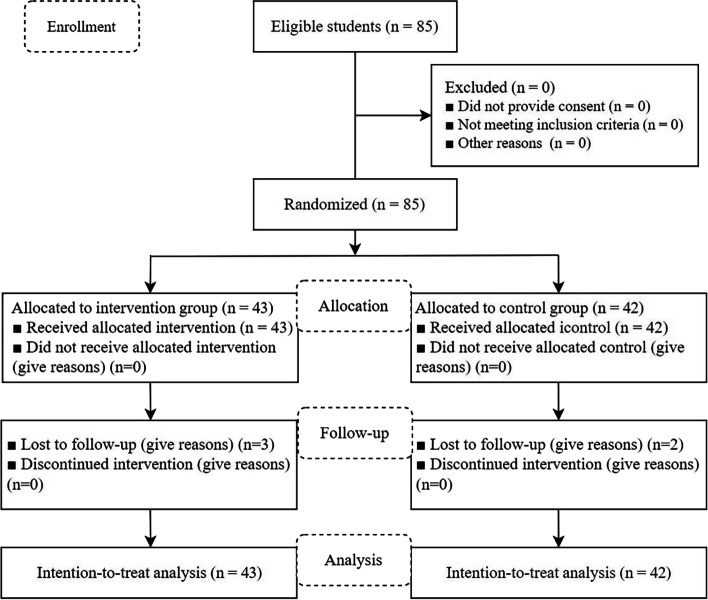
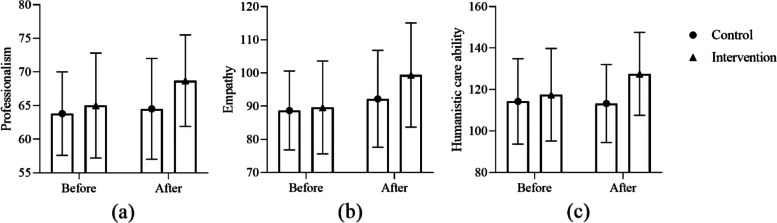
Background: Narrative medicine has become a solution to cultivate medical students’ ability of empathy and humanistic care. However, the role of narrative medicine is lacking in the study of professionalism. The aim of this study was to analyze the effects of narrative medical theory learning and narrative writing on professionalism, empathy and humanistic care ability of nursing students. Methods: This cluster randomized controlled trial was conducted between June 2021 and June 2022 in two universities in Jiangsu, China. The participants of this study were 85 nursing students who were randomly divided into the intervention group ( n = 43) or the control group ( n = 42). Participants in the intervention group were trained in narrative medical theory learning and narrative writing based on a Web-based platform, while those in the control group were not. Self-report questionnaires of professionalism, empathy and humanistic care ability were used before and after intervention. Results: The results showed that the professionalism score of the intervention group was (68.7 ± 6.8 vs. 64.5 ± 7.5; P = 0.005), empathy (99.4 ± 15.7 vs. 92.2 ± 14.6; P = 0.014) and humanistic care ability (127.6 ± 20.0 vs. 113.3 ± 18.8; P = 0.004) were better than the control group. Conclusion: The results of this quantitative study suggest that narrative medical theory education and narrative writing based on the network platform can promote the development of professionalism, empathy and humanistic care ability of nursing undergraduates.
Overview
The claims and statistics of this paper haven’t been checked yet.
Run the check — free, no account needed. It reads the open-access text and checks the sources it cites.
Integrity signals
Registry
Cites
Statistics
Figures
Verification
Claims the paper makes
The claims and statistics of this paper haven’t been checked yet.
Run the check — free, no account needed. It reads the open-access text and checks the sources it cites.
Claims other papers make about this one
Each is checked against this paper’s own text: does it say what the citing paper says it does?
The source backs part of the claim, not all of it — or backs it for a different population, condition or comparison.
In the citing paper
“These studies indicate that the long-term stability of teaching outcomes and the efficiency of translating knowledge comprehension into clinical decision-making capabilities remain critical challenges to be addressed [11–21].”
From Exploring the integration of AI and national quality courses in China: a study on teaching practices in nursing smart education (2025) · cites this paper as [12]
Experimental — accuracy not yet measured
Self-check
Percentages, sums and reported differences re-computed from the paper’s own numbers.
The self-check needs the paper’s full text.
Citations
Cites
Consort 2010 statement: extension to cluster randomised trials
Campbell, M. K., Piaggio, G., Elbourne, D. R., Altman, D. G., & for the CONSORT Group (2012) · BMJ · doi:10.1136/bmj.e5661 · Cited by 3,510
Charon, R. (2001) · JAMA · doi:10.1001/jama.286.15.1897 · Cited by 2,351
The Devil is in the Third Year: A Longitudinal Study of Erosion of Empathy in Medical School
Hojat, M., Vergare, M. J., Maxwell, K., Brainard, G. C., Herrine, S. K., Isenberg, G. A., Veloski, J. J., & Gonnella, J. S. (2009) · Academic Medicine · doi:10.1097/acm.0b013e3181b17e55 · Cited by 1,673 · cited 1×
“showed that the level of empathy did not change during the first 2 years of medical education, however, at the end of the third year, medical students showed a significant decline in empathy and this decline persisted until graduation, notably, the weakening of empathy occurred when the course was directed towards pat…”
BackgroundProfessionalization and Bureaucratization
Hall, R. H. (1968) · American Sociological Review · doi:10.2307/2092242 · Cited by 1,265
The Effects of Physician Empathy on Patient Satisfaction and Compliance
Kim, S. S., Kaplowitz, S., & Johnston, M. V. (2004) · Evaluation & the Health Professions · doi:10.1177/0163278704267037 · Cited by 1,063 · cited 1×
“There is growing evidence that improved empathy during clinical practice increases patient adherence to treatment and patient satisfaction and builds positive relationships between nurses and patients, leading to more effective treatment outcomes [25, 26].”
BackgroundEffectiveness of empathy in general practice: a systematic review
Derksen, F., Bensing, J., & Lagro-Janssen, A. (2013) · British Journal of General Practice · doi:10.3399/bjgp13x660814 · Cited by 1,034 · cited 1×
“Empathy is a multidimensional concept that includes emotional, cognitive, moral, behavioral and relational dimensions [21].”
BackgroundNursing: human science and human care. A theory of nursing.
Watson, J. (1988) · PubMed · Cited by 895
Narrative medicine as a medical education tool: A systematic review
Milota, M., van Thiel, G. J. M. W., & van Delden, J. J. M. (2019) · Medical Teacher · doi:10.1080/0142159x.2019.1584274 · Cited by 337 · cited 4×
“To help healthcare professionals truly understand patients from different perspectives and experience their inner feelings in future clinical practice, so as to improve the level of humanistic literacy [2].”
BackgroundInfluentialLiu, W., Zhao, S., Shi, L., Zhang, Z., Liu, X., Li, L., Duan, X., Li, G., Lou, F., Jia, X., et al. (2018) · BMJ Open · doi:10.1136/bmjopen-2017-019525 · Cited by 334 · cited 1×
“However, in the clinical environment, nursing students are faced with the high turnover rate of nurses, negative doctor-patient relationship, frequent workplace violence and other situations [16, 17], leading to cognitive deviation of nursing profession [18], which is not conducive to the cultivation of their professi…”
BackgroundThe Empathy Enigma: An Empirical Study of Decline in Empathy Among Undergraduate Nursing Students
Ward, J., Cody, J. W., Schaal, M., & Hojat, M. (2012) · Journal of Professional Nursing · doi:10.1016/j.profnurs.2011.10.007 · Cited by 321 · cited 1×
“found the greatest decline in empathy levels among those students with the most clinical exposure and those with healthcare work experience [12].”
Background
Research works printed but not linked: 11
- Yang NX, Li XY, Yan H, et al. Influence of narrative medical education on empathy ability and academic achievement of clinical medical students: a randomized controlled trial. Chinese J Clin Psychol. 2018;26(03):557–560+556.
- Shi HR, Zhou X, Shan BF, et al. The practice and effects of narrative nursing course for nursing undergraduates. Chinese J Nurs Educ. 2021;18(06):510–4.
- Wang YB, Wu SL, Wang L. Discussion on the application of narrative medicine in nursing psychology teaching. Med Philos. 2021;42(01):44–7.
- Li W, Li CJ, Chen BB, et al. Exploration and practice of narrative medicine education on promoting medical Students’Empathy ability. Chinese Health Ser Manage. 2022;39(09):678–83.
- Shan YW, Wu KL, Sun YN, et al. Application of moral education online teaching of surgical nursing science based on the medical narrative concept in undergraduate nursing teaching. Chin Nurs Res. 2021;35(23):4260–4.
- LZ, MX. Current situation investigation and countermeasures of medical students' professional identity. Xuexiao Dangjian Yu Sixiang Jiaoyu. 2016;21:72–4.
- ZQ. Study on the empathy status for higher vocational nursing students in Hunan Province: Sun Yat-sen University; 2010.
- YH. An empirical study on evaluation of humanistic Cadng ability of nursing undergraduates: Fujian Medical University; 2007.
- Fisher LD, Dixon DO, Herson J, et al. Intention to treatment in clinical trials. In: Issues in pharmaceutical drug development. New York: Statistical; 1989. p. 331–50.
- Hua QQ, Dai XY, Yi XH, et al. Cultivating path of medical Students' humanistic care ability from the perspective of narrative medicine. Med Philos. 2022;43(13):68–72.
- SL, ZD, ZL, et al. The mediating effect of emotional intelligence on perceived organizational care climate and humanistic care of undergraduate nursing students. J Nurs. 2021;28(11):46–50.
Cited by
Sorted by citations
Items 101–119 of 119
Perceptual and Cognitive Skills Related to Art Knowledge and Expertise
Farling, C., Chamberlain, R., Levitan, C., & Sherman, A. (2026) · Empirical Studies of the Arts · doi:10.1177/02762374261456549
“( Charon, 2001; Chen et al., 2017; Hardy, 2017; Xue et al., 2023).”
Guo, Y., Huang, X., Guan, C., Wang, R. L., Yao, J., Yang, L., & Li, S. (2026) · PLoS ONE · doi:10.1371/journal.pone.0351867
“Furthermore, efforts should be made to help students transform ethical sensitivity into a source of professional meaning [55,58].”
Chen, H., Batool, S., Lai, L., Zhang, J. P., 周乐山, Wang, J., & Wang, Y. (2026) · BMC Medical Education · doi:10.1186/s12909-026-09809-0
“• Narrative learning : Students wrote reflective diaries within one week after the infant-care experience to promote self-reflection and internalization of caring experience [7, 31].”
InfluentialDiviani, N. (2026) · Springer eBooks · doi:10.1007/978-3-032-11375-7_441
Slavova, V., & Georgieva, A. P. (2026) · BMJ Open · doi:10.1136/bmjopen-2026-118098
“26 27 Despite the existence of international and national research, there is a lack of targeted qualitative, narrative studies exploring how nurses in Bulgaria experience and make sense of compassionate care within long-term and hospice care settings.”
Widiyati, W. (2026) · Al-Munawwarah Journal of Islamic Education · doi:10.38073/almunawwarah.v2i1.4536
Sutton, J. (2026) · Journal of Holistic Nursing · doi:10.1177/08980101261475015
Zanella, E., Arcadi, P., Sorrenti, A., Cafiero, C., Lusignani, M., & Terzoni, S. (2026) · Teaching and learning in nursing · doi:10.1016/j.teln.2026.07.007
Lv, J., Wang, L., Lu, M., Zhao, Y., Dong, J., Zhang, L., Wang, Y., & Lin, P. (2026) · Frontiers in Psychology · doi:10.3389/fpsyg.2026.1865123
“…potentially employing narrative case analysis and role-play, represents a theoretically grounded avenue for reconstructing professional meaning and attenuating vulnerability to negative clinical stimuli amplification; this warrants evaluation through controlled designs (Xue et al., 2023).”
Vallero, D. A. (2026) · Elsevier eBooks · doi:10.1016/b978-0-443-44925-3.00011-9
Weng, G., Wang, M., Guo, L., Lin, J., Gao, Z., Lin, Y., & Weng, Y. (2026) · Journal of Evaluation in Clinical Practice · doi:10.1111/jep.70552
Wu, A., Sun, S., Wang, L., Li, X., Huang, X., He, Y., 卢建文, & Zhao, B. (2026) · Research Square · doi:10.21203/rs.3.rs-10409407/v1
Using Narrative Medicine to Teach Spiritual Care Competence Among Health Professions Students
Chang, C.-C., & Tsai, J. (2026) · American Journal of Hospice and Palliative Medicine® · doi:10.1177/10499091261481125
Huang, S., & Sun, H.-L. (2026) · Nurse Education Today · doi:10.1016/j.nedt.2026.107418
Self-citationSultan, H. M. (2026) · Teaching and learning in nursing · doi:10.1016/j.teln.2026.08.012
Fang, B., Guo, L., Zhang, H., Yang, Y., Wu, R., Wu, J., Jiang, S., & Zhu, L. (2026) · BMC Health Services Research · doi:10.1186/s12913-026-15542-7
“…past twenty years, interventions based on narrative competency have been shown to significantly improve communication between patients and healthcare providers, reduce medical disputes, and expand their value beyond clinical positions to various front-line personnel in the healthcare system [4, 5].”
Li, X., Weihong, Y., Guo, L., Fan, R., Peng, H., & Zhang, F. (2026) · Journal of Nursing Management · doi:10.1155/jonm/7831111
Bai, J., Shi, N., Cheng, J., Li, Y., 佘国荣, Zheng, F., & Cheng, X. (2026) · Frontiers in Medicine · doi:10.3389/fmed.2026.1956818
“Studies of narrative medicine and reflective writing have reported improvements in reflective capacity, empathy, professionalism, and humanistic caring, providing empirical support for the proposed link between narrative engagement and reflective and affective processes (37 – 39).”
Weng, X., 杨, 禧., Xing, H., Zhang, N., & Qian, Q. (2026) · Global Education Bulletin · doi:10.71052/grb2025/rfiy6466
Metadata
- Authors
- Xue, M., Sun, H., Xue, J., Zhou, J., Qu, J., Ji, S., Bu, Y., & Liu, Y.
- Affiliations
- Yangzhou University (CN)
- Corresponding author
- Liu, Yongbing
- Venue
- BMC Medical Education
- Published
- 2023-01-18
- Volume
- 23
- Issue
- 1
- Pages
- 38-38
- ISSN
- 1472-6920 (ISSN-L)
- PMC
- PMC9850682
- OpenAlex
- W4317361252
- Cited by
- 119
- References
- 41
- Citations by year
- 2026: 44 · 2025: 42 · 2024: 24 · 2023: 9
- FWCI
- 24.13
- Type
- journal article
- Language
- en
- Open access
- gold
- doi.org
- Locations
- BMC Medical Education (publishedVersion, cc-by)
- PubMed Central (publishedVersion, cc-by)
- PubMed (publishedVersion)
- DOAJ (DOAJ: Directory of Open Access Journals) (submittedVersion, cc-by-sa)
- Funders
- the Jiangsu Graduate Research and Innovation Program (KYCX21_3298)
- the 2020 Medical Education Research Project of the Medical Education Branch of the Chinese Medical Association and Medical Education Professional Committee of the Chinese Society of Higher Education (20A0576)
- the Interdisciplinary Research Project of Chinese Language and Literature Special Zone of Yangzhou University (yzuxk202019)
- Topics
- Health Sciences › Medicine › Psychiatry and Mental health › Empathy and Medical Education
- Social Sciences › Education › Innovations in Medical Education
- Health Sciences › Nursing › Leadership and Management › Healthcare Education and Workforce Issues
- Keywords
- narrative medicine, nursing students, professionalism, empathy, humanistic caring, narrative writing, online learning platforms, nursing education, undergraduate nursing education
- MeSH terms
- Professionalism, Narrative Medicine, Empathy, Humans, Students, Nursing, Narration
About these checks
Registry, retraction, Cites and statistics results are computed, not judged, with one exception: a printed reference that no index lists is read once by a model before it counts as a citation error. Claims are extracted by a model and kept only when their quote appears verbatim in the text; each cited source is then checked, with a model’s help, for whether it says what the claim relies on. Those verdicts can be wrong — read the claim’s quote and the cited source before relying on one.
Statistics and arithmetic are recomputed, not judged.
Confidence bands are shown only for fields calibrated on our annotated test set. None is calibrated yet, so no band is shown.
What counts as a claim ›How we measure confidence ›How we check this ›
Are you an author, or do you see a problem with this page? Request a review
