

Understanding factors affecting patient and public engagement and recruitment to digital health interventions: a systematic review of qualitative studies
Open accessThe DOI matches its Crossref record; 96 of the 101 references it cites were found in a registry or an index, and 1 are not checked yet.
Abstract
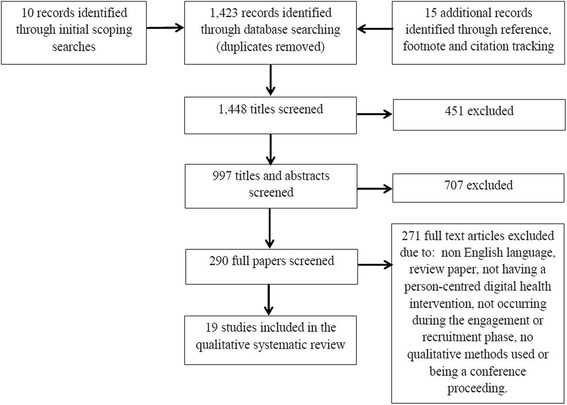
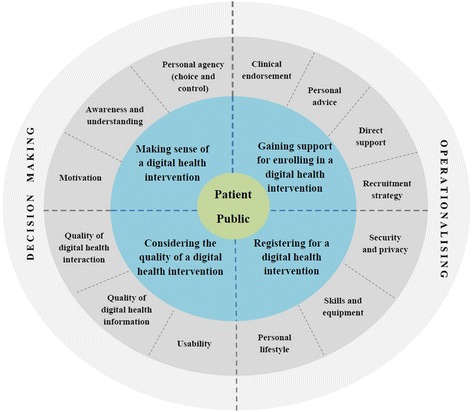
BACKGROUND: Numerous types of digital health interventions (DHIs) are available to patients and the public but many factors affect their ability to engage and enrol in them. This systematic review aims to identify and synthesise the qualitative literature on barriers and facilitators to engagement and recruitment to DHIs to inform future implementation efforts. METHODS: PubMed, MEDLINE, CINAHL, Embase, Scopus and the ACM Digital Library were searched for English language qualitative studies from 2000 - 2015 that discussed factors affecting engagement and enrolment in a range of DHIs (e.g. 'telemedicine', 'mobile applications', 'personal health record', 'social networking'). Text mining and additional search strategies were used to identify 1,448 records. Two reviewers independently carried out paper screening, quality assessment, data extraction and analysis. Data was analysed using framework synthesis, informed by Normalization Process Theory, and Burden of Treatment Theory helped conceptualise the interpretation of results. RESULTS: Nineteen publications were included in the review. Four overarching themes that affect patient and public engagement and enrolment in DHIs emerged; 1) personal agency and motivation; 2) personal life and values; 3) the engagement and recruitment approach; and 4) the quality of the DHI. The review also summarises engagement and recruitment strategies used. A preliminary DIgital Health EnGagement MOdel (DIEGO) was developed to highlight the key processes involved. Existing knowledge gaps are identified and a number of recommendations made for future research. Study limitations include English language publications and exclusion of grey literature. CONCLUSION: This review summarises and highlights the complexity of digital health engagement and recruitment processes and outlines issues that need to be addressed before patients and the public commit to digital health and it can be implemented effectively. More work is needed to create successful engagement strategies and better quality digital solutions that are personalised where possible and to gain clinical accreditation and endorsement when appropriate. More investment is also needed to improve computer literacy and ensure technologies are accessible and affordable for those who wish to sign up to them. SYSTEMATIC REVIEW REGISTRATION: International Prospective Register of Systematic Reviews CRD42015029846.
Overview
The claims and statistics of this paper haven’t been checked yet.
Free: it reads the open-access text and checks the first 5 claims that cite a source we can check. Create a free account to check every claim.
Integrity signals
Registry
Cites
Statistics
Figures
Verification
Claims the paper makes
The claims and statistics of this paper haven’t been checked yet.
Free: it reads the open-access text and checks the first 5 claims that cite a source we can check. Create a free account to check every claim.
Claims other papers make about this one
Each is checked against this paper’s own text: does it say what the citing paper says it does?
The source backs part of the claim, not all of it — or backs it for a different population, condition or comparison.
In the citing paper
“no reviews specifically addressed how potential participants were identified, recruited, and retained, a key issue if telehealth interventions are to be successfully implemented [73].”
From Telehealth Interventions to Support Self-Management of Long-Term Conditions: A Systematic Metareview of Diabetes, Heart Failure, Asthma, Chronic Obstructive Pulmonary Disease, and Cancer (2017) · cites this paper as [73]
Experimental — accuracy not yet measuredThe source backs part of the claim, not all of it — or backs it for a different population, condition or comparison.
In the citing paper
“The digital health engagement model was based on both burden of treatment theory and normalization process theory [48]. It proposes 4 key influences on whether an individual will engage with a health technology: personal agency and motivation (which is affected by aspects of their illness); personal life and values; the engagement and recruitment approach taken by those seeking to promote the”
From Beyond Adoption: A New Framework for Theorizing and Evaluating Nonadoption, Abandonment, and Challenges to the Scale-Up, Spread, and Sustainability of Health and Care Technologies (2017) · cites this paper as [48]
Experimental — accuracy not yet measuredThe source backs part of the claim, not all of it — or backs it for a different population, condition or comparison.
In the citing paper
“The benefits of digital health interventions are vast, including increased accessibility, anonymity and cost-effectiveness (O'Connor et al., 2016).”
From Therapeutic games to reduce anxiety and depression in young people: A systematic review and exploratory meta‐analysis of their use and effectiveness. (2024) · cites this paper as O'Connor et al., 2016
Experimental — accuracy not yet measuredThe cited source says what the claim attributes to it.
In the citing paper
“Clinical endorsement of digital health products and services including systems for regulation and accreditation of technology and data enabled services is required and has been suggested previously [42], and a recent systematic review of the international literature on barriers and facilitators to patient and public involvement with digital health has suggested this is a key issue [43].”
The cited source says what the claim attributes to it.
In the citing paper
“and has been successfully used in other systematic reviews [25, 26]”
2 more claims about this paper
Create a free account to see every claim other papers make about this one.
Self-check
Percentages, sums and reported differences re-computed from the paper’s own numbers.
The self-check needs the paper’s full text.
Citations
Cites
Tong, A., Sainsbury, P., & Craig, J. (2007) · International Journal for Quality in Health Care · doi:10.1093/intqhc/mzm042 · Cited by 42,509
Users of the world, unite! The challenges and opportunities of Social Media
Kaplan, A. M., & Haenlein, M. (2010) · Business Horizons · doi:10.1016/j.bushor.2009.09.003 · Cited by 17,875
Hoffmann, T. C., Glasziou, P. P., Boutron, I., Milne, R., Perera, R., Moher, D., Altman, D. G., Barbour, V., Macdonald, H., Johnston, M., et al. (2014) · BMJ · doi:10.1136/bmj.g1687 · Cited by 10,548
Qualitative data analysis for applied policy research
(2002) · Analyzing Qualitative Data · doi:10.4324/9780203413081-14 · Cited by 4,964
Qualitative data analysis for applied policy research
Ritchie, J., & Spencer, L. (2010) · Analyzing qualitative data · doi:10.4324/9780203413081_chapter_9 · Cited by 4,800
Enhancing transparency in reporting the synthesis of qualitative research: ENTREQ
Tong, A., Flemming, K., McInnes, E., Oliver, S., & Craig, J. (2012) · BMC Medical Research Methodology · doi:10.1186/1471-2288-12-181 · Cited by 3,569
Qualitative Research: Rigour and qualitative research
Mays, N., & Pope, C. (1995) · BMJ · doi:10.1136/bmj.311.6997.109 · Cited by 2,715
eHealth Literacy: Essential Skills for Consumer Health in a Networked World.
Norman, C. D., & Skinner, H. A. (2006) · Journal of Medical Internet Research · doi:10.2196/jmir.8.2.e9 · Cited by 2,643
Checklists for improving rigour in qualitative research: a case of the tail wagging the dog?
Barbour, R. S. (2001) · BMJ · doi:10.1136/bmj.322.7294.1115 · Cited by 2,613
A conceptual framework for implementation fidelity
Carroll, C., Patterson, M., Wood, S., Booth, A., Rick, J., & Balain, S. (2007) · Implementation Science · doi:10.1186/1748-5908-2-40 · Cited by 2,559
Cited by
Items 601–636 of 636
Hitzig, S. L., Mirbaha, S., Puddicombe, N., Winston, A., Hemphill, J., Kokorelias, K. M., & Sheppard, C. L. (2026) · Disability and Rehabilitation Assistive Technology · doi:10.1080/17483107.2026.2643747
König, L. M., Volpi, L., & Koch, T. (2026) · Digital Health · doi:10.1177/20552076261429621 · Cited by 2
Serwaa, D., Chang, S., Gauci, L., Jefford, M., Ee, C., Hickey, M., Cohen, P. A., Marino, J. L., Saunders, C. M., Susanto, N. S., et al. (2026) · Global Implementation Research and Applications · doi:10.1007/s43477-026-00221-w
Kim, H. R., Kim, H. J., Yu, E., Ahn, H. Y., Park, B. K., Kim, M. K., Oh, C. R., Yoon, D. W., Kwak, Y., Noh, Y., et al. (2026) · Journal of Korean Medical Science · doi:10.3346/jkms.2026.41.e153 · Cited by 1
Roesler, A., Geusens, F., van Uytsel, H., Varnfield, M., Devlieger, R., & Bogaerts, A. (2026) · Maternal and Child Health Journal · doi:10.1007/s10995-026-04247-2
Supporting Callers’ Needs in Crisis: Designing the Next Generation of 9-1-1 for Medical Emergencies
Zhang, Z., Bhadani, A. S., Meybodi, M. M., & Machado, L. (2026) · CHI Conference on Human Factors in Computing Systems · doi:10.1145/3772318.3790677
Hoang, V. L., Nguyen, N. T., Bui, H. T., Hoang, T. H., & Liamputtong, P. (2025) · Springer eBooks · doi:10.1007/978-981-97-0821-5_133-1
Rethinking Social Media in Youth Health Promotion: Navigating Ethics, Equity, and Algorithmic Risk
Buro, A. W., & Gomes, M. M. S. (2026) · American Journal of Health Promotion · doi:10.1177/08901171261448035
Development of an online sleep education program for university students: a Co-design approach
Schmickler, J. M., Vilgertshofer, C.-L., Kaiser, L., & Mess, F. (2026) · Cogent Education · doi:10.1080/2331186x.2026.2674401
Alexiou, E., Raftopoulou, G., & Karakasidou, E. (2026) · Child Psychiatry & Human Development · doi:10.1007/s10578-026-02041-3 · Cited by 1
Awaji, N. N. A., Alhasawi, A., Zakri, Y., Dayel, L. A., Alhamlan, L., & Almutairi, R. (2026) · Frontiers in Pediatrics · doi:10.3389/fped.2026.1858892
Preez, A. D., Marshall, D., Kelly, L., Swift, K., Evans, Z., Clinton, M., Doshi, R., Fitzhugh, C., Gardner, B., Gibson, R., et al. (2026) · Journal of Nutritional Science · doi:10.1017/jns.2026.10104
Eleryan, N., Hemming, R., Sparkes, V., & Sheeran, L. (2026) · BMJ Open · doi:10.1136/bmjopen-2026-116784
Sukriti, K. C., Hopkinson, N. S., Neves, A. L., Majeed, A., & Laverty, A. A. (2026) · Online Journal of Public Health Informatics · doi:10.2196/83483
Zhang, A., Matson, T. E., Barrett, T. D., Kepner, W. E., & Glass, J. E. (2026) · doi:10.2196/preprints.106668
Hoang, V. L., Nguyen, N. T., Bui, H. T., Hoang, T. H., & Liamputtong, P. (2026) · Springer eBooks · doi:10.1007/978-981-92-1288-0_133
Choi, S., & Zo, H. (2026) · International Journal of Medical Informatics · doi:10.1016/j.ijmedinf.2026.106647
Hansen, J. K., Tang, L. H., Simonÿ, C., & Thualagant, N. (2026) · Disability and Rehabilitation Assistive Technology · doi:10.1080/17483107.2026.2714661
Aasdahl, L., Bach, K., Nilsen, T. I. L., Ottersen, S. G., Klevanger, N. E., Eder, C., Øverås, C. K., Granviken, F., Debik, J., Lervik, L. C. N., et al. (2026) · BMJ Open · doi:10.1136/bmjopen-2026-122680
Liu, J., Yang, T., Xu, R., Wan, J., & Zhu, X. (2026) · Population Health Management · doi:10.1177/19427891261468437
Abdu, S. M. M., Youness, S. M., & El‐Gilany, A. (2026) · BMC Public Health · doi:10.1186/s12889-026-28907-8
Chen, S., Lian, J., Hu, W., Wang, T., & Cao, Y. (2026) · Frontiers in Public Health · doi:10.3389/fpubh.2026.1922940
Trends shaping the future of the pharmaceutical industry
Alqahtani, L. M. (2026) · Elsevier eBooks · doi:10.1016/b978-0-443-40572-3.00009-5
Aldekhyyel, R. N., Shagrani, L. M., Albattah, S. M., Alghamdi, B., Alsalman, A. A., Alabbas, S. K., & Alkhlaiwi, H. E. (2026) · Healthcare · doi:10.3390/healthcare14172838
Gehrmann, J., Stephan, J., Stullich, A., & Richter, M. (2026) · doi:10.2196/preprints.110034
Xu, J., Shen, J., Huang, G., & Wang, J. (2026) · JMIR mhealth and uhealth · doi:10.2196/91108
Sağlık Hizmetlerinde Akıllı Kalite ve Akreditasyon: Karma Yöntemli Bir Çalışma
Kocaman, E., & Terlemez, B. (2026) · Mehmet Akif Ersoy Üniversitesi Uygulamalı Bilimler Dergisi · doi:10.31200/makuubd.2029510
Temiz, M., & Koç, G. (2026) · Spiritual Psychology and Counseling · doi:10.37898/spiritualpc.1942319
Farquhar, M., Barnes, S., Lovick, R., Burkin, J., Howson, S., Mahadeva, R., Gilligan, D., Müller, I., Greenwell, K., Todd, C. J., et al. (2026) · BMC Digital Health · doi:10.1186/s44247-026-00309-1
Boronczyk, B., Avşar, P., Nugent, L., Renjith, V., Byrne, S., & Wilson, H. J. E. (2026) · International Journal of Orthopaedic and Trauma Nursing · doi:10.1016/j.ijotn.2026.101331
Usability, educational engagement, and patient-reported outcomes in a mobile asthma intervention
Zhang, S., Li, X., Choi, D. H., Desai, S., Patel, R., Agarwal, R., Ahsan, A. M., Green, S., Feldman, J. M., Reznik, M., et al. (2026) · Journal of Asthma · doi:10.1080/02770903.2026.2751846
Digital Pharmacy in Community and Healthcare Settings
Hussain, R., Alomari, M., Alshorman, K., & Ahmad, N. A. (2026) · Elsevier eBooks · doi:10.1016/b978-0-443-26472-6.00182-0
Renaud, L., Gallay, L., & Tran, A. (2026) · Le Pharmacien Clinicien · doi:10.1016/j.phacli.2026.04.008
Nasta, L., & Sestino, A. (2026) · Technology Analysis and Strategic Management · doi:10.1080/09537325.2026.2753220
Garg, K. R., Kabra, G., Pandey, K. K., Mishra, V., & Kaushal, A. K. (2026) · International Journal of Innovation Science · doi:10.1108/ijis-02-2026-0098
Khattak, M. W., Ross, V., Dirix, H., Gruden, C., Brijs, T., Adnan, M., & Brijs, K. (2026) · Accident Analysis & Prevention · doi:10.1016/j.aap.2026.108841
Metadata
- Authors
- O’Connor, S., Hanlon, P., O’Donnell, C. A., Garcia, S., Glanville, J., & Mair, F. S.
- Affiliations
- University of Glasgow (GB)
- Corresponding author
- Mair, Frances S.
- Venue
- BMC Medical Informatics and Decision Making
- Published
- 2016-09-15
- Volume
- 16
- Issue
- 1
- Pages
- 120-120
- ISSN
- 1472-6947 (ISSN-L)
- PMC
- PMC5024516
- OpenAlex
- W2518961151
- Cited by
- 636
- References
- 99
- Citations by year
- 2026: 49 · 2025: 91 · 2024: 93 · 2023: 84 · 2022: 77 · 2021: 83 · 2020: 60 · 2019: 37 · 2018: 40 · 2017: 21
- FWCI
- 6.24
- Type
- journal article
- Language
- en
- Open access
- gold
- doi.org
- Licence
- Locations
- BMC Medical Informatics and Decision Making (publishedVersion, cc-by)
- PubMed Central (publishedVersion, cc-by)
- PubMed (publishedVersion)
- Research Explorer (The University of Manchester) (publishedVersion, cc-by)
- Edinburgh Napier Research Repository (Edinburgh Napier University) (publishedVersion, cc-by)
- ENLIGHTEN (Jurnal Bimbingan dan Konseling Islam) (acceptedVersion)
- Research Output (Edinburgh Napier University) (submittedVersion, cc-by)
- Edinburgh Research Explorer (University of Edinburgh) (submittedVersion, cc-by)
- Funders
- Technology Strategy Board
- Topics
- Health Sciences › Health Professions › General Health Professions › Mobile Health and mHealth Applications
- Health Sciences › Health Professions › Health Information Management › Health, Technology, Consumer Behavior
- Social Sciences › Psychology › Applied Psychology › Digital Mental Health Interventions
- Keywords
- digital health interventions, patient engagement, recruitment (clinical trials), barriers and facilitators, individual agency, motivation, engagement strategies, computer literacy, telemedicine, mobile health apps, personal health records, social networking, Normalization Process Theory
- MeSH terms
- Humans, Medical Informatics Applications, Telemedicine, Qualitative Research, Electronic Health Records, Mobile Applications
About these checks
Registry, retraction, Cites and statistics results are computed, not judged, with one exception: a printed reference that no index lists is read once by a model before it counts as a citation error. Claims are extracted by a model and kept only when their quote appears verbatim in the text; each cited source is then checked, with a model’s help, for whether it says what the claim relies on. Those verdicts can be wrong — read the claim’s quote and the cited source before relying on one.
Statistics and arithmetic are recomputed, not judged.
Confidence bands are shown only for fields calibrated on our annotated test set. None is calibrated yet, so no band is shown.
What counts as a claim ›How we measure confidence ›How we check this ›
Are you an author, or do you see a problem with this page? Request a review
Data sources
Bibliographic data: Semantic Scholar, OpenAlex, Crossref.
Contains information from the Semantic Scholar Academic Graph Datasets, made available under the ODC Attribution License (ODC-BY 1.0).
Semantic Scholar’s data is described in: Kinney, R., et al. (2023). The Semantic Scholar Open Data Platform. arXiv:2301.10140.
