

Use of AI-based tools for healthcare purposes: a survey study from consumers’ perspectives
Open accessThe DOI matches its Crossref record; 89 of the 90 references it cites were found in a registry or an index; 8 of the 89 sources its claims cite were checked for support.
Abstract
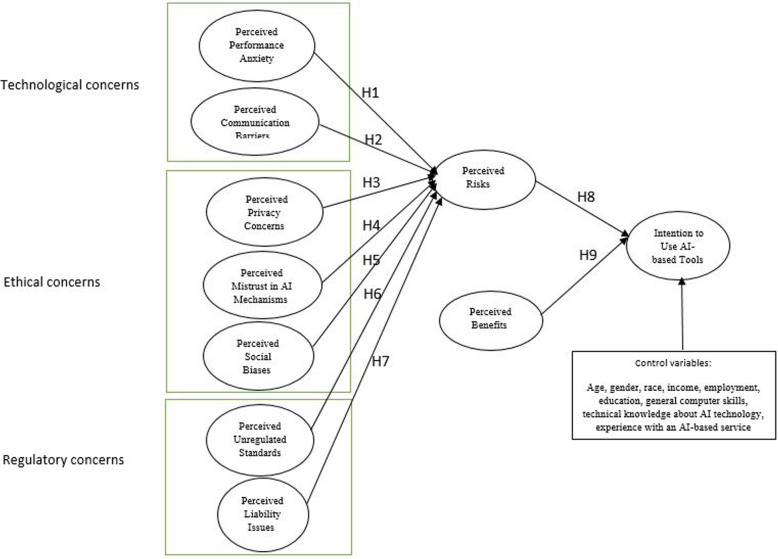
Background: Several studies highlight the effects of artificial intelligence (AI) systems on healthcare delivery. AI-based tools may improve prognosis, diagnostics, and care planning. It is believed that AI will be an integral part of healthcare services in the near future and will be incorporated into several aspects of clinical care. Thus, many technology companies and governmental projects have invested in producing AI-based clinical tools and medical applications. Patients can be one of the most important beneficiaries and users of AI-based applications whose perceptions may affect the widespread use of AI-based tools. Patients should be ensured that they will not be harmed by AI-based devices, and instead, they will be benefited by using AI technology for healthcare purposes. Although AI can enhance healthcare outcomes, possible dimensions of concerns and risks should be addressed before its integration with routine clinical care. Methods: We develop a model mainly based on value perceptions due to the specificity of the healthcare field. This study aims at examining the perceived benefits and risks of AI medical devices with clinical decision support (CDS) features from consumers’ perspectives. We use an online survey to collect data from 307 individuals in the United States. Results: The proposed model identifies the sources of motivation and pressure for patients in the development of AI-based devices. The results show that technological, ethical (trust factors), and regulatory concerns significantly contribute to the perceived risks of using AI applications in healthcare. Of the three categories, technological concerns (i.e., performance and communication feature) are found to be the most significant predictors of risk beliefs. Conclusions: This study sheds more light on factors affecting perceived risks and proposes some recommendations on how to practically reduce these concerns. The findings of this study provide implications for research and practice in the area of AI-based CDS. Regulatory agencies, in cooperation with healthcare institutions, should establish normative standard and evaluation guidelines for the implementation and use of AI in healthcare. Regular audits and ongoing monitoring and reporting systems can be used to continuously evaluate the safety, quality, transparency, and ethical factors of AI-based services.
Overview
CoChat Summary
TL;DR
This survey study develops a value-based model of U.S. consumers’ intention to use AI-based clinical decision support tools, finding that technological, ethical (trust), and regulatory concerns shape perceived risks, while perceived benefits and risks predict intention. The model explained 67% of variance in perceived risks and 80% of variance in intention to use.
Key findings
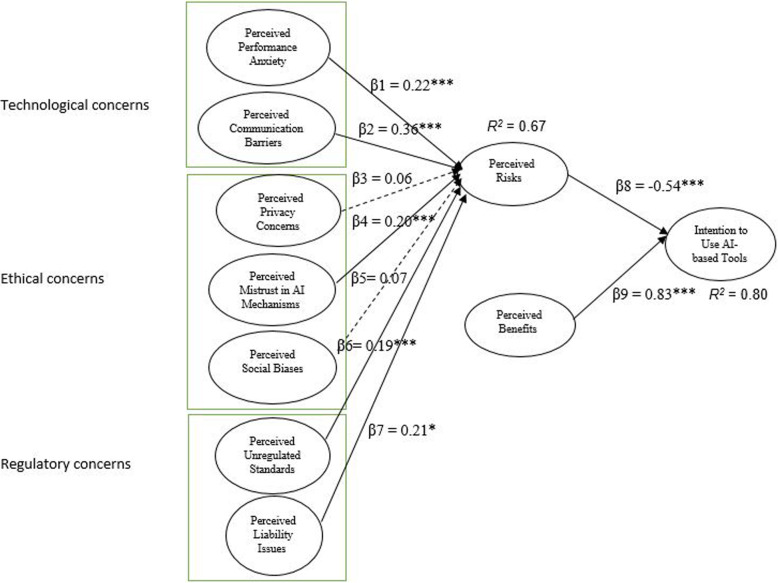
- Perceived benefits had a strong positive effect on intention to use AI-based tools (β = 0.83, p < 0.001), while perceived risks had a negative effect (β = −0.54, p < 0.001); the model explained 80% of variance in intention.
- Technological concerns were the most significant predictors of risk beliefs: perceived communication barriers (β = 0.36, p < 0.001) and perceived performance anxiety (β = 0.22, p < 0.001).
- Among ethical concerns, perceived mistrust in AI mechanisms was significant (β = 0.20, p < 0.001), but perceived privacy concerns (β = 0.06, non-significant) and perceived social biases (β = 0.07, non-significant) were not supported.
- Regulatory concerns were significant: perceived unregulated standards (β = 0.19, p < 0.001) and perceived liability issues (β = 0.21, p < 0.05); the model explained 67% of variance in perceived risks. Control variables including gender, income, education, employment, technical knowledge about AI, and familiarity with AI services influenced intention.
Methods
- Online survey via Amazon’s Mechanical Turk in April 2020 with U.S. participants; a scenario described an AI-based clinical decision support device for diagnosis, treatment, prescription advice, and care planning without direct physician interaction. The abstract reports 307 individuals, while the methods/results report 500 completed surveys, 73 dropped, and 427 final valid responses.
- Pilot work included review by five AI professionals, face validity with 15 students, and a pilot test with 117 undergraduate students.
- Hypotheses tested with structural equation modeling in IBM SPSS AMOS version 26, including confirmatory factor analysis, convergent/discriminant validity checks, bootstrapping with 5,000 samples, and controls for demographics and technology experience.
Limitations
- Stated: the sample was drawn only from the United States; lack of racial diversity (69% white) and age variety (66% aged 20–40) limit generalizability; MTurk self-report may include respondents not fully aware of AI and may induce sample selection bias; control variables were self-assessed; the study used the general concept of AI rather than a specific type; and it examined voluntary consumer use.
- Evident in the text: the abstract reports 307 individuals, whereas the methods/results report 427 final valid responses after exclusions, creating a sample-size discrepancy.
Model-written summary. Check it against the paper before relying on it.
Integrity signals
Registry
Cites
Statistics
Figures
Verification
Claims the paper makes
7 Valid · 2 Not valid · 78 Not checked · 86 Own results and interpretations
The cited sources that could be checked couldn’t confirm or dispute this claim.
In the paper
“However, previous studies suggest that not all individuals are willing to accept the use of medical AI devices [10].”
§ Use of AI-based tools for healthcare purposes: a survey study from consumers’ perspectives > Background
What the sources say
- Could not verifycites [10] Laï M-C, Brian M, Mamzer M-F. Perceptions of artificial intelligence in healthcare: findings from a qualitative survey study among actors in France. J Transl Med. 2020;18(1):1–13. sourceExperimental — accuracy not yet measured
Our copy of Cacho-Díaz et al. (2020, J Transl Med 18:1) is a review of tumor microenvironment differences between primary tumors and brain metastases; no passage addresses artificial intelligence, medical AI devices, or willingness/acceptance among individuals. Searches for 'artificial intelligence acceptance willingness medical AI devices' and 'patients attitudes toward technology adoption healthcare' returned only glossary/additional-information sections and reference lists on cancer biology (e.g. Lung cancer section on Keap1/Nrf2 mutations, References 89-92), and the Data availability section states no datasets were generated. Nothing in our copy supports or contradicts the attributed claim, so it cannot be judged from this source. (LLM, conf=0.80)
hedged- Asserted: passes — The authors put it forward as true.
- Checkable: passes — It can be checked against evidence.
- Load-bearing: passes — The paper’s conclusions depend on it.
- Based: passes — The paper gives a reason why it holds.
- Could not verify
Every source the paper cites for this claim was checked and supports it.
In the paper
“Privacy is one of the most critical concerns while using AI systems because users’ personal data (such as habits, preferences, and health records) is likely to be stored and shared across the AI network [25].”
§ Use of AI-based tools for healthcare purposes: a survey study from consumers’ perspectives > Methods > Perceived privacy concerns
What the sources say
- Supportedcites [25] Dwivedi YK, Hughes L, Ismagilova E, Aarts G, Coombs C, Crick T, et al. Artificial intelligence (AI): multidisciplinary perspectives on emerging challenges, opportunities, and agenda for research, practice and policy. Int J Inf Manag. 2019;101994. In Press. source
The TAM-DEF section (p. 52) calls privacy possibly the top concern in using AI systems and says users’ intimate data is likely to be stored and shared across the AI network. It gives food habits and shopping preferences as examples; the application-domains section (p. 5) also raises privacy concerns about storing and sharing healthcare data. (LLM, conf=0.90)
hedgedstates a cause- Asserted: passes — The authors put it forward as true.
- Checkable: passes — It can be checked against evidence.
- Load-bearing: passes — The paper’s conclusions depend on it.
- Based: passes — The paper gives a reason why it holds.
- Supported
A result the paper reports from its own data — it cites no other source for it, so there is none to check. The quote shows it is in the paper.
In the paper
“The results show that technological, ethical (trust factors), and regulatory concerns significantly contribute to the perceived risks of using AI applications in healthcare.”
§ Use of AI-based tools for healthcare purposes: a survey study from consumers’ perspectives > Abstract > Results
plainstates a cause- Asserted: passes — The authors put it forward as true.
- Checkable: passes — It can be checked against evidence.
- Load-bearing: passes — The paper’s conclusions depend on it.
- Based: passes — The paper gives a reason why it holds.
A result the paper reports from its own data — it cites no other source for it, so there is none to check. The quote shows it is in the paper.
In the paper
“Of the three categories, technological concerns (i.e., performance and communication feature) are found to be the most significant predictors of risk beliefs.”
§ Use of AI-based tools for healthcare purposes: a survey study from consumers’ perspectives > Abstract > Results
plainstates a cause- Asserted: passes — The authors put it forward as true.
- Checkable: passes — It can be checked against evidence.
- Load-bearing: passes — The paper’s conclusions depend on it.
- Based: passes — The paper gives a reason why it holds.
A result the paper reports from its own data — it cites no other source for it, so there is none to check. The quote shows it is in the paper.
In the paper
“no effects of age, race, and general computer skills were found on the intention to use.”
§ Use of AI-based tools for healthcare purposes: a survey study from consumers’ perspectives > Methods > Control variables
plain- Asserted: passes — The authors put it forward as true.
- Checkable: passes — It can be checked against evidence.
- Load-bearing: unclear — It is unclear whether the paper’s conclusions depend on it.
- Based: passes — The paper gives a reason why it holds.
52 more claims
Create a free account to see all 173 claims and to verify the 81 references still open.
- Probably not a substantial claim. 91
- It may state two separate claims as one. 45
- The quote only partly states this claim. 1
Claims other papers make about this one
Each is checked against this paper’s own text: does it say what the citing paper says it does?
The source backs part of the claim, not all of it — or backs it for a different population, condition or comparison.
In the citing paper
“The implementation of AI in healthcare sectors [47, 146] have created an urge amongst researchers to pursue innovative methods to develop e-healthcare systems.”
From Federated learning-based AI approaches in smart healthcare: Concepts, taxonomies, challenges and open issues (2023) · cites this paper as [146]
Experimental — accuracy not yet measuredIn the citing paper
“The changing role of nurses may introduce anxiety toward AI, 27 which directly affects the attitudes toward AI and the resulting potential difficulties in future adoption and usage of its applications in practice in addition to the concern of invaded privacy that may result from some AI-integrated technology applications. 27”
From Exploring nurses’ awareness and attitudes toward artificial intelligence: implications for nursing practice (2024) · cites this paper as [27]
Self-check
Percentages, sums and reported differences re-computed from the paper’s own numbers.
Each contradiction between two passages listed here was confirmed by an independent check.
Rated minor: it would not touch a result — a value no result rests on, a p-value that stays on the same side of the significance level, or a conflict that is clerical, resolved elsewhere in the paper, or outside its own findings.
In the paper
§ Use of AI-based tools for healthcare purposes: a survey study from consumers’ perspectives > Abstract > Methods
“We use an online survey to collect data from 307 individuals in the United States.”
§ Use of AI-based tools for healthcare purposes: a survey study from consumers’ perspectives > Methods > Analyses
“After excluding responses that failed the response quality questions, the final set of useable and valid responses contained 427 samples.”
Rated minor: it would not touch a result — a value no result rests on, a p-value that stays on the same side of the significance level, or a conflict that is clerical, resolved elsewhere in the paper, or outside its own findings.
In the paper
§ Use of AI-based tools for healthcare purposes: a survey study from consumers’ perspectives > Discussion > Limitations and future studies
“In this study, we used the general concept of AI, and no specific type of AI clinical tools was examined.”
§ Use of AI-based tools for healthcare purposes: a survey study from consumers’ perspectives > Background
“There are different types of medial AI, and this study focuses on devices with AI-based CDS features.”
Citations
Cites
1 retracted
Wang, Y., Zang, W., Du, Y., Ma, Y., Li, M., Li, P., Chen, X., Wang, T., Dong, Z., & Zhao, G. (2020) · Journal of Translational Medicine · doi:10.1186/s12967-020-02265-4 · Cited by 2
RetractedArtificial intelligence: a modern approach
(1995) · Choice Reviews Online · doi:10.5860/choice.33-1577 · Cited by 21,974
Pls-Sem: indeed a silver bullet
Hair, J. F., Ringle, C. M., & Sarstedt, M. (2011) · Journal of Marketing Theory and Practice · doi:10.2753/mtp1069-6679190202 · Cited by 21,631
Learned helplessness in humans: Critique and reformulation.
Abramson, L. Y., Seligman, M. E., & Teasdale, J. D. (1978) · Journal of Abnormal Psychology · doi:10.1037//0021-843x.87.1.49 · Cited by 7,121
Structural Equation Modeling and Regression: Guidelines for Research Practice
Gefen, D., Straub, D., & Boudreau, M.-C. (2000) · Communications of the Association for Information Systems · doi:10.17705/1cais.00407 · Cited by 6,416
A guide to deep learning in healthcare
Esteva, A., Robicquet, A., Ramsundar, B., Kuleshov, V., DePristo, M., Chou, K., Cui, C., Corrado, G., Thrun, S., & Dean, J. (2019) · Nature Medicine · doi:10.1038/s41591-018-0316-z · Cited by 5,312 · cited 1×
“However, it is widely believed that these systems will fundamentally change medical practice in the near future [15].”
BackgroundArtificial intelligence in healthcare: past, present and future
Jiang, F., Jiang, Y., Zhi, H., Dong, Y., Li, H., Ma, S., Wang, Y., Dong, Q., Shen, H., & Wang, Y. (2017) · Stroke and Vascular Neurology · doi:10.1136/svn-2017-000101 · Cited by 4,837
Dwivedi, Y. K., Hughes, L., Ismagilova, E., Aarts, G., Coombs, C., Crick, T., Duan, Y., Dwivedi, R., Edwards, J., Eirug, A., et al. (2021) · International Journal of Information Management · doi:10.1016/j.ijinfomgt.2019.08.002 · Cited by 4,611 · cited 10×
“As previous studies introduce several concerns and challenges with AI [25], the main focus of this model is to better explain and categorize factors affecting risk beliefs associated with AI.”
BackgroundResultInfluentialInternet Users' Information Privacy Concerns (IUIPC): The Construct, the Scale, and a Causal Model
Malhotra, N. K., Kim, S. S., & Agarwal, J. (2004) · Information Systems Research · doi:10.1287/isre.1040.0032 · Cited by 3,173 · cited 1×
“Previous studies indicate that invasion of privacy in the past significantly influence risk beliefs [80].”
BackgroundConducting behavioral research on Amazon’s Mechanical Turk
Mason, W., & Suri, S. (2012) · Behavior Research Methods · doi:10.3758/s13428-011-0124-6 · Cited by 3,172 · cited 1×
“Consistent with other studies, we used “ captcha ” questions to prevent and identify care-less, hurried, or haphazard answers [60].”
Result
Research works printed but not linked: 7
- Whittlestone J, Nyrup R, Alexandrova A, Dihal K, Cave S. Ethical and societal implications of algorithms, data, and artificial intelligence: a roadmap for research. London: Nuffield Foundation; 2019.
- Angwin J, Larson J, Mattu S, Kirchner L. Machine bias. ProPublica. 2016;23:2016.
- Gupta RK, Kumari R. Artificial intelligence in public health: opportunities and challenges. JK Sci. 2017;19(4):191–2.
- Hair JF, Black WC, Babin BJ, Anderson RE, Tatham RL. Multivariate data analysis 6th edition. Pearson prentice hall New Jersey humans: critique and reformulation. J Abnorm Psychol. 2006;87:49–74.
- Chin WW. The partial least squares approach to structural equation modeling. Mod Methods Bus Res. 1998;295(2):295–336.
- Fornell C, Tellis GJ, Zinkhan GM. Validity assessment: a structural equations approach using partial least squares. Chicago: Proceedings of the American Marketing Association Educators’ Conference; 1982.
- Kline RB. Principles and practice of structural equation modeling: Guilford publications; 2015.
Cited by
Items 301–400 of 632
The Impact of Artificial Intelligence on Health Outcomes: A Review
Shah, S. (2024) · Premier journal of science. · doi:10.70389/pjs.100006 · Cited by 7
Envisioning Possibilities and Challenges of AI for Personalized Cancer Care
Kong, E. W. S., Huang, K., & Gautam, A. (2024) · ACM Conference on Computer Supported Cooperative Work (CSCW) · doi:10.1145/3678884.3681885 · Cited by 6
Shah, H. P., Naqvi, A. S., Rajput, P., Ambra, H., Venkatesh, H., Saleem, J., Saravanan, S., Wanjari, M. B., & Mittal, G. C. (2025) · Narra J · doi:10.52225/narra.v5i1.1361 · Cited by 6
Ethical Considerations and Bias in AI Applications in Healthcare
Ali, A. (2025) · Information systems engineering and management · doi:10.1007/978-3-031-84404-1_7 · Cited by 6
Exploring Young Adults' Attitudes Toward AI-Driven mHealth Apps: Qualitative Study
Aboueldahab, A., Damaschi, G., D’Αddario, M., & Steca, P. (2025) · JMIR Human Factors · doi:10.2196/76075 · Cited by 6
Nazlı, K. A. Y. A., & İşçi, E. (2024) · Fenerbahçe Üniversitesi Sağlık Bilimleri Dergisi · Cited by 7
Aqeel, U., & John, S. (2025) · Health Professions Education · doi:10.55890/2452-3011.1377 · Cited by 7
Lee, J., Yang, Z. D., Shi, W., & Liu, Y. (2026) · Computers in Human Behavior · doi:10.1016/j.chb.2026.108955 · Cited by 6
Shin, H., Xie, R., Yoon, H., & Lee, J. (2026) · Tourism Management Perspectives · doi:10.1016/j.tmp.2026.101492 · Cited by 6
Raharja, N. M., Suwarno, I., & Sugiyarta, S. (2023) · Journal of Robotics and Control (JRC) · doi:10.18196/jrc.v3i6.13341 · Cited by 7
Society 5.0 Healthcare: Ethics, Legal Rights, Human Rights, Safety and Security
Blenman, K., Hull, R., Maimela, C., Molefi, T., Khanyile, R., & Dlamini, Z. (2023) · Springer eBooks · doi:10.1007/978-3-031-36461-7_12 · Cited by 6
Aguerrebere, P. M., Medina, E., & Pacanowski, T. G. (2024) · Communication & Society · doi:10.15581/003.37.2.197-216 · Cited by 6
Komalasari, R. (2024) · Advances in healthcare information systems and administration book series · doi:10.4018/979-8-3693-1874-4.ch018 · Cited by 6
Thakur, J., & Kansra, P. (2024) · Advances in hospitality, tourism and the services industry (AHTSI) book series · doi:10.4018/979-8-3693-7909-7.ch009 · Cited by 6
Exploring policy and regulations of clinical AI systems: Views from patients with chronic diseases
Wang, B., Asan, O., & Alelyani, T. (2025) · Health Policy and Technology · doi:10.1016/j.hlpt.2025.101035 · Cited by 6
Artificial intelligence in healthcare
Srivastava, S., Tyagi, A. K., & Sajidha, S. A. (2023) · Elsevier eBooks · doi:10.1016/b978-0-323-99421-7.00015-5 · Cited by 6
Hatherall, L., Keküllüoğlu, D., Kökciyan, N., Rovatsos, M., Sethi, N., Vierkant, T., & Vallor, S. (2023) · International Symposium on Trustworthy Autonomous Systems (TAS) · doi:10.1145/3597512.3597529 · Cited by 6
Al‐Abrrow, H., Atshan, N. A., & Jaboob, A. S. (2024) · Lecture notes in networks and systems · doi:10.1007/978-3-031-63717-9_7 · Cited by 5
Supporting quadruple aim in primary care using artificial intelligence
Tan, N. C., Lim, R. H. L., & Ng, D. C. C. (2025) · Annals of the Academy of Medicine Singapore · doi:10.47102/annals-acadmedsg.202515 · Cited by 5
Human-Centric AI Tools Into Agile Methodologies for Optimized Software Development
Babulak, E., Kumar, A. P., Guru, D., Kudithipudi, K., Maddini, S., Gonaygunta, H., & Nadella, S. (2025) · Advances in computational intelligence and robotics book series · doi:10.4018/979-8-3373-4839-1.ch002 · Cited by 5
Al‐Khalifa, K. S., Ahmed, W. M., Azhari, A. A., Ibrahim, A. I. O., Alsaljah, R. S., Ali, R., Ainoosah, S., & Alfaraj, A. (2025) · European Journal Of Dental Education · doi:10.1111/eje.70042 · Cited by 6
Irwansyah, I. (2025) · KOME · doi:10.17646/kome.of.33 · Cited by 5
Patient perceptions on the use of artificial intelligence (AI) in fertility treatment
Fee, N., Glover, L. E., Bauman, R., & Crosby, D. A. (2025) · Human Fertility · doi:10.1080/14647273.2025.2591161 · Cited by 5
Mao, K., Cui, R., & Wang, Z. (2026) · Frontiers in Psychology · doi:10.3389/fpsyg.2026.1773754 · Cited by 5
CARACTERÍSTICAS AGRONÔMICAS DE SOJA EM FUNÇÃO DE ESPAÇAMENTOS ENTRE LINHAS DE SEMEADURA
Pereira, M. W., Meert, L., Neto, A. M. D. O., Guerra, N., Krenski, A., & Willwock, L. (2018) · Colloquium Agrariae · doi:10.5747/ca.2018.v14.n3.a241 · Cited by 5
Artificial Intelligence in Medicine and Health Sciences
Hegde, P. R., & Shenoy, M. (2021) · Archives of Medicine and Health Sciences · doi:10.4103/amhs.amhs_315_20 · Cited by 5
Artificial Intelligence in medicine: Potential applications and barriers to deployment
Sonawane, U., & Komorowski, M. (2023) · AI critique · doi:10.1515/9783839467664-009 · Cited by 5
ATIAS: A Model for Understanding Intentions to Use AI Technology
Faruqe, F., Medsker, L., & Watkins, R. (2023) · Studies in computational intelligence · doi:10.1007/978-3-031-44127-1_5 · Cited by 5
Cano, J., Bertomeu‐González, V., Fácila, L., Hornero, F., Alcaraz, R., & Rieta, J. J. (2023) · Bioengineering · doi:10.3390/bioengineering10121439 · Cited by 5
Wang, Q. (2024) · American Journal of Health Behavior · doi:10.5993/ajhb.48.1.6 · Cited by 5
The Impact and Acceptance of Large Language Models in Healthcare: A Perspective from China
JosephNg, P. S., Fu, Z., Zhang, R., & Phan, K. Y. (2024) · Journal of Advanced Research in Applied Sciences and Engineering Technology · doi:10.37934/araset.59.2.110158 · Cited by 6
Gonzalez, X. T., Steger-May, K., & Abraham, J. (2024) · Journal of the American Medical Informatics Association · doi:10.1093/jamia/ocae257 · Cited by 5
Mathew, J., Mer, A., & Tanwar, V. (2024) · International Research Journal of Multidisciplinary Scope · doi:10.47857/irjms.2024.05i04.01507 · Cited by 5
Debiasing anchoring bias in the context of telemedicine
Chua, A. Y. K., Seth, N., & Banerjee, S. (2025) · Behaviour and Information Technology · doi:10.1080/0144929x.2024.2444548 · Cited by 5
The public’s views on responsibility for medical errors in Kazakhstan
Tsigengagel, О., Alchimbayeva, M., Khismetova, Z. A., & Glushkova, N. (2022) · International Journal of Healthcare Management · doi:10.1080/20479700.2022.2104191 · Cited by 5
Angeles, C. N., Samson, B. D., Mama, B. R. Z. I., Luriaga, R. L., Delizo, J. P. D., & Ching, M. R. D. (2024) · Proceedings of the 2024 8th International Conference on E-Commerce, E-Business, and E-Government · doi:10.1145/3675585.3675587 · Cited by 4
“Esmaeilzadeh [32] argued that without clear policies and a lack of guidelines, technology adoption can lead to risks.”
Duke, S. A., Sandøe, P., Skelly, T. A. M., & Holm, S. (2025) · Big Data & Society · doi:10.1177/20539517251386035 · Cited by 4
Borzu, Z. A., Keikha, L., & Shahraki-Mohammadi, A. (2025) · Journal of Medical Education and Curricular Development · doi:10.1177/23821205251407758 · Cited by 4
Nursing Educators’ Perceptions of AI in Research: Risks and Benefits
MRAYYAN, M. T., & Alomari, A. K. (2026) · Nursing Research and Practice · doi:10.1155/nrp/2058036 · Cited by 4
Salman, H., Ahmad, M. A., Ibrahim, R. B., & Mahmood, J. (2026) · PeerJ Computer Science · doi:10.7717/peerj-cs.3417 · Cited by 4
Artificial intelligence in transitional care: practice, promise, and pitfalls—a scoping review
Fakha, A., & Boonstra, A. (2026) · Frontiers in Digital Health · doi:10.3389/fdgth.2025.1690223 · Cited by 4
Dan, F. A.-O., Valentine Joseph Owan, P. D., Ogabor, J. O., Asu-Okang, S., Akpa, S. U., Iferi, E., Ejeh, E. I., Alo, A. O., Opara, P. I., & Aduma, P. O. (2026) · Discover Public Health · doi:10.1186/s12982-026-01447-7 · Cited by 6
When AI Writes Back: Ethical Considerations by Physicians on AI-Drafted Patient Message RepliesPreprint
Hu, D., Guo, Y., Cho, H., Chow, E., Mukamel, D. B., Sorkin, D. H., Reikes, A., Perret, D., Pandita, D., & Zheng, K. Q. (2025) · PubMed Central · doi:10.48550/arxiv.2508.13217 · Cited by 4
Chaibi, A., Tanveer, M., Zouari, E. A., & Zaiem, I. (2026) · Human Factors in Healthcare · doi:10.1016/j.hfh.2026.100132 · Cited by 4
Alenezi, I. N., Mersal, F. A., & Elbilgahy, A. A. (2026) · PLoS ONE · doi:10.1371/journal.pone.0345726 · Cited by 4
Dunker, Ø., Bergsjø, L. O., Severinsen, G.-H., Glette, H., & Nilsen, K. B. (2026) · Clinical Neurophysiology Practice · doi:10.1016/j.cnp.2026.04.003 · Cited by 4
Frost, E. K., Aquino, Y. S. J., Braunack‐Mayer, A., & Carter, S. M. (2025) · Health Expectations · doi:10.1111/hex.70185 · Cited by 4
The paradox of AI assistance: enhancing quality while hindering efficiency in local hospitals
Dai, S., Xie, Z., Yang, Z., & Miao, W. (2025) · Journal of Digital Management · doi:10.1007/s44362-025-00009-2 · Cited by 4
Galkin, F., & Zhavoronkov, A. A. (2023) · Healthy ageing and longevity · doi:10.1007/978-3-031-35176-1_1 · Cited by 4
Patient Attitude on the Application of Artificial Intelligence in Diabetes Care
Masrom, M. B., Krisnan, L., Yahya, Y., & Kaundan, M. K. (2024) · International Conference on Artificial Intelligence and Data Sciences (AiDAS) · doi:10.1109/aidas63860.2024.10730338 · Cited by 4
Implementation of AI in healthcare challenges and potential
Zakiuddin, K. S., Dhale, S. A., & Fulzele, P. R. (2024) · AIP conference proceedings · doi:10.1063/5.0240525 · Cited by 4
Roychowdhury, S., Singh, B. K., Das, A., & Choudhury, A. (2025) · Studies in big data · doi:10.1007/978-981-97-5734-3_7 · Cited by 4
Tehreem, S. (2025) · AI and Machine Learning Advances · doi:10.64220/amla.v1i1.004 · Cited by 4
Revesai, Z., & Kogeda, O. P. (2025) · Communications in computer and information science · doi:10.1007/978-3-031-96262-2_13 · Cited by 4
The Future Role of Clinical Artificial Intelligence: View of Chronic Patients
Wang, B., Asan, O., Liao, T., & Mansouri, M. (2024) · IEEE Transactions on Technology and Society · doi:10.1109/tts.2024.3374647 · Cited by 4
Development of AI model to analyze the customer behavior by decision making system
Narayan, Y., Tripathi, M. A., Singh, P. P., Vidhate, D. A., Singh, R., & Rao, M. M. S. (2023) · International Conference on New Frontiers in Communication, Automation, Management and Security (ICCAMS) · doi:10.1109/iccams60113.2023.10525748 · Cited by 4
Sharma, R., Gulati, A., & Chopra, K. (2023) · Springer eBooks · doi:10.1007/978-981-99-6472-7_2 · Cited by 4
Classification Of Sleep-Wake State In A Ballistocardiogram System Based On Deep LearningPreprint
Ahmed, N., Singh, A., Srivyshnav, K. S., Kumar, G., Parchani, G., & Saran, V. (2020) · arXiv (Cornell University) · doi:10.48550/arxiv.2011.08977 · Cited by 4
Guleria, S., Schwartz, B., Sharma, Y., Fernandes, P., Jablonski, J. A., Adewole, S., Srivastava, S., Rhoads, F., Porter, M. D., Yeghyayan, M., et al. (2023) · arXiv (Cornell University) · doi:10.48550/arxiv.2308.13035 · Cited by 4
Iheme, O. C. (2023) · ScholarWorks (Walden University) · Cited by 4
Serrano, C. (2020) · theses.fr (ABES) · doi:10.70675/f922f096z4c1ez4483z9369z79545992e52b · Cited by 4
Ethical Issues Raised by Artificial Intelligence and Big Data in Population Health: A Scoping Review
Couture, V., Roy, M.-C., Dez, E., Tremblay, F., & Bélisle-Pipon, J.-C. (2025) · Frontiers in Sociology · doi:10.3389/fsoc.2025.1536389 · Cited by 3
User Acceptance of Large Language Model-Powered Conversation Agents for Mental Health Support
Cheng, N., Yu, R., & Wang, X. (2025) · Springer series in design and innovation · doi:10.1007/978-981-95-0211-0_29 · Cited by 3
Saini, S. K., & Sunil, D. (2025) · International Journal of Environmental Sciences · doi:10.64252/0e30q322 · Cited by 3
Synthesizing AI Failure Research: A Scoping Review
Li, C., Lin, Y., Tu, X., Chen, J. E., & Zhao, Z. (2025) · Business & Information Systems Engineering · doi:10.1007/s12599-025-00970-2 · Cited by 3
Imran, M., Noor, M., & Ansari, H. W. A. (2025) · Strategic Business Research · doi:10.1016/j.sbr.2025.100026 · Cited by 3
Boda, K., Matuz, A., Almási, R., & Csathó, Á. (2026) · Acta Psychologica · doi:10.1016/j.actpsy.2026.106400 · Cited by 3
Pesapane, F., Giambersio, E., Rotili, A., Grasso, R., Gaeta, A., Battaglia, O., Conti, L., Pizzoli, S. F. M., Raimondi, S., Gandini, S., et al. (2026) · JCO Clinical Cancer Informatics · doi:10.1200/cci-25-00210 · Cited by 3
A Comprehensive Risk Analysis Framework for Medical AI: A Mixed‐Methods Approach
Wang, Y., Deng, Z., Deng, Z., & Evans, R. (2026) · Risk Analysis · doi:10.1111/risa.70192 · Cited by 3
Public acceptance of LLM-driven healthcare chatbots in China: An empirical study
Qian, Y., Fu, Y., Chen, Y., Ke, L., & Zhao, X. (2026) · Digital Health · doi:10.1177/20552076261437614 · Cited by 4
Said, A. S. A., Al-Ahmad, M. M., Shanableh, S., & Alomar, M. (2026) · Frontiers in Digital Health · doi:10.3389/fdgth.2026.1797213 · Cited by 3
Wójcik, S., Rulkiewicz, A., & Domienik‐Karłowicz, J. (2026) · Frontiers in Digital Health · doi:10.3389/fdgth.2026.1933451 · Cited by 3
Technologies and Innovations for Smart Health Care System in Society 5.0
Yadav, N., Bala, S., Thakur, L., Yadav, N., & Yadav, D. (2023) · Springer eBooks · doi:10.1007/978-981-99-6472-7_10 · Cited by 3
Lamrani, M., Moghadas, M., Kalia, Y. N., & Santer, V. (2024) · Springer eBooks · doi:10.1007/978-981-99-8122-9_19 · Cited by 3
Azharuddin, A., & Chandran, S. P. (2024) · Emergency health services journal. · doi:10.4103/ehsj.ehsj_5_24 · Cited by 3
What’s your archetype? Understanding how IT Identity influences information systems adoption
Senanayake, S., & Chamakiotis, P. (2025) · International Journal of Information Management · doi:10.1016/j.ijinfomgt.2025.102889 · Cited by 3
Nene, S. E. (2025) · International Journal of Africa Nursing Sciences · doi:10.1016/j.ijans.2025.100869 · Cited by 3
Ontika, N. N., Saßmannshausen, S. M., de Carvalho, A. F. P., Hadid, F., & Müller, C. (2025) · Proceedings of the ACM on Human-Computer Interaction · doi:10.1145/3757568 · Cited by 3
Hswen, Y., Rafaï, I., Lacombe, A., Davin-Casalena, B., Dubois, D., Blayac, T., & Ventelou, B. (2024) · Artificial Intelligence in Health · doi:10.36922/aih.3561 · Cited by 3
Kim, B., & Kwon, S. (2024) · IEEE RO-MAN · doi:10.1109/ro-man60168.2024.10731444 · Cited by 3
Antweiler, D., & Fuchs, G. (2025) · Computers & Graphics · doi:10.1016/j.cag.2025.104212 · Cited by 3
Blockchain and AI in Tanzanian EHR systems: perceptions, challenges, and solutions
Mwogosi, A., Mambile, C., Kibinda, N. M., & Shao, D. D. (2025) · Journal of Systems and Information Technology · doi:10.1108/jsit-10-2024-0377 · Cited by 4
Public perceptions and implementation considerations on the use of artificial intelligence in health
Romero, R. A., & Young, S. D. (2021) · Journal of Evaluation in Clinical Practice · doi:10.1111/jep.13580 · Cited by 3
Digitalization and new technologies in care – concepts and potentials for nursing care provision
Hasseler, M. (2022) · V&R unipress eBooks · doi:10.14220/9783737014793.103 · Cited by 3
Fawzy, A., Nirmala, D. C., Khansa, D., & Wardhana, Y. T. (2023) · International Journal of Medical Science and Clinical Research Studies · doi:10.47191/ijmscrs/v3-i7-23 · Cited by 3
Alsalemi, N., Sadowski, C. A., Kilpatrick, K., Elftouh, N., Houle, S. K. D., & Lafrance, J. (2024) · BMC Health Services Research · doi:10.1186/s12913-024-10568-1 · Cited by 3
AI in Healthcare and Economic Growth: A Comparative Analysis of Developed and Emerging Economies
Begum, S., & Paul, S. (2024) · Studies in systems, decision and control · doi:10.1007/978-3-031-65207-3_51 · Cited by 3
Aloyuni, S. (2021) · Journal of Pharmaceutical Research International · doi:10.9734/jpri/2021/v33i47b33112 · Cited by 3
Barman, P. K., Foulds, J. R., & Reynolds, T. L. (2026) · arXiv (Cornell University) · doi:10.48550/arxiv.2603.11237 · Cited by 3
Singh, R. R., Tripathi, S. K., Bharti, A. K., & Yadav, P. K. (2025) · Journal of Forensic Science and Medicine · doi:10.4103/jfsm.jfsm_88_23 · Cited by 2
Changing Landscapes of Training with Artificial Intelligence
Pandey, S., & Gaikwad, H. V. (2024) · International Conference on Signal Processing, Communication, Power and Embedded System (SCOPES) · doi:10.1109/scopes64467.2024.10990713 · Cited by 2
Schumacher, A., & Halabi, M. E. (2025) · Psychology and Marketing · doi:10.1002/mar.22237 · Cited by 2
Nguyen-Khanh, C. H., Hai-Nam, L., & Nguyen, X. N. (2025) · World Congress on Medical Physics and Biomedical Engineering, September 7 - 12, 2009, Munich, Germany · doi:10.1007/978-3-031-90194-2_89 · Cited by 2
Lee, J., Yoo, W., & Kim, H. (2025) · Frontiers in Genetics · doi:10.3389/fgene.2025.1563544 · Cited by 3
Pervaiz, K., & Bawa, S. S. (2025) · Communications in computer and information science · doi:10.1007/978-3-031-93601-2_6 · Cited by 2
Toh, H. J., Chan, H. Y., Ploug, T., Holm, S., & Lysaght, T. (2025) · Asian Bioethics Review · doi:10.1007/s41649-025-00380-2 · Cited by 2
Châm, N. T. P. (2025) · Journal of Cultural Analysis and Social Change · doi:10.64753/jcasc.v10i2.1894 · Cited by 2
Patient Perspectives Towards Artificial Intelligence in Heart Failure Care
Suepiantham, S., & Katira, R. (2025) · Cureus · doi:10.7759/cureus.98378 · Cited by 2
Ethical considerations in artificial intelligence-powered patient counseling
Patne, A. Y., & Suryawanshic, M. (2025) · Elsevier eBooks · doi:10.1016/b978-0-443-43823-3.00011-x · Cited by 2
Karacan, Y. (2025) · Turkiye Klinikleri Journal of Nursing Sciences · doi:10.5336/nurses.2025-108192 · Cited by 2
Metadata
- Authors
- Esmaeilzadeh, P.
- Affiliations
- Florida International University (US)
- Corresponding author
- Esmaeilzadeh, Pouyan
- ORCID
- Esmaeilzadeh, Pouyan
- Venue
- BMC Medical Informatics and Decision Making
- Published
- 2020-07-22
- Volume
- 20
- Issue
- 1
- Pages
- 170-170
- ISSN
- 1472-6947 (ISSN-L)
- PMC
- PMC7376886
- OpenAlex
- W3044430020
- Cited by
- 507
- References
- 90
- Citations by year
- 2026: 83 · 2025: 129 · 2024: 126 · 2023: 84 · 2022: 47 · 2021: 33 · 2020: 3
- FWCI
- 12.29
- Type
- journal article
- Language
- en
- Open access
- gold
- doi.org
- Licence
- cc-by
- creativecommons.org/licenses/by/4.0 (tdm)
- creativecommons.org/licenses/by/4.0 (vor)
- Locations
- BMC Medical Informatics and Decision Making (publishedVersion, cc-by)
- PubMed Central (publishedVersion, cc-by)
- PubMed (publishedVersion)
- DOAJ (DOAJ: Directory of Open Access Journals) (submittedVersion, cc-by-sa)
- Topics
- Health Sciences › Medicine › Health Informatics › Artificial Intelligence in Healthcare and Education
- Physical Sciences › Computer Science › Artificial Intelligence › Ethics and Social Impacts of AI
- Social Sciences › Decision Sciences › Information Systems and Management › Technology Adoption and User Behaviour
- Keywords
- artificial intelligence in healthcare, clinical decision support, patient perspectives, risk perception, perceived benefits, trust in AI, regulatory concerns, ethical considerations, AI medical devices, perceived value
- MeSH terms
- Adult, Artificial Intelligence, Delivery of Health Care, Female, Health Facilities, Humans, Male, Middle Aged, Surveys and Questionnaires, United States, Decision Support Systems, Clinical, Young Adult
About these checks
Registry, retraction, Cites and statistics results are computed, not judged, with one exception: a printed reference that no index lists is read once by a model before it counts as a citation error. Claims are extracted by a model and kept only when their quote appears verbatim in the text; each cited source is then checked, with a model’s help, for whether it says what the claim relies on. Those verdicts can be wrong — read the claim’s quote and the cited source before relying on one.
The claim verdicts this report counts are experimental: their accuracy is not yet measured.
A language model drew the claims from the paper on 2026-10-05, under version 3 of the claim definition (model deepseek-v4.1-flash, prompt extract-v3).
A second model labelled each claim on 2026-10-05 (model jev-1.13-20260917, definition revision gold-guideline-v0.2).
Cited sources are checked with a language model’s help (qwen3.8-omni-flash and gpt-6-sol).
Statistics and arithmetic are recomputed, not judged.
Confidence bands are shown only for fields calibrated on our annotated test set. None is calibrated yet, so no band is shown.
What counts as a claim ›How we measure confidence ›How we check this ›
Are you an author, or do you see a problem with this page? Request a review
Data sources
Bibliographic data: Semantic Scholar, OpenAlex, Crossref.
Contains information from the Semantic Scholar Academic Graph Datasets, made available under the ODC Attribution License (ODC-BY 1.0).
Semantic Scholar’s data is described in: Kinney, R., et al. (2023). The Semantic Scholar Open Data Platform. arXiv:2301.10140.
