

Use of AI-based tools for healthcare purposes: a survey study from consumers’ perspectives
Open accessThe DOI matches its Crossref record; 89 of the 90 references it cites were found in a registry or an index; 8 of the 89 sources its claims cite were checked for support.
Abstract
Background: Several studies highlight the effects of artificial intelligence (AI) systems on healthcare delivery. AI-based tools may improve prognosis, diagnostics, and care planning. It is believed that AI will be an integral part of healthcare services in the near future and will be incorporated into several aspects of clinical care. Thus, many technology companies and governmental projects have invested in producing AI-based clinical tools and medical applications. Patients can be one of the most important beneficiaries and users of AI-based applications whose perceptions may affect the widespread use of AI-based tools. Patients should be ensured that they will not be harmed by AI-based devices, and instead, they will be benefited by using AI technology for healthcare purposes. Although AI can enhance healthcare outcomes, possible dimensions of concerns and risks should be addressed before its integration with routine clinical care. Methods: We develop a model mainly based on value perceptions due to the specificity of the healthcare field. This study aims at examining the perceived benefits and risks of AI medical devices with clinical decision support (CDS) features from consumers’ perspectives. We use an online survey to collect data from 307 individuals in the United States. Results: The proposed model identifies the sources of motivation and pressure for patients in the development of AI-based devices. The results show that technological, ethical (trust factors), and regulatory concerns significantly contribute to the perceived risks of using AI applications in healthcare. Of the three categories, technological concerns (i.e., performance and communication feature) are found to be the most significant predictors of risk beliefs. Conclusions: This study sheds more light on factors affecting perceived risks and proposes some recommendations on how to practically reduce these concerns. The findings of this study provide implications for research and practice in the area of AI-based CDS. Regulatory agencies, in cooperation with healthcare institutions, should establish normative standard and evaluation guidelines for the implementation and use of AI in healthcare. Regular audits and ongoing monitoring and reporting systems can be used to continuously evaluate the safety, quality, transparency, and ethical factors of AI-based services.
Overview
CoChat Summary
TL;DR
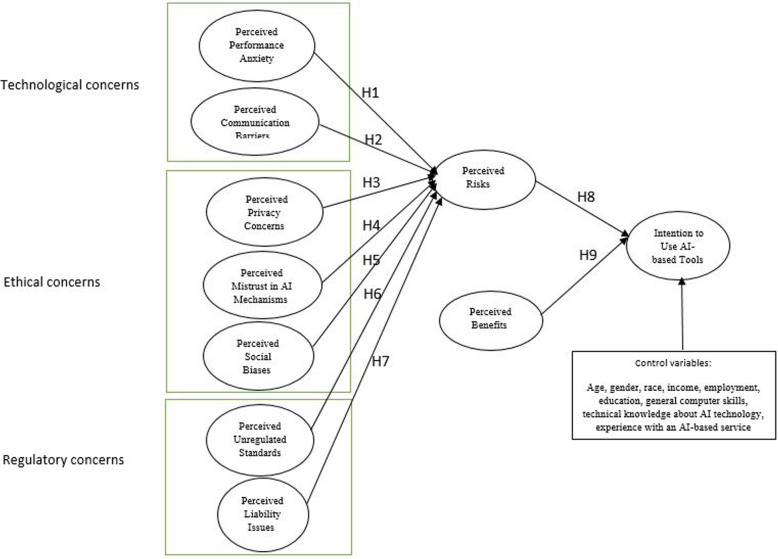
This survey study develops a value-based model of U.S. consumers’ intention to use AI-based clinical decision support tools, finding that technological, ethical (trust), and regulatory concerns shape perceived risks, while perceived benefits and risks predict intention. The model explained 67% of variance in perceived risks and 80% of variance in intention to use.
Key findings
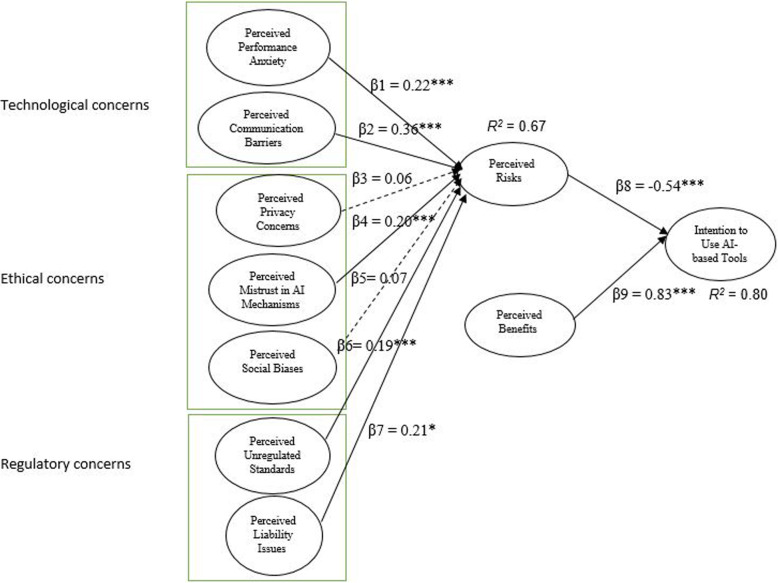
- Perceived benefits had a strong positive effect on intention to use AI-based tools (β = 0.83, p < 0.001), while perceived risks had a negative effect (β = −0.54, p < 0.001); the model explained 80% of variance in intention.
- Technological concerns were the most significant predictors of risk beliefs: perceived communication barriers (β = 0.36, p < 0.001) and perceived performance anxiety (β = 0.22, p < 0.001).
- Among ethical concerns, perceived mistrust in AI mechanisms was significant (β = 0.20, p < 0.001), but perceived privacy concerns (β = 0.06, non-significant) and perceived social biases (β = 0.07, non-significant) were not supported.
- Regulatory concerns were significant: perceived unregulated standards (β = 0.19, p < 0.001) and perceived liability issues (β = 0.21, p < 0.05); the model explained 67% of variance in perceived risks. Control variables including gender, income, education, employment, technical knowledge about AI, and familiarity with AI services influenced intention.
Methods
- Online survey via Amazon’s Mechanical Turk in April 2020 with U.S. participants; a scenario described an AI-based clinical decision support device for diagnosis, treatment, prescription advice, and care planning without direct physician interaction. The abstract reports 307 individuals, while the methods/results report 500 completed surveys, 73 dropped, and 427 final valid responses.
- Pilot work included review by five AI professionals, face validity with 15 students, and a pilot test with 117 undergraduate students.
- Hypotheses tested with structural equation modeling in IBM SPSS AMOS version 26, including confirmatory factor analysis, convergent/discriminant validity checks, bootstrapping with 5,000 samples, and controls for demographics and technology experience.
Limitations
- Stated: the sample was drawn only from the United States; lack of racial diversity (69% white) and age variety (66% aged 20–40) limit generalizability; MTurk self-report may include respondents not fully aware of AI and may induce sample selection bias; control variables were self-assessed; the study used the general concept of AI rather than a specific type; and it examined voluntary consumer use.
- Evident in the text: the abstract reports 307 individuals, whereas the methods/results report 427 final valid responses after exclusions, creating a sample-size discrepancy.
Model-written summary. Check it against the paper before relying on it.
Integrity signals
Registry
Cites
Statistics
Figures
Verification
Claims the paper makes
7 Valid · 2 Not valid · 78 Not checked · 86 Own results and interpretations
The cited sources that could be checked couldn’t confirm or dispute this claim.
In the paper
“However, previous studies suggest that not all individuals are willing to accept the use of medical AI devices [10].”
§ Use of AI-based tools for healthcare purposes: a survey study from consumers’ perspectives > Background
What the sources say
- Could not verifycites [10] Laï M-C, Brian M, Mamzer M-F. Perceptions of artificial intelligence in healthcare: findings from a qualitative survey study among actors in France. J Transl Med. 2020;18(1):1–13. sourceExperimental — accuracy not yet measured
Our copy of Cacho-Díaz et al. (2020, J Transl Med 18:1) is a review of tumor microenvironment differences between primary tumors and brain metastases; no passage addresses artificial intelligence, medical AI devices, or willingness/acceptance among individuals. Searches for 'artificial intelligence acceptance willingness medical AI devices' and 'patients attitudes toward technology adoption healthcare' returned only glossary/additional-information sections and reference lists on cancer biology (e.g. Lung cancer section on Keap1/Nrf2 mutations, References 89-92), and the Data availability section states no datasets were generated. Nothing in our copy supports or contradicts the attributed claim, so it cannot be judged from this source. (LLM, conf=0.80)
hedged- Asserted: passes — The authors put it forward as true.
- Checkable: passes — It can be checked against evidence.
- Load-bearing: passes — The paper’s conclusions depend on it.
- Based: passes — The paper gives a reason why it holds.
- Could not verify
Every source the paper cites for this claim was checked and supports it.
In the paper
“Privacy is one of the most critical concerns while using AI systems because users’ personal data (such as habits, preferences, and health records) is likely to be stored and shared across the AI network [25].”
§ Use of AI-based tools for healthcare purposes: a survey study from consumers’ perspectives > Methods > Perceived privacy concerns
What the sources say
- Supportedcites [25] Dwivedi YK, Hughes L, Ismagilova E, Aarts G, Coombs C, Crick T, et al. Artificial intelligence (AI): multidisciplinary perspectives on emerging challenges, opportunities, and agenda for research, practice and policy. Int J Inf Manag. 2019;101994. In Press. source
The TAM-DEF section (p. 52) calls privacy possibly the top concern in using AI systems and says users’ intimate data is likely to be stored and shared across the AI network. It gives food habits and shopping preferences as examples; the application-domains section (p. 5) also raises privacy concerns about storing and sharing healthcare data. (LLM, conf=0.90)
hedgedstates a cause- Asserted: passes — The authors put it forward as true.
- Checkable: passes — It can be checked against evidence.
- Load-bearing: passes — The paper’s conclusions depend on it.
- Based: passes — The paper gives a reason why it holds.
- Supported
A result the paper reports from its own data — it cites no other source for it, so there is none to check. The quote shows it is in the paper.
In the paper
“The results show that technological, ethical (trust factors), and regulatory concerns significantly contribute to the perceived risks of using AI applications in healthcare.”
§ Use of AI-based tools for healthcare purposes: a survey study from consumers’ perspectives > Abstract > Results
plainstates a cause- Asserted: passes — The authors put it forward as true.
- Checkable: passes — It can be checked against evidence.
- Load-bearing: passes — The paper’s conclusions depend on it.
- Based: passes — The paper gives a reason why it holds.
A result the paper reports from its own data — it cites no other source for it, so there is none to check. The quote shows it is in the paper.
In the paper
“Of the three categories, technological concerns (i.e., performance and communication feature) are found to be the most significant predictors of risk beliefs.”
§ Use of AI-based tools for healthcare purposes: a survey study from consumers’ perspectives > Abstract > Results
plainstates a cause- Asserted: passes — The authors put it forward as true.
- Checkable: passes — It can be checked against evidence.
- Load-bearing: passes — The paper’s conclusions depend on it.
- Based: passes — The paper gives a reason why it holds.
A result the paper reports from its own data — it cites no other source for it, so there is none to check. The quote shows it is in the paper.
In the paper
“no effects of age, race, and general computer skills were found on the intention to use.”
§ Use of AI-based tools for healthcare purposes: a survey study from consumers’ perspectives > Methods > Control variables
plain- Asserted: passes — The authors put it forward as true.
- Checkable: passes — It can be checked against evidence.
- Load-bearing: unclear — It is unclear whether the paper’s conclusions depend on it.
- Based: passes — The paper gives a reason why it holds.
52 more claims
Create a free account to see all 173 claims and to verify the 81 references still open.
- Probably not a substantial claim. 91
- It may state two separate claims as one. 45
- The quote only partly states this claim. 1
Claims other papers make about this one
Each is checked against this paper’s own text: does it say what the citing paper says it does?
The source backs part of the claim, not all of it — or backs it for a different population, condition or comparison.
In the citing paper
“The implementation of AI in healthcare sectors [47, 146] have created an urge amongst researchers to pursue innovative methods to develop e-healthcare systems.”
From Federated learning-based AI approaches in smart healthcare: Concepts, taxonomies, challenges and open issues (2023) · cites this paper as [146]
Experimental — accuracy not yet measuredIn the citing paper
“The changing role of nurses may introduce anxiety toward AI, 27 which directly affects the attitudes toward AI and the resulting potential difficulties in future adoption and usage of its applications in practice in addition to the concern of invaded privacy that may result from some AI-integrated technology applications. 27”
From Exploring nurses’ awareness and attitudes toward artificial intelligence: implications for nursing practice (2024) · cites this paper as [27]
Self-check
Percentages, sums and reported differences re-computed from the paper’s own numbers.
Each contradiction between two passages listed here was confirmed by an independent check.
Rated minor: it would not touch a result — a value no result rests on, a p-value that stays on the same side of the significance level, or a conflict that is clerical, resolved elsewhere in the paper, or outside its own findings.
In the paper
§ Use of AI-based tools for healthcare purposes: a survey study from consumers’ perspectives > Abstract > Methods
“We use an online survey to collect data from 307 individuals in the United States.”
§ Use of AI-based tools for healthcare purposes: a survey study from consumers’ perspectives > Methods > Analyses
“After excluding responses that failed the response quality questions, the final set of useable and valid responses contained 427 samples.”
Rated minor: it would not touch a result — a value no result rests on, a p-value that stays on the same side of the significance level, or a conflict that is clerical, resolved elsewhere in the paper, or outside its own findings.
In the paper
§ Use of AI-based tools for healthcare purposes: a survey study from consumers’ perspectives > Discussion > Limitations and future studies
“In this study, we used the general concept of AI, and no specific type of AI clinical tools was examined.”
§ Use of AI-based tools for healthcare purposes: a survey study from consumers’ perspectives > Background
“There are different types of medial AI, and this study focuses on devices with AI-based CDS features.”
Citations
Cites
1 retracted
Wang, Y., Zang, W., Du, Y., Ma, Y., Li, M., Li, P., Chen, X., Wang, T., Dong, Z., & Zhao, G. (2020) · Journal of Translational Medicine · doi:10.1186/s12967-020-02265-4 · Cited by 2
RetractedArtificial intelligence: a modern approach
(1995) · Choice Reviews Online · doi:10.5860/choice.33-1577 · Cited by 21,974
Pls-Sem: indeed a silver bullet
Hair, J. F., Ringle, C. M., & Sarstedt, M. (2011) · Journal of Marketing Theory and Practice · doi:10.2753/mtp1069-6679190202 · Cited by 21,631
Learned helplessness in humans: Critique and reformulation.
Abramson, L. Y., Seligman, M. E., & Teasdale, J. D. (1978) · Journal of Abnormal Psychology · doi:10.1037//0021-843x.87.1.49 · Cited by 7,121
Structural Equation Modeling and Regression: Guidelines for Research Practice
Gefen, D., Straub, D., & Boudreau, M.-C. (2000) · Communications of the Association for Information Systems · doi:10.17705/1cais.00407 · Cited by 6,416
A guide to deep learning in healthcare
Esteva, A., Robicquet, A., Ramsundar, B., Kuleshov, V., DePristo, M., Chou, K., Cui, C., Corrado, G., Thrun, S., & Dean, J. (2019) · Nature Medicine · doi:10.1038/s41591-018-0316-z · Cited by 5,312 · cited 1×
“However, it is widely believed that these systems will fundamentally change medical practice in the near future [15].”
BackgroundArtificial intelligence in healthcare: past, present and future
Jiang, F., Jiang, Y., Zhi, H., Dong, Y., Li, H., Ma, S., Wang, Y., Dong, Q., Shen, H., & Wang, Y. (2017) · Stroke and Vascular Neurology · doi:10.1136/svn-2017-000101 · Cited by 4,837
Dwivedi, Y. K., Hughes, L., Ismagilova, E., Aarts, G., Coombs, C., Crick, T., Duan, Y., Dwivedi, R., Edwards, J., Eirug, A., et al. (2021) · International Journal of Information Management · doi:10.1016/j.ijinfomgt.2019.08.002 · Cited by 4,611 · cited 10×
“As previous studies introduce several concerns and challenges with AI [25], the main focus of this model is to better explain and categorize factors affecting risk beliefs associated with AI.”
BackgroundResultInfluentialInternet Users' Information Privacy Concerns (IUIPC): The Construct, the Scale, and a Causal Model
Malhotra, N. K., Kim, S. S., & Agarwal, J. (2004) · Information Systems Research · doi:10.1287/isre.1040.0032 · Cited by 3,173 · cited 1×
“Previous studies indicate that invasion of privacy in the past significantly influence risk beliefs [80].”
BackgroundConducting behavioral research on Amazon’s Mechanical Turk
Mason, W., & Suri, S. (2012) · Behavior Research Methods · doi:10.3758/s13428-011-0124-6 · Cited by 3,172 · cited 1×
“Consistent with other studies, we used “ captcha ” questions to prevent and identify care-less, hurried, or haphazard answers [60].”
ResultKaplan, A., & Haenlein, M. (2019) · Business Horizons · doi:10.1016/j.bushor.2018.08.004 · Cited by 3,140 · cited 1×
“Background Artificial Intelligence (AI) generally refers to a computerized system (hardware or software) that is able to perform physical tasks and cognitive functions, solve various problems, or make decisions without explicit human instructions [1].”
BackgroundArtificial intelligence and the future of work: Human-AI symbiosis in organizational decision making
Jarrahi, M. H. (2018) · Business Horizons · doi:10.1016/j.bushor.2018.03.007 · Cited by 2,772 · cited 3×
“A range of techniques and applications are under the broad umbrella of AI, such as genetic algorithms, neural networks, machine learning, and pattern recognition [2].”
BackgroundInfluentialAlgorithms of Oppression: How Search Engines Reinforce Racism
Noble, S. U. (2020) · doi:10.2307/j.ctt1pwt9w5 · Cited by 2,709
Duan, Y., Edwards, J. S., & Dwivedi, Y. K. (2019) · International Journal of Information Management · doi:10.1016/j.ijinfomgt.2019.01.021 · Cited by 2,628 · cited 1×
“Society generally is yet to fully grasp many of the ethical and regulatory considerations associated with AI and big data [86].”
BackgroundHow to Use a Monte Carlo Study to Decide on Sample Size and Determine Power
Muthén, L. K., & Muthén, B. O. (2002) · Structural Equation Modeling: A Multidisciplinary Journal · doi:10.1207/s15328007sem0904_8 · Cited by 2,362
The practical implementation of artificial intelligence technologies in medicine
He, J., Baxter, S. L., Xu, J., Xu, J., Zhou, X., & Zhang, K. (2019) · Nature Medicine · doi:10.1038/s41591-018-0307-0 · Cited by 2,246 · cited 1×
“1 Research model and quality of autonomous operations an essential factor affecting the use of AI devices [27].”
BackgroundDwivedi, Y. K., Rana, N. P., Jeyaraj, A., Clement, M., & Williams, M. D. (2019) · Information Systems Frontiers · doi:10.1007/s10796-017-9774-y · Cited by 2,137 · cited 1×
“Previous research mainly studies customers ’ intention to use AI devices using existing technology acceptance theories (such as TAM, UTAUT) [83, 84].”
BackgroundInside the Turk: Understanding Mechanical Turk as a Participant Pool
Paolacci, G., & Chandler, J. (2014) · Current Directions in Psychological Science · doi:10.1177/0963721414531598 · Cited by 2,136
Value-based Adoption of Mobile Internet: An empirical investigation
Kim, H.-W., Chan, H. C., & Gupta, S. (2007) · Decision Support Systems · doi:10.1016/j.dss.2005.05.009 · Cited by 2,084 · cited 2×
“The value is estimated based on the trade-off of technology [12].”
BackgroundImplementing Machine Learning in Health Care — Addressing Ethical Challenges
Char, D. S., Shah, N. H., & Magnus, D. (2018) · New England Journal of Medicine · doi:10.1056/nejmp1714229 · Cited by 1,857 · cited 1×
“Trust between public and healthcare systems is essential for effective healthcare delivery [36].”
BackgroundLower bounds on sample size in structural equation modeling
Christopher Westland, J. (2010) · Electronic Commerce Research and Applications · doi:10.1016/j.elerap.2010.07.003 · Cited by 1,846
(1995) · Cited by 1,801
Haenssle, H. A., Fink, C., Schneiderbauer, R., Toberer, F., Buhl, T., Blum, A., Kalloo, A., Hassen, A. B. H., Thomas, L., Enk, A., et al. (2018) · Annals of Oncology · doi:10.1093/annonc/mdy166 · Cited by 1,571
Consumers acceptance of artificially intelligent (AI) device use in service delivery
Gursoy, D., Chi, O. H., Lu, L., & Nunkoo, R. (2019) · International Journal of Information Management · doi:10.1016/j.ijinfomgt.2019.03.008 · Cited by 1,437 · cited 6×
“The control variables are age, gender, race, income, employment, education, general computer skills, technical knowledge about AI technology, and experience with an AI-based service, which are found and tested by prior research as factors affecting the adoption of AI devices e.g., [3].”
BackgroundMethodResultInfluentialThe Effects of Personalization and Familiarity on Trust and Adoption of Recommendation Agents1
Komiak, S. Y. X., & Benbasat, I. (2006) · MIS Quarterly · doi:10.2307/25148760 · Cited by 1,374
Artificial Intelligence and the Public Sector—Applications and Challenges
Wirtz, B. W., Weyerer, J. C., & Geyer, C. (2019) · International Journal of Public Administration · doi:10.1080/01900692.2018.1498103 · Cited by 1,341 · cited 1×
“Wirtz, Weyerer [48] emphasize the challenges connected to the responsibility and accountability of AI systems.”
BackgroundHandbook of Univariate and Multivariate Data Analysis and Interpretation with SPSS
Ho, R. (2006) · Chapman & Hall/CRC eBooks · doi:10.1201/9781420011111 · Cited by 1,318
Detecting and Deterring Insufficient Effort Responding to Surveys
Huang, J. L., Curran, P. G., Keeney, J., Poposki, E. M., & DeShon, R. P. (2012) · Journal of Business and Psychology · doi:10.1007/s10869-011-9231-8 · Cited by 1,295
Developing and validating a service robot integration willingness scale
Lu, L., Cai, R., & Gursoy, D. (2019) · International Journal of Hospitality Management · doi:10.1016/j.ijhm.2019.01.005 · Cited by 1,013 · cited 2×
“The use of AI devices in service delivery (such as health-care) may cause noteworthy communication barriers be-tween customers and AI devices [18].”
BackgroundSegars, A. H. (1997) · Omega · doi:10.1016/s0305-0483(96)00051-5 · Cited by 993
Granny and the robots: ethical issues in robot care for the elderly
Sharkey, A., & Sharkey, N. (2012) · Ethics and Information Technology · doi:10.1007/s10676-010-9234-6 · Cited by 985
A governance model for the application of AI in health care
Reddy, S., Allan, S., Coghlan, S., & Cooper, P. (2020) · Journal of the American Medical Informatics Association · doi:10.1093/jamia/ocz192 · Cited by 979
Bansal, G., Zahedi, F. “., & Gefen, D. (2010) · Decision Support Systems · doi:10.1016/j.dss.2010.01.010 · Cited by 958
Sun, T. Q., & Medaglia, R. (2019) · Government Information Quarterly · doi:10.1016/j.giq.2018.09.008 · Cited by 948 · cited 2×
“A study reports that, in general, individuals are likely to exhibit a lack of trust in the features of AI systems [38].”
BackgroundMachine learning in medicine: Addressing ethical challenges
Vayena, E., Blasimme, A., & Cohen, I. G. (2018) · PLOS Medicine · doi:10.1371/journal.pmed.1002689 · Cited by 912 · cited 6×
“Method of data collection for AI may increase risks as AI systems need huge datasets, and patients are concerned that their personal information will be collected without their knowledge [30].”
BackgroundInfluentialFiske, A., Henningsen, P., & Buyx, A. (2019) · Journal of Medical Internet Research · doi:10.2196/13216 · Cited by 857 · cited 1×
“There is a growing interest in research about AI-centric technologies, yet individuals have not integrated AI devices into many aspects of their lives [76].”
BackgroundAutomated machine learning: Review of the state-of-the-art and opportunities for healthcare
Waring, J., Lindvall, C., & Umeton, R. (2020) · Artificial Intelligence in Medicine · doi:10.1016/j.artmed.2020.101822 · Cited by 834 · cited 1×
“AI tools operate based on the auto-learn models, which improve their performance over time [46].”
MethodGoverning artificial intelligence: ethical, legal and technical opportunities and challenges
Cath, C. (2018) · Philosophical Transactions of the Royal Society A: Mathematical, Physical and Engineering Sciences · doi:10.1098/rsta.2018.0080 · Cited by 745 · cited 3×
“Cath [22] Perceived liability issues The extent to which an individual is concerned about the liability and responsibility of using AI clinical tools.”
BackgroundInfluentialAn Empirical Examination of the Concern for Information Privacy Instrument
Stewart, K. A., & Segars, A. H. (2002) · Information Systems Research · doi:10.1287/isre.13.1.36.97 · Cited by 734 · cited 1×
“Segars [20] Perceived mistrust in AI mechanisms The degree to which an individual believes that AI models and AI-driven diagnostics and recommendations in health care are still not trustworthy.”
BackgroundHengstler, M., Enkel, E., & Duelli, S. (2016) · Technological Forecasting and Social Change · doi:10.1016/j.techfore.2015.12.014 · Cited by 661
Sohn, K., & Kwon, O. (2020) · Telematics and Informatics · doi:10.1016/j.tele.2019.101324 · Cited by 646
Artificial intelligence-enabled healthcare delivery
Reddy, S., Fox, J., & Purohit, M. P. (2019) · Journal of the Royal Society of Medicine · doi:10.1177/0141076818815510 · Cited by 635
Artificial Intelligence and Digital Pathology: Challenges and Opportunities
Tizhoosh, H. R., & Pantanowitz, L. (2018) · Journal of Pathology Informatics · doi:10.4103/jpi.jpi_53_18 · Cited by 544
Sharma, R., Yetton, P., & Crawford, J. (2009) · MIS Quarterly · doi:10.2307/20650305 · Cited by 496 · cited 1×
“Finally, as using the self-report survey method can raise the common method variance issue, we examined the potential for common method bias [70].”
Pesapane, F., Volonté, C., Codari, M., & Sardanelli, F. (2018) · Insights into Imaging · doi:10.1007/s13244-018-0645-y · Cited by 479
The use of social media in travel information search
Chung, N., & Koo, C. (2015) · Telematics and Informatics · doi:10.1016/j.tele.2014.08.005 · Cited by 474 · cited 1×
“However, the value-based adoption model is viewed as a more appropriate approach to explain the behavior of service consumers by indicating that most consumers support new technologies based on their personal perceptions [13].”
BackgroundBansal, G., Zahedi, F. M., & Gefen, D. (2016) · Information & Management · doi:10.1016/j.im.2015.08.001 · Cited by 457
Understanding perceived risks in mobile payment acceptance
Yang, Y., Liu, Y., Li, H., & Yu, B. (2015) · Industrial Management & Data Systems · doi:10.1108/imds-08-2014-0243 · Cited by 390
Randomized controlled trial of a 12-week digital care program in improving low back pain
Shebib, R., Bailey, J. F., Smittenaar, P., Perez, D. A., Mecklenburg, G., & Hunter, S. (2019) · npj Digital Medicine · doi:10.1038/s41746-018-0076-7 · Cited by 341
Tumor microenvironment differences between primary tumor and brain metastases
Cacho-Díaz, B., García-Botello, D. R., Wegman-Ostrosky, T., Reyes-Soto, G., Ortiz-Sánchez, E., & Herrera-Montalvo, L. A. (2020) · Journal of Translational Medicine · doi:10.1186/s12967-019-02189-8 · Cited by 310
Xu, J., Yang, P., Xue, S., Sharma, B., Sanchez-Martin, M., Wang, F., Beaty, K. A., Dehan, E., & Parikh, B. (2019) · Human Genetics · doi:10.1007/s00439-019-01970-5 · Cited by 305
Andersen, P. H., & Kumar, R. (2006) · Industrial Marketing Management · doi:10.1016/j.indmarman.2004.10.010 · Cited by 301
Coombs, C., Hislop, D., Taneva, S. K., & Barnard, S. (2020) · The Journal of Strategic Information Systems · doi:10.1016/j.jsis.2020.101600 · Cited by 301 · cited 1×
“Promoting AI-based services has become one of the focal points of many companies ’ strategies [6].”
BackgroundLaï, M.-C., Brian, M., & Mamzer, M.-F. (2020) · Journal of Translational Medicine · doi:10.1186/s12967-019-02204-y · Cited by 294
Cenfetelli, R. T., Benbasat, I., & Al-Natour, S. (2008) · Information Systems Research · doi:10.1287/isre.1070.0163 · Cited by 272 · cited 1×
“We conducted Harman ’ s one-factor test to check if the common method bias would be a problem [71].”
Method30 years of intelligence models in management and business: A bibliometric review
López-Robles, J. R., Otegi-Olaso, J. R., Porto Gómez, I., & Cobo, M. J. (2019) · International Journal of Information Management · doi:10.1016/j.ijinfomgt.2019.01.013 · Cited by 268
Patients’ views of wearable devices and AI in healthcare: findings from the ComPaRe e-cohort
Tran, V.-T., Riveros, C., & Ravaud, P. (2019) · npj Digital Medicine · doi:10.1038/s41746-019-0132-y · Cited by 264
Houssami, N., Turner, R. M., & Morrow, M. (2017) · Breast Cancer Research and Treatment · doi:10.1007/s10549-017-4324-3 · Cited by 243
Regulation of predictive analytics in medicine
Parikh, R. B., Obermeyer, Z., & Navathe, A. S. (2019) · Science · doi:10.1126/science.aaw0029 · Cited by 223 · cited 1×
“As AI-based devices are not in line with traditional medical practices, the ambiguity about the safety and efficacy of AI models in healthcare are still strong reasons that facilitate users ’ risks [51].”
BackgroundLee, J.-G., Kim, K. J., Lee, S., & Shin, D.-H. (2015) · International Journal of Human–Computer Interaction · doi:10.1080/10447318.2015.1070547 · Cited by 220 · cited 2×
“Lee, Kim [39] indicate that the autonomy of AI systems affects the users ’ perception of trustworthiness.”
BackgroundStructural Equation Modeling: Perspectives on the Present and the Future
Byrne, B. M. (2001) · International Journal of Testing · doi:10.1080/15305058.2001.9669479 · Cited by 219
Structural Equation Modeling: Perspectives on the Present and the Future
Byrne, B. (2001) · International Journal of Testing · doi:10.1207/s15327574ijt013&4_11 · Cited by 219
Lee, S., Lee, N., & Sah, Y. J. (2020) · International Journal of Human–Computer Interaction · doi:10.1080/10447318.2019.1699748 · Cited by 204
O’Leary, M. B., Wilson, J. M., & Metiu, A. (2014) · MIS Quarterly · doi:10.25300/misq/2014/38.4.13 · Cited by 191 · cited 2×
“Studies highlight that recruiting survey respondents from MTurk can improve the reliability of data compared to traditional subject pools [58].”
BackgroundResultZhao, X., Xia, Q., & Huang, W. (2020) · Information & Management · doi:10.1016/j.im.2020.103265 · Cited by 177 · cited 1×
“Multi-dimensional concerns associated with AI clinical tools may also be viewed as a cause of technostress, which occurs when an individual is unable to adapt to using technology [16].”
BackgroundRomero-Brufau, S., Wyatt, K. D., Boyum, P., Mickelson, M., Moore, M., & Cognetta-Rieke, C. (2020) · International Journal of Medical Informatics · doi:10.1016/j.ijmedinf.2019.104072 · Cited by 143 · cited 2×
“AI can be used in the form of clinical decision support (CDS) to support patientspecific diagnosis and treatment decisions and perform population-based risk prediction analytics [5].”
BackgroundTurja, T., Aaltonen, I., Taipale, S., & Oksanen, A. (2020) · Information & Management · doi:10.1016/j.im.2019.103220 · Cited by 142
Sarin, S., Sego, T., & Chanvarasuth, N. (2003) · Journal of Marketing Theory and Practice · doi:10.1080/10696679.2003.11658502 · Cited by 134
Sundar, S. S., Waddell, T. F., & Jung, E. H. (2016) · 2016 11th ACM/IEEE International Conference on Human-Robot Interaction (HRI) · doi:10.1109/hri.2016.7451771 · Cited by 92 · cited 3×
“Previous research mainly studies customers’ intention to use AI devices using existing technology acceptance theories (such as TAM, UTAUT) [83, 84].”
Background(2019) · AMA Journal of Ethics · doi:10.1001/amajethics.2019.138 · Cited by 89 · cited 1×
“Regulations should illuminate the role of patients in relation to AI devices so that they are aware of their position to refuse AI-base treatments where possible [87].”
BackgroundIt's not the algorithm, it's the data
Kirkpatrick, K. (2017) · Communications of the ACM · doi:10.1145/3022181 · Cited by 86
Artificial Intelligence Hits the Barrier of Meaning
Mitchell, M. (2019) · Information · doi:10.3390/info10020051 · Cited by 80 · cited 1×
“According to Mitchell [28], AI systems are still vulnerable in many areas, such as hacker attacks.”
BackgroundRacism, responsibility and autonomy in HCI: Testing perceptions of an AI agent
Hong, J.-W., & Williams, D. (2019) · Computers in Human Behavior · doi:10.1016/j.chb.2019.06.012 · Cited by 69
Lo, W. L. A., Lei, D., Li, L., Huang, D. F., & Tong, K.-F. (2018) · JMIR mHealth and uHealth · doi:10.2196/mhealth.8127 · Cited by 68
Lee, B., & Cranage, D. A. (2018) · Journal of Hospitality Marketing & Management · doi:10.1080/19368623.2017.1337539 · Cited by 65
Froomkin, A. M., Kerr, I., & Pineau, J. (2025) · Robot Law: Volume II · doi:10.4337/9781800887305.00012 · Cited by 59
Esmaeilzadeh, P. (2019) · Health Communication · doi:10.1080/10410236.2018.1471336 · Cited by 49
Self-citationSundar, S. S., Waddell, T. F., & Jung, E. H. (2016) · ACM/IEEE International Conference on Human-Robot Interaction (HRI) · doi:10.5555/2906831.2906890 · Cited by 47
Zandi, D., Reis, A., Vayena, E., & Goodman, K. (2019) · Bulletin of the World Health Organization · doi:10.2471/blt.18.227686 · Cited by 39
Radiology and artificial intelligence: An opportunity for our specialty
Beregi, J.-P., Zins, M., Masson, J.-P., Cart, P., Bartoli, J.-M., Silberman, B., Boudghene, F., & Meder, J.-F. (2018) · Diagnostic and Interventional Imaging · doi:10.1016/j.diii.2018.11.002 · Cited by 38
Should Watson Be Consulted for a Second Opinion?
(2019) · AMA Journal of Ethics · doi:10.1001/amajethics.2019.131 · Cited by 33 · cited 2×
“Another aspect of liability risk refers to the situation where appropriate treatment options recommended by AI are mistakenly dismissed [21].”
BackgroundMas, F. D., Piccolo, D., Cobianchi, L., Edvinsson, L. I., Presch, G., Massaro, M., Škrap, M., Vajana, F. J. D. T., D'Auria, A., & Bagnoli, C. (2019) · ARCA (Università Ca' Foscari Venezia) · Cited by 30
Artificial Intelligence in Health Care: Brave New World or Golden Opportunity?
Dreyer, K., & Allen, B. (2018) · Journal of the American College of Radiology · doi:10.1016/j.jacr.2018.01.010 · Cited by 28
Artificial intelligence in health – The three big challenges
Khanna, S. (2013) · Australasian Medical Journal · doi:10.4066/amj.2013.1758 · Cited by 26 · cited 1×
“Previous studies highlight the importance of AI in healthcare, especially in medical informatics [7].”
BackgroundArtificial Intelligence: Australia's Ethics Framework
Dawson, D., Schleiger, E., Horton, J., McLaughlin, J., Robinson, C., Quezada, G., Scowcroft, J., & Hajkowicz, S. A. (2019) · CSIRO · doi:10.25919/ydfm-5p75 · Cited by 26
Artificial Intelligence: Australia’s ethics framework - a discussion paper
Dawson, D., Schleiger, E., Horton, J., McLaughlin, J., Robinson, C., Quezada, G., Scowcroft, J., & Hajkowicz, S. A. (2019) · Cited by 19
O'Leary, M. B., Wilson, J. M., & Metiu, A. (2013) · doi:10.2139/ssrn.2322710 · Cited by 16
The HeartMath coherence model: implications and challenges for artificial intelligence and robotics
Edwards, S. D. (2019) · AI & SOCIETY · doi:10.1007/s00146-018-0834-8 · Cited by 13
Research works printed but not linked: 7
- Whittlestone J, Nyrup R, Alexandrova A, Dihal K, Cave S. Ethical and societal implications of algorithms, data, and artificial intelligence: a roadmap for research. London: Nuffield Foundation; 2019.
- Angwin J, Larson J, Mattu S, Kirchner L. Machine bias. ProPublica. 2016;23:2016.
- Gupta RK, Kumari R. Artificial intelligence in public health: opportunities and challenges. JK Sci. 2017;19(4):191–2.
- Hair JF, Black WC, Babin BJ, Anderson RE, Tatham RL. Multivariate data analysis 6th edition. Pearson prentice hall New Jersey humans: critique and reformulation. J Abnorm Psychol. 2006;87:49–74.
- Chin WW. The partial least squares approach to structural equation modeling. Mod Methods Bus Res. 1998;295(2):295–336.
- Fornell C, Tellis GJ, Zinkhan GM. Validity assessment: a structural equations approach using partial least squares. Chicago: Proceedings of the American Marketing Association Educators’ Conference; 1982.
- Kline RB. Principles and practice of structural equation modeling: Guilford publications; 2015.
Cited by
Revolutionizing healthcare: the role of artificial intelligence in clinical practice
Alowais, S. A., Alghamdi, S. S., Alsuhebany, N., Alqahtani, T., Alshaya, A. I., Almohareb, S. N., Aldairem, A., Alrashed, M., Bin Saleh, K., Badreldin, H. A., et al. (2023) · BMC Medical Education · doi:10.1186/s12909-023-04698-z · Cited by 3,146
“However, the same study found that 80% of Americans would be willing to use AI-powered tools to help manage their health [109].”
BackgroundYang, G., Ye, Q., & Xia, J. (2022) · Information Fusion · doi:10.1016/j.inffus.2021.07.016 · Cited by 717
Ali, O., Abdelbaki, W., Shrestha, A., Elbasi, E., Alryalat, M. A. A., & Dwivedi, Y. K. (2023) · Journal of Innovation & Knowledge · doi:10.1016/j.jik.2023.100333 · Cited by 568
Habbal, A., Ali, M. K., & Abuzaraida, M. A. (2024) · Expert Systems with Applications · doi:10.1016/j.eswa.2023.122442 · Cited by 407
Young, A. T., Amara, D., Bhattacharya, A., & Wei, M. L. (2021) · The Lancet Digital Health · doi:10.1016/s2589-7500(21)00132-1 · Cited by 400
Metadata
- Authors
- Esmaeilzadeh, P.
- Affiliations
- Florida International University (US)
- Corresponding author
- Esmaeilzadeh, Pouyan
- ORCID
- Esmaeilzadeh, Pouyan
- Venue
- BMC Medical Informatics and Decision Making
- Published
- 2020-07-22
- Volume
- 20
- Issue
- 1
- Pages
- 170-170
- ISSN
- 1472-6947 (ISSN-L)
- PMC
- PMC7376886
- OpenAlex
- W3044430020
- Cited by
- 507
- References
- 90
- Citations by year
- 2026: 83 · 2025: 129 · 2024: 126 · 2023: 84 · 2022: 47 · 2021: 33 · 2020: 3
- FWCI
- 12.29
- Type
- journal article
- Language
- en
- Open access
- gold
- doi.org
- Licence
- cc-by
- creativecommons.org/licenses/by/4.0 (tdm)
- creativecommons.org/licenses/by/4.0 (vor)
- Locations
- BMC Medical Informatics and Decision Making (publishedVersion, cc-by)
- PubMed Central (publishedVersion, cc-by)
- PubMed (publishedVersion)
- DOAJ (DOAJ: Directory of Open Access Journals) (submittedVersion, cc-by-sa)
- Topics
- Health Sciences › Medicine › Health Informatics › Artificial Intelligence in Healthcare and Education
- Physical Sciences › Computer Science › Artificial Intelligence › Ethics and Social Impacts of AI
- Social Sciences › Decision Sciences › Information Systems and Management › Technology Adoption and User Behaviour
- Keywords
- artificial intelligence in healthcare, clinical decision support, patient perspectives, risk perception, perceived benefits, trust in AI, regulatory concerns, ethical considerations, AI medical devices, perceived value
- MeSH terms
- Adult, Artificial Intelligence, Delivery of Health Care, Female, Health Facilities, Humans, Male, Middle Aged, Surveys and Questionnaires, United States, Decision Support Systems, Clinical, Young Adult
About these checks
Registry, retraction, Cites and statistics results are computed, not judged, with one exception: a printed reference that no index lists is read once by a model before it counts as a citation error. Claims are extracted by a model and kept only when their quote appears verbatim in the text; each cited source is then checked, with a model’s help, for whether it says what the claim relies on. Those verdicts can be wrong — read the claim’s quote and the cited source before relying on one.
The claim verdicts this report counts are experimental: their accuracy is not yet measured.
A language model drew the claims from the paper on 2026-10-05, under version 3 of the claim definition (model deepseek-v4.1-flash, prompt extract-v3).
A second model labelled each claim on 2026-10-05 (model jev-1.13-20260917, definition revision gold-guideline-v0.2).
Cited sources are checked with a language model’s help (qwen3.8-omni-flash and gpt-6-sol).
Statistics and arithmetic are recomputed, not judged.
Confidence bands are shown only for fields calibrated on our annotated test set. None is calibrated yet, so no band is shown.
What counts as a claim ›How we measure confidence ›How we check this ›
Are you an author, or do you see a problem with this page? Request a review
Data sources
Bibliographic data: Semantic Scholar, OpenAlex, Crossref.
Contains information from the Semantic Scholar Academic Graph Datasets, made available under the ODC Attribution License (ODC-BY 1.0).
Semantic Scholar’s data is described in: Kinney, R., et al. (2023). The Semantic Scholar Open Data Platform. arXiv:2301.10140.
