

Use of AI-based tools for healthcare purposes: a survey study from consumers’ perspectives
Open accessThe DOI matches its Crossref record; 89 of the 90 references it cites were found in a registry or an index; 8 of the 89 sources its claims cite were checked for support.
Abstract
Background: Several studies highlight the effects of artificial intelligence (AI) systems on healthcare delivery. AI-based tools may improve prognosis, diagnostics, and care planning. It is believed that AI will be an integral part of healthcare services in the near future and will be incorporated into several aspects of clinical care. Thus, many technology companies and governmental projects have invested in producing AI-based clinical tools and medical applications. Patients can be one of the most important beneficiaries and users of AI-based applications whose perceptions may affect the widespread use of AI-based tools. Patients should be ensured that they will not be harmed by AI-based devices, and instead, they will be benefited by using AI technology for healthcare purposes. Although AI can enhance healthcare outcomes, possible dimensions of concerns and risks should be addressed before its integration with routine clinical care. Methods: We develop a model mainly based on value perceptions due to the specificity of the healthcare field. This study aims at examining the perceived benefits and risks of AI medical devices with clinical decision support (CDS) features from consumers’ perspectives. We use an online survey to collect data from 307 individuals in the United States. Results: The proposed model identifies the sources of motivation and pressure for patients in the development of AI-based devices. The results show that technological, ethical (trust factors), and regulatory concerns significantly contribute to the perceived risks of using AI applications in healthcare. Of the three categories, technological concerns (i.e., performance and communication feature) are found to be the most significant predictors of risk beliefs. Conclusions: This study sheds more light on factors affecting perceived risks and proposes some recommendations on how to practically reduce these concerns. The findings of this study provide implications for research and practice in the area of AI-based CDS. Regulatory agencies, in cooperation with healthcare institutions, should establish normative standard and evaluation guidelines for the implementation and use of AI in healthcare. Regular audits and ongoing monitoring and reporting systems can be used to continuously evaluate the safety, quality, transparency, and ethical factors of AI-based services.
Overview
CoChat Summary
TL;DR
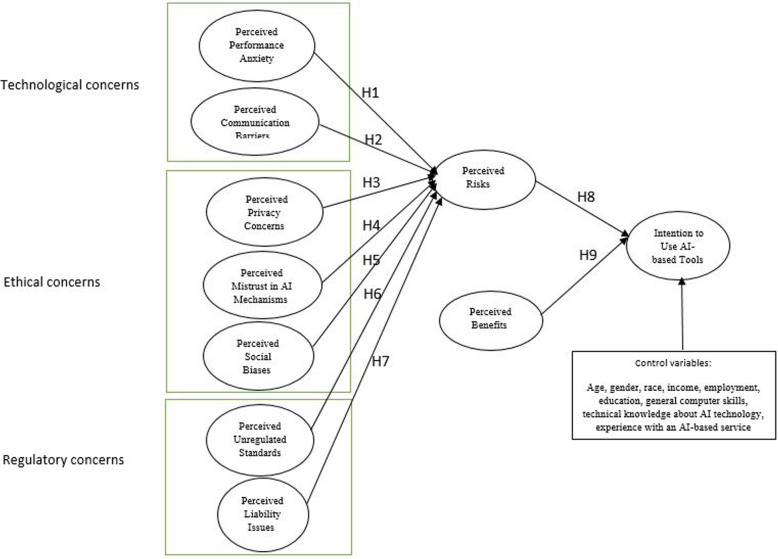
This survey study develops a value-based model of U.S. consumers’ intention to use AI-based clinical decision support tools, finding that technological, ethical (trust), and regulatory concerns shape perceived risks, while perceived benefits and risks predict intention. The model explained 67% of variance in perceived risks and 80% of variance in intention to use.
Key findings
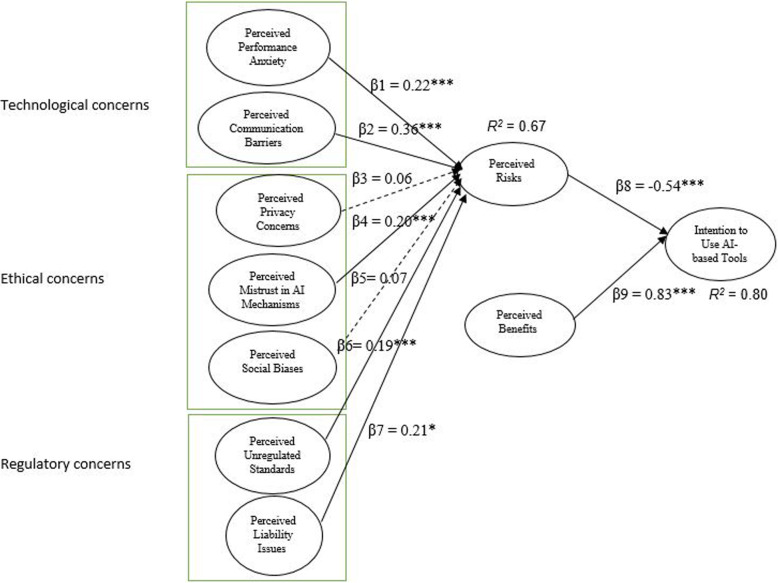
- Perceived benefits had a strong positive effect on intention to use AI-based tools (β = 0.83, p < 0.001), while perceived risks had a negative effect (β = −0.54, p < 0.001); the model explained 80% of variance in intention.
- Technological concerns were the most significant predictors of risk beliefs: perceived communication barriers (β = 0.36, p < 0.001) and perceived performance anxiety (β = 0.22, p < 0.001).
- Among ethical concerns, perceived mistrust in AI mechanisms was significant (β = 0.20, p < 0.001), but perceived privacy concerns (β = 0.06, non-significant) and perceived social biases (β = 0.07, non-significant) were not supported.
- Regulatory concerns were significant: perceived unregulated standards (β = 0.19, p < 0.001) and perceived liability issues (β = 0.21, p < 0.05); the model explained 67% of variance in perceived risks. Control variables including gender, income, education, employment, technical knowledge about AI, and familiarity with AI services influenced intention.
Methods
- Online survey via Amazon’s Mechanical Turk in April 2020 with U.S. participants; a scenario described an AI-based clinical decision support device for diagnosis, treatment, prescription advice, and care planning without direct physician interaction. The abstract reports 307 individuals, while the methods/results report 500 completed surveys, 73 dropped, and 427 final valid responses.
- Pilot work included review by five AI professionals, face validity with 15 students, and a pilot test with 117 undergraduate students.
- Hypotheses tested with structural equation modeling in IBM SPSS AMOS version 26, including confirmatory factor analysis, convergent/discriminant validity checks, bootstrapping with 5,000 samples, and controls for demographics and technology experience.
Limitations
- Stated: the sample was drawn only from the United States; lack of racial diversity (69% white) and age variety (66% aged 20–40) limit generalizability; MTurk self-report may include respondents not fully aware of AI and may induce sample selection bias; control variables were self-assessed; the study used the general concept of AI rather than a specific type; and it examined voluntary consumer use.
- Evident in the text: the abstract reports 307 individuals, whereas the methods/results report 427 final valid responses after exclusions, creating a sample-size discrepancy.
Model-written summary. Check it against the paper before relying on it.
Integrity signals
Registry
Cites
Statistics
Figures
Verification
Claims the paper makes
7 Valid · 2 Not valid · 78 Not checked · 86 Own results and interpretations
The cited sources that could be checked couldn’t confirm or dispute this claim.
In the paper
“However, previous studies suggest that not all individuals are willing to accept the use of medical AI devices [10].”
§ Use of AI-based tools for healthcare purposes: a survey study from consumers’ perspectives > Background
What the sources say
- Could not verifycites [10] Laï M-C, Brian M, Mamzer M-F. Perceptions of artificial intelligence in healthcare: findings from a qualitative survey study among actors in France. J Transl Med. 2020;18(1):1–13. sourceExperimental — accuracy not yet measured
Our copy of Cacho-Díaz et al. (2020, J Transl Med 18:1) is a review of tumor microenvironment differences between primary tumors and brain metastases; no passage addresses artificial intelligence, medical AI devices, or willingness/acceptance among individuals. Searches for 'artificial intelligence acceptance willingness medical AI devices' and 'patients attitudes toward technology adoption healthcare' returned only glossary/additional-information sections and reference lists on cancer biology (e.g. Lung cancer section on Keap1/Nrf2 mutations, References 89-92), and the Data availability section states no datasets were generated. Nothing in our copy supports or contradicts the attributed claim, so it cannot be judged from this source. (LLM, conf=0.80)
hedged- Asserted: passes — The authors put it forward as true.
- Checkable: passes — It can be checked against evidence.
- Load-bearing: passes — The paper’s conclusions depend on it.
- Based: passes — The paper gives a reason why it holds.
- Could not verify
Every source the paper cites for this claim was checked and supports it.
In the paper
“Privacy is one of the most critical concerns while using AI systems because users’ personal data (such as habits, preferences, and health records) is likely to be stored and shared across the AI network [25].”
§ Use of AI-based tools for healthcare purposes: a survey study from consumers’ perspectives > Methods > Perceived privacy concerns
What the sources say
- Supportedcites [25] Dwivedi YK, Hughes L, Ismagilova E, Aarts G, Coombs C, Crick T, et al. Artificial intelligence (AI): multidisciplinary perspectives on emerging challenges, opportunities, and agenda for research, practice and policy. Int J Inf Manag. 2019;101994. In Press. source
The TAM-DEF section (p. 52) calls privacy possibly the top concern in using AI systems and says users’ intimate data is likely to be stored and shared across the AI network. It gives food habits and shopping preferences as examples; the application-domains section (p. 5) also raises privacy concerns about storing and sharing healthcare data. (LLM, conf=0.90)
hedgedstates a cause- Asserted: passes — The authors put it forward as true.
- Checkable: passes — It can be checked against evidence.
- Load-bearing: passes — The paper’s conclusions depend on it.
- Based: passes — The paper gives a reason why it holds.
- Supported
A result the paper reports from its own data — it cites no other source for it, so there is none to check. The quote shows it is in the paper.
In the paper
“The results show that technological, ethical (trust factors), and regulatory concerns significantly contribute to the perceived risks of using AI applications in healthcare.”
§ Use of AI-based tools for healthcare purposes: a survey study from consumers’ perspectives > Abstract > Results
plainstates a cause- Asserted: passes — The authors put it forward as true.
- Checkable: passes — It can be checked against evidence.
- Load-bearing: passes — The paper’s conclusions depend on it.
- Based: passes — The paper gives a reason why it holds.
A result the paper reports from its own data — it cites no other source for it, so there is none to check. The quote shows it is in the paper.
In the paper
“Of the three categories, technological concerns (i.e., performance and communication feature) are found to be the most significant predictors of risk beliefs.”
§ Use of AI-based tools for healthcare purposes: a survey study from consumers’ perspectives > Abstract > Results
plainstates a cause- Asserted: passes — The authors put it forward as true.
- Checkable: passes — It can be checked against evidence.
- Load-bearing: passes — The paper’s conclusions depend on it.
- Based: passes — The paper gives a reason why it holds.
A result the paper reports from its own data — it cites no other source for it, so there is none to check. The quote shows it is in the paper.
In the paper
“no effects of age, race, and general computer skills were found on the intention to use.”
§ Use of AI-based tools for healthcare purposes: a survey study from consumers’ perspectives > Methods > Control variables
plain- Asserted: passes — The authors put it forward as true.
- Checkable: passes — It can be checked against evidence.
- Load-bearing: unclear — It is unclear whether the paper’s conclusions depend on it.
- Based: passes — The paper gives a reason why it holds.
52 more claims
Create a free account to see all 173 claims and to verify the 81 references still open.
- Probably not a substantial claim. 91
- It may state two separate claims as one. 45
- The quote only partly states this claim. 1
Claims other papers make about this one
Each is checked against this paper’s own text: does it say what the citing paper says it does?
The source backs part of the claim, not all of it — or backs it for a different population, condition or comparison.
In the citing paper
“The implementation of AI in healthcare sectors [47, 146] have created an urge amongst researchers to pursue innovative methods to develop e-healthcare systems.”
From Federated learning-based AI approaches in smart healthcare: Concepts, taxonomies, challenges and open issues (2023) · cites this paper as [146]
Experimental — accuracy not yet measuredIn the citing paper
“The changing role of nurses may introduce anxiety toward AI, 27 which directly affects the attitudes toward AI and the resulting potential difficulties in future adoption and usage of its applications in practice in addition to the concern of invaded privacy that may result from some AI-integrated technology applications. 27”
From Exploring nurses’ awareness and attitudes toward artificial intelligence: implications for nursing practice (2024) · cites this paper as [27]
Self-check
Percentages, sums and reported differences re-computed from the paper’s own numbers.
Each contradiction between two passages listed here was confirmed by an independent check.
Rated minor: it would not touch a result — a value no result rests on, a p-value that stays on the same side of the significance level, or a conflict that is clerical, resolved elsewhere in the paper, or outside its own findings.
In the paper
§ Use of AI-based tools for healthcare purposes: a survey study from consumers’ perspectives > Abstract > Methods
“We use an online survey to collect data from 307 individuals in the United States.”
§ Use of AI-based tools for healthcare purposes: a survey study from consumers’ perspectives > Methods > Analyses
“After excluding responses that failed the response quality questions, the final set of useable and valid responses contained 427 samples.”
Rated minor: it would not touch a result — a value no result rests on, a p-value that stays on the same side of the significance level, or a conflict that is clerical, resolved elsewhere in the paper, or outside its own findings.
In the paper
§ Use of AI-based tools for healthcare purposes: a survey study from consumers’ perspectives > Discussion > Limitations and future studies
“In this study, we used the general concept of AI, and no specific type of AI clinical tools was examined.”
§ Use of AI-based tools for healthcare purposes: a survey study from consumers’ perspectives > Background
“There are different types of medial AI, and this study focuses on devices with AI-based CDS features.”
Citations
Cites
1 retracted
Wang, Y., Zang, W., Du, Y., Ma, Y., Li, M., Li, P., Chen, X., Wang, T., Dong, Z., & Zhao, G. (2020) · Journal of Translational Medicine · doi:10.1186/s12967-020-02265-4 · Cited by 2
RetractedArtificial intelligence: a modern approach
(1995) · Choice Reviews Online · doi:10.5860/choice.33-1577 · Cited by 21,974
Pls-Sem: indeed a silver bullet
Hair, J. F., Ringle, C. M., & Sarstedt, M. (2011) · Journal of Marketing Theory and Practice · doi:10.2753/mtp1069-6679190202 · Cited by 21,631
Learned helplessness in humans: Critique and reformulation.
Abramson, L. Y., Seligman, M. E., & Teasdale, J. D. (1978) · Journal of Abnormal Psychology · doi:10.1037//0021-843x.87.1.49 · Cited by 7,121
Structural Equation Modeling and Regression: Guidelines for Research Practice
Gefen, D., Straub, D., & Boudreau, M.-C. (2000) · Communications of the Association for Information Systems · doi:10.17705/1cais.00407 · Cited by 6,416
A guide to deep learning in healthcare
Esteva, A., Robicquet, A., Ramsundar, B., Kuleshov, V., DePristo, M., Chou, K., Cui, C., Corrado, G., Thrun, S., & Dean, J. (2019) · Nature Medicine · doi:10.1038/s41591-018-0316-z · Cited by 5,312 · cited 1×
“However, it is widely believed that these systems will fundamentally change medical practice in the near future [15].”
BackgroundArtificial intelligence in healthcare: past, present and future
Jiang, F., Jiang, Y., Zhi, H., Dong, Y., Li, H., Ma, S., Wang, Y., Dong, Q., Shen, H., & Wang, Y. (2017) · Stroke and Vascular Neurology · doi:10.1136/svn-2017-000101 · Cited by 4,837
Dwivedi, Y. K., Hughes, L., Ismagilova, E., Aarts, G., Coombs, C., Crick, T., Duan, Y., Dwivedi, R., Edwards, J., Eirug, A., et al. (2021) · International Journal of Information Management · doi:10.1016/j.ijinfomgt.2019.08.002 · Cited by 4,611 · cited 10×
“As previous studies introduce several concerns and challenges with AI [25], the main focus of this model is to better explain and categorize factors affecting risk beliefs associated with AI.”
BackgroundResultInfluentialInternet Users' Information Privacy Concerns (IUIPC): The Construct, the Scale, and a Causal Model
Malhotra, N. K., Kim, S. S., & Agarwal, J. (2004) · Information Systems Research · doi:10.1287/isre.1040.0032 · Cited by 3,173 · cited 1×
“Previous studies indicate that invasion of privacy in the past significantly influence risk beliefs [80].”
BackgroundConducting behavioral research on Amazon’s Mechanical Turk
Mason, W., & Suri, S. (2012) · Behavior Research Methods · doi:10.3758/s13428-011-0124-6 · Cited by 3,172 · cited 1×
“Consistent with other studies, we used “ captcha ” questions to prevent and identify care-less, hurried, or haphazard answers [60].”
Result
Research works printed but not linked: 7
- Whittlestone J, Nyrup R, Alexandrova A, Dihal K, Cave S. Ethical and societal implications of algorithms, data, and artificial intelligence: a roadmap for research. London: Nuffield Foundation; 2019.
- Angwin J, Larson J, Mattu S, Kirchner L. Machine bias. ProPublica. 2016;23:2016.
- Gupta RK, Kumari R. Artificial intelligence in public health: opportunities and challenges. JK Sci. 2017;19(4):191–2.
- Hair JF, Black WC, Babin BJ, Anderson RE, Tatham RL. Multivariate data analysis 6th edition. Pearson prentice hall New Jersey humans: critique and reformulation. J Abnorm Psychol. 2006;87:49–74.
- Chin WW. The partial least squares approach to structural equation modeling. Mod Methods Bus Res. 1998;295(2):295–336.
- Fornell C, Tellis GJ, Zinkhan GM. Validity assessment: a structural equations approach using partial least squares. Chicago: Proceedings of the American Marketing Association Educators’ Conference; 1982.
- Kline RB. Principles and practice of structural equation modeling: Guilford publications; 2015.
Cited by
Items 101–200 of 632
Cognitive engagement with AI ‐enabled technologies and value creation in healthcare
Kumar, P. S., Vrontis, D., & Pallonetto, F. (2023) · Journal of Consumer Behaviour · doi:10.1002/cb.2196 · Cited by 48
Malaysia Public Sector Challenges of Implementation of Artificial Intelligence (AI)
Mahusin, N., Sallehudin, H., & Satar, N. S. M. (2024) · IEEE Access · doi:10.1109/access.2024.3448311 · Cited by 50
Choudhury, A., Shahsavar, Y., & Shamszare, H. (2025) · JMIR Human Factors · doi:10.2196/72867 · Cited by 46
Farah, L., Borget, I., Martelli, N., & Vallée, A. (2024) · Journal of Medical Internet Research · doi:10.2196/51514 · Cited by 44
Wangpitipanit, S., Lininger, J., & Anderson, N. (2024) · BMC Nursing · doi:10.1186/s12912-024-02170-x · Cited by 44
Trust and acceptance of AI caregiving robots: The role of ethics and self-efficacy
Lin, C. S., Kuo, Y., & Wang, T. (2024) · Computers in Human Behavior Artificial Humans · doi:10.1016/j.chbah.2024.100115 · Cited by 44
Medical practitioner perspectives on AI in emergency triage
Townsend, B., Plant, K. L., Hodge, J., Ashaolu, O., & Călinescu, R. (2023) · Frontiers in Digital Health · doi:10.3389/fdgth.2023.1297073 · Cited by 42
Adigwe, O. P., Onavbavba, G., & Sanyaolu, S. E. (2024) · Frontiers in Artificial Intelligence · doi:10.3389/frai.2023.1293297 · Cited by 42
Critical review of self‐diagnosis of mental health conditions using artificial intelligence
Wimbarti, S., Kairupan, B. H. R., & Tallei, T. E. (2024) · International Journal of Mental Health Nursing · doi:10.1111/inm.13303 · Cited by 42
Unlocking Patient Resistance to AI in Healthcare: A Psychological Exploration
Sobaih, A. E. E., Chaibi, A., Brini, R., & Ibrahim, T. M. A. (2025) · European Journal of Investigation in Health Psychology and Education · doi:10.3390/ejihpe15010006 · Cited by 42
Dean, T., Seecheran, R. V., Badgett, R. G., Zackula, R., & Symons, J. (2024) · JAMIA Open · doi:10.1093/jamiaopen/ooae100 · Cited by 41
Vakili, S. T., Haywood, D., Kirk, D., Abdou, A. M., Gopalakrishnan, R., Sadeghi, S., Guedes, H., Tan, C. J., Thamm, C., Bernard, R., et al. (2024) · JCO Clinical Cancer Informatics · doi:10.1200/cci.24.00119 · Cited by 43
Singh, A., Randive, S., Breggia, A., Ahmad, B., Christman, R., & Amal, S. (2023) · Cancers · doi:10.3390/cancers15235659 · Cited by 41
Jabar, M. A., Chiong-Javier, E., & Sherer, P. P. (2024) · Asia Pacific Journal of Education · doi:10.1080/02188791.2024.2303048 · Cited by 41
Svestkova, A., Huang, Y., & Šmahel, D. (2025) · Digital Health · doi:10.1177/20552076251360973 · Cited by 39
Guo, S., Song, Y., Chen, G., Han, H., Wu, H. Y., & Ma, J. (2025) · Digital Health · doi:10.1177/20552076251374121 · Cited by 39
Tan, T.-H., Hsu, C., Chen, C., Hsu, S., Liu, T.-L., Lin, H., Wang, J., Liu, C., & Huang, C. (2021) · BMC Geriatrics · doi:10.1186/s12877-021-02229-3 · Cited by 38
Tursynbek, A., Zhaksylykova, D., Cruz, J. P., & Balay‐odao, E. M. (2024) · Journal of Clinical Nursing · doi:10.1111/jocn.17584 · Cited by 37
Chen, J., Chen, C., Walther, J. B., & Sundar, S. S. (2021) · CHI Conference Extended Abstracts on Human Factors in Computing Systems (CHI EA) · doi:10.1145/3411763.3451735 · Cited by 37
Khan, S. D., Hoodbhoy, Z., Raja, M. H. R., Kim, J. Y., Hogg, H. D. J., Manji, A. A. A., Gulamali, F., Hasan, A., Shaikh, A., Tajuddin, S., et al. (2024) · PLOS Digital Health · doi:10.1371/journal.pdig.0000514 · Cited by 36
“However, only a small number of studies focused on user acceptability, user training, and technical expertise requirements, which are key facilitators of successful integration [52].”
BackgroundHe, X., Xi, Z., & Ding, H. (2023) · Journal of Medical Internet Research · doi:10.2196/50342 · Cited by 37
The impact of medical cyber–physical systems on healthcare service delivery
Sony, M., Antony, J., & McDermott, O. (2022) · The TQM Journal · doi:10.1108/tqm-01-2022-0005 · Cited by 37
Liefgreen, A., Weinstein, N., Wachter, S., & Mittelstadt, B. (2023) · AI & Society · doi:10.1007/s00146-023-01684-3 · Cited by 35
Algorithmovigilance, lessons from pharmacovigilance
Balendran, A., Benchoufi, M., Evgeniou, T., & Ravaud, P. (2024) · npj Digital Medicine · doi:10.1038/s41746-024-01237-y · Cited by 34
Xing, Y., Yu, L., Zhang, Z., & Zheng, L. J. (2023) · Journal of Organizational and End User Computing · doi:10.4018/joeuc.327278 · Cited by 35
AI-generated content in cross-domain applications: Research trends, challenges and propositions
Li, J., Qu, L., Cai, T., Zhao, Z., Haldar, N. A. H., Krishna, A., Kong, X., Macau, F., Chakraborty, T., Deroy, A., et al. (2025) · Knowledge-Based Systems · doi:10.1016/j.knosys.2025.114634 · Cited by 34
Wenderott, K., Krups, J., Luetkens, J. A., & Weigl, M. (2024) · Applied Ergonomics · doi:10.1016/j.apergo.2024.104243 · Cited by 33
AI Can Be a Powerful Social Innovation for Public Health if Community Engagement Is at the Core
Bazzano, A. N., Mantsios, A. R., Mattei, N., Kosorok, M. R., & Culotta, A. (2025) · Journal of Medical Internet Research · doi:10.2196/68198 · Cited by 33
An Empirical Analysis of Artificial Intelligence (AI) as a Growth Engine for the Healthcare Sector
Whig, V., Othman, B., Haque, M. A., Gehlot, A., Qamar, S., & Singh, J. (2022) · International Conference on Advance Computing and Innovative Technologies in Engineering (ICACITE) · doi:10.1109/icacite53722.2022.9823607 · Cited by 33
Madaudo, C., Parlati, A. L. M., Lisi, D. D., Carluccio, R., Sucato, V., Vadalà, G., Nardi, E., Macaione, F., Cannata, A. N., Manzullo, N., et al. (2024) · Journal of Cardiovascular Medicine · doi:10.2459/jcm.0000000000001664 · Cited by 32
Certified SAFe® 6 Agilist, N. Y., & Rahman, M. M. (2025) · doi:10.63125/qh5qgk22 · Cited by 32
Moal, O., Roger, É., Lamouroux, A., Younes, C., Bonnet, G., Moal, B., & Lafitte, S. (2022) · Computers in Biology and Medicine · doi:10.1016/j.compbiomed.2022.105637 · Cited by 32
Artificial intelligence in healthcare services: past, present and future research directions
Shah, W. S., Elkhwesky, Z., Jasim, K. M., Elkhwesky, E. F. Y., & Elkhwesky, F. F. Y. (2023) · Review of Managerial Science · doi:10.1007/s11846-023-00699-w · Cited by 32
Siddiqui, M. F., Alam, A., Калматович, К. Р., Mouna, A., Villela, R., Nurmamatovna, M. A., Mrad, Y. N., Rahat, S. A. A., Magarde, B. K., Muhammad, W., et al. (2022) · Studies in computational intelligence · doi:10.1007/978-981-19-6379-7_2 · Cited by 31
Generative Artificial Intelligence: Enhancing Patient Education in Cardiovascular Imaging
Marey, A., Saad, A. M., Killeen, B. D., Gómez, C., Tregubova, M., Unberath, M., & Umair, M. (2023) · BJR|Open · doi:10.1093/bjro/tzae018 · Cited by 31
Lee, V. W. P., Cheng, D. Y. Y., Lit, K. K., Buaton, H., & Lam, E. (2025) · Asia Pacific Journal of Social Work and Development · doi:10.1080/29949769.2025.2457363 · Cited by 30
Morandé, S. (2022) · International Journal of Information Management Data Insights · doi:10.1016/j.jjimei.2022.100124 · Cited by 31
Lysø, E. H., Hesjedal, M. B., Skolbekken, J., & Solbjør, M. (2024) · Social Science & Medicine · doi:10.1016/j.socscimed.2024.116771 · Cited by 30
The Present and Future of AI: Ethical Issues and Research Opportunities
Srivastava, A., Marabelli, M., Blanch‐Hartigan, D., Moriarty, J., Carey, E., Persky, S., & Torous, J. B. (2025) · Communications of the Association for Information Systems · doi:10.17705/1cais.05611 · Cited by 29
Deploying Foundation Model Powered Agent Services: A Survey
Xu, W., Chen, J., Zheng, P., Yi, X., Tian, T., Zhu, W., Wan, Q., Wang, H., Fan, Y., Su, Q., et al. (2025) · IEEE Communications Surveys & Tutorials · doi:10.1109/comst.2025.3580745 · Cited by 30
Reducing Bias in Healthcare Artificial Intelligence
Byrne, M. D. (2021) · Journal of PeriAnesthesia Nursing · doi:10.1016/j.jopan.2021.03.009 · Cited by 29
Ethical Challenges of Artificial Intelligence in Health Care: A Narrative Review
Hui, A. T., Ahn, S. S., Lye, C. T., & Deng, J. (2021) · Ethics in Biology Engineering and Medicine An International Journal · doi:10.1615/ethicsbiologyengmed.2022041580 · Cited by 30
Patient Experiences with AI in Healthcare Settings
Hoseini, M. S. (2023) · AI and Tech in Behavioral and Social Sciences · doi:10.61838/kman.aitech.1.3.3 · Cited by 29
Chadaga, K., Prabhu, S., Sampathila, N., Chadaga, R., Bhat, D., Sharma, A., & Swathi, K. S. (2024) · SLAS TECHNOLOGY · doi:10.1016/j.slast.2024.100129 · Cited by 29
The Impact and Role of Artificial Intelligence (AI) in Healthcare: Systematic Review
Singh, K., Prabhu, A. A., & Kaur, N. (2025) · Current Topics in Medicinal Chemistry · doi:10.2174/0115680266339394250225112747 · Cited by 30
Baraka, A. A. E., Alhijji, M. A. A., Alrajeh, R. A. I., Alotaibi, D. N. B., Bukhamis, S., Alsafraa, N. A. M., & Hassan, E. A. (2025) · International Nursing Review · doi:10.1111/inr.70035 · Cited by 28
Clinical Decision Support for Laboratory Testing
Hughes, A. E. O., & Jackups, R. (2022) · Clinical Chemistry · doi:10.1093/clinchem/hvab201 · Cited by 28
A nationwide survey on the perceptions of general surgeons on artificial intelligence
Voskens, F. J., Abbing, J. R., Ruys, A. T., Ruurda, J. P. H., & Broeders, I. A. M. J. (2022) · Artificial Intelligence Surgery · doi:10.20517/ais.2021.10 · Cited by 28
Subaveerapandiyan, A., Mvula, D., Ahmad, N., Taj, A., & Ahmed, M. G. (2024) · Journal of Health Organization and Management · doi:10.1108/jhom-04-2024-0154 · Cited by 28
Liu, J., Wang, X., & Zhang, J. (2025) · Behavioral Sciences · doi:10.3390/bs15050697 · Cited by 27
Andrade, S. M., da Silva‐Sauer, L., de Carvalho, C. D., de Araújo, E. L. M., Lima, E. D. O., Fernandes, F. M. L., Moreira, K. L. D. A. F., Camilo, M. E., Andrade, L. M. M. D. S., Borges, D. T., et al. (2023) · Frontiers in Human Neuroscience · doi:10.3389/fnhum.2023.1234168 · Cited by 27
Koh, L. Y., & Yuen, K. F. (2024) · Journal of Retailing and Consumer Services · doi:10.1016/j.jretconser.2024.103998 · Cited by 28
Factors influencing patients’ engagement with ChatGPT for accessing health-related information
Alanezi, F. (2024) · Critical Public Health · doi:10.1080/09581596.2024.2348164 · Cited by 26
“The authors created both survey and interview questionnaire based on the literature reviewed from (Ahuja et al., 2020; Esmaeilzadeh, 2020; He et al., 2019; Hermes et al., 2020; Hodge et al., 1999; Reddy et al., 2019; Sezgin et al., 2020; Shim & Jo, 2020) which identified the potential factors that…”
InfluentialEsmaeilzadeh, P. (2025) · BMC Medical Informatics and Decision Making · doi:10.1186/s12911-025-03182-6 · Cited by 26
“Transparency and explainabil-ity remain integral to maintaining informed consent and clinical accountability [31].”
Self-citationAlbarracin, M., Hipólito, I., Tremblay, S. E., Fox, J. G., René, G., Friston, K. J., & Ramstead, M. J. D. (2023) · Communications in computer and information science · doi:10.1007/978-3-031-47958-8_9 · Cited by 29
Mitigating AI bias in financial decision-making: A DEI perspective
Omogbeme, A. O., & Odewuyi, O. M. (2024) · World Journal of Advanced Research and Reviews · doi:10.30574/wjarr.2024.24.3.3894 · Cited by 26
Nagar, S., Patidar, M., Sheikh, R., Singh, S., Kashiv, A., Jain, A., Namdeo, S. K., Paranjpe, P., & Mandloi, D. S. (2024) · IEEE International Conference on Advances in Computing Research on Science Engineering and Technology (ACROSET) · doi:10.1109/acroset62108.2024.10743527 · Cited by 25
Role of Trust in AI-Driven Healthcare Systems: Discussion from the Perspective of Patient Safety
Ünver, M. B., & Asan, O. (2022) · Proceedings of the International Symposium on Human Factors and Ergonomics in Health Care · doi:10.1177/2327857922111026 · Cited by 25
Naggar, M., Alharbi, Z. A., Alanazi, A. M., Alsaiari, S. O., Alhemaidani, A. M., Alanazi, S. F., & Alanazi, M. M. (2023) · Cureus · doi:10.7759/cureus.42858 · Cited by 25
Expert gaze as a usability indicator of medical AI decision support systems: a preliminary study
Castner, N., Arsiwala-Scheppach, L. T., Mertens, S., Krois, J., Thaqi, E., Kasneci, E., Wahl, S., & Schwendicke, F. (2024) · npj Digital Medicine · doi:10.1038/s41746-024-01192-8 · Cited by 25
Challenges for AI in Healthcare Systems
Bertl, M., Lamo, Y., Leucker, M., Margaria, T., Mohammadi, E., Mukhiya, S. K., Pechmann, L., Piho, G., & Rabbi, F. (2024) · Lecture notes in computer science · doi:10.1007/978-3-031-73741-1_11 · Cited by 26
Potential Benefits of Artificial Intelligence in Healthcare
Hoppe, N., Härting, R.-C., & Rahmel, A. (2022) · Intelligent systems reference library · doi:10.1007/978-3-031-11170-9_9 · Cited by 24
Almalki, M. (2021) · Medical Archives · doi:10.5455/medarh.2021.75.50-55 · Cited by 24
Wang, B., Asan, O., & Mansouri, M. (2023) · JMIR Human Factors · doi:10.2196/49788 · Cited by 23
Liu, Y., Su, Y.-Y., Alhur, A., & Naeem, S. B. (2025) · Information Development · doi:10.1177/02666669251343030 · Cited by 23
Bout, N., Moukhliss, G., Belhadaoui, H., Afifi, N., & Abık, M. (2025) · Discover Internet of Things · doi:10.1007/s43926-025-00174-w · Cited by 23
What May Impact Trustworthiness of AI in Digital Healthcare: Discussion from Patients’ Viewpoint
Wang, B., Asan, O., & Mansouri, M. (2023) · Proceedings of the International Symposium on Human Factors and Ergonomics in Health Care · doi:10.1177/2327857923121001 · Cited by 23
Habibi, F., Ghaderkhani, S., Shokoohi, M., Banari, T., Morsali, M., Abadi, R. N. S., & Kiamehr, H. (2025) · AI and Ethics · doi:10.1007/s43681-025-00673-0 · Cited by 23
Hachoumi, N., Eddabbah, M., & Adib, A. R. E. (2025) · Informatics and Health · doi:10.1016/j.infoh.2025.05.002 · Cited by 23
Arslan, N., Esin, K., & Ayyıldız, F. (2025) · BMC Public Health · doi:10.1186/s12889-025-22507-8 · Cited by 22
Albergante, L., O’Flynn, C., & Meyer, G. D. (2025) · Journal of the American Veterinary Medical Association · doi:10.2460/javma.24.09.0617 · Cited by 22
Ma, J. S., O’Riordan, M., Mazzer, K., Batterham, P. J., Bradford, S., Kõlves, K., Titov, N., Klein, B., & Rickwood, D. (2022) · JMIR Human Factors · doi:10.2196/34514 · Cited by 22
Yang, R., Zhao, G., & Yan, B. (2022) · Molecules · doi:10.3390/molecules27196249 · Cited by 22
Security and privacy concerns in smart healthcare system
AbdulRaheem, M., Awotunde, J. B., Chakraborty, C., Adeniyi, A. E., Oladipo, I. D., & Bhoi, A. K. (2023) · Elsevier eBooks · doi:10.1016/b978-0-323-91916-6.00002-3 · Cited by 22
Hogg, H. D. J., Al-Zubaidy, M., Keane, P. A., Hughes, G., Beyer, F. R., & Maniatopoulos, G. (2023) · Frontiers in Health Services · doi:10.3389/frhs.2023.1161822 · Cited by 22
Zakhmi, K., Ushmani, A., Mohanty, M. R., Agrawal, S., Banduni, A., & Rao, S. S. K. (2025) · Cureus · doi:10.7759/cureus.85446 · Cited by 22
Esmaeilzadeh, P., Hassanein, K., & Head, M. M. (2025) · Behaviour and Information Technology · doi:10.1080/0144929x.2025.2477754 · Cited by 21
Self-citationChatbots in Pharmacy: A Boon or a Bane for Patient Care and Pharmacy Practice?
Ramadhani, C. (2023) · Sciences of Pharmacy · doi:10.58920/sciphar02030001 · Cited by 21
Frost, E. K., Bosward, R., Aquino, Y. S. J., Braunack‐Mayer, A., & Carter, S. M. (2024) · International Journal of Medical Informatics · doi:10.1016/j.ijmedinf.2024.105417 · Cited by 21
Sacca, L., Lobaina, D., Burgoa, S., Lotharius, K. C., Moothedan, E., Gilmore, N., Xie, J. F., Mohler, R., Scharf, G., Knecht, M. K., et al. (2024) · Journal of Clinical Medicine · doi:10.3390/jcm13092525 · Cited by 21
Nagar, R., Quirk, H. D., & Anderson, P. L. (2023) · Internet Interventions · doi:10.1016/j.invent.2023.100676 · Cited by 21
Chandrasekaran, R., & Moustakas, E. (2025) · Journal of the American Medical Informatics Association · doi:10.1093/jamia/ocaf218 · Cited by 20
What if you have a humanoid AI robot doctor?: An investigation of public trust in South Korea
Kim, D. K., & Kim, S. (2021) · Journal of Communications In Healthcare · doi:10.1080/17538068.2021.1994825 · Cited by 20
Enhancing E-Business Communication with a Hybrid Rule-Based and Extractive-Based Chatbot
Doğan, O., & Gürcan, Ö. F. (2024) · Journal of theoretical and applied electronic commerce research · doi:10.3390/jtaer19030097 · Cited by 21
Assistive Tools or Insecurity: The Impact of Technological Readiness on Willingness to Use AI
Li, H., Ren, T., & Zhang, Z. (2024) · International Journal of Human-Computer Interaction · doi:10.1080/10447318.2024.2443802 · Cited by 20
Winter, P., & Carusi, A. (2022) · Journal of Responsible Technology · doi:10.1016/j.jrt.2022.100052 · Cited by 20
Al-Qudimat, A. R., Alqudimat, M. R., Singh, K., Fares, Z. E., Ismail, M., Yasin, H. E., Al‐Zoubi, R. M., & Aboumarzouk, O. M. (2025) · Health Science Reports · doi:10.1002/hsr2.70623 · Cited by 19
Machine learning in expert systems for disease diagnostics in human healthcare
Yadav, A. K., Shukla, R., & Singh, T. R. (2021) · Elsevier eBooks · doi:10.1016/b978-0-12-821777-1.00022-7 · Cited by 21
Jang, W., Chang, Y., Kim, B., Lee, Y. J., & Kim, S.-C. (2023) · International Journal of Human-Computer Interaction · doi:10.1080/10447318.2023.2209995 · Cited by 19
Expert-centered Evaluation of Deep Learning Algorithms for Brain Tumor Segmentation
Hoebel, K., Bridge, C. P., Ahmed, S., Akintola, O. O., Chung, C. D., Huang, R. Y., Johnson, J. M., Kim, A. E., Ly, K. I., Chang, K., et al. (2023) · Radiology Artificial Intelligence · doi:10.1148/ryai.220231 · Cited by 19
AI illuminates paths in oral cancer
Kapoor, D. U., Saini, P. K., Sharma, N., Singh, A., Prajapati, B. G., Elossaily, G. M., & Rashid, S. (2024) · EXCLI journal · doi:10.17179/excli2024-7253 · Cited by 19
The future of quality and accreditation surveys: Digital transformation and artificial intelligence
ÇAYIRTEPE, Z., & Şenel, F. Ç. (2020) · International Journal for Quality in Health Care · doi:10.1093/intqhc/mzac025 · Cited by 19
Banerjee, D., Rajput, D., Banerjee, S., & Saharan, V. A. (2022) · Springer eBooks · doi:10.1007/978-981-16-5180-9_11 · Cited by 19
Applications of Artificial Intelligence for Health Informatics: A Systematic Review
Hasan, M. E., Islam, M. J., Islam, R., Chen, D., Sanín, C., & Xu, G. (2023) · Journal of Artificial Intelligence for Medical Sciences · doi:10.55578/joaims.230920.001 · Cited by 18
Davis, V. H., Qiang, J. R., Adekoya, I., Howse, D., Seshie, A. Z., Kosowan, L., Delahunty‐Pike, A., Abaga, E., Cooney, J., Robinson, M., et al. (2025) · Journal of Medical Internet Research · doi:10.2196/52244 · Cited by 19
Zhang, S., Han, B., & Fan, M. (2025) · Digital Health · doi:10.1177/20552076251350001 · Cited by 18
Classification of Sleep-Wake State in Ballistocardiogram system based on Deep Learning
Ahmed, N., Srivyshnav, K. S., Chokalingam, K., Rawooth, M., Kumar, G., Parchani, G., & Saran, V. (2022) · Annual International Conference of the IEEE Engineering in Medicine and Biology Society (EMBC) · doi:10.1109/embc48229.2022.9871831 · Cited by 18
Ahmed, I., Feng, B., Yeboah, K. E., Feng, J., Jumani, M. S., & Ali, S. A. (2024) · Scientific Reports · doi:10.1038/s41598-024-78521-0 · Cited by 18
AI-driven optimisation of EHR systems implementation in Tanzania’s primary health care
Mwogosi, A. (2024) · Transforming Government People Process and Policy · doi:10.1108/tg-08-2024-0195 · Cited by 17
Metadata
- Authors
- Esmaeilzadeh, P.
- Affiliations
- Florida International University (US)
- Corresponding author
- Esmaeilzadeh, Pouyan
- ORCID
- Esmaeilzadeh, Pouyan
- Venue
- BMC Medical Informatics and Decision Making
- Published
- 2020-07-22
- Volume
- 20
- Issue
- 1
- Pages
- 170-170
- ISSN
- 1472-6947 (ISSN-L)
- PMC
- PMC7376886
- OpenAlex
- W3044430020
- Cited by
- 507
- References
- 90
- Citations by year
- 2026: 83 · 2025: 129 · 2024: 126 · 2023: 84 · 2022: 47 · 2021: 33 · 2020: 3
- FWCI
- 12.29
- Type
- journal article
- Language
- en
- Open access
- gold
- doi.org
- Licence
- cc-by
- creativecommons.org/licenses/by/4.0 (tdm)
- creativecommons.org/licenses/by/4.0 (vor)
- Locations
- BMC Medical Informatics and Decision Making (publishedVersion, cc-by)
- PubMed Central (publishedVersion, cc-by)
- PubMed (publishedVersion)
- DOAJ (DOAJ: Directory of Open Access Journals) (submittedVersion, cc-by-sa)
- Topics
- Health Sciences › Medicine › Health Informatics › Artificial Intelligence in Healthcare and Education
- Physical Sciences › Computer Science › Artificial Intelligence › Ethics and Social Impacts of AI
- Social Sciences › Decision Sciences › Information Systems and Management › Technology Adoption and User Behaviour
- Keywords
- artificial intelligence in healthcare, clinical decision support, patient perspectives, risk perception, perceived benefits, trust in AI, regulatory concerns, ethical considerations, AI medical devices, perceived value
- MeSH terms
- Adult, Artificial Intelligence, Delivery of Health Care, Female, Health Facilities, Humans, Male, Middle Aged, Surveys and Questionnaires, United States, Decision Support Systems, Clinical, Young Adult
About these checks
Registry, retraction, Cites and statistics results are computed, not judged, with one exception: a printed reference that no index lists is read once by a model before it counts as a citation error. Claims are extracted by a model and kept only when their quote appears verbatim in the text; each cited source is then checked, with a model’s help, for whether it says what the claim relies on. Those verdicts can be wrong — read the claim’s quote and the cited source before relying on one.
The claim verdicts this report counts are experimental: their accuracy is not yet measured.
A language model drew the claims from the paper on 2026-10-05, under version 3 of the claim definition (model deepseek-v4.1-flash, prompt extract-v3).
A second model labelled each claim on 2026-10-05 (model jev-1.13-20260917, definition revision gold-guideline-v0.2).
Cited sources are checked with a language model’s help (qwen3.8-omni-flash and gpt-6-sol).
Statistics and arithmetic are recomputed, not judged.
Confidence bands are shown only for fields calibrated on our annotated test set. None is calibrated yet, so no band is shown.
What counts as a claim ›How we measure confidence ›How we check this ›
Are you an author, or do you see a problem with this page? Request a review
Data sources
Bibliographic data: Semantic Scholar, OpenAlex, Crossref.
Contains information from the Semantic Scholar Academic Graph Datasets, made available under the ODC Attribution License (ODC-BY 1.0).
Semantic Scholar’s data is described in: Kinney, R., et al. (2023). The Semantic Scholar Open Data Platform. arXiv:2301.10140.
