

Distribution of nursing workforce in the world using Gini coefficient
Open accessThe DOI matches its Crossref record; 25 of the 26 references it cites were found in a registry or an index.
Abstract
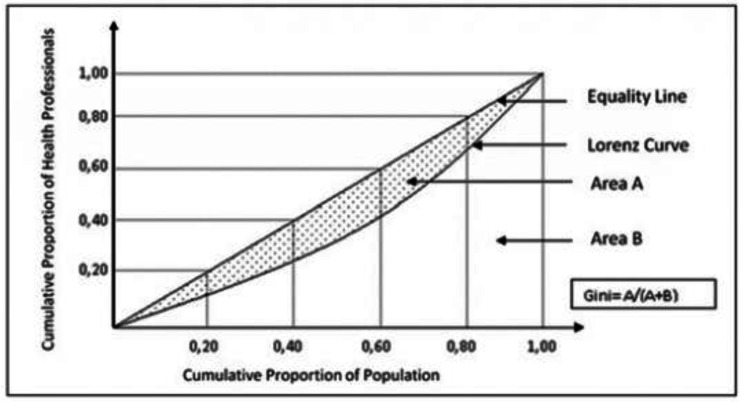
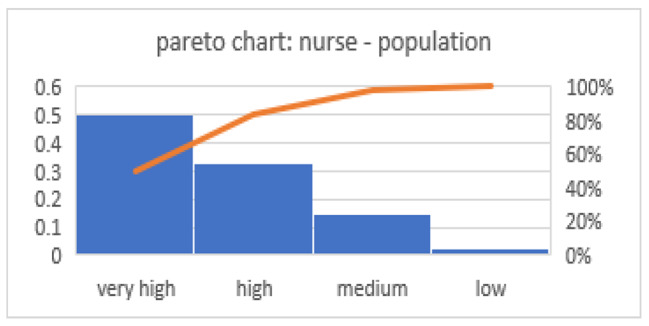
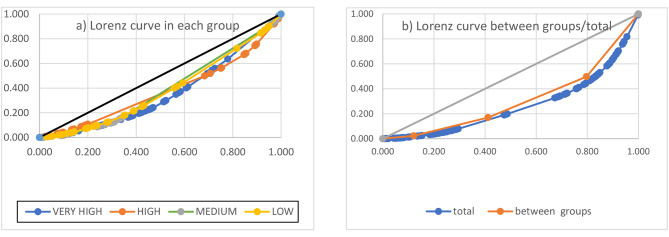
INTRODUCTION: Unequal Access to human resources for health, reduces access to healthcare services, worsens the quality of services and reduces health outcomes. This study aims to investigate the distribution of the nursing workforce around the world. METHODS: This is a descriptive-analytical study, which was conducted in 2021. The number of nurses and world populations was gathered from World Health Organization (WHO) and The United Nations (UN) databases. The UN has divided world countries based on the Human Development Index (HDI) into four categories of very high, high, medium and low HDI. To investigate the distribution of the nurses around the world, we used the nurse population ratio (per 10,000 population), Gini coefficient, Lorenz curve and Pareto curve. FINDINGS: On average, there were 38.6 nurses for every 10,000 people in the world. Nations with the very high HDI, had the highest nurse/population ratio (95/10,000), while the low HDI nations had the lowest nurse/population ratio (7/10,000). Most nurses around the world were females (76.91%) who were in the age group of 35-44 (29.1%). The Gini coefficient of nations in the each four HDI categories varied from 0.217 to 0.283. The Gini coefficient of the nations between the four HDI categories was 0.467, and the Gini coefficient of the whole world was 0.667. CONCLUSION: There were inequalities between countries all over the world. Policymakers should focus on the equitable distribution of the nursing workforce across all local, national and regional levels.
Overview
The claims and statistics of this paper haven’t been checked yet.
Free: it reads the open-access text and checks the first 5 claims that cite a source we can check. Create a free account to check every claim.
Integrity signals
Registry
Cites
Statistics
Figures
Verification
Claims the paper makes
The claims and statistics of this paper haven’t been checked yet.
Free: it reads the open-access text and checks the first 5 claims that cite a source we can check. Create a free account to check every claim.
Claims other papers make about this one
Each is checked against this paper’s own text: does it say what the citing paper says it does?
The cited source says what the claim attributes to it.
In the citing paper
“Given the findings of a recent study that approximately 77% of nurses worldwide are female (89), this is not surprising, considering that nurses constitute the largest proportion of all professions in this review.”
From Digital resilience interventions for healthcare workers: a systematic review (2025) · cites this paper as [89]
Self-check
Percentages, sums and reported differences re-computed from the paper’s own numbers.
The self-check needs the paper’s full text.
Citations
Cites
State of the world's nursing 2020: investing in education, jobs and leadership
McCarthy, C. F. (2020) · Cited by 845
Human resources and health outcomes: cross-country econometric study
Anand, S., & Bärnighausen, T. (2004) · The Lancet · doi:10.1016/s0140-6736(04)17313-3 · Cited by 652
How to bridge the gap in human resources for health
Hongoro, C., & McPake, B. (2004) · The Lancet · doi:10.1016/s0140-6736(04)17229-2 · Cited by 440 · cited 3×
“In this respect, factors such as a low capacity for medical training, poor living and working conditions, and inadequate salaries could drive health workers out of the country [2].”
BackgroundInfluentialResponding to the global human resources crisis
Narasimhan, V., Brown, H., Pablos-Mendez, A., Adams, O., Dussault, G., Elzinga, G., Nordstrom, A., Habte, D., Jacobs, M., Solimano, G., et al. (2004) · The Lancet · doi:10.1016/s0140-6736(04)16108-4 · Cited by 284
Brown, M. C. (1994) · Social Science & Medicine · doi:10.1016/0277-9536(94)90189-9 · Cited by 274 · cited 1×
“70, the distribution is completely unequal [15].”
International Migration of Health Workers: Labour and Social Issues.
Bach, S. (2003) · Research Portal (King's College London) · Cited by 237
The Next Frontier—Human Development and the Anthropocene: UNDP Human Development Report 2020
Baumann, F. (2021) · Environment Science and Policy for Sustainable Development · doi:10.1080/00139157.2021.1898908 · Cited by 130 · cited 1×
“Sixty-six countries were included in the very high, 53 ones in the high, 37 ones in the medium and 33 ones in the low HDI groups [14].”
Tandi, T. E., Cho, Y., Akam, A. J.-C., Afoh, C. O., Ryu, S. H., Choi, M. S., Kim, K., & Choi, J. W. (2015) · International Journal for Equity in Health · doi:10.1186/s12939-015-0172-0 · Cited by 129 · cited 1×
“Different studies have also reported these results [4, 6, 16, 20].”
ResultRobinson, J. J. A., & Wharrad, H. J. (2000) · Journal of Advanced Nursing · doi:10.1046/j.1365-2648.2000.01458.x · Cited by 80
Health Workforce Equity in Urban Community Health Service of China
Chen, R., Zhao, Y., Du, J., Wu, T., Huang, Y., & Guo, A. (2014) · PLoS ONE · doi:10.1371/journal.pone.0115988 · Cited by 74
Research works printed but not linked: 3
- Anand S Organization WH Measuring health workforce inequalities: methods and application to China 2010 and India World Health Organization
- WHO State of the world’s nursing 2020: investing in education, jobs and leadership 2020 Geneva World Health Organization
- Masoumi SJ Nasabi NA Varzandeh M Bordbar N Gender Equality among Nurses: Promotion strategies for gender Equality J Health Manage Inform Sci 2020 7 4 252 8
Cited by
Economocracy: Global Economic Governance
Χαλλουμής, C. C. Κ. (2025) · Economies · doi:10.3390/economies13080230 · Cited by 44
Kattan, W., & Al‐Hanawi, M. K. (2025) · Human Resources for Health · doi:10.1186/s12960-025-01010-6 · Cited by 30
“Additionally, structural health system factors— such as urbanization patterns, healthcare facility density, and national employment policies—play pivotal roles in determining how nurses are allocated across regions and sectors [5].”
InfluentialTomlinson, E., Schoch, M., & McDonall, J. (2025) · Nurse Education Today · doi:10.1016/j.nedt.2025.106928 · Cited by 25
Transforming neonatal nursing in India: challenges, opportunities, and the way forward
Kalyan, G., Joshi, P., Murry, L. L., Campbell-Yeo, M. L., & Tiwari, S. K. (2024) · The Lancet Regional Health - Southeast Asia · doi:10.1016/j.lansea.2024.100522 · Cited by 22
Equity and trends in the allocation of health human resources in China from 2012 to 2021
Chai, Y., Xian, G., Kou, R., Wang, M., Liu, Y., Fu, G., & Luo, S. (2024) · Archives of Public Health · doi:10.1186/s13690-024-01407-0 · Cited by 21
“…an even distribution; when 0.2 < G < 0.3, it suggests a relatively balanced distribution; when 0.3 < G < 0.4, it signifies a relatively reasonable distribution; when 0.4 < G < 0.5, it indicates a relatively unfair distribution; and when G > 0.5, it suggests a highly unfair distribution [49].”
BackgroundInfluentialDigital resilience interventions for healthcare workers: a systematic review
Larsson, M., Ho, D. M., Kirschner, M., Seifritz, E., & Manoliu, A. (2025) · Frontiers in Psychiatry · doi:10.3389/fpsyt.2025.1519670 · Cited by 14
Holmberg, C. (2024) · Journal of Advanced Nursing · doi:10.1111/jan.16562 · Cited by 18
Parkinson, B., Cullum, N. A., Sutton, M., Checkland, K., Bower, P., Bramwell, D., & Meacock, R. (2024) · Journal of Nursing Management · doi:10.1155/2024/7513374 · Cited by 13
“Studies have demonstrated inequalities in the density and distribution of nurses between countries [43, 44] and at a subnational level within 58 countries [45].”
Piervisani, L., Maria, M. D., Spagnuolo, S., Nazzaro, P., Rocco, G., Vellone, E., & Alvaro, R. (2024) · Journal of Nursing Scholarship · doi:10.1111/jnu.13020 · Cited by 13
Bayadsi, J., Drach‐Zahavy, A., Cohen, M., & Srulovici, E. (2024) · International Journal of Nursing Studies · doi:10.1016/j.ijnurstu.2024.104919 · Cited by 15
Roupa, A., Patelarou, A. E., Giakoumidakis, K., Fousiani, K., Miliaraki, M., Stratidaki, E., & Patelarou, E. (2025) · Healthcare · doi:10.3390/healthcare13010075 · Cited by 16
Kwek, S. Q., Yeo, T. M., Teo, J. Y. C., Seah, A. C. W., Ning, J. P. K., & Wang, W. (2025) · European Journal of Cardiovascular Nursing · doi:10.1093/eurjcn/zvaf084 · Cited by 13
The role of gender in antimicrobial resistance: Findings from a scoping review
Ruckert, A., Dobreva, Z., Naro, S. G., Paulin, S., Wilson, L. A., McGall, C., Morgan, R., Melles-Brewer, M. M., Coates, A., Thanh, G. T., et al. (2025) · Global Public Health · doi:10.1080/17441692.2025.2542400 · Cited by 12
“Within healthcare, globally, women make up 70% of nurses and are responsible for frontline infection prevention and control (IPC) interventions which increases their exposure to DRIs (Charani et al., 2021; Gautron et al., 2023; Kharazmi et al., 2023; Terri Collins, 2023).”
Bias in Gini coefficient estimation for gamma mixture populations
Vila, R., & Saulo, H. (2025) · Statistical Papers · doi:10.1007/s00362-025-01768-w · Cited by 10
“…inequality within a distribution can be quantified using this method, which has applications in a variety of fields, including economics, finance, ecology, health, and environment, among others; see, for example, Damgaard and Weiner (2000), Yao (1999), Sun et al. (2010), and Kharazmi et al. (2023).”
Kućar, M., Brajša‐Žganec, A., & Neuberg, M. (2025) · Nursing Reports · doi:10.3390/nursrep15050174 · Cited by 5
“Across the world, the female gender is prevalent in nursing [44] and Croatia is not an exception to that rule.”
Frazier, C., Miao, C., Evans, M. S., & Frazier, E. (2025) · Pediatric Dermatology · doi:10.1111/pde.70026 · Cited by 4
“Inequality in the percentage of the pediatric population residing beyond an OHSA was assessed by computing the Gini coefficient using the ineq package in R, with a Gini coefficient of 0 representing complete equality and a Gini coefficient of 1 denoting complete inequality [1, 8].”
Yu, F., Zhao, J., Zhang, X., Li, T., Lu, H., Chang, Y., & Li, X. (2026) · PLoS ONE · doi:10.1371/journal.pone.0343263 · Cited by 4
“%) was higher than typical workforce estimates, which show that women account for about 77%−90% of nurses, depending on region and setting [53].”
Integrating prior information into Gini coefficient estimation: A credibility method
Wen, L., Cao, R., & Zhang, Y. (2025) · Communication in Statistics- Theory and Methods · doi:10.1080/03610926.2025.2488895 · Cited by 3
Always on duty - Fostering climate resilience in the nursing profession: A discussion paper
Baumbusch, J., Yip, I. S., & Bandara, N. A. (2025) · International Journal of Nursing Studies · doi:10.1016/j.ijnurstu.2025.105227 · Cited by 3
Thirdhand Smoke and Neonatal/Pediatric Health: A Scoping Review on Nursing Implications
Vanzi, V., Lommi, M., Stievano, A., Rocco, G., Zega, M., & Caggianelli, G. (2025) · Healthcare · doi:10.3390/healthcare13243289 · Cited by 2
“They are central to health-system performance, carrying out a broad spectrum of functions, from health promotion and disease prevention to treatment and rehabilitation [24].”
Quenum, Y. (2026) · Frontiers in Psychiatry · doi:10.3389/fpsyt.2026.1772856 · Cited by 2
“Psychiatric nurses, most of whom are women (73), may struggle to have patients ’ expressed wishes fully recognized within medical decision-making structures (52), thereby invalidating their holistic assessment of the situation and their caring-centered approach (74).”
Tamaki, T., Morioka, N., Machida, A., & Kashiwagi, M. (2024) · Human Resources for Health · doi:10.1186/s12960-024-00922-z · Cited by 2
Chen, J., Liu, Y., Qu, Y., Xing, J., Zhu, Y., Li, X., & Wu, X. (2024) · BMC Nursing · doi:10.1186/s12912-024-02446-2 · Cited by 3
Lorenz, E., Grüne, E., Popp, J., Pfeifer, K., & Carl, J. (2024) · BMC Nursing · doi:10.1186/s12912-024-02639-9 · Cited by 1
Health Personnel Inequality Trends in Turkey: Theil Index and Gini Analysis
Şenel, K. (2025) · International Journal of Health Management and Tourism · doi:10.31201/ijhmt.1731530 · Cited by 1
Unmaking AI: A Framework for Critical Investigation
Munn, L., Magee, L., Arora, V., & Khan, A. H. (2025) · Critical AI · doi:10.1215/2834703x-12095973 · Cited by 1
Morioka, N., Tamaki, T., & Takahashi, K. (2026) · Nursing Reports · doi:10.3390/nursrep16010025 · Cited by 1
Eryılmaz, M., Kurutkan, M. N., Bağış, M., Boztoprak, H., Özkan, Ş., & ÖZİŞLİ, Ö. (2026) · Journal of Health Organization and Management · doi:10.1108/jhom-06-2025-0341 · Cited by 1
Rahimi, S., Chegini, N., Hosseinkhani, Z., Ahmadieh, A., Aliakbari, M., & Senmar, M. (2026) · BMC Nursing · doi:10.1186/s12912-026-04483-5 · Cited by 1
“Nurses constitute the largest number of healthcare workers in the hospital [8], and play an important role in care organizations [9].”
A Bibliometric Analysis of Nurse Workforce Shortages in the Western Pacific Region
Ludin, S. M., & Ramazanu, S. (2026) · INTERNATIONAL JOURNAL OF CARE SCHOLARS · doi:10.31436/ijcs.v9i1.473 · Cited by 1
Botomba, S., Horwood, C. M., Muyer, M., Beia, A., Lukadi, M., Mizele, B., Poka, N., Mapatano, M. A., & Akilimali, P. Z. (2026) · BMC Health Services Research · doi:10.1186/s12913-026-14799-2 · Cited by 1
“Similar patterns have been observed else-where, but not with sex [60, 61].”
Appiah, S., Badu, D. A., Mintah, J. E., Osei, E. A., Toure, H. A., Amoah, E. O., & Agyemang, L. (2026) · Journal of research in nursing · doi:10.1177/17449871261452951 · Cited by 1
Emergency Service/Department as an (Un)Favorable Nursing Practice Environment
Alves, T. S. P., Cardoso, A. P. S., Alvarelhão, J., & Sardo, P. M. G. (2026) · Journal of Emergency Nursing · doi:10.1016/j.jen.2026.06.015 · Cited by 1
Psychological Distress amongst Healthcare Workers in Douala
Manga, J. L. O., Eyoum, C., Arsène, B. F. A., Errero, N. F., Myriam, D. T.-H., & Ndiaye, M. (2024) · Occupational Diseases and Environmental Medicine · doi:10.4236/odem.2024.124027
Šćepanović, L., & Vujošević, Z. (2024) · Srpski medicinski casopis Lekarske komore · doi:10.5937/smclk5-53578
Konagalla, S. V., Azeem, M. I., Kumaravel, V., Machiraju, V. K., Nguyen, M., Decker, R. A., Pasham, S., Doma, S., Pendyala, R., Shanmugam, V., et al. (2025) · Academia Mental Health and Well-Being · doi:10.20935/mhealthwellb7570 · Cited by 2
The Sense Theory of Situatedness of Male Nurses in Nursing: A Constructivist Grounded Theory Study
Gadia, M. T., Alduhesa, K., Alerta, K., Baranggan, D. B., Fernandez, J. A., Manlapas, E. C., Te, P., & Alforque, J. M. L. (2025) · Recoletos Multidisciplinary Research Journal · doi:10.32871/rmrj25si.t2418
Distribution of industrial income in Mexico, 2003-2018: structure, dynamics and competitiveness
Martínez, A. C., de Chihuahua, U. A. D. C. U. A. D. C. U. A., Juárez, N. C., & Bencomo, A. G. (2025) · Análisis Económico · doi:10.24275/uam/azc/dcsh/ae/2025v40n105/callejas
Armstrong, S., & Bell, C. A. (2024) · Trends in Nursing · doi:10.14804/4-1-74
On the Bias of the Gini Coefficient Estimator for Zero-Truncated Poisson Distributions
Vila, R., & Saulo, H. (2026) · Mathematical Methods of Statistics · doi:10.3103/s1066530726700122
“The Gini coe ffi cient is a well-established measure of inequality and dispersion, widely applied in areas such as economics, ecology, and epidemiology [1 – 5].”
Gambaran Efikasi Diri Perawat Instalasi Gawat Darurat pada Rumah Sakit di Kabupaten Sleman
Santoso, E. B., Kusumawati, H. I., & Sutono, S. (2025) · Jurnal Keperawatan Klinis dan Komunitas (Clinical and Community Nursing Journal) · doi:10.22146/jkkk.106863
Lu, W., Yu, Y., Sun, Q., Yin, Z., Yao, L., Zou, X., Li, B., & Liu, J. (2025) · Research Square · doi:10.21203/rs.3.rs-8300167/v1
Vila, R., & Saulo, H. (2026) · Social Choice and Welfare · doi:10.1007/s00355-026-01681-7
“Understanding and quantifying inequality in distributions of economic or social variables is a central concern across multiple disciplines, from economics Yao (1999) and environment studies Sun et al. (2010) to health sciences (Kharazmi et al., 2023) and ecology (Damgaard and Weiner, 2000).”
Postoperativ smärtbedömning; Sjuksköterskans perspektiv : En litteraturstudie
Johansson Norgren, S.-L., & Boström Vanvreten, T. (2024) · DiVA at Umeå University (Umeå University)
Hanalis‐Miller, T., Bracha, S., Matalon, T., Wadhawker, S., & Gershfeld-Litvin, A. (2026) · BMC Nursing · doi:10.1186/s12912-026-04356-x
“Given conservative cultural values prevalent in some populations within the Israeli society and BC’s connection to identity, body image, and sexuality, the predominantly female nursing workforce [29] may offer advantages in helping female patients feel comfortable during intimate care [30, 31].”
Wage gap among Iranian nurses: a decomposition analysis in Southern Iran
Bayati, M., Keshavarzi, A., & Shirazi, A. M. A. (2026) · Human Resources for Health · doi:10.1186/s12960-026-01054-2
“…suggests that workforce maldistribution is driven less by the wage gap and more by other factors, such as geographic and socio-economic disparities, availability of educational programs, health policies and governance regarding resource allocation, and a supportive work environment [9, 10, 50].”
InfluentialEspenoza, R. S. C. L., & Joan P. Bacarisas, D. (2026) · International Journal of Research and Innovation in Applied Science · doi:10.51584/ijrias.2026.11010090
Advocating for Nursing and for Health
Copley, D. J., & Morley, G. (2026) · Springer Publishing Company eBooks · doi:10.1891/9780826160522.0002
Bernardino, A. L. L. M. (2025) · Portuguese National Funding Agency for Science, Research and Technology (RCAAP Project by FCT)
Cancer profile among medical evacuees from São Tomé and Príncipe: a descriptive study (2019–2025)
David, L. C., Garcia, T. M., Barreto, I., Carvalho, E., Barreto, L., Aleydis, C., Coelho, L., & Santos, L. L. (2026) · ecancermedicalscience · doi:10.3332/ecancer.2026.2093
Villarreal, S. D. R., Auz, A. J. V., Albuja, M. A. C., & Pupiales, M. E. C. (2026) · Benessere Revista de Enfermería · doi:10.22370/bre.111.2026.4789
Williams, J. R., Reeves, E. A., Grant, G. G., & Béliveau, A. (2026) · Springer eBooks · doi:10.1007/978-3-032-06072-3_1
Mikhail, M. E. A., Block, A. E., Elofey, H., & Ammar, N. (2026) · International Journal of Africa Nursing Sciences · doi:10.1016/j.ijans.2026.101078
Zhang, Z., & Chen, C. (2026) · Serican Journal of Medicine · doi:10.17161/sjm.v3i2.25326
Exoskeletons as a potential intervention to support simulated perioperative staff tasks
Gonzales, A., Barbieri, D. F., Srinivasan, D., Carbonell, A. M., Joseph, A., & Cha, J. S. (2026) · Journal of Safety Research · doi:10.1016/j.jsr.2026.05.004
Inequality measures of the generalized gamma distribution with a practicable application tool
Altun, E., Gezer, F., & Alqifari, H. N. (2026) · PLoS ONE · doi:10.1371/journal.pone.0348349
“[3] analyzed the global distribution of the nursing workforce using the Gini coefficient to assess inequality across countries.”
Vange, S. S., Vraa-Jensen, M., Andersen, E. B., Jensen, L. X., Matiangi, M. O., Wao, H., Nygaard, S. S., & Sørensen, J. B. (2026) · Global Health Action · doi:10.1080/16549716.2026.2675808
“Nurses are the largest group of health professionals in rural settings, and they play a central role in sustaining rural healthcare systems [17–19].”
Asiri, M. Y., Al-Ghareeb, S. A., Alanazi, H., Alenazy, B. A., Alhamidi, S. A., & Baltazar, J. K. R. (2026) · BMC Nursing · doi:10.1186/s12912-026-04807-5
“Females are commonly reported to constitute a higher proportion of the nursing workforce worldwide, as indicated by a previous analytical study that utilized data from the World Health Organization and the United Nations database [37].”
Manirafasha, E. N., Ewing, H., Ndaimani, A., Ngwibete, A., Maweu, D., & Uwimana, C. (2026) · Nursing Research and Reviews · doi:10.2147/nrr.s616234
Panagou, E., Parissopoulos, S., Konstantinidis, T. I., Tsatsou, I., & Govina, O. (2026) · Cureus · doi:10.7759/cureus.111027
“Also, most nurses worldwide belong to the age group of 35-44 [17].”
Alkubati, S. A., Almagharbeh, W. T., Hendy, A., Ibrahim, R. K., Alasqah, I., Alqarawi, N., Salameh, B. S., Almazan, J. U., Alhetar, S. Z. M., & Elsayed, S. M. (2026) · Teaching and learning in nursing · doi:10.1016/j.teln.2026.05.030
Role of temporal variation of spatial inequality in epidemiology
Ruz, S. N., & Ghosh, A. (2026) · Physica A Statistical Mechanics and its Applications · doi:10.1016/j.physa.2026.131775
Murphy, G. T., Sampalli, T., Mojbafan, A., Rose, A. E., Martin‐Misener, R., Chamberland-Rowe, C., & Rigby, J. (2026) · Health Policy · doi:10.1016/j.healthpol.2026.105736
Nyande, F. K., Konlan, K. D., Tetteh, C., Kumi, P., Atakro, C. A., Obeng, S., Zottor, P., Adu-Amoah, D. B., Amoah, G. O., & Japiong, M. (2026) · Journal of Nursing Management · doi:10.1155/jonm/6684285
Tsoulou, V., Stavropoulou, A., Stamou, A., & Polikandrioti, M. (2026) · Psychiatry International · doi:10.3390/psychiatryint7040180
“Effective functioning of healthcare systems largely depend on the availability and quality of the health workforce, out of whom nurses have a prominent role in providing care [1].”
Nurse Resilience for Clinical Practice: An Updated Integrative Review
Cooper, A. L., Leslie, G. D., & Brown, J. A. (2026) · Journal of Advanced Nursing · doi:10.1111/jan.70747 · Cited by 1
Osaka, K., Onishi, K., Soriano, K., Tanioka, T., Miyagawa, M., Akaike, M., Nishioka, Y., Irahara, M., Kwan, R. Y. C., Gochoosuren, G., et al. (2026) · Nursing Reports · doi:10.3390/nursrep16090320
“Although Mongolia’s national nurse-to-population ratio (42.14 per 10,000) [12] is marginally above the global average [13], it remains well below the OECD average [14] and neighboring Asian systems such as Japan [15], and this national figure masks substantial urban–rural maldistribution and a…”
InfluentialRise of the Rebel Flock: The Symbols and Narratives That Build Rebellion
Spindel, J. E. (2026) · The Forum · doi:10.1515/for-2026-0018
El‐Ashry, A. M., Alanazi, E. F. A., Khedr, M. A., Othman, A. A., Baaqil, S. M., Alwadei, N. H., Rajhi, F. A., Alsharari, A. S., Alanazi, H. F. A., Almutairi, W. A., et al. (2026) · Healthcare · doi:10.3390/healthcare14183065
“Nurses are the largest professional group in health systems, with roughly 30 million nurses worldwide and 184,565 registered nurses in Saudi Arabia [3,4], so how they engage with these tools matters at scale.”
Studi mengenai kepuasan kerja perawat di rumah sakit swasta di Kota Batam
Trisatmodjo, F. S. E., Keni, K., & Gunawan, S. (2026) · Jurnal Manajemen Bisnis dan Kewirausahaan · doi:10.24912/jmbk.v10i5.38988
The Global Nursing Workforce and Disasters: A Mixed-Methods Study of Nursing and System Resilience
Kruger, K. (2026) · Deep Blue (University of Michigan) · doi:10.7302/dspace/30558
Glimpsing Moral Distress: A Participatory Photography Exploration with Critical Care Nurses
Gelder, G. V. (2025) · Sheffield Hallam University · doi:10.7190/shu-thesis-00845
Metadata
- Authors
- Kharazmi, E., Bordbar, N., & Bordbar, S.
- Affiliations
- Shiraz University of Medical Sciences (IR)
- Corresponding author
- Bordbar, Shima
- Venue
- BMC Nursing
- Published
- 2023-05-05
- Volume
- 22
- Issue
- 1
- Pages
- 151-151
- ISSN
- 1472-6955 (ISSN-L)
- PMC
- PMC10161512
- OpenAlex
- W4372335386
- Semantic Scholar
- c94b37dd92878b8d530d9657b678987a3765fe2a
- Cited by
- 55
- References
- 26
- Citations by year
- 2026: 27 · 2025: 17 · 2024: 11
- FWCI
- 18.56
- Type
- journal article
- Language
- en
- Open access
- gold
- doi.org
- Licence
- cc-by
- creativecommons.org/licenses/by/4.0 (tdm)
- creativecommons.org/licenses/by/4.0 (vor)
- Locations
- BMC Nursing (publishedVersion, cc-by)
- PubMed Central (publishedVersion, cc-by)
- PubMed (publishedVersion)
- DOAJ (DOAJ: Directory of Open Access Journals) (submittedVersion, cc-by-sa)
- Funders
- Shiraz University of Medical Sciences
- Shiraz University
- Vice Chancellor for Research and Technology, Kerman University of Medical Sciences
- Topics
- Health Sciences › Medicine › Public Health, Environmental and Occupational Health › Global Health Workforce Issues
- Health Sciences › Nursing › Issues, ethics and legal aspects › Nursing Education, Practice, and Leadership
- Health Sciences › Nursing › Research and Theory › Nursing education and management
- Keywords
- nursing workforce, nurse-to-population ratio, Gini coefficient, Human Development Index, health workforce inequality, Lorenz curve, Pareto curve
About these checks
Registry, retraction, Cites and statistics results are computed, not judged, with one exception: a printed reference that no index lists is read once by a model before it counts as a citation error. Claims are extracted by a model and kept only when their quote appears verbatim in the text; each cited source is then checked, with a model’s help, for whether it says what the claim relies on. Those verdicts can be wrong — read the claim’s quote and the cited source before relying on one.
Statistics and arithmetic are recomputed, not judged.
Confidence bands are shown only for fields calibrated on our annotated test set. None is calibrated yet, so no band is shown.
What counts as a claim ›How we measure confidence ›How we check this ›
Are you an author, or do you see a problem with this page? Request a review
Data sources
Bibliographic data: Semantic Scholar, OpenAlex, Crossref.
Contains information from the Semantic Scholar Academic Graph Datasets, made available under the ODC Attribution License (ODC-BY 1.0).
Semantic Scholar’s data is described in: Kinney, R., et al. (2023). The Semantic Scholar Open Data Platform. arXiv:2301.10140.
