

Distribution of nursing workforce in the world using Gini coefficient
Open accessThe DOI matches its Crossref record; 25 of the 26 references it cites were found in a registry or an index.
Abstract
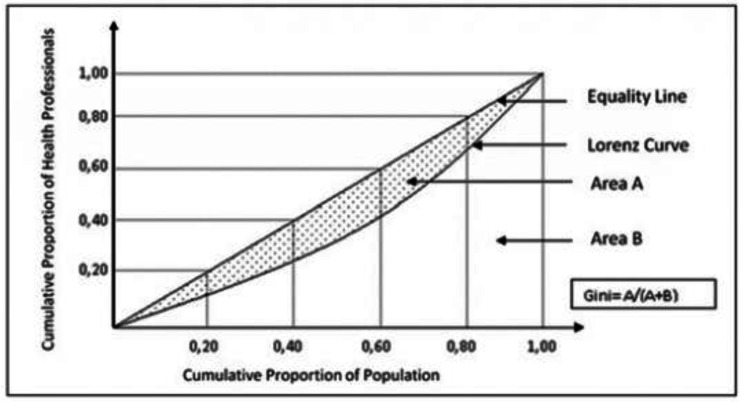
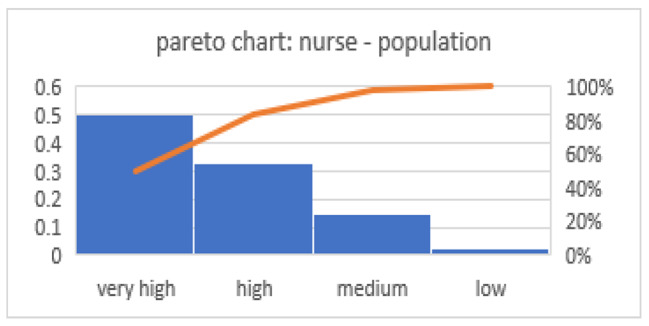
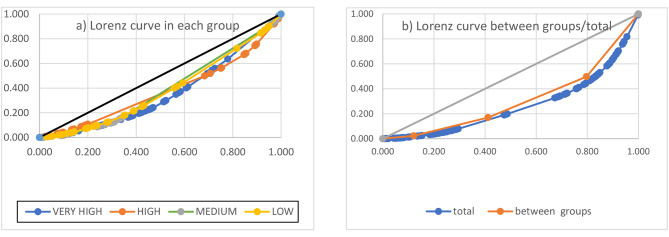
INTRODUCTION: Unequal Access to human resources for health, reduces access to healthcare services, worsens the quality of services and reduces health outcomes. This study aims to investigate the distribution of the nursing workforce around the world. METHODS: This is a descriptive-analytical study, which was conducted in 2021. The number of nurses and world populations was gathered from World Health Organization (WHO) and The United Nations (UN) databases. The UN has divided world countries based on the Human Development Index (HDI) into four categories of very high, high, medium and low HDI. To investigate the distribution of the nurses around the world, we used the nurse population ratio (per 10,000 population), Gini coefficient, Lorenz curve and Pareto curve. FINDINGS: On average, there were 38.6 nurses for every 10,000 people in the world. Nations with the very high HDI, had the highest nurse/population ratio (95/10,000), while the low HDI nations had the lowest nurse/population ratio (7/10,000). Most nurses around the world were females (76.91%) who were in the age group of 35-44 (29.1%). The Gini coefficient of nations in the each four HDI categories varied from 0.217 to 0.283. The Gini coefficient of the nations between the four HDI categories was 0.467, and the Gini coefficient of the whole world was 0.667. CONCLUSION: There were inequalities between countries all over the world. Policymakers should focus on the equitable distribution of the nursing workforce across all local, national and regional levels.
Overview
The claims and statistics of this paper haven’t been checked yet.
Free: it reads the open-access text and checks the first 5 claims that cite a source we can check. Create a free account to check every claim.
Integrity signals
Registry
Cites
Statistics
Figures
Verification
Claims the paper makes
The claims and statistics of this paper haven’t been checked yet.
Free: it reads the open-access text and checks the first 5 claims that cite a source we can check. Create a free account to check every claim.
Claims other papers make about this one
Each is checked against this paper’s own text: does it say what the citing paper says it does?
The cited source says what the claim attributes to it.
In the citing paper
“Given the findings of a recent study that approximately 77% of nurses worldwide are female (89), this is not surprising, considering that nurses constitute the largest proportion of all professions in this review.”
From Digital resilience interventions for healthcare workers: a systematic review (2025) · cites this paper as [89]
Self-check
Percentages, sums and reported differences re-computed from the paper’s own numbers.
The self-check needs the paper’s full text.
Citations
Cites
State of the world's nursing 2020: investing in education, jobs and leadership
McCarthy, C. F. (2020) · Cited by 845
Human resources and health outcomes: cross-country econometric study
Anand, S., & Bärnighausen, T. (2004) · The Lancet · doi:10.1016/s0140-6736(04)17313-3 · Cited by 652
How to bridge the gap in human resources for health
Hongoro, C., & McPake, B. (2004) · The Lancet · doi:10.1016/s0140-6736(04)17229-2 · Cited by 440 · cited 3×
“In this respect, factors such as a low capacity for medical training, poor living and working conditions, and inadequate salaries could drive health workers out of the country [2].”
BackgroundInfluentialResponding to the global human resources crisis
Narasimhan, V., Brown, H., Pablos-Mendez, A., Adams, O., Dussault, G., Elzinga, G., Nordstrom, A., Habte, D., Jacobs, M., Solimano, G., et al. (2004) · The Lancet · doi:10.1016/s0140-6736(04)16108-4 · Cited by 284
Brown, M. C. (1994) · Social Science & Medicine · doi:10.1016/0277-9536(94)90189-9 · Cited by 274 · cited 1×
“70, the distribution is completely unequal [15].”
International Migration of Health Workers: Labour and Social Issues.
Bach, S. (2003) · Research Portal (King's College London) · Cited by 237
The Next Frontier—Human Development and the Anthropocene: UNDP Human Development Report 2020
Baumann, F. (2021) · Environment Science and Policy for Sustainable Development · doi:10.1080/00139157.2021.1898908 · Cited by 130 · cited 1×
“Sixty-six countries were included in the very high, 53 ones in the high, 37 ones in the medium and 33 ones in the low HDI groups [14].”
Tandi, T. E., Cho, Y., Akam, A. J.-C., Afoh, C. O., Ryu, S. H., Choi, M. S., Kim, K., & Choi, J. W. (2015) · International Journal for Equity in Health · doi:10.1186/s12939-015-0172-0 · Cited by 129 · cited 1×
“Different studies have also reported these results [4, 6, 16, 20].”
ResultRobinson, J. J. A., & Wharrad, H. J. (2000) · Journal of Advanced Nursing · doi:10.1046/j.1365-2648.2000.01458.x · Cited by 80
Health Workforce Equity in Urban Community Health Service of China
Chen, R., Zhao, Y., Du, J., Wu, T., Huang, Y., & Guo, A. (2014) · PLoS ONE · doi:10.1371/journal.pone.0115988 · Cited by 74
Research works printed but not linked: 3
- Anand S Organization WH Measuring health workforce inequalities: methods and application to China 2010 and India World Health Organization
- WHO State of the world’s nursing 2020: investing in education, jobs and leadership 2020 Geneva World Health Organization
- Masoumi SJ Nasabi NA Varzandeh M Bordbar N Gender Equality among Nurses: Promotion strategies for gender Equality J Health Manage Inform Sci 2020 7 4 252 8
Cited by
Economocracy: Global Economic Governance
Χαλλουμής, C. C. Κ. (2025) · Economies · doi:10.3390/economies13080230 · Cited by 44
Kattan, W., & Al‐Hanawi, M. K. (2025) · Human Resources for Health · doi:10.1186/s12960-025-01010-6 · Cited by 30
“Additionally, structural health system factors— such as urbanization patterns, healthcare facility density, and national employment policies—play pivotal roles in determining how nurses are allocated across regions and sectors [5].”
InfluentialTomlinson, E., Schoch, M., & McDonall, J. (2025) · Nurse Education Today · doi:10.1016/j.nedt.2025.106928 · Cited by 25
Transforming neonatal nursing in India: challenges, opportunities, and the way forward
Kalyan, G., Joshi, P., Murry, L. L., Campbell-Yeo, M. L., & Tiwari, S. K. (2024) · The Lancet Regional Health - Southeast Asia · doi:10.1016/j.lansea.2024.100522 · Cited by 22
Equity and trends in the allocation of health human resources in China from 2012 to 2021
Chai, Y., Xian, G., Kou, R., Wang, M., Liu, Y., Fu, G., & Luo, S. (2024) · Archives of Public Health · doi:10.1186/s13690-024-01407-0 · Cited by 21
“…an even distribution; when 0.2 < G < 0.3, it suggests a relatively balanced distribution; when 0.3 < G < 0.4, it signifies a relatively reasonable distribution; when 0.4 < G < 0.5, it indicates a relatively unfair distribution; and when G > 0.5, it suggests a highly unfair distribution [49].”
BackgroundInfluential
Metadata
- Authors
- Kharazmi, E., Bordbar, N., & Bordbar, S.
- Affiliations
- Shiraz University of Medical Sciences (IR)
- Corresponding author
- Bordbar, Shima
- Venue
- BMC Nursing
- Published
- 2023-05-05
- Volume
- 22
- Issue
- 1
- Pages
- 151-151
- ISSN
- 1472-6955 (ISSN-L)
- PMC
- PMC10161512
- OpenAlex
- W4372335386
- Cited by
- 55
- References
- 26
- Citations by year
- 2026: 27 · 2025: 17 · 2024: 11
- FWCI
- 18.56
- Type
- journal article
- Language
- en
- Open access
- gold
- doi.org
- Licence
- cc-by
- creativecommons.org/licenses/by/4.0 (tdm)
- creativecommons.org/licenses/by/4.0 (vor)
- Locations
- BMC Nursing (publishedVersion, cc-by)
- PubMed Central (publishedVersion, cc-by)
- PubMed (publishedVersion)
- DOAJ (DOAJ: Directory of Open Access Journals) (submittedVersion, cc-by-sa)
- Funders
- Shiraz University of Medical Sciences
- Shiraz University
- Vice Chancellor for Research and Technology, Kerman University of Medical Sciences
- Topics
- Health Sciences › Medicine › Public Health, Environmental and Occupational Health › Global Health Workforce Issues
- Health Sciences › Nursing › Issues, ethics and legal aspects › Nursing Education, Practice, and Leadership
- Health Sciences › Nursing › Research and Theory › Nursing education and management
- Keywords
- nursing workforce, nurse-to-population ratio, Gini coefficient, Human Development Index, health workforce inequality, Lorenz curve, Pareto curve
About these checks
Registry, retraction, Cites and statistics results are computed, not judged, with one exception: a printed reference that no index lists is read once by a model before it counts as a citation error. Claims are extracted by a model and kept only when their quote appears verbatim in the text; each cited source is then checked, with a model’s help, for whether it says what the claim relies on. Those verdicts can be wrong — read the claim’s quote and the cited source before relying on one.
Statistics and arithmetic are recomputed, not judged.
Confidence bands are shown only for fields calibrated on our annotated test set. None is calibrated yet, so no band is shown.
What counts as a claim ›How we measure confidence ›How we check this ›
Are you an author, or do you see a problem with this page? Request a review
Data sources
Bibliographic data: Semantic Scholar, OpenAlex, Crossref.
Contains information from the Semantic Scholar Academic Graph Datasets, made available under the ODC Attribution License (ODC-BY 1.0).
Semantic Scholar’s data is described in: Kinney, R., et al. (2023). The Semantic Scholar Open Data Platform. arXiv:2301.10140.
