

The DOI matches its Crossref record; 87 of the 89 references it cites were found in a registry or an index.
Filial piety and older adult caregiving among Chinese and Chinese-American families in the United States: a concept analysis
Open accessAbstract
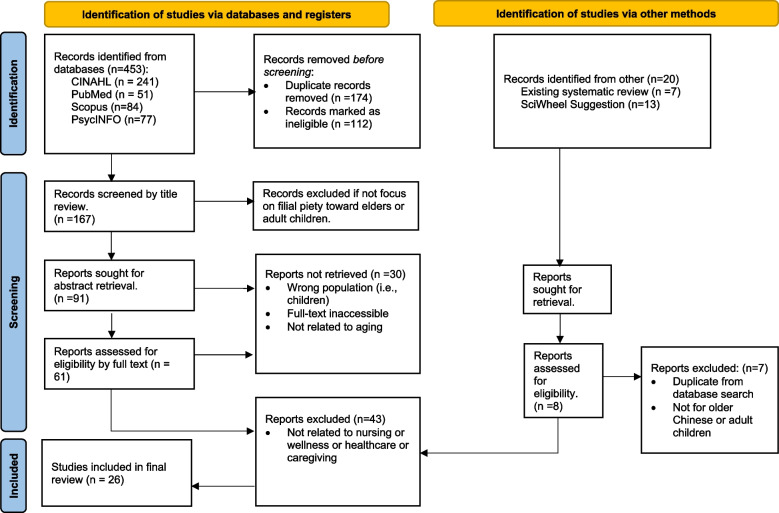
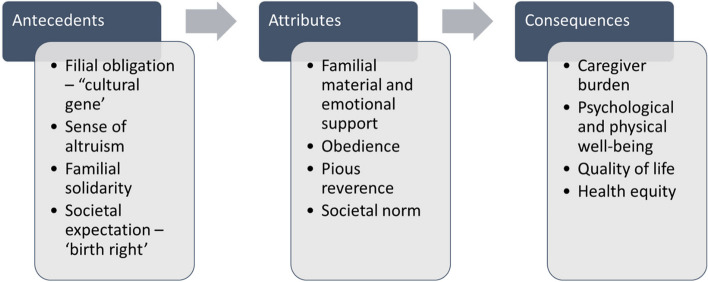
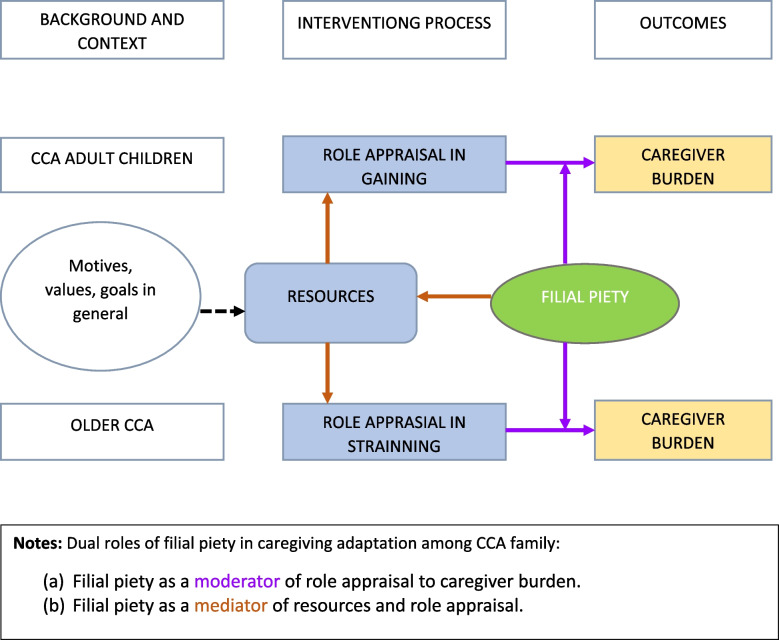
Background: The culturally sensitive nursing practice has not embedded filial piety as a cultural value and stance pertaining to caregiving among aging Chinese and Chinese-American (CCA) families in the United States, yet it is critical for healthy aging among CCAs. Purpose: To understand filial piety when caring for aging CCAs and conceptualize an operational definition and framework. Methods: A systematic search was conducted in CINAHL, PubMed, Scopus, and PsycINFO databases. Analysis of the concept of filial piety among CCAs used Walker and Avant’s methods. Twenty-six studies were selected in the final full-text analysis. Findings: Synthesis of evidence identified four antecedents: (a) filial obligation as a ‘cultural gene’, (b) sense of altruism, (c) familial solidarity, and (d) societal expectation of ‘birth right’. Attributes included familial material and emotional support, obedience, pious reverence, and societal norms. Consequences were related to caregiver burden, psychological and physical well-being, quality of life, and health equity. Conclusion: Filial piety is an intrinsic desire to support aging parents and an extrinsic desire to adhere to Chinese societal moral tenets. The proposed operational framework “Caregiving for aging CCAs in the United States” merits further study.
Overview
The claims and statistics of this paper haven’t been checked yet.
Run the check — free, no account needed. It reads the open-access text and checks the sources it cites.
Integrity signals
Registry
Cites
Statistics
Figures
Verification
Claims the paper makes
The claims and statistics of this paper haven’t been checked yet.
Run the check — free, no account needed. It reads the open-access text and checks the sources it cites.
Claims other papers make about this one
Each is checked against this paper’s own text: does it say what the citing paper says it does?
The cited source says what the claim attributes to it.
In the citing paper
“These strategies often reflected deeply rooted Confucian values, particularly filial piety and familial obligation, framing caregiving as a moral responsibility rather than merely a personal burden.”
Self-check
Percentages, sums and reported differences re-computed from the paper’s own numbers.
The self-check needs the paper’s full text.
Citations
Cites
The PRISMA 2020 statement: An updated guideline for reporting systematic reviews
Page, M. J., McKenzie, J. E., Bossuyt, P. M., Boutron, I., Hoffmann, T. C., Mulrow, C. D., Shamseer, L., Tetzlaff, J. M., Akl, E. A., Brennan, S. E., et al. (2021) · BMJ · doi:10.1136/bmj.n71 · Cited by 108,283
Personality trait structure as a human universal.
McCrae, R. R., & Costa, P. T. (1997) · American Psychologist · doi:10.1037/0003-066x.52.5.509 · Cited by 4,234
The handbook of Chinese psychology
Freeman, N., & Habermann, G. (1996) · Oxford University Press eBooks · Cited by 1,939
Qualitative research: deductive and inductive approaches to data analysis
Azungah, T. (2018) · Qualitative Research Journal · doi:10.1108/qrj-d-18-00035 · Cited by 1,262
Gain in the Caregiving Experience: Where Are We? What Next?
Kramer, B. J. (1997) · The Gerontologist · doi:10.1093/geront/37.2.218 · Cited by 693
Cultural values and caregiving: The updated sociocultural stress and coping model
Knight, B. G., & Sayegh, P. (2010) · The Journals of Gerontology Series B: Psychological Sciences and Social Sciences · doi:10.1093/geronb/gbp096 · Cited by 585
A test of the Dual Filial Piety model
Yeh, K., & Bedford, O. (2003) · Asian Journal of Social Psychology · doi:10.1046/j.1467-839x.2003.00122.x · Cited by 529
Bedford, O. A., & Yeh, K. (2019) · Frontiers in Psychology · doi:10.3389/fpsyg.2019.00100 · Cited by 391
Gene-culture coevolutionary theory
Feldman, M. W., & Laland, K. N. (1996) · Trends in Ecology & Evolution · doi:10.1016/0169-5347(96)10052-5 · Cited by 379
Policies of Exclusion: Implications for the Health of Immigrants and Their Children
Perreira, K. M., & Pedroza, J. M. (2019) · Annual Review of Public Health · doi:10.1146/annurev-publhealth-040218-044115 · Cited by 369
Research works printed but not linked: 5
- Ebrey P, Walthall A, Palais J. Confucius and the analects: to 1800: a culture social, and political history. Pre-Modern East Asia. 2nd ed. New York: Houghton Mifflin Company; 2009. p. 26.
- Walker LO, Avant KC. Concept analysis. Strategies for theory construction in nursing. 6th ed. Pearson; 2019. p. 157–78.
- Chow NWS. The practice of filial piety and its impact on long-term care policies for elderly people in Asian Chinese communities. Asian J Gerontol Geriatr. 2006;1:31–5.
- Li EC-Y, Yu CK-C. Filial piety as a protective factor against burden experienced by family caregivers of diabetic patients in Hong Kong. Asia Pac J Couns Psychother. 2018;9(2):186–203.
- Choy MM. Obeying an evolving cultural value: Influences of filial piety and acculturation on Asian - Americans [Master thesis]. Duke University; 2018.
Cited by
Sorted by citations
Items 101–109 of 109
Gong, K., & Zhang, J. (2026) · Acta Psychologica · doi:10.1016/j.actpsy.2026.107753
Hu, Y., Fan, Z., Wong, H. T., & Fung, H. H.-L. (2026) · Elsevier eBooks · doi:10.1016/b978-0-443-27490-9.00023-3
Meng, F., Wang, X., Chen, S., Zhou, W., Jiang, Y., & Yang, J. (2026) · Frontiers in Public Health · doi:10.3389/fpubh.2026.1807631
Wanga, H., Tian, Y., Wang, Z., Ji, Y., Jiang, Y., & Zhang, X. (2026) · International Journal of Nursing Studies · doi:10.1016/j.ijnurstu.2026.105703
Trajectories of Marital Satisfaction in China: Risk, Protection, and Cultural Buffers
Chen, Y. (2026) · Journal of Happiness Studies · doi:10.1007/s10902-026-01119-y
Constrained endurance in long-term family caregiving: Rethinking resilience through nursing ethics
Zhang, H. Y., Huang, L., Qin, H., Chong, M., Fan, Z., Liu, C., Sun, J., Xingyi, S., Li, J., Gu, J., et al. (2026) · Nursing Ethics · doi:10.1177/09697330261490920
When filial duty exceeds capacity: How moral obligations become caregiver distress
Wang, H., Li, X., Wang, X., Tang, Y., Dong, L., Lyu, X., & Xiang, X. (2026) · Social Science & Medicine · doi:10.1016/j.socscimed.2026.119924
Li, R., & Zhao, N. (2026) · Medicine · doi:10.1097/md.0000000000051140
Ou, J., Sun, L., Shen, T., & Wang, Z. (2026) · Research Square · doi:10.21203/rs.3.rs-10945806/v1
Metadata
- Authors
- Xiao, C., Patrician, P. A., Montgomery, A. P., Wang, Y., Jablonski, R., & Markaki, A.
- Affiliations
- University of Alabama at Birmingham (US)
- Southwest University (CN)
- Corresponding author
- Xiao, Chunhong
- ORCID
- Venue
- BMC Nursing
- Published
- 2024-02-13
- Volume
- 23
- Issue
- 1
- Pages
- 115-115
- ISSN
- 1472-6955 (ISSN-L)
- PMC
- PMC10863110
- OpenAlex
- W4391784446
- Cited by
- 109
- References
- 89
- Citations by year
- 2026: 59 · 2025: 42 · 2024: 8
- FWCI
- 78.18
- Type
- journal article
- Language
- en
- Open access
- gold
- doi.org
- Locations
- BMC Nursing (publishedVersion, cc-by)
- PubMed Central (publishedVersion, cc-by)
- PubMed (publishedVersion)
- DOAJ (DOAJ: Directory of Open Access Journals) (submittedVersion)
- Topics
- Social Sciences › Sociology and Political Science › Intergenerational Family Dynamics and Caregiving
- Health Sciences › Nursing › Research and Theory › Nursing care and research
- Social Sciences › Life-span and Life-course Studies › Aging, Elder Care, and Social Issues
- Keywords
- filial piety, Chinese American families, Chinese family, intergenerational caregiving, filial duty, altruism, social expectations, caregiver burden, healthy aging
About these checks
Registry, retraction, Cites and statistics results are computed, not judged, with one exception: a printed reference that no index lists is read once by a model before it counts as a citation error. Claims are extracted by a model and kept only when their quote appears verbatim in the text; each cited source is then checked, with a model’s help, for whether it says what the claim relies on. Those verdicts can be wrong — read the claim’s quote and the cited source before relying on one.
Statistics and arithmetic are recomputed, not judged.
Confidence bands are shown only for fields calibrated on our annotated test set. None is calibrated yet, so no band is shown.
What counts as a claim ›How we measure confidence ›How we check this ›
Are you an author, or do you see a problem with this page? Request a review
