

Mobile phone text messaging interventions for HIV and other chronic diseases: an overview of systematic reviews and framework for evidence transfer
Open accessThe DOI matches its Crossref record; 28 of the 28 references it cites were found in a registry or an index.
Abstract
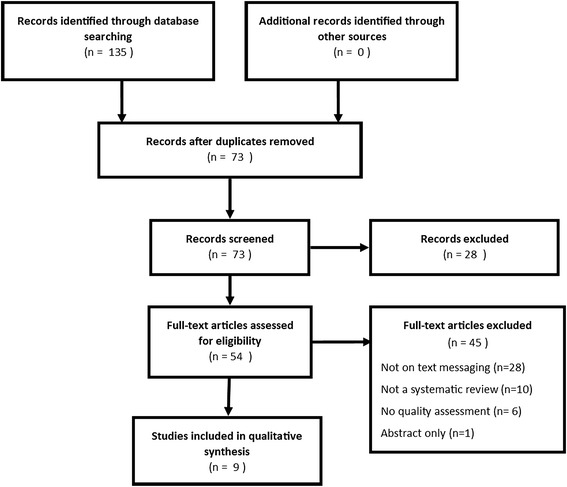
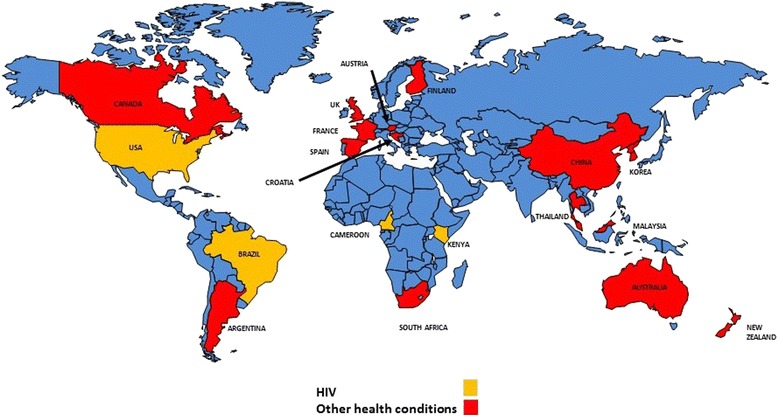
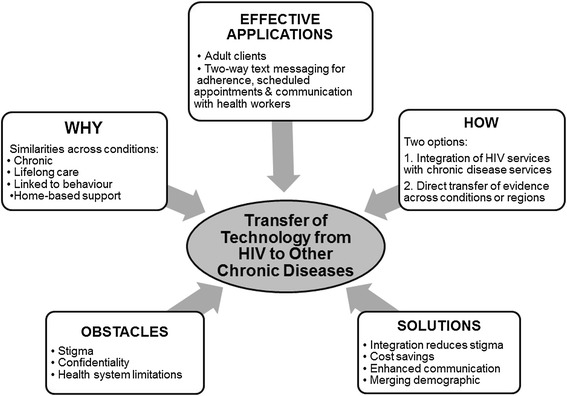
BACKGROUND: Strong international commitment and the widespread use of antiretroviral therapy have led to higher longevity for people living with human immune deficiency virus (HIV). Text messaging interventions have been shown to improve health outcomes in people living with HIV. The objectives of this overview were to: map the state of the evidence of text messaging interventions, identify knowledge gaps, and develop a framework for the transfer of evidence to other chronic diseases. METHODS: We conducted a systematic review of systematic reviews on text messaging interventions to improve health or health related outcomes. We conducted a comprehensive search of PubMed, EMBASE (Exerpta Medica Database), CINAHL (Cumulative Index to Nursing and Allied Health Literature), PsycINFO, Web of Science (WoS) and the Cochrane Library on the 17th April 2014. Screening, data extraction and assessment of methodological quality were done in duplicate. Our findings were used to develop a conceptual framework for transfer. RESULTS: Our search identified 135 potential systematic reviews of which nine were included, reporting on 37 source studies, conducted in 19 different countries. Seven of nine (77.7%) of these reviews were high quality. There was some evidence for text messaging as a tool to improve adherence to antiretroviral therapy. Text messages also improved attendance at appointments and behaviour change outcomes. The findings were inconclusive for self-management of illness, treatment of tuberculosis and communicating results of medical investigations. The geographical distribution of text messaging research was limited to specific regions of the world. Prominent knowledge gaps included the absence of data on long term outcomes, patient satisfaction, and economic evaluations. The included reviews also identified methodological limitations in many of the primary studies. CONCLUSIONS: Global evidence supports the use of text messaging as a tool to improve adherence to medication and attendance at scheduled appointments. Given the similarities between HIV and other chronic diseases (long-term medications, life-long care, strong link to behaviour and the need for home-based support) evidence from HIV may be transferred to these diseases using our proposed framework by integration of HIV and chronic disease services or direct transfer.
Overview
The claims and statistics of this paper haven’t been checked yet.
Free: it reads the open-access text and checks the first 5 claims that cite a source we can check. Create a free account to check every claim.
Integrity signals
Registry
Cites
Statistics
Figures
Verification
Claims the paper makes
The claims and statistics of this paper haven’t been checked yet.
Free: it reads the open-access text and checks the first 5 claims that cite a source we can check. Create a free account to check every claim.
Claims other papers make about this one
Each is checked against this paper’s own text: does it say what the citing paper says it does?
In the citing paper
“Most of the available literature on mHealth interventions is focused on communicable diseases (such as HIV and Malaria) or on maternal care [13].”
From A systematic review of randomized controlled trials of mHealth interventions against non-communicable diseases in developing countries (2016) · cites this paper as [13]
Self-check
Percentages, sums and reported differences re-computed from the paper’s own numbers.
The self-check needs the paper’s full text.
Citations
Cites
(2005) · PubMed · Cited by 7,011
Development of AMSTAR: A measurement tool to assess the methodological quality of systematic reviews
Shea, B. J., Grimshaw, J. M., Wells, G. A., Boers, M., Andersson, N., Hamel, C., Porter, A. C., Tugwell, P., Moher, D., & Bouter, L. M. (2007) · BMC Medical Research Methodology · doi:10.1186/1471-2288-7-10 · Cited by 4,374
Shea, B. J., Hamel, C., Wells, G. A., Bouter, L. M., Kristjansson, E., Grimshaw, J., Henry, D. A., & Boers, M. (2009) · Journal of Clinical Epidemiology · doi:10.1016/j.jclinepi.2008.10.009 · Cited by 1,755 · cited 2×
“Disagreements were resolved by adjudication of a third author (LM) using AMSTAR documentation [15].”
MethodLester, R. T., Ritvo, P., Mills, E. J., Kariri, A., Karanja, S., Chung, M. H., Jack, W., Habyarimana, J., Sadatsafavi, M., Najafzadeh, M., et al. (2010) · The Lancet · doi:10.1016/s0140-6736(10)61997-6 · Cited by 1,278 · cited 1×
“On the African continent recent reports suggest that mobile phone text messages can be used to improve outcomes in people living with HIV [4-7].”
BackgroundSelf-citationText messaging as a tool for behavior change in disease prevention and management
Cole-Lewis, H., & Kershaw, T. (2010) · Epidemiologic Reviews · doi:10.1093/epirev/mxq004 · Cited by 1,190 · cited 9×
“CRITERIA Cole-Lewis 2010 [19] De Jongh 2012 [18] Finitsis 2014 [20] GurolUrganci 2012 [22] GurolUrganci 2013 [21] Horvath 2012 [6] Militello 2012 [23] Nglazi 2013 [24] VodopivecJamsek 2012 [25]”
BackgroundInfluentialPop-Eleches, C., Thirumurthy, H., Habyarimana, J. P., Zivin, J. G., Goldstein, M. P., de Walque, D., MacKeen, L., Haberer, J., Kimaiyo, S., Sidle, J., et al. (2011) · AIDS · doi:10.1097/qad.0b013e32834380c1 · Cited by 982 · cited 1×
“On the African continent recent reports suggest that mobile phone text messages can be used to improve outcomes in people living with HIV [4-7].”
BackgroundMobile phone messaging for facilitating self-management of long-term illnesses
de Jongh, T., Gurol-Urganci, I., Vodopivec-Jamsek, V., Car, J., & Atun, R. (2012) · Cochrane Database of Systematic Reviews · doi:10.1002/14651858.cd007459.pub2 · Cited by 599 · cited 10×
“[6,18,21,22,25].”
BackgroundInfluentialMobile phone messaging reminders for attendance at healthcare appointments
Gurol-Urganci, I., de Jongh, T., Vodopivec-Jamsek, V., Atun, R., & Car, J. (2013) · Cochrane Database of Systematic Reviews · doi:10.1002/14651858.cd007458.pub3 · Cited by 594
Horvath, T., Azman, H., Kennedy, G. E., & Rutherford, G. W. (2012) · Cochrane Database of Systematic Reviews · doi:10.1002/14651858.cd009756 · Cited by 428 · cited 8×
“On the African continent recent reports suggest that mobile phone text messages can be used to improve outcomes in people living with HIV [4-7].”
BackgroundInfluentialFinitsis, D. J., Pellowski, J. A., & Johnson, B. T. (2014) · PLoS ONE · doi:10.1371/journal.pone.0088166 · Cited by 355 · cited 7×
“CRITERIA Cole-Lewis 2010 [19] De Jongh 2012 [18] Finitsis 2014 [20] GurolUrganci 2012 [22] GurolUrganci 2013 [21] Horvath 2012 [6] Militello 2012 [23] Nglazi 2013 [24] VodopivecJamsek 2012 [25]”
BackgroundInfluentialTackling Africa’s chronic disease burden: from the local to the global
de-Graft Aikins, A., Unwin, N., Agyemang, C., Allotey, P., Campbell, C., & Arhinful, D. (2010) · Globalization and Health · doi:10.1186/1744-8603-6-5 · Cited by 334 · cited 1×
“In sub-Saharan Africa these chronic diseases are on the rise and do not receive sufficient attention [9].”
BackgroundRamachandran, A., Snehalatha, C., Ram, J., Selvam, S., Simon, M., Nanditha, A., Shetty, A. S., Godsland, I. F., Chaturvedi, N., Majeed, A., et al. (2013) · The Lancet Diabetes & Endocrinology · doi:10.1016/s2213-8587(13)70067-6 · Cited by 330 · cited 1×
“Similar outcomes are of interest in both conditions, notably adherence to medication and lifestyle modifications, both of which can be achieved using mobile phone technology [30,31].”
BackgroundMobile phone messaging for preventive health care
Vodopivec-Jamsek, V., de Jongh, T., Gurol-Urganci, I., Atun, R., & Car, J. (2012) · Cochrane Database of Systematic Reviews · doi:10.1002/14651858.cd007457.pub2 · Cited by 319 · cited 7×
“CRITERIA Cole-Lewis 2010 [19] De Jongh 2012 [18] Finitsis 2014 [20] GurolUrganci 2012 [22] GurolUrganci 2013 [21] Horvath 2012 [6] Militello 2012 [23] Nglazi 2013 [24] VodopivecJamsek 2012 [25]”
BackgroundInfluentialHIV infection and cardiovascular disease
Hemkens, L. G., & Bucher, H. C. (2014) · European Heart Journal · doi:10.1093/eurheartj/eht528 · Cited by 251
Why reinvent the wheel? Leveraging the lessons of HIV scale-up to confront non-communicable diseases
Rabkin, M., & El-Sadr, W. M. (2011) · Global Public Health · doi:10.1080/17441692.2011.552068 · Cited by 190 · cited 3×
“These include demand-side barriers, inequitable availability of services, human resource shortages, limited adherence support, lack of infrastructure and equipment, unreliable drug and diagnostics supplies, poor referral and linkage systems, the need for community engagement; as well as stigma and discrimination [14].”
BackgroundInfluentialJanssens, B., Van Damme, W., Raleigh, B., Gupta, J., Khem, S., Ty, K. S., Vun, M., Ford, N., & Zachariah, R. (2007) · Bulletin of the World Health Organization · doi:10.2471/blt.06.036574 · Cited by 176 · cited 1×
“in Cambodia and Kenya [26].”
Militello, L. K., Kelly, S. A., & Melnyk, B. M. (2012) · Worldviews on Evidence-Based Nursing · doi:10.1111/j.1741-6787.2011.00239.x · Cited by 167 · cited 8×
“CRITERIA Cole-Lewis 2010 [19] De Jongh 2012 [18] Finitsis 2014 [20] GurolUrganci 2012 [22] GurolUrganci 2013 [21] Horvath 2012 [6] Militello 2012 [23] Nglazi 2013 [24] VodopivecJamsek 2012 [25]”
BackgroundInfluentialMbuagbaw, L., van der Kop, M. L., Lester, R. T., Thirumurthy, H., Pop-Eleches, C., Ye, C., Smieja, M., Dolovich, L., Mills, E. J., & Thabane, L. (2013) · BMJ Open · doi:10.1136/bmjopen-2013-003950 · Cited by 147 · cited 1×
“With regards to text messaging only level of education seems to be a factor affecting response [29].”
BackgroundSelf-citationNglazi, M. D., Bekker, L.-G., Wood, R., Hussey, G. D., & Wiysonge, C. S. (2013) · BMC Infectious Diseases · doi:10.1186/1471-2334-13-566 · Cited by 119 · cited 5×
“CRITERIA Cole-Lewis 2010 [19] De Jongh 2012 [18] Finitsis 2014 [20] GurolUrganci 2012 [22] GurolUrganci 2013 [21] Horvath 2012 [6] Militello 2012 [23] Nglazi 2013 [24] VodopivecJamsek 2012 [25]”
BackgroundInfluentialCell phone short messaging service (SMS) for HIV/AIDS in South Africa: a literature review.
Khatry-Chhetry, M. B., & Murray, P. J. (2010) · PubMed · Cited by 101
Mobile phones: exceptional tools for HIV/AIDS, health, and crisis management
Lester, R. T., & Karanja, S. (2008) · The Lancet Infectious Diseases · doi:10.1016/s1473-3099(08)70265-2 · Cited by 96 · cited 1×
“chronic disease management [2].”
Cell phones: tightening the communication gap in resource-limited antiretroviral programmes?
Lester, R. T., Gelmon, L., & Plummer, F. A. (2006) · AIDS · doi:10.1097/qad.0b013e3280108508 · Cited by 88
Mobile phone messaging for communicating results of medical investigations
Gurol-Urganci, I., de Jongh, T., Vodopivec-Jamsek, V., Car, J., & Atun, R. (2012) · Cochrane Database of Systematic Reviews · doi:10.1002/14651858.cd007456.pub2 · Cited by 85 · cited 7×
“CRITERIA Cole-Lewis 2010 [19] De Jongh 2012 [18] Finitsis 2014 [20] GurolUrganci 2012 [22] GurolUrganci 2013 [21] Horvath 2012 [6] Militello 2012 [23] Nglazi 2013 [24] VodopivecJamsek 2012 [25]”
BackgroundInfluentialNigatu, T. H. (2012) · Preventing Chronic Disease · doi:10.5888/pcd9.110331 · Cited by 71 · cited 4×
“HIV and NCDs have very different pathogeneses and clinical features [12].”
BackgroundInfluentialHeyland, D. K., Kernerman, P., Gafni, A., & Cook, D. J. (1996) · Critical Care Medicine · doi:10.1097/00003246-199609000-00025 · Cited by 70 · cited 1×
“Borrowing from Heyland’s Generalizability criteria, items such as: similarities between patients, clinical setting, cost, outcome measures and safety must be considered [27].”
MethodMbuagbaw, L., van der Kop, M. L., Lester, R. T., Thirumurthy, H., Pop-Eleches, C., Smieja, M., Dolovich, L., Mills, E. J., & Thabane, L. (2013) · BMJ Open · doi:10.1136/bmjopen-2013-002954 · Cited by 36
Self-citationAccess to Drugs for Treatment of Noncommunicable Diseases
Bollyky, T. J. (2013) · PLoS Medicine · doi:10.1371/journal.pmed.1001485 · Cited by 23 · cited 1×
“There is also an unmet need for affordable medication for many NCDs in low and middle income countries [10], a problem resolved in HIV care through sustained commitments to disease control [10].”
BackgroundHIGH RISK PATIENTS BENEFIT MOST FROM THE SMS-BASED INTERVENTION: PP.20.272
Wizner, B., Gaciong, Z. A., Narkiewicz, K., Szykula, D., & Grodzicki, T. K. (2010) · Journal of Hypertension · doi:10.1097/01.hjh.0000379198.08164.51 · Cited by 3
Cited by
Iribarren, S. J., Cato, K., Falzon, L., & Stone, P. W. (2017) · PLOS ONE · doi:10.1371/journal.pone.0170581 · Cited by 519
Mobile Health (mHealth) in Low- and Middle-Income Countries
McCool, J., Dobson, R., Whittaker, R., & Paton, C. (2022) · Annual Review of Public Health · doi:10.1146/annurev-publhealth-052620-093850 · Cited by 269
Anstey Watkins, J. O. T., Goudge, J., Gómez-Olivé, F. X., & Griffiths, F. (2018) · Social Science & Medicine · doi:10.1016/j.socscimed.2018.01.011 · Cited by 196
“Lines of evidence of the effectiveness of mHealth solutions in LMICs have been inconsistent in systematic reviews (Bärnighausen et al., 2011; Bloomfield et al., 2014; Catalani et al., 2013; Cole-Lewis and Kershaw, 2010; Fjeldsoe et al., 2009; Free et al., 2013; Krishna et al., 2009; Mbuagbaw et al., 2015; Velthoven et…”
BackgroundBhaskar, S., Bradley, S., Chattu, V. K., Adisesh, A., Nurtazina, A., Kyrykbayeva, S., Sakhamuri, S., Moguilner, S., Pandya, S., Schroeder, S., et al. (2020) · Frontiers in Public Health · doi:10.3389/fpubh.2020.00410 · Cited by 176
“Another important and emerging area is the use of text messaging [short message service (SMS) or multimedia message service (MMS)] as a model for service delivery (131–136).”
BackgroundDaher, J., Vijh, R., Linthwaite, B., Dave, S., Kim, J., Dheda, K., Peter, T., & Pai, N. P. (2017) · BMJ Open · doi:10.1136/bmjopen-2017-017604 · Cited by 173
“Innovations aiming to reduce risky sexual behaviours could be interactive and tailored to the setting and population, with a deep understanding of patients’ needs and preferences.(137) 140 141 Any communication with patients could be customised for timing to avoid fatigue with its uptake.”
Background
Metadata
- Authors
- Mbuagbaw, L., Mursleen, S., Lytvyn, L., Smieja, M., Dolovich, L., & Thabane, L.
- Affiliations
- Central Hospital of Yaoundé (CM)
- McMaster University (CA)
- St. Joseph’s Healthcare Hamilton (CA)
- Population Health Research Institute (CA)
- Corresponding author
- Mbuagbaw, Lawrence
- Venue
- BMC Health Services Research
- Published
- 2015-01-22
- Volume
- 15
- Issue
- 1
- Pages
- 33-33
- ISSN
- 1472-6963 (ISSN-L)
- PMC
- PMC4308847
- OpenAlex
- W2071226302
- Cited by
- 187
- References
- 28
- Citations by year
- 2026: 3 · 2025: 5 · 2024: 8 · 2023: 7 · 2022: 17 · 2021: 33 · 2020: 27 · 2019: 26 · 2018: 19 · 2017: 21 · 2016: 14 · 2015: 7
- FWCI
- 3.69
- Type
- journal article
- Language
- en
- Open access
- gold
- doi.org
- Locations
- BMC Health Services Research (publishedVersion, cc-by)
- PubMed Central (publishedVersion, cc-by)
- PubMed (publishedVersion)
- Topics
- Health Sciences › Health Professions › General Health Professions › Mobile Health and mHealth Applications
- Social Sciences › Health › Social Media in Health Education
- Health Sciences › Medicine › Infectious Diseases › HIV/AIDS Research and Interventions
- Keywords
- text messaging intervention, mobile health, HIV, chronic disease, antiretroviral therapy adherence, appointment attendance, behavior change, evidence transfer, self-management, tuberculosis, patient satisfaction, economic evaluation, long-term outcomes
- MeSH terms
- Assessment of Medication Adherence, Appointments and Schedules, Chronic Disease, Health Promotion, Humans, Self Care, HIV Infections, Drug Monitoring, Reminder Systems, Patient Satisfaction, Cell Phone, Anti-Retroviral Agents, Medication Adherence, Text Messaging
About these checks
Registry, retraction, Cites and statistics results are computed, not judged, with one exception: a printed reference that no index lists is read once by a model before it counts as a citation error. Claims are extracted by a model and kept only when their quote appears verbatim in the text; each cited source is then checked, with a model’s help, for whether it says what the claim relies on. Those verdicts can be wrong — read the claim’s quote and the cited source before relying on one.
Statistics and arithmetic are recomputed, not judged.
Confidence bands are shown only for fields calibrated on our annotated test set. None is calibrated yet, so no band is shown.
What counts as a claim ›How we measure confidence ›How we check this ›
Are you an author, or do you see a problem with this page? Request a review
Data sources
Bibliographic data: Semantic Scholar, OpenAlex, Crossref.
Contains information from the Semantic Scholar Academic Graph Datasets, made available under the ODC Attribution License (ODC-BY 1.0).
Semantic Scholar’s data is described in: Kinney, R., et al. (2023). The Semantic Scholar Open Data Platform. arXiv:2301.10140.
