

The DOI matches its Crossref record; 55 of the 55 references it cites were found in a registry or an index.
Social media use in healthcare: A systematic review of effects on patients and on their relationship with healthcare professionals
Open accessAbstract
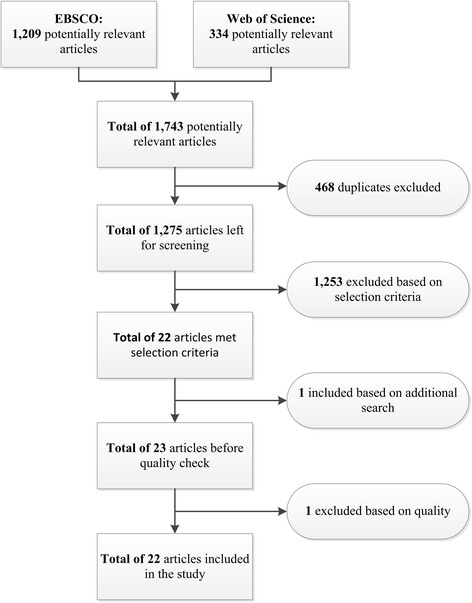
BACKGROUND: Since the emergence of social media in 2004, a growing percentage of patients use this technology for health related reasons. To reflect on the alleged beneficial and potentially harmful effects of social media use by patients, the aim of this paper is to provide an overview of the extant literature on the effects of social media use for health related reasons on patients and their relationship with healthcare professionals. METHODS: We conducted a systematic literature review on empirical research regarding the effects of social media use by patients for health related reasons. The papers we included met the following selection criteria: (1) published in a peer-reviewed journal, (2) written in English, (3) full text available to the researcher, (4) contain primary empirical data, (5) the users of social media are patients, (6) the effects of patients using social media are clearly stated, (7) satisfy established quality criteria. RESULTS: Initially, a total of 1,743 articles were identified from which 22 were included in the study. From these articles six categories of patients' use of social media were identified, namely: emotional, information, esteem, network support, social comparison and emotional expression. The types of use were found to lead to seven identified types of effects on patients, namely improved self-management and control, enhanced psychological well-being, and enhanced subjective well-being, diminished subjective well-being, addiction to social media, loss of privacy, and being targeted for promotion. Social media use by patients was found to affect the healthcare professional and patient relationship, by leading to more equal communication between the patient and healthcare professional, increased switching of doctors, harmonious relationships, and suboptimal interaction between the patient and healthcare professional. CONCLUSIONS: Our review provides insights into the emerging utilization of social media in healthcare. In particular, it identifies types of use by patients as well as the effects of such use, which may differ between patients and doctors. Accordingly, our results framework and propositions can serve to guide future research, and they also have practical implications for healthcare providers and policy makers.
Overview
The claims and statistics of this paper haven’t been checked yet.
Run the check — free, no account needed. It reads the open-access text and checks the sources it cites.
Integrity signals
Registry
Cites
Statistics
Figures
Verification
Claims the paper makes
The claims and statistics of this paper haven’t been checked yet.
Run the check — free, no account needed. It reads the open-access text and checks the sources it cites.
Claims other papers make about this one
Each is checked against this paper’s own text: does it say what the citing paper says it does?
The source backs part of the claim, not all of it — or backs it for a different population, condition or comparison.
In the citing paper
“Health promotion on social media also encouraged patients to seek medical attention more willingly [11].”
From Social Media Use Among Parents and Caregivers of Children With Rare Genetic Diseases: Scoping Review (2025) · cites this paper as [11]
Experimental — accuracy not yet measuredThe source backs part of the claim, not all of it — or backs it for a different population, condition or comparison.
In the citing paper
“Most patients discuss information they have found online with their health care provider”
From Social Media Use Among Parents and Caregivers of Children With Rare Genetic Diseases: Scoping Review (2025) · cites this paper as [11]
Experimental — accuracy not yet measuredThe source backs part of the claim, not all of it — or backs it for a different population, condition or comparison.
In the citing paper
“however, physicians often react negatively to discussions involving information sourced from social media [11-13].”
From Social Media Use Among Parents and Caregivers of Children With Rare Genetic Diseases: Scoping Review (2025) · cites this paper as [11]
Experimental — accuracy not yet measuredThe cited source says what the claim attributes to it.
In the citing paper
“Prior literature has highlighted both benefits and risks of social media in healthcare,4–13 but there remains limited understanding of how generational perspectives shape views of professionalism in healthcare social media use.”
From Evaluating perceptions of social media professionalism by healthcare workers (2026) · cites this paper as [5]
The cited source says what the claim attributes to it.
In the citing paper
“Social media use is also related to shorter relationships with health care providers, as online discussions prompted patients to seek specific providers [11].”
From Social Media Use Among Parents and Caregivers of Children With Rare Genetic Diseases: Scoping Review (2025) · cites this paper as [11]
The cited source says what the claim attributes to it.
In the citing paper
“social media empowers patients to be more informed and involved in their own care”
From Social Media Use Among Parents and Caregivers of Children With Rare Genetic Diseases: Scoping Review (2025) · cites this paper as [11]
The cited source says what the claim attributes to it.
In the citing paper
“allowing for improved communication with medical professionals [11,12].”
From Social Media Use Among Parents and Caregivers of Children With Rare Genetic Diseases: Scoping Review (2025) · cites this paper as [11]
The check wasn’t confident either way, so it gives no verdict — never disputed.
In the citing paper
“popularity of SM has also been embraced by health care professionals (HCPs) [5].”
From Dangers and Benefits of Social Media on E-Professionalism of Health Care Professionals: Scoping Review (2021) · cites this paper as [5]
Experimental — accuracy not yet measured
Self-check
Percentages, sums and reported differences re-computed from the paper’s own numbers.
The self-check needs the paper’s full text.
Citations
Cites
Preferred Reporting Items for Systematic Reviews and Meta-Analyses: the PRISMA statement
Moher, D., Liberati, A., Tetzlaff, J., Altman, D. G., & for the PRISMA Group (2009) · BMJ · doi:10.1136/bmj.b2535 · Cited by 83,823
Preferred reporting items for systematic reviews and meta-analyses: the PRISMA Statement.
(2009) · PubMed Central · Cited by 44,859
Users of the world, unite! The challenges and opportunities of Social Media
Kaplan, A. M., & Haenlein, M. (2010) · Business Horizons · doi:10.1016/j.bushor.2009.09.003 · Cited by 17,875 · cited 4×
“Among other uses, blogs can be used as personals diaries to express thoughts, feelings, and stories [9].”
BackgroundMethodInfluentialHappiness is everything, or is it? Explorations on the meaning of psychological well-being.
Ryff, C. D. (1989) · Journal of Personality and Social Psychology · doi:10.1037/0022-3514.57.6.1069 · Cited by 14,847 · cited 2×
“Moreover, “self-actualizers are described as having strong feelings of empathy and affection for all human beings and as being capable of greater love, deeper friendship, and more complete identification with others” [33].”
BackgroundPower, politics, and MIS implementation
Markus, M. L. (1983) · Communications of the ACM · doi:10.1145/358141.358148 · Cited by 2,224 · cited 1×
“According to the political variant of the interaction theory [49], “a product of the interaction of system”
BackgroundSocial capital, self-esteem, and use of online social network sites: A longitudinal analysis.
Steinfield, C., Ellison, N. B., & Lampe, C. (2008) · Journal of Applied Developmental Psychology · doi:10.1016/j.appdev.2008.07.002 · Cited by 1,919
Social Support Measurement and Intervention
(2000) · Oxford University Press eBooks · doi:10.1093/med:psych/9780195126709.001.0001 · Cited by 1,887 · cited 1×
“process of interaction in relationships which is intended to improve coping, esteem, belonging, and competence through actual or perceived exchanges of psychosocial resources” [19].”
BackgroundStandard Quality Assessment Criteria for Evaluating Primary Research Papers from a Variety of Fields
Kmet, L. M., Cook, L. S., & Lee, R. C. (2004) · University of Alberta Library · doi:10.7939/r37m04f16 · Cited by 1,682 · cited 3×
“The articles were assessed on their quality by using the standard quality assessment criteria as identified by [12].”
MethodInfluentialThe health-related functions of social support
Schaefer, C. A., Coyne, J. C., & Lazarus, R. S. (1981) · Journal of Behavioral Medicine · doi:10.1007/bf00846149 · Cited by 1,326 · cited 2×
“Social support is represented through five different categories and four of these categories were found to be common types of social media use by patients for health related purposes [18].”
BackgroundThe decision and the organization
MacDougall, C. D., & Wilson, H. (1965) · Marzani & Munsell eBooks · Cited by 1,149
Research works printed but not linked: 4
- Williams J. A new roadmap for healthcare business success. J Healthc Financ Manage Assoc. 2011;65(5):62–9.
- Mattson M, Hall JG. Health as communication nexus: A service-learning approach. Dubuque: Kendall Hunt; 2011.
- Sahoo FM, Mohapatra L. Psychological well-Being in professional groups. J Indian Acad Appl Psychol. 2009;35(2):211–7.
- Simon HA. Decision and organization. Amsterdam: North-Holland Publishing; 1972.
Cited by
Sorted by citations
Al-Dmour, H. H., Masa’deh, R. M. T., Salman, A. Z., Abuhashesh, M., & Al-Dmour, R. (2020) · Journal of Medical Internet Research · doi:10.2196/19996 · Cited by 407
“The content of the questionnaire (constructs and measures) was mainly selected and adopted from previous relevant studies [2,10,29,30,36-38] using a 5-point Likert scale ranging from strongly disagree (1) to strongly agree (5).”
BackgroundMethodEvaluating the Impact of Attempts to Correct Health Misinformation on Social Media: A Meta-Analysis
Walter, N., Brooks, J. J., Saucier, C. J., & Suresh, S. (2020) · Health Communication · doi:10.1080/10410236.2020.1794553 · Cited by 390
“At the same time that social media can facilitate support, complement offline information, and empower patients, the deluge of false and misleading information on these platforms constitutes a substantial threat to public health (Smailhodzic et al., 2016).”
BackgroundJiang, S., & Ngien, A. (2020) · Social Media + Society · doi:10.1177/2056305120912488 · Cited by 367
Giustini, D. M., Ali, S. M., Fraser, M., & Boulos, M. N. K. (2018) · Online Journal of Public Health Informatics · doi:10.5210/ojphi.v10i2.8270 · Cited by 271
“Use of Facebook and Twitter was viewed favourably and rarely associated with harmful effects in e-professionalism or social relationships [16,28,52].”
BackgroundMethodInfluentialImpact of COVID-19 on the digital divide: a rapid review
Litchfield, I. J., Shukla, D., & Greenfield, S. (2021) · BMJ Open · doi:10.1136/bmjopen-2021-053440 · Cited by 289
Metadata
- Authors
- Smailhodzic, E., Hooijsma, W., Boonstra, A., & Langley, D. J.
- Affiliations
- University of Groningen (NL)
- Netherlands Organisation for Applied Scientific Research (NL)
- Venue
- BMC Health Services Research
- Published
- 2016-08-26
- Volume
- 16
- Issue
- 1
- Pages
- 442-442
- ISSN
- 1472-6963 (ISSN-L)
- PMC
- PMC5000484
- OpenAlex
- W2512433998
- Cited by
- 827
- References
- 55
- Citations by year
- 2026: 75 · 2025: 107 · 2024: 107 · 2023: 99 · 2022: 111 · 2021: 127 · 2020: 96 · 2019: 61 · 2018: 29 · 2017: 14
- FWCI
- 6.51
- Type
- journal article
- Language
- en
- Open access
- gold
- doi.org
- Licence
- cc-by
- Locations
- BMC Health Services Research (publishedVersion, cc-by)
- PubMed Central (publishedVersion, cc-by)
- PubMed (publishedVersion)
- Data Archiving and Networked Services (DANS) (acceptedVersion)
- TNO Repository (submittedVersion)
- University of Groningen research database (University of Groningen / Centre for Information Technology) (submittedVersion, cc-by)
- Repository hosted by TU Delft Library (TU Delft) (submittedVersion)
- Topics
- Social Sciences › Health › Social Media in Health Education
- Health Sciences › Health Professions › General Health Professions › Health Literacy and Information Accessibility
- Social Sciences › Sociology and Political Science › Impact of Technology on Adolescents
- Keywords
- social media use, patient self-management, psychological well-being, subjective well-being, social media addiction, privacy loss, social comparison, network support, patient-physician communication
- MeSH terms
- Female, Health Personnel, Humans, Male, Professional-Patient Relations, Self Care, Consumer Health Information, Social Media
About these checks
Registry, retraction, Cites and statistics results are computed, not judged, with one exception: a printed reference that no index lists is read once by a model before it counts as a citation error. Claims are extracted by a model and kept only when their quote appears verbatim in the text; each cited source is then checked, with a model’s help, for whether it says what the claim relies on. Those verdicts can be wrong — read the claim’s quote and the cited source before relying on one.
Statistics and arithmetic are recomputed, not judged.
Confidence bands are shown only for fields calibrated on our annotated test set. None is calibrated yet, so no band is shown.
What counts as a claim ›How we measure confidence ›How we check this ›
Are you an author, or do you see a problem with this page? Request a review
