

The DOI matches its Crossref record; 46 of the 47 references it cites were found in a registry or an index.
General self-efficacy modifies the effect of stress on burnout in nurses with different personality types
Open accessAbstract
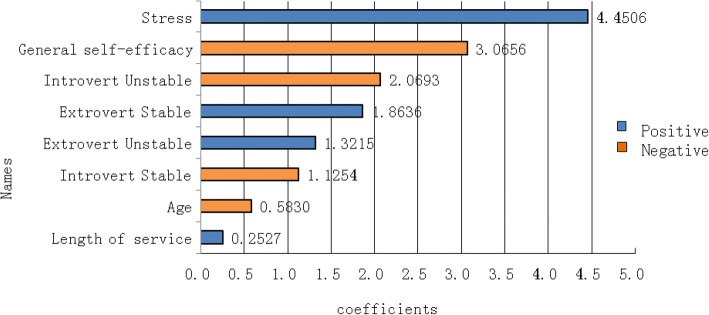
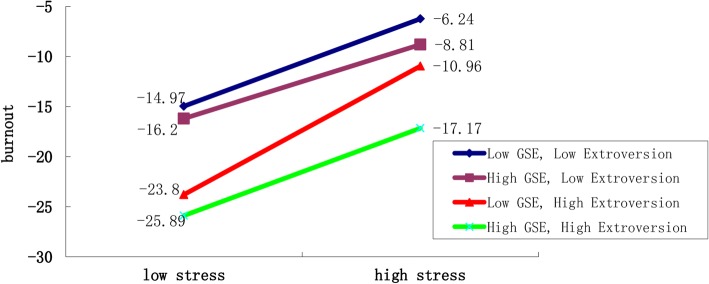
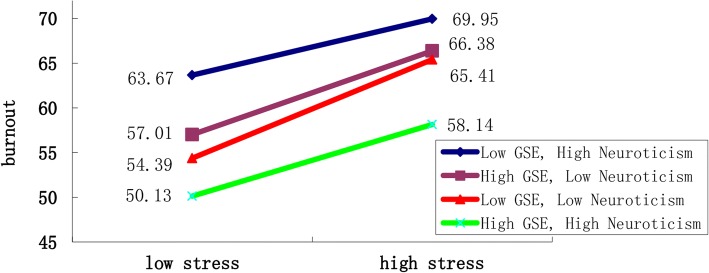
BACKGROUND: Burnout is a health problem in nurses. Individuals with a certain personality are more susceptible to job-related burnout. General self-efficacy (GSE) is an important predictor of job-related burnout. The relationships between general self-efficacy, job-related burnout and different personality types are still not clear. This study aims to analyze the relationships of job-related burnout, stress, general self-efficacy and personality types, as well as their interactions in job-related burnout. METHOD: A cross-sectional survey of 860 nurses was conducted between June and July 2015 in China. We measured their job-related burnout using the scale of the Maslach Occupational Burnout Scale, and personality, stress, and GSE. Machine learning of generalized linear model were performed. RESULTS: Maslach Burnout Inventory (MBI) professional efficacy was significantly associated with gender, marital status, age, job title and length of service. A machine learning algorithm showed that stress was the most important factor in job-related burnout, followed by GSE, personality type (introvert unstable), and job title. Individuals with low GSE and either introversion or unstable (high neuroticism) personality seemed to have stronger burnout when they faced stress (regardless of stress intensity) compared to others. CONCLUSION: Stress, GSE and introvert unstable personality are the top three factors of job-related burnout. GSE moderates the effect of stress on burnout in nurses with extroversion or neuroticism personality. Reducing stress, increasing GSE, and more social support may alleviate job-related burnout in nurses. Nurses with introvert unstable personality should be given more social support in reducing stress and enhancing their GSE.
Overview
The claims and statistics of this paper haven’t been checked yet.
Run the check — free, no account needed. It reads the open-access text and checks the sources it cites.
Integrity signals
Registry
Cites
Statistics
Figures
Verification
Claims the paper makes
The claims and statistics of this paper haven’t been checked yet.
Run the check — free, no account needed. It reads the open-access text and checks the sources it cites.
Claims other papers make about this one
Each is checked against this paper’s own text: does it say what the citing paper says it does?
In the citing paper
“The Cronbach’s ɑ was 0.883 in the present study [39].”
From Workflow interruption and nurses’ mental workload in electronic health record tasks: An observational study (2023) · cites this paper as [39]
Self-check
Percentages, sums and reported differences re-computed from the paper’s own numbers.
The self-check needs the paper’s full text.
Citations
Cites
Self-efficacy: Toward a unifying theory of behavioral change
Bandura, A. (1977) · Psychological Review · doi:10.1037/0033-295x.84.2.191 · Cited by 43,925
Maslach, C., Schaufeli, W. B., & Leiter, M. P. (2001) · Annual Review of Psychology · doi:10.1146/annurev.psych.52.1.397 · Cited by 12,852 · cited 2×
“reported that the levels of job-related burnout in young employees was relatively high [29] .”
Self-efficacy: Toward a unifying theory of behavioral change
Bandura, A. (1978) · Advances in Behaviour Research and Therapy · doi:10.1016/0146-6402(78)90002-4 · Cited by 10,586
Dawson, J., & Richter, A. W. (2006) · Journal of Applied Psychology · doi:10.1037/0021-9010.91.4.917 · Cited by 1,861
Perceived Teacher Self‐Efficacy as a Predictor of Job Stress and Burnout: Mediation Analyses
Schwarzer, R., & Hallum, S. (2008) · Applied Psychology · doi:10.1111/j.1464-0597.2008.00359.x · Cited by 1,179
Schwarzer, R., Bäßler, J., Kwiatek, P., Schröder, K. E. E., & Zhang, J. X. (1997) · Applied Psychology · doi:10.1111/j.1464-0597.1997.tb01096.x · Cited by 967
Born to burnout: A meta-analytic path model of personality, job burnout, and work outcomes
Swider, B. W., & Zimmerman, R. D. (2010) · Journal of Vocational Behavior · doi:10.1016/j.jvb.2010.01.003 · Cited by 929
Maslach burnout inventory-general survey
김, 영. (2009) · Cited by 907
Relationships between personality variables and burnout: A meta-analysis
Alarcon, G., Eschleman, K. J., & Bowling, N. A. (2009) · Work & Stress · doi:10.1080/02678370903282600 · Cited by 804
Bakker, A. B., van der Zee, K. I., Lewig, K. A., & Dollard, M. F. (2006) · The Journal of Social Psychology · doi:10.3200/socp.146.1.31-50 · Cited by 602
Research works printed but not linked: 4
- Farber BA. Crisis in education: stress and burnout in the American teacher. San Francisco: Jossey-Bass; 1st edition. Psyccritiques. 1991;37(4).
- Fangfang L. Investigation and analysis on the impact of Librarian’s personality and coping style upon job burnout. Library Information Serv. 2010;54(9):60–3.
- Li Y, Li Y. Developing the diagnostic Ctiterion of job burnout. Psychol Sci. 2006;29(1):148–50.
- Wang S, Zhao Q, Li S. A survey of job burnout of clinical nurses. Chin Nurs Res. 2008;22(9):2292–3.
Cited by
Sorted by citations
Items 101–133 of 133
Takeuchi, Y., Tanaka, K., Wada, T., Seto, M., Fujimura, K., Kato, M., & Isihara, T. (2026) · BMC Nursing · doi:10.1186/s12912-026-04976-3 · Cited by 1
Occupational Health and Safety in the Healthcare Sector
Modenese, A., & Gobba, F. (2022) · MDPI eBooks · doi:10.3390/books978-3-0365-4593-6 · Cited by 1
Rossi, A. A., Mannarini, S., Taccini, F., Castelnuovo, G., & Pietrabissa, G. (2025) · Journal of Clinical Medicine · doi:10.3390/jcm14061988 · Cited by 4
Hsiao, S. C. (2021) · Revista de Cercetare si Interventie Sociala · doi:10.33788/rcis.74.1 · Cited by 1
Self Care, Personality Traits, and Burnout in Emergency Nurses
Imardiani, I., Efroliza, E., & Rusnida, E. (2022) · Media Keperawatan Indonesia · doi:10.26714/mki.5.1.2022.58-66 · Cited by 1
Beyazgül, B., CİNDOĞLU, Ç., & Koruk, İ. (2023) · Journal of Surgery and Medicine · doi:10.28982/josam.7379 · Cited by 1
Psychological and Somatic Stress-Personality Interactions
Archer, T. (2018) · Clinical and Experimental Psychology · doi:10.4172/2471-2701.1000199
Burnout Syndrome and Its Predictors Among Female Medical Students at Al-Azhar University
Elsheikh, A. A., & Hammouda, S. M. (2021) · International Journal of Medical Arts · doi:10.21608/ijma.2021.53784.1222
Factors Associated with Overall Experience in Advanced-Practice Doctoral Programs
Chipman, K. (2021) · University of North Florida Digital Commons (University of North Florida)
Yektiningsih, E., Risnasari, N., & Wijayanti, E. T. (2021) · Journal Of Nursing Practice · doi:10.30994/jnp.v5i1.165
Socio-demographic characteristics as predictors of psychosocial resources of call centre agents
Harry, N. (2022) · Journal of Psychology in Africa · doi:10.1080/14330237.2022.2028074 · Cited by 1
Kiểm tra tính giá trị và độ tin cậy bộ câu hỏi đánh giá tình trạng mệt mỏi phiên bản Việt Nam
Phạm, V. T., Nguyễn, T. P. L., Nguyễn, P. H., & Lê, X. Đ. (2022) · Tạp chí Khoa học Điều dưỡng · doi:10.54436/jns.2022.04.507
العنزي, خ. ب. ا. ه. (2022) · مجلة كلية التربية جامعة بنها · doi:10.21608/jfeb.2022.272208
Mao, X., Hou, T., Tang, Y., Ni, C., Zhang, J., Deng, W., Chen, L., Wang, X., Li, Z., Jia, Y., et al. (2023) · doi:10.2196/preprints.45592
Sharma, A., & Singh, S. (2021) · International Journal of Advanced Academic Studies · doi:10.33545/27068919.2021.v3.i4c.665
Schirmann, K. C. M., Contrera, L., Godoy, B. M., & Cardoso, A. I. D. Q. (2023) · Saúde e Desenvolvimento Humano · doi:10.18316/sdh.v11i3.9824
Lefe, L., Vlastos, D. D., & Theofilou, P. (2023) · Series of Clinical and Medical Case Reports and Reviews · doi:10.54178/2993-3579.v1i5a2013
NURSE BURNOUT PREDICTORS IN HEALTHCARE UNITS DURING COVID-19 IN EAST JAVA, INDONESIA
Santoso, W., & Sudarsih, S. (2023) · Jurnal Administrasi Kesehatan Indonesia · doi:10.20473/jaki.v11i2.2023.252-263
Mediating Effect of Self-efficacy Between Personality Traits and Workplace Bullying of Nurses
Fagbenro, D. A., Olasupo, M. O., Idemudia, E. S., & Sulaiman, S. A. (2024) · Journal of Client-centered Nursing Care · doi:10.32598/jccnc.10.3.619.1
Physician burn-out, transformational and servant leadership
Wan, A. (2025) · BMJ Leader · doi:10.1136/leader-2024-001060 · Cited by 1
Li, C., Liu, D., Wang, H., Deng, F., Zhu, Q., Yin, Z., & Fang, Y. (2025) · Nursing and Health Sciences · doi:10.1111/nhs.70107 · Cited by 1
Phoosuwan, N., Wongsrila, A., Pusuwan, P., Kedthongma, W., & Lundberg, P. C. (2025) · Research Square · doi:10.21203/rs.3.rs-6650347/v1
Dekerlegand, R. L. (2025) · Journal of Physical Therapy Education · doi:10.1097/jte.0000000000000422
Wang, M., Zhao, Y., Cao, L., Shu, Z., Liu, C., Zhu, Y., Bian, F., Wang, S., Jiang, L., Xu, X.-L., et al. (2025) · BMC Nursing · doi:10.1186/s12912-025-03493-z
Self-citationCreation and Program Evaluation of a Women in Surgery in ENT (WISE) Group
Oulousian, E., Graham, M. E., Chan, Y., Lea, J., & Hu, A. C. (2025) · Journal of Otolaryngology - Head and Neck Surgery · doi:10.1177/19160216251390414
Predictors of Burnout Among Child Counselors
Fichtner, O., Parikh, S. B., & Cox, K. (2025) · Journal of Infant Child and Adolescent Psychotherapy · doi:10.1080/15289168.2025.2581882
Shan, Y., Shang, J., Yan, Y., & Ye, X. (2023) · Figshare · doi:10.6084/m9.figshare.22617770
Lu, M., Zhang, F., Xiaohong, T., Wang, L., Zan, J., Zhu, Y., & Feng, D. (2022) · Figshare · doi:10.6084/m9.figshare.19607572
Shan, Y., Shang, J., Yan, Y., & Ye, X. (2023) · Figshare · doi:10.6084/m9.figshare.22617767
Evaluating the CARE Intervention for Improving Ethical Confidence in Dementia Care Professionals
Schou‐Juul, F., Ferm, L.-M. T., Kinch, S., Skov, S. S., Ritz, C., & Lauridsen, S. (2024) · Asian Journal of Ethics in Health and Medicine · doi:10.51847/19ycicyv5v
Effect of Continuing Professional Development on Self-Efficacy for Nurses: A Cross-Sectional Study
Alshammari, M. (2026) · The Journal of Continuing Education in Nursing · doi:10.3928/00220124-20260406-01
Кокун, О. М., Vietrov, S., Serdiuk, L., & Яворська-Вєтрова, І. В. (2026) · Military Psychology · doi:10.1080/08995605.2026.2696630
Metadata
- Authors
- Yao, Y., Zhao, S., Gao, X., An, Z., Wang, S., Li, H., Li, Y., Gao, L., Lu, L., & Dong, Z.
- Affiliations
- Zhengzhou University (CN)
- Henan Medical University (CN)
- Yale Cancer Center (US)
- Corresponding author
- Yao, Yongcheng
- Venue
- BMC Health Services Research
- Published
- 2018-08-29
- Volume
- 18
- Issue
- 1
- Pages
- 667-667
- ISSN
- 1472-6963 (ISSN-L)
- PMC
- PMC6114188
- OpenAlex
- W2889508361
- Cited by
- 133
- References
- 47
- Citations by year
- 2026: 4 · 2025: 13 · 2024: 16 · 2023: 26 · 2022: 26 · 2021: 29 · 2020: 14 · 2019: 4 · 2018: 1
- FWCI
- 16.25
- Type
- journal article
- Language
- en
- Open access
- gold
- doi.org
- Licence
- Locations
- BMC Health Services Research (publishedVersion, cc-by)
- Europe PMC (PubMed Central) (publishedVersion, cc-by)
- PubMed Central (publishedVersion, cc-by)
- PubMed (publishedVersion)
- DOAJ (DOAJ: Directory of Open Access Journals) (submittedVersion, cc-by-sa)
- Funders
- Education Department of Henan Province
- Science and Technology Department of Henan Province
- Xinxiang Medical University
- Henan Provincial Science and Technology Research Project
- Topics
- Social Sciences › Psychology › Social Psychology › Stress and Burnout Research
- Health Sciences › Medicine › Public Health, Environmental and Occupational Health › Occupational Health and Burnout
- Health Sciences › Health Professions › General Health Professions › Healthcare professionals’ stress and burnout
- Keywords
- general self-efficacy, occupational stress, nurses, personality types, introversion, neuroticism, moderating effect, Maslach Burnout Inventory, social support
- MeSH terms
- Occupational Stress, Adult, Burnout, Professional, China, Cross-Sectional Studies, Female, Humans, Male, Middle Aged, Nurses, Personality, Surveys and Questionnaires, Social Support, Self Efficacy
About these checks
Registry, retraction, Cites and statistics results are computed, not judged, with one exception: a printed reference that no index lists is read once by a model before it counts as a citation error. Claims are extracted by a model and kept only when their quote appears verbatim in the text; each cited source is then checked, with a model’s help, for whether it says what the claim relies on. Those verdicts can be wrong — read the claim’s quote and the cited source before relying on one.
Statistics and arithmetic are recomputed, not judged.
Confidence bands are shown only for fields calibrated on our annotated test set. None is calibrated yet, so no band is shown.
What counts as a claim ›How we measure confidence ›How we check this ›
Are you an author, or do you see a problem with this page? Request a review
