

Implementation of eHealth Technology in Community Health Care: the complexity of stakeholder involvement
Open accessThe DOI matches its Crossref record; 50 of the 50 references it cites were found in a registry or an index.
Abstract
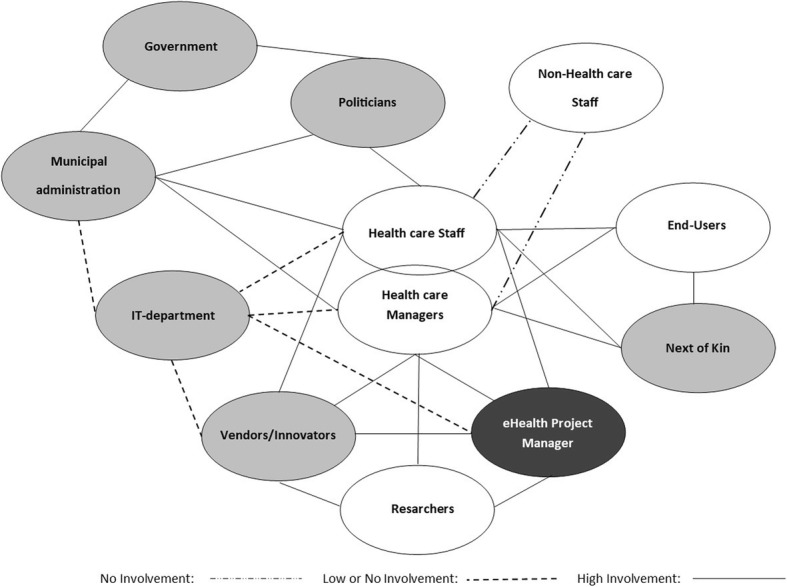
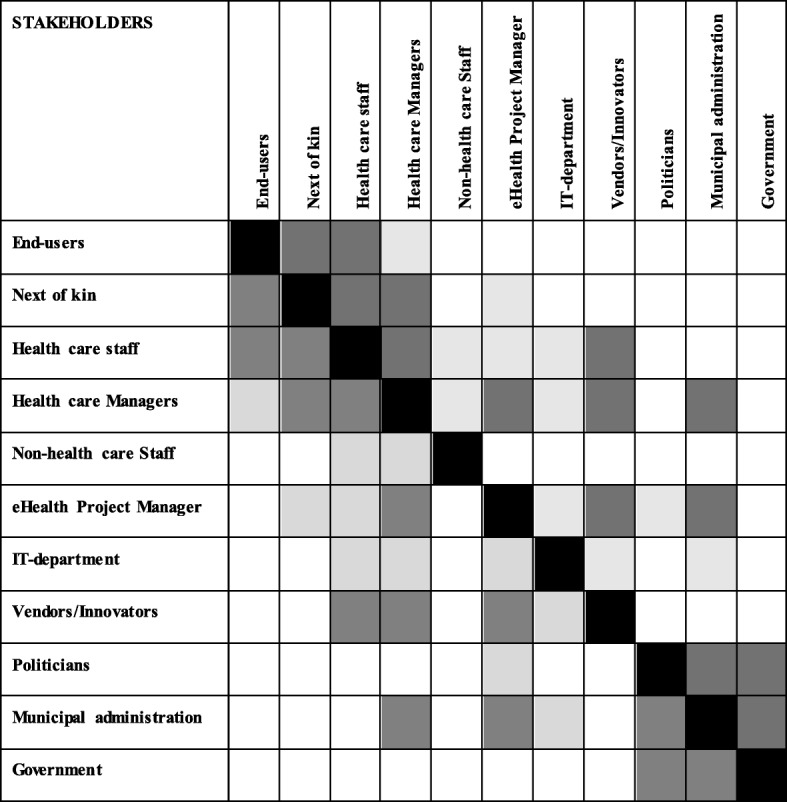
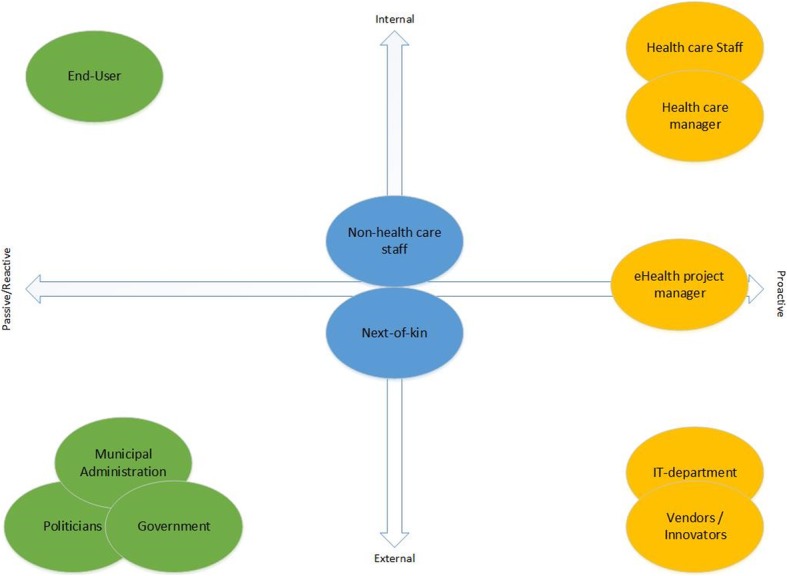
Background: The implementation of any technology in community health care is seen as a challenge. Similarly, the implementation of eHealth technology also has challenges, and many initiatives never fully reach their potential. In addition, the complexity of stakeholders complicates the situation further, since some are unused to cooperating and the form of cooperation is new. The paper’s aim is to give an overview of the stakeholders and the relationships and dependencies between them, with the goal of contributing this knowledge to future similar projects in a field seeing rapid development. Methods: In this longitudinal qualitative and interpretive study involving eight municipalities in Norway, we analysed how eHealth initiatives have proven difficult due to the complexity and lack of involvement and integration from stakeholders. As part of a larger project, this study draws on data from 20 interviews with employees on multiple levels, specifically, project managers and middle managers; healthcare providers and next of kin; and technology vendors and representatives of the municipal IT support services. Results: We identified the stakeholders involved in the implementation of eHealth community health care in the municipalities, then described and discussed the relationships among them. The identification of the various stakeholders illustrates the complexity of innovative implementation projects within the health care domain—in particular, community health care. Furthermore, we categorised the stakeholders along two dimensions (external–internal) and their degree of integration (core stakeholders, support stakeholders and peripheral stakeholders). Conclusions: Study findings deepen theoretical knowledge concerning stakeholders in eHealth technology implementation initiatives. Findings show that the number of stakeholders is high, and illustrate the complexity of stakeholders’ integration. Moreover, stakeholder integration in public community health care differs from a classical industrial stakeholder map in that the municipality is not just one stakeholder, but is instead comprised of many. These stakeholders are internal to the municipality but external to the focal actor, and this complicating factor influences their integration. Our findings also contribute to practice by highlighting how projects within the health care domain should identify and involve these stakeholders at an early stage. We also offer a model for use in this context.
Overview
The claims and statistics of this paper haven’t been checked yet.
Free: it reads the open-access text and checks the first 5 claims that cite a source we can check. Create a free account to check every claim.
Integrity signals
Registry
Cites
Statistics
Figures
Verification
Claims the paper makes
The claims and statistics of this paper haven’t been checked yet.
Free: it reads the open-access text and checks the first 5 claims that cite a source we can check. Create a free account to check every claim.
Self-check
Percentages, sums and reported differences re-computed from the paper’s own numbers.
The self-check needs the paper’s full text.
Citations
Cites
(2010) · Cited by 24,023
Qualitative Data Analysis: A Methods Sourcebook
Miles, M. B., Huberman, A. M., & Saldaña, J. (1988) · Cited by 20,701
Building Theories from Case Study Research
Eisenhardt, K. M. (1989) · The Academy of Management Review · doi:10.2307/258557 · Cited by 17,455
Hartley, J. (2004) · Essential Guide to Qualitative Methods in Organizational Research · doi:10.4135/9781446280119.n26 · Cited by 15,461
Qualitative Data Analysis: A Sourcebook of New Methods
Lotto, L. S., Miles, M. B., & Huberman, A. M. (1986) · Educational Evaluation and Policy Analysis · doi:10.2307/1163741 · Cited by 10,315
Co-creation experiences: The next practice in value creation
Prahalad, C. K., & Ramaswamy, V. (2004) · Journal of Interactive Marketing · doi:10.1002/dir.20015 · Cited by 6,487 · cited 1×
“The implementation of eHealth technology may also be seen as changing practice, and as a stage in the innovation of services [29]; this includes active collaboration and co-creation between vendors and consumers [30, 31].”
BackgroundThe Stakeholder Theory of the Corporation: Concepts, Evidence, and Implications
Donaldson, T., & Preston, L. E. (1995) · The Academy of Management Review · doi:10.2307/258887 · Cited by 5,846 · cited 1×
“Although stakeholder theory was developed primarily for investor-owned corporations [33], several authors have found the approach useful in other contexts, such as e-government, social media, local government issues and project management (e.”
BackgroundStrategic Management: A Stakeholder Approach
Freeman, R. E. (2010) · Cambridge University Press eBooks · doi:10.1017/cbo9781139192675 · Cited by 4,494
Epistemic cultures: how the sciences make knowledge
(1999) · Choice Reviews Online · doi:10.5860/choice.37-0887 · Cited by 3,346
Etzkowitz, H., & Loet Leydesdorff, A. (2002) · Cited by 1,194
Research works printed but not linked: 3
- The Norwegian Ministry of Health and Care Services Meld. St. 29. 2012–2013 2012 Oslo Future care
- Norwegian Ministry of Local Government and Modernisation Meld. St. 27. 2015–2016. Digital agenda for Norway—ICT for a simpler everyday life and increased productivity Oslo 2015
- Marcelo AB Celi LAG Hamish SF Fraser JSO Paik K Nikore V Understanding local policy and the national eHealth strategy Global health informatics: principles of eHealth and mHealth to improve quality of care 2017 Cambridge MIT Press 91 100
Cited by
Experimental Constraints on Chondrule Formation
Hewins, R. H., Connolly, H. C., Jr., & Libourel, G. (2005) · ASPC · Cited by 186
Implementation of health technology: Directions for research and practice
van Gemert-Pijnen, J. (2022) · Frontiers in Digital Health · doi:10.3389/fdgth.2022.1030194 · Cited by 72
“Key stakeholders can be identi fi ed based on their role in the process of implementation and the level of strategic in fl uence they have on short-or long-term success and failure of implementation (7 – 9).”
BackgroundVarsi, C., Ledel Solem, I. K., Eide, H., Børøsund, E., Kristjansdottir, O. B., Heldal, K., Waxenberg, L. B., Weiss, K. E., Schreurs, K. M. G., Morrison, E. J., et al. (2021) · BMC Health Services Research · doi:10.1186/s12913-021-06278-7 · Cited by 53
Sociotechnical analysis of factors influencing IoT adoption in healthcare: A systematic review
Kronlid, C., Brantnell, A., Elf, M., Borg, J., & Palm, K. (2024) · Technology in Society · doi:10.1016/j.techsoc.2024.102675 · Cited by 46
Heijsters, F. A. C. J., Santema, J. M. M., Mullender, M. G., Bouman, M., de Bruijne, M. C., & van Nassau, F. (2022) · BMJ Open · doi:10.1136/bmjopen-2022-065778 · Cited by 32
Nøst, T. H., Faxvaag, A., & Steinsbekk, A. (2021) · BMC Health Services Research · doi:10.1186/s12913-021-06188-8 · Cited by 16
Weimar, S. N., Martjan, R. S., & Terzidis, O. (2024) · Management Review Quarterly · doi:10.1007/s11301-024-00417-0 · Cited by 33
“It is crucial to address the specific digital health business model challenges that include the complex stakeholder landscape (Nilsen et al. 2020), the revenue model and reimbursement challenges startups face (Hagen and Lauer 2018; Chakraborty et al. 2023a), regulations (Berensmann and Gratzfeld…”
Desafios à translação do conhecimento na era digital
Presado, M. H., Marques, F. M., Ferreira, Ó., Cardoso, M. M. E., Sousa, A. D., & do Nascimento, T. F. R. (2022) · New Trends in Qualitative Research · doi:10.36367/ntqr.10.2022.e517 · Cited by 15
Guldemond, N. (2024) · Diabetes Obesity and Metabolism · doi:10.1111/dom.15476 · Cited by 23
“163,164 Co-creation is also proven to be an effective method for change management.”
MethodDong, C., Liu, J., & Mi, J. (2023) · Healthcare · doi:10.3390/healthcare11142019 · Cited by 13
Shen, M., Feng, Z., Shen, Y., & Shi, Z. (2025) · BMC Nursing · doi:10.1186/s12912-025-03927-8 · Cited by 12
“By contrast, community health practice demands competencies in population health databases, telehealth platforms, and health information exchange systems [7, 8].”
InfluentialLosová, V. Š., & Dvouletý, O. (2024) · Journal of Health Organization and Management · doi:10.1108/jhom-06-2023-0203 · Cited by 19
Data-Driven Personalization of a Physiotherapy Care Pathway: Case Study of Posture Scanning
Korhonen, O., Väyrynen, K., Krautwald, T., Bilby, G., Broers, H. A. T., Giunti, G., & Isomursu, M. (2020) · JMIR Rehabilitation and Assistive Technologies · doi:10.2196/18508 · Cited by 12
“Service design takes all the different stakeholders who are part of the service delivery into consideration to understand their needs and expectations [27,28]; this also applies to health care [29].”
BackgroundArnahoutova, K., Geest, S. D., Mielke, J., Boaz, A., Schoemans, H. M., & Valenta, S. (2025) · Evaluation & the Health Professions · doi:10.1177/01632787251352837 · Cited by 17
Skjelvik, A., West, N., & Görges, M. (2025) · Journal of Medical Internet Research · doi:10.2196/64388 · Cited by 7
“Our sampling approach in Norway was based on previous research on key stakeholders for assisted living technologies [23,55,56].”
Identifying Relevant Stakeholders in Digital Healthcare
Nipa, N. S., Alam, M., & Haque, M. S. (2021) · Communications in computer and information science · doi:10.1007/978-3-030-82269-9_27 · Cited by 12
Moll, C., Arndt, F., Arvanitis, T. N., González, N., Groene, O., Ortega-Gil, A., Verdoy, D., & Bloemeke, J. (2023) · Digital Health · doi:10.1177/20552076231222100 · Cited by 10
“48 Clearly describing responsibilities between the different healthcare providers that are involved in the ADLIFE care concepts (i.e. GPs, clinicians, nurses) is also important to ensure a successful implementation and later use of the digital health platforms.”
Stanimirović, D. (2024) · Digital Health · doi:10.1177/20552076241254019 · Cited by 12
“28,29 Resistance to change and limited user adoption have emerged as some of the most signi fi cant barriers in healthcare digitalization initiatives.”
BackgroundGamble, E., Heavin, C., & Linehan, C. (2025) · Journal of Medical Internet Research · doi:10.2196/62947 · Cited by 7
A sociotechnical framework for integration of telehealth into clinical workflow
Olivencia, S. B., & Sasangohar, F. (2023) · IISE Transactions on Healthcare Systems Engineering · doi:10.1080/24725579.2023.2211083 · Cited by 8
“This is in line with previous research documenting the benefits and complexities that result from involving stakeholders in health technology implementation and assessment (Brereton et al., 2017; Nilsen et al., 2020).”
ResultEnam, A., Dreyer, H. C., & de Boer, L. (2022) · BMC Health Services Research · doi:10.1186/s12913-022-08164-2 · Cited by 9
“However, to implement distance monitoring service on a large scale and adopt it as a routine service, it is crucial to understand its effect on resource utilization [9, 15].”
BackgroundWeimar, S. N., Martjan, R. S., & Terzidis, O. (2025) · Journal of Medical Internet Research · doi:10.2196/65725 · Cited by 16
“The complexity of health care systems is further compounded by the broad stakeholder landscape that includes health insurers, health care providers, and patients, among others [10].”
Pajalić, Z., Olsen, S. E. G., Hamre, A., Strøm, B. S., Clausen, C., Saplacan, D., & Kulla, G. (2024) · Public Health in Practice · doi:10.1016/j.puhip.2024.100470 · Cited by 8
“Other studies emphasize the need to carefully assess the utility value of the WT in the home care sector in opposition to privacy [42,43].”
BackgroundBraake, E. T., Grünloh, C., & Tabak, M. (2024) · International Journal of COPD · doi:10.2147/copd.s432568 · Cited by 5
Patient Co-Creation Initiatives in the Ambulatory Care Setting during COVID-19: A Systematic Review
Lieneck, C., Pacheco, G. J., Cole, M., Hipp, L., Leal, G., Matamoros, K., Rojas-Trejo, B., Stepp, N., & Torres, C. (2024) · Medicina · doi:10.3390/medicina60010111 · Cited by 4
Rombouts, M., Raaijmakers, L. G. M., Kuunders, T. J. M., Steijn-Martens, R. V., de Vuijst, T., van Donkersgoed, H., & van de Goor, L. A. M. (2021) · Journal of Prevention · doi:10.1007/s10935-021-00651-2 · Cited by 4
Facilitators of and Barriers to Global Digital Oral Health: Mixed Methods Study
Emami, E., Talla, P. K., Inquimbert, C., & Giraudeau, N. (2026) · Journal of Medical Internet Research · doi:10.2196/76236 · Cited by 4
Vis, C., van Bodegom‐Vos, L., Walters, B. H., Powell, B. J., Ista, E., & van Nassau, F. (2025) · Implementation Science · doi:10.1186/s13012-025-01477-w · Cited by 5
“Generally, it is common practice to involve stakeholders in implementation [43].”
A New eHealth Investment Appraisal Framework for Africa: Validation
Broomhead, S. C., Mars, M., & Scott, R. E. (2023) · International Journal of Environmental Research and Public Health · doi:10.3390/ijerph20146426 · Cited by 3
“The implementations are high risk, extend across several years, and affect several stakeholder types including patients, healthcare workers, healthcare organisations, insurance companies, and governments [3].”
BackgroundCommunity nursing and the digital technology revolution: the past, present and future
Ramadan, F. (2024) · British Journal of Community Nursing · doi:10.12968/bjcn.2024.0076 · Cited by 3
E-Health implementation in the Democratic Republic of the Congo: Current position
Djamba, K. J., Havyarimana, V., Mbambazi, B. P., & Niyongabo, J. (2025) · International Journal of Health Sciences · doi:10.53730/ijhs.v9n1.15543 · Cited by 4
“…of health care services’ (Sneha, 2017), According to this definition, it is evident that effective eHealth deployment incorporates stakeholders and procedures from a wide variety of healthcare tasks (Nilsen et al., 2020), and entails much more than just technology (Vest, 2010; Barlow et al., 2006).”
Chapel, B., Ologeanu‐Taddei, R., Cases, A.-S., & Hayot, M. (2022) · Systèmes d information & management · doi:10.3917/sim.221.0067 · Cited by 7
Gruß, I., Dawson, T., Kaplan, C. D., Pihlstrom, D. J., Fellows, J. L., & Polk, D. E. (2023) · Implementation Science Communications · doi:10.1186/s43058-023-00496-2 · Cited by 3
“Using such approaches to involve healthcare professionals in the implementation of novel practices can, however, be challenging [9].”
BackgroundSivalingam, C., & Ramaswamy, R. (2024) · Journal of International Financial Management and Accounting · doi:10.1111/jifm.12198 · Cited by 3
RetractedCoopmans, A. G., Mannak, R. S., Braspenning, A. M., Wouters, E., & Bongers, I. M. B. (2025) · Journal of Medical Internet Research · doi:10.2196/67839 · Cited by 2
“While the importance of identification, involvement, and analysis of the involved organizations [58-61] is acknowledged in the literature, there is limited research adopting a phase specific perspective on how organizational involvement leads to organizational boundaries.”
Mathew, S., & Chambers, R. M. (2021) · BJGP Open · doi:10.3399/bjgpo.2020.0169 · Cited by 2
“Early identification and engagement of key stakeholders facilitates early adoption and implementation of health technology.(9) Key stakeholders we identified included clinicians, practice managers, CCG”
BackgroundGrøndal-Eeles, L. C., Dugstad, J., Eide, H., & Nilsen, E. R. (2025) · BMC Health Services Research · doi:10.1186/s12913-025-12264-0 · Cited by 2
“This is still true [29, 36], and the emergence of health care innovations such as the call centers under study, demonstrates the need for mapping stakeholders.”
Self-citationWouters, E. (2021) · Routledge eBooks · doi:10.4324/9781003155317-3 · Cited by 3
Quadruple helix collaboration for eHealth: a business relationship approach
Nilsson, L., Lagrosen, S. O., & Qvarfordt, M. (2024) · International Journal of Healthcare Technology and Management · doi:10.1504/ijhtm.2024.140387 · Cited by 1
Skjelvik, A., & Yang, B. (2025) · Springer proceedings in complexity · doi:10.1007/978-981-96-0401-2_15 · Cited by 1
Lindhardt, C. L., Feenstra, M. M., Faurholt, H., Andersen, L. R., & Thygesen, M. K. (2025) · Healthcare · doi:10.3390/healthcare13091073 · Cited by 2
“Healthcare professionals’ resistance to VCs may play an important role, and it might be beneficial for the HCPs to be regarded as co-creators in a clinical setting [39].”
Innovation readiness index for healthcare organizations and significance of its factors
Gabrielyan, A. R., Aleksandrova, O. Y., & Mikhailov, I. А. (2025) · Medical Technologies Assessment and Choice · doi:10.17116/medtech20254702131 · Cited by 1
Pandya, A., Wadhwa, M., Harshika, K., Anukriti, & Zafar, S. (2025) · QAI Journal for Healthcare Quality and Patient Safety · doi:10.4103/qaij.qaij_17_25 · Cited by 1
Opportunities and Challenges for Designing in Connected Health: Insights From an Expert Workshop
Premanandan, S., Ahmad, A., Jaranka, A., Üreten, E., Lee, E., Gross, J., Cajander, Å., Ouhbi, S., Larusdottir, M. K., Eriksson, O., et al. (2025) · Journal of Medical Internet Research · doi:10.2196/72446 · Cited by 4
“Despite the clear benefits, ensuring effective collaboration across stakeholders presents ongoing challenges [47].”
Glavas, C., Ma, J., Sood, S., George, E. S., Daly, R. M., Gvozdenko, E., de Courten, B. V., Scott, D. S., & Jansons, P. (2025) · Technologies · doi:10.3390/technologies13110511 · Cited by 1
“End-users provide critical insights on digital technology use and expectations for lifestyle program delivery [20,21].”
Andersen, F., Løkkeberg, S. E. T., Hardeland, C., & Leonardsen, A. L. (2026) · Journal of Primary Care & Community Health · doi:10.1177/21501319251408672 · Cited by 2
“39”
Fachinger, U., Henke, K., & Mähs, M. (2022) · Gesundheit. Politik - Gesellschaft - Wirtschaft · doi:10.1007/978-3-658-34027-8_20 · Cited by 1
Geraidine, R. S., & da Silva, L. F. (2025) · International Journal of Managing Projects in Business · doi:10.1108/ijmpb-10-2024-0237 · Cited by 2
Enhancing diagnostic innovation by leveraging the co-creation approach
Lennerz, J. K., Farfsing, A., Kiehl, T., Perner, S., van Duuren, J., Christ, M., & Farfsing, J. W. (2025) · Journal of Pathology Informatics · doi:10.1016/j.jpi.2025.100460 · Cited by 1
Delardes, B., Chakraborty, S. P., Smith, K. L., & Bowles, K. (2022) · Australasian Journal of Paramedicine · doi:10.33151/ajp.19.918
“This allowed us to create a tool that combines the needs of the core stakeholders, hopefully increasing uptake through proactive co-creation and designing our proforma within the limits of described organisational readiness.(22)”
MethodKnowledge Transfer and the Challenges of the Virtual World
Presado, M. H., Marques, F. M., Ferreira, Ó., Cardoso, M. M. E., Sousa, A. D., do Nascimento, T. F. R., & Baixinho, C. L. (2022) · Lecture notes in networks and systems · doi:10.1007/978-3-031-04680-3_1
ICT and Social Services Delivery in the Local Government Councils (LGCs) in Enugu State Nigeria
Ukwu, F. E., Manasseh, C. O., Logan, C. S., Okanya, O. C., Eze-Dike, F. U., & Ejim, E. P. (2023) · International Journal of Business and Economics Research · doi:10.11648/j.ijber.20231203.16
Eriksson‐Liebon, M. (2024) · Linköping University medical dissertations · doi:10.3384/9789180755597
Araújo, L. M. S. (2024) · Digital Library of Theses and Dissertations (Universidade de São Paulo) · doi:10.11606/t.22.2024.tde-22052024-145817
Artos, E. E. B., & Brito, E. J. F. (2024) · Acta Pediátrica de México · doi:10.18233/apm.v45i6.2830 · Cited by 2
Service-Learning in Healthcare Facility Design
Dahiya, R., Selvakumar, P., Karunakaran, N. B., Khanna, G., Anute, N., & Manjunath, T. C. (2025) · IGI Global eBooks · doi:10.4018/979-8-3693-9704-6.ch014
Martjan, R. S., Weimar, S. N., & Terzidis, O. (2025) · IEEE International Conference on Engineering, Technology and Innovation (ICE/ITMC) · doi:10.1109/ice/itmc65658.2025.11106652
Weimar, S. N., Martjan, R. S., Dang, K. A., & Terzidis, O. (2025) · IEEE International Conference on Engineering, Technology and Innovation (ICE/ITMC) · doi:10.1109/ice/itmc65658.2025.11106572
“Startups are another frequently discussed group, comprising digital health startups [33] and, more broadly, entrepreneurs, inventors [29], and innovators [39].”
InfluentialVideo på legevaktsentralene gir mer presise vurderinger og færre unødige oppmøter
Vikeså, M. D. (2025) · Sykepleien Forskning · doi:10.4220/sykepleiens.2025.100370
El‐Sehrawy, A. A. M. A., Prasad, K., Almedee, A. F., Ismail, S. M., Younes, Z. B. B., Singh, A., Sabarivani, A., Ray, S., Joshi, K. K., & Khosravi, M. (2025) · Research Square · doi:10.21203/rs.3.rs-7352863/v1
Implementation Challenges of Smarter and Integrated Local Health Information System
Aguila, E. M., Actub, S. D., Adalia, E. M., Aguirre, N. N., Agulto, A. G. B., Alfaro, A. D. M., Alvaro, M. R., Apiado, L. D., & Calacday, C. R. (2025) · Journal of interdisciplinary perspectives · doi:10.69569/jip.2025.607
Sofia, B., Luca, F., & Giulia, R. (2022) · Journal of integrative nursing and palliative care · doi:10.51847/ro7wxh7mpg
Varsi, C., Ledel Solem, I. K., Eide, H., Børøsund, E., Kristjánsdóttir, Ó. B., Heldal, K., Waxenberg, L. B., Weiss, K. E., Schreurs, K. M. G., Morrison, E. J. P., et al. (2021) · Figshare · doi:10.6084/m9.figshare.14313472
Frijns, F., Pat, J. J., Blanker, M. H., Steffens, M. G., & Witte, L. P. W. (2026) · Trials · doi:10.1186/s13063-026-09936-5
Family interventions in dementia mental health environments (FIND ME): a mixed-methods protocol
Wolverson, E., Gillam, J., Dunn, R., Hoe, J., Underwood, B. R., Mwale, S., Credland, N., Robertson, M., Wyatt, M., Lane, R., et al. (2026) · BMJ Open · doi:10.1136/bmjopen-2025-110244
“24 Partic-ipatory research necessitates a shift in the traditional power balance between researchers and end-users to ensure collective ownership, equal participation and legitimate shared decision-making.”
Kungwalo, E. C., Kanjo, C., Kunyenje, G., & Chikumba, P. (2026) · PLOS Digital Health · doi:10.1371/journal.pdig.0001238 · Cited by 1
Poppe, A., Grün, E. S., Butz, C., Meenen, B., Lampe, D., Schmidt, J., Greiner, W., Köberlein-Neu, J., Meyer, I., & eRIKA Study Group (2026) · doi:10.2196/preprints.100362
Dawson, T., Kaplan, C. D., & Polk, D. E. (2026) · BMC Oral Health · doi:10.1186/s12903-026-08390-8
“Participatory engagement can be challenging, however, because approaches must be responsive to differing healthcare contexts [11].”
Hwabamungu, B., & Shepherd, P. (2026) · Digital Health · doi:10.1177/20552076261462656
“10 The multiple relationship types between stakeholders in the digitalisation activity system have far reaching implications.”
Miles, J. (2026) · Information Technology and People · doi:10.1108/itp-04-2025-0559 · Cited by 2
Glavas, C., Sood, S., Ebeling, P. R., Gvozdenko, E., Ross, B. D., Jansons, P., Kiss, N. K., Daly, R. M., & Scott, D. M. (2026) · Bone · doi:10.1016/j.bone.2026.118011
Peels, D. A., Boekhout, J. M., Berendsen, B., Czwikla, G., van Uffelen, J. G. Z., & van Nassau, F. (2026) · Global Implementation Research and Applications · doi:10.1007/s43477-026-00242-5
Digital Simulations for Future Proof Nurses: Hybrid Implementation Approach
Walburg, S., & Terlouw, G. (2026) · Education Sciences · doi:10.3390/educsci16091353
Standal, B., Kenter, R. M. F., Gullslett, M. K., Nordgreen, T., & Teig, I. L. (2026) · Frontiers in Digital Health · doi:10.3389/fdgth.2026.1955151
“Poor integration with existing IT systems aligns with observations by Nilsen et al. (67), who note that limited involvement and insufficient integration of the IT department can significantly hinder the implementation of e-health technologies and even give rise to resistance among key actors.”
Self-citationPoppe, A., Grün, E. S., Butz, C., Meenen, B., Lampe, D., Schmidt, J., Greiner, W., Köberlein–Neu, J., Meyer, I., & eRIKA Study Group (2026) · JMIR Formative Research · doi:10.2196/100362
Metadata
- Authors
- Nilsen, E. R., Stendal, K., & Gullslett, M. K.
- Affiliations
- University of South-Eastern Norway (NO)
- Corresponding author
- Nilsen, Etty R.
- Venue
- BMC Health Services Research
- Published
- 2020-05-11
- Volume
- 20
- Issue
- 1
- Pages
- 395-395
- ISSN
- 1472-6963 (ISSN-L)
- PMC
- PMC7212667
- OpenAlex
- W3025074108
- Cited by
- 78
- References
- 50
- Citations by year
- 2026: 13 · 2025: 24 · 2024: 16 · 2023: 7 · 2022: 9 · 2021: 7 · 2020: 1
- FWCI
- 0.92
- Type
- journal article
- Language
- en
- Open access
- gold
- doi.org
- Licence
- cc-by
- creativecommons.org/licenses/by/4.0 (tdm)
- creativecommons.org/licenses/by/4.0 (vor)
- Locations
- BMC Health Services Research (publishedVersion, cc-by)
- PubMed Central (publishedVersion, cc-by)
- PubMed (publishedVersion)
- DOAJ (DOAJ: Directory of Open Access Journals) (submittedVersion, cc-by-sa)
- NORA - Norwegian Open Research Archives (submittedVersion, cc-by)
- Funders
- Norges Forskningsråd (229883 and 234978)
- Topics
- Health Sciences › Health Professions › Health Information Management › Electronic Health Records Systems
- Social Sciences › Business, Management and Accounting › Management Information Systems › Information Systems Theories and Implementation
- Health Sciences › Medicine › Public Health, Environmental and Occupational Health › Telemedicine and Telehealth Implementation
- Keywords
- eHealth implementation, community-based care, stakeholder engagement, stakeholder integration, stakeholder mapping, municipal health services, stakeholder relations, health technology implementation, stakeholder model
- MeSH terms
- Community Health Services, Delivery of Health Care, Health Personnel, Humans, Longitudinal Studies, Norway, Technology, Telemedicine, Qualitative Research
About these checks
Registry, retraction, Cites and statistics results are computed, not judged, with one exception: a printed reference that no index lists is read once by a model before it counts as a citation error. Claims are extracted by a model and kept only when their quote appears verbatim in the text; each cited source is then checked, with a model’s help, for whether it says what the claim relies on. Those verdicts can be wrong — read the claim’s quote and the cited source before relying on one.
Statistics and arithmetic are recomputed, not judged.
Confidence bands are shown only for fields calibrated on our annotated test set. None is calibrated yet, so no band is shown.
What counts as a claim ›How we measure confidence ›How we check this ›
Are you an author, or do you see a problem with this page? Request a review
Data sources
Bibliographic data: Semantic Scholar, OpenAlex, Crossref.
Contains information from the Semantic Scholar Academic Graph Datasets, made available under the ODC Attribution License (ODC-BY 1.0).
Semantic Scholar’s data is described in: Kinney, R., et al. (2023). The Semantic Scholar Open Data Platform. arXiv:2301.10140.
