

Implementation of eHealth Technology in Community Health Care: the complexity of stakeholder involvement
Open accessThe DOI matches its Crossref record; 50 of the 50 references it cites were found in a registry or an index.
Abstract
Background: The implementation of any technology in community health care is seen as a challenge. Similarly, the implementation of eHealth technology also has challenges, and many initiatives never fully reach their potential. In addition, the complexity of stakeholders complicates the situation further, since some are unused to cooperating and the form of cooperation is new. The paper’s aim is to give an overview of the stakeholders and the relationships and dependencies between them, with the goal of contributing this knowledge to future similar projects in a field seeing rapid development. Methods: In this longitudinal qualitative and interpretive study involving eight municipalities in Norway, we analysed how eHealth initiatives have proven difficult due to the complexity and lack of involvement and integration from stakeholders. As part of a larger project, this study draws on data from 20 interviews with employees on multiple levels, specifically, project managers and middle managers; healthcare providers and next of kin; and technology vendors and representatives of the municipal IT support services. Results: We identified the stakeholders involved in the implementation of eHealth community health care in the municipalities, then described and discussed the relationships among them. The identification of the various stakeholders illustrates the complexity of innovative implementation projects within the health care domain—in particular, community health care. Furthermore, we categorised the stakeholders along two dimensions (external–internal) and their degree of integration (core stakeholders, support stakeholders and peripheral stakeholders). Conclusions: Study findings deepen theoretical knowledge concerning stakeholders in eHealth technology implementation initiatives. Findings show that the number of stakeholders is high, and illustrate the complexity of stakeholders’ integration. Moreover, stakeholder integration in public community health care differs from a classical industrial stakeholder map in that the municipality is not just one stakeholder, but is instead comprised of many. These stakeholders are internal to the municipality but external to the focal actor, and this complicating factor influences their integration. Our findings also contribute to practice by highlighting how projects within the health care domain should identify and involve these stakeholders at an early stage. We also offer a model for use in this context.
Overview
The claims and statistics of this paper haven’t been checked yet.
Free: it reads the open-access text and checks the first 5 claims that cite a source we can check. Create a free account to check every claim.
Integrity signals
Registry
Cites
Statistics
Figures
Verification
Claims the paper makes
The claims and statistics of this paper haven’t been checked yet.
Free: it reads the open-access text and checks the first 5 claims that cite a source we can check. Create a free account to check every claim.
Self-check
Percentages, sums and reported differences re-computed from the paper’s own numbers.
The self-check needs the paper’s full text.
Citations
Cites
(2010) · Cited by 24,023
Qualitative Data Analysis: A Methods Sourcebook
Miles, M. B., Huberman, A. M., & Saldaña, J. (1988) · Cited by 20,701
Building Theories from Case Study Research
Eisenhardt, K. M. (1989) · The Academy of Management Review · doi:10.2307/258557 · Cited by 17,455
Hartley, J. (2004) · Essential Guide to Qualitative Methods in Organizational Research · doi:10.4135/9781446280119.n26 · Cited by 15,461
Qualitative Data Analysis: A Sourcebook of New Methods
Lotto, L. S., Miles, M. B., & Huberman, A. M. (1986) · Educational Evaluation and Policy Analysis · doi:10.2307/1163741 · Cited by 10,315
Co-creation experiences: The next practice in value creation
Prahalad, C. K., & Ramaswamy, V. (2004) · Journal of Interactive Marketing · doi:10.1002/dir.20015 · Cited by 6,487 · cited 1×
“The implementation of eHealth technology may also be seen as changing practice, and as a stage in the innovation of services [29]; this includes active collaboration and co-creation between vendors and consumers [30, 31].”
BackgroundThe Stakeholder Theory of the Corporation: Concepts, Evidence, and Implications
Donaldson, T., & Preston, L. E. (1995) · The Academy of Management Review · doi:10.2307/258887 · Cited by 5,846 · cited 1×
“Although stakeholder theory was developed primarily for investor-owned corporations [33], several authors have found the approach useful in other contexts, such as e-government, social media, local government issues and project management (e.”
BackgroundStrategic Management: A Stakeholder Approach
Freeman, R. E. (2010) · Cambridge University Press eBooks · doi:10.1017/cbo9781139192675 · Cited by 4,494
Epistemic cultures: how the sciences make knowledge
(1999) · Choice Reviews Online · doi:10.5860/choice.37-0887 · Cited by 3,346
Etzkowitz, H., & Loet Leydesdorff, A. (2002) · Cited by 1,194
Proceedings of the 18th European conference on information systems (ECIS2010)
Tervonen, T., Brock, D. B., Graeff, D. P., & Hillege, H. L. (2010) · Cited by 836
Proceedings of the 16th International Conference Information Systems 2023
(2023) · doi:10.33965/is2023 · Cited by 828
Concannon, T. W., Fuster, M., Saunders, T., Patel, K., Wong, J. B., Leslie, L. K., & Lau, J. (2014) · Journal of General Internal Medicine · doi:10.1007/s11606-014-2878-x · Cited by 468 · cited 2×
“In the field of eHealth, several studies have applied a stakeholder perspective, but, as noted above, most of these were performed in the context of a hospital [13, 37].”
BackgroundHealth Care Spending And Use Of Information Technology In OECD Countries
Anderson, G. F., Frogner, B. K., Johns, R. A., & Reinhardt, U. E. (2006) · Health Affairs · doi:10.1377/hlthaff.25.3.819 · Cited by 249 · cited 1×
“It has been argued that eHealth initiatives will only succeed if the patient is kept at the centre and if socio-cultural/behavioural, organisational, financial, political and technical barriers are addressed with the objective of empowering patients [21, 28].”
BackgroundLindberg, B., Nilsson, C., Zotterman, D., Söderberg, S., & Skär, L. (2013) · International Journal of Telemedicine and Applications · doi:10.1155/2013/461829 · Cited by 235
Involving Stakeholders in Developing Corporate Brands: the Communication Dimension
Gregory, A. (2007) · Journal of Marketing Management · doi:10.1362/026725707x178558 · Cited by 219 · cited 1×
“on the nature of the involvement and the extent to which they should be involved [41].”
BackgroundPouloudi, A., & Whitley, E. A. (1997) · European Journal of Information Systems · doi:10.1057/palgrave.ejis.3000252 · Cited by 219
Identifying healthcare actors involved in the adoption of information systems
Mantzana, V., Themistocleous, M., Irani, Z., & Morabito, V. (2007) · European Journal of Information Systems · doi:10.1057/palgrave.ejis.3000660 · Cited by 180 · cited 2×
“In the field of eHealth, several studies have applied a stakeholder perspective, but, as noted above, most of these were performed in the context of a hospital [13, 37].”
BackgroundNilsen, E. R., Dugstad, J., Eide, H., Gullslett, M. K., & Eide, T. (2016) · BMC Health Services Research · doi:10.1186/s12913-016-1913-5 · Cited by 174 · cited 4×
“Moreover, as we found, this can sometimes result in resistant behaviour from the IT department [29].”
BackgroundInfluentialSelf-citationDugstad, J., Eide, T., Nilsen, E. R., & Eide, H. (2019) · BMC Health Services Research · doi:10.1186/s12913-019-4191-1 · Cited by 174 · cited 3×
“Part of a larger project [19, 29], the data for this study came from 20 interviews with employees on several Nilsen et al.”
BackgroundSelf-citationImplementing complex innovations in fluid multi-stakeholder environments: Experiences of ‘telecare’
Barlow, J., Bayer, S., & Curry, R. (2006) · Technovation · doi:10.1016/j.technovation.2005.06.010 · Cited by 173
ICT and the future of health care: aspects of health promotion
Haluza, D., & Jungwirth, D. (2014) · International Journal of Medical Informatics · doi:10.1016/j.ijmedinf.2014.09.005 · Cited by 171 · cited 1×
“Research underscores that collaboration among these stakeholders can facilitate eHealth implementation processes [19, 20].”
BackgroundStakeholder Governance: Adapting Stakeholder Theory to E-Government
Flak, L. S., & Rose, J. (2005) · Communications of the Association for Information Systems · doi:10.17705/1cais.01631 · Cited by 167
Kamal, M. M., Weerakkody, V., & Irani, Z. (2011) · Government Information Quarterly · doi:10.1016/j.giq.2010.08.003 · Cited by 165
Vest, J. R. (2010) · International Journal of Medical Informatics · doi:10.1016/j.ijmedinf.2010.09.003 · Cited by 143
Cetina, K. K. (2009) · Harvard University Press eBooks · doi:10.2307/j.ctvxw3q7f · Cited by 140
Survival of the project: A case study of ICT innovation in health care
Andreassen, H., Kjekshus, L. E., & Tjora, A. (2015) · Social Science & Medicine · doi:10.1016/j.socscimed.2015.03.016 · Cited by 131 · cited 1×
“The digitalisation of health care services and the large-scale implementation of eHealth is a slow process, and many initiated projects are never fully realised as part of the normal routine [12].”
BackgroundAchterkamp, M. C., & Vos, J. F. J. (2007) · Systems Research and Behavioral Science · doi:10.1002/sres.760 · Cited by 129 · cited 3×
“Vos J, Boonstra A, Achtercamp M. Understanding the dyadic promoter– stakeholder relations in complex projects.”
MethodInfluentialSchiller, C., Winters, M., Hanson, H. M., & Ashe, M. C. (2013) · BMC Public Health · doi:10.1186/1471-2458-13-428 · Cited by 124 · cited 2×
“In our stakeholder mapping, we base our concept of the ‘focal actor’ around Freeman’s [38, 39] seminal work.”
BackgroundMethodHospitality and hostility in hospitals: a case study of an EPR adoption among surgeons
Jensen, T. B., & Aanestad, M. (2007) · European Journal of Information Systems · doi:10.1057/palgrave.ejis.3000713 · Cited by 119
eHealth adoption factors in medical hospitals: A focus on the Netherlands
Faber, S., van GEENHUIZEN, M., & de Reuver, M. (2017) · International Journal of Medical Informatics · doi:10.1016/j.ijmedinf.2017.01.009 · Cited by 110 · cited 3×
“The authors define ‘organisational readiness’ as ‘the availability of the needed organisational resources for adoption’ [25], but as their study was conducted in hospitals, the operationalisation of this concept must be adapted to Nilsen et al.”
BackgroundInfluentialThe concept of welfare technology in Swedish municipal eldercare
Frennert, S., & Baudin, K. (2019) · Disability and Rehabilitation · doi:10.1080/09638288.2019.1661035 · Cited by 104 · cited 1×
“Those who decide to implement eHealth technology into municipal health care must be positive towards the changes and the possibilities offered by the technology; however, municipal health care organisations seem to struggle with understanding these premises [32].”
BackgroundFrennert, S. (2019) · Disability and Rehabilitation Assistive Technology · doi:10.1080/17483107.2019.1642393 · Cited by 76 · cited 2×
“With this in mind, however, the users of eHealth technology are usually health care workers, and this may hinder eHealth technology implementation initiatives, due to lack of experience and knowledge about the technology [26].”
BackgroundThe routine use of mobile health services in the presence of health consciousness
Meng, F., Guo, X., Peng, Z. C., Zhang, X., & Vogel, D. (2019) · Electronic Commerce Research and Applications · doi:10.1016/j.elerap.2019.100847 · Cited by 74
Database security: Research and practice
Bertino, E., Jajodia, S., & Samarati, P. (1995) · Information Systems · doi:10.1016/0306-4379(95)00029-4 · Cited by 59
Social media as public sphere: a stakeholder perspective
Johannessen, M. R., Sæbø, Ø., & Flak, L. S. (2016) · Transforming Government People Process and Policy · doi:10.1108/tg-01-2015-0003 · Cited by 56 · cited 1×
“Within health care, the stakeholder issue is frequently an area of focus, with the patient often seen as an important stakeholder (see, for instance, [35]).”
BackgroundBoonstra, A., & Van Offenbeek, M. (2010) · Information Systems Journal · doi:10.1111/j.1365-2575.2010.00358.x · Cited by 50 · cited 1×
“Following this definition, it is clear that successful eHealth implementation involves much more than just technology [22–24] and includes stakeholders and processes across a broad range of functions in the health care field [23].”
BackgroundExplaining stakeholder involvement in social enterprise governance through resources and legitimacy
Huybrechts, B., de Wilmars, S. M., & Rijpens, J. (2014) · doi:10.4324/9780203487747-18 · Cited by 49 · cited 4×
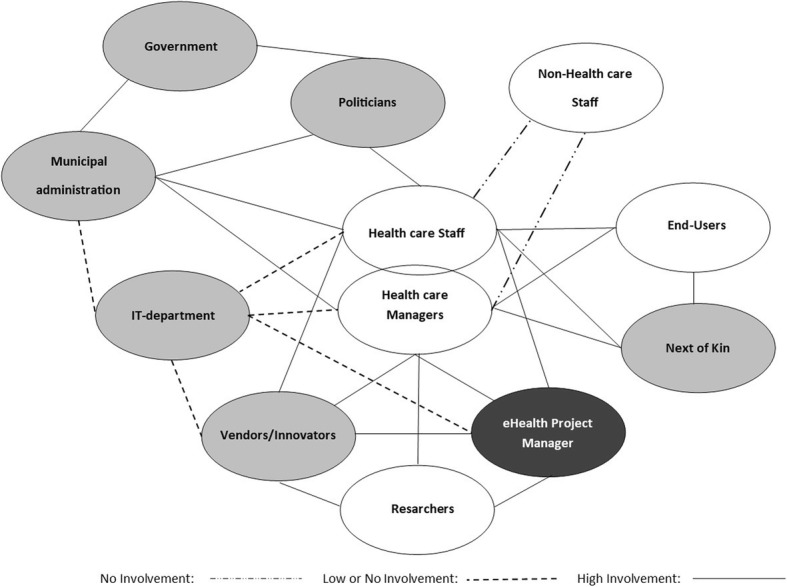
“1, these stakeholders (the health care staff, managers, the eHealth project managers and the vendors) are connected to the IT department by dotted lines and indicate a relationship with low involvement [40] and passive or non-integration [30].”
BackgroundInfluentialHwabamungu, B., Brown, I., & Williams, Q. (2017) · International Journal of Medical Informatics · doi:10.1016/j.ijmedinf.2017.11.002 · Cited by 26
Stakeholder integration in service innovation - an exploratory case study in the healthcare industry
Jonas, J. M., & Roth, A. (2017) · International Journal of Technology Management · doi:10.1504/ijtm.2017.082358 · Cited by 24
Stakeholder integration in service innovation - an exploratory case study in the healthcare industry
Roth, A., & Jonas, J. M. (2017) · International Journal of Technology Management · doi:10.1504/ijtm.2017.10003242 · Cited by 16 · cited 11×
“These relationships can be labelled as ‘stakeholder involvement’ [40] and ‘stakeholder integration’ [30], and are partly overlapping.”
BackgroundMethodInfluentialIdentifying Motives for Implementing eHealth by using Activity Theory
Svensson, A. (2020) · Sustainability · doi:10.3390/su12041298 · Cited by 14 · cited 2×
“The implementation of eHealth technology is contextually dependent, and factors that affect such contexts are organisational issues, technological infrastructure and human action [27].”
BackgroundE-Health: Value Proposition and Technologies Enabling Collaborative Healthcare
Sneha, S., & Straub, D. W. (2017) · Hawaii International Conference on System Sciences (HICSS) · doi:10.24251/hicss.2017.108 · Cited by 12 · cited 4×
“eHealth is enabled through integrated applications in the healthcare environment, and includes technologies related to computing, communication and sensing [21].”
BackgroundInfluentialHealth System Efficiency and eHealth Interoperability – How Much Interoperability Do We Need?
Stroetmann, K. A. (2014) · Advances in intelligent systems and computing · doi:10.1007/978-3-319-05948-8_38 · Cited by 11 · cited 1×
“Although the digitalisation of health care services is often the focus of these projects, the complexity of eHealth initiatives often lead to failure or less-thanoptimal solutions [10, 11].”
BackgroundGoverning e-Health Infrastructures: Dealing with Tensions
Bygstad, B., & Hanseth, O. (2016) · International Conference on Information Systems · Cited by 8
Korhonen, O., & Isomursu, M. (2017) · Journal of the Association for Information Systems · Cited by 8
Understanding dyadic promoter-stakeholder relations in complex projects
Vos, J. F. J., Boonstra, A., & Achterkamp, M. C. (2022) · International journal of information systems and project management · doi:10.12821/ijispm040401 · Cited by 6
PRODUCING COMMUNAL HEALTH THROUGH SELF CARE: THE EMERGENCE OF DIGITAL PATIENT ACTIVISM
Petrakaki, D. (2017) · Journal of the Association for Information Systems · Cited by 6
The role of IT-service in future health care, can they be ignored?
Stendal, K., & Dugstad, J. (2018) · Cited by 2
Self-citationPILOTPROSJEKTER I KOMMUNAL E-HELSE – FREMMES ELLER HEMMES TJENESTEINNOVASJON?
Eikebrokk, T. R., Moe, C. E., & Stendal, K. (2016) · NORA - Norwegian Open Research Archives · Cited by 1
Self-citation
Research works printed but not linked: 3
- The Norwegian Ministry of Health and Care Services Meld. St. 29. 2012–2013 2012 Oslo Future care
- Norwegian Ministry of Local Government and Modernisation Meld. St. 27. 2015–2016. Digital agenda for Norway—ICT for a simpler everyday life and increased productivity Oslo 2015
- Marcelo AB Celi LAG Hamish SF Fraser JSO Paik K Nikore V Understanding local policy and the national eHealth strategy Global health informatics: principles of eHealth and mHealth to improve quality of care 2017 Cambridge MIT Press 91 100
Cited by
Experimental Constraints on Chondrule Formation
Hewins, R. H., Connolly, H. C., Jr., & Libourel, G. (2005) · ASPC · Cited by 186
Implementation of health technology: Directions for research and practice
van Gemert-Pijnen, J. (2022) · Frontiers in Digital Health · doi:10.3389/fdgth.2022.1030194 · Cited by 72
“Key stakeholders can be identi fi ed based on their role in the process of implementation and the level of strategic in fl uence they have on short-or long-term success and failure of implementation (7 – 9).”
BackgroundVarsi, C., Ledel Solem, I. K., Eide, H., Børøsund, E., Kristjansdottir, O. B., Heldal, K., Waxenberg, L. B., Weiss, K. E., Schreurs, K. M. G., Morrison, E. J., et al. (2021) · BMC Health Services Research · doi:10.1186/s12913-021-06278-7 · Cited by 53
Sociotechnical analysis of factors influencing IoT adoption in healthcare: A systematic review
Kronlid, C., Brantnell, A., Elf, M., Borg, J., & Palm, K. (2024) · Technology in Society · doi:10.1016/j.techsoc.2024.102675 · Cited by 46
Heijsters, F. A. C. J., Santema, J. M. M., Mullender, M. G., Bouman, M., de Bruijne, M. C., & van Nassau, F. (2022) · BMJ Open · doi:10.1136/bmjopen-2022-065778 · Cited by 32
Metadata
- Authors
- Nilsen, E. R., Stendal, K., & Gullslett, M. K.
- Affiliations
- University of South-Eastern Norway (NO)
- Corresponding author
- Nilsen, Etty R.
- Venue
- BMC Health Services Research
- Published
- 2020-05-11
- Volume
- 20
- Issue
- 1
- Pages
- 395-395
- ISSN
- 1472-6963 (ISSN-L)
- PMC
- PMC7212667
- OpenAlex
- W3025074108
- Cited by
- 78
- References
- 50
- Citations by year
- 2026: 13 · 2025: 24 · 2024: 16 · 2023: 7 · 2022: 9 · 2021: 7 · 2020: 1
- FWCI
- 0.92
- Type
- journal article
- Language
- en
- Open access
- gold
- doi.org
- Licence
- cc-by
- creativecommons.org/licenses/by/4.0 (tdm)
- creativecommons.org/licenses/by/4.0 (vor)
- Locations
- BMC Health Services Research (publishedVersion, cc-by)
- PubMed Central (publishedVersion, cc-by)
- PubMed (publishedVersion)
- DOAJ (DOAJ: Directory of Open Access Journals) (submittedVersion, cc-by-sa)
- NORA - Norwegian Open Research Archives (submittedVersion, cc-by)
- Funders
- Norges Forskningsråd (229883 and 234978)
- Topics
- Health Sciences › Health Professions › Health Information Management › Electronic Health Records Systems
- Social Sciences › Business, Management and Accounting › Management Information Systems › Information Systems Theories and Implementation
- Health Sciences › Medicine › Public Health, Environmental and Occupational Health › Telemedicine and Telehealth Implementation
- Keywords
- eHealth implementation, community-based care, stakeholder engagement, stakeholder integration, stakeholder mapping, municipal health services, stakeholder relations, health technology implementation, stakeholder model
- MeSH terms
- Community Health Services, Delivery of Health Care, Health Personnel, Humans, Longitudinal Studies, Norway, Technology, Telemedicine, Qualitative Research
About these checks
Registry, retraction, Cites and statistics results are computed, not judged, with one exception: a printed reference that no index lists is read once by a model before it counts as a citation error. Claims are extracted by a model and kept only when their quote appears verbatim in the text; each cited source is then checked, with a model’s help, for whether it says what the claim relies on. Those verdicts can be wrong — read the claim’s quote and the cited source before relying on one.
Statistics and arithmetic are recomputed, not judged.
Confidence bands are shown only for fields calibrated on our annotated test set. None is calibrated yet, so no band is shown.
What counts as a claim ›How we measure confidence ›How we check this ›
Are you an author, or do you see a problem with this page? Request a review
Data sources
Bibliographic data: Semantic Scholar, OpenAlex, Crossref.
Contains information from the Semantic Scholar Academic Graph Datasets, made available under the ODC Attribution License (ODC-BY 1.0).
Semantic Scholar’s data is described in: Kinney, R., et al. (2023). The Semantic Scholar Open Data Platform. arXiv:2301.10140.
