

Patient activation levels and socioeconomic factors among the Amazonas population with diabetes a cross-sectional study
Open accessThe DOI matches its Crossref record; 38 of the 39 references it cites were found in a registry or an index.
Abstract
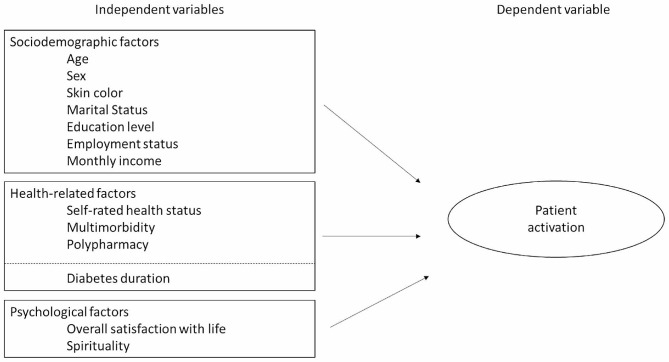
Background: The presence of chronic conditions such as type 2 diabetes mellitus (T2DM) requires behavioral lifestyle changes mediated by individuals’ motivation for change and adherence to treatment. This study aims to explore activation levels in individuals with T2DM treated in primary care facilities and to identify the association between demographic, clinical, psychosocial factors, and patient activation amongst populations in the Brazilian state of Amazonas. Methods: SAPPA is a cross-sectional study conducted in Amazonas, approved by the Universidade Federal do Amazona’s IRB in Brazil. Individuals with T2DM were evaluated in their homes (n = 4,318,325). The variables were sex, age, skin color, education level; health-related variables such as body mass index, nutritional behavior, and frequency of physical activity. Measures related to patient self-management behaviors over the past 6 months (Patient Activation Measure – PAM-13) were included in the survey. Descriptive and frequency data are presented as mean (standard deviation (SD)) or numeric percentage). Statistical testing was performed using IBM SPSS V.26, and a p -value of < 0.050 showed significance. Activation levels were dichotomized into low activation (Levels 1 and 2) and high activation (Levels 3 and 4). A multivariate linear model assessed the association between the PAM-13 score and the following variables: age, sex, BMI, skin color, number of comorbidities, burden of symptoms, and number of medications. Results: Logistic regression analyses indicated a statistically significant association between sex, age, education, self-rated health, and general satisfaction with life. men were 43% more likely to score lower levels ( p < 0.001). The results also indicated that advanced age had lower PAM levels ( p < 0.001). Participants with fewer years of education were 44% more likely to have lower levels of PAM ( p = 0.03). Worse self-rated health ( p < 0.001) and lower general life satisfaction ( p = 0.014) were associated with lower PAM levels. Conclusions: Low patient activation was associated with worse sociodemographic, health, and psychological conditions in the Amazon population. The low level of patient activation observed in this sample highlights an important impediment to diabetes disease management/self-management in disadvantaged populations.
Overview
The claims and statistics of this paper haven’t been checked yet.
Free: it reads the open-access text and checks the first 5 claims that cite a source we can check. Create a free account to check every claim.
Integrity signals
Registry
Cites
Statistics
Figures
Verification
Claims the paper makes
The claims and statistics of this paper haven’t been checked yet.
Free: it reads the open-access text and checks the first 5 claims that cite a source we can check. Create a free account to check every claim.
Claims other papers make about this one
Each is checked against this paper’s own text: does it say what the citing paper says it does?
The cited source says what the claim attributes to it.
In the citing paper
“A previous study showed that the Amazonian population with type 2 diabetes mellitus shows low motivation for behavioral change, which impacts disease management 49 .”
From Healthy eating among people with type 2 diabetes in the Brazilian Amazon: a qualitative study in primary health care (2026) · cites this paper as [49]
Self-check
Percentages, sums and reported differences re-computed from the paper’s own numbers.
The self-check needs the paper’s full text.
Citations
Cites
Hibbard, J. H., Stockard, J., Mahoney, E. R., & Tusler, M. (2004) · Health Services Research · doi:10.1111/j.1475-6773.2004.00269.x · Cited by 2,748 · cited 2×
“Patient activation refers to one’s internal readiness and capabilities to undertake health-promoting actions [9].”
InfluentialSocial determinants of health and diabetes: A scientific review
Hill-Briggs, F., Adler, N. E., Berkowitz, S. A., Chin, M. H., Gary-Webb, T. L., Navas-Acien, A., Thornton, P. L., & Haire-Joshu, D. (2021) · Diabetes Care · doi:10.2337/dci20-0053 · Cited by 1,732 · cited 1×
“Income, education, and occupation show a graded association with diabetes prevalence and complications across all levels of socioeconomic factors [16].”
Do increases in patient activation result in improved self-management behaviors?
Hibbard, J. H., Mahoney, E. R., Stock, R., & Tusler, M. (2007) · Health Services Research · doi:10.1111/j.1475-6773.2006.00669.x · Cited by 906 · cited 1×
“The Patient Activation Measure– 13 (PAM-13) is a 13-item measure that assesses self-efficacy, behavior, and knowledge [20].”
Type 2 diabetes and quality of life
Trikkalinou, A., Papazafiropoulou, A. K., & Melidonis, A. (2017) · World Journal of Diabetes · doi:10.4239/wjd.v8.i4.120 · Cited by 597 · cited 1×
“Our findings also suggested that patients with a lower health status show significantly lower patient activation, consistent with previous studies [8, 35–37].”
Update on Health Literacy and Diabetes
Bailey, S. C., Brega, A. G., Crutchfield, T. M., Elasy, T., Herr, H., Kaphingst, K., Karter, A. J., Moreland-Russell, S., Osborn, C. Y., Pignone, M., et al. (2014) · The Diabetes Educator · doi:10.1177/0145721714540220 · Cited by 296 · cited 1×
“This capacity is critical for optimal medication adherence [34].”
Fatores associados à incapacidade funcional dos idosos no Brasil: análise multinível
Alves, L. C., Leite, I. D. C., & Machado, C. J. (2010) · Revista de Saúde Pública · doi:10.1590/s0034-89102010005000009 · Cited by 214
Skill Set or Mind Set? Associations between Health Literacy, Patient Activation and Health
Smith, S. G., Curtis, L. M., Wardle, J., von Wagner, C., & Wolf, M. S. (2013) · PLoS ONE · doi:10.1371/journal.pone.0074373 · Cited by 195 · cited 1×
“Our findings also suggested that patients with a lower health status show significantly lower patient activation, consistent with previous studies [8, 35–37].”
Measuring Health Literacy: A Pilot Study of a New Skills-Based Instrument
McCormack, L., Bann, C., Squiers, L., Berkman, N. D., Squire, C., Schillinger, D., Ohene-Frempong, J., & Hibbard, J. (2010) · Journal of Health Communication · doi:10.1080/10810730.2010.499987 · Cited by 184 · cited 1×
“Health literacy is described as an individual’s ability to obtain, navigate, and understand the basic health information necessary to make an appropriate health-related decision [33].”
Health Status and Clinical Practice: When Will They Meet?
Rumsfeld, J. S. (2002) · Circulation · doi:10.1161/01.cir.0000020805.31531.48 · Cited by 182 · cited 2×
“Self-rated health is the factor that is most strongly related to the functional disability of the elderly in Brazil [38].”
Social Disparities in Health Literacy in the United States
Fleary, S. A., & Ettienne, R. (2019) · HLRP Health Literacy Research and Practice · doi:10.3928/24748307-20190131-01 · Cited by 169 · cited 1×
“Income and education level are the highest contributors to overall disparities in health literacy [32].”
Mensuração da espiritualidade/religiosidade em saúde no Brasil: uma revisão sistemática
Forti, S., Serbena, C. A., & Scaduto, A. A. (2020) · Ciência & Saúde Coletiva · doi:10.1590/1413-81232020254.21672018 · Cited by 145
Begum, N., Donald, M., Ozolins, I., & Dower, J. (2011) · Diabetes Research and Clinical Practice · doi:10.1016/j.diabres.2011.05.031 · Cited by 135 · cited 1×
“Our findings corroborate previous studies from a variety of settings and populations including older adults [29], vascular diseases [30], and DM [8, 31] suggesting that individuals with higher education levels and higher income have/experience higher activation.”
Hendriks, M. C. P., & Rademakers, J. J. D. J. M. (2014) · BMC Health Services Research · doi:10.1186/1472-6963-14-393 · Cited by 122 · cited 1×
“Patient activation can be affected by employment status [11], age, health status [11–13], and education level [14].”
Lubetkin, E. I., Lu, W.-H., & Gold, M. R. (2010) · Journal of Health Care for the Poor and Underserved · doi:10.1353/hpu.0.0350 · Cited by 99 · cited 3×
“Next comes the hard work of building effective interventions that support and empower patients [25].”
Su, D., Michaud, T. L., Estabrooks, P., Schwab, R. J., Eiland, L. A., Hansen, G., DeVany, M., Zhang, D., Li, Y., Pagán, J. A., et al. (2019) · Telemedicine and e-Health · doi:10.1089/tmj.2018.0205 · Cited by 97
Prevalência de diabetes autorreferido no Brasil: Resultados da Pesquisa Nacional de Saúde 2013
Iser, B. P. M., Stopa, S. R., Chueiri, P. S., Szwarcwald, C. L., Malta, D. C., Monteiro, H. O. D. C., Duncan, B. B., & Schmidt, M. I. (2015) · Epidemiologia e Serviços de Saúde · doi:10.5123/s1679-49742015000200013 · Cited by 90
Arifin, B., Idrus, L. R., van Asselt, A. D. I., Purba, F. D., Perwitasari, D. A., Thobari, J. A., Cao, Q., Krabbe, P. F. M., & Postma, M. J. (2019) · Quality of Life Research · doi:10.1007/s11136-019-02105-z · Cited by 90
Silva-Tinoco, R., Cuatecontzi-Xochitiotzi, T., de la Torre-Saldaña, V., León-García, E., Serna-Alvarado, J., Orea‐Tejeda, A., Castillo‐Martínez, L., Gay, J. G., de León, D. F. C., & Prada, D. (2020) · BMC Endocrine Disorders · doi:10.1186/s12902-020-00604-6 · Cited by 90 · cited 1×
“Furthermore, socioeconomic and educational gradients influence diabetes knowledge among primary care patients with T2DM [28].”
Prevalence of diabetes in Brazil over time: a systematic review with meta-analysis
Telo, G. H., Cureau, F. V., de Souza, M. S., Andrade, T. S., Copês, F., & Schaan, B. D. (2016) · Diabetology & Metabolic Syndrome · doi:10.1186/s13098-016-0181-1 · Cited by 81 · cited 1×
“As one of the most prevalent non-chronic diseases, T2DM affects 6% of the adult population [2], and it has also been observed as making a progressive increase in Brazilian adults over time [3].”
Walker, R. J., Smalls, B. L., & Egede, L. E. (2015) · Diabetes Research and Clinical Practice · doi:10.1016/j.diabres.2015.09.007 · Cited by 70 · cited 1×
“Socioeconomic factors are a multidimensional construct that includes educational, economic, and occupational status [27].”
Tusa, N., Kautiainen, H., Elfving, P., Sinikallio, S., & Mäntyselkä, P. T. (2020) · BMC Family Practice · doi:10.1186/s12875-020-01301-y · Cited by 66 · cited 1×
“Studies from different countries have shown percentages somewhat different with fewer patients demonstrating low activation and more patients showing high PAM-13 levels, such as Finland [24], the Netherlands [8], and the USA [25, 26].”
Zimbudzi, E., Lo, C., Ranasinha, S., Fulcher, G. R., Jan, S., Kerr, P. G., Polkinghorne, K. R., Russell, G. M., Walker, R. G., & Zoungas, S. (2017) · BMJ Open · doi:10.1136/bmjopen-2017-017695 · Cited by 64 · cited 1×
“Patient activation can be affected by employment status [11], age, health status [11–13], and education level [14].”
Silva-Tinoco, R., Cuatecontzi-Xochitiotzi, T., de la Torre-Saldaña, V., León-García, E., Serna-Alvarado, J., GUZMAN-OLVERA, E. B., Cabrera, D., Gay, J. G., & Prada, D. (2020) · International Journal for Equity in Health · doi:10.1186/s12939-020-01188-2 · Cited by 51 · cited 1×
“Diabetes care demands changing the role perspective of health care systems, health care professionals, and T2DM patients to improve diabetes-related outcomes [5].”
Hosseinzadeh, H., Verma, I., & Gopaldasani, V. (2020) · Australian Journal of Primary Health · doi:10.1071/py19204 · Cited by 49 · cited 1×
“Higher patient activation levels significantly improve T2DM self-management [10].”
Development and validation of the Intrinsic Religiousness Inventory (IRI)
Taunay, T. C. D., Cristino, E. D., Machado, M. O., Rola, F. H., Lima, J. W. O., Macêdo, D. S., Gondim, F. D. A. A., Moreira‐Almeida, A., & Carvalho, A. F. (2012) · Brazilian Journal of Psychiatry · doi:10.1590/s1516-44462012000100014 · Cited by 48 · cited 1×
“Intrinsic Religiousness Inventory (IRI) was used to measure spirituality adapted for Brazilian populations [22].”
van Vugt, H. A., Boels, A. M., de Weerdt, I., de Koning, E. J. P., & Rutten, G. E. H. M. (2018) · Patient Preference and Adherence · doi:10.2147/ppa.s188391 · Cited by 48 · cited 5×
“Studies from different countries have shown percentages somewhat different with fewer patients demonstrating low activation and more patients showing high PAM-13 levels, such as Finland [24], the Netherlands [8], and the USA [25, 26].”
InfluentialSari, Y., Isworo, A., Upoyo, A. S., Taufik, A., Setiyani, R., Swasti, K. G., Haryanto, H., Yusuf, S., Nasruddin, N., & Kamaluddin, R. (2021) · Health and Quality of Life Outcomes · doi:10.1186/s12955-021-01756-2 · Cited by 48 · cited 1×
“Therefore, an assessment of the self-rated health of patients with DM is important because it can help monitor treat-ment guidelines to avoid serious consequences [40].”
Iser, B. P. M., Malta, D. C., Duncan, B. B., de Moura, L., Vigo, Á., & Schmidt, M. I. (2014) · PLoS ONE · doi:10.1371/journal.pone.0108044 · Cited by 46
Golubinski, V., Oppel, E., & Schreyögg, J. (2020) · Patient Education and Counseling · doi:10.1016/j.pec.2020.05.005 · Cited by 46
Fatores associados à incapacidade funcional dos idosos no Brasil: análise multinível
Alves, L. C., Leite, I. D. C., & Machado, C. J. (2010) · Redalyc (Universidad Autónoma del Estado de México) · Cited by 44
Chubak, J., Anderson, M. L., Saunders, K. W., Hubbard, R. A., Tuzzio, L., Liss, D. T., Morales, L. S., & Reid, R. J. (2012) · Journal of the American Geriatrics Society · doi:10.1111/j.1532-5415.2012.04008.x · Cited by 41 · cited 1×
“Older age and worse health reports tend to be factors that contribute to the decline in patient activation over time [41], as found in the present study.”
Validation of the Brazilian Version of the Patient Activation Measure 13
Cunha, C. M., da Cunha, D. C. P. T., Manzato, R. D. O., Nepomuceno, E., da Silva, D., & Dantas, R. A. S. (2019) · Journal of Nursing Measurement · doi:10.1891/1061-3749.27.1.97 · Cited by 24 · cited 1×
“This measurement was adapted and validated for the Brazilian population [21].”
Patient Activation and its Predictors in Hospitalized Older Adults in Singapore
Chan, E., Glass, G. F., Cheong, R. Q., Chin, G. F., & Chng, D. Y. J. (2021) · Geriatric Nursing · doi:10.1016/j.gerinurse.2021.01.006 · Cited by 24 · cited 1×
“Our findings corroborate previous studies from a variety of settings and populations including older adults [29], vascular diseases [30], and DM [8, 31] suggesting that individuals with higher education levels and higher income have/experience higher activation.”
Humphries, M. D., Welch, P., Hasegawa, J. S., & Mell, M. W. (2020) · Annals of Vascular Surgery · doi:10.1016/j.avsg.2020.11.019 · Cited by 19 · cited 1×
“Our findings corroborate previous studies from a variety of settings and populations including older adults [29], vascular diseases [30], and DM [8, 31] suggesting that individuals with higher education levels and higher income have/experience higher activation.”
de Leon, E. B., Campos, H. L. M., Brito, F. A., & Almeida, F. A. (2022) · JMIR Research Protocols · doi:10.2196/37572 · Cited by 15
Self-citationFactors associated with patient activation in a socially deprived population: Evidence from Germany
Golubinski, V., & Wild, E. (2021) · Patient Education and Counseling · doi:10.1016/j.pec.2021.03.039 · Cited by 15 · cited 2×
“Our findings can inform decision-makers and health practitioners about targetting patient activation interventions for such populations [11].”
Bahrom, N. H., Ramli, A. S., Isa, M. R., Abdul-Hamid, H., Badlishah-Sham, S. F., Baharudin, N., & Mohamed-Yassin, M.-S. (2020) · Journal of Primary Care & Community Health · doi:10.1177/2150132720931301 · Cited by 13
PERFIL EPIDEMIOLÓGICO DE PACIENTES PORTADORES DE DIABETES MELLITUS CADASTRADOS NA ATENÇÃO PRIMÁRIA
Mangueira, H. T., da Silva, E. S., Oliveira, C. D. B., Nascimento, M. B. G., Félix, T. G. D. S., de Oliveira, R. R., & Batista, J. L. F. P. (2020) · Revista Enfermagem Atual In Derme · doi:10.31011/reaid-2020-v.94-n.32-art.775 · Cited by 7
Research works printed but not linked: 3
- IDF International Diabetes Federation. IDF Diabetes Atlas 10th edition. 2021. https://diabetesatlas.org/
- Ministério da Saúde. Manual do pé diabético: estratégias para o cuidado da pessoa com doença crônica. Manual do pé diabético: estratégias para o cuidado da pessoa com doença crônica., 2016, p. 62. https://doi.org/ISBN978-85-334-2361-9
- Brasil Planificação Da atenção primária à saúde nos estados Conselho Nac De Secretários De Saúde 2011 23 436
Cited by
Zeidalkilani, J., Milhem, Y. A., Shorafa, R. N., Taha, S., Koni, A. A., Al‐Jabi, S. W., & Zyoud, S. H. (2024) · BMC Nephrology · doi:10.1186/s12882-024-03674-z · Cited by 15
Fareed, N., Asgher, H., Tsilimigras, D. I., Chatzipanagiotou, O. P., Catalano, G., Hartwell, B., Bolton, K., & Pawlik, T. M. (2025) · Journal of Medical Internet Research · doi:10.2196/77995 · Cited by 3
“Patient activation is an evidence-based concept that represents an individual’s confidence, self-management skills, and self-efficacy [32].”
Kronik Hastalığı Olan Bireylerde Hasta Aktifliği ve Hastalığa Uyum
Tuncay, F. Ö., & Yapar, S. N. (2024) · Cumhuriyet Üniversitesi Sağlık Bilimleri Enstitüsü Dergisi · doi:10.51754/cusbed.1465857 · Cited by 2
Fareed, N., Asgher, H., Tsilimigras, D. I., Chatzipanagiotou, O. P., Catalano, G., Hartwell, B., Bolton, K., & Pawlik, T. M. (2025) · medRxiv · doi:10.1101/2025.05.23.25328074 · Cited by 1
“32 Given our emphasis on whole-person health, we chose sample systems and tools that encompass health-related needs: medical needs (e.g., hypertension, diabetes), behavioral needs (e.g., diet, alcohol, and tobacco use), and social needs (e.g., food, transportation) to ensure a holistic and…”
Farias, T. A. D. S., Ueno, T. M. R. L., Monteiro, W. F., Campos, H. L. M., & Leon, E. B. D. (2026) · Cadernos de Saúde Pública · doi:10.1590/0102-311xen175125
Self-citation
Metadata
- Authors
- de Leon, E. B., Campos, H. L. M., Santos, N. B., Brito, F. A., & Almeida, F. A.
- Affiliations
- Universidade Federal do Amazonas (BR)
- Nebraska Medical Center (US)
- ORCID
- Venue
- BMC Health Services Research
- Published
- 2024-02-06
- Volume
- 24
- Issue
- 1
- Pages
- 169-169
- ISSN
- 1472-6963 (ISSN-L)
- PMC
- PMC10848446
- OpenAlex
- W4391579636
- Cited by
- 8
- References
- 39
- Citations by year
- 2026: 4 · 2025: 2 · 2024: 2
- FWCI
- 2.62
- Type
- journal article
- Language
- en
- Open access
- gold
- doi.org
- Licence
- cc-by
- creativecommons.org/licenses/by/4.0 (tdm)
- creativecommons.org/licenses/by/4.0 (vor)
- Locations
- BMC Health Services Research (publishedVersion, cc-by)
- PubMed Central (publishedVersion, cc-by)
- PubMed (publishedVersion)
- DOAJ (DOAJ: Directory of Open Access Journals) (submittedVersion)
- Funders
- Fundação de Amparo à Pesquisa do Estado do Amazonas (Universal 2018)
- Coordenação de Aperfeiçoamento de Pessoal de Nível Superior (001)
- Conselho Nacional de Desenvolvimento Científico e Tecnológico
- Topics
- Health Sciences › Medicine › Endocrinology, Diabetes and Metabolism › Diabetes Management and Education
- Health Sciences › Health Professions › General Health Professions › Health and Wellbeing Research
- Health Sciences › Medicine › Epidemiology › Chronic Disease Management Strategies
- Keywords
- patient activation, type 2 diabetes, Patient Activation Measure, socioeconomic factors, self-management, primary care, life satisfaction, self-rated health, educational attainment, sex differences, health disparities
- MeSH terms
- Brazil, Cross-Sectional Studies, Diabetes Mellitus, Type 2, Humans, Male, Patient Participation, Socioeconomic Factors
About these checks
Registry, retraction, Cites and statistics results are computed, not judged, with one exception: a printed reference that no index lists is read once by a model before it counts as a citation error. Claims are extracted by a model and kept only when their quote appears verbatim in the text; each cited source is then checked, with a model’s help, for whether it says what the claim relies on. Those verdicts can be wrong — read the claim’s quote and the cited source before relying on one.
Statistics and arithmetic are recomputed, not judged.
Confidence bands are shown only for fields calibrated on our annotated test set. None is calibrated yet, so no band is shown.
What counts as a claim ›How we measure confidence ›How we check this ›
Are you an author, or do you see a problem with this page? Request a review
Data sources
Bibliographic data: Semantic Scholar, OpenAlex, Crossref.
Contains information from the Semantic Scholar Academic Graph Datasets, made available under the ODC Attribution License (ODC-BY 1.0).
Semantic Scholar’s data is described in: Kinney, R., et al. (2023). The Semantic Scholar Open Data Platform. arXiv:2301.10140.
