

Parenthood in transition – Somali-born parents’ experiences of and needs for parenting support programmes
Open accessThe DOI matches its Crossref record; 36 of the 36 references it cites were found in a registry or an index.
Abstract
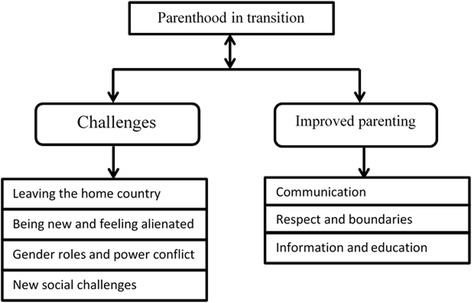
BACKGROUND: Pre- and post-migration trauma due to forced migration may impact negatively on parents' ability to care for their children. Little qualitative work has examined Somali-born refugees' experiences. The aim of this study is to explore Somali-born refugees' experiences and challenges of being parents in Sweden, and the support they need in their parenting. METHODS: A qualitative descriptive study was undertaken. Data were collected from four focus group discussions (FGDs) among 23 Somali-born mothers and fathers living in a county in central Sweden. Qualitative content analysis has been applied. RESULTS: A main category, Parenthood in Transition, emerged as a description of a process of parenthood in transition. Two generic categories were identified: Challenges, and Improved parenting. Challenges emerged from leaving the home country and being new and feeling alienated in the new country. In Improved parenting, an awareness of opportunities in the new country and ways to improve their parenting was described, which includes how to improve their communication and relationship with their children. The parents described a need for information on how to culturally adapt their parenting and obtain support from the authorities. CONCLUSIONS: Parents experienced a process of parenthood in transition. They were looking to the future and for ways to improve their parenting. Schools and social services can overcome barriers that prevent lack of knowledge about the new country's systems related to parenthood. Leaving the home country often means separation from the family and losing the social network. We suggest that staff in schools and social services offer parent training classes for these parents throughout their children's childhood, with benefits for the child and family.
Overview
The claims and statistics of this paper haven’t been checked yet.
Free: it reads the open-access text and checks the first 5 claims that cite a source we can check. Create a free account to check every claim.
Integrity signals
Registry
Cites
Statistics
Figures
Verification
Claims the paper makes
The claims and statistics of this paper haven’t been checked yet.
Free: it reads the open-access text and checks the first 5 claims that cite a source we can check. Create a free account to check every claim.
Claims other papers make about this one
Each is checked against this paper’s own text: does it say what the citing paper says it does?
The source backs part of the claim, not all of it — or backs it for a different population, condition or comparison.
In the citing paper
“Family separation, including parents’ separation from their children, was common across all classes of migrants and was a major source of concern”
From Refugees, asylum-seekers and undocumented migrants and the experience of parenthood: a synthesis of the qualitative literature (2017) · cites this paper as [55]
Experimental — accuracy not yet measuredThe source backs part of the claim, not all of it — or backs it for a different population, condition or comparison.
In the citing paper
“Generally, studies showed that refugees had more rights and fared better (compared to undocumented migrants) because they had better access to resettlement programs and services”
From Refugees, asylum-seekers and undocumented migrants and the experience of parenthood: a synthesis of the qualitative literature (2017) · cites this paper as [55]
Experimental — accuracy not yet measuredThe source backs part of the claim, not all of it — or backs it for a different population, condition or comparison.
In the citing paper
“Resettlement programs (health, education, child care, social programs) when accessible, were described as helpful and allowed families to get ahead”
From Refugees, asylum-seekers and undocumented migrants and the experience of parenthood: a synthesis of the qualitative literature (2017) · cites this paper as [55]
Experimental — accuracy not yet measuredThe source backs part of the claim, not all of it — or backs it for a different population, condition or comparison.
In the citing paper
“Where reunification with family, particularly children, had taken place, parents described the challenges of learning to live with each other again and coping with emotions of having been separated”
From Refugees, asylum-seekers and undocumented migrants and the experience of parenthood: a synthesis of the qualitative literature (2017) · cites this paper as [55]
Experimental — accuracy not yet measuredThe source backs part of the claim, not all of it — or backs it for a different population, condition or comparison.
In the citing paper
“The impact of serial migration and deportation led to families being fragmented and dealing with issues such as single parenthood and reunification”
From Refugees, asylum-seekers and undocumented migrants and the experience of parenthood: a synthesis of the qualitative literature (2017) · cites this paper as [55]
Experimental — accuracy not yet measured
1 more claim about this paper
Create a free account to see every claim other papers make about this one.
Self-check
Percentages, sums and reported differences re-computed from the paper’s own numbers.
The self-check needs the paper’s full text.
Citations
Cites
The qualitative content analysis process
Elo, S., & Kyngäs, H. (2008) · Journal of Advanced Nursing · doi:10.1111/j.1365-2648.2007.04569.x · Cited by 22,617 · cited 3×
“Definitions for each category, sub-category and code were developed and the relationship between them was defined based on their “belonging together” [35], concurrence, antecedents or consequences [36].”
BackgroundMethodWhy We Need a New Welfare State
(2002) · doi:10.1093/0199256438.001.0001 · Cited by 2,486 · cited 1×
“Social welfare includes monthly child benefits for all parents, subsidized daycare, free school and housing support for people with low income [28].”
Background(1995) · Medical Entomology and Zoology · Cited by 2,472
Sadler, G. R., Lee, H.-C., Lim, R. S.-H., & Fullerton, J. (2010) · Nursing & Health Sciences · doi:10.1111/j.1442-2018.2010.00541.x · Cited by 1,257
Bhugra, D. (2004) · Acta Psychiatrica Scandinavica · doi:10.1046/j.0001-690x.2003.00246.x · Cited by 1,196 · cited 2×
“associated with experience of trauma, violence and loss of family members [7–9].”
BackgroundFocus group discussion: a tool for health and medical research.
Wong, L. P. (2008) · PubMed · Cited by 802
Mental Health of Immigrants and Refugees
Pumariega, A. J., Rothe, E., & Pumariega, J. B. (2005) · Community Mental Health Journal · doi:10.1007/s10597-005-6363-1 · Cited by 584 · cited 2×
“associated with experience of trauma, violence and loss of family members [7–9].”
BackgroundSainsbury, D. (2006) · Journal of European Social Policy · doi:10.1177/0958928706065594 · Cited by 347 · cited 1×
“for vulnerable individuals [27].”
Traumatic events, migration characteristics and psychiatric symptoms among Somali refugees
Bhui, K., Abdi, A., Abdi, M., Pereira, S., Dualeh, M., Robertson, D., Sathyamoorthy, G., & Ismail, H. (2003) · Social Psychiatry and Psychiatric Epidemiology · doi:10.1007/s00127-003-0596-5 · Cited by 268
Challenges to parenting in a new culture: Implications for child and family welfare
Lewig, K. A., Arney, F., & Salveron, M. (2009) · Evaluation and Program Planning · doi:10.1016/j.evalprogplan.2009.05.002 · Cited by 207 · cited 3×
“Several international studies both qualitative and quantitative have shown that the daily stressors and adjusting as a parent in a new country will render difficulties generally for immigrant parents in a new culture [19–22].”
BackgroundResult
Research works printed but not linked: 2
- Statistics Sweden S Utrikesfödda efter födelseland, ålder, kön och tid 2012
- Qualitative research review guidelines – RATS [ http://bmjopen.bmj.com/content/suppl/2012/01/12/bmjopen-2011-000138.DC1/BMJ_Open_IMG_Physician_Migration_RATS_Checklist.pdf]. Accessed date (2 January 2015).
Cited by
Items 101–110 of 110
Savosnick, G., & Olsvold, N. (2023) · Fokus på familien · doi:10.18261/fokus.51.3.3
Essere padri e rifugiati. Riflessioni sulle concezioni e le pratiche emergenti di genitorialità
Elia, A., & Fedele, V. (2023) · MONDI MIGRANTI · doi:10.3280/mm2023-003004
The Stressors and Challenges of Single Motherhood: The Lived Experiences of African Immigrant Women
Stennett-Thomas, A.-L. (2024) · doi:10.32920/25193690.v1 · Cited by 1
Betydningen av fellesskap for foreldreskap
Hirsch, S. H., & Kiamanesh, P. (2024) · Fokus på familien · doi:10.18261/fokus.52.2.3
Where There is Hope and Family, There is Home: Foundations of Refugee Families’ Wellbeing in Canada
Isaqzai, S., Akesson, B., & Frensch, K. M. (2025) · Journal of Immigrant & Refugee Studies · doi:10.1080/15562948.2025.2514168
Yöntem, G. A., Çağlayan, İ., Kahraman, P. B., Derman, M. T., SEZER, G. O., Zeteroğlu, E. Ş., ÖZHAN, M. M., & Başal, H. A. (2026) · Family Relations · doi:10.1111/fare.70108
van Leuven, L., Enebrink, P., Lalouni, M., & Forster, M. O. (2026) · Journal of the American Academy of Child & Adolescent Psychiatry · doi:10.1016/j.jaac.2026.06.018
MacInnes, H., Tryggvason, N., Åberg, L., & Bolin, A. (2026) · European Journal of Social Work · doi:10.1080/13691457.2026.2712636
“As, for instance, Osman et al.’s (2016, 2017) research has demonstrated, parenting programmes need to be customised to suit the specific requirements of participants.”
Allport, T., & Osman, F. (2026) · Global Health Action · doi:10.1080/16549716.2026.2732764
“This therefore includes what they have in their ‘backpack’ (their experiences before, during and since migration), their love for their children, the individual and family challenges they are going through, and their desire for connection, for a sense of village in their new context [2,9].”
Self-citationDefining “Good Enough” Parenting
Tembo, M. J., & Studsrød, I. (2026) · Springer eBooks · doi:10.1007/978-3-032-35709-0_87
Metadata
- Authors
- Osman, F., Klingberg-Allvin, M., Flacking, R., & Schön, U.-K.
- Affiliations
- Dalarna University (SE)
- Karolinska Institutet (SE)
- Corresponding author
- Osman, Fatumo
- Venue
- BMC International Health and Human Rights
- Published
- 2016-02-16
- Volume
- 16
- Issue
- 1
- Pages
- 7-7
- ISSN
- 1472-698X (ISSN-L)
- PMC
- PMC4754847
- OpenAlex
- W2287581980
- Cited by
- 112
- References
- 36
- Citations by year
- 2026: 7 · 2025: 4 · 2024: 8 · 2023: 11 · 2022: 13 · 2021: 11 · 2020: 36 · 2019: 7 · 2018: 4 · 2017: 8 · 2016: 3
- FWCI
- 9.82
- Type
- journal article
- Language
- en
- Open access
- gold
- doi.org
- Licence
- Locations
- BMC International Health and Human Rights (publishedVersion, cc-by)
- PubMed Central (publishedVersion, cc-by)
- PubMed (publishedVersion)
- Dalarna University College Electronic Archive (submittedVersion, other-oa)
- Funders
- Public Health Agency
- Folkhälsomyndigheten
- Topics
- Social Sciences › Psychology › Clinical Psychology › Migration, Health and Trauma
- Social Sciences › Education › Education and experiences of immigrants and refugees
- Social Sciences › Sociology and Political Science › Migration, Refugees, and Integration
- Keywords
- parenthood, forced migration, refugee parents, parenting challenges, parent-child communication, social networks, family separation, parent training, social services, schools, Sweden
- MeSH terms
- Armed Conflicts, Adult, Child, Child, Preschool, Fathers, Female, Humans, Male, Mental Health, Middle Aged, Mothers, Refugees, Social Support, Somalia, Sweden, Parenting, Focus Groups, Qualitative Research
About these checks
Registry, retraction, Cites and statistics results are computed, not judged, with one exception: a printed reference that no index lists is read once by a model before it counts as a citation error. Claims are extracted by a model and kept only when their quote appears verbatim in the text; each cited source is then checked, with a model’s help, for whether it says what the claim relies on. Those verdicts can be wrong — read the claim’s quote and the cited source before relying on one.
Statistics and arithmetic are recomputed, not judged.
Confidence bands are shown only for fields calibrated on our annotated test set. None is calibrated yet, so no band is shown.
What counts as a claim ›How we measure confidence ›How we check this ›
Are you an author, or do you see a problem with this page? Request a review
Data sources
Bibliographic data: Semantic Scholar, OpenAlex, Crossref.
Contains information from the Semantic Scholar Academic Graph Datasets, made available under the ODC Attribution License (ODC-BY 1.0).
Semantic Scholar’s data is described in: Kinney, R., et al. (2023). The Semantic Scholar Open Data Platform. arXiv:2301.10140.
