

The DOI matches its Crossref record; 27 of the 27 references it cites were found in a registry or an index.
Findings from the SASA! Study: a cluster randomized controlled trial to assess the impact of a community mobilization intervention to prevent violence against women and reduce HIV risk in Kampala, Uganda
Open accessAbstract
BACKGROUND: Intimate partner violence (IPV) and HIV are important and interconnected public health concerns. While it is recognized that they share common social drivers, there is limited evidence surrounding the potential of community interventions to reduce violence and HIV risk at the community level. The SASA! study assessed the community-level impact of SASA!, a community mobilization intervention to prevent violence and reduce HIV-risk behaviors. METHODS: From 2007 to 2012 a pair-matched cluster randomized controlled trial (CRT) was conducted in eight communities (four intervention and four control) in Kampala, Uganda. Cross-sectional surveys of a random sample of community members, 18- to 49-years old, were undertaken at baseline (n = 1,583) and four years post intervention implementation (n = 2,532). Six violence and HIV-related primary outcomes were defined a priori. An adjusted cluster-level intention-to-treat analysis compared outcomes in intervention and control communities at follow-up. RESULTS: The intervention was associated with significantly lower social acceptance of IPV among women (adjusted risk ratio 0.54, 95% confidence interval (CI) 0.38 to 0.79) and lower acceptance among men (0.13, 95% CI 0.01 to 1.15); significantly greater acceptance that a woman can refuse sex among women (1.28, 95% CI 1.07 to 1.52) and men (1.31, 95% CI 1.00 to 1.70); 52% lower past year experience of physical IPV among women (0.48, 95% CI 0.16 to 1.39); and lower levels of past year experience of sexual IPV (0.76, 95% CI 0.33 to 1.72). Women experiencing violence in intervention communities were more likely to receive supportive community responses. Reported past year sexual concurrency by men was significantly lower in intervention compared to control communities (0.57, 95% CI 0.36 to 0.91). CONCLUSIONS: This is the first CRT in sub-Saharan Africa to assess the community impact of a mobilization program on the social acceptability of IPV, the past year prevalence of IPV and levels of sexual concurrency. SASA! achieved important community impacts, and is now being delivered in control communities and replicated in 15 countries. TRIAL REGISTRATION: ClinicalTrials.gov #NCT00790959.
Overview
The claims and statistics of this paper haven’t been checked yet.
Run the check — free, no account needed. It reads the open-access text and checks the sources it cites.
Integrity signals
Registry
Cites
Statistics
Figures
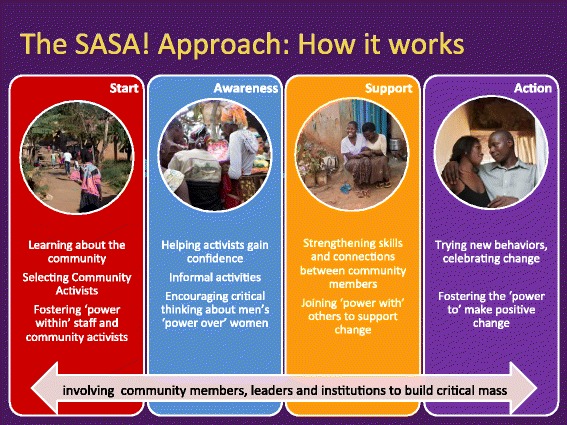
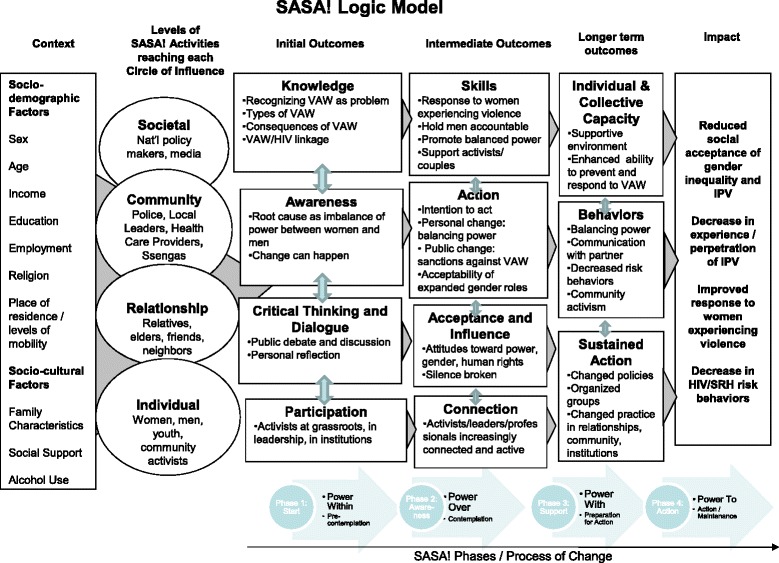
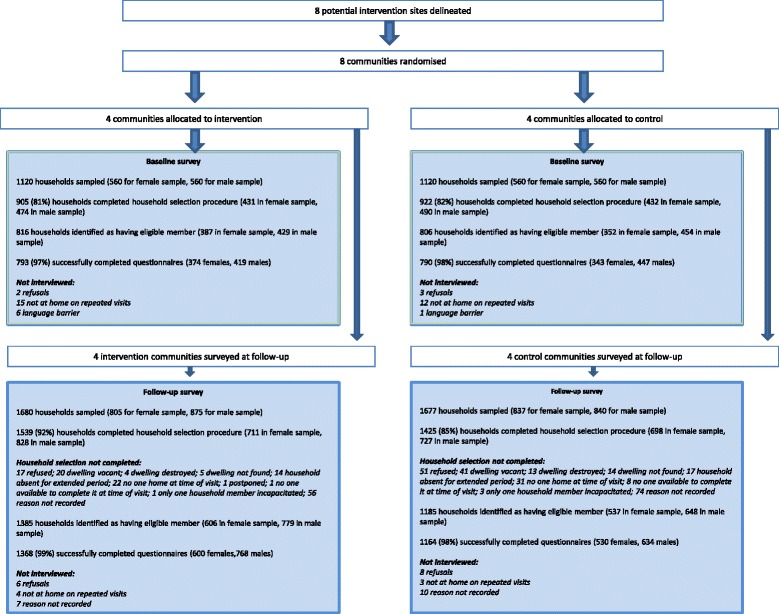
Verification
Claims the paper makes
The claims and statistics of this paper haven’t been checked yet.
Run the check — free, no account needed. It reads the open-access text and checks the sources it cites.
Claims other papers make about this one
Each is checked against this paper’s own text: does it say what the citing paper says it does?
The cited source says what the claim attributes to it.
In the citing paper
“At the end of the intervention, there were reported lower rates of IPV among the intervention community.”
From A systematic review of intimate partner violence interventions focused on improving social support and/ mental health outcomes of survivors (2020) · cites this paper as [34]
The cited source says what the claim attributes to it.
In the citing paper
“9 (3 RCTs, 3 pre-post evaluations, 3 qualitative research) of the studies we reviewed consisted of interventions described as being community-based [34–42].”
From A systematic review of intimate partner violence interventions focused on improving social support and/ mental health outcomes of survivors (2020) · cites this paper as [34]
The cited source says what the claim attributes to it.
In the citing paper
“However, it must be noted that only few of the advocate-based studies and 1 of the community-focused interventions reported an impact on IPV, with good level of evidence [15, 20–23, 34], similar to what has been found in other reviews of advocate-based interventions on intimate partner violence [45].”
From A systematic review of intimate partner violence interventions focused on improving social support and/ mental health outcomes of survivors (2020) · cites this paper as [34]
Self-check
Percentages, sums and reported differences re-computed from the paper’s own numbers.
The self-check needs the paper’s full text.
Citations
Cites
The world report on violence and health
Krug, E. G., Mercy, J. A., Dahlberg, L. L., & Zwi, A. B. (2002) · The Lancet · doi:10.1016/s0140-6736(02)11133-0 · Cited by 9,110
World Report on Violence and Health.
Hoffman, J. S. (2003) · Injury Prevention · doi:10.1136/ip.9.1.93 · Cited by 1,746
García‐Moreno, C., Jansen, H. A. F. M., Ellsberg, M. C., Heise, L., & Watts, C. H. (2005) · Cited by 1,730
The Global Prevalence of Intimate Partner Violence Against Women
Devries, K. M., Mak, J., Garcia‐Moreno, C., Petzold, M., Child, J. C., Falder, G., Lim, S. S., Bacchus, L., Engell, R. E., Rosenfeld, L. C., et al. (2013) · Science · doi:10.1126/science.1240937 · Cited by 1,485
Grosskurth, H., Todd, J., Mwijarubi, E., Mayaud, P., Nicoll, A., ka-Gina, G., Newell, J., Grosskurth, H., Todd, J., Mayaud, P., et al. (1995) · The Lancet · doi:10.1016/s0140-6736(95)91380-7 · Cited by 1,387
Dunkle, K., Jewkes, R. K., Brown, H., Gray, G., McIntryre, J. A., & Harlow, S. D. (2004) · The Lancet · doi:10.1016/s0140-6736(04)16098-4 · Cited by 1,339
Devries, K. M., Mak, J. Y., Bacchus, L. J., Child, J. C., Falder, G., Petzold, M., Astbury, J., & Watts, C. H. (2013) · PLoS Medicine · doi:10.1371/journal.pmed.1001439 · Cited by 1,258
Self-citationJewkes, R. K., Dunkle, K., Nduna, M., & Shai, N. (2010) · The Lancet · doi:10.1016/s0140-6736(10)60548-x · Cited by 1,215
The global prevalence of intimate partner homicide: a systematic review
Stöckl, H., Devries, K., Rotstein, A., Abrahams, N., Campbell, J., Watts, C., & Moreno, C. G. (2013) · The Lancet · doi:10.1016/s0140-6736(13)61030-2 · Cited by 955
Pronyk, P., Hargreaves, J., Kim, J. C., Morison, L. A., Godfrey Phetla, B., Watts, C., Busza, J. R., & Porter, J. D. (2006) · The Lancet · doi:10.1016/s0140-6736(06)69744-4 · Cited by 913
Simple sample size calculation for cluster-randomized trials
Hayes, R., & Bennett, S. (1999) · International Journal of Epidemiology · doi:10.1093/ije/28.2.319 · Cited by 824
Violence a global public health problem
Dahlberg, L. L., & Krug, E. G. (2006) · Ciência & Saúde Coletiva · doi:10.1590/s1413-81232006000200007 · Cited by 757
Garcia‐Moreno, C. (2001) · DigitalGeorgetown (Georgetown University Library) · Cited by 751
Jewkes, R. K., Nduna, M., Levin, J. B., Jama, N., Dunkle, K., Puren, A. J., & Duvvury, N. (2008) · BMJ · doi:10.1136/bmj.a506 · Cited by 747
Habicht, J. (1999) · International Journal of Epidemiology · doi:10.1093/ije/28.1.10 · Cited by 729
What Works to Prevent Partner Violence? An Evidence Overview.
Heise, L. (2011) · LSHTM Research Online (London School of Hygiene and Tropical Medicine) · Cited by 422
Maman, S., Mbwambo, J. K. K., Hogan, N. M., Kilonzo, G. P., & Sweat, M. D. (2001) · AIDS Care · doi:10.1080/09540120120063223 · Cited by 322
Kamali, A., QUIGLEY, M. A., Nakiyingi, J., Kinsman, J., Kengeya‐Kayondo, J. F., Gopal, R., Ojwiya, A., Hughes, P. J., Carpenter, L., & WHITWORTH, J. A. G. (2003) · The Lancet · doi:10.1016/s0140-6736(03)12598-6 · Cited by 318
Pronyk, P., Kim, J. C., Abramsky, T., Godfrey Phetla, B., Hargreaves, J., Morison, L. A., Watts, C., Busza, J. R., & Porter, J. D. (2008) · AIDS · doi:10.1097/qad.0b013e328307a040 · Cited by 271
Self-citationGupta, J., Falb, K., Lehmann, H., Kpebo, D. O., Xuan, Z., Hossain, M., Zimmerman, C., Watts, C. H., & Annan, J. R. (2013) · BMC International Health and Human Rights · doi:10.1186/1472-698x-13-46 · Cited by 213
Intimate partner violence is associated with incident HIV infection in women in Uganda
Kouyoumdjian, F. G., Calzavara, L., Bondy, S. J., O'Campo, P. J., Serwadda, D., Nalugoda, F. K., Kagaayi, J., Kigozi, G., Wawer, M. J., & Gray, R. H. (2013) · AIDS · doi:10.1097/qad.0b013e32835fd851 · Cited by 190
Zablotska, I. B., Gray, R. H., Koenig, M. A., Serwadda, D., Nalugoda, F., Kigozi, G., Sewankambo, N., Lutalo, T., Mangen, F. W., & Wawer, M. (2009) · AIDS and Behavior · doi:10.1007/s10461-007-9333-5 · Cited by 181
Diehr, P. H., Martin, D. C., Koepsell, T. D., & Cheadle, A. D. (1995) · Statistics in Medicine · doi:10.1002/sim.4780141309 · Cited by 133
Hossain, M., Zimmerman, C., Kiss, L., Abramsky, T., Kone, D., Bakayoko-Topolska, M., Annan, J., Lehmann, H., & Watts, C. (2014) · BMC Public Health · doi:10.1186/1471-2458-14-339 · Cited by 129
Self-citationAbramsky, T., Devries, K. M., Kiss, L., Francisco, L. V., Nakuti, J., Musuya, T., Kyegombe, N., Starmann, E., Kaye, D. K., Michau, L., et al. (2012) · Trials · doi:10.1186/1745-6215-13-96 · Cited by 109
Self-citationShafer, L. A., Biraro, S., Nakiyingi‐Miiro, J., Kamali, A., Ssematimba, D., Ouma, J., Ojwiya, A., Hughes, P. J., der Paal, L. V., Whitworth, J. A. G., et al. (2008) · AIDS · doi:10.1097/qad.0b013e32830a7502 · Cited by 105
Biraro, S., Shafer, L. A., Kleinschmidt, I., Wolff, B., Karabalinde, A., Nalwoga, A. P., Musinguzi, J., Kirungi, W. L., Opio, A. A., Whitworth, J. A. G., et al. (2009) · Sexually Transmitted Infections · doi:10.1136/sti.2008.033928 · Cited by 48
Research works printed but not linked: 3
- Michau L: The SASA! Activist Kit for Preventing Violence against Women and HIV. 2008, Raising Voices, Kampala
- Garcia-Moreno C, Jansen HA, Ellsberg M, Heise L, Watts CH: WHO Multi-Country Study on Womens Health and Domestic Violence against Women. 2005, World Health Organization, Geneva
- Donner A, Klar N: Design and Analysis of Cluster Randomised Trials in Health Research. 2000, Arnold, London
Cited by
Sorted by citations
Starrs, A. M., Ezeh, A. C., Barker, G., Basu, A., Bertrand, J. T., Blum, R., Coll-Seck, A. M., Grover, A., Laski, L., Roa, M., et al. (2018) · The Lancet · doi:10.1016/s0140-6736(18)30293-9 · Cited by 1,598
Global Prevalence of Past-year Violence Against Children: A Systematic Review and Minimum Estimates
Hillis, S., Mercy, J., Amobi, A., & Kress, H. (2016) · Pediatrics · doi:10.1542/peds.2015-4079 · Cited by 1,477
Challenges and opportunities in global mental health: a research-to-practice perspective
Wainberg, M. L., Scorza, P., Shultz, J. M., Helpman, L., Mootz, J. J., Johnson, K. A., Neria, Y., Bradford, J.-M. E., Oquendo, M. A., & Arbuckle, M. R. (2017) · Current Psychiatry Reports · doi:10.1007/s11920-017-0780-z · Cited by 875
Jewkes, R., Flood, M., & Lang, J. (2015) · The Lancet · doi:10.1016/s0140-6736(14)61683-4 · Cited by 905
Prevention of violence against women and girls: what does the evidence say?
Ellsberg, M., Arango, D., Morton, M., Gennari, F., Kiplesund, S., Contreras, M., & Watts, C. (2015) · The Lancet · doi:10.1016/s0140-6736(14)61703-7 · Cited by 761
Metadata
- Authors
- Abramsky, T., Devries, K., Kiss, L., Nakuti, J., Kyegombe, N., Starmann, E., Cundill, B., Francisco, L., Kaye, D., Musuya, T., Michau, L., & Watts, C.
- Affiliations
- London School of Hygiene & Tropical Medicine (GB)
- Raising Voices (UG)
- Johns Hopkins University (US)
- Makerere University (UG)
- Center for Domestic Violence Prevention (UG)
- Corresponding author
- Abramsky, Tanya
- ORCID
- Venue
- BMC Medicine
- Published
- 2014-07-31
- Volume
- 12
- Issue
- 1
- Pages
- 122-122
- ISSN
- 1741-7015 (ISSN-L)
- PMC
- PMC4243194
- OpenAlex
- W2132488181
- Cited by
- 507
- References
- 27
- Citations by year
- 2026: 39 · 2025: 39 · 2024: 32 · 2023: 41 · 2022: 46 · 2021: 49 · 2020: 48 · 2019: 54 · 2018: 44 · 2017: 30 · 2016: 42 · 2015: 25 · 2014: 17
- FWCI
- 48.37
- Type
- journal article
- Language
- en
- Open access
- gold
- doi.org
- Locations
- BMC Medicine (publishedVersion, cc-by)
- Europe PMC (PubMed Central) (publishedVersion, cc-by)
- PubMed Central (publishedVersion, cc-by)
- PubMed (publishedVersion)
- LSHTM Research Online (London School of Hygiene and Tropical Medicine) (acceptedVersion)
- Greater South Information System
- Funders
- Irish Aid
- London School of Hygiene and Tropical Medicine
- Jerry M. Lewis, M.D. Mental Health Research Foundation
- Australian Agency for International Development
- South African Medical Research Council
- Serbian Academy of Sciences and Arts
- Medical Research Council
- Topics
- Social Sciences › Health › Intimate Partner and Family Violence
- Health Sciences › Medicine › Infectious Diseases › HIV/AIDS Research and Interventions
- Health Sciences › Medicine › Epidemiology › HIV, Drug Use, Sexual Risk
- Keywords
- community mobilization, intimate partner violence, violence against women, HIV risk behavior, sexual concurrency, sexual refusal, Kampala, Uganda, sub-Saharan Africa, community-level interventions, HIV prevention, gender norms, sexual and gender-based violence, sexual and reproductive health
- MeSH terms
- Adolescent, Adult, Community Health Services, Cross-Sectional Studies, Female, Humans, Male, Middle Aged, Risk Factors, Spouse Abuse, Uganda, HIV Infections, Cluster Analysis, Treatment Outcome, Community Networks
About these checks
Registry, retraction, Cites and statistics results are computed, not judged, with one exception: a printed reference that no index lists is read once by a model before it counts as a citation error. Claims are extracted by a model and kept only when their quote appears verbatim in the text; each cited source is then checked, with a model’s help, for whether it says what the claim relies on. Those verdicts can be wrong — read the claim’s quote and the cited source before relying on one.
Statistics and arithmetic are recomputed, not judged.
Confidence bands are shown only for fields calibrated on our annotated test set. None is calibrated yet, so no band is shown.
What counts as a claim ›How we measure confidence ›How we check this ›
Are you an author, or do you see a problem with this page? Request a review
