

Vaccines for the prevention of seasonal influenza in patients with diabetes: systematic review and meta-analysis
Open accessThe DOI matches its Crossref record; 68 of the 68 references it cites were found in a registry or an index.
Abstract
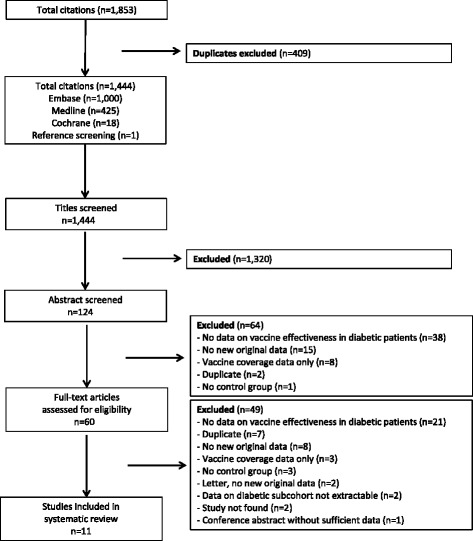
BACKGROUND: Patients with diabetes are at increased risk of severe influenza disease; influenza vaccination for these patients is therefore recommended by the World Health Organization and several National Immunization Technical Advisory Groups. However, no systematic review has evaluated the effects of influenza vaccines for patients with diabetes. METHODS: We conducted a systematic review and meta-analysis by searching Medline, Embase, Cochrane Central Register of Controlled Trials, and ClinicalTrials.gov from inception until November 2014. We included all types of studies reporting on the efficacy, effectiveness, and/or safety of influenza vaccination in patients with type 1 and type 2 diabetes of all ages. We used the Newcastle-Ottawa scale to assess risk of bias in observational studies. Residual confounding was addressed by comparing estimates of vaccine effectiveness (VE) during influenza seasons to those obtained during off-seasons. Quality of the evidence for each outcome was assessed using the GRADE methodology. RESULTS: Following review of 1,444 articles, 11 observational studies with a total of 170,924 participants were included. In diabetic patients of working-age (18-64 years), influenza vaccination prevented all-cause hospitalization with a pooled VE of 58% (95% CI, 6-81%) and hospitalization due to influenza or pneumonia (VE 43%; 95% CI, 28-54%), whereas no effects on all-cause mortality and influenza-like illness (ILI) were observed. In the elderly (65+), influenza vaccination prevented all-cause mortality (VE 38%; 95% CI, 32-43%), all-cause hospitalization (VE 23%; 95% CI, 1-40%), hospitalization due to influenza or pneumonia (VE 45%; 95% CI, 34-53%), and ILI (VE 13%; 95% CI, 10-16%). However, significant off-season estimates for several outcomes indicated residual confounding, particularly in elderly patients. Quality of the evidence was low to very low for all outcomes. Laboratory-confirmed influenza infections were not reported. CONCLUSIONS: Due to strong residual confounding in most of the identified studies, the available evidence is insufficient to determine the magnitude of benefit that diabetic people derive from seasonal influenza vaccination. Adequately powered randomized controlled trials or quasi-experimental studies using laboratory-confirmed influenza-specific outcomes are urgently needed.
Overview
The claims and statistics of this paper haven’t been checked yet.
Free: it reads the open-access text and checks the first 5 claims that cite a source we can check. Create a free account to check every claim.
Integrity signals
Registry
Cites
Statistics
Figures
Verification
Claims the paper makes
The claims and statistics of this paper haven’t been checked yet.
Free: it reads the open-access text and checks the first 5 claims that cite a source we can check. Create a free account to check every claim.
Claims other papers make about this one
Each is checked against this paper’s own text: does it say what the citing paper says it does?
The check wasn’t confident either way, so it gives no verdict — never disputed.
In the citing paper
“while exenatide has been shown to cause nodular C-cell lesions without medullary thyroid carcinoma”
From American Association of Clinical Endocrinology Clinical Practice Guideline: Developing a Diabetes Mellitus Comprehensive Care Plan-2022 Update. (2022) · cites this paper as [1809]
Experimental — accuracy not yet measuredThe check wasn’t confident either way, so it gives no verdict — never disputed.
In the citing paper
“An increase in thyroid C-cell hyperplasia, adenomas, and medullary thyroid carcinomas was observed in preclinical rodent studies of liraglutide”
From American Association of Clinical Endocrinology Clinical Practice Guideline: Developing a Diabetes Mellitus Comprehensive Care Plan-2022 Update. (2022) · cites this paper as [1809]
Experimental — accuracy not yet measured
Self-check
Percentages, sums and reported differences re-computed from the paper’s own numbers.
The self-check needs the paper’s full text.
Citations
Cites
Preferred Reporting Items for Systematic Reviews and Meta-Analyses: the PRISMA statement
Moher, D., Liberati, A., Tetzlaff, J., Altman, D. G., & for the PRISMA Group (2009) · BMJ · doi:10.1136/bmj.b2535 · Cited by 83,823
Preferred reporting items for systematic reviews and meta-analyses: the PRISMA Statement.
(2009) · PubMed Central · Cited by 44,859
Preferred reporting items for systematic reviews and meta-analyses: The PRISMA statement
Moher, D., Liberati, A., Tetzlaff, J., Altman, D. G., & the PRISMA Group* (2009) · Annals of Internal Medicine · doi:10.7326/0003-4819-151-4-200908180-00135 · Cited by 37,554
Cochrane Handbook for Systematic Reviews of Interventions: Cochrane Book Series
(2008) · doi:10.1002/9780470712184 · Cited by 25,048
GRADE: an emerging consensus on rating quality of evidence and strength of recommendations
Guyatt, G. H., Oxman, A. D., Vist, G. E., Kunz, R., Falck-Ytter, Y., Alonso-Coello, P., & Schünemann, H. J. (2008) · BMJ · doi:10.1136/bmj.39489.470347.ad · Cited by 23,305 · cited 2×
“Details on the GRADE methodology can be found elsewhere [25-27].”
MethodGrading quality of evidence and strength of recommendations
(2004) · BMJ · doi:10.1136/bmj.328.7454.1490 · Cited by 8,477 · cited 1×
“Details on the GRADE methodology can be found elsewhere [25-27].”
MethodGlobal estimates of diabetes prevalence for 2013 and projections for 2035
Guariguata, L., Whiting, D. R., Hambleton, I., Beagley, J., Linnenkamp, U., & Shaw, J. E. (2014) · Diabetes Research and Clinical Practice · doi:10.1016/j.diabres.2013.11.002 · Cited by 4,642 · cited 1×
“Although a shift towards younger ages has been observed in the manifestation of diabetes in several industrialized countries [40-43], no studies were identified which reported data on influenza VE in diabetic children or adolescents.”
BackgroundDanaei, G., Finucane, M. M., Lu, Y., Singh, G. M., Cowan, M. J., Paciorek, C. J., Lin, J. K., Farzadfar, F., Khang, Y.-H., Stevens, G. A., et al. (2011) · The Lancet · doi:10.1016/s0140-6736(11)60679-x · Cited by 3,568 · cited 1×
“Background Worldwide, more than 347 million people live with diabetes [1].”
BackgroundGRADE guidelines: a new series of articles in the Journal of Clinical Epidemiology
Guyatt, G. H., Oxman, A. D., Schünemann, H. J., Tugwell, P., & Knottnerus, A. (2011) · Journal of Clinical Epidemiology · doi:10.1016/j.jclinepi.2010.09.011 · Cited by 3,094 · cited 1×
“Details on the GRADE methodology can be found elsewhere [25-27].”
MethodDiabetes Mellitus, Fasting Glucose, and Risk of Cause-Specific Death
The Emerging Risk Factors Collaboration (2011) · New England Journal of Medicine · doi:10.1056/nejmoa1008862 · Cited by 2,726 · cited 1×
“An impaired immune response has been hypothesized to be responsible for an increased risk of infection [8-10] as well as infection-related complications in patients with diabetes [11,12].”
BackgroundPatterson, C. C., Dahlquist, G. G., Gyürüs, E., Green, A., & Soltész, G. (2009) · The Lancet · doi:10.1016/s0140-6736(09)60568-7 · Cited by 1,854 · cited 1×
“Although a shift towards younger ages has been observed in the manifestation of diabetes in several industrialized countries [40-43], no studies were identified which reported data on influenza VE in diabetic children or adolescents.”
BackgroundDanaei, G., Finucane, M. M., Lin, J. K., Singh, G. M., Paciorek, C. J., Cowan, M. J., Farzadfar, F., Stevens, G. A., Lim, S. S., Riley, L. M., et al. (2011) · The Lancet · doi:10.1016/s0140-6736(10)62036-3 · Cited by 1,239
Increased Risk of Common Infections in Patients with Type 1 and Type 2 Diabetes Mellitus
Muller, L. M. A. J., Gorter, K. J., Hak, E., Goudzwaard, W. L., Schellevis, F. G., Hoepelman, A. I. M., & Rutten, G. E. H. M. (2005) · Clinical Infectious Diseases · doi:10.1086/431587 · Cited by 1,023 · cited 1×
“An impaired immune response has been hypothesized to be responsible for an increased risk of infection [8-10] as well as infection-related complications in patients with diabetes [11,12].”
BackgroundQuantifying the Risk of Infectious Diseases for People With Diabetes
Shah, B. R., & Hux, J. E. (2003) · Diabetes Care · doi:10.2337/diacare.26.2.510 · Cited by 902 · cited 1×
“An impaired immune response has been hypothesized to be responsible for an increased risk of infection [8-10] as well as infection-related complications in patients with diabetes [11,12].”
BackgroundVaccines for preventing influenza in healthy adults
Jefferson, T., Di Pietrantonj, C., Rivetti, A., Bawazeer, G. A., Al-Ansary, L. A., & Ferroni, E. (2010) · Cochrane Database of Systematic Reviews · doi:10.1002/14651858.cd001269.pub4 · Cited by 896
GRADE guidelines: 13. Preparing Summary of Findings tables and evidence profiles—continuous outcomes
Guyatt, G. H., Thorlund, K., Oxman, A. D., Walter, S. D., Patrick, D., Furukawa, T. A., Johnston, B. C., Karanicolas, P., Akl, E. A., Vist, G., et al. (2013) · Journal of Clinical Epidemiology · doi:10.1016/j.jclinepi.2012.08.001 · Cited by 772 · cited 1×
“The results of the GRADE evidence rating were recorded in GRADE evidence profiles using the GRADEpro software [28].”
MethodVaccines for preventing influenza in the elderly
Demicheli, V., Jefferson, T., Di Pietrantonj, C., Ferroni, E., Thorning, S., Thomas, R. E., & Rivetti, A. (2018) · Cochrane Database of Systematic Reviews · doi:10.1002/14651858.cd004876.pub4 · Cited by 695
Effectiveness of Influenza Vaccine in the Community-Dwelling Elderly
Nichol, K. L., Nordin, J. D., Nelson, D. B., Mullooly, J. P., & Hak, E. (2007) · New England Journal of Medicine · doi:10.1056/nejmoa070844 · Cited by 656 · cited 1×
“In fact, studies among elderly people have found that VE estimates against all-cause deaths were higher than expected given the observed effectiveness against laboratoryconfirmed influenza cases [57,58].”
BackgroundPopulations at risk for severe or complicated influenza illness: systematic review and meta-analysis
Mertz, D., Kim, T. H., Johnstone, J., Lam, P.-P., Science, M., Kuster, S. P., Fadel, S. A., Tran, D., Fernandez, E., Bhatnagar, N., et al. (2013) · BMJ · doi:10.1136/bmj.f5061 · Cited by 634 · cited 1×
“Since patients with diabetes are at increased risk of medical complications attributable to influenza infections [2], annual vaccination against influenza is recommended for these patients by the World Health Organization (WHO) [3] and several National Immunization Technical Advisory Groups (NITAGs) [4-7].”
BackgroundGrohskopf, L. A., Sokolow, L. Z., Broder, K. R., Olsen, S. J., Karron, R. A., Jernigan, D. B., & Bresee, J. S. (2016) · MMWR. Recommendations and Reports · doi:10.15585/mmwr.rr6505a1 · Cited by 593
Grohskopf, L. A., Shay, D. K., Shimabukuro, T. T., Sokolow, L. Z., Keitel, W. A., Bresee, J., & Cox, N. J. (2013) · PubMed · Cited by 577
Mortality benefits of influenza vaccination in elderly people: an ongoing controversy
Simonsen, L., Taylor, R. J., Viboud, C., Miller, M. A., & Jackson, L. A. (2007) · The Lancet Infectious Diseases · doi:10.1016/s1473-3099(07)70236-0 · Cited by 520 · cited 1×
“It was concluded that selection bias have led observational studies to greatly exaggerate influenza vaccine benefits in this particular age group [55,59].”
BackgroundEvidence of bias in estimates of influenza vaccine effectiveness in seniors
Jackson, L. A., Jackson, M. L., Nelson, J. C., Neuzil, K. M., & Weiss, N. S. (2006) · International Journal of Epidemiology · doi:10.1093/ije/dyi274 · Cited by 493 · cited 2×
“It was concluded that selection bias have led observational studies to greatly exaggerate influenza vaccine benefits in this particular age group [55,59].”
BackgroundVu, T., Farish, S., Jenkins, M., & Kelly, H. (2002) · Vaccine · doi:10.1016/s0264-410x(02)00041-5 · Cited by 376
Qaddafi, M. (1977) · Medical Entomology and Zoology · Cited by 342
Vaccines for preventing influenza in the elderly
Jefferson, T., Di Pietrantonj, C., Al-Ansary, L. A., Ferroni, E., Thorning, S., & Thomas, R. E. (2010) · Cochrane Database of Systematic Reviews · doi:10.1002/14651858.cd004876.pub3 · Cited by 253 · cited 2×
“No additional studies reporting on influenza VE or safety specifically in subgroups of diabetic patients were identified in the Cochrane review on influenza vaccination in the elderly [30].”
BackgroundHak, E., Nordin, J., Wei, F., Mullooly, J., Poblete, S., Strikas, R., & Nichol, K. L. (2002) · Clinical Infectious Diseases · doi:10.1086/341403 · Cited by 218 · cited 5×
“We included six cohort [21,29,31-34] and five case–control [35-39] studies.”
BackgroundMethodResultInfluentialCalvet, H. M., & Yoshikawa, T. T. (2001) · Infectious Disease Clinics of North America · doi:10.1016/s0891-5520(05)70153-7 · Cited by 213 · cited 1×
“An impaired immune response has been hypothesized to be responsible for an increased risk of infection [8-10] as well as infection-related complications in patients with diabetes [11,12].”
BackgroundVaccines for preventing influenza in healthy adults
Demicheli, V., Jefferson, T., Al-Ansary, L. A., Ferroni, E., Rivetti, A., & Di Pietrantonj, C. (2014) · Cochrane Database of Systematic Reviews · doi:10.1002/14651858.cd001269.pub5 · Cited by 195
Effectiveness of influenza vaccine in reducing hospital admissions in people with diabetes
COLQUHOUN, A. J., NICHOLSON, K. G., BOTHA, J. L., & RAYMOND, N. T. (1997) · Epidemiology and Infection · doi:10.1017/s095026889700825x · Cited by 157 · cited 3×
“Colquhoun [36] not matched, 1989 and 1993 UK ≤19–85 years Cases, n = 59 ICD-9 codes, diabetes register 1989, A(H3N2) 114 (37 cases, 77 controls) Controls, n = 55 1993, A(H3N2) and B”
BackgroundMethodImmunological assessment of influenza vaccines and immune correlates of protection
Reber, A., & Katz, J. (2013) · Expert Review of Vaccines · doi:10.1586/erv.13.35 · Cited by 157 · cited 1×
“However, the value of these studies is limited not only because of their small size and contradicting findings, but also because influenza antibody titers do not perfectly correlate with clinical protection [19].”
BackgroundHak, E., Verheij, T. J. M., Grobbee, D. E., Nichol, K. L., & Hoes, A. W. (2002) · Journal of Epidemiology and Community Health · doi:10.1136/jech.56.12.951 · Cited by 138 · cited 1×
“This scenario is referred to as ‘confounding by indication’ [52].”
BackgroundYende, S. P., van der Poll, T., Lee, M., Huang, D. T., Newman, A. B., Kong, L., Kellum, J. A., Harris, T. B., Bauer, D. C., Satterfield, S., et al. (2010) · Thorax · doi:10.1136/thx.2010.136317 · Cited by 128 · cited 1×
“An impaired immune response has been hypothesized to be responsible for an increased risk of infection [8-10] as well as infection-related complications in patients with diabetes [11,12].”
BackgroundLooijmans-Van den Akker, I., Verheij, T. J. M., Buskens, E., Nichol, K. L., Rutten, G. E. H. M., & Hak, E. (2006) · Diabetes Care · doi:10.2337/dc05-2517 · Cited by 114
Incidence of Type 1 Diabetes in Sweden Among Individuals Aged 0–34 Years, 1983–2007
Dahlquist, G. G., Nyström, L., Patterson, C. C., the Swedish Childhood Diabetes Study Group, & the Diabetes Incidence in Sweden Study Group (2011) · Diabetes Care · doi:10.2337/dc11-0056 · Cited by 101
Diepersloot, R. J. A., Bouter, K. P., BEYER, W. E. P., Hoekstra, J. B. L., & Masurel, N. (1987) · Diabetologia · doi:10.1007/bf00292541 · Cited by 91 · cited 1×
“In fact, while some studies found a reduced immune response to vaccination in patients with diabetes [13,14], others did not detect a difference in the humoral response between diabetic patients and healthy controls [15-18].”
BackgroundThe immune response to influenza vaccination in diabetic patients
Pozzilli, P., Gale, E., Visallil, N., Baroni, M. G., Crovari, P., Frighi, V., Cavallo, M. G., & Andreani, D. (1986) · Diabetologia · doi:10.1007/bf00870139 · Cited by 90 · cited 1×
“In fact, while some studies found a reduced immune response to vaccination in patients with diabetes [13,14], others did not detect a difference in the humoral response between diabetic patients and healthy controls [15-18].”
BackgroundEffectiveness of influenza vaccination in elderly diabetic patients: A retrospective cohort study
Wang, I., Lin, C., Chang, Y.-C., Lin, P., Liang, C., Liu, Y., Chang, C., Yen, T., Huang, C., & Sung, F. (2012) · Vaccine · doi:10.1016/j.vaccine.2012.11.017 · Cited by 88 · cited 5×
“We included six cohort [21,29,31-34] and five case–control [35-39] studies.”
BackgroundMethodResultInfluentialKissling, E., Valenciano, M., Falcão, J. M., Larrauri, A., Widgren, K., Pitigoi, D., Oroszi, B., Nunes, B., Savulescu, C., Mazick, A., et al. (2009) · Eurosurveillance · doi:10.2807/ese.14.44.19388-en · Cited by 82 · cited 1×
“Therefore, laboratory confirmation has been advocated as a minimum requirement for studies assessing influenza vaccine efficacy or effectiveness [48-51].”
BackgroundNavarro‐Marí, J. M., Pérez-Ruiz, M., Cantudo-Muñoz, P., Petit-Gancedo, C., Jiménez‐Valera, M., & Rosa-Fraile, M. (2005) · Journal of Clinical Epidemiology · doi:10.1016/j.jclinepi.2004.08.014 · Cited by 81 · cited 1×
“Therefore, laboratory confirmation has been advocated as a minimum requirement for studies assessing influenza vaccine efficacy or effectiveness [48-51].”
BackgroundFrasca, D., Diaz, A., Romero, M., Mendez, N. V., Landin, A. M., Ryan, J. G., & Blomberg, B. B. (2013) · Vaccine · doi:10.1016/j.vaccine.2013.05.003 · Cited by 79
Dorrell, L., Hassan, I., Chakraverty, P., & Ong, E. (1997) · International Journal of STD & AIDS · doi:10.1258/0956462971919264 · Cited by 67 · cited 1×
“In fact, while some studies found a reduced immune response to vaccination in patients with diabetes [13,14], others did not detect a difference in the humoral response between diabetic patients and healthy controls [15-18].”
BackgroundHeymann, A. D., Shapiro, Y., Chodick, G., Shalev, V., Kokia, E., Kramer, E., & Shemer, J. (2004) · Diabetes Care · doi:10.2337/diacare.27.11.2581 · Cited by 67 · cited 6×
“We included six cohort [21,29,31-34] and five case–control [35-39] studies.”
BackgroundMethodInfluentialLau, D., Eurich, D. T., Majumdar, S. R., Katz, A., & Johnson, J. A. (2013) · Thorax · doi:10.1136/thoraxjnl-2012-203109 · Cited by 63 · cited 10×
“[35], which provided the majority of off-season estimates for this analysis.”
BackgroundMethodInfluentialEpidemiological Perspectives on Type 1 Diabetes in Childhood and Adolescence in Germany
Ehehalt, S., Dietz, K., Willasch, A. M., Neu, A., & for the Baden-Württemberg Diabetes Incidence Registry (DIARY) Group (2010) · Diabetes Care · doi:10.2337/dc09-1503 · Cited by 59
GRADE guidelines—an introduction to the 10th–13th articles in the series
Guyatt, G. H., Oxman, A. D., & Schünemann, H. J. (2012) · Journal of Clinical Epidemiology · doi:10.1016/j.jclinepi.2012.05.011 · Cited by 59 · cited 1×
“We used the GRADE methodology to assess the quality of the respective body of evidence for each outcome [24,25].”
MethodWong, K. (2012) · Archives of Internal Medicine · doi:10.1001/archinternmed.2011.2038 · Cited by 56 · cited 1×
“, studies using instrumental variable method [61]) are urgently needed to clarify the true effect of influenza vaccination in this important patient population.”
MethodGasparini, R., Amicizia, D., Lai, P. L., Rossi, S., & Panatto, D. (2013) · Human Vaccines & Immunotherapeutics · doi:10.4161/hv.22231 · Cited by 53
Thomas, R. E. (2014) · Vaccine · doi:10.1016/j.vaccine.2014.02.059 · Cited by 53 · cited 1×
“Therefore, laboratory confirmation has been advocated as a minimum requirement for studies assessing influenza vaccine efficacy or effectiveness [48-51].”
BackgroundWoolpert, T., Brodine, S. K., Lemus, H., Waalen, J., Blair, P. J., & Faix, D. J. (2012) · BMC Infectious Diseases · doi:10.1186/1471-2334-12-129 · Cited by 46 · cited 1×
“Therefore, laboratory confirmation has been advocated as a minimum requirement for studies assessing influenza vaccine efficacy or effectiveness [48-51].”
BackgroundRidenhour, B. J., Campitelli, M. A., Kwong, J. C., Rosella, L. C., Armstrong, B., Mangtani, P., Calzavara, A. J., & Shay, D. K. (2013) · PLoS ONE · doi:10.1371/journal.pone.0076318 · Cited by 44 · cited 1×
“The alternative scenario is called ‘healthy vaccinee bias’ and refers to a situation when patients who are in better health condition are more likely to be vaccinated [53].”
BackgroundJackson, M. L., Yu, O., Nelson, J. C., Naleway, A. L., Belongia, E. A., Baxter, R. P., Narwaney, K. J., Jacobsen, S. J., Shay, D. K., & Jackson, L. A. (2013) · American Journal of Epidemiology · doi:10.1093/aje/kwt124 · Cited by 43 · cited 1×
“Since identification of both confounding by indication and healthy vaccine bias is challenging, some authors have suggested using off-season estimates of VE as control period to assess the extent of residual confounding [54].”
BackgroundNohynek, H., Wichmann, O., & D’Ancona, F. “. (2013) · Clinical Microbiology and Infection · doi:10.1111/1469-0691.12315 · Cited by 41
Self-citationRodriguez-Blanco, T., Vila-Corcoles, A., de Diego, C., Ochoa-Gondar, O., Valdivieso, E., Bobe, F., Morro, A., Herńndez, N., Martin, A., Calamote, F., et al. (2012) · Human Vaccines & Immunotherapeutics · doi:10.4161/hv.18548 · Cited by 39 · cited 5×
“We included six cohort [21,29,31-34] and five case–control [35-39] studies.”
BackgroundMethodInfluentialStatement on Seasonal Influenza Vaccine for 2013–2014
(2013) · Canada Communicable Disease Report · doi:10.14745/ccdr.v39i00a04 · Cited by 39
El‐Madhun, A. S., Cox, R. J., Seime, A., Sövik, O., & Haaheim, L. R. (1998) · Vaccine · doi:10.1016/s0264-410x(97)88328-4 · Cited by 32 · cited 1×
“In fact, while some studies found a reduced immune response to vaccination in patients with diabetes [13,14], others did not detect a difference in the humoral response between diabetic patients and healthy controls [15-18].”
BackgroundBEYER, W. E. P. (2006) · Vaccine · doi:10.1016/j.vaccine.2006.05.038 · Cited by 28
Yasuda, H., Nagata, M., Moriyama, H., Kobayashi, H., Akisaki, T., Ueda, H., Hara, K., & Yokono, K. (2011) · Diabetic Medicine · doi:10.1111/j.1464-5491.2011.03391.x · Cited by 26 · cited 1×
“Another patient with a family history of type 2 diabetes developed fulminant type 1 diabetes with thrombocytopenia within 7 days after seasonal influenza vaccination [47].”
BackgroundZuccotti, G., Scaramuzza, A. E., Riboni, S., Mameli, C., Pariani, E., Tanzi, E., Zanetti, A. R., & Radaelli, G. (2009) · Vaccine · doi:10.1016/j.vaccine.2009.06.082 · Cited by 25 · cited 1×
“Regarding diabetic patients, one study compared reactogenicity of trivalent inactivated influenza vaccines with virosomal influenza vaccines in children with diabetes type 1 and found only transient and non-severe adverse events in both groups [45].”
BackgroundMuszkat, M., Friedman, G., Dannenberg, H., Greenbaum, E., Lipo, M., Heymann, Y., Zakay‐Rones, Z., & Ben‐Yehuda, A. (2003) · Experimental Gerontology · doi:10.1016/j.exger.2003.07.004 · Cited by 25 · cited 1×
“In fact, while some studies found a reduced immune response to vaccination in patients with diabetes [13,14], others did not detect a difference in the humoral response between diabetic patients and healthy controls [15-18].”
BackgroundInfluenza immunization and mortality among diabetic Medicare beneficiaries in West Virginia.
Schade, C. P., & McCombs, M. (2004) · PubMed · Cited by 24
Vistoli, F., Focosi, D., Monica, D. D., Giannecchini, S., Luciana, M. M., Occhipinti, M., Barsotti, M., Rene, D., Piero, M., Scatena, F., et al. (2010) · Transplant International · doi:10.1111/j.1432-2277.2010.01193.x · Cited by 21
Selvais, P. L., Hermans, M. P., Donckier, J. E., & Buysschaert, M. (1997) · Diabetes Care · doi:10.2337/diacare.20.7.1212 · Cited by 14
Isotani, H. (2000) · Internal Medicine · doi:10.2169/internalmedicine.39.862 · Cited by 9 · cited 4×
“One article [31] did not report the age of included patients (Table 1).”
BackgroundMethodInfluentialVistoli, F., Focosi, D., Monica, D. D., Mariotti, M., Occhipinti, M., Barsotti, M., Duquesnoy, R., Marchetti, P., Scatena, F., Boggi, U., et al. (2011) · Transplant International · doi:10.1111/j.1432-2277.2011.01297.x · Cited by 8
Vistoli, F., Focosi, D., Duquesnoy, R. J., donno, M. D., Mariotti, M. L., Occhipinti, M., Barsotti, M., Scatena, F., Marchetti, P., & Boggi, U. (2010) · Transplantation · doi:10.1097/00007890-201007272-01933 · Cited by 4
Epidemiologisches Bulletin 34 / 2013
Koch-Institut, R. (2013) · Publication server of the Robert Koch Institute (Robert Kock Institute) · doi:10.25646/4624 · Cited by 2
Research works printed but not linked: 1
- 22. Vamos EP, Pape UJ, Curcin V, Harris MJ, Valabhji J, Majeed A, et al. Influenza vaccine effectiveness against hospitalisation and death in people with Type 2 diabetes. Wiley-Blackwell; 2014, p. 74-75. http://onlinelibrary.wiley.com/ doi/10.1111/dme.12378_2/pdf. · doi:10.1111/dme.12378_2/pdf
Cited by
Badawi, A., & Ryoo, S. G. (2016) · International Journal of Infectious Diseases · doi:10.1016/j.ijid.2016.06.015 · Cited by 703
“However, given the quality of the body of evidence, it was proposed that these observations should be considered with caution.(33,34) Indeed, despite numerous recommendations from public health organizations across the world (US Centers for Disease Control and Prevention (CDC), WHO, etc.”
BackgroundJapanese clinical practice guideline for diabetes 2019
Araki, E., Goto, A., Kondo, T., Noda, M., Noto, H., Origasa, H., Osawa, H., Taguchi, A., Tanizawa, Y., Tobe, K., et al. (2020) · Diabetology International · doi:10.1007/s13340-020-00439-5 · Cited by 545
Ssentongo, P., Ssentongo, A. E., Heilbrunn, E. S., Ba, D. M., & Chinchilli, V. M. (2020) · PLOS ONE · doi:10.1371/journal.pone.0238215 · Cited by 532
“[58] Mounting evidence postulates that SARS-CoV-2 may become seasonal requiring annual vaccination.”
BackgroundBlonde, L., Umpierrez, G. E., Reddy, S. S., McGill, J. B., Berga, S. L., Bush, M., Chandrasekaran, S., DeFronzo, R. A., Einhorn, D., Galindo, R. J., et al. (2022) · Endocrine Practice · doi:10.1016/j.eprac.2022.08.002 · Cited by 507
Japanese Clinical Practice Guideline for Diabetes 2019
Araki, E., Goto, A., Kondo, T., Noda, M., Noto, H., Origasa, H., Osawa, H., Taguchi, A., Tanizawa, Y., Tobe, K., et al. (2020) · Journal of Diabetes Investigation · doi:10.1111/jdi.13306 · Cited by 341
Metadata
- Authors
- Remschmidt, C., Wichmann, O., & Harder, T.
- Affiliations
- Robert Koch Institute (DE)
- Corresponding author
- Remschmidt, Cornelius
- Venue
- BMC Medicine
- Published
- 2015-03-17
- Volume
- 13
- Issue
- 1
- Pages
- 53-53
- ISSN
- 1741-7015 (ISSN-L)
- PMC
- PMC4373029
- OpenAlex
- W2031022865
- Cited by
- 115
- References
- 68
- Citations by year
- 2026: 5 · 2025: 10 · 2024: 7 · 2023: 13 · 2022: 12 · 2021: 11 · 2020: 16 · 2019: 6 · 2018: 10 · 2017: 10 · 2016: 14 · 2015: 1
- FWCI
- 1.52
- Type
- journal article
- Language
- en
- Open access
- gold
- doi.org
- Locations
- BMC Medicine (publishedVersion, cc-by)
- Europe PMC (PubMed Central) (publishedVersion, cc-by)
- PubMed Central (publishedVersion, cc-by)
- PubMed (publishedVersion)
- Publication server of the Robert Koch Institute (Robert Kock Institute) (submittedVersion)
- Funders
- Koch Institute for Integrative Cancer Research, Massachusetts Institute of Technology
- Robert Koch Institut
- Topics
- Health Sciences › Medicine › Epidemiology › Influenza Virus Research Studies
- Social Sciences › Health › Vaccine Coverage and Hesitancy
- Health Sciences › Medicine › Epidemiology › Respiratory viral infections research
- Keywords
- influenza vaccination, seasonal influenza, diabetes mellitus, type 1 diabetes, type 2 diabetes, vaccine effectiveness, hospitalization, mortality, influenza-like illness, pneumonia, older adults, residual confounding
- MeSH terms
- Aged, Aged, 80 and over, Diabetes Mellitus, Female, Hospitalization, Humans, Influenza, Human, Influenza Vaccines, Male, Middle Aged, Vaccination
About these checks
Registry, retraction, Cites and statistics results are computed, not judged, with one exception: a printed reference that no index lists is read once by a model before it counts as a citation error. Claims are extracted by a model and kept only when their quote appears verbatim in the text; each cited source is then checked, with a model’s help, for whether it says what the claim relies on. Those verdicts can be wrong — read the claim’s quote and the cited source before relying on one.
Statistics and arithmetic are recomputed, not judged.
Confidence bands are shown only for fields calibrated on our annotated test set. None is calibrated yet, so no band is shown.
What counts as a claim ›How we measure confidence ›How we check this ›
Are you an author, or do you see a problem with this page? Request a review
Data sources
Bibliographic data: Semantic Scholar, OpenAlex, Crossref.
Contains information from the Semantic Scholar Academic Graph Datasets, made available under the ODC Attribution License (ODC-BY 1.0).
Semantic Scholar’s data is described in: Kinney, R., et al. (2023). The Semantic Scholar Open Data Platform. arXiv:2301.10140.
